
Lead-Free Piezoelectric Ceramics Market Size and Share
Market Overview
| Study Period | 2022 - 2032 |
|---|---|
| Market Size (2027) | USD 402.08 Million |
| Market Size (2032) | USD 745.74 Million |
| Growth Rate (2027 - 2032) | 13.15 % |
| Fastest Growing Market | Asia-Pacific |
| Largest Market | Asia-Pacific |
| Market Concentration | Medium |
Major Players *Disclaimer: Major Players sorted in no particular order Image © Mordor Intelligence. Reuse requires attribution under CC BY 4.0. | |
Lead-Free Piezoelectric Ceramics Market Analysis by Mordor Intelligence
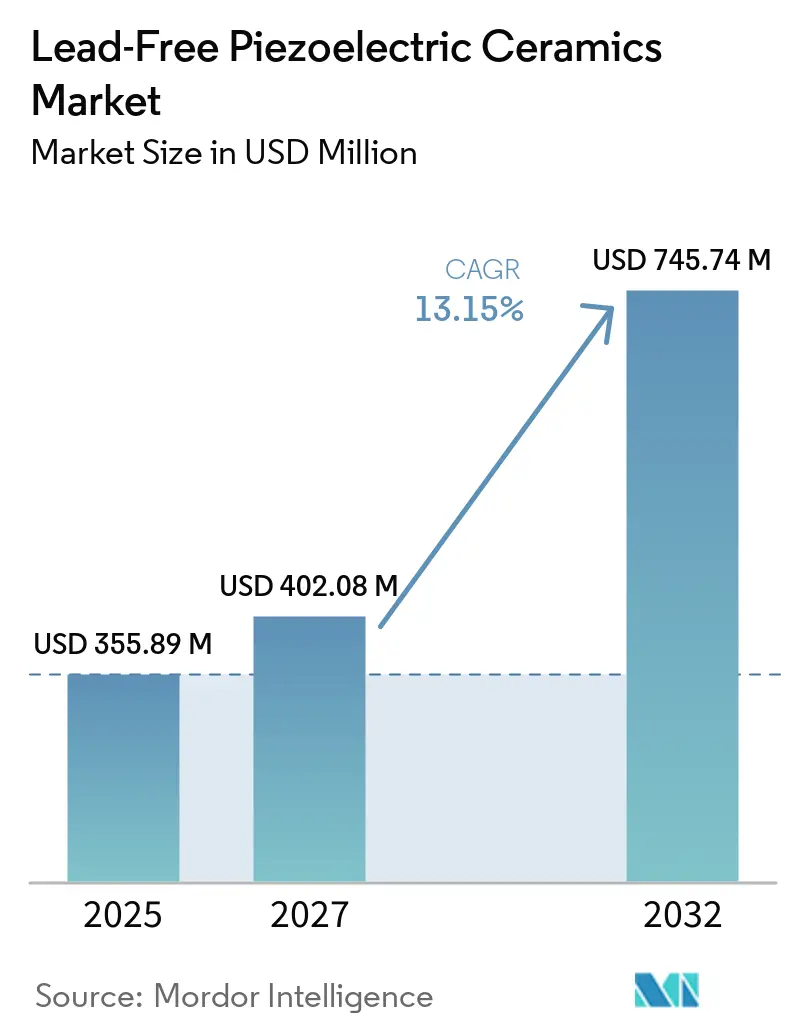
The lead-free piezoelectric ceramics market size was valued at USD 355.89 million in 2026 and is estimated to grow from USD 402.08 million in 2027 to USD 745.74 million by 2032, at a CAGR of 13.15% during the forecast period (2027-2032). Market growth is linked to regulatory changes and material progress in potassium sodium niobate (KNN) and bismuth sodium titanate (BNT). The RoHS exemption for lead in specified piezoelectric ceramics expires at the end of 2027, placing material qualification within current procurement cycles. As a result, lead-free piezoelectric ceramic market participants are qualifying alternatives alongside existing product programs rather than waiting for later redesigns. This timing gives suppliers with qualified formulations, controlled sintering processes, and application data a stronger position in medical, automotive, and electronics programs. The lead-free piezoelectric ceramics market also benefits from biocompatibility and environmental compliance, which add value beyond direct material substitution.
Key Report Takeaways
- By material, KNN held 38.23% of the lead-free piezoelectric ceramics market share in 2026 and is forecast to record the highest CAGR of 14.56% through 2032.
- By configuration, monolith elements accounted for 46.45% of market share in 2026, while thin films are forecast to grow at a CAGR of 14.73% through 2032.
- By end-user industry, medical held 42.51% of market share in 2026, while transportation is projected to advance at a CAGR of 15.17% through 2032.
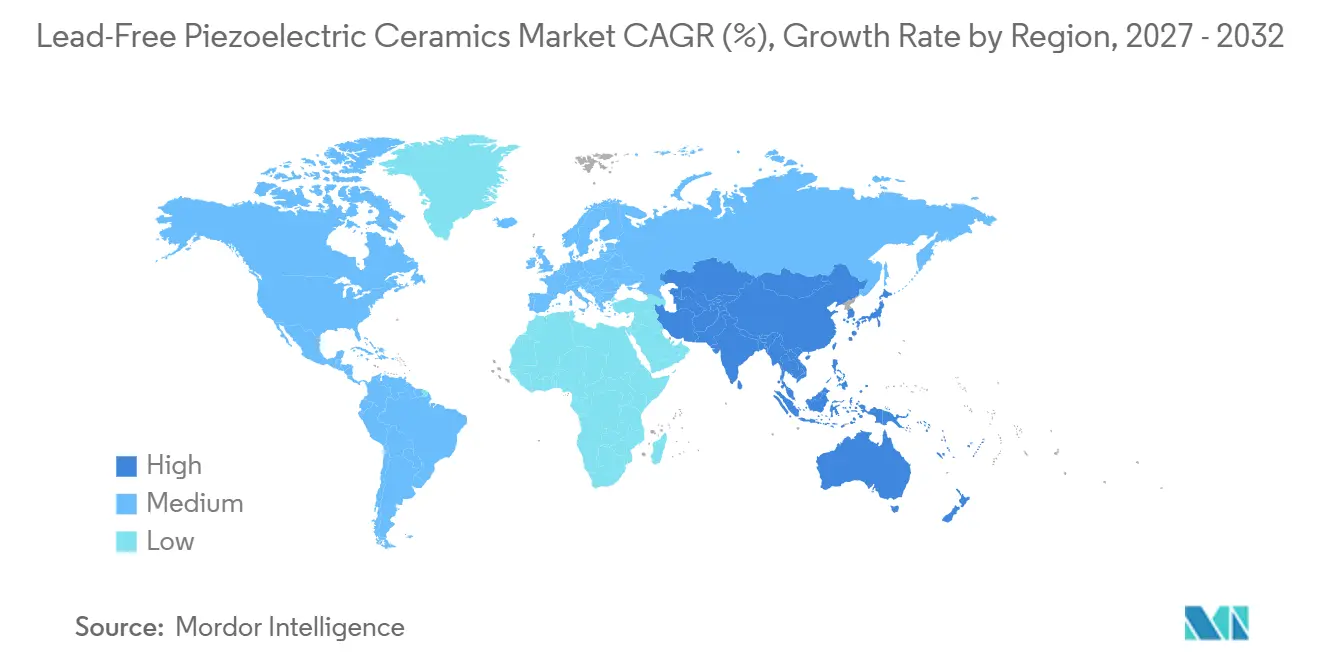
- By geography, Asia-Pacific accounted for 40.17% of market share in 2026 and is forecast to register a CAGR of 14.32% through 2032.
Note: Market numbers in this report are based on Mordor Intelligence's proprietary estimation framework, which combines nine months of actuals with Q4 projections for base year 2026.
Market Trends and Insights
Drivers Impact Analysis of Lead-Free Piezoelectric Ceramics Market*
| Drivers | (~) % Impact on CAGR Forecast | Geographic Relevance | Impact Timeline |
|---|---|---|---|
| Stricter RoHS and REACH Compliance Requirements | +3.0% | Global, with the highest intensity in the EU and East Asia | Short term (≤ 2 years) |
| Medical Imaging and Therapeutic Device Adoption | +2.8% | Global, concentrated in North America, the EU, and Japan | Medium term (2-4 years) |
| Automotive Electrification and Advanced Sensing | +2.5% | APAC core, spillover to North America and the EU | Medium term (2-4 years) |
| IoT, Energy Harvesting, and Self-Powered Sensors | +2.0% | APAC core, spillover to North America and the EU | Long term (≥ 4 years) |
| Demand for Consumer Electronics and Miniaturized Components | +1.5% | APAC core, China, South Korea, and North America | Medium term (2-4 years) |
| Source: Mordor Intelligence | |||
Stricter RoHS and REACH Compliance Requirements
The December 31, 2027, expiry of RoHS exemption 7(c)-VI for Lead Zirconate Titanate (PZT) ceramics creates a defined qualification deadline for industrial original equipment manufacturers. Directive (EU) 2025/2363 affects the timing of component procurement that relies on the existing exemption. REACH also shapes supplier selection through procurement scorecards, even where a formal exemption remains in place. Large European automotive and medical device buyers may treat lead content as a supply-chain risk before a legal deadline requires material replacement. Chinese exporters selling into European supply chains face both product-level RoHS requirements and upstream customer scrutiny under REACH. These conditions drive demand for compliant alternatives in the lead-free piezoelectric ceramics market and broaden its relevance in export-oriented Asian manufacturing.
Medical Imaging and Therapeutic Device Adoption
Demand for lead-free piezoelectric ceramics in medical applications is driven by biocompatibility requirements and the push toward smaller ultrasound systems. CeramTec announced a Bismuth Sodium Titanate–Barium Titanate (BNT-BT) piezoceramic in February 2025 for high-power ultrasound, infusion bubble detection, and drug nebulization applications. The company described the material as having performance comparable to PZT in those uses. Medical device qualification programs take several years, so a material announcement can precede broader adoption in production. A 2025 study reported a 64-channel, Potassium Sodium Niobate (KNN)-based wearable ultrasound imager with an 8.36 MHz center frequency and a bandwidth exceeding 40%, enabling vascular monitoring without lead[1]. This body of performance evidence provides medical design teams with a broader set of lead-free transducer options for evaluation.
Automotive Electrification and Advanced Sensing
Vehicle electrification increases the need for sensing in battery systems, proximity detection, and structural monitoring. These applications require fast response and low power consumption, which are important characteristics of piezoelectric components. The lead-free piezoelectric ceramics market may benefit as automotive developers evaluate alternatives that meet both reliability and compliance requirements. Automotive qualification activity also affects component selection years before vehicle production begins. A CTS Corporation design-in award for lead-free proximity sensors intended for 2027 vehicle production indicates a link between current qualification work and later demand. Automotive teams can use early design-in work to examine both material response and the broader effect of new ceramic formulations on device packaging, electronics, and system verification. Reliability evidence generated in automotive programs may also be relevant to industrial sensing and medical instrumentation, where comparable validation requirements apply.
IoT, Energy Harvesting, and Self-Powered Sensors
Self-powered Internet of Things nodes align with the current strengths of lead-free piezoelectrics, which offer moderate piezoelectric response, mechanical durability, and regulatory compliance. A 2025 study reported a hierarchical Potassium Sodium Niobate (KNN) composite with a g₃₃ value of 73.04 × 10⁻³ V·m·N⁻¹ and a g₃₃ × d₃₃ figure of merit of 17,311.6 × 10⁻¹⁵ m²·N⁻¹ for wireless ultrasonic energy harvesting. Lead-free compositions also offer biocompatibility and Registration, Evaluation, Authorization and Restriction of Chemicals (REACH)-aligned attributes that can support wearable health monitoring and pavement-embedded traffic sensing. These attributes reduce procurement friction where PZT raises concerns about lead content. They also allow device designers to consider material selection alongside the operating environment, particularly where a sensor is worn on the body or installed in public infrastructure. Research published in 2025 showed that machine-learning methods can accelerate KNN composition design and predictive phase mapping, potentially shortening the path to materials designed for specific vibration frequency bands.
Restraints Impact Analysis of Lead-Free Piezoelectric Ceramics Market*
| Restraints | (~) % Impact on CAGR Forecast | Geographic Relevance | Impact Timeline |
|---|---|---|---|
| Lead-Free Performance Gaps Versus PZT | -1.8% | Global, most acute in North America and the EU, high-performance actuator uses | Medium term (2-4 years) |
| Alkali and Bismuth Volatility During Sintering | -1.2% | Global, the highest operational impact in volume production hubs in APAC | Long term (≥ 4 years) |
| High Manufacturing Costs and Limited Large-Scale Production Scalability | -1.5% | Global, most acute among mid-tier manufacturers in APAC and South America | Medium term (2-4 years) |
| Source: Mordor Intelligence | |||
Lead-Free Performance Gaps Versus PZT
The performance gap between commercially available KNN and soft-grade PZT remains a key constraint for high-specification actuators. Standard sintered KNN typically delivers d₃₃ values of 120 to 200 pC/N, while doped and textured variants can reach 350 to 400 pC/N. Soft PZT can deliver 300 to 700 pC/N, depending on composition, making direct replacement difficult in some high-power designs. KNN is more competitive in energy-harvesting figures of merit and bandwidth than in strain-per-volt requirements. Adoption is therefore likely to occur first in sensing and energy-harvesting applications, with high-power actuation taking longer to transition. The lead-free piezoelectric ceramics market must accommodate component redesign in applications where PZT performance cannot be matched by a direct material substitution.
Alkali and Bismuth Volatility During Sintering
Alkali and bismuth volatility during high-temperature sintering can cause batch-level compositional variation. This issue is more difficult to manage at scale than in laboratory production, where smaller loads allow tighter control of the sintering atmosphere. In KNN, potassium and sodium can evaporate at different rates above 1,000°C, altering the K/Na ratio and shifting the material away from its preferred phase boundary. BNT systems face a similar risk from bismuth volatility above 900°C, which can reduce electromechanical coupling and raise scrap rates. A 2025 study found that B₂O₃-assisted low-temperature sintering can reduce bismuth loss in BNT-BT-KNN composites[2]. The process adds powder engineering steps that are not yet standard on high-output lines, so the manufacturing challenge remains relevant to the lead-free piezoelectric ceramics market. Tighter controls and additional sintering aids also increase manufacturing complexity, which can limit capacity expansion among producers that lack specialized processing capability.
*Our forecasts treat driver/restraint impacts as directional, not additive. The impact forecasts reflect baseline growth, mix effects, and variable interactions.
Lead-Free Piezoelectric Ceramics Market Segment Analysis
By Material:
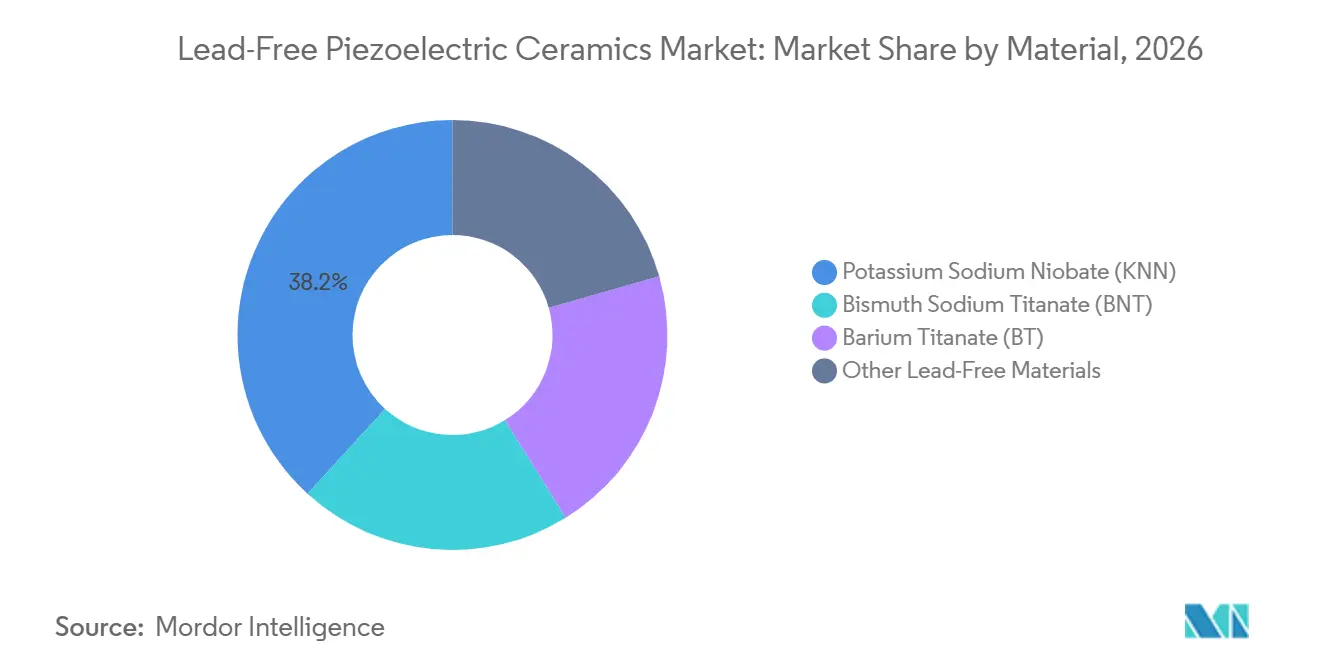
KNN Leads Revenue and GrowthKNN held 38.23% of the lead-free piezoelectric ceramics market share in 2026 and is projected to grow at a CAGR of 14.56% through 2032. Its position reflects commercial deployment and research investment that support continued formulation development. The perovskite structure allows compositional tuning via substitutions with antimony, lithium, tantalum, or bismuth, enabling developers to target piezoelectric response, temperature tolerance, and processing behavior without moving to a different material family. A January 2025 study reported textured KNN-Sb ceramics with a d₃₃ value near 807 pC/N and an electromechanical coupling factor near 88%. This result supports ongoing evaluation of KNN for transducer and actuator applications. It provides component designers with evidence that textured KNN can exceed the performance range typically associated with standard sintered KNN.
BNT holds the second revenue position in the material analysis. CeramTec's February 2025 BNT-BT announcement provided a production-oriented example for medical ultrasound and bubble detection. This is relevant because medical customers often require long qualification periods before production use. BNT-BT is also applicable to high-power ultrasound and drug nebulization, where stable and repeatable material performance is required. BT remains suited to lower-performance sensing in consumer electronics, though its lower Curie temperature limits its use in automotive and industrial environments with demanding thermal conditions. Textured KNN remains important because grain-orientation approaches can improve response and narrow the performance gap with PZT. A 2025 review described textured lead-free ceramic systems and their use of templated grain growth approaches.

By Configuration:
Monolith Retains Scale While Thin Films Grow FastestMonolithic elements accounted for 46.45% of the lead-free piezoelectric ceramics market share in 2026. Their position reflects established use in bulk ultrasonic transducers, flow-measurement sensors, and conventional actuation systems. Manufacturers value their proven production methods and lower per-piece cost. Monolithic geometries also align with established PZT supply chain practices, reducing the tooling changes required for initial substitution. This form is especially relevant for applications where established component dimensions, packaging, and assembly processes are as important as the ceramic formulation itself. KNN and BNT monoliths can therefore offer a practical first step for manufacturers responding to compliance deadlines, providing an adoption path that does not require every application to transition to a new device architecture immediately.
Multilayer configurations combine higher capacitance with lower drive voltage in compact stack designs. A 2025 study demonstrated KNN-based multilayer actuators with 0.14% strain under 3 kV/mm and a d₃₃* value of 466 pm/V. These results support potential qualification for precision optical and microfluidic positioning systems. They are relevant to devices where a compact stack must produce useful displacement at a lower drive voltage than a bulk element. Thin films are forecast to record a CAGR of 14.73% through 2032, driven by their role in piezoelectric micromachined ultrasonic transducers (PMUTs) used in wearable ultrasound patches, intraoral probes, and compact acoustic nodes. PMUT development differs from conventional bulk-replacement approaches and supports purpose-built miniature devices. The demonstrated 64-channel KNN ultrasound array supports the technical role of thin films in wearable medical systems.
By End-User Industry:
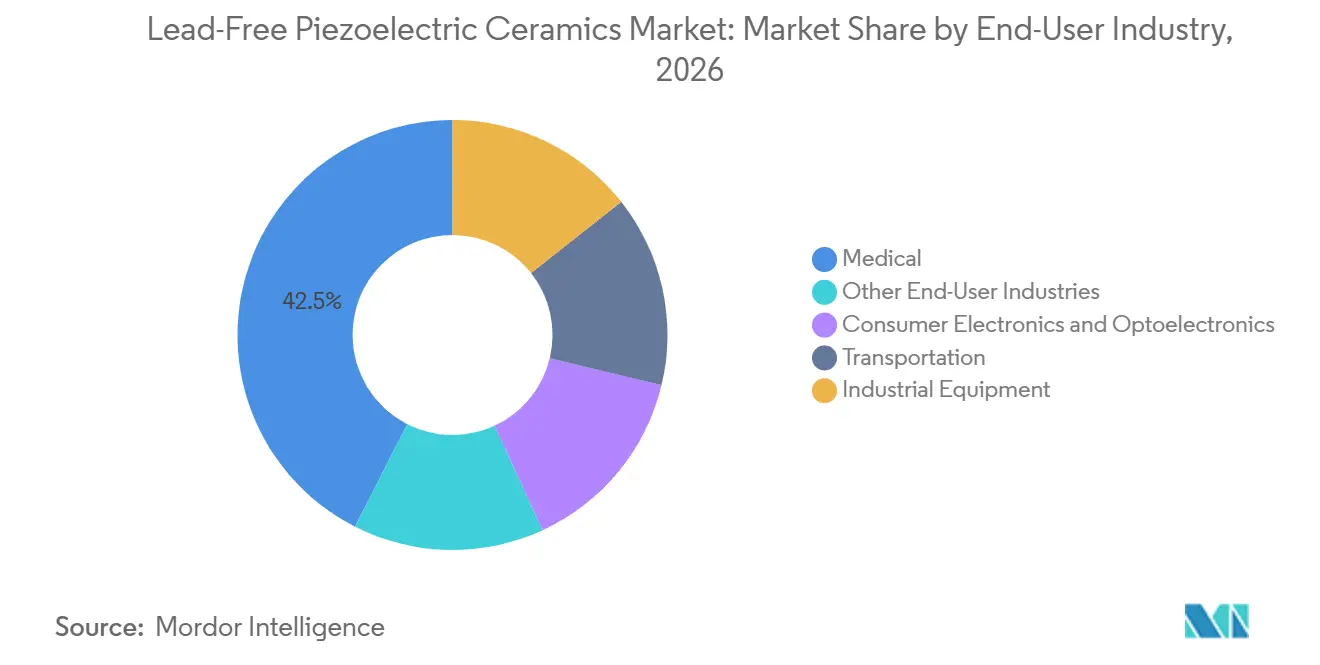
Medical Leads Revenue While Transportation ExpandsMedical accounted for 42.51% of the lead-free piezoelectric ceramics market share in 2026. Ultrasonic imaging transducers, therapeutic applicators, bubble detectors, and precision drug-delivery systems support this revenue base. The segment also benefits from the value placed on biocompatibility in body-proximal devices. Although PZT exemptions for medical applications may continue, procurement teams may consider lead content a supply chain and reputational concern, bringing forward material evaluation before a formal restriction requires substitution. Medical applications also have long verification cycles, so material evidence available as of 2026 can guide device programs that enter production several years later.
Transportation is projected to expand at a CAGR of 15.17% through 2032. Battery electric vehicle platforms require sensing for battery structural integrity, thermal gradients, parking, and advanced driver-assistance systems. Piezoelectric ceramics offer precision, fast response, and low power consumption in these applications. Vehicle manufacturers and Tier-1 suppliers must verify performance across automotive temperature ranges and under demanding reliability conditions. Automotive procurement cycles link component selection to subsequent vehicle production, so current qualification activity can shape future demand. Industrial equipment remains an important contributor through flow sensing, ultrasonic cleaning, and nondestructive testing. Consumer electronics and optoelectronics remain the most cost-sensitive end uses, as established PZT supply chains benefit from extensive manufacturing scale.
Geography Analysis
APAC Lead-Free Piezoelectric Ceramics Market
Asia-Pacific accounted for 40.17% of the lead-free piezoelectric ceramics market share in 2026 and is expected to register a CAGR of 14.32% through 2032. The region benefits from a large electronics manufacturing base, an active academic pipeline for lead-free ceramic materials, and domestic research programs. Japan is home to major suppliers such as Murata, TDK, KYOCERA, and Niterra, which hold significant commercial positions in the KNN and BNT materials markets. Japan's research programs support the transition of laboratory progress toward commercial formulations. South Korea is investing in lead-free piezoelectric compositions for OLED display haptics and medical devices. The Korea Display Industry Association identified lead-free piezoelectric actuator modules for OLED panels as a national research priority in 2025.
China and North America Lead-Free Piezoelectric Ceramics Market
China is a major center of consumer electronics manufacturing and is also expanding its role as a producer. Suppliers such as Zibo Yuhai target export opportunities with cost-competitive, lead-free grades, putting pressure on the margins of mid-tier component suppliers in Europe and North America. China also faces compliance expectations from customers selling finished goods into European markets. In North America, demand is driven by automotive sensor qualification programs and medical device manufacturers. Automotive model-year cycles mean that component decisions are often made well before production begins. The lead-free piezoelectric ceramics market in North America, therefore, has a demand pipeline connected to procurement activity in 2024 and 2025 and to planned production in 2027 and 2028.
EMEA and South America Lead-Free Piezoelectric Ceramics Market
Europe's market is closely tied to the 2027 RoHS deadline. Germany and France have significant automotive original equipment manufacturers and Tier-1 supply chains, while the United Kingdom has medical device and industrial sensing manufacturers seeking compliant material options. These conditions sustain demand for qualification work before procurement scorecards are updated. South America, the Middle East, and Africa hold smaller revenue positions in the analyzed market. Brazil's medical device production base presents an opportunity for lead-free materials, while Saudi Arabia offers demand for industrial sensors that can support near-term applications. These smaller regions are more likely to rely on imported materials and components as demand for local applications develops. Across all regions, the lead-free piezoelectric ceramics market is shaped by the interplay among local manufacturing capacity, customer qualification requirements, and the value placed on lead-free components.
Competitive Landscape
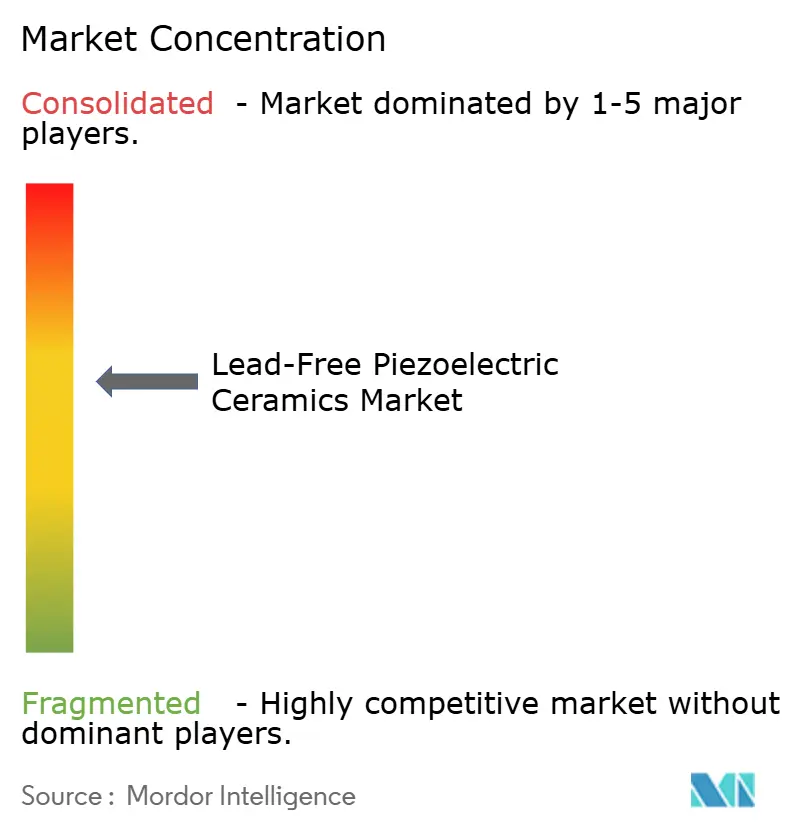
The lead-free piezoelectric ceramics market is moderately consolidated, with Japanese and German manufacturers holding strong positions in material formulations, integrated production, and intellectual property. Murata Manufacturing, TDK, and KYOCERA have broad market positions through vertically integrated supply chains and proprietary KNN and BNT formulations. CeramTec and Physik Instrumente (PI) are advancing BNT-BT approaches for medical and industrial sensing. Integrated production gives these companies greater control over powder quality, sintering conditions, and component-level qualification. KYOCERA's June 2026 U.S. patent application describes KNN ceramics with d₃₁ values above 100 pC/N and Curie temperatures above 200°C, indicating an effort to address mid-temperature industrial applications that have traditionally relied on PZT-grade materials. Niterra and Samsung Electro-Mechanics are drawing on their existing ceramic and electronic-component capabilities as they expand their lead-free piezoelectric activities.
PI Ceramic announced in April 2025 that its work on lead-free potassium sodium niobate (KNN) and bismuth sodium titanate (BNT) piezoceramics had progressed to customer-facing development activity. The company opened a joint development program for micropumps, ultrasonic nebulizers, and high-power ultrasonic transducers. CeramTec's medical BNT-BT disclosure is another example of a supplier using application-specific materials to support qualification in medical devices. These developments shift competition toward the ability to deliver materials with demonstrated application performance, rather than solely laboratory results. Smaller companies such as TRS Technologies and Piezo Technologies retain positions in single-crystal and precision-transducer niches, where performance specifications carry more weight than high-output production economics. This leaves room for specialized suppliers even as large integrated manufacturers set the pace in broader component categories.
The competitive environment also reflects advances in materials design and sintering. Machine-learning methods can shorten composition-development timelines and support well-funded new entrants with materials capabilities. Advanced sintering can improve production consistency but requires process expertise and capital investment. Medium-output, application-specific formulations for industrial sensing and defense remain open areas, as certification cycles are demanding and dedicated high-output tooling may not be justified. These applications tend to favor suppliers that work closely with customers on tailored compositions and component requirements. Cost-focused Chinese suppliers compete where certified lead-free materials carry a limited price premium, while established suppliers differentiate through qualification support, vertically integrated manufacturing, and proprietary formulations. The market remains moderately concentrated because these technical and production capabilities are not evenly distributed. Buyers must therefore assess material data, supply assurance, and qualification support together, as a supplier's ability to provide stable production lots can matter as much as reported laboratory results. This favors firms that can link powder processing, sintering, component design, and application testing within a coordinated development process.
Lead-Free Piezoelectric Ceramics Industry Leaders
-
Physik Instrumente (PI) SE & Co. KG.
-
CTS Corporation
-
CeramTec GmbH
-
Murata Manufacturing Co., Ltd.
-
TDK Corporation
- *Disclaimer: Major Players sorted in no particular order
Lead-Free Piezoelectric Ceramics Market Companies Covered in this Report
- CeramTec GmbH
- CTS Corporation
- FUJI CERAMICS CORPORATION
- Johnson Matthey
- KEMET Corporation
- KYOCERA Corporation
- Murata Manufacturing Co., Ltd.
- Niterra Co., Ltd.
- Physik Instrumente (PI) SE & Co. KG.
- Piezo Technologies
- SAMSUNG ELECTRO-MECHANICS
- Sumitomo Chemical Co., Ltd.
- TDK Corporation
- TRS Technologies, Inc.
- Zibo Yuhai Electronic Ceramic Co., Ltd.
Recent Industry Developments in Lead-Free Piezoelectric Ceramics Market
- April 2026: Murata Manufacturing Co., Ltd. commercially released the first AEC-Q200-qualified KNN-based piezoelectric actuator series for automotive ADAS ultrasonic sensing, operating across the full automotive temperature range without lead. This marked the first automotive-grade, lead-free piezoelectric actuator from a Tier-1 component manufacturer to enter mass production in the lead-free piezoelectric ceramics market.
- April 2025: Physik Instrumente's PI Ceramic division announced a manufacturing breakthrough for lead-free KNN and BNT piezoceramic components and opened a joint development program with customers targeting micropumps, ultrasonic nebulizers, and high-power ultrasonic transducers in the lead-free piezoelectric ceramics market.
Global Lead-Free Piezoelectric Ceramics Market Report Scope
Lead-free piezoelectric ceramics are ceramic materials that convert mechanical stress into electrical energy, and vice versa, without the use of toxic lead. These materials generate an electric charge in response to applied mechanical stress and, conversely, deform mechanically when subjected to an electric field.
The lead-free piezoelectric ceramics market is segmented by material, configuration, end-user industry, and geography. By material, the market is segmented into potassium sodium niobate (KNN), bismuth sodium titanate (BNT), barium titanate (BT), and other lead-free materials. By configuration, the market is segmented into monoliths, multilayer, and thin films. By end-user industry, the market is segmented into consumer electronics and optoelectronics, transportation, industrial equipment, medical, and other end-user industries. The report also covers the market size and forecasts for lead-free piezoelectric ceramics in 15 countries across major regions. The market sizes and forecasts are provided in terms of value (USD).
Segmentation Overview
| Potassium Sodium Niobate (KNN) |
| Bismuth Sodium Titanate (BNT) |
| Barium Titanate (BT) |
| Other Lead-Free Materials |
| Monolith |
| Multilayer |
| Thin Films |
| Consumer Electronics and Optoelectronics |
| Transportation |
| Industrial Equipment |
| Medical |
| Other End-User Industries |
| Asia-Pacific | China |
| India | |
| Japan | |
| South Korea | |
| Rest of Asia-Pacific | |
| North America | United States |
| Canada | |
| Mexico | |
| Europe | Germany |
| United Kingdom | |
| France | |
| Italy | |
| Rest of Europe | |
| South America | Brazil |
| Argentina | |
| Rest of South America | |
| Middle East and Africa | Saudi Arabia |
| South Africa | |
| Rest of Middle East and Africa |
| By Material | Potassium Sodium Niobate (KNN) | |
| Bismuth Sodium Titanate (BNT) | ||
| Barium Titanate (BT) | ||
| Other Lead-Free Materials | ||
| By Configuration | Monolith | |
| Multilayer | ||
| Thin Films | ||
| By End-User Industry | Consumer Electronics and Optoelectronics | |
| Transportation | ||
| Industrial Equipment | ||
| Medical | ||
| Other End-User Industries | ||
| By Geography | Asia-Pacific | China |
| India | ||
| Japan | ||
| South Korea | ||
| Rest of Asia-Pacific | ||
| North America | United States | |
| Canada | ||
| Mexico | ||
| Europe | Germany | |
| United Kingdom | ||
| France | ||
| Italy | ||
| Rest of Europe | ||
| South America | Brazil | |
| Argentina | ||
| Rest of South America | ||
| Middle East and Africa | Saudi Arabia | |
| South Africa | ||
| Rest of Middle East and Africa | ||
Key Questions Answered in the Report
What is current market size of Lead-Free Piezoelectric Ceramics Market?
The lead-free piezoelectric ceramics market size was valued at USD 355.89 million in 2026 and is estimated to grow from USD 402.08 million in 2027 to USD 745.74 million by 2032, at a CAGR of 13.15% during the forecast period (2027-2032).
Which end-user application is growing fastest?
Transportation is the fastest-growing end-user application, with a projected CAGR of 15.17% through 2032.
Which region has the strongest growth outlook?
Asia-Pacific holds a 40.17% revenue share in 2026 and is expected to grow at a 14.32% CAGR through 2032.
What is the main technical challenge for lead-free materials?
KNN and related materials may require component redesign for high-power applications because commercially available versions may not match the strain and piezoelectric response of soft PZT. Sintering-related volatility of alkali and bismuth also makes consistent high-volume manufacturing more difficult. Process controls and sintering aids can help but add manufacturing complexity.