
Lead-Acid Battery Transportation Market Size and Share
Market Overview
| Study Period | 2022 - 2032 |
|---|---|
| Market Size (2027) | USD 4.05 Billion |
| Market Size (2032) | USD 6.21 Billion |
| Growth Rate (2027 - 2032) | 8.91 % |
| Fastest Growing Market | Asia-Pacific |
| Largest Market | Asia-Pacific |
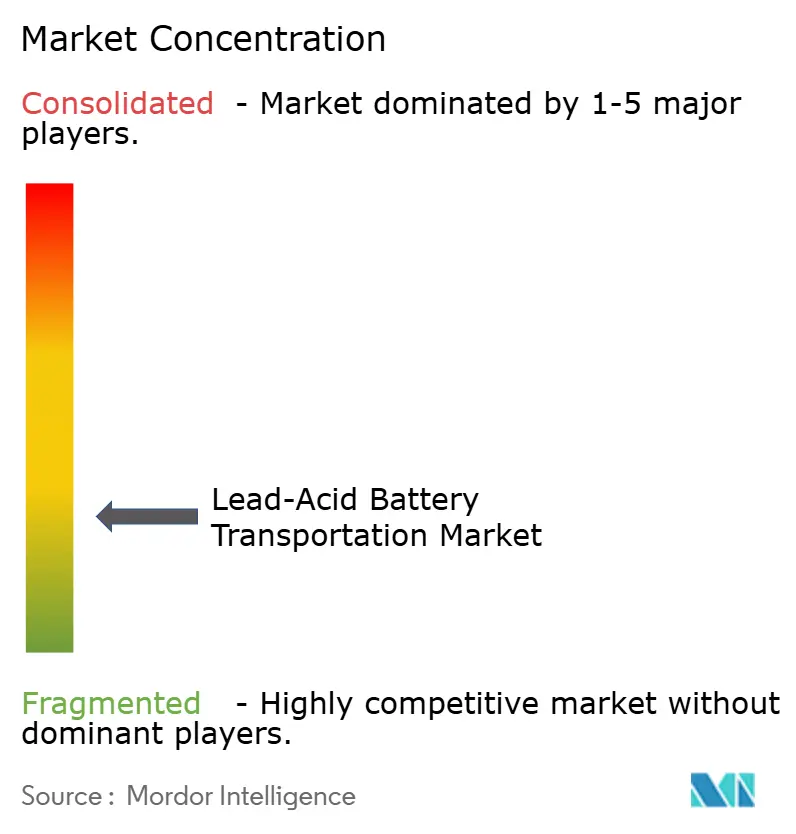
| Market Concentration | Low |
Major Players *Disclaimer: Major Players sorted in no particular order Image © Mordor Intelligence. Reuse requires attribution under CC BY 4.0. | |
Lead-Acid Battery Transportation Market Analysis by Mordor Intelligence
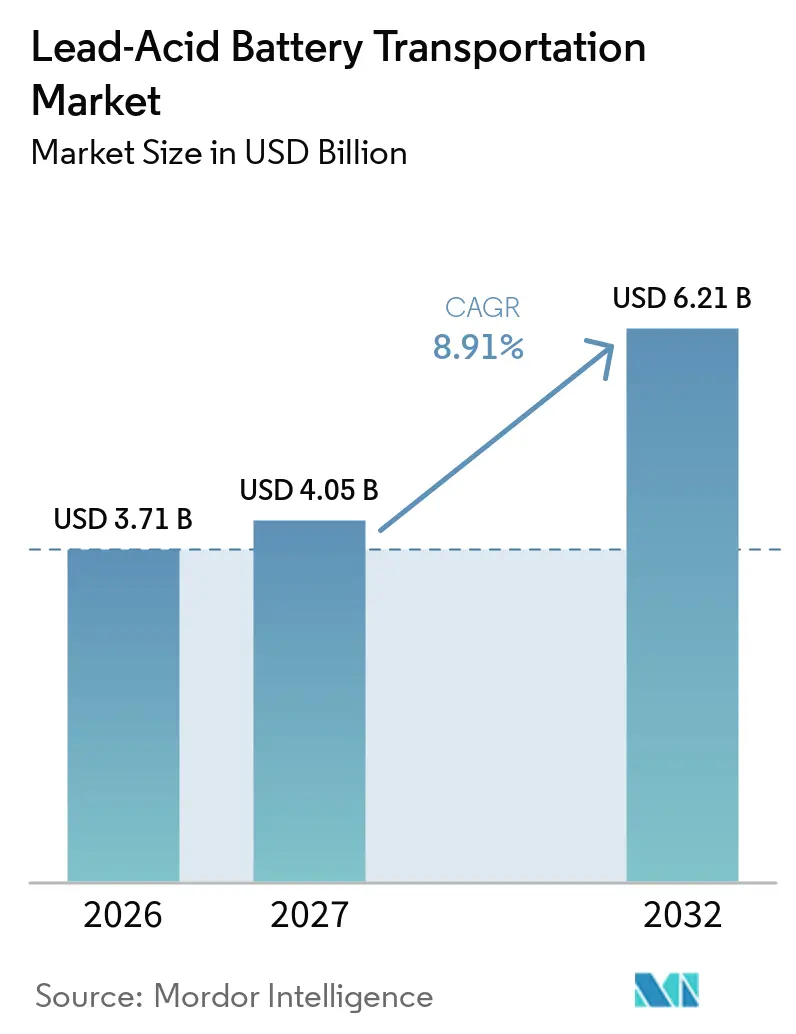
The Lead-Acid Battery Transportation Market size is projected to be USD 3.71 billion in 2026, USD 4.05 billion in 2027, and reach USD 6.21 billion by 2032, growing at a CAGR of 8.91% from 2027 to 2032. The lead-acid battery transportation market is supported by recurring deliveries of replacement batteries, industrial batteries, and returned units that require controlled handling. Aging vehicle fleets sustain replacement demand even when new vehicle production changes. Hazardous goods rules raise the value of carriers that can provide trained personnel, suitable equipment, and reliable documentation. Investments in battery logistics networks for other chemistries can also expand storage and handling capacity available to lead-acid consignments. The lead-acid battery transportation market therefore favors operators that can serve both routine distribution and regulated reverse flows.
Key Report Takeaways
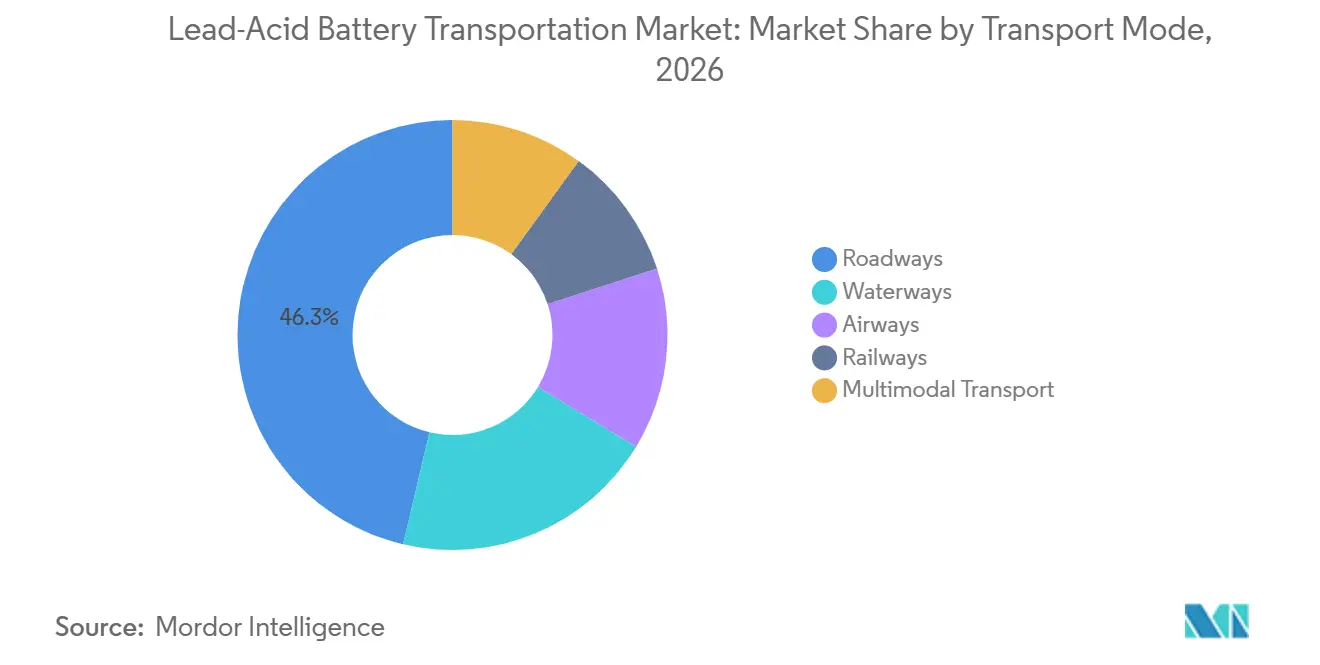
- By transport mode, Roadways held 46.3% of the lead-acid battery transportation market share in 2026, while Multimodal Transport is forecast to grow at a 12.4% CAGR through 2032.
- By battery status, New Cells and Packs accounted for 65.7% of the lead-acid battery transportation market share in 2026, while End-of-life Batteries are projected to grow at a 13.4% CAGR through 2032.
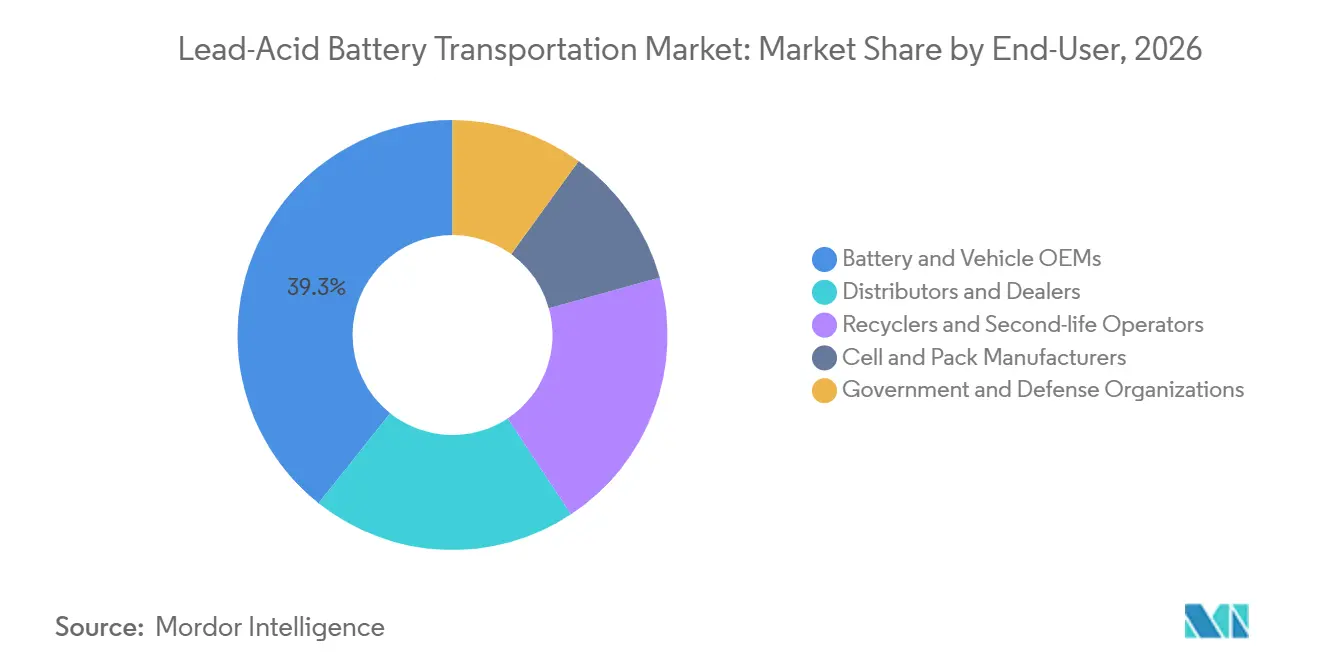
- By end user, Battery and Vehicle OEMs held 39.3% of the lead-acid battery transportation market share in 2026, while Recyclers and Second-life Operators are forecast to grow at a 14.2% CAGR through 2032.
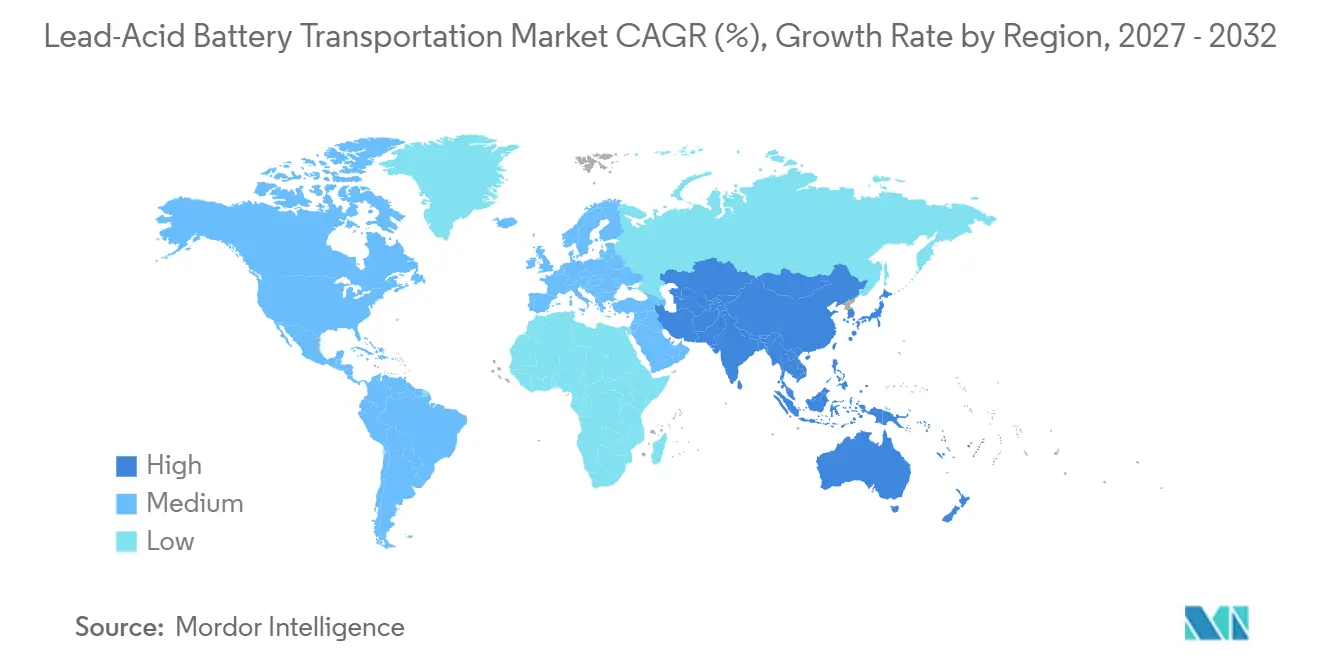
- By geography, Asia-Pacific held 47.3% of the lead-acid battery transportation market share in 2026 and is forecast to grow at a 13.1% CAGR through 2032.
Note: Market numbers in this report are based on Mordor Intelligence's proprietary estimation framework, which combines nine months of actuals with Q4 projections for base year 2026.
Market Trends and Insights
Drivers Impact Analysis of Lead-Acid Battery Transportation Market*
| Driver | (~) % Impact on CAGR Forecast | Geographic Relevance | Impact Timeline |
|---|---|---|---|
| Installed Vehicle Parc and Replacement Demand | +2.8% | Global | Long term (≥ 4 years) |
| Commercial Vehicle, Forklift and Backup-Power Demand | +2.1% | Global | Medium term (2-4 years) |
| Reverse Logistics and Lead-Recovery Requirements | +1.5% | Global | Medium term (2-4 years) |
| Specialized Battery and Hazmat Logistics Services | +1.2% | Global | Medium term (2-4 years) |
| Mode-Specific Classification and Documentation Complexity | +0.8% | Global | Short term (≤ 2 years) |
| Freight-Density Economics and Backhaul Optimization Opportunities | +0.6% | North America and Europe | Medium term (2-4 years) |
| Source: Mordor Intelligence | |||
Installed Vehicle Parc and Replacement Demand
Replacement requirements make the lead-acid battery transportation market less dependent on new vehicle sales than many freight categories. Battery Council International reported that North American automotive lead battery shipments grew 2.5% in 2025 and projected growth of 2.8% in 2026 and 2.6% in 2027.[1] The same update cited a light-vehicle fleet with an average age above 12.5 years in North America.[2] Older vehicles require service and replacement parts over a longer period, which supports predictable delivery routes for distributors and retailers. The lead-acid battery transportation market benefits when carriers can align collection schedules, depot capacity, and local delivery routes with those replacement cycles. This demand pattern gives established regional networks a practical advantage in dense automotive aftermarket locations.
Commercial Vehicle, Forklift and Backup-Power Demand
Commercial vehicles, forklifts, and backup-power equipment broaden the lead-acid battery transportation market beyond passenger vehicle replacement. Battery Council International stated that industrial lead battery demand remains supported by data centers, battery energy storage systems, and industrial uses.[3] Industrial batteries can weigh more than standard automotive units, so their movement requires capacity planning, safe loading procedures, and appropriate vehicles. Forklift fleets also create repeat demand at warehouses, manufacturing sites, and distribution facilities. Backup-power systems create deliveries that are less frequent but often time-sensitive because operators need uninterrupted power coverage. These movements allow specialist carriers to build work around more than one customer type in the lead-acid battery transportation market.
Reverse Logistics and Lead-Recovery Requirements
Reverse logistics is a central source of freight activity because used lead-acid batteries must move from collection points to authorized processing sites. Battery Council International states that new lead batteries made in the United States contain more than 80% recycled material. The U.S. Environmental Protection Agency describes collection networks that connect retailers, distributors, and recyclers for lead-acid batteries.[4] These networks require secure pickup, identification, packaging, and delivery records. The lead-acid battery transportation market gains volume as formal collection systems replace less organized return channels. Remote locations can be especially demanding because there are fewer nearby consolidation points and fewer compliant transport choices.
Growth of Specialized Battery and Hazmat Logistics Services
Specialized logistics investment strengthens the operating base for the lead-acid battery transportation market. DHL Supply Chain started construction in May 2026 on a 17,000-square-meter European Battery Logistics Hub in Holtum, Netherlands, for high-voltage battery storage and distribution. DHL Group also reported in June 2026 that it operates more than 20 battery logistics competence centers. CEVA Logistics introduced a battery reverse logistics solution in 2025 for France, the United Kingdom, and Spain, with plans for centers in 10 European countries by 2027. Shared hazardous-goods infrastructure can make trained labor, storage areas, and documented processes more accessible to lead-acid shippers. Operators with broad mode coverage can also offer customers one accountable service partner.
Restraints Impact Analysis of Lead-Acid Battery Transportation Market*
| Restraint | (~) % Impact on CAGR Forecast | Geographic Relevance | Impact Timeline |
|---|---|---|---|
| Lithium-Ion Substitution in New Vehicle and Stationary Applications | -1.6% | Global | Long term (≥ 4 years) |
| Environmental Compliance and Acid-Containment Costs | -1.0% | North America and Europe | Medium term (2-4 years) |
| Inconsistent Used-Battery Status Data and Carrier Acceptance Rules | -0.7% | Global | Short term (≤ 2 years) |
| Limited Compliant Transfer and Temporary-Storage Capacity | -0.5% | Asia-Pacific and Middle East and Africa | Medium term (2-4 years) |
| Source: Mordor Intelligence | |||
Lithium-Ion Substitution in New Vehicle and Stationary Applications
Lithium-ion adoption can limit new lead-acid battery volumes in selected automotive and industrial applications. The shift is more relevant in premium vehicles, cold storage, and intensive multi-shift equipment where customers place a high value on operating characteristics. This change can reduce some forward transport volumes in the lead-acid battery transportation market. It does not remove the need to collect and process lead-acid units already in service. End-of-life shipments can require more careful segregation and documentation than standard forward deliveries. Carriers that develop reverse logistics capabilities can therefore protect part of their business as the battery mix changes.
Environmental Compliance and Acid-Containment Costs
Environmental and safety obligations increase the cost of moving wet, spillable batteries. IATA stated that its 2025 battery shipping regulations expanded coverage to wet, spillable and non-spillable batteries. The rules require shippers and carriers to manage packaging, labels, documentation, and safe handling for regulated shipments. The U.S. Environmental Protection Agency has also published work on battery labeling requirements and standards. Smaller transport providers may find it harder to maintain trained teams and dedicated equipment across several regions. The lead-acid battery transportation market consequently places a premium on carriers with established compliance procedures and audited facilities.
*Our forecasts treat driver/restraint impacts as directional, not additive. The impact forecasts reflect baseline growth, mix effects, and variable interactions.
Lead-Acid Battery Transportation Market Segment Analysis
By Transport Mode:
Roadways Support Established Distribution, While Multimodal Transport ExpandsRoadways held 46.3% of the lead-acid battery transportation market share in 2026. Local delivery from distributors to retailers, workshops, and vehicle service points make road freight essential for regular battery replacement flows. Hazmat-certified trucks can serve short routes with fewer handoffs than other modes. This reduces the handling exposure associated with wet batteries and enables scheduled collection of returned units. Industrial packs can require suitable loading methods and vehicle capacity, which also supports road freight use. Waterways can carry bulk shipments from manufacturing centers at lower unit freight cost. Railways remain suitable for selected long-distance domestic moves where terminals and compliance processes are available.
Multimodal Transport is forecast to record a 12.4% CAGR through 2032 within the lead-acid battery transportation market size. Shippers can combine sea or rail for the primary journey with road transport for final delivery. This arrangement can reduce dependence on air freight for long-distance shipments. IATA’s 2025 update to battery shipping regulations increased attention to the safe carriage of wet, spillable batteries. Nippon Express, Honda, and JR Freight began long-distance rail transport of Electric vehicle (EV) battery packs in Japan during 2025. Although this project involves another chemistry, it shows how battery transport providers can use rail and road together to reduce handling and improve safety. The lead-acid battery transportation market can use comparable routes for bulk import and distribution flows.

By Battery Status:
New Cells and Packs Sustain Volumes, While End-of-life Batteries Raise Service NeedsNew Cells and Packs accounted for 65.7% of the lead-acid battery transportation market share in 2026. This category is supported by OEM supply, aftermarket replacement, and industrial battery deliveries. Freight procurement for new batteries is typically based on regular routes, planned delivery windows, and high shipment density. These conditions support competitive pricing but require reliable service quality. Used and Returned Batteries move through warranty replacement, refurbishment, and collection programs. Damaged and Defective Batteries form a smaller category but need separate handling, containment, and carrier acceptance. Prototype Batteries likewise require close documentation because their characteristics and packaging can vary.
End-of-life Batteries are forecast to grow at a 13.4% CAGR through 2032 in the lead-acid battery transportation market size. Collection and delivery to recycling facilities become more important as producer responsibility programs and structured recovery networks develop. Gravita India Limited reported USD 218.93 million in consolidated revenue in H1 FY26 and described a capacity path toward 700,000 MTPA by FY28. The scale-up indicates the demand for consistent supply of recoverable materials to recycling operations. Carriers need clear records of battery condition, origin, and transfer to manage these flows. End-of-life loads can have higher service requirements than standard new-cell shipments. This supports differentiation for operators that can organize secure collection, temporary storage, and final delivery.
By End User:
OEM Contracts Provide Scale, While Recyclers Expand Reverse FlowsBattery and Vehicle Original Equipment Manufacturers (OEMs) held 39.3% of the lead-acid battery transportation market share in 2026. Their supply chains require delivery from battery plants to assembly locations, regional warehouses, and distribution centers. These customers often use longer-term freight contracts because compliance, tracking, and reliability are important. Cell and Pack Manufacturers also require outbound transport to industrial customers and distributors. Distributors and Dealers need frequent smaller deliveries that suit dense road networks. Government and Defense Organizations create less frequent shipments, but documentation and chain-of-custody expectations can be strict. The lead-acid battery transportation market therefore requires providers to handle both large scheduled contracts and dispersed local distribution.
Recyclers and Second-life Operators are forecast to grow at a 14.2% CAGR through 2032. Their work depends on the movement of used batteries from retail, fleet, industry, and collection locations to controlled facilities. Battery Council International describes lead battery recycling as a mature circular system that links collection with material recovery. Second-life activity can add an additional transfer before a battery reaches final recycling. This increases the need for traceable handoffs and appropriate storage. The lead-acid battery transportation market benefits when recycling networks expand their collection coverage. It also rewards logistics firms that can balance inbound pickups with outbound freight rather than operating one-way routes.
Geography Analysis
APAC Lead-Acid Battery Transportation Market
Asia-Pacific held 47.3% of the lead-acid battery transportation market share in 2026 and is forecast to grow at a 13.1% CAGR through 2032. The region combines dense vehicle populations, large battery manufacturing centers, and fast-growing organized recycling systems. India is an important source of reverse logistics activity as collection and processing capacity expand. Gravita India Limited stated that it has more than 1,000 collection points in India. FedEx expanded dangerous-goods shipping capabilities in Greater Jakarta and Batam during 2025 for most dangerous goods classes. These developments can improve the handling options available to battery customers in Southeast Asia. The regional opportunity also depends on whether carriers can connect manufacturing zones with dispersed repair, retail, and recovery points. A provider with local road capacity and cross-border documentation expertise can reduce delays between those points. The lead-acid battery transportation market in Asia-Pacific also requires different service models for dense urban corridors and more remote collection areas.
North America and Europe Lead-Acid Battery Transportation Market
North America has an established automotive aftermarket and a clear lead battery collection system. The lead-acid battery transportation market in the region is supported by vehicle age and steady aftermarket replacement needs. Battery Council International reported 2.5% growth in North American automotive lead battery shipments in 2025. The region also has detailed hazardous material requirements for handling and transport. Europe has dense logistics infrastructure, cross-border routes, and growing investment in specialized battery facilities. DHL’s Netherlands hub and CEVA’s reverse logistics program demonstrate investment in battery logistics capacity across Europe. In both regions, established collection rules favor providers that can document each transfer consistently. The route economics are strongest where operators can combine new-battery deliveries with used battery pickups. That operating model supports fuller vehicles and avoids unnecessary empty return trips.
South America and MEA Lead-Acid Battery Transportation Market
South America has demand linked to vehicle fleets, mining, and the replacement needs of industrial users. Brazil has a large vehicle base, while mining regions require transport of heavy battery systems between operating sites and recovery locations. The Middle East and Africa combine commercial fleet growth, imports through major logistics hubs, and industrial demand from mining and backup-power uses. These regions may have fewer specialist carriers than North America or Europe. This creates an opportunity for providers with established hazardous-goods licenses and local partnerships. The lead-acid battery transportation market can expand when these providers add collection points, secure storage, and consistent cross-border processes. Service reliability matters because customers in remote mining or infrastructure locations have fewer alternatives when a battery shipment is delayed. The same location challenges can increase the value of scheduled pickups and planned consolidation. Providers that build trusted local networks can address the shortage of compliant options without changing the basic service requirements.
Competitive Landscape
The lead-acid battery transportation market has large global forwarders with fragmented market, regional hazardous-goods specialists, and domestic asset-based carriers. Competition is shaped by safety systems, network coverage, mode availability, and customer service rather than price alone. DHL, DSV, Kuehne+Nagel, A.P. Moller-Maersk, J.B. Hunt, Schneider National, and Ryder operate across relevant freight or logistics services. DSV completed its acquisition of DB Schenker on April 30, 2025. DSV stated that the combined organization had annual revenue of EUR 41.6 billion, 160,000 employees, and operations in more than 90 countries. The combination gives the company broader network coverage for customers seeking multi-country battery freight services. Large networks can also offer customers alternatives when a route, carrier, or facility has a capacity constraint. Regional specialists still have a role when local operating knowledge and direct service relationships are more important than a global footprint.
Leading providers are building specialized capabilities for storage, reverse logistics, and multimodal movement. DHL’s 2026 Netherlands facility is designed for battery storage and distribution and is scheduled to begin operations in early 2027. CEVA launched a secure maritime transport service for used lithium-ion batteries to continental Europe in March 2026. These examples show that providers are expanding processes that can also support controlled lead-acid battery movements. Nippon Express announced a fire-resistant 20-foot ISO container for battery transport and storage, effective October 1, 2026. Specialized equipment and trained teams can help carriers compete for demanding contracts. Customers will assess these capabilities alongside pricing, pickup coverage, and the carrier’s ability to manage exceptions. A service provider that can resolve a rejected shipment or containment issue quickly can protect a customer’s operating schedule. These factors make operational discipline a meaningful competitive feature in the lead-acid battery transportation market.
The most attractive openings are in reverse logistics, compliant temporary storage, and digital chain-of-custody services. Battery collection programs need dependable pickup schedules and secure delivery to processors. Customers also need clear information on shipment’s battery status and documented transfer between parties. A.P. Moller-Maersk and CATL signed a global strategic partnership in October 2026 covering ocean, air, project logistics, warehousing, and end-of-life battery recycling solutions. This agreement indicates that large logistics groups are extending their battery service portfolios. Smaller providers can compete by concentrating on collection density, local storage, and difficult handling needs that require a specialized response. Lead-acid shipments often require a practical combination of standard freight management and hazardous goods control. This creates room for both global integrators and qualified local service providers. The competitive landscape remains shaped by execution quality rather than a single standard operating model. For customers, the most useful proposition combines predictable pickups, documented condition checks, suitable containment, and dependable delivery to the designated facility. A missed collection can cause storage constraints at a retailer, workshop, depot, or industrial site. A failed delivery can also delay the return of material to a recycler and complicate a customer’s regulatory records. These operational details explain why established procedures and trained staff remain important to supplier selection. They also help explain why a broad network alone does not guarantee a strong position in the lead-acid battery transportation market. Providers must demonstrate that their systems work reliably at each handoff, including pickup, consolidation, storage, transfer, and final delivery.
Lead-Acid Battery Transportation Industry Leaders
-
DHL Group
-
Kuehne+Nagel International AG
-
DSV A/S
-
DB Schenker
-
CEVA Logistics
- *Disclaimer: Major Players sorted in no particular order
Lead-Acid Battery Transportation Market Companies Covered in this Report
- A.P. Moller–Maersk
- C.H. Robinson Worldwide, Inc.
- CEVA Logistics
- DB Schenker
- DHL Group
- DSV A/S
- Exide Industries Limited
- Expeditors International of Washington, Inc.
- FedEx Corporation
- GEODIS
- Gravita India Limited
- GXO Logistics, Inc.
- J.B. Hunt Transport Services, Inc.
- Kuehne+Nagel International AG
- Nippon Express Holdings, Inc.
- Rhenus Group
- Ryder System, Inc.
- Schneider National, Inc.
- United Parcel Service, Inc. (UPS)
- XPO, Inc.
Recent Industry Developments in Lead-Acid Battery Transportation Market
- September 2026: NX Trading Co., Ltd. announced the launch, effective October 1, 2026, of a fire-resistant 20-foot ISO-standard container for battery transport and storage, certified by Japan's Hazardous Materials Safety Technology Association. The container enables modal shift across trailer, rail, and sea without container changes, reducing handling risk for lead-acid and other large-format batteries.
- May 2026: DHL Supply Chain broke ground on a new European Battery Logistics Hub in Holtum, Limburg, the Netherlands. The 17,000-square-meter facility is dedicated to high-voltage battery storage and distribution for EV and battery energy storage system applications and is scheduled for operations in early 2027.
- March 2026: CEVA Logistics launched a new secure maritime transport service for used lithium-ion batteries to continental Europe on CMA CGM shipping lines, deploying 5 specifically adapted containers as an initial fleet. The service extends CEVA's 2025 reverse logistics solution to the waterways segment and strengthens end-of-life battery transport coverage in Europe.
- October 2025: A.P. Moller-Maersk and CATL signed a global strategic partnership MoU, designating Maersk as CATL's preferred logistics provider for ocean freight, air freight, project logistics, and warehousing. The agreement includes collaboration on end-of-life battery recycling solutions and the electrification of port ecosystems, meaningfully expanding Maersk's battery reverse logistics footprint beyond new-cell transport.
Global Lead-Acid Battery Transportation Market Report Scope
Lead-acid battery transportation refers to the specialized logistics and shipping processes involved in moving lead-acid batteries, such as standard automotive batteries and backup industrial batteries, across supply chains while complying with hazardous materials regulations. These batteries contain corrosive sulfuric acid and heavy lead plates, and are legally classified as Class 8 Corrosive Dangerous Goods. The transportation process requires rigorous safety protocols to prevent acid leaks, terminal short-circuits, and the build-up of explosive hydrogen gas.
The Lead-acid battery transportation market is segmented by transport mode, battery status, end user, and geography. The transport mode segment includes roadways, airways, waterways, railways, and multimodal options. The battery status segment covers new cells/packs, used/returned batteries, damaged/defective batteries, prototypes, and end-of-life batteries. The end user segment consists of OEMs, cell/pack manufacturers, distributors, recyclers, and govt/defense entities. The report also covers the market size and forecasts for the global lead-acid battery transportation market across 26 countries in key regions. For each segment, the market sizing and forecasts have been provided on the basis of value (USD).
Segmentation Overview
| Roadways |
| Airways |
| Waterways |
| Railways |
| Multimodal Transport |
| New Cells and Packs |
| Used and Returned Batteries |
| Damaged and Defective Batteries |
| Prototype Batteries |
| End-of-life Batteries |
| Battery and Vehicle OEMs |
| Cell and Pack Manufacturers |
| Distributors and Dealers |
| Recyclers and Second-life Operators |
| Government and Defense Organizations |
| North America | United States |
| Canada | |
| Mexico | |
| Europe | Germany |
| France | |
| Italy | |
| Spain | |
| United Kingdom | |
| Poland | |
| Russia | |
| Rest of Europe | |
| Asia-Pacific | China |
| India | |
| Japan | |
| South Korea | |
| Australia | |
| Indonesia | |
| Vietnam | |
| Thailand | |
| Rest of Asia-Pacific | |
| South America | Brazil |
| Argentina | |
| Chile | |
| Rest of South America | |
| Middle East and Africa | Saudi Arabia |
| United Arab Emirates | |
| Egypt | |
| South Africa | |
| Morocco | |
| Rest of Middle East and Africa |
| By Transport Mode | Roadways | |
| Airways | ||
| Waterways | ||
| Railways | ||
| Multimodal Transport | ||
| By Battery Status | New Cells and Packs | |
| Used and Returned Batteries | ||
| Damaged and Defective Batteries | ||
| Prototype Batteries | ||
| End-of-life Batteries | ||
| By End User | Battery and Vehicle OEMs | |
| Cell and Pack Manufacturers | ||
| Distributors and Dealers | ||
| Recyclers and Second-life Operators | ||
| Government and Defense Organizations | ||
| By Geography | North America | United States |
| Canada | ||
| Mexico | ||
| Europe | Germany | |
| France | ||
| Italy | ||
| Spain | ||
| United Kingdom | ||
| Poland | ||
| Russia | ||
| Rest of Europe | ||
| Asia-Pacific | China | |
| India | ||
| Japan | ||
| South Korea | ||
| Australia | ||
| Indonesia | ||
| Vietnam | ||
| Thailand | ||
| Rest of Asia-Pacific | ||
| South America | Brazil | |
| Argentina | ||
| Chile | ||
| Rest of South America | ||
| Middle East and Africa | Saudi Arabia | |
| United Arab Emirates | ||
| Egypt | ||
| South Africa | ||
| Morocco | ||
| Rest of Middle East and Africa | ||
Key Questions Answered in the Report
What is the projected value of the lead-acid battery transportation market by 2032?
The market is projected to reach USD 6.21 billion by 2032, expanding at an 8.91% CAGR from 2027. Growth is supported by recurring replacement delivery, industrial use, and regulated return flows, rather than only by new battery production.
Which transport mode leads battery freight activity?
Roadways lead with 46.3% share in 2026 because they support local distribution and collection routes. They are particularly suitable where retailers, workshops, fleet operators, and collection points require frequent deliveries or pickups within a limited service area.
Why are end-of-life batteries important for logistics providers?
End-of-life Batteries are forecast to grow at 13.4% CAGR through 2032 and require documented, controlled reverse logistics. Their movement creates demand for pickup, consolidation, secure temporary storage, condition records, and delivery to approved recycling facilities.
Which region has the highest share of battery transport demand?
Asia-Pacific holds 47.3% share in 2026 and is forecast to grow at 13.1% CAGR through 2032. The region combines vehicle populations, battery production, and expanding organized collection systems, which support both forward distribution and returned-battery transport.
What capabilities do battery logistics customers expect from carriers?
Customers require hazardous-goods compliance, secure handling, traceable transfers, suitable storage, and reliable delivery schedules. They also value carriers that can manage routine delivery and reverse collection through coordinated processes rather than disconnected service providers.
How does battery recycling affect transport demand?
Recycling creates recurring pickup and delivery flows between collection points and processing facilities. A more formal collection network increases the need for scheduled routes, documented transfers, and suitable containment throughout the return journey.