
Lead-Acid Battery Handling Market Size and Share
Market Overview
| Study Period | 2022 - 2032 |
|---|---|
| Market Size (2027) | USD 651.59 Million |
| Market Size (2032) | USD 738.29 Million |
| Growth Rate (2027 - 2032) | 2.53 % |
| Fastest Growing Market | Asia-Pacific |
| Largest Market | Asia-Pacific |
| Market Concentration | Low |
Major Players *Disclaimer: Major Players sorted in no particular order Image © Mordor Intelligence. Reuse requires attribution under CC BY 4.0. | |
Lead-Acid Battery Handling Market Analysis by Mordor Intelligence
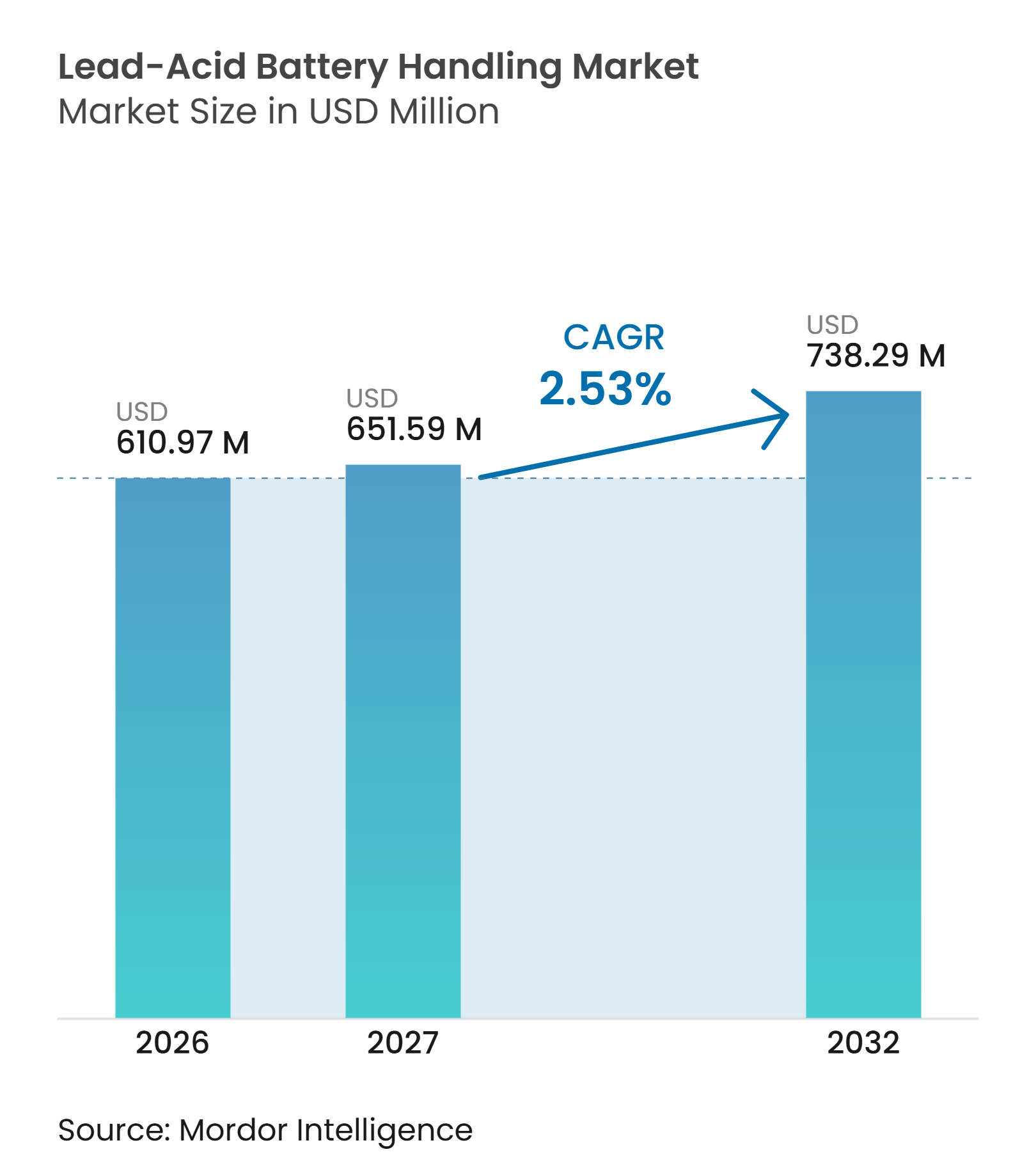
The Lead-Acid Battery Handling Market size is expected to increase from USD 610.97 million in 2026 to USD 651.59 million in 2027 and reach USD 738.29 million by 2032, at a CAGR of 2.53% over 2027-2032. The lead-acid battery handling market continues to serve facilities that use established traction battery systems in warehousing, manufacturing, and recycling. Its demand base depends on the continued operation of lead-acid forklift fleets, which require charging, movement, storage, and replacement processes. Battery rooms, service networks, and recycling systems support recurring equipment and service needs across the installed fleet in the lead-acid battery handling market. Lead-acid batteries also retain a circular supply position, as new lead-acid batteries in the United States contain more than 80% recycled material.[1]
Key Report Takeaways
- By handling equipment, forklifts and electric pallet trucks held 26.1% revenue share in 2026, while robotic handling systems are forecast to expand at a 3.9% CAGR through 2032.
- By handling service, transportation held 21.4% revenue share in 2026, while recycling and end-of-life handling are forecast to expand at a 3.5% CAGR through 2032.
- By automation level, manual battery handling held 54.7% revenue share in 2026, while fully automated battery handling is forecast to expand at a 4.1% CAGR through 2032.
- By end user, battery manufacturers held 29.3% revenue share in 2026, while battery recycling companies are forecast to expand at a 2.9% CAGR through 2032.
- By geography, Asia-Pacific held 39.7% revenue share in 2026 and is forecast to expand at a 2.7% CAGR through 2032.
Note: Market numbers in this report are based on Mordor Intelligence's proprietary estimation framework, which combines nine months of actuals with Q4 projections for base year 2026.
Market Trends and Insights
Drivers Impact Analysis of Lead-Acid Battery Handling Market*
| Driver | (~) % Impact on CAGR Forecast | Geographic Relevance | Impact Timeline |
|---|---|---|---|
| Electrification of Indoor Material-Handling Fleets | +0.6% | Global, concentrated in North America, Europe, and Asia-Pacific | Medium term (2-4 years) |
| Warehouse Throughput and Multi-Shift Operations | +0.5% | Global, with high intensity in Asia-Pacific and North America | Short term (≤ 2 years) |
| Expansion of E-Commerce Distribution Infrastructure | +0.4% | North America, Europe, Asia-Pacific, and the Middle East and Africa | Medium term (2-4 years) |
| Established Lead-Recycling and Service Infrastructure | +0.3% | North America and Europe, with maturing activity in Asia-Pacific and South America | Long term (≥ 4 years) |
| Battery-Room Space Optimization Through Vertical Storage | +0.2% | North America and Europe, with early gains in Japan and South Korea | Medium term (2-4 years) |
| Retrofit Demand from Legacy Lead-Acid Fleets | +0.3% | Global, concentrated in Southeast Asia, South America, and the Middle East and Africa | Medium term (2-4 years) |
| Source: Mordor Intelligence | |||
Electrification of Indoor Material-Handling Fleets Broadens the Installed Handling Base
The lead-acid battery handling market benefits when facilities replace internal-combustion trucks with electric equipment but retain conventional traction batteries. A 2025 lifecycle study found that 40.7% of electric forklifts sold use lead-acid traction batteries.[2] Single-shift and standard multi-shift sites often value the established maintenance routines and lower initial cost of these batteries. An 80V, 1,376 Ah traction battery can take 5 hours to charge, which creates a need for planned charging and battery movement. Each forklift can require 2 to 3 batteries when continuous operation is necessary. This relationship keeps demand for handling equipment linked to the electric fleet base even as lithium-ion use expands in premium applications.
Warehouse Throughput and Multi-Shift Operations Drive Structured Battery Handling Investment
The lead-acid battery handling market serves high-throughput facilities where battery exchange becomes a coordinated operating task. A warehouse with 200 forklifts across several shifts must manage charging, watering, equalization, spare inventory, and safe physical movement. Japan provides an example of this operating model, where battery-powered trucks represent a large part of the forklift fleet. Energy with BMS service monitors charging and discharging voltage, temperature, and electrolyte levels over 24 hours.[3] Companies such as Daiken Kogyo have used monitored battery operations to improve fleet allocation and reduce unplanned downtime. JP Semi-automated equipment, including lifting fixtures, roller-track exchange systems, and monitoring units, therefore remains relevant where operators seek better throughput without full robotic installation.
Expansion of E-Commerce Distribution Infrastructure Multiplies Battery Handling Sites
The lead-acid battery handling market gains sites when distribution networks add facilities that operate battery-powered material-handling equipment. Large fulfillment centers often use mixed fleets, with lead-acid batteries still present in standard-duty pallet movement. Third-party logistics providers can retain these fleets because they operate for several clients and may not recover the cost of a full lithium conversion from one contract. New distribution centers create needs for charging areas, extraction equipment, storage racks, and service processes. This pattern also supports facilities that combine lead-acid and lithium-ion equipment during fleet transitions. The resulting demand is tied to the number and operating intensity of distribution locations rather than to a single battery technology choice.
Retrofit Demand from Legacy Lead-Acid Fleets Sustains Handling Equipment Renewal
The lead-acid battery handling market has a substantial retrofit requirement because existing battery rooms need periodic equipment renewal. Forklifts with battery rooms installed 5 to 10 years earlier can require replacement fixtures, chargers, ventilation upgrades, and capacity planning as batteries age. OSHA rules require adequate ventilation in battery charging areas to manage hazards associated with charging operations.[4] Older tray dimensions and compartment designs can make replacement systems less standardized. This condition favors suppliers that understand the installed equipment and can adapt handling systems to existing layouts. It also maintains demand in North America and Europe, where many forklift fleets entered service between 2015 and 2020.
Restraints Impact Analysis of Lead-Acid Battery Handling Market*
| Restraint | (~) % Impact on CAGR Forecast | Geographic Relevance | Impact Timeline |
|---|---|---|---|
| High Capital Cost of Automated Battery Rooms | -0.5% | Global, most acute in North America and Europe | Medium term (2-4 years) |
| Lithium-Ion Migration in High-Utilization Fleets | -0.6% | Global, concentrated in North America, Europe, and China | Long term (≥ 4 years) |
| Maintenance, Ventilation and Safety Requirements | -0.3% | North America and Europe, with growing regulatory influence in Asia-Pacific | Medium term (2-4 years) |
| Limited Standardization of Legacy Battery Compartments | -0.2% | Global, with high relevance in retrofit-heavy locations | Medium term (2-4 years) |
| Source: Mordor Intelligence | |||
High Capital Cost of Automated Battery Rooms Limits Adoption Among Smaller Operators
Automated battery rooms require robotic extractors, conveyors, charging controls, and facility integration. These investments can be difficult to justify for operators with 20 to 100 forklifts that run only 1 shift. Larger sites with more than 300 lead-acid forklifts can reduce labor needs and improve battery management through automation. Smaller sites usually rely on manual or semi-manual systems because those systems match their scale and existing layouts. The decision is further complicated by the possibility that a later change to lithium-ion can remove the need for battery swapping. This cost barrier limits the potential customer base for high-value automated equipment within the lead-acid battery handling market.
Lithium-Ion Migration in High-Utilization Fleets Compresses the Long-Term Addressable Market
Lithium-ion adoption limits demand where fleets operate for 3 shifts and need frequent battery changes. A lithium-ion battery can support opportunity charging during breaks and can replace 2 to 3 lead-acid batteries in some forklift applications. A 2025 lifecycle analysis reported EUR 54,036 in per-machine savings from a switch to lithium iron phosphate batteries in an 80 V industrial forklift, with a 51.94% lifecycle cost efficiency improvement. DOI.ORG The shift is not universal because existing battery rooms, mixed fleets, and temperature conditions can support continued lead-acid use. The lead-acid battery handling market consequently retains a large installed base while its high-use applications face greater substitution risk. Facilities with established processes can also defer a full technology change when replacement costs are high.
*Our forecasts treat driver/restraint impacts as directional, not additive. The impact forecasts reflect baseline growth, mix effects, and variable interactions.
Lead-Acid Battery Handling Market Segment Analysis
By Handling Equipment:
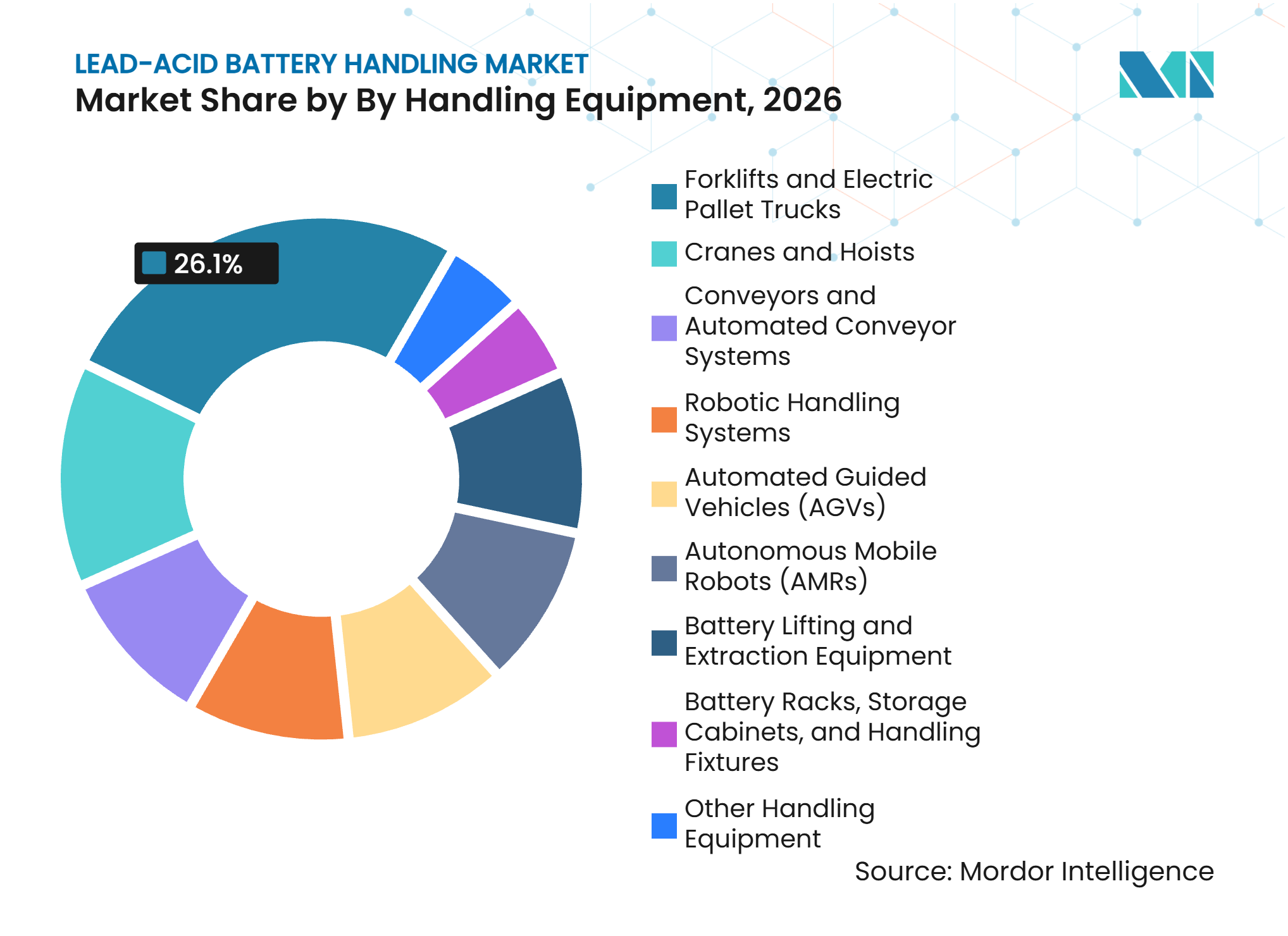
Specialist Extraction Systems and Robotic Integration Define the Growth DivideForklifts and electric pallet trucks accounted for 26.1% of the lead-acid battery handling market share in 2026. They move batteries that can weigh from 800 kg to 3,000 kg, depending on voltage and capacity. Cranes and hoists serve manufacturing settings where overhead movement is necessary. Conveyors support high-throughput battery production lines and repeatable movement between process stages.
Robotic handling systems in the lead-acid battery handling market are projected to grow at a 3.9% CAGR through 2032. Battery lifting and extraction equipment, along with racks and storage cabinets, support day-to-day battery room management. Industrial battery installations require purpose-built fixtures that meet safe handling and workspace needs. International Electrotechnical Commission (IEC) 62485-2 provides safety guidance for stationary industrial battery installations, including measures relevant to battery rooms and handling layouts. Automated Guided Vehicles (AGVs) and Autonomous Mobile Robots (AMRs) are used in large facilities, although heavy battery payloads and acid containment requirements limit adoption to specialized configurations. Cimcorp entered the electric vehicle (EV) battery manufacturing field in April 2025 with gantry robot and conveyor solutions for cell-assembly buffer storage, showing how robotics suppliers are extending into battery-related material movement.



By Handling Service:
Recycling-Linked Services Emerge as the Fastest-Growing Revenue LayerTransportation held 21.4% of global revenue in the lead-acid battery handling market in 2026. Each battery swap normally creates movement into and out of the charging process, making transportation a recurring service activity. Loading and unloading, lifting and positioning, and installation and removal support the core workflow of a battery room. Large third-party logistics and manufacturing facilities can use specialist service contracts for these tasks. Sorting and inspection are also becoming more important where batteries must be assessed before storage or recycling.
Recycling and end-of-life handling are expected to grow at a 3.5% CAGR through 2032. The European Union requires 75% recycling efficiency for lead-acid batteries by December 31, 2025, rising to 80% by 2030. It also sets lead recovery targets of 90% by 2027 and 95% by 2031. Colombia's Resolución 0799 de 2025 established systems for the collection and management of used lead-acid batteries. These requirements support services that sort, discharge, and prepare batteries before recycling.
By Automation Level:
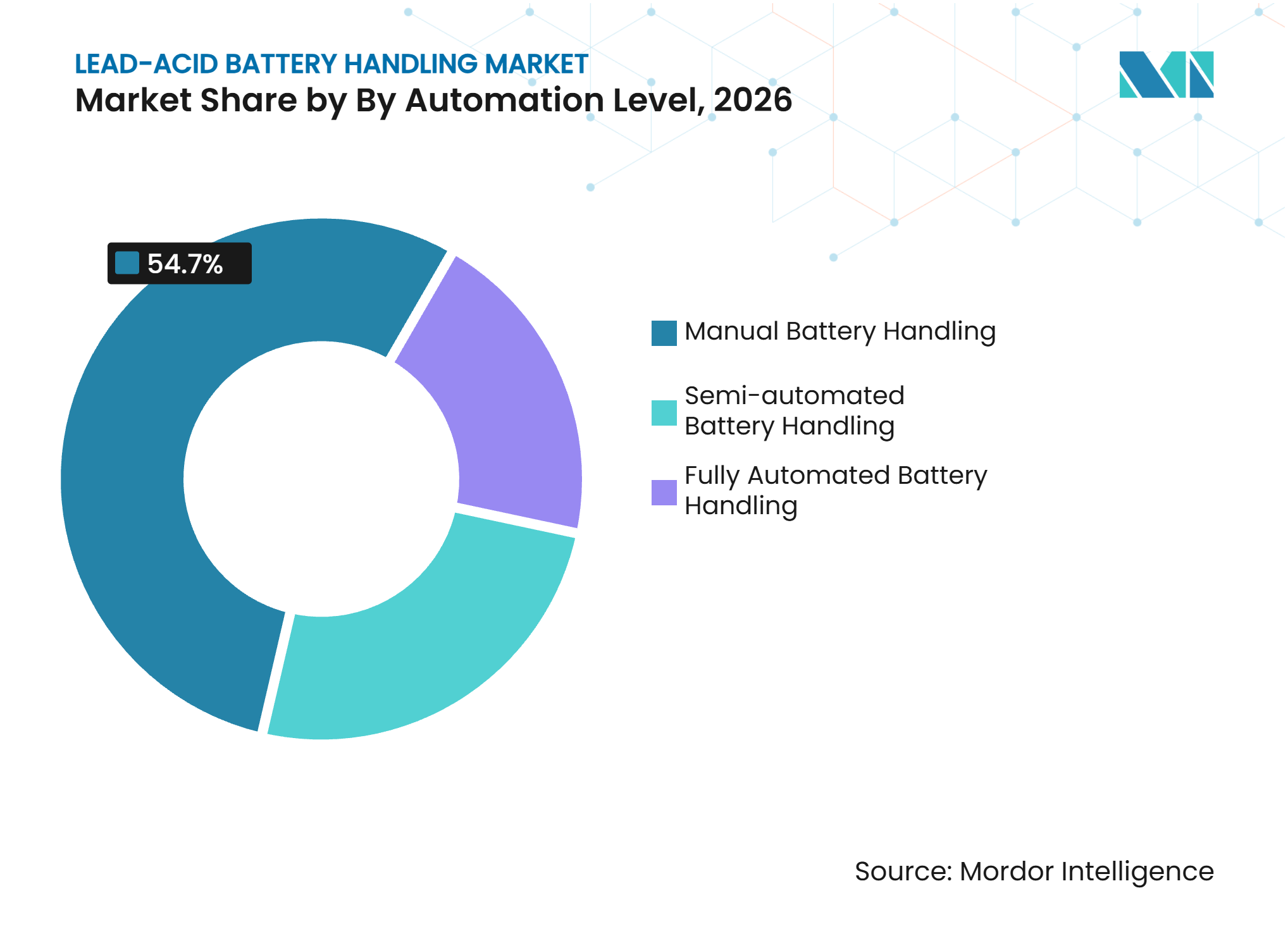
A Dominant Manual Base Coexists With Accelerating Automation at the Production TierManual battery handling accounted for 54.7% of the lead-acid battery handling market size in 2026. Small and midsized warehouses often use an attendant, a hydraulic extractor, and a charger bank rather than an automated system. Facilities running fewer than 50 forklifts on 1 shift can find this approach adequate for their operating pattern. Semi-automated systems offer a middle option through roller-track exchange equipment, assisted lifting, and monitoring dashboards. They improve control without requiring a full change to the facility layout.
Fully automated battery handling is forecast to expand at a 4.1% CAGR through 2032. Battery manufacturers use automation to reduce exposure to acid, hydrogen, and high-voltage terminals across repeated handling cycles. Recycling facilities also have an incentive to automate where they process high volumes under recycling efficiency requirements. HOPPECKE reported that its Price per Cycle framework, validated by DNV, demonstrated up to 30% more charge cycles than standard PzS alternatives. Greenfield battery manufacturing facilities in China, India, and Southeast Asia can integrate automated handling more easily than mature facilities that require retrofit work.

By End User:
Battery Manufacturers Lead, Recyclers Accelerate on Regulatory TailwindsBattery manufacturers held 29.3% of end-user demand in 2026. They handle batteries during assembly, formation, aging, quality inspection, and movement between production stages. This group is a key buyer of automated equipment because each unit can pass through several controlled handling steps. Automotive Original Equipment Manufacturers (OEMs) and battery pack manufacturers also manage batteries during incoming goods, assembly, and finished-product staging. Warehousing and distribution operators account for a large volume of use but are generally more sensitive to equipment cost and slower to automate.
Battery recycling companies are forecast to expand at a 2.9% CAGR through 2032. These facilities must sort batteries by chemistry, discharge them safely, manage acid spills, and move items that can weigh from 20 kg to 800 kg through processing lines. Their requirements differ from conventional warehouse operations and often require purpose-built equipment. ITS Logistics launched battery logistics hubs in Indianapolis and Dallas in October 2025 for compliant storage, handling, and distribution of lithium-ion and lead-acid batteries. Energy storage system operators remain a stable niche for stationary lead-acid battery handling infrastructure.
Geography Analysis
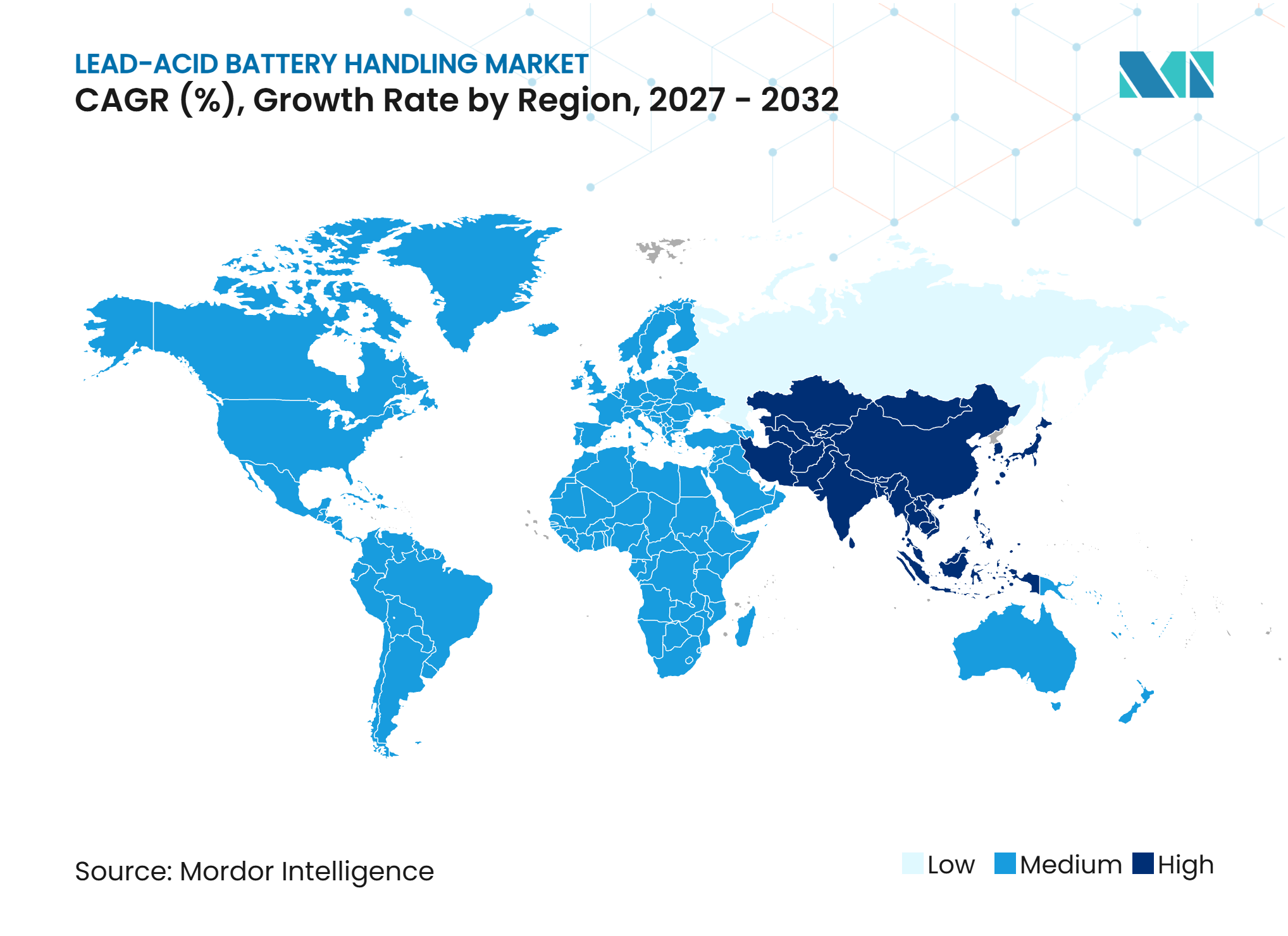
Asia-Pacific held 39.7% of global revenue in the lead-acid battery handling market in 2026 and is projected to grow at a 2.7% CAGR through 2032. China contributes much of the region's volume through lead-acid battery manufacturing, where production sites are deploying Automated Guided Vehicle-based movement and automated storage systems that connect with battery management platforms. India and South Korea add demand through manufacturing and warehousing expansion. Vietnam's 2025 National Solid Waste Management Plan also supports more formal handling of used batteries.
Europe is the second-largest geography for the lead-acid battery handling market, with demand supported by established industrial fleets. Germany, Poland, France, and the United Kingdom combine established industrial fleets with structured recycling requirements. The EU Battery Regulation creates demand for recycling and end-of-life service providers by setting defined efficiency and recovery targets. EnerSys announced a USD 4.5 million investment in flooded lead battery production capacity at its Bielsko-Biała, Poland facility in April 2025. Germany and the Benelux countries show stronger demand for semi-automated and fully automated rooms because labor costs and safety expectations encourage less manual handling. Russia and the rest of Europe maintain demand through cost-sensitive industrial fleets.
North America is the third major geography in the lead-acid battery handling market. The United States has a developed lead recycling system, and new lead-acid batteries contain more than 80% recycled material. The region has an estimated 856,000 operating forklifts that sustain demand for charging stations, battery rooms, and maintenance services. Canada and Mexico add demand through logistics and industrial development, while South America records moderate growth and Colombia's 2025 resolution creates a formal basis for used lead-acid battery collection and handling. The Middle East and Africa offer greenfield demand as industrial sites and logistics facilities are built in Saudi Arabia and the UAE.
Competitive Landscape
Market Concentration
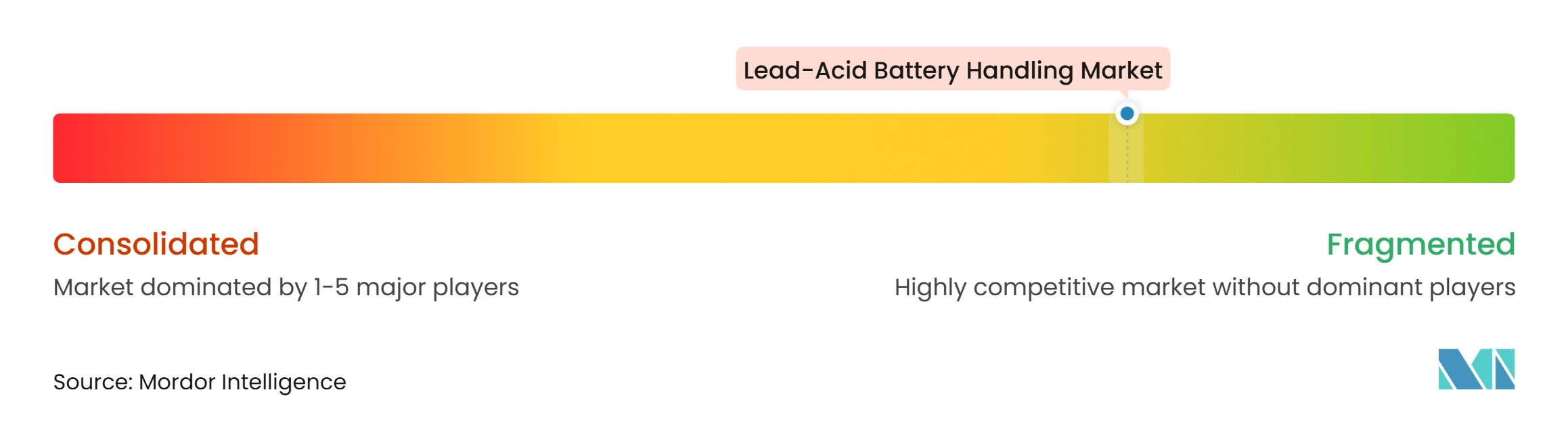
The lead-acid battery handling market is fragmented in equipment and more concentrated in service infrastructure. Battery companies including EnerSys, HOPPECKE, and Stryten Energy can sell handling systems, chargers, and monitoring services to their installed battery base. Pure-play suppliers such as BHS Inc., Multi-Shifter Inc., Carney Battery Handling Ltd., Materials Transportation Company, and Raymond Storage Concepts hold positions in North America through application engineering and service relationships. The lead-acid battery handling market therefore includes specialists that focus on battery rooms and broader Original Equipment Manufacturers (OEMs) that place energy systems within larger truck offerings.
Specialists emphasize product engineering for particular battery sizes, room configurations, and service requirements. Diversified Original Equipment Manufacturers (OEMs) seek to integrate vehicle, battery, charging, and service decisions within one customer relationship. KION has advanced lithium-ion battery production approaches that seek to reduce battery cost and link energy choices to its material-handling platform. Stryten Energy announced a July 2025 supply program with KION North America's 200-location dealer network for material-handling batteries and chargers. This program extends aftermarket access through an established dealer channel rather than a newly built direct sales network.
Recycling-specific equipment and monitored, semi-automated battery management offer open areas for suppliers in the lead-acid battery handling market. Recyclers require systems that work in corrosive and variable conditions rather than only in standard charging rooms. HOPPECKE's Price per Cycle framework positions lifecycle performance as a procurement factor, which can influence requirements for alignment and temperature management in handling systems. EnerSys launched its Next Generation NexSys® iON platform in July 2026 for 24/7 heavy-duty forklift use, with up to 300% nominal energy throughput per day. The lead-acid battery handling market remains supported by facilities where lead-acid systems and established battery rooms remain economically practical.
Lead-Acid Battery Handling Industry Leaders
-
EnerSys
-
Exide Industries Limited
-
HOPPECKE Batterien GmbH and Co. KG
-
BHS Inc.
-
Carney Battery Handling Ltd.
- *Disclaimer: Major Players sorted in no particular order
Lead-Acid Battery Handling Market Companies Covered in this Report
- EnerSys
- ABB Ltd.
- Amara Raja Energy and Mobility Limited
- Beckhoff Automation GmbH and Co. KG
- BHS Inc.
- Bosch Rexroth AG
- Carney Battery Handling Ltd.
- Crown Battery Manufacturing Company
- Exide Industries Limited
- HOPPECKE Batterien GmbH and Co. KG
- Hyster-Yale Materials Handling, Inc.
- Jungheinrich AG
- KION Group AG
- Materials Transportation Company
- Multi-Shifter, Inc.
- Raymond Storage Concepts, Inc.
- Saft Groupe S.A.
- Stryten Energy LLC
- Systems Sunlight S.A.
- Toyota Material Handling, U.S.A., Inc.
Recent Industry Developments in Lead-Acid Battery Handling Market
- July 2026: EnerSys (NYSE: ENS) launched the Next Generation NexSys® iON lithium-ion battery platform for 24/7 multi-shift heavy-duty forklift operations, supporting up to 300% nominal energy throughput per day and compatibility across a broad range of forklift models. The launch signals EnerSys's move to reposition its revenue mix toward lithium-based solutions, potentially redirecting demand from lead-acid battery handling infrastructure at the premium multi-shift tier.
- October 2025: ITS Logistics launched its Battery Logistics Hubs network, establishing dedicated multi-tenant facilities in Indianapolis and Dallas designed for compliant lithium-ion and lead-acid battery storage, handling, and distribution. The network targets electric vehicle (EV) manufacturers and Tier 1 automakers requiring scalable, compliance-ready battery logistics operations across U.S. geographies.
- July 2025: Stryten Energy LLC announced a supply program with KION North America, providing its full line of advanced lead material handling batteries and charger solutions across KION's 200-location U.S. dealer network. The program expands Stryten's distribution reach for tubular and flat-plate lead batteries and application-specific chargers without requiring direct dealer channel investment.
- April 2025: Stryten Energy LLC announced a plan to expand U.S. manufacturing capacity to 24 gigawatt-hours across its 11 domestic battery manufacturing and component plants, covering advanced lead, lithium, and vanadium redox flow technologies. The expansion plan, supported by advanced manufacturing tax credits, includes material-handling battery production and is projected to create hundreds of manufacturing jobs across Arkansas, Georgia, Iowa, Kansas, and Virginia.
Global Lead-Acid Battery Handling Market Report Scope
Electric submersible pumps (ESPs) are electrically driven pumping systems designed to lift fluids from underground wells to the surface by using a motor-powered pump assembly installed below the fluid level. In the oil and gas industry, ESPs are primarily used in artificial lift applications to increase production from oil and gas wells when natural reservoir pressure is insufficient to bring fluids to the surface at the required flow rate. These systems typically consist of a downhole electric motor, multistage centrifugal pump, seal section, and power cable, with supporting surface equipment such as variable speed drives and control systems. ESPs are deployed in onshore and offshore oilfields to handle varying production rates, well depths, fluid properties, and operating conditions, helping improve hydrocarbon recovery, production efficiency, and well productivity.
The Global Oil and Gas Electric Submersible Pump Market is segmented by operating configuration, deployment type, and end user. By operating configuration, the market is segmented into single-stage pumps and multistage pumps. By deployment type, the market is segmented into onshore and offshore applications. By end user, the market is segmented into integrated oil companies, national oil companies, independent exploration and production companies, and oilfield service companies. The report also covers the market size and forecasts for the global oil and gas electric submersible pump market across 26 countries in key regions, including North America, Europe, Asia-Pacific, South America, and the Middle East and Africa. For each segment, market sizing and forecasts are provided on the basis of value (USD).
Segmentation Overview
| Forklifts and Electric Pallet Trucks |
| Cranes and Hoists |
| Conveyors and Automated Conveyor Systems |
| Robotic Handling Systems |
| Automated Guided Vehicles (AGVs) |
| Autonomous Mobile Robots (AMRs) |
| Battery Lifting and Extraction Equipment |
| Battery Racks, Storage Cabinets, and Handling Fixtures |
| Other Handling Equipment |
| Loading and Unloading |
| Transportation Within Facilities |
| Lifting and Positioning |
| Installation and Removal |
| Sorting and Inspection |
| Storage and Inventory Management |
| Packaging and Palletization |
| Recycling and End-of-Life Handling |
| Manual Battery Handling |
| Semi-automated Battery Handling |
| Fully Automated Battery Handling |
| Battery Manufacturers |
| Automotive OEMs and Battery Pack Manufacturers |
| Third-party Logistics Providers |
| Industrial and Manufacturing Facilities |
| Warehousing and Distribution Centers |
| Energy Storage System Operators |
| Battery Recycling Companies |
| Other End Users |
| North America | United States |
| Canada | |
| Mexico | |
| Europe | Germany |
| France | |
| Italy | |
| Spain | |
| United Kingdom | |
| Poland | |
| Russia | |
| Rest of Europe | |
| Asia-Pacific | China |
| India | |
| Japan | |
| South Korea | |
| Australia | |
| Indonesia | |
| Vietnam | |
| Thailand | |
| Rest of Asia-Pacific | |
| South America | Brazil |
| Argentina | |
| Chile | |
| Rest of South America | |
| Middle East and Africa | Saudi Arabia |
| United Arab Emirates | |
| Egypt | |
| South Africa | |
| Morocco | |
| Rest of Middle East and Africa |
| By Handling Equipment | Forklifts and Electric Pallet Trucks | |
| Cranes and Hoists | ||
| Conveyors and Automated Conveyor Systems | ||
| Robotic Handling Systems | ||
| Automated Guided Vehicles (AGVs) | ||
| Autonomous Mobile Robots (AMRs) | ||
| Battery Lifting and Extraction Equipment | ||
| Battery Racks, Storage Cabinets, and Handling Fixtures | ||
| Other Handling Equipment | ||
| By Handling Service | Loading and Unloading | |
| Transportation Within Facilities | ||
| Lifting and Positioning | ||
| Installation and Removal | ||
| Sorting and Inspection | ||
| Storage and Inventory Management | ||
| Packaging and Palletization | ||
| Recycling and End-of-Life Handling | ||
| By Automation Level | Manual Battery Handling | |
| Semi-automated Battery Handling | ||
| Fully Automated Battery Handling | ||
| By End User | Battery Manufacturers | |
| Automotive OEMs and Battery Pack Manufacturers | ||
| Third-party Logistics Providers | ||
| Industrial and Manufacturing Facilities | ||
| Warehousing and Distribution Centers | ||
| Energy Storage System Operators | ||
| Battery Recycling Companies | ||
| Other End Users | ||
| By Geography | North America | United States |
| Canada | ||
| Mexico | ||
| Europe | Germany | |
| France | ||
| Italy | ||
| Spain | ||
| United Kingdom | ||
| Poland | ||
| Russia | ||
| Rest of Europe | ||
| Asia-Pacific | China | |
| India | ||
| Japan | ||
| South Korea | ||
| Australia | ||
| Indonesia | ||
| Vietnam | ||
| Thailand | ||
| Rest of Asia-Pacific | ||
| South America | Brazil | |
| Argentina | ||
| Chile | ||
| Rest of South America | ||
| Middle East and Africa | Saudi Arabia | |
| United Arab Emirates | ||
| Egypt | ||
| South Africa | ||
| Morocco | ||
| Rest of Middle East and Africa | ||
Key Questions Answered in the Report
What is the projected size of the lead-acid battery handling market by 2032?
The market is projected to reach USD 738.29 million by 2032, growing at a 2.53% CAGR from 2027 to 2032.
Which equipment category holds the largest revenue share?
Forklifts and electric pallet trucks hold the largest handling equipment share at 26.1% in 2026.
Which handling approach is growing fastest?
Fully automated battery handling is forecast to grow at a 4.1% CAGR through 2032.
Why do warehouses still use lead-acid battery handling systems?
Existing forklift fleets, battery rooms, maintenance practices, and lower initial battery costs support continued use.
What is driving recycling-related battery services?
The European Union's recycling efficiency and lead recovery requirements, along with formal collection rules in Colombia, support recycling and end-of-life handling.
Which region leads global demand?
Asia-Pacific holds the largest share at 39.7% in 2026 and has the highest forecast CAGR at 2.7% through 2032.