
Layered Double Hydroxide Market Size and Share
Market Overview
| Study Period | 2022 - 2032 |
|---|---|
| Market Size (2027) | USD 0.97 Billion |
| Market Size (2032) | USD 1.46 Billion |
| Growth Rate (2027 - 2032) | 8.41 % |
| Fastest Growing Market | Asia-Pacific |
| Largest Market | Asia-Pacific |
| Market Concentration | Low |
Major Players *Disclaimer: Major Players sorted in no particular order Image © Mordor Intelligence. Reuse requires attribution under CC BY 4.0. | |
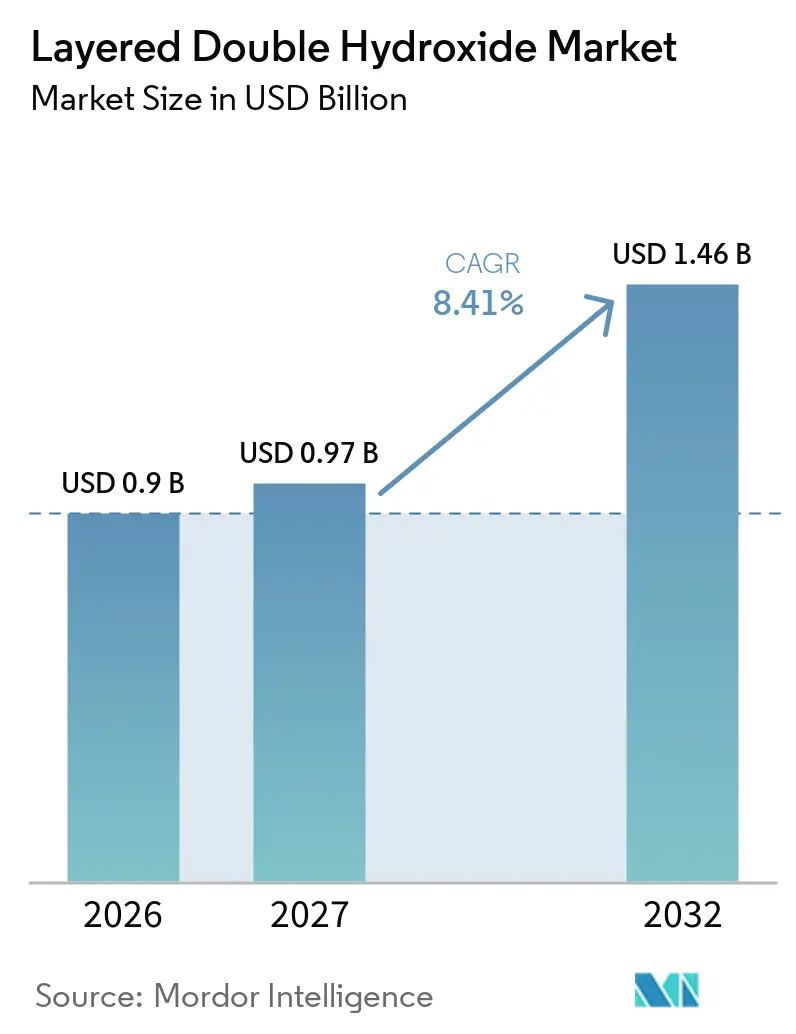
Layered Double Hydroxide Market Analysis by Mordor Intelligence
The layered double hydroxide market size was valued at USD 0.90 billion in 2026 and is estimated to grow from USD 0.97 billion in 2027 to USD 1.46 billion by 2032, at a CAGR of 8.41% during the forecast period (2027-2032). The layered double hydroxide market is expanding beyond its established role in acid scavenging toward applications in environmental compliance, polymer safety, and drug delivery. Demand is driven by stricter controls on persistent pollutants, the shift toward halogen-free materials, and growing activity in regenerative medicine. However, the market faces cost pressure, as high-purity production requires controlled conditions and refined inputs. Suppliers are responding by prioritizing pharmaceutical, anti-corrosion, and electrocatalysis grades over standard powders, shifting the opportunity from high-quantity materials to specialized products with stricter technical and regulatory requirements.
Key Report Takeaways
- By grade, plastic grade held 40.12% of the layered double hydroxide market share in 2026, while pharmaceutical grade is forecast to grow at a 9.12% CAGR through 2032.
- By type, Mg-Al LDH accounted for 44.45% of the layered double hydroxide market share in 2026 and is projected to expand at a 9.31% CAGR through 2032.
- By form, powdered form represented 68.14% of revenue in 2026, while liquid form is forecast to record an 8.96% CAGR through 2032.
- By application, additives captured 31.83% of revenue in 2026, while water treatment is projected to grow at a 9.53% CAGR through 2032.
- By end-user industry, chemicals accounted for 32.69% of revenue in 2026 and are forecast to grow at a 9.67% CAGR through 2032.
- By geography, Asia-Pacific held 40.52% of revenue in 2026 and is forecast to grow at a 9.55% CAGR through 2032.
Note: Market numbers in this report are based on Mordor Intelligence's proprietary estimation framework, which combines nine months of actuals with Q4 projections for base year 2026.
Market Trends and Insights
Drivers Impact Analysis of Layered Double Hydroxide Market*
| Drivers | (~) % Impact on CAGR Forecast | Geographic Relevance | Impact Timeline |
|---|---|---|---|
| Expansion of Water and Wastewater Treatment Applications | +2.0% | Global, with intensity in North America, Europe, China, India, and ASEAN | Medium term (2-4 years) |
| Demand for Halogen-Free Polymer Stabilizers and Flame Retardants | +1.8% | Europe and North America, with spillover to the Asia-Pacific through export compliance | Short term (≤ 2 years) |
| Growth in Pharmaceutical and Biomedical Formulations | +1.5% | Global, led by North America, Europe, Japan, and South Korea | Medium term (2-4 years) |
| Adoption of Tunable Catalysts and Catalyst Supports | +1.2% | Global, led by China and Germany | Long term (≥ 4 years) |
| PFAS and Microplastic Remediation Requirements | +1.0% | North America and EU primary; expanding to APAC following regulatory alignment | Short term (≤ 2 years) |
| Source: Mordor Intelligence | |||
Expansion of Water and Wastewater Treatment Applications
Municipal and industrial users seeking adsorbents capable of removing multiple types of contaminants are driving demand in the layered double hydroxide market. A 2025 study reported that a copper-aluminum LDH with nitrate intercalation achieved perfluorooctanoic acid (PFOA) adsorption of 1,702 mg/g at neutral pH and room temperature. The material also completed 6 cycles of capture, destruction, and regeneration without a significant loss of capacity[1]. ZnAl and MgAl LDHs have also shown an affinity for heavy-metal oxyanions, including chromate and arsenate, in wastewater applications. These properties extend the application scope of the layered double hydroxide market beyond per- and polyfluoroalkyl substances (PFAS) remediation to include effluent treatment in mining, semiconductor manufacturing, and textiles. PFAS and microplastic remediation requirements are increasing the need for materials that can perform under varied water conditions.
Demand for Halogen-Free Polymer Stabilizers and Flame Retardants
The layered double hydroxide market is gaining traction as polymer processors replace halogenated systems with alternatives that enhance flame resistance and reduce smoke toxicity. A 2025 study found that a 15 wt% phytate-intercalated MgAl LDH in polypropylene achieved a UL-94 V-1 rating. The same formulation reduced peak smoke production by 41.2% and peak carbon monoxide release by 35.3%. Separate 2025 work showed that phytic acid and polyethylenimine (PEI)-modified Ca-Al LDH can improve intumescent protection in polylactic acid (PLA) bioplastic composites. This supports the layered double hydroxide market, where packaging and construction regulations favor lower-hazard materials. The result is a broader role for LDHs in plastics that require both heat stability and fire protection.
Growth in Pharmaceutical and Biomedical Formulations
The layered double hydroxide market is expanding into pharmaceutical products as LDHs combine pH response with anion exchange. Hydrotalcite has an established role as an antacid excipient, while newer work focuses on controlled drug release. A 2025 review described a doxorubicin-loaded CuAl LDH with near-complete drug encapsulation and pH-triggered release. The review also described LDH-based oral insulin delivery that sustained hypoglycemic effects for 12 hours in murine models. Research on bone repair, wound healing, and nerve regeneration further highlights the importance of controlled ion release and the material memory effect. Producers with validated, pharmacopeia-aligned processes may hold an advantage, as compliant manufacturing is difficult to establish quickly.
Adoption of Tunable Catalysts and Catalyst Supports
Catalysts with controlled active-site density and metal dispersion represent an additional growth avenue for the layered double hydroxide market. LDH-derived mixed metal oxides are promising supports for applications in oxygen evolution, carbon dioxide reduction, selective hydrogenation, and syngas conversion. A 2025 study reported room-temperature and atmospheric-pressure synthesis of NiFe-LDH for anion-exchange membrane electrolysis. The material achieved 1 A/cm² at 1.69 V in a full-cell electrolyzer. This may reduce dependence on high-pressure hydrothermal production routes and give the layered double hydroxide market an entry point into green hydrogen equipment beyond its traditional polymer and water-treatment applications.
Restraints Impact Analysis of Layered Double Hydroxide Market*
| Restraints | (~) % Impact on CAGR Forecast | Geographic Relevance | Impact Timeline |
|---|---|---|---|
| High Synthesis, Purification, and Scale-Up Costs | -1.2% | Global, with greater pressure in North America, Europe, and Japan | Medium term (2-4 years) |
| Competition from Established Adsorbents and Catalyst Supports | -0.8% | Global, with greater pressure in price-sensitive Asia-Pacific and South American markets | Short term (≤ 2 years) |
| Powder Recovery, Regeneration, and Metal-Leaching Risks | -0.5% | Water treatment and agricultural end uses globally | Long term (≥ 4 years) |
| Source: Mordor Intelligence | |||
High Synthesis, Purification, and Scale-Up Costs
The layered double hydroxide market is constrained by the costs associated with controlling temperature, pH, and reagent purity during co-precipitation and hydrothermal synthesis. These requirements increase capital spending per ton compared with calcium carbonate and standard alumina trihydrate. A 2025 study examined solvent-free mechanochemical and molten-salt routes that may reduce production costs. However, morphology control and batch reproducibility at the commercial scale remain unresolved[2]. Nabaltec AG reported that its 2025 EBIT fell 31.8% to EUR 15.2 million (~USD 17.04 million) on EUR 197.0 million (~USD 220.88 million) of revenue, citing raw material and energy costs as margin pressures. These pressures are more pronounced for high-purity products used in pharmaceutical and advanced coating applications.
Competition from Established Adsorbents and Catalyst Supports
The layered double hydroxide market competes with zeolites, activated carbon, and silica-alumina catalysts, which have established production networks and familiar operating practices. Most industrial wastewater facilities already have activated carbon regeneration systems, which raises switching costs even where layered double hydroxides (LDHs) offer higher adsorption capacity per unit weight. Suppliers must therefore demonstrate clear performance advantages rather than compete on price alone. Powder recovery, regeneration, and metal leaching also require careful management in water treatment and agricultural applications. Near-term adoption will depend on regulations that render incumbent materials insufficient for specific contaminants or operating conditions. This makes verified field performance critical to the expansion of the layered double hydroxide market.
*Our forecasts treat driver/restraint impacts as directional, not additive. The impact forecasts reflect baseline growth, mix effects, and variable interactions.
Layered Double Hydroxide Market Segment Analysis
By Grade:
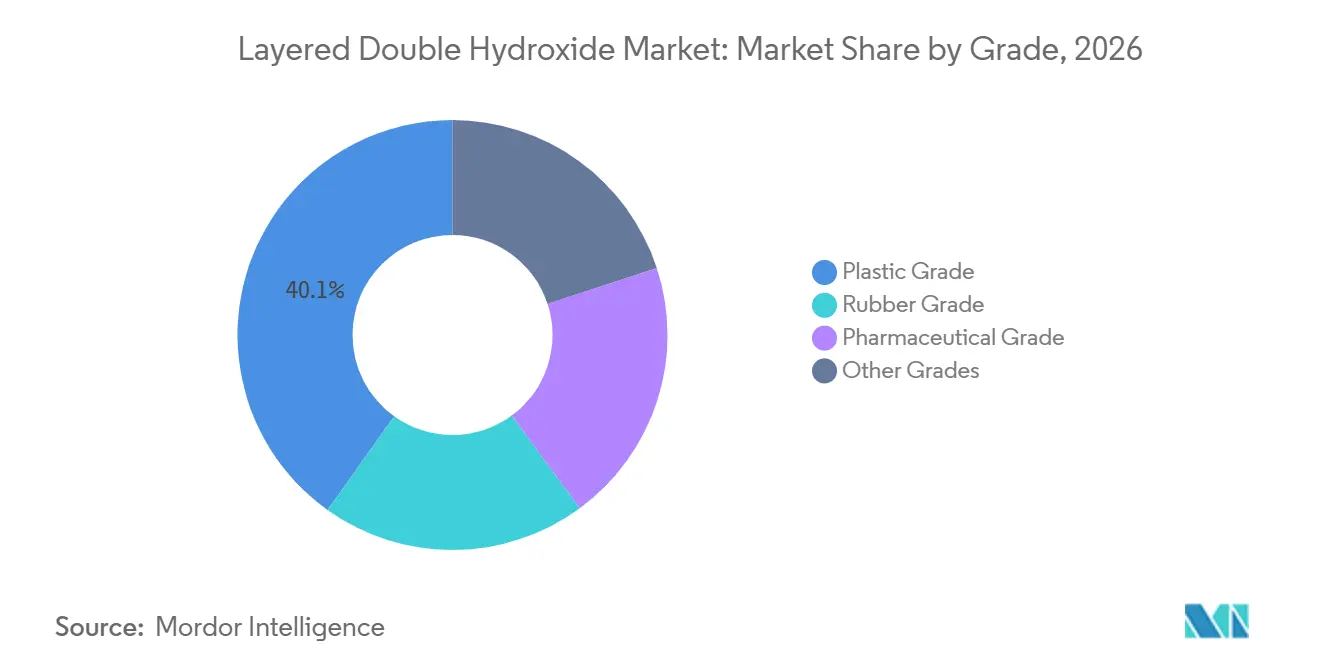
Pharmaceutical Grade Gaining Ground on an Industrial BasePlastic grade accounted for 40.12% of grade revenue in 2026, supported by its use as a heat stabilizer and acid scavenger in polyvinyl chloride (PVC) and as a flame-retardant additive in polyolefin compounds. Rubber grade held the second-largest position, as LDHs can neutralize acidic catalyst residues and improve thermal stability in automotive and industrial rubber products. Pharmaceutical grade is forecast to grow at a 9.12% CAGR from 2027 to 2032, driven by commercial interest in drug-delivery platforms and controlled-release excipient formulations. The layered double hydroxide market continues to rely on industrial grades for scale, while pharmaceutical applications represent a higher-value growth path. Plastic grade remains closely tied to the operational needs of PVC and polyolefin processors, who require materials that can manage acidity, heat exposure, and product stability during compounding. Rubber applications represent another established source of demand, as thermal durability is important for automotive and industrial components.
Pharmaceutical demand follows a different buying process, with greater emphasis on documentation and controlled performance. These differing requirements limit direct substitution between grades and give suppliers reason to maintain a broad portfolio of production and quality standards rather than relying on a single material type. A 2025 review documented near-complete encapsulation of doxorubicin in LDH nanocomposites and sustained, pH-triggered release, supporting development work with contract development and manufacturing organizations. Food additives and agricultural formulations remain smaller parts of the portfolio but are gaining attention as soil amendments and slow-release carriers. Producers that invest in validated pharmaceutical facilities may face less competition from late entrants, as qualification requires significant capital investment and process documentation. This reflects the layered double hydroxide market's shift toward applications where quality systems are as important as material performance. The difference between industrial and pharmaceutical requirements can shape investment decisions. Industrial grades require efficient production and dependable supply for high-output customers, while pharmaceutical grades require tighter control over raw materials, processing, and documentation before acceptance. The faster growth outlook for pharmaceutical materials makes this investment relevant despite the added cost, supporting a portfolio approach in which established industrial demand funds the development of capabilities for more specialized grades.

By Type:
Mg-Al LDH’s Dominance Masks Emerging HeterogeneityMg-Al LDH held 44.45% of type revenue in 2026, making it the largest type category. Its position reflects the availability of magnesium and aluminum salt precursors, established synthesis methods, and the ability to accommodate a broad range of intercalated anions. Mg-Al LDH is also forecast to grow at a 9.31% CAGR through 2032. The combination of market share and growth indicates that this established chemistry still has room to expand, supported by uses in polymers, water treatment, and general-purpose additives. Mg-Al LDH benefits from a long history of use in polymer systems and from manufacturing methods familiar to suppliers. Its broad applicability provides buyers with a material with known processing behavior across multiple uses, reducing qualification burdens compared with less established compositions. The type also remains relevant where suppliers require scalable co-precipitation synthesis and dependable raw-material availability. Its continued growth suggests that widespread use has not limited its ability to gain traction in new applications, and the established base provides producers with a platform to introduce related, higher-value grades.
Zn-Al LDH is gaining attention in PFAS and heavy-metal removal, as its surface charge density and accessible interlayer sites can improve adsorption kinetics. A 2025 study reported stronger perfluorooctanoic acid (PFOA) adsorption kinetics for Zn-Al LDH than for Mg-Al grades. Ca-Al LDH is being used in flame-retardant bioplastics; research published in 2025 achieved a UL-94 V-0 rating in polylactic acid (PLA) composites using Ca-Al LDH with a 9,10-dihydro-9-oxa-10-phosphaphenanthrene 10-oxide (DOPO)-based polyamide. Ternary MgAlLa and NiFe materials are emerging in electrocatalysis and anti-corrosion coatings, although their output remains low. Qualifying these alternative types for defined applications can diversify the layered double hydroxide market without weakening the role of Mg-Al LDH. The emerging diversity in LDH types also affects production planning. Suppliers must decide whether to focus on large-output grades or invest in smaller batches designed for specific technical functions. The latter approach can involve more customer testing and closer coordination with end users, but can also limit direct price competition where a material delivers a defined performance advantage. The choice of type is therefore increasingly linked to both commercial strategy and chemistry.
By Form:
Powder Dominates, Liquid Formulations Gain ShareThe powdered form accounted for 68.14% of the layered double hydroxide market in 2026. Its dominant position reflects compatibility with dry blending and compounding operations in polymer processing. Many installed polymer lines are designed for powder dosing, which supports continued use through the forecast period. Liquid form is forecast to grow at an 8.96% CAGR through 2032, driven by relevance to pharmaceutical suspensions, paper coatings, and in situ water treatment systems. Buyers who choose liquid materials can avoid a separate dispersion step, benefiting the layered double hydroxide market. Powder retains its role because it fits the operational requirements of large polymer-processing facilities that need materials compatible with existing storage, handling, and dosing systems. Liquid formulations offer a different benefit where dispersion time affects throughput or where the material must be introduced into a treatment stream. The faster projected growth in liquids indicates that customers in those settings are seeking process convenience and control. This does not suggest powder demand will decline, but it does make formulation design more important to the revenue mix.
A 2025 study found that in situ Zn/Al LDH formation outperformed preformed ex situ materials for perfluorooctanoic acid (PFOA) removal, supporting interest in liquid precursor formulations for on-site synthesis. Granular form remains relevant for fixed-bed water treatment and catalysis, where it provides mechanical strength and can improve value per ton relative to standard powder. Pharmaceutical buyers also require controlled-particle-size suspensions for drug encapsulation, thereby gradually creating a premium liquid category within the layered double hydroxide market. Form choice affects storage, transport, dosing, and material preparation time. Buyers assess these practical considerations alongside adsorption capacity, thermal behavior, and other technical properties. As a result, suppliers may use packaging and formulation development to address customer requirements without changing the underlying LDH chemistry, supporting differentiation where basic powder grades are otherwise difficult to distinguish. The growing liquid category demonstrates how process convenience can become commercially significant.
By Application:
Water Treatment’s Rising Weight Reshapes the PortfolioAdditives captured 31.83% of segment revenue in 2026. This category includes acid scavengers, heat stabilizers, UV absorbers, and flame-retardant co-additives used in plastics, rubber, and coatings. Water treatment is forecast to expand at a 9.53% CAGR from 2027 to 2032. Its growth is linked to tighter regulation of PFAS and heavy-metal discharges. Catalysts and catalyst precursors form the second-largest application group, with mixed metal oxides used in refinery processing and green hydrogen systems. The layered double hydroxide market combines a mature additives base with faster growth in environmental applications. Environmental applications also follow different purchasing patterns than additive uses. Municipal and industrial water projects may require extended testing periods before a material is accepted, and may also require solutions capable of managing mixed contaminant streams rather than a single regulated substance. This increases the role of technical validation, regeneration plans, and material recovery in supplier discussions.
The polymer additives base remains valuable because it provides recurring demand across established compounding operations. Research from Rice University and KAIST described CuAl-NO₃ LDH that removed PFAS more than 1,000 times more effectively than conventional activated carbon in continuous-flow systems. This gives procurement teams performance evidence for material selection in complex water streams. Adsorbents support environmental and industrial processes where regenerability and selectivity can reduce operational limitations associated with single-use sorbents. Water treatment demand also benefits from LDHs' ability to target multiple anionic contaminants. The additives category remains essential to the layered double hydroxide market because it serves a large polymer-processing output. The overall application mix is becoming broader as regulatory requirements increase the value of selective removal materials. Water treatment contracts can require collaboration with engineering firms, plant operators, and testing organizations before a new material is adopted, making supplier credibility and accessible performance data important for reaching municipal and industrial customers. Additive suppliers operate within a different commercial setting, where compatibility with established formulations can be decisive. The ability to serve both settings can spread commercial risk across several demand patterns and enhance the value of research applicable to multiple applications.
By End-User Industry:
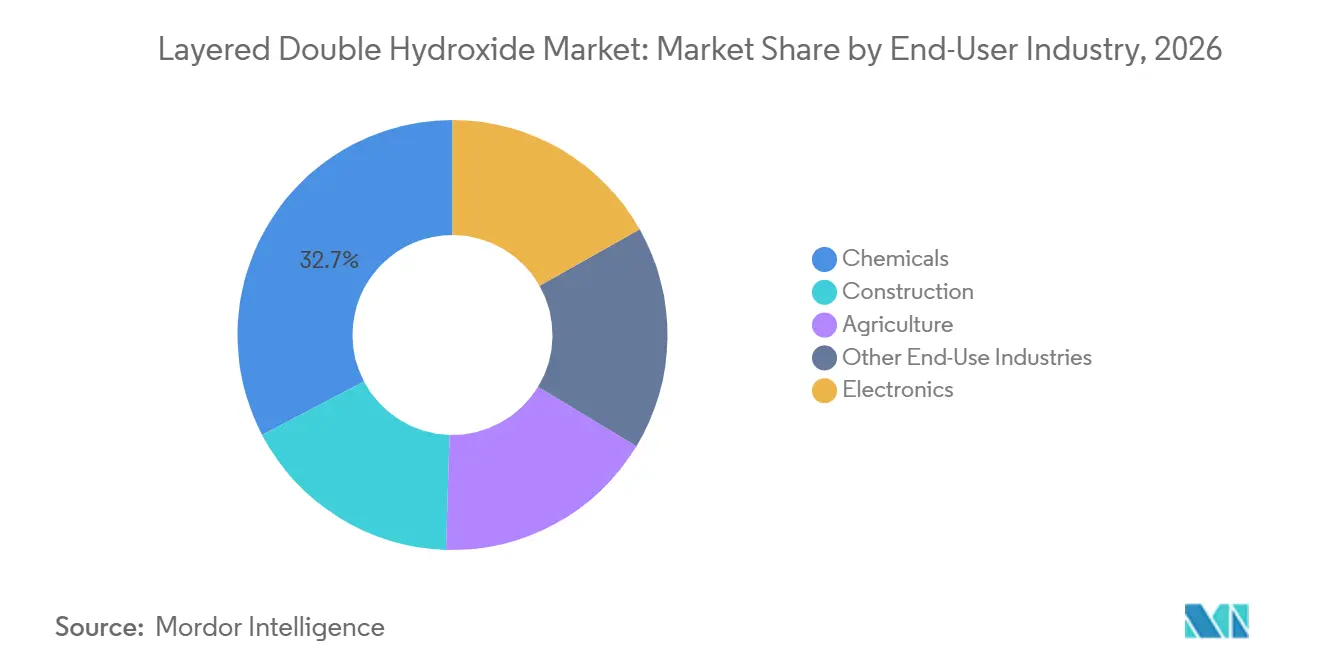
Chemicals Sector Consolidates Lead While Diversification ExpandsThe chemicals sector accounted for 32.69% of the layered double hydroxide market in 2026 and is forecast to grow at a 9.67% CAGR through 2032. PVC stabilizer systems, polymer acid scavenging, and refinery catalyst uses support this position, reflecting that upstream chemical processing remains a central source of demand. Electronics is an important secondary sector, as LDH-based anticorrosion coatings are being considered for battery pack housings and circuit board laminates. The ion-exchange function can offer advantages over passive barrier coatings, and the layered double hydroxide market gains further support when electronics suppliers seek materials that improve coating durability. The position of the chemicals sector is also tied to established production and compounding infrastructure. Processors value materials that can be introduced without major changes to equipment or handling methods, which favors LDH products with predictable particle characteristics and thermal performance. At the same time, the sector's growth rate indicates that demand is not confined to replacement purchases but also includes new requirements in stabilization, catalytic processing, and higher-value coatings. Suppliers serving chemical customers, therefore, need reliable output and technical support during qualification.
Construction uses LDHs as halogen-free flame retardants and polymer modifiers in cable sheathing. Demand in this area can vary with building-code enforcement and construction cycles in Europe and North America. Agriculture uses LDHs as slow-release carriers for micronutrients and pesticides, and peer-reviewed work has supported their potential to improve agrochemical efficacy and persistence in soil. The connection between chemical processing and electronics in Asia is particularly relevant because electric-vehicle supply chains require corrosion-resistant enclosure materials. This supports a higher-growth channel for the layered double hydroxide market through 2032 and favors producers that can supply consistent grades across polymer and coating uses. It also supports closer links between material suppliers and downstream compounders, as application testing often determines whether a grade reaches commercial use. Refinery applications remain important because they provide a sustained industrial base for catalyst-related demand. The expanding role of electronics does not displace that base, but it makes the end-user mix less dependent on a single set of polymer applications. This balance can help producers direct technical resources toward products with clear performance requirements and make customer qualification a more important part of commercial planning. A material supplier may need to demonstrate performance in cable compounds, coating systems, or industrial processing before recurring orders develop. These activities take time, but they can build more durable commercial relationships than sales of undifferentiated powders.
Geography Analysis
APAC Layered Double Hydroxide Market
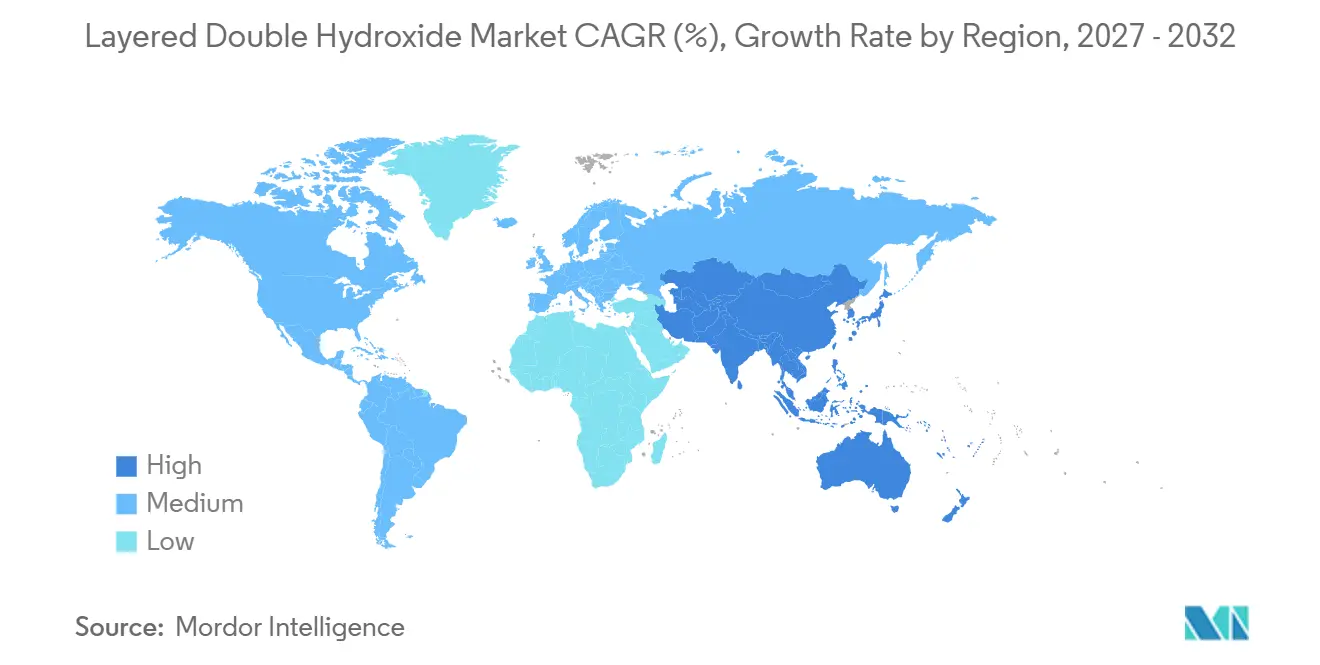
Asia-Pacific held 40.52% of regional revenue in 2026 and is forecast to grow at a 9.55% CAGR through 2032. China supports regional demand through polymer processing, catalyst applications, adsorbents, and pharmaceutical carriers. India contributes through pharmaceutical manufacturing and local demand for pharmaceutical-grade excipients. Japan and South Korea remain important markets for specialty chemicals and electronics. Kyowa Chemical Industry introduced KISUMA X, a next-generation non-halogen flame retardant, in October 2025. These factors position Asia-Pacific as central to the regional outlook and the development of higher-value applications.
North America and Europe Layered Double Hydroxide Market
North America presents a technically demanding environment for water-treatment materials. U.S. EPA enforcement of PFAS drinking-water maximum contaminant levels is increasing demand for filtration materials capable of operating in continuous municipal systems. Canada contributes through petrochemical processing, while Mexico supports demand for standard-grade additives through manufacturing growth. Europe is shaped by REACH restrictions on halogenated flame retardants, proposals to restrict PFAS, and corporate sustainability reporting requirements. Nabaltec invested EUR 30 million in a viscosity-optimized hydroxide production line that became operational in the second quarter of 2026, adding 30,000 tons of annual capacity.
MEA and South America Layered Double Hydroxide Market
South America, the Middle East, and Africa remain smaller parts of the layered double hydroxide market. Brazil offers a developing use case for slow-release fertilizer carriers in agriculture. Saudi Arabia's petrochemical expansion supports interest in catalyst materials. South Africa's mining sector creates demand for heavy-metal adsorbents. Investment in Gulf Cooperation Council (GCC) desalination and wastewater systems may also support the adoption of LDH. These regions require demonstration projects, as established adsorbents already have strong operating histories. Growth in these smaller markets depends on whether suppliers can demonstrate a practical advantage over existing materials. In Brazil, agricultural use depends on an LDH carrier's ability to support controlled delivery under local growing conditions. In the Middle East, petrochemical and water projects may value catalyst supports and selective adsorbents, but project operators will seek evidence that new materials can integrate with existing systems. South African mining applications similarly require materials capable of addressing heavy-metal streams under site-specific operating conditions. Demonstration projects can reduce uncertainty by comparing the performance of adsorption, recovery, and regeneration against materials already in use. This makes technical partnerships important for suppliers entering these regions, and demand is likely to build through targeted projects rather than immediate high-scale replacement of established adsorbents.
Competitive Landscape
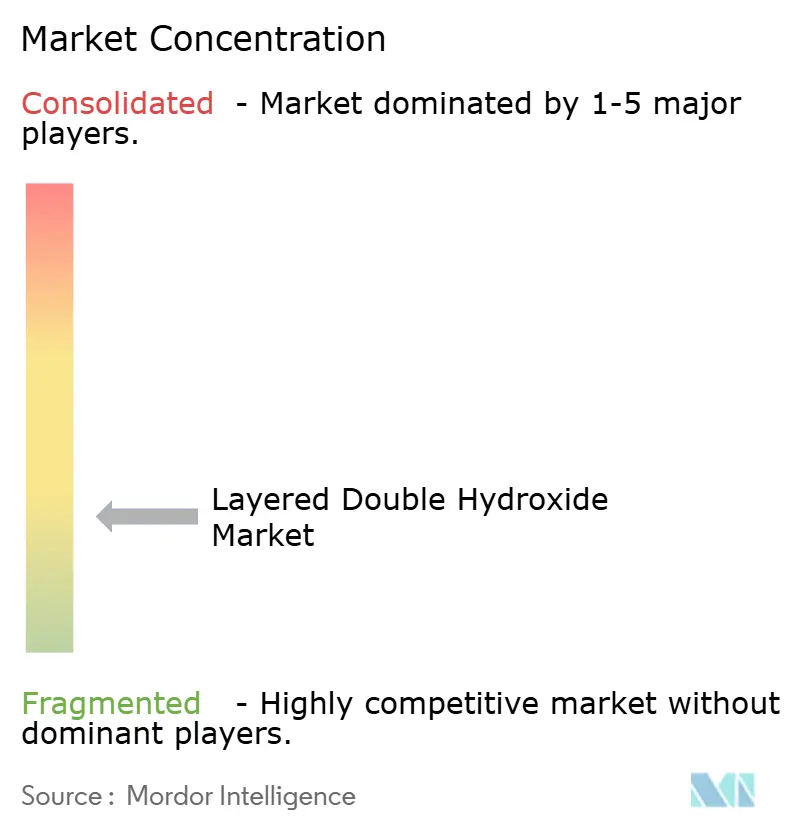
The layered double hydroxide market is fragmented, with Kyowa Chemical Industry and Clariant among the suppliers in terms of portfolio breadth and market position. Doobon, Shandong Repolyfine Chemical, Sakai Chemical Industry, Sasol, and Saekyung Chemical are capable producers that compete on price and proximity to polymer customers. Chinese suppliers have increased price pressure for standard-grade powders. Established companies are responding by emphasizing pharmaceutical-quality materials, anti-corrosion formulations, and electrocatalyst precursors. These products command higher prices due to more stringent qualification and performance requirements. As a result, the layered double hydroxide market is divided between price-sensitive bulk powders and specialized materials.
Clariant completed a CHF 100 million expansion at Daya Bay, China, with its second production line fully operational in November 2025. The expansion supported halogen-free flame-retardant output for e-mobility and added Exolit OP 1242 and OP 1266 grades for polybutylene terephthalate (PBT) applications. BASF began production at its Zhanjiang Verbund site in November 2025 and commissioned its steam cracker in December 2025. The integrated site strengthens BASF's ability to supply materials to Asia-Pacific polymer markets. Nabaltec published its first sustainability report aligned with the Corporate Sustainability Reporting Directive in December 2025. These developments indicate that capacity, product design, and supplier documentation are becoming competitive tools in the layered double hydroxide market.
Patent activity in precision layered double hydroxide (LDH) synthesis for electrocatalysis and biomedical delivery is increasing, particularly in Japan and South Korea. Companies are seeking intellectual property protection before pharmaceutical-grade pathways become more clearly defined. Regulatory compliance is also becoming a factor in supplier selection for multinational polymer processors with Scope 3 reporting obligations. No single supplier has been identified as combining large-scale, validated synthesis documentation with pharmacopeia alignment for pharmaceutical-grade LDH. This creates an opportunity for a producer capable of meeting Good Manufacturing Practice (GMP)-compliant development and manufacturing requirements. The layered double hydroxide market remains competitive, but technical specialization can reduce direct exposure to standard-powder pricing. A supplier's competitive position also depends on its ability to provide consistent material characteristics across batches, which is particularly important for pharmaceutical, coating, and catalytic applications, where variations in particle properties or purity can affect the end product. Companies serving standard polymer applications face a different challenge, as customers can compare prices more directly when performance is similar. This explains the pricing pressure on conventional powders from Chinese domestic producers. Larger companies can respond by supporting application development and offering products tailored to specific safety, durability, or processing requirements. Capacity additions in Asia-Pacific can improve customer access, but do not, on their own, establish an advantage in specialized grades. Product documentation, testing data, and the ability to meet regulatory requirements can be equally important.
Layered Double Hydroxide Industry Leaders
-
Kyowa Chemical Industry Co., Ltd.
-
CLARIANT
-
DOOBON
-
SAKAI CHEMICAL INDUSTRY CO.,LTD.
-
Kisuma Chemicals
- *Disclaimer: Major Players sorted in no particular order
Layered Double Hydroxide Market Companies Covered in this Report
- BASF
- CLARIANT
- DOOBON
- Dow
- Kisuma Chemicals
- Kyowa Chemical Industry Co., Ltd.
- Nabaltec AG
- Nippon Chemical Industrial CO., LTD.
- Saekyung Chemical Co.,Limited
- SAKAI CHEMICAL INDUSTRY CO.,LTD.
- Sasol
- Shandong Repolyfine Chemical Co., Ltd.
- Sinwon Chemical Co., Ltd.
- Sumitomo Chemical Co., Ltd.
- TODA KOGYO CORP.
Recent Industry Developments in Layered Double Hydroxide Market
- June 2026: Clariant completed a CHF 100 million capacity expansion at Daya Bay, China. The second production line became fully operational in November 2025, increasing halogen-free flame retardant output, including layered double hydroxide-based Exolit lines, for the Asia-Pacific e-mobility market. The expansion also added two new Exolit OP grades, OP 1242 and OP 1266, engineered for PBT applications in electric-vehicle components.
- November 2025: BASF initiated production at the Zhanjiang Verbund site. The facility, representing EUR 8.7 billion in total capital expenditure from 2019 to 2028, manufactured its first products in November 2025 and commissioned its steam cracker in December 2025, strengthening BASF's position as a low-cost layered double hydroxide precursor supplier to Asia-Pacific polymer markets.
Global Layered Double Hydroxide Market Report Scope
Layered double hydroxides (LDHs) are two-dimensional (2D) anionic clay materials composed of positively charged metal hydroxide sheets and exchangeable anions in the interlayer spaces. These materials consist of brucite-like layers, where divalent and trivalent metal cations are arranged in a structured lattice, creating a net positive charge that is balanced by anions and water molecules residing between the layers.
The layered double hydroxide market is segmented by grade, type, form, application, end-user industry, and geography. By grade, the market is segmented into plastic grade, rubber grade, pharmaceutical grade, and other grades. By type, the market is segmented into Mg-Al LDH, Zn-Al LDH, Ca-Al LDH, and Other LDH Types. By form, the market is segmented into powdered form, granular form, and liquid form. By application, the market is segmented into additives, catalysts and catalyst precursors, absorbents, water treatment, and other applications. By end-user industry, the market is segmented into chemicals, electronics, construction, agriculture, and other end-use industries. The report also covers market sizes and forecasts for layered double hydroxide across 15 countries in major regions. The market sizes and forecasts are provided in terms of value (USD).
Segmentation Overview
| Plastic Grade |
| Rubber Grade |
| Pharmaceutical Grade |
| Other Grades |
| Mg-Al LDH |
| Zn-Al LDH |
| Ca-Al LDH |
| Other LDH Types |
| Powdered Form |
| Granular Form |
| Liquid Form |
| Additives |
| Catalysts and Catalyst Precursors |
| Absorbents |
| Water Treatment |
| Other Applications |
| Chemicals |
| Electronics |
| Construction |
| Agriculture |
| Other End-Use Industries |
| Asia-Pacific | China |
| India | |
| Japan | |
| South Korea | |
| ASEAN Countries | |
| Rest of Asia-Pacific | |
| North America | United States |
| Canada | |
| Mexico | |
| Europe | Germany |
| United Kingdom | |
| France | |
| Italy | |
| NORDIC Countries | |
| Rest of Europe | |
| South America | Brazil |
| Argentina | |
| Rest of South America | |
| Middle East and Africa | Saudi Arabia |
| South Africa | |
| Rest of Middle East and Africa |
| By Grade | Plastic Grade | |
| Rubber Grade | ||
| Pharmaceutical Grade | ||
| Other Grades | ||
| By Type | Mg-Al LDH | |
| Zn-Al LDH | ||
| Ca-Al LDH | ||
| Other LDH Types | ||
| By Form | Powdered Form | |
| Granular Form | ||
| Liquid Form | ||
| By Application | Additives | |
| Catalysts and Catalyst Precursors | ||
| Absorbents | ||
| Water Treatment | ||
| Other Applications | ||
| By End-User Industry | Chemicals | |
| Electronics | ||
| Construction | ||
| Agriculture | ||
| Other End-Use Industries | ||
| By Geography | Asia-Pacific | China |
| India | ||
| Japan | ||
| South Korea | ||
| ASEAN Countries | ||
| Rest of Asia-Pacific | ||
| North America | United States | |
| Canada | ||
| Mexico | ||
| Europe | Germany | |
| United Kingdom | ||
| France | ||
| Italy | ||
| NORDIC Countries | ||
| Rest of Europe | ||
| South America | Brazil | |
| Argentina | ||
| Rest of South America | ||
| Middle East and Africa | Saudi Arabia | |
| South Africa | ||
| Rest of Middle East and Africa | ||
Key Questions Answered in the Report
What is current market size of Layered Double Hydroxide Market?
The layered double hydroxide market size was valued at USD 0.90 billion in 2026 and is estimated to grow from USD 0.97 billion in 2027 to USD 1.46 billion by 2032, at a CAGR of 8.41% during the forecast period (2027-2032).
Why is water treatment important for LDH suppliers?
Water treatment is the fastest-growing application at a 9.53% CAGR through 2032, supported by PFAS and heavy-metal remediation needs.
Which LDH chemistry has the largest share?
Mg-Al LDH leads type demand with 44.45% of revenue in 2026 and is projected to grow at a 9.31% CAGR through 2032.
Which region has the largest demand base?
Asia-Pacific leads with 40.52% of revenue in 2026 and the highest regional growth rate, at 9.55%, through 2032.