
South America Transformer Market Size and Share
| Study Period | 2019 - 2030 |
| Forecast Data Period | 2025 - 2030 |
| Historical Data Period | 2019 - 2023 |
| Market Size (2025) | USD 2.35 Billion |
| Market Size (2030) | USD 2.75 Billion |
| CAGR (2025 - 2030) | 3.18% |
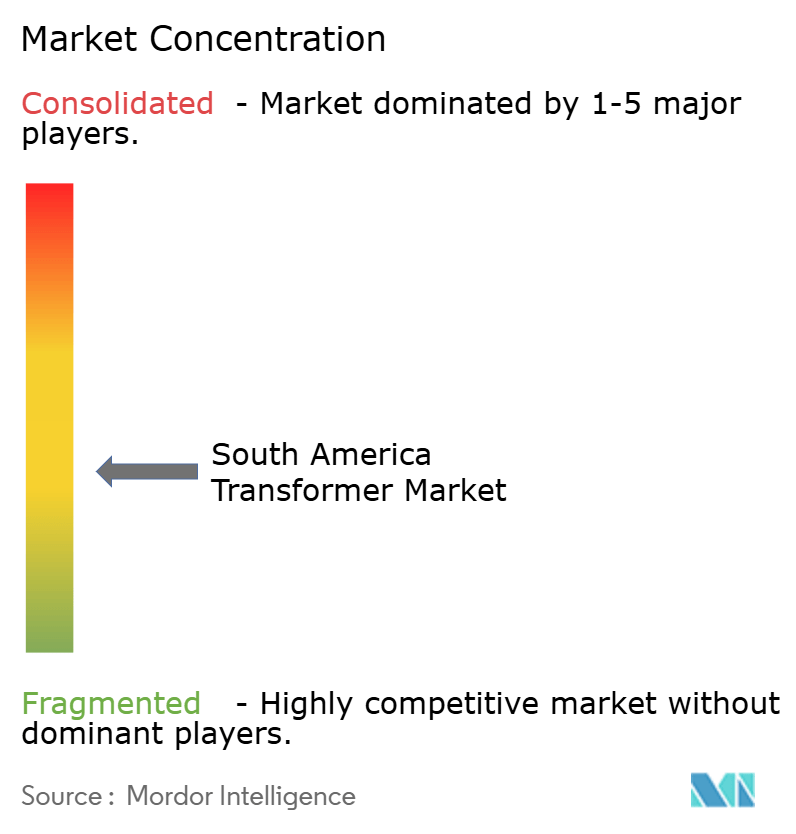
| Market Concentration | Medium |
Major Players *Disclaimer: Major Players sorted in no particular order |
South America Transformer Market Analysis by Mordor Intelligence
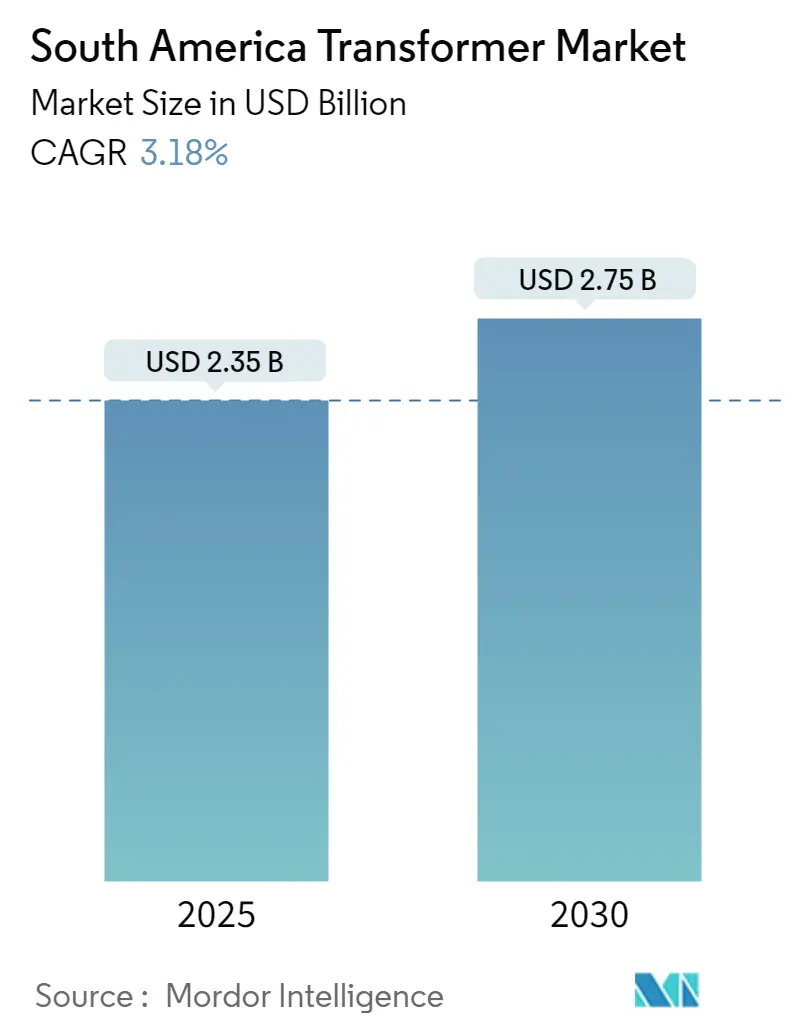
The South America Transformer Market size is estimated at USD 2.35 billion in 2025, and is expected to reach USD 2.75 billion by 2030, at a CAGR of 3.18% during the forecast period (2025-2030).
- Over the long term, factors such as growing power demand in line with the increasing population, a global inclination toward renewable-based power generation, and related adjustments in the transmission infrastructure are expected to drive the transformers market in South America during the forecast period.
- On the other hand, challenges like high initial cost and lack of investor confidence due to the fragility of the sociopolitical equilibrium of the region are expected to restrain the inflow of investments in the T&D sector. This may negatively impact the region's demand for transformers (especially power transformers) during the forecast period.
- Nevertheless, technological developments, such as smart transformers for smart grids, have opened up new potential for transformer company operations. It is expected to create ample opportunities for market players in the coming years.
- Brazil is expected to witness significant growth in the South American transformer market during the forecast period.
South America Transformer Market Trends and Insights
Air-cooled Segment is Expected to Dominate the Market during the Forecast Period
- A dry-type transformer or air-cooled transformer is a type of transformer that uses air as a coolant. A dry-type transformer has no moving parts and is a static device that uses eco-friendly temperature insulation systems. The dry-type transformer is more eco-friendly compared to the oil-filled type transformer. It is less flammable and poses a lesser fire risk. It is employed in various applications, including high-rise buildings, airports, stadiums, hotels, shopping malls, chemical and refinery plants, substations for interior cities, rural areas, and residential complexes.
- The ongoing industrialization in South America in countries like Argentina and Brazil is a crucial driver for the air-cooled transformers market. As industries expand and diversify, the demand for reliable and robust electrical systems is likely to increase. Air-cooled transformers, with their ability to efficiently handle varying loads and environmental conditions, are well-suited to meet the challenges posed by industrial applications.
- Government initiatives to promote energy efficiency and sustainability have been a major factor in the growth of the air-cooled energy transformer market. Manufacturers have been striving to improve the efficiency and performance of their transformers, leading to a surge in technological innovation.
- This industrial growth, coupled with the development of smart grids and renewable energy projects, is expected to boost the market for air-cooled transformers in the region. For instance, in August 2023, GE Vernova announced that its subsidiary Grid Solutions had signed a contract with Casa dos Ventos for the construction of two 500 kV air-insulated substations (AIS) for the Serra do Tigre Wind Complex located in the municipalities of Sao Tome and Currais Novos in the state of Rio Grande do Norte.
- For instance, in November 2023, Atlas Renewable Energy announced that the company had secured USD 447.8 million from the Brazilian Development Bank (BNDES) to develop a 902MW single-phase project in Brazil.
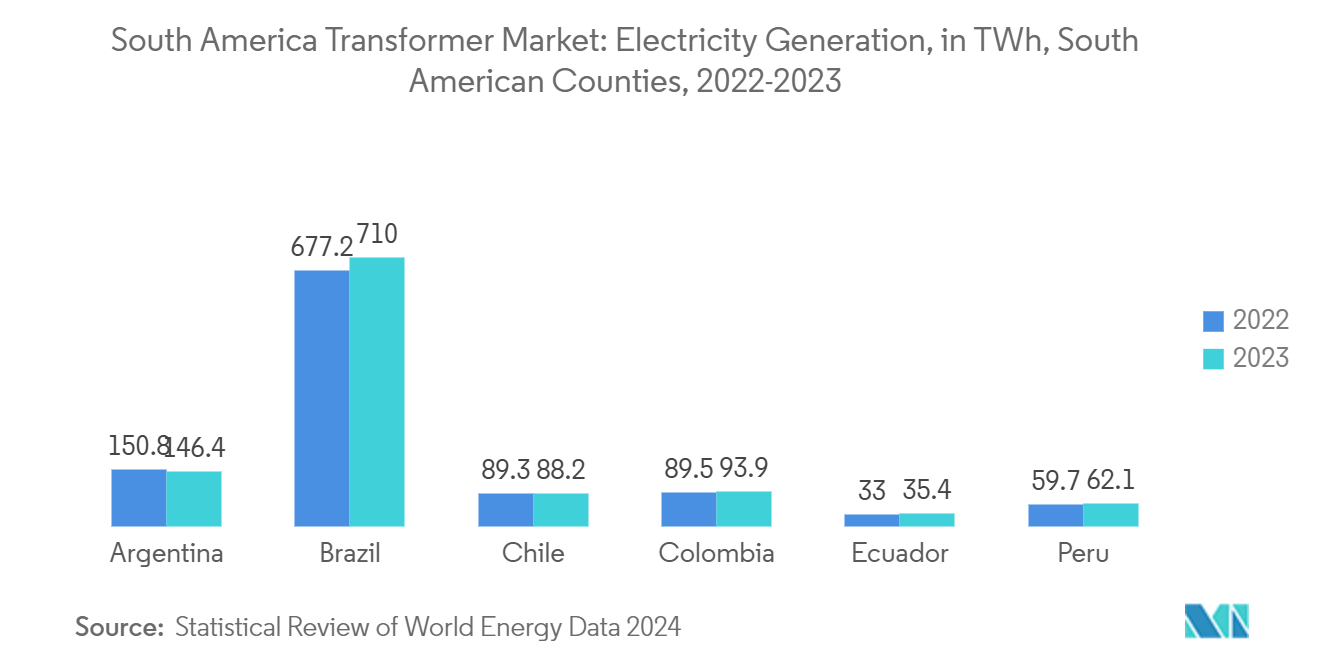
- According to the Statistical Review of World Energy Data, in South America, the share of electricity generation increased by 4.9% in 2023 compared to 2022. In 2023, Brazil topped the charts in South America, generating a robust 710 terawatt-hours of electricity. Following closely, Argentina secured the second spot, producing nearly 146.4 terawatt-hours.
- The demand for dry-type transformers over the past years has been driven by the increasing demand for electricity on account of urbanization and industrialization, coupled with the low daily maintenance cost of dry-type transformers, especially in countries like Brazil, Colombia, Ecuador, and Chile.
- Overall, the demand for air-cooled transformers is expected to increase during the forecast period as the need for power T&D infrastructure increases in South America, coupled with the advantages of the air-cooled transformer to be used in commercial and residential places without many hazards and environmental damage.
Brazil is Expected to Witness Significant Growth during the Forecast Period
- Brazil is the largest energy consumer in South America. Like Argentina, the country's energy sector mainly relies on thermal power plants (including oil, natural gas, and coal). According to the Statistical Review of World Energy, in 2023, nearly 50.3% of the total energy consumed in Brazil was generated from thermal power plants, while the rest was generated through nuclear and renewable.
- Transportation and industry are the two most significant sectors that account for 75% of final energy consumption in Brazil. According to the International Energy Agency (IEA), in the Stated Policies Scenario (STEPS), the country is expected to witness 30% growth in energy consumption by 2050, with most demand coming from the industries.
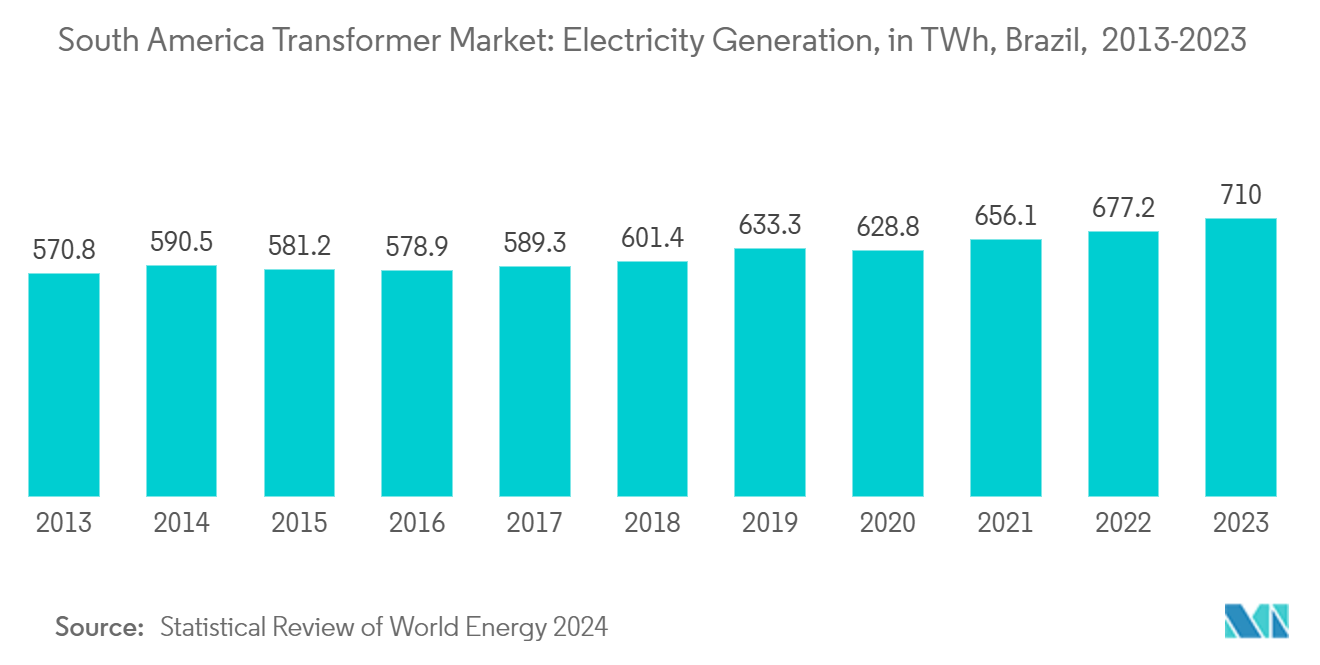
- In 2023, the country had more than 150 GW of power generating capacity, which generated nearly 710.0 terawatt-hours (TWh) of electricity. Hydroelectric was the most utilized sector in the country, generating nearly 64% of the total electricity in 2023. Among the other sectors, renewable generated around 28.6% of the electricity, while the rest was generated from thermal and nuclear power plants.
- Growth in generation capacity is likely to increase investment in transmission and distribution grid infrastructure. Under the 10-year expansion plan (PDE 2029) published by the Brazilian Energy Research Agency (EPE), the country is expected to invest around USD 20 billion in the electricity transmission sector until 2029. Out of the total investment, nearly USD 14 billion will be in the transmission lines, while the remaining is expected to be in the substations.
- In July 2023, Engie was selected to build more than 1,000 km of power transmission lines in the country. The company received a 30-year concession to design, construct, and offer operations and maintenance of the transmission lines in the states of Bahia, Minas Gerais, and Espírito Santo. The estimated investment of the project would be around USD 557 million.
- The Brazilian Ministry of Mines and Energy also initiated a public consultation on the Ten-Year Energy Expansion Plan 2031, which foresees the investment of USD 97 billion in the electricity sector over 2021-2031, including USD 54 billion in centralized generation, USD 25 billion in distributed generation, and USD 19 billion in transmission.
- Brazilian renewable energy firms are inaugurating photovoltaic plants, bolstered by agreements for self-production. These investments bolster the solar power sector and align with Brazil's broader renewable energy and sustainability objectives. The increased capacity from these plants contributes significantly to the country's energy mix, reducing reliance on non-renewable sources and promoting environmental sustainability.
- For instance, in July 2024, Elera Renováveis is set to supply 48 MW from its expansive 1.2-GWp Janauba solar complex to BRK, a leading sanitation firm. From 2025 to 2039, this agreement ensures an annual supply of 119,533 MWh, sufficient to energize around 57,000 homes annually. Operating on a self-production by equivalence model, BRK now holds a stake in the Janauba solar complex. Elera, under the umbrella of Brookfield Asset Management Inc., has been proactive in forging such partnerships. Elera previously inked a 15-year power purchase agreement (PPA) with Igua Saneamento, granting them 50 MW from the Janauba solar complex. With its impressive 1.2 GWp capacity, the Janauba solar complex is one of Brazil's largest. These strategic agreements ensure a steady supply of renewable energy and strengthen the financial viability and operational sustainability of the involved firms.
- Thus, such investments in transmission line projects are anticipated to create demand for transformers in Brazil in the upcoming years.
Competitive Landscape
The South American transformer market is semi-fragmented. Some of the major players in the market (in no particular order) include ABB Ltd, Siemens AG, General Electric Company, Toshiba Corporation, and Mitsubishi Electric Corporation.
South America Transformer Industry Leaders
-
ABB Ltd
-
General Electric Company
-
Toshiba Corporation
-
Siemens AG
-
Mitsubishi Electric Corporation
- *Disclaimer: Major Players sorted in no particular order
Recent Industry Developments
- January 2024: Eletrobras Furnas, one of the largest electric power companies in South America, acquired a set of power transformers from WEG. These transformers were intended to expand the West Zone Substation, one of the most important in Rio de Janeiro, Brazil. The supply includes a set of power transformers composed of three units of 300 MVA with 550kV/145KV and various materials and equipment for infrastructure, maneuvers, supervision, and implementation protection. This investment is expected to allow an additional increase of 900 MVA in the installed capacity of the substation, totaling 1800 MVA.
- November 2023: Hitachi Energy won an order to provide Taesa, one of Brazil's largest private electric energy transmission groups, with an extensive upgrade of the Garabi high-voltage direct current (HVDC) converter station in Brazil. The link can transmit up to 2,200 megawatts of electricity. The Garabi converter station enables power exchange between Argentina and Brazil, which is usually impossible as Argentina's power system operates at 50 Hz, and Brazil's operates at 60 Hz.
South America Transformer Market Report Scope
A transformer is a device that transfers electric energy from one alternating-current circuit to one or more other circuits, either increasing (stepping up) or reducing (stepping down) the voltage. Transformers are employed for varying purposes, like reducing the voltage of conventional power circuits to operate low-voltage devices, such as doorbells and toy electric trains, and raising the voltage from electric generators so that electric power can be transmitted over long distances.
The South American transformer market is segmented by power rating, cooling type, transformer type, and geography. By power rating, the market is segmented into large, medium, and small. By cooling type, the market is segmented into air-cooled and oil-cooled. By transformer type, the market is segmented into power transformer and distribution transformer. The report also covers the market size and forecasts for the transformer market across major countries in South America. The market sizing and forecasts were made for each segment based on revenue (USD).
| Large |
| Medium |
| Small |
| Air Cooled |
| Oil Cooled |
| Single Phase |
| Three Phase |
| Power Transformer |
| Distribution Transformer |
| Argentina |
| Brazil |
| Chile |
| Colombia |
| Rest of South America |
| By Power Rating | Large |
| Medium | |
| Small | |
| By Cooling Type | Air Cooled |
| Oil Cooled | |
| By Phase | Single Phase |
| Three Phase | |
| By Transformer Type | Power Transformer |
| Distribution Transformer | |
| By Geography | Argentina |
| Brazil | |
| Chile | |
| Colombia | |
| Rest of South America |
Key Questions Answered in the Report
How big is the South America Transformer Market?
The South America Transformer Market size is expected to reach USD 2.35 billion in 2025 and grow at a CAGR of 3.18% to reach USD 2.75 billion by 2030.
What is the current South America Transformer Market size?
In 2025, the South America Transformer Market size is expected to reach USD 2.35 billion.
Who are the key players in South America Transformer Market?
ABB Ltd, General Electric Company, Toshiba Corporation, Siemens AG and Mitsubishi Electric Corporation are the major companies operating in the South America Transformer Market.
What years does this South America Transformer Market cover, and what was the market size in 2024?
In 2024, the South America Transformer Market size was estimated at USD 2.28 billion. The report covers the South America Transformer Market historical market size for years: 2019, 2020, 2021, 2022, 2023 and 2024. The report also forecasts the South America Transformer Market size for years: 2025, 2026, 2027, 2028, 2029 and 2030.
South America Transformer Market Report
Statistics for the 2025 South America Transformer market share, size and revenue growth rate, created by Mordor Intelligence™ Industry Reports. South America Transformer analysis includes a market forecast outlook for 2025 to 2030 and historical overview. Get a sample of this industry analysis as a free report PDF download.