
Market Overview
| Study Period | 2020 - 2031 |
|---|---|
| Forecast Data Period | 2026 - 2031 |
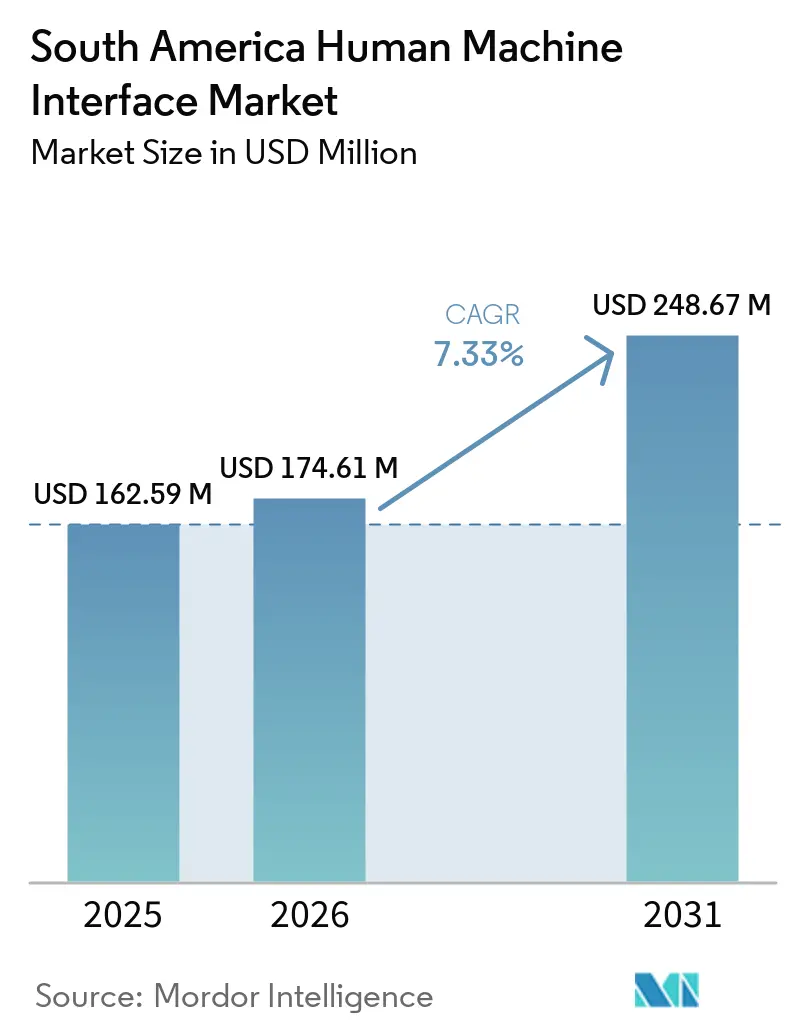
| Base Year Market Size (2025) | USD 162.59 Million |
| Market Size (2026) | USD 174.61 Million |
| Market Size (2031) | USD 248.67 Million |
| Growth Rate (2026 - 2031) | 7.33 % |
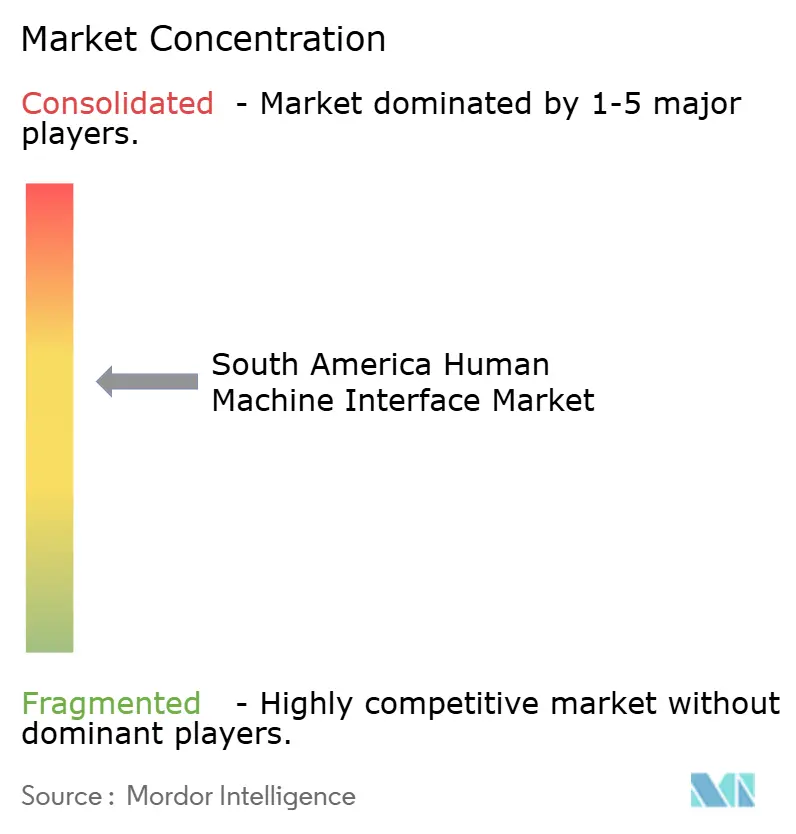
| Market Concentration | Medium |
Major Players *Disclaimer: Major Players sorted in no particular order Image © Mordor Intelligence. Reuse requires attribution under CC BY 4.0. | |
South America Human Machine Interface Market Analysis by Mordor Intelligence
The South America human machine interface market was valued at USD 162.59 billion in 2025 and is forecast to reach USD 248.67 billion by 2031, advancing at a CAGR of 7.33% from 2026 to 2031. Demand is tied to the region's resource industries, food processing base, and expanding manufacturing operations. Remote mines, offshore assets, and dispersed industrial sites increase the value of interfaces that support centralized monitoring and remote access. Replacement spending is occurring alongside new investment in software-defined automation, which lets operators separate interface functions from proprietary hardware. Compliance requirements in pharmaceutical production are also making validated software and audit trails more important in purchasing decisions. Companies that combine panel hardware, software, engineering services, and local support are better placed to serve both replacement projects and new facilities.
Key Report Takeaways
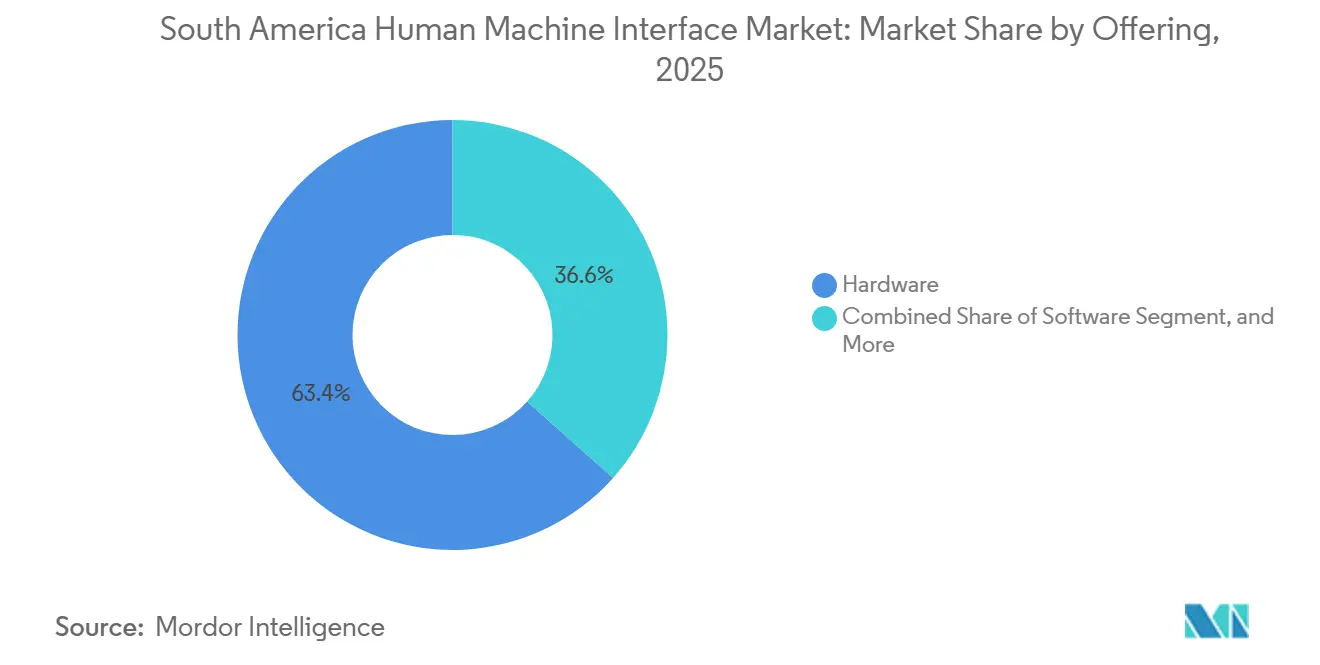
- By offering, hardware held 63.42% of the South America human machine interface market share in 2025, while software is projected to expand at a 7.92% CAGR through 2031.
- By interface technology, touchscreen technology held 59.38% revenue share in 2025, while AR/VR-assisted interfaces are projected to expand at an 8.31% CAGR through 2031.
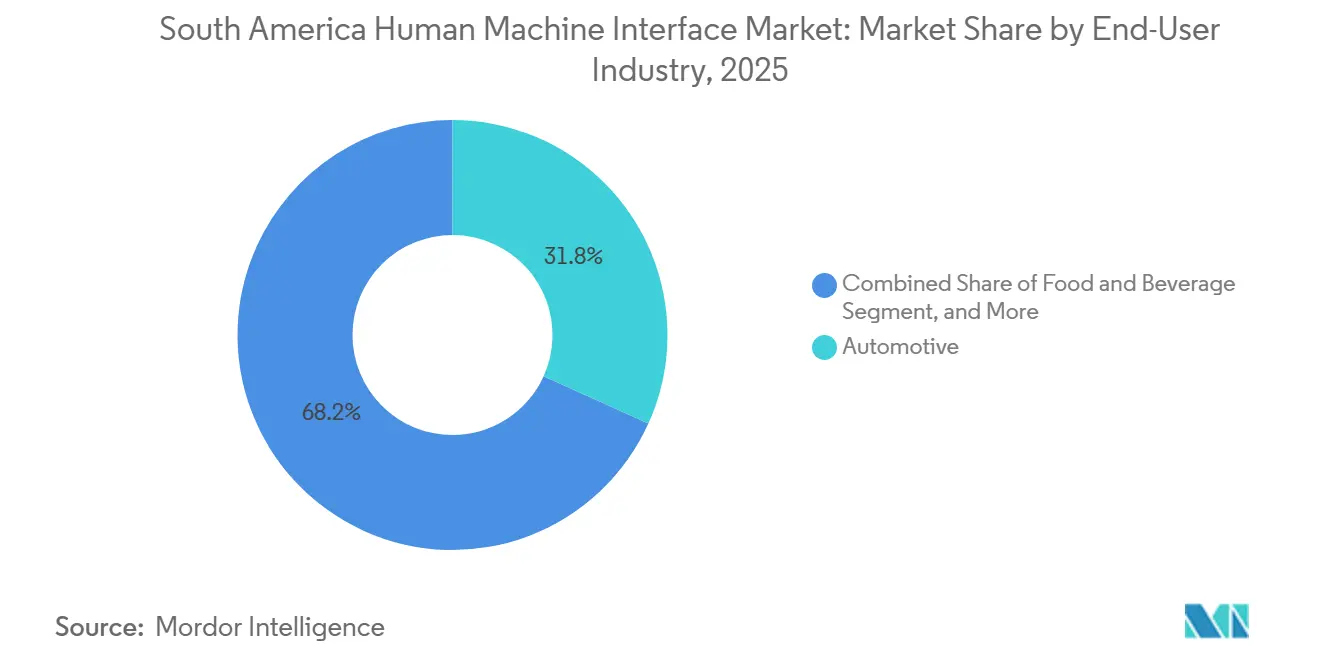
- By end-user industry, automotive held 31.76% revenue share in 2025, while pharmaceuticals are projected to expand at a 9.28% CAGR through 2031 in the South America human machine interface market.
- By configuration, embedded HMIs held a 51.16% revenue share in 2025, while distributed and remote HMIs are projected to expand at a 7.93% CAGR through 2031.
- By geography, Brazil held 54.69% revenue share in 2025, while Colombia is projected to expand at an 8.14% CAGR through 2031 in the South America human machine interface market.
Note: Market size and forecast figures in this report are generated using Mordor Intelligence’s proprietary estimation framework, updated with the latest available data and insights as of January 2026.
South America Human Machine Interface Market Trends and Insights
Drivers Impact Analysis*
| Driver | (~) % Impact on CAGR Forecast | Geographic Relevance | Impact Timeline |
|---|---|---|---|
| Industry 4.0 Adoption Across Manufacturing and Process Industries | +2.0% | Global, with concentrated pull in Brazil and Argentina | Medium term (2-4 years) |
| Replacement of Legacy HMI and Control Systems | +1.7% | Brazil and Argentina, with aging 2008-2015 installed base | Short term (≤ 2 years) |
| Expansion of Mining, Lithium, Oil and Gas Automation | +1.5% | Brazil, Argentina, Colombia, with spillover to Chile and Peru | Long term (≥ 4 years) |
| Growth of Industrial Digitalization and Remote Monitoring | +1.0% | Brazil as the primary market and Colombia as a secondary market | Medium term (2-4 years) |
| Increasing Demand for Ruggedized Interfaces in Harsh Environments | +0.5% | Brazil mining and offshore oil, and Argentina's Puna plateau | Medium term (2-4 years) |
| Localization of HMI Engineering and System-Integration Capabilities | +0.4% | Brazil and Colombia, with early gains in São Paulo and Bogotá | Long term (≥ 4 years) |
| Source: Mordor Intelligence | |||
Industry 4.0 Adoption Across Manufacturing and Process Industries
Brazilian manufacturers are moving from stand-alone equipment toward more connected production systems. In 2025, 74% of Brazilian industrial companies invested in new equipment, but connected production automation accounted for only 5% of total investment. The figure reached 7% among large companies, showing that adoption is more advanced in larger facilities. This leaves a broad group of mechanized plants that may add connected interfaces as they update equipment. The South America human machine interface (HMI) market benefits because an HMI often serves as the operator-facing layer for those projects. Initial interface deployments can also create demand for later investments in process data, digital twins, and predictive maintenance tools.
Brazil's Programa Brasil Mais Produtivo is supporting smart-factory digitalization through a BRL 56 million (USD 10.88 million) initiative administered with ABDI, BNDES, and SENAI. That program can widen access to first-time HMI deployments among mid-sized manufacturers. The South America human machine interface market also benefits from industrial tax measures that improve the return on automation purchases. Larger businesses can spread configuration and training costs across multiple sites, while smaller facilities often need simpler entry points. Vendors can respond with preconfigured packages for particular production lines and local technical support. This approach may make connected control systems more accessible without requiring a full redesign of a factory's existing equipment.
Replacement of Legacy HMI and Control Systems
Many industrial interface systems in the region were installed during the 2008-2015 commodity investment cycle. Equipment from that period is now within or beyond a standard 8-12-year replacement window. Replacement projects can therefore proceed even when a plant is not adding capacity. The South America human machine interface market gains from these upgrades because older panels and software may no longer meet current reliability, connectivity, or security requirements. Operators also face the risk that legacy components become difficult to maintain or recertify. A replacement decision is especially important where an interface controls continuous production or hazardous operations.
The timing of a migration can influence which supplier retains the customer relationship. A supplier that limits operational disruption during a platform change may secure follow-on work for the next replacement cycle. Rockwell Automation has maintained its FactoryTalk View installed base while presenting FactoryTalk Optix as a browser-accessible option for new and expanding projects.[1]Rockwell Automation, “8 Key Industrial Automation Trends in 2025,” Rockwell Automation, rockwellautomation.com The South America human machine interface market may see greater replacement activity from 2028 to 2030 as the 2010-2015 installation group reaches the end of life. Certification requirements for industrial electronics may also shorten some replacement cycles when older equipment cannot meet current qualification conditions. Planning upgrades as a budgeted reliability program can reduce the risk of an unplanned shutdown.
Expansion of Mining, Lithium, Oil and Gas Automation
Mining, lithium, oil, and gas projects require continuous monitoring of complex processes. Lithium brine operations in Argentina often take place in remote and demanding conditions, making it difficult to maintain a large on-site technical team. Direct lithium extraction systems require real-time data from pumping, treatment, and process control equipment. The South America human machine interface market serves these projects by bringing information from dispersed assets into control rooms and remote operator stations. Rugged hardware and reliable communications are important because downtime can affect production and worker safety. The same operational needs are present at offshore oil platforms and large mineral processing sites.
Rio Tinto's Rincón Project in Salta has a cumulative investment of above USD 2.5 billion and targets 60,000 tonnes of battery-grade lithium carbonate annually by 2028. Rockwell Automation supplied systems for the project's control room and pumping facilities. Petrobras' 2026-2030 Business Plan commits USD 109 billion in total capital expenditure, with digital transformation and automation identified as operational efficiency levers.[2]Petrobras, “Plano Estratégico Petrobras 2026-2030,” Petrobras, petrobras.com.br These investments support demand for interfaces capable of managing data from geographically separated process units. The South America human machine interface market presents an opportunity for a single remote console to reduce the need for physical travel and enable faster response to operating issues. Vendors also need to design systems for harsh environments and provide service coverage that matches project locations.
Growth of Industrial Digitalization and Remote Monitoring
IIoT platforms and HMI software are becoming increasingly integrated in industrial monitoring. This shift is particularly relevant in South America because operations are often spread across large distances. Remote access can help a central engineering team support sites without permanent specialists. The South America human machine interface market is therefore moving beyond local visualization toward interfaces that share data across plants, control rooms, and maintenance teams. Connected-worker tools and AR applications can guide staff through diagnostics when specialized expertise is located elsewhere. These systems can also support maintenance planning by providing operators with real-time access to equipment status.
Rockwell Automation identifies smart HMIs, AR, and connected-worker technologies as important layers in industrial automation. Elipse Plant Manager version 7.0 added an MCP connector in 2026, allowing users to query process information through natural-language prompts. In pharmaceutical facilities, validated computerized systems and demonstrable data integrity make audit-trail capabilities a material factor in interface selection. The South America human machine interface market can benefit as plants establish the connectivity needed for predictive maintenance and anomaly detection. A well-designed remote architecture also creates a record of process activity that can support internal reviews and regulated production requirements.
Restraints Impact Analysis*
| Restraint | (~) % Impact on CAGR Forecast | Geographic Relevance | Impact Timeline |
|---|---|---|---|
| High Initial Investment and Skilled-Operator Shortages | -1.3% | Region-wide, most acute in SMEs across Brazil, Argentina, and Colombia | Medium term (2-4 years) |
| Cybersecurity Exposure Across Connected Operational Technology | -0.9% | Brazil and Colombia, with spillover to Argentina | Long term (≥ 4 years) |
| Currency Volatility and Imported-Component Cost Exposure | -0.7% | Argentina peso volatility and Brazil BRL to USD exposure | Medium term (2-4 years) |
| Import Certification Delays and Non-Harmonized Compliance Requirements | -0.6% | Brazil, Argentina, and national requirements affecting São Paulo and Buenos Aires | Medium term (2-4 years) |
| Source: Mordor Intelligence | |||
High Initial Investment and Skilled-Operator Shortages
Upfront cost remains a significant barrier for many South American manufacturers. Ruggedized panels, industrial PCs, software licenses, and systems integration can require a large initial commitment. Smaller firms also need to account for training, configuration, and support costs. In 2025, 61% of Brazilian industrial companies identified economic uncertainty as their main barrier to equipment investment. The same survey found that 43% identified skilled-labor shortages as a barrier. These conditions make technology acquisition and operator readiness part of the same purchase decision.
Large multinationals and state-linked enterprises can more readily fund multi-site HMI projects. Many SMEs instead replace basic panels without moving to a connected architecture. This limits software adoption where recurring vendor revenue depends on remote access, analytics, or advanced configuration tools. The South America human machine interface market may expand more evenly when suppliers offer sector-specific packages that combine hardware, simple software, and remote diagnostics. Standardized packages can reduce engineering time and improve the clarity of a project's expected return. Local training also remains important because the system's value depends on operators' ability to use and maintain the equipment effectively.
Cybersecurity Exposure Across Connected Operational Technology
Connected HMI systems increase the number of pathways through which an industrial operation can be exposed to cyber risk. A compromised interface can affect physical production processes as well as information systems. South American operators must navigate national rules that vary across jurisdictions, as the region lacks a harmonized operational technology framework comparable to the European Union's NIS2 Directive. The South America human machine interface market must therefore address security as part of system design, not as a later add-on. Access management, network segmentation, certificate controls, and secure software updates are becoming central requirements. Buyers may delay connected deployments if these protections are not clear.
Rockwell Automation notes that operational technology cybersecurity is a core requirement for connected industrial automation. A breach can require a production shutdown, resulting in costs that may exceed the expense of preventive controls. Elipse Software's December 2025 version 6.9 update included OPC UA certificate password protection and other reliability features. The South America human machine interface market will favor suppliers that integrate security functions into standard product updates and engineering practices. Industrial users will also need to align interface procurement with their broader operational technology governance and incident-response processes.
*Our forecasts treat driver/restraint impacts as directional, not additive. The impact forecasts reflect baseline growth, mix effects, and variable interactions.
Segment Analysis
By Offering: Software Expands While Hardware Anchors Revenue
Hardware accounted for 63.42% of the South America human machine interface market share in 2025. Panel interfaces remain central to machine-level control in automotive, food and beverage, and energy operations. Industrial PCs also support applications that require greater local computing capability. Hardware demand is sustained by embedded panel replacements and the need for equipment that operates reliably in plant environments. The installed base creates an ongoing requirement for compatible components, services, and upgrades. Hardware remains the most visible part of many automation purchases, even as customers place more emphasis on software capabilities.
Software is projected to advance at a 7.92% CAGR from 2026 to 2031. Visualization tools, configuration environments, analytics, and remote access support the South America human machine interface market size for software. Schneider Electric's partnership with Stefanini IHM focuses on software-defined automation that separates automation software from proprietary hardware. This model enables digital changes without requiring a complete replacement of the physical platform. Services such as commissioning, remote diagnostics, and lifecycle support constitute a third layer of offerings. Aging installations need these services to maintain reliable performance after the original hardware has been sold. Software suppliers can gain relevance where customers want interoperability across equipment from several vendors. ANVISA requirements for computerized-system validation also make software qualification important in Brazilian pharmaceutical production.



By Interface Technology: Touchscreen Leads While AR/VR-Assisted Systems Advance
Touchscreen technology accounted for 59.38% of the South America human-machine interface market share in 2025. It is used across automotive assembly, pharmaceutical manufacturing, process plants, and control-room applications. Its broad acceptance reflects familiar operation, flexible display layouts, and lower hardware costs over time. Touchscreen systems also allow a single device to present alarms, process diagrams, operating instructions, and maintenance information. These features make them suitable for many general industrial uses. The dominant position does not eliminate the need for physical buttons or keypads under certain operating conditions.
AR/VR-assisted interfaces are projected to advance at an 8.31% CAGR from 2026 to 2031. Mining sites in Colombia, lithium operations in Argentina, and offshore platforms in Brazil can use remote guidance when experts cannot easily reach the location. AR overlays may show equipment information while a field worker performs inspection or maintenance work. Rockwell Automation identifies AR and connected-worker tools as components of industrial digitalization. Voice-controlled and gesture-based interfaces remain emerging options, including in pharmaceutical cleanrooms, where hands-free interaction can support sterile processes. Push-button and keypad devices remain relevant in high-vibration and hazardous environments where moisture, dust, gloves, or metallic material can make capacitive touch operation less reliable. The South America human machine interface industry is therefore likely to use hybrid interfaces rather than adopt a single interaction method. Suppliers are refining touchscreen durability and response while developing remote and hands-free functions for specialized settings.
By End-User Industry: Automotive Holds the Largest Base and Pharmaceuticals Advance Fastest
Automotive captured 31.76% of the South America human machine interface market share in 2025. Brazil's vehicle manufacturing base supports demand for assembly-line control, machine monitoring, and production-quality interfaces. Electric vehicle production adds requirements for tighter process visibility in new manufacturing stages. Automation vendors also use industry events in São Paulo to present robotics, digital services, and lifecycle solutions for automotive and broader manufacturing users. Food and beverage processing and packaging drive demand for sanitary design, portion control, and plant automation. Together, these industries support continued spending on machine-level and line-level interfaces.
Pharmaceuticals are projected to advance at a 9.28% CAGR from 2026 to 2031. Brazil's RDC 658/2022 requires computerized-system validation across regulated GxP production environments. This requirement makes every HMI connected to a regulated process part of a broader validation and data-integrity program. Research on Brazilian pharmaceutical automation described pressure on producers to modernize as regulatory alignment with PIC/S standards develops. Argentina's ANMAT is following a similar approach to computerized system validation. Oil and gas, mining, energy and utilities, aerospace and defense, and semiconductors and electronics each have different operating requirements. Many of these sectors increasingly value remote monitoring because they operate across dispersed sites. The South America human machine interface market can serve them through rugged devices, hazardous-area equipment, and systems that can be updated without a permanent on-site engineering team.
By Configuration: Embedded HMI Maintains the Largest Base and Remote Models Scale
Embedded HMIs accounted for 51.16% of the South America human-machine interface market share in 2025. Machine builders and OEMs favor panel-and-controller architectures because they offer predictable equipment cost and integrated operation. Facilities also frequently replace embedded panels on a like-for-like basis before they are ready to change their operating model. This supports a large installed base in machinery, packaging, food processing, and utilities. Embedded systems can be a practical option where a local operator station is sufficient. They also provide a familiar upgrade route for plants that want to retain existing controller architectures.
Distributed and remote HMIs are projected to grow at a 7.93% CAGR from 2026 to 2031. Operations in remote basins, high-altitude extraction areas, and offshore sites support the South America human machine interface market size for this configuration. Argentina's lithium brine projects on the Puna plateau and Brazil's pre-salt platforms show why remote operation can become a basic requirement. FactoryTalk Optix supports browser-based HMI configuration and deployment from different locations. Stand-alone HMIs are used in applications where a dedicated interface is needed, but distributed access remains secondary. New projects from 2026 are more likely to specify browser-based and cloud-accessible functions at the design stage. Tighter requirements for industrial electronics may also accelerate the replacement of older embedded equipment where certification conditions change.
Geography Analysis
Brazil held 54.69% of the South America human machine interface market share in 2025. Its position reflects demand from automotive production, agribusiness processing, petrochemicals, offshore oil and gas, mining, and pharmaceuticals. This diversified industrial base can support interface demand even when a single sector slows. In 2025, 74% of Brazilian industrial firms invested in new equipment. Domestic machinery accounted for 48% of procurement, and imported machinery accounted for 47%, marking the first time domestic purchases exceeded imports since 2023. This pattern supports opportunities for local software firms, system integrators, distributors, and service providers. INMETRO requirements for industrial electronics can increase the qualification demands facing imported hardware while reinforcing the role of local technical support.
Colombia is projected to advance at an 8.14% CAGR from 2026 to 2031. Aging equipment in oil refining, thermal power, and mining is creating a replacement cycle alongside investment in IIoT-enabled systems. The South America human machine interface market in Colombia also includes retrofits from proprietary installations to more distributed and cloud-accessible SCADA environments. Argentina presents a different demand pattern through lithium brine development on the Puna plateau. Its high-altitude sites require reliable platforms that can operate with limited on-site support. The Rincón project demonstrates the scale of demand for automation that can result from investment in battery materials.[3]Emede Electric, “Rockwell Automation, Salas de Control para Rio Tinto Proyecto Rincón, Salta,” Emede Electric, emede-electric.com Currency volatility can raise the cost of imported components, which may support local software and engineering firms that can price services in local currency.
The Rest of South America includes Chile, Peru, Ecuador, Bolivia, and other countries with demand centered on mining, energy, and agribusiness. Chile's large copper sector is using advanced analytics and intelligent process monitoring to improve safety and operational continuity at mining operations. Peru's polymetallic mines and Ecuador's hydrocarbon facilities use hazardous-area equipment, including explosion-proof panels. Bolivia's lithium development is at an earlier stage and may create longer-term automation requirements as extraction capacity develops. Vendors need Spanish and Portuguese interfaces, local service coverage, and subregional distribution partners to address these markets effectively.
Competitive Landscape
The South America human machine interface market is moderately concentrated. Siemens, Rockwell Automation, Schneider Electric, ABB, Honeywell, and Mitsubishi Electric compete in large process and factory automation projects. These companies combine HMI hardware, SCADA software, engineering, and lifecycle services in integrated offerings. Their installed bases create advantages when customers need compatible upgrades and long-term technical support. Regulatory requirements can also favor platforms with audit trails and validation capabilities in pharmaceutical and other regulated-process applications. The South America human machine interface market remains open to regional specialists and Asian-origin suppliers where price, local service, or a focused application matters more than a broad automation platform.
ABB introduced its Automation Extended program in February 2026 to support the continuous modernization of distributed control systems without production interruption. The program uses System 800xA, Symphony Plus, and ABB Freelance platforms. Schneider Electric and Stefanini IHM signed a memorandum of understanding in April 2026 to support open, software-defined automation in Brazil. This move is intended to separate automation software from proprietary hardware and reduce dependence on legacy systems. Elipse Software launched Elipse Plant Manager version 7.0 in 2026, featuring an MCP connector for natural-language queries about process information. These actions show that modernization, open architectures, and easier access to operating data are becoming important competitive themes.
Regional engineering depth is important because projects frequently require Portuguese or Spanish support, site-specific design, and familiarity with local compliance procedures. Elipse Software has a long-established installed base in the energy, infrastructure, and process industries, giving it a path to compete for higher-value software work. Asian-origin suppliers such as Advantech, Weintek Labs, Delta Electronics, and Beijer Electronics are active in cost-sensitive machine-builder and SME applications. Their lower hardware cost can be attractive when platform integration is not the main buying criterion. Global suppliers can respond by pairing broad technology portfolios with local integrators and more accessible implementation models. The South America human machine interface industry is likely to reward suppliers that can support legacy migrations while giving customers flexibility in future software choices.
South America Human Machine Interface Industry Leaders
Siemens AG
Schneider Electric SE
Rockwell Automation, Inc.
ABB Ltd
Honeywell International Inc.
- *Disclaimer: Major Players sorted in no particular order

Recent Industry Developments
- August 2026: ABB confirmed participation in EXPOSIBRAM 2026 in Belo Horizonte from August 24-27, presenting automation, digitalization, and electrification solutions targeting operational cost reduction and efficiency. ABB introduced predictive-fault technology capabilities not yet deployed by Brazilian miners at scale and sought to expand penetration in the critical minerals sector, where South America's lithium, copper, and iron ore industries represent a growing addressable market for advanced automation platforms.
- July 2026: Beckhoff Automation's Next Multi-touch Panel Generation HMI platform won the Red Dot Award 2026, an internationally recognized industrial design honor. The recognition validated Beckhoff Brazil's strategy of positioning its multi-touch panels as productivity-enhancing operator interfaces, reinforcing the brand's premium positioning in South America's growing factory automation segment.
- June 2026: Brazil's ANVISA updated its IVD device registration technical guidance on June 27, 2026, introducing cloud LIMS data access as an alternative to on-site performance verification, with updated data interfaces required to comply with HL7 FHIR R4 standards. The change shortens registration cycles for manufacturers with certified cloud platforms and sets a precedent for digital interface standardization in regulatory submissions, with direct implications for HMI-adjacent pharmaceutical automation equipment seeking ANVISA market authorization.
- May 2026: ABB Robotics exhibited at FEIMEC 2026 in São Paulo, presenting integrated robotics, digital services, and lifecycle automation solutions for the Brazilian industrial market. ABB positioned its South America cluster strategy, spanning Brazil, Argentina, and Chile, around accessible, scalable automation aligned with diverse modernization needs of Brazilian manufacturing clients.


South America Human Machine Interface Market Report Scope
The South America Human Machine Interface (HMI) Market comprises hardware, software, and services that enable interaction and communication between human operators and machines, equipment, industrial systems, and automated processes. HMI solutions allow users to monitor, control, configure, and visualize machine and process operations through graphical, touch, physical-control, gesture, voice, and immersive interfaces. The market includes HMI technologies used to improve operational visibility, equipment control, process efficiency, safety, and human-machine interaction across industrial and commercial applications.
The South America Human Machine Interface Market is Segmented by Offering (Hardware, Software, and Services), Interface Technology (Touchscreen, Push-button/Keypad, Gesture-based, Voice-controlled, and AR/VR-assisted), End-User Industry (Automotive, Food and Beverage, Packaging, Pharmaceutical, Oil and Gas, Metal and Mining, Energy and Utilities, Aerospace and Defense, Semiconductors and Electronics, and Other End Users), Configuration (Embedded HMI, Stand-alone HMI, and Distributed/Remote HMI), and Geography (Brazil, Argentina, Colombia, and Rest of South America). The Market Forecasts are Provided in Terms of Value (USD).
By Offering
| Hardware | HMI Panels |
| Industrial PCs | |
| Software | Configuration / Programming |
| Services |
By Interface Technology
| Touchscreen |
| Push-button / Keypad |
| Gesture-based |
| Voice-controlled |
| AR / VR-assisted |
By End-User Industry
| Automotive |
| Food and Beverage |
| Packaging |
| Pharmaceutical |
| Oil and Gas |
| Metal and Mining |
| Energy and Utilities |
| Aerospace and Defense |
| Semiconductors and Electronics |
| Other End Users |
By Configuration
| Embedded HMI |
| Stand-alone HMI |
| Distributed / Remote HMI |
By Geography
| Brazil |
| Argentina |
| Colombia |
| Rest of South America |
| By Offering | Hardware | HMI Panels |
| Industrial PCs | ||
| Software | Configuration / Programming | |
| Services | ||
| By Interface Technology | Touchscreen | |
| Push-button / Keypad | ||
| Gesture-based | ||
| Voice-controlled | ||
| AR / VR-assisted | ||
| By End-User Industry | Automotive | |
| Food and Beverage | ||
| Packaging | ||
| Pharmaceutical | ||
| Oil and Gas | ||
| Metal and Mining | ||
| Energy and Utilities | ||
| Aerospace and Defense | ||
| Semiconductors and Electronics | ||
| Other End Users | ||
| By Configuration | Embedded HMI | |
| Stand-alone HMI | ||
| Distributed / Remote HMI | ||
| By Geography | Brazil | |
| Argentina | ||
| Colombia | ||
| Rest of South America | ||


Key Questions Answered in the Report
What is the South America human machine interface market size?
The South America human machine interface market was valued at USD 162.59 billion in 2025 and is forecast to reach USD 248.67 billion by 2031, advancing at a 7.33% CAGR from 2026 to 2031.
Which offering holds the largest revenue base in South America?
Hardware held 63.42% revenue share in 2025, supported by panel interfaces and industrial PCs used across factory and process applications.
Which interface technology is expanding the fastest?
AR/VR-assisted interfaces are projected to advance at an 8.31% CAGR through 2031, supported by remote inspection and guided-maintenance applications.
Why are pharmaceutical applications expanding quickly?
Pharmaceuticals are projected to advance at a 9.28% CAGR through 2031 because validated computerized systems and data integrity are important in regulated production.
Which country leads regional demand?
Brazil held 54.69% revenue share in 2025 because of its broad base in automotive, agribusiness processing, mining, offshore oil and gas, and pharmaceuticals.
What configuration is best suited to remote industrial sites?
Distributed and remote HMI is projected to advance at a 7.93% CAGR through 2031 because remote mines, brine operations, and offshore facilities need centralized access and support.
Page last updated on:





