
Kenya Liquid Packaging Cartons Market Size and Share
Market Overview
| Study Period | 2021 - 2032 |
|---|---|
| Forecast Data Period | 2027 - 2032 |
| Base Year Market Size (2026) | USD 3.19 Million |
| Market Size (2027) | USD 3.41 Million |
| Market Size (2032) | USD 4.67 Million |
| Growth Rate (2027 - 2032) | 6.49 % |
| Market Concentration | Medium |
Major Players *Disclaimer: Major Players sorted in no particular order Image © Mordor Intelligence. Reuse requires attribution under CC BY 4.0. | |
Kenya Liquid Packaging Cartons Market Analysis by Mordor Intelligence
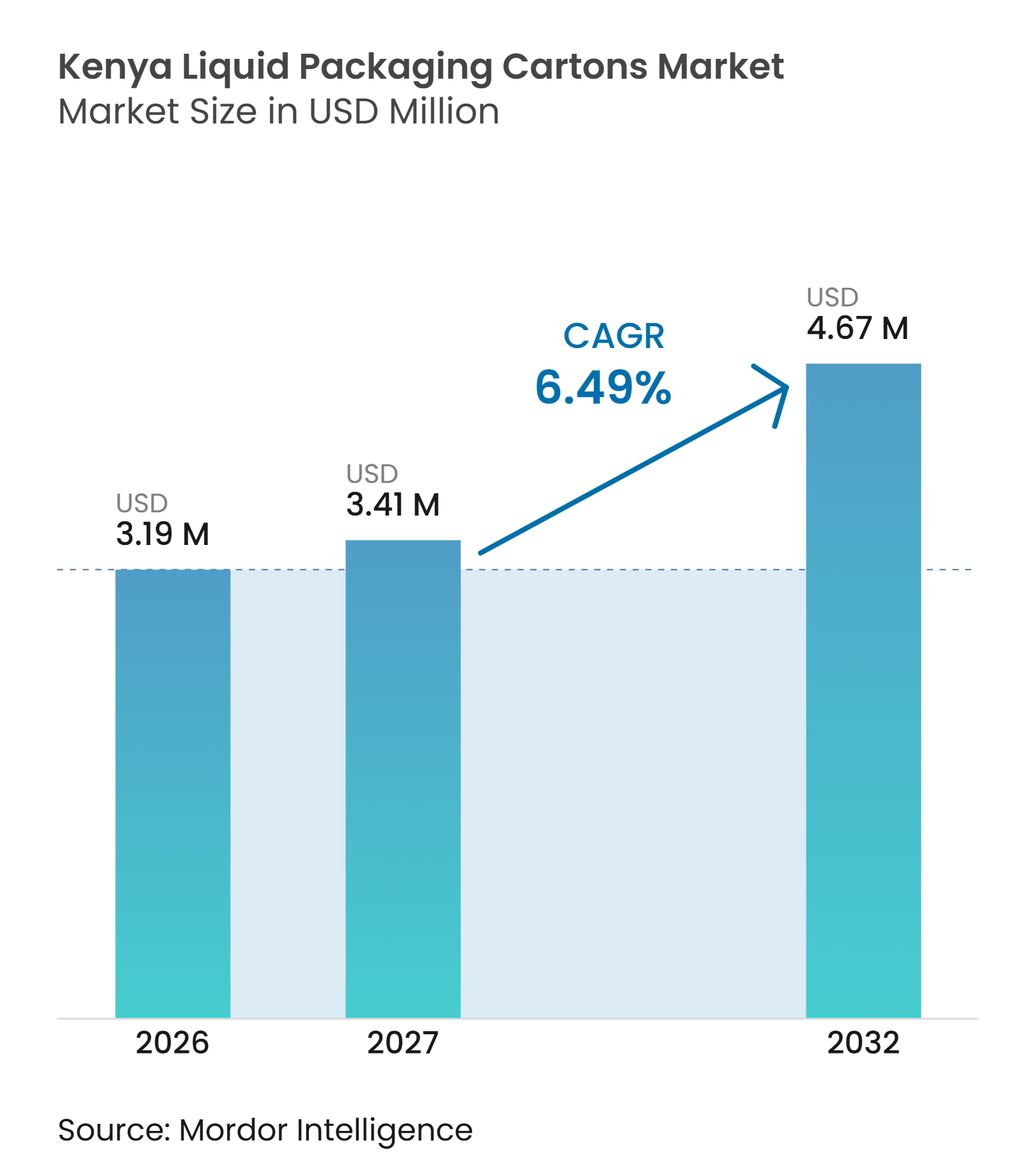
The Kenya Liquid Packaging Cartons Market size is projected to expand from USD 3.19 million in 2026 and USD 3.41 million in 2027 to USD 4.67 million by 2032, registering a CAGR of 6.49% between 2027 and 2032.
Kenya’s formal dairy system provides a stable base for the Kenya liquid packaging cartons market because packaged milk is a regular household purchase and an important input for tea consumption. Formal milk collection and processing are expanding, which brings more volume into channels that require regulated filling and distribution. Ambient carton formats allow processors to reach locations where refrigerated transport and retail storage remain limited. Local aseptic material production is expected to shorten supply lead times and reduce exposure to imported laminate costs. At the same time, informal milk sales, investment requirements for filling lines, and producer-responsibility obligations limit the speed of carton conversion.
Key Report Takeaways
- By product type, aseptic cartons held 85.09% of the Kenya liquid packaging cartons market share in 2026 and are projected to expand at a 6.76% CAGR through 2032.
- By application, milk accounted for 64.81% of total value in 2026, while plant-based beverages are projected to expand at a 7.81% CAGR through 2032 in the Kenya liquid packaging cartons market.
- By pack size, above-500 ml formats held 44.76% of the market share in 2026, while below-250 ml formats are projected to expand at a 7.06% CAGR through 2032.
Note: Market numbers in this report are based on Mordor Intelligence's proprietary estimation framework, which combines nine months of actuals with Q4 projections for base year 2026.
Market Trends and Insights
Drivers Impact Analysis of Kenya Liquid Packaging Cartons Market*
| Driver | (~) % Impact on CAGR Forecast | Geographic Relevance | Impact Timeline |
|---|---|---|---|
| Rising Formalization of Milk Processing and Retail Distribution | +2.1% | National, with early gains in Nairobi, Kiambu, and Rift Valley | Medium term (2-4 years) |
| Ambient UHT Distribution Reducing Cold-Chain Dependence | +1.5% | National, with strong uptake in Western Kenya and Coast | Long term (≥ 4 years) |
| Expansion of Smaller On-the-Go Juice and Beverage Packs | +0.9% | Urban centers, Nairobi, Mombasa, and Kisumu | Short term (≤ 2 years) |
| Late-2026 Local Aseptic-Packaging Capacity Addition | +0.7% | National, with spillover to East and Central Africa | Short term (≤ 2 years) |
| Carton Recovery Partnerships Improving Material Circularity | +0.4% | Nairobi and Thika urban recycling hubs | Medium term (2-4 years) |
| School Milk and Institutional Nutrition Programs Increasing Portion-Pack Demand | +0.3% | National, with early gains in ECDE-dense counties | Medium term (2-4 years) |
| Source: Mordor Intelligence | |||
Rising Formalization of Milk Processing and Retail Distribution
Kenya’s formal milk intake reached 1.01 billion liters in 2025, the highest annual volume recorded since the Kenya Dairy Board started collecting the series in 2001. The Kenya liquid packaging cartons market gains when milk moves from informal sales to regulated processing, because processors need controlled-filling formats for retail distribution, transport, shelf management, and traceability across retail channels. The Kenya Dairy Board and the International Livestock Research Institute are certifying smaller dairy businesses in Nakuru, Nyandarua, and Uasin Gishu through the MoreMilk 2 initiative. This program links producers to regulated markets, builds their operational capacity, and creates a clearer path from farm collection to processed products. Kenya Dairy Board licensing and food-safety requirements under the Dairy Industry Act favor formal processors that use compliant packaging systems.[1] The pace of certification will therefore shape how quickly the accessible demand base expands.
Ambient UHT Distribution Reducing Cold-Chain Dependence
Aseptic cartons support the Kenya liquid packaging cartons market by enabling UHT milk and beverages to be transported without refrigerated storage. This is important outside the Nairobi and Rift Valley corridors, where power reliability and cold-chain coverage can limit fresh dairy distribution. Bio Foods stated that UHT products account for 60% of modern-trade dairy sales in Kenya, underscoring the importance of ambient formats in organized retail. A cooperative with UHT processing and aseptic filling can distribute to distant counties without relying on refrigerated vehicles or refrigerated retail cabinets. Tetra Pak’s Nairobi hub serves 13 countries, demonstrating the regional reach possible through ambient supply chains. This distribution model makes packaged dairy more feasible in areas that would otherwise have limited access to long-life products and fewer choices for safely stored milk.
Expansion of Smaller On-the-Go Juice and Beverage Packs
Below-250 ml formats are projected to expand at a 7.06% CAGR through 2032 in the Kenya liquid packaging cartons market. Their demand is supported by school milk programs, urban travel patterns, and beverage brands serving younger buyers. Tetra Pak reports that school milk programs in Kenya use 200 ml aseptic packs because they do not require refrigeration, provide individual portions, and help reduce handling losses. County-funded programs provide a steadier source of demand than discretionary retail purchases because they are tied to planned education and nutrition budgets. The format also fits juice sales through transit locations, convenience outlets, and workplace cafeterias where buyers often need a finished serving. This combination supports smaller packs even when household spending conditions are uneven.
Late-2026 Local Aseptic-Packaging Capacity Addition
Texplast Industries Limited is expected to commission an aseptic packaging facility in late 2026 with USD 15 million from Norfund and a total investment of USD 30 million. The project introduces local production capacity for multilayer packaging used in UHT dairy, juices, flavored beverages, and liquid food. Local supply can reduce procurement lead times, which are longer for materials imported from Europe and Asia, thereby improving production planning for processors. It can also reduce working-capital pressure for mid-sized processors that currently need to hold more imported stock as a safeguard against delayed deliveries. Texplast’s recycling activity gives the project relevance within the country’s producer-responsibility framework. The new facility could strengthen price competition for packaging buyers in Kenya and neighboring markets.
Restraints Impact Analysis of Kenya Liquid Packaging Cartons Market*
| Restraint | (~) % Impact on CAGR Forecast | Geographic Relevance | Impact Timeline |
|---|---|---|---|
| Informal Milk Trade Limiting Addressable Formal Packaging Demand | -2.0% | National, strongest in rural counties, Nyandarua, Trans Nzoia, and Meru | Long term (≥ 4 years) |
| High Filling-Line and Validation Investment Requirements | -1.5% | National | Short term (≤ 2 years) |
| Competition from Plastic, Glass and Flexible Packaging | -1.1% | Urban centers and peri-urban markets, Nairobi, Mombasa, and Kisumu | Medium term (2-4 years) |
| Composite-Pack Recycling Economics and EPR Execution Risk | -0.5% | National, concentrated in collection-scarce counties | Medium term (2-4 years) |
| Source: Mordor Intelligence | |||
Informal Milk Trade Limits Formal Packaging Demand
Informal sales restrict the Kenya liquid packaging cartons market because a large share of milk still reaches buyers without formal processing or retail packaging. Formal intake reached 1.01 billion liters in 2025, but it remains well below Kenya’s total milk output, leaving processors with a limited supply base. Smallholder suppliers often prefer informal channels because payments can be faster and quality rejections are less likely. The MoreMilk 2 program is addressing this barrier by offering certification, capacity development, and a route into regulated markets. Progress will depend on whether the commercial benefit of formal sales outweighs the convenience of informal trade for farmers and traders. Until more producers move into compliant supply chains, a significant share of potential carton demand will remain inaccessible.
High Filling-Line and Validation Investment Requirements
Aseptic filling systems require considerable capital, commissioning work, validation, maintenance, imported spare parts, and trained technical staff. These requirements concentrate carton filling among larger dairy processors and can delay conversion by smaller licensed businesses with limited access to finance. The Kenya Dairy Board lists more than 30 active processors and 186 small processors, which indicates the large number of businesses that may face investment constraints. Bio Foods’ planned long-life UHT investment received development-finance support, indicating the financial scale of the transition even for an established processor. Flexible pouches and plastic bottles can remain attractive to smaller producers because their entry costs are lower and their equipment needs are less demanding. The resulting gap in filling capability limits the speed at which smaller processors can add carton volumes.
*Our forecasts treat driver/restraint impacts as directional, not additive. The impact forecasts reflect baseline growth, mix effects, and variable interactions.
Kenya Liquid Packaging Cartons Market Segment Analysis
By Product Type:
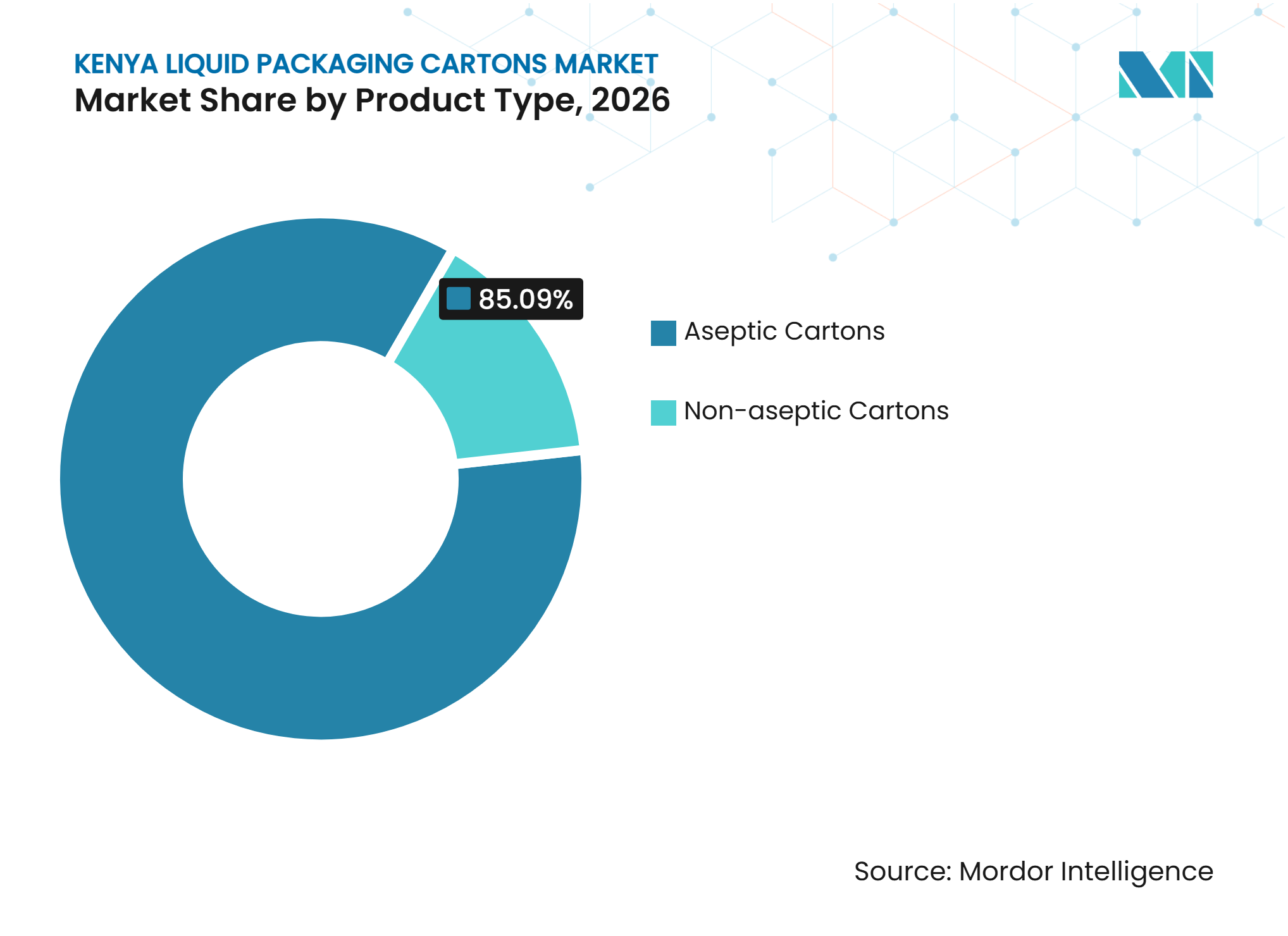
Aseptic Cartons Maintain Structural LeadershipAseptic cartons accounted for 85.09% of the total value in 2026 and are projected to grow at a 6.76% CAGR through 2032. Their lead reflects the need to distribute UHT milk, juices, and beverages beyond refrigerated retail networks. Aseptic-format demand benefits from the ability to supply Mombasa, Kisumu, and inland areas without continuous refrigeration. Ambient handling reduces losses and allows retailers with limited equipment to stock long-life liquid products. This model is particularly relevant where energy supply is unreliable. It also gives processors a route into locations where fresh products would have a narrow selling window.
Global carton suppliers are introducing aluminum-free barrier laminates that can provide oxygen protection without the conventional foil layer. SIG states that its aluminum-free full-barrier packs use a lower-carbon material design and are assessed through ISO-aligned life-cycle methods. This development can make recyclability easier to manage as packaging obligations become more important in Kenya. Non-aseptic gable-top cartons remain relevant in Nairobi and selected cities with reliable refrigerated retail. These formats are used for fresh pasteurized milk in 1-liter and 500 ml packs. Kenya Dairy Board quality controls provide a basis for compliance with demand wherever refrigerated distribution is available.



By Application:
Milk Supports Volume While Plant-Based Beverages AdvanceMilk accounted for 64.81% of total value in 2026. Its position rests on regular household consumption and Kenya’s established tea culture. Kenya Dairy Board reported per-capita milk consumption of 86.1 liters per year, which supports a large base for packaged dairy. Milk products also receive favorable tax treatment because milk is not subject to excise duty or VAT. This can help preserve demand through changes in broader consumer spending. Juice is the next important application and relies on ambient distribution to reach counties outside the capital.
Plant-based beverages are projected to expand at a 7.81% CAGR through 2032, making them the fastest-growing application. Brookside Dairy introduced an unsweetened oat milk product in January 2026, expanding carton use into dairy-free, lactose-free, and sugar-free choices. The offer targets consumers in Nairobi and Mombasa who seek alternatives to conventional dairy. Other applications include cream, flavored milk, liquid yogurt, energy drinks, and functional beverages. Liquid food, including soups, broths, and cooking cream, may serve food-service operators and urban households that value long shelf life. These categories diversify carton demand beyond conventional milk cycles.
By Pack Size:
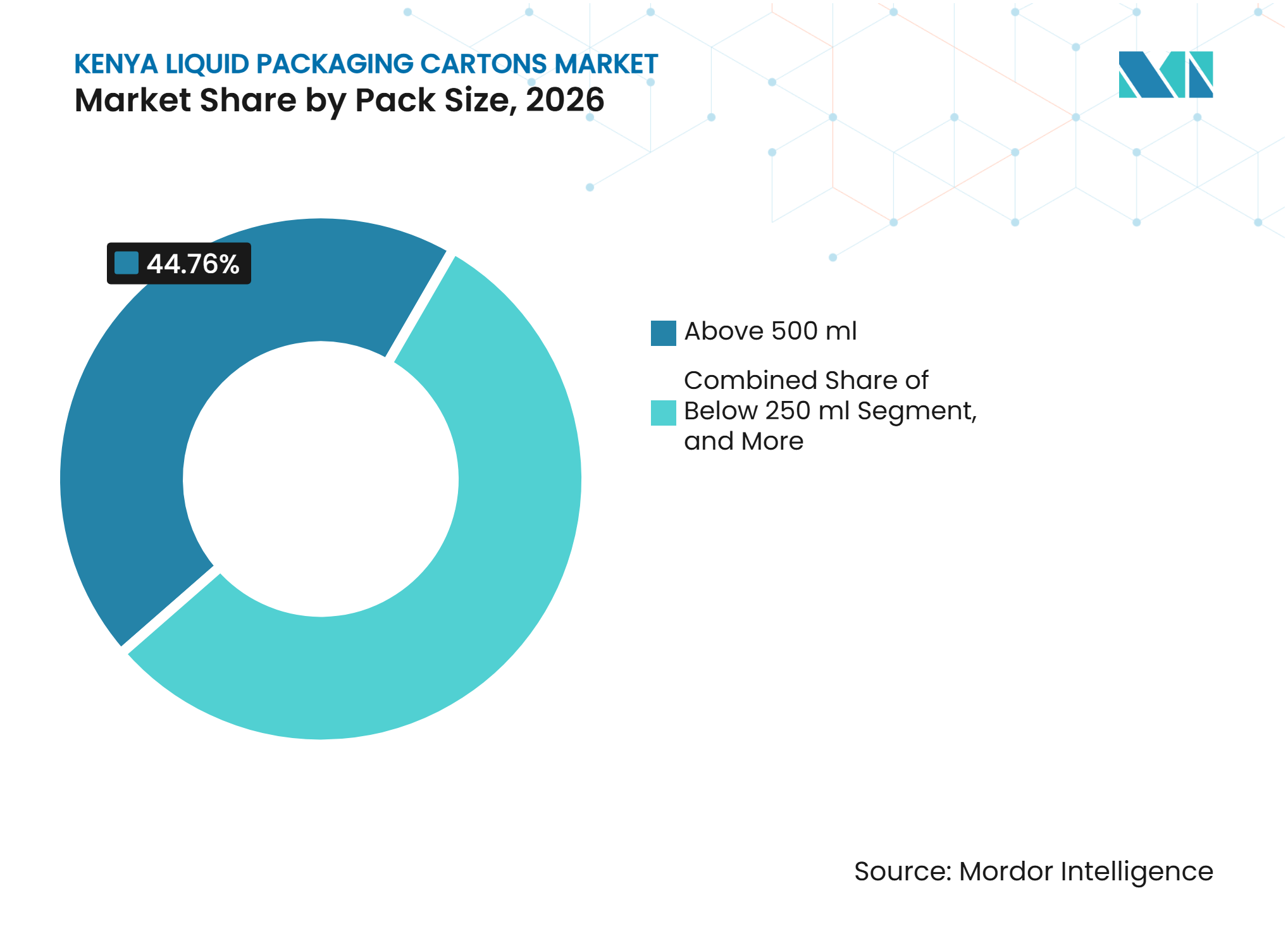
Larger Cartons Lead While Portion Packs Gain MomentumAbove-500 ml formats held 44.76% of total value in 2026. Their position reflects household bulk purchases and the broad availability of 1-liter UHT cartons in modern trade. Brookside, New KCC, and Githunguri Dairy distribute much of their UHT output in 500 ml and 1-liter formats. Retailers can store these products without refrigeration, including kiosks and dukas across the country. The 250-500 ml category occupies a middle ground between affordability and multi-use. It is well suited to juice purchases at petrol stations, transit points, and workplace cafeterias.
Below-250 ml packs are projected to expand at a 7.06% CAGR through 2032. School milk programs anchor volumes through institutional contracts rather than retail purchases alone. Tetra Pak reports that school programs have been extended across counties including Kilifi, Migori, Nakuru, West Pokot, and Baringo. This broader program base can provide stable demand for 200 ml cartons. The format also supports portion control and requires no cold storage. A wider shift from loose milk and sachets toward packaged UHT products can further support small and mid-size formats.

Geography Analysis
Nairobi Metropolitan Area
The Nairobi metropolitan area is the largest concentration zone for the Kenya liquid packaging cartons market because it combines formal retail, food service, and institutional buyers. Modern trade has a stronger presence in the capital corridor than in many other parts of the country. This supports demand for both aseptic and refrigerated gable-top cartons. Plant-based beverages have gained shelf space in upscale supermarkets, widening the range of liquid products packed in cartons. Brookside’s January 2026 oat milk launch illustrates the shift toward dairy-free options in urban retail. Nairobi school milk programs have also used 200 ml aseptic packs, which have created a repeatable model for institutional purchasing. Texplast’s expected local capacity gives processors in the corridor an earlier opportunity to shorten material supply cycles.
Rift Valley and Western Kenya
Rift Valley and Western Kenya form the main milk-production belt and are central to the long-term demand base. The region includes Trans Nzoia, Nyandarua, Uasin Gishu, Nakuru, Kisumu, and nearby counties. Formalization programs are active in several of these counties, connecting smaller suppliers with regulated dairy businesses. Tetra Pak, the United Nations Industrial Development Organization, Githunguri Dairy Farmers Co-operative Society, and the Kenya Dairy Board launched a dairy-farming program in May 2025. The initiative is supported by the Swedish International Development Cooperation Agency and aims to train more than 10,000 smallholder farmers. Higher formal milk deliveries can support additional demand for filling, while school milk programs create local demand for portion cartons.
Coastal and Inland Markets
Coastal and inland markets favor ambient cartons where heat, limited cold storage, and long transport routes make refrigerated products harder to handle. Mombasa has a ready-to-drink juice base that supports aseptic formats ranging from 200 ml to 500 ml. In Eastern Kenya, school milk participation has helped introduce packaged dairy in areas where habitual carton purchases were less established. Tetra Pak reported higher attendance and enrollment in participating schools in Meru, Embu, and Garissa, which gives county programs a broader social and commercial role. The Kenya Dairy Board coordinates the National School Milk Program with counties, while the Office of the First Lady has endorsed its expansion.[2] Kenya’s dairy and waste-management requirements also make safe filling, collection systems, and producer compliance more relevant as ambient distribution expands.
Competitive Landscape
Market Concentration
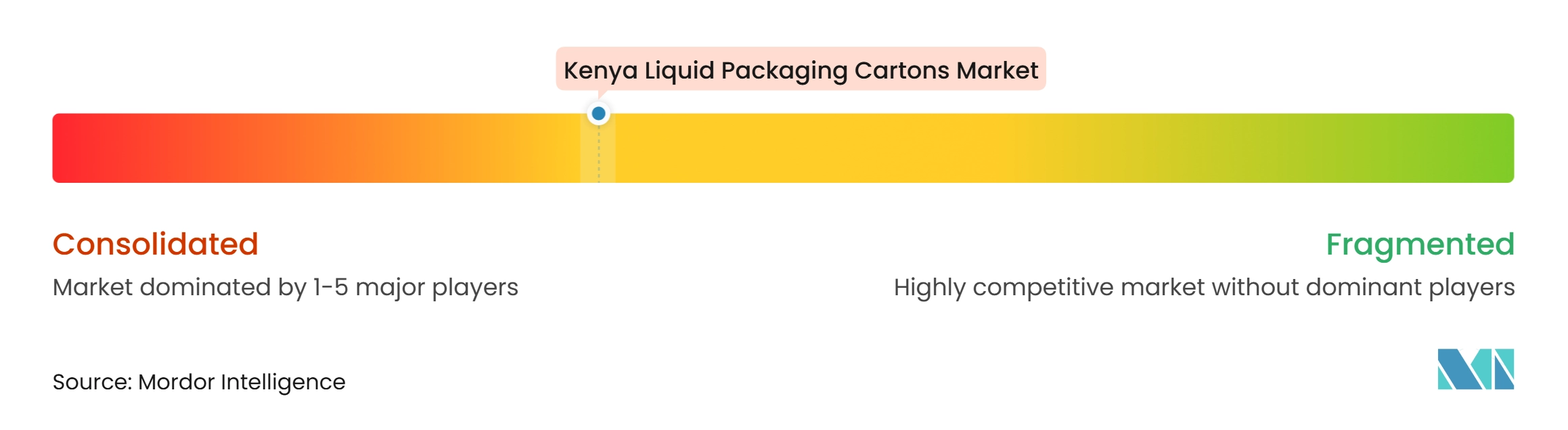
The Kenya liquid packaging cartons market is moderately concentrated among packaging suppliers but remains fragmented among dairy fillers. Tetra Pak East Africa holds the strongest established supply position through its Nairobi hub and relationships with milk processors. The company’s hub serves 13 countries, giving it regional operating scale. SIG Group, Elopak, Greatview Aseptic Packaging, and IPI supply or compete for carton demand through imported materials and equipment systems. Their competitive position depends on lead time, laminate design, filling technology, and service support. Elopak reported 7.9% year-over-year growth in EMEA carton and closure revenue in the second quarter of 2026, indicating continued activity in the region.[3]
Elopak and Nampak Southern Africa Holdings received unconditional approval from the Competition Authority of Kenya to form a joint venture to supply local liquid cartons. The parties plan to begin with carton imports and subsequently establish local converting capability. Texplast’s late-2026 facility is another significant move because it may introduce local aseptic laminate capacity. Tetra Pak and PAKPRO also launched a recovery project for post-consumer liquid-board packaging. These efforts show that local material access and recovery arrangements are becoming part of competitive positioning.
Mid-tier suppliers, including Techpak Industries Limited, Nampak Kenya, and Agri Pro-Pak, compete through distribution reach and customer proximity. Flexible pouches remain a lower-cost substitute for smaller processors, although modern retailers often favor cartons for shelf stability and food-safety positioning. Filling-side competition includes processors such as Kinangop Dairy and Uplands Premium Dairies, which increasingly assess carton suppliers on recyclability and material availability. The National Environment Management Authority administers the Extended Producer Responsibility regulations under Legal Notice No. 176 of 2024. Producers and importers must register, establish take-back systems, and submit compliance reports. These obligations favor suppliers that can help customers address post-consumer collection. The Kenya liquid packaging cartons market is therefore moving toward competition based on operating support, price, and technology.
Kenya Liquid Packaging Cartons Industry Leaders
-
Tetra Pak East Africa Limited
-
Techpak Industries Limited
-
Nampak Kenya Limited
-
Texplast Industries Limited
-
Elopak AS
- *Disclaimer: Major Players sorted in no particular order
Kenya Liquid Packaging Cartons Market Companies Covered in this Report
- Tetra Pak East Africa Limited
- Techpak Industries Limited
- Nampak Kenya Limited
- Texplast Industries Limited
- Elopak AS
- SIG Group AG
- Greatview Aseptic Packaging Co., Ltd.
- IPI S.r.l.
- Pactiv Evergreen Inc.
- UFlex Limited
- Brookside Dairy Limited
- New Kenya Co-operative Creameries Limited
- Githunguri Dairy Farmers Co-operative Society Limited
- Coca-Cola Beverages Africa Kenya Limited
- Del Monte Kenya Limited
- Kevian Kenya Limited
- Bio Food Products Limited
- Kinangop Dairy Limited
- Uplands Premium Dairies Limited
- Agri Pro-Pak Limited
Recent Industry Developments in Kenya Liquid Packaging Cartons Market
- September 2026: Tetra Pak East Africa celebrated 70 years of operations in the region at a Nairobi event attended by Kenya's Cabinet Secretary for Investment, Trade and Industry Lee Kinyanjui, who disclosed that processed milk volumes grew 13.3% to 701.5 million liters in 2025 from 619.1 million liters in 2024, the company's Nairobi hub currently serves 13 countries across the region and the event reaffirmed Tetra Pak's commitment to circular economy and sustainability initiatives.
- August 2026: The Energy Efficiency and Livelihoods for Africa project documented that Tetra Pak's Nairobi facility had implemented continuous energy-efficiency measures, including a photovoltaic system that supplies 15% of the site's electricity consumption, a step within the company's broader operational sustainability commitments for its East Africa hub.
- March 2026: Tetra Pak East Africa received the Best Booth Award at Propak East Africa 2026, held March 3-5 at Sarit Expo Centre in Nairobi, the company showcased food processing and dairy-processing innovations to manufacturers, policymakers, and technology providers across the packaging, plastics, printing, and food processing value chains, marking 70 years in the region.
- January 2026: Brookside Dairy launched its oat unsweetened milk in East Africa, the first major product in its plant-based portfolio, the launch signals an expansion of the aseptic carton category into plant-based beverages by one of Kenya's largest dairy processors and introduces a new volume stream for carton fillers targeting health-conscious and dairy-free consumers.
Kenya Liquid Packaging Cartons Market Report Scope
The Kenya Liquid Packaging Cartons Market covers the production, supply, distribution, and consumption of paperboard-based packaging cartons used to store, transport, and preserve liquid and semi-liquid products. These cartons typically comprise multiple layers of paperboard, plastic polymers, and, for aseptic cartons, aluminium foil, ensuring structural integrity and protection from moisture, oxygen, light, and external contamination.
The Kenya Liquid Packaging Cartons Market Report is Segmented by Product Type (Aseptic Cartons and Non-Aseptic Cartons), Application (Milk, Juices, Plant-Based Beverages, Dairy Products (Excluding Milk), Energy and Functional Drinks, Liquid Food, and Other Applications), and Pack Size (Below 250 ml, 250-500 ml, and Above 500 ml). The Market Forecasts are Provided in Terms of Value (USD).
Segmentation Overview
| Aseptic Cartons |
| Non-Aseptic Cartons |
| Milk |
| Juices |
| Plant Based Beverages |
| Dairy Products (Excluding Milk) |
| Energy and Functional Drinks |
| Liquid Food |
| Other Applications |
| Below 250 ml |
| 250-500 ml |
| Above 500 ml |
| By Product Type | Aseptic Cartons |
| Non-Aseptic Cartons | |
| By Applications | Milk |
| Juices | |
| Plant Based Beverages | |
| Dairy Products (Excluding Milk) | |
| Energy and Functional Drinks | |
| Liquid Food | |
| Other Applications | |
| By Pack Size | Below 250 ml |
| 250-500 ml | |
| Above 500 ml |
Key Questions Answered in the Report
What is the Kenya liquid packaging cartons market size?
It is projected to increase from USD 3.19 million in 2026 and USD 3.41 million in 2027 to USD 4.67 million by 2032, at a 6.49% CAGR.
What is driving demand for liquid packaging cartons in Kenya?
Formal milk processing, UHT distribution, school milk programs, and local aseptic packaging capacity are supporting demand.
Which product type leads liquid packaging cartons sales in Kenya?
Aseptic cartons led with an 85.09% share in 2026 and are projected to expand at a 6.76% CAGR through 2032.
Which application is expanding fastest in Kenya?
Plant-based beverages are projected to expand at a 7.81% CAGR through 2032, supported by new dairy-free offerings.
Why are smaller carton formats gaining use in Kenya?
Below-250 ml cartons are projected to expand at a 7.06% CAGR, supported by school milk programs and convenient urban consumption.
How do packaging regulations affect carton suppliers in Kenya?
Extended Producer Responsibility rules require producers and importers to register, operate take-back systems, and submit annual compliance reports.