
Market Overview
| Study Period | 2021 - 2031 |
|---|---|
| Forecast Data Period | 2026 - 2031 |
| Base Year Market Size (2025) | USD 199.67 Million |
| Market Size (2026) | USD 205.56 Million |
| Market Size (2031) | USD 237.73 Million |
| Growth Rate (2026 - 2031) | 2.95 % |
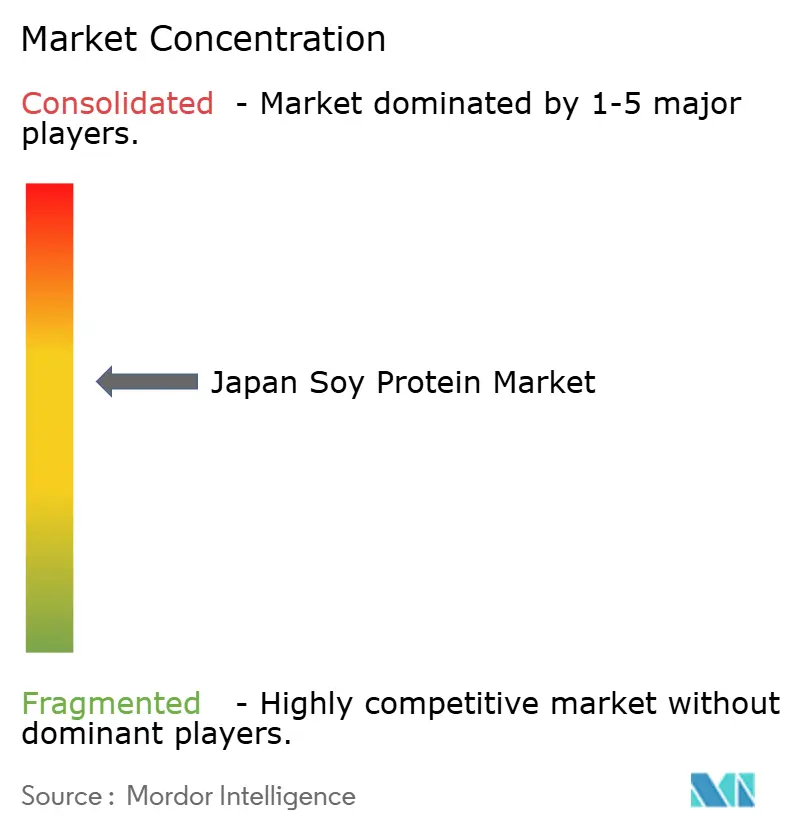
| Market Concentration | Medium |
Major Players *Disclaimer: Major Players sorted in no particular order Image © Mordor Intelligence. Reuse requires attribution under CC BY 4.0. | |
Japan Soy Protein Market Analysis by Mordor Intelligence
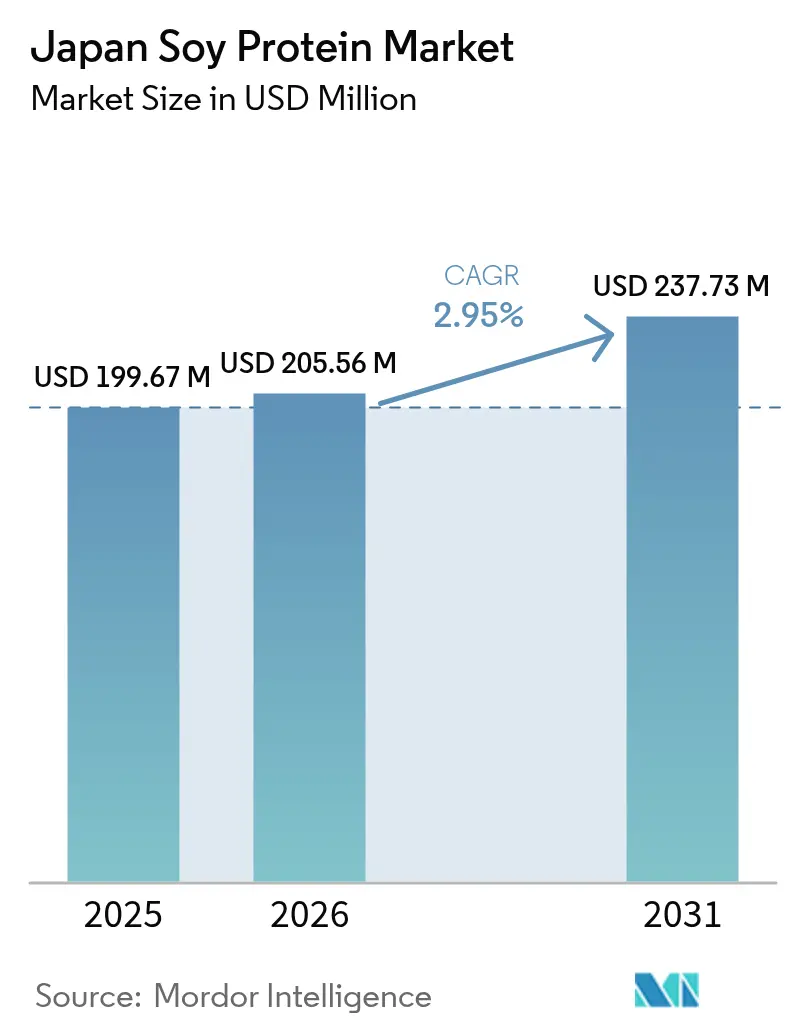
Japan soy protein market size in 2026 is estimated at USD 205.56 million, growing from 2025 value of USD 199.67 million with 2031 projections showing USD 237.73 million, growing at 2.95% CAGR over 2026-2031. The market growth is driven by Japan's aging demographic, rising health consciousness among consumers, and government initiatives to improve food self-sufficiency. Market expansion is constrained by dependence on soybean imports and increasing competition from alternative plant proteins. The demand for cost-effective, digestible, high-quality protein has increased the adoption of soy protein isolates in meat alternatives, beverages, and clinical nutrition products. The market demonstrates higher uptake of enzymatically hydrolyzed soy proteins, specifically in addressing nutritional requirements of elderly populations affected by sarcopenia. Companies are investing in research and development to enhance flavor masking, texture improvement, and allergen reduction to meet local preferences.
Key Report Takeaways
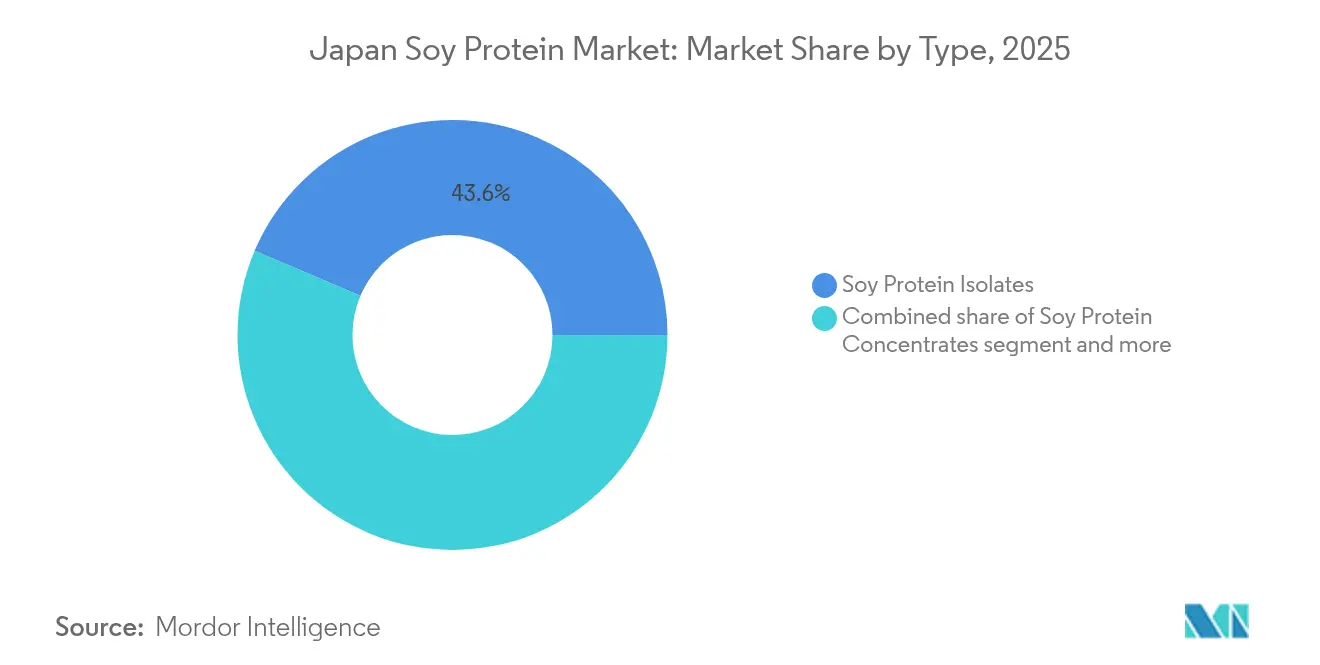
- By type, soy protein isolates led with 43.60% Japan soy protein market share in 2025, and hydrolysed soy protein records the fastest growth at a 3.42% CAGR for 2026-2031.
- By nature, the conventional segment dominated with a 90.85% share in 2025, whereas organic soy protein is projected to expand at a 4.92% CAGR to 2031.
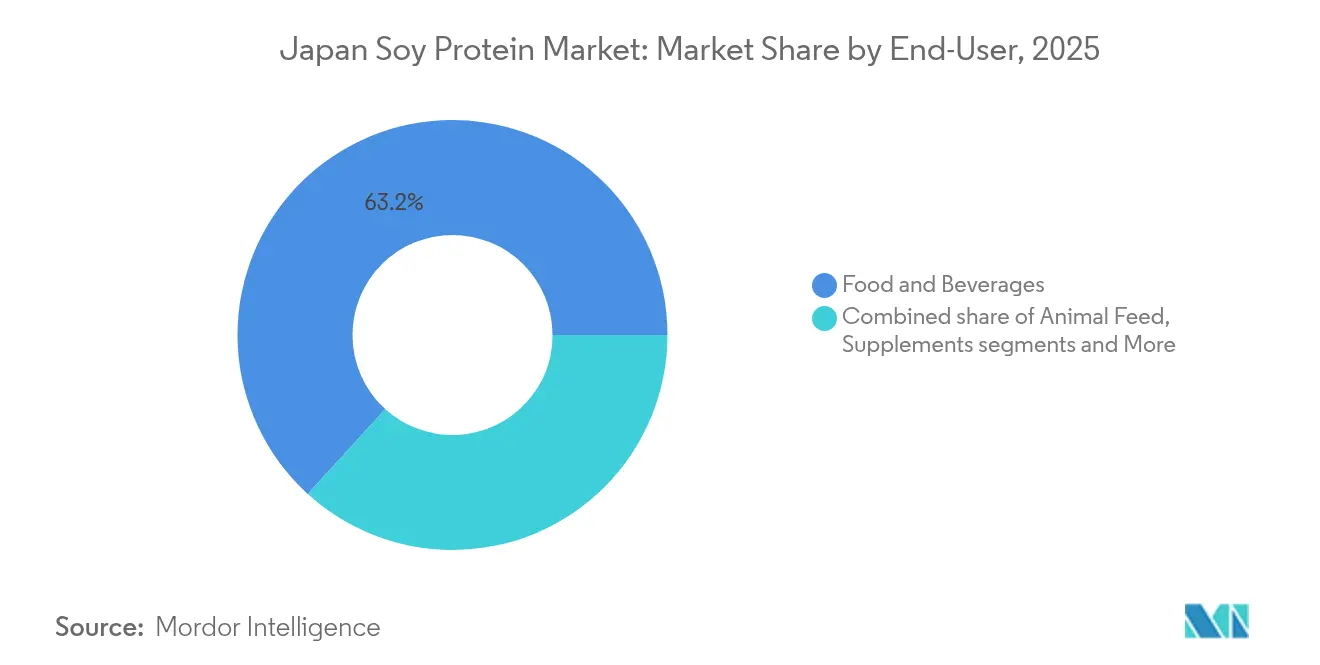
- By end-user, food and beverages commanded 63.25% of the Japan soy protein market size in 2025; the supplements segment is advancing at a 3.91% CAGR during 2026-2031.
Note: Market size and forecast figures in this report are generated using Mordor Intelligence’s proprietary estimation framework, updated with the latest available data and insights as of 2026.
Japan Soy Protein Market Trends and Insights
Drivers Impact Analysis*
| DRIVER | (~) % IMPACT ON CAGR FORECAST | GEOGRAPHIC RELEVANCE | IMPACT TIMELINE |
|---|---|---|---|
| Aging population and muscle-health focus | +0.7% | National, concentrated in urban centres | Long term (≥ 4 years) |
| Rising flexitarian eating habits | +0.5% | Tokyo, Osaka, Kyoto | Medium term (2-4 years) |
| Government self-sufficiency programmes | +0.4% | National, especially agricultural regions | Long term (≥ 4 years) |
| Ready-to-eat protein-enriched meals | +0.3% | Urban areas | Short term (≤ 2 years) |
| Convenience-food expansion | +0.3% | Metropolitan zones | Medium term (2-4 years) |
| Processing-technology advances | +0.2% | Industrial hubs | Medium term (2-4 years) |
| Source: Mordor Intelligence | |||
Aging population and muscle-health focus
Japan's aging population represents the highest elderly proportion globally, creating substantial market opportunities in protein-enriched clinical nutrition. This demographic transformation drives manufacturers to develop specialized soy protein products for sarcopenia prevention and management. Food companies are actively reformulating their product portfolios to address age-specific nutritional requirements, establishing sustained market growth. The increasing adoption of hydrolyzed soy proteins reflects their enhanced digestibility and absorption characteristics, particularly beneficial for elderly consumers with diminished digestive capabilities. This trend shapes product development strategies across the clinical nutrition segment, influencing both domestic and international market dynamics.
Rising flexitarian eating habits
Japanese urban households are increasingly adopting flexitarian diets by substituting plant-based proteins for animal protein in one or two meals per week. Young consumers associate plant proteins with environmental sustainability and weight control, and favor brands that combine authenticity with convenience. Manufacturers have responded by introducing hybrid products such as patties and dumplings that combine chicken or seafood with soy concentrates, reducing fat content while maintaining price points. This approach extends soy protein's market reach beyond the vegan segment in Japan, increasing the total addressable market. Young consumers associate plant protein with eco-friendliness and weight control, favoring brands that balance authenticity with contemporary convenience. In turn, manufacturers are introducing hybrid patties and dumplings, combining chicken or seafood with soy concentrates. This innovation reduces fat and saturated fat content without raising prices. By adopting this broader strategy, soy is now appealing not just to strict vegans, but to a wider audience, thereby enlarging the potential market for soy protein in Japan.
Government self-sufficiency programmes
The Japanese Ministry of Agriculture, Forestry and Fisheries (MAFF) has implemented a Basic Plan for Food, Agriculture and Rural Areas that focuses on increasing domestic soybean production. The plan includes subsidies for high-protein soybean varieties, automation equipment grants, and research funding for improved farming methods. Pilot farms in Hokkaido are growing specialized soybean varieties for protein extraction, achieving yields of 3.4 tonnes per hectare compared to the national average of 2.2 tonnes[1]. These initiatives reduce exposure to international commodity price fluctuations while enhancing product traceability, enabling manufacturers to market products with "Japanese-grown soy" labels that appeal to consumers concerned about food security. According to JPPFA, the Domestic production volume of soy proteins in Japan in 2024 was estimated to be ~41 '000 tons 2024 [2].
Processing technology advances
Ajinomoto's transglutaminase enzyme creates networks that replicate the texture of minced pork, while Fuji Oil's solvent-free extraction at low temperatures maintains natural isoflavones that attract health-focused consumers. These technological developments reduce the functional differences between soy and animal proteins, enabling broader applications from bakery products to sports nutrition. Production costs have improved, with enzymatically modified isolates now manufactured at lower costs compared to previous years, helping maintain profit margins despite inflation. Innovations are bridging the functional gaps between soy and animal proteins, easing formulation challenges. This expansion now spans applications, from bakery fillings to sports gels. Additionally, cost dynamics are shifting: factory trials reveal that enzymatically modified isolates are now produced at a 12% lower unit cost than five years prior, bolstering margin stability amidst inflationary pressures.
Restraints Impact Analysis*
| RESTRAINT | (~) % IMPACT ON CAGR FORECAST | GEOGRAPHIC RELEVANCE | IMPACT TIMELINE |
|---|---|---|---|
| High dependence on imported soybeans | -0.7% | National | Medium term (2-4 years) |
| Persisting soy allergen concern | -0.4% | National | Long term (≥ 4 years) |
| Competition from alternative plant proteins | -0.6% | National | Long term (≥ 4 years) |
| Price volatility of soybeans | -0.5% | National | Medium term (2-4 years) |
| Source: Mordor Intelligence | |||
High dependence on imported soybeans
Japan's soybean supply chain remains vulnerable due to its substantial reliance on imports from the United States, Brazil, and Canada. The country's dependence on international markets makes it susceptible to supply disruptions and geopolitical tensions, which became evident during recent trade disputes and weather-related challenges in commodity markets. While Japan's limited agricultural land continues to restrict domestic production despite government support, companies are taking proactive steps to build more resilient supply chains. These businesses are forming long-term partnerships with international suppliers and investing in vertical integration projects. Significant initiative involves the collaboration between Protein Industries Canada, Alinova Canada Inc., and Marusan Ai Co., who are working together to build a specialized soy processing facility in Ontario dedicated to producing soy milk powder for Japanese consumers. The Observatory of Economic Complexity (OEC) reports that Japan's soybean imports reached 288 billion yen in 2024, with the United States, Brazil, and Canada maintaining their positions as the main suppliers [3].
Price volatility of soybeans
Global soybean price volatility presents a persistent challenge for Japanese soy protein manufacturers. The volatility is amplified by currency effects, particularly the yen's depreciation. Price instability creates significant margin pressure for manufacturers, especially those serving price-sensitive market segments where passing cost increases to customers is difficult. Weather-related disruptions in major soybean-producing regions and changing global demand patterns contribute to price unpredictability, complicating long-term planning and investment decisions. While manufacturers implement hedging strategies and explore alternative sourcing arrangements to mitigate price risk, these measures add operational complexity and cost. The volatility particularly affects smaller processors who lack the scale to implement comprehensive risk management programs, creating competitive advantages for larger, more financially stable companies.
*Our forecasts treat driver/restraint impacts as directional, not additive. The impact forecasts reflect baseline growth, mix effects, and variable interactions.
Segment Analysis
By Type: Isolates Lead While Hydrolysates Gain Momentum
The Japanese market has embraced Soy Protein Isolates, which now command a substantial 43.60% market share in 2025. These isolates have become essential ingredients for food manufacturers, offering a neutral flavor profile and functional properties that enable effective protein fortification across food products. In the meat alternatives segment, their gelling and water-binding properties create authentic meat-like textures that resonate with consumers. The hydrolyzed soy protein segment shows promise with an anticipated growth rate of 3.42% from 2026 to 2031, as these proteins offer improved digestibility and bioavailability, key factors for Japan's aging population. Meanwhile, Soy Protein Concentrates continue to serve manufacturers in the mid-market segment by balancing cost-effectiveness with protein content requirements.
The market's evolution has been significantly shaped by advancements in enzymatic hydrolysis technology, which has become instrumental in protein modification. Recent research demonstrates the effectiveness of specialized hydrolysis processes, with modified soybean protein hydrolysates achieving 68.86% protein content while reducing bitterness by four-fold compared to standard hydrolysates. These improvements have transformed the competitive landscape across market segments, offering manufacturers more options to meet consumer demands.

By Nature: Organic Growth Outpaces Conventional
In 2025, conventional products dominated Japan's soy protein market, seizing a 90.85% share, thanks to their abundant supply, familiar ingredients, and cost-effectiveness. J-Oil Mills, a key player, is enhancing taste and dispersibility through solvent-free dehulling and advanced deodorization, ensuring mainstream acceptance joilmills.co.jp. These advancements not only improve product quality but also cater to consumer preferences for better-tasting and easily mixable soy protein options. With ongoing efficiency improvements, conventional producers are poised to maintain their market share, even as consumers lean towards ethically sourced products. Additionally, the established infrastructure and economies of scale further strengthen the position of conventional soy protein in the market.
While organic soy protein currently holds a modest share, it boasts a robust 4.92% CAGR through 2031, outpacing the broader market. As urban affluence rises and concerns over pesticide residues tighten, consumers are willing to shell out a 30-40% premium. Driven by MAFF’s 2024 Organic Vision, which simplifies certification for smaller farms maff.go.jp, the market size for organic soy protein in Japan is set to surpass USD 28.73 million by 2031. Clean-label snacks, smoothies, and meal-replacement sachets lead the charge, with digital platforms emphasizing soil-to-shelf traceability, bolstering health-conscious millennials' willingness to pay. This growth is further supported by increasing awareness of sustainable farming practices and the perceived health benefits of organic products, making organic soy protein a compelling choice for a niche but growing consumer base.
By End-User: Supplements Segment Accelerates Beyond Food Applications
The food and beverages segment holds a substantial 63.25% share of the Japan soy protein market in 2025. The meat alternatives sub-segment demonstrates notable growth as flexitarian consumers increasingly seek products that offer familiar textures while reducing their environmental footprint. Through high-moisture extrusion technology, manufacturers produce protein fibers that effectively mimic meat textures, while the combination of soy proteins with traditional Japanese seasonings ensures alignment with local taste preferences. In the beverage industry, companies incorporate protein isolates to improve product stability and nutritional content in drinks such as lattes and smoothies. Despite being a mature market, the segment continues to expand through consistent product innovations in convenience stores.
The supplements segment demonstrates promising growth prospects with a projected CAGR of 3.91% from 2026 to 2031. Companies are responding to the needs of Japan's aging population by developing targeted products, including single-serve supplements that combine isoflavones, calcium, and vitamin D to support bone health. The sports nutrition category, particularly products that integrate branched-chain amino acids with hydrolyzed soy peptides, is experiencing significant growth through online sales channels, highlighting the market's receptiveness to products backed by scientific evidence.
Geography Analysis
Japan's soy protein market shows clear differences between regions, with urban areas driving new product development while rural regions build up their production capabilities. The strategic placement of food manufacturing facilities in industrial zones near cities gives them a natural advantage in distribution and logistics. With high disposable incomes, premium products thrive; for instance, a probiotic-enriched soy milk, priced 35% higher than the standard, flew off the shelves within weeks of its debut at a top urban grocery chain. Urban cafés are now infusing soy isolates into their specialty drinks, broadening the occasions for out-of-home consumption. To maintain a consistent buzz, manufacturers are collaborating with department-store food halls to craft seasonal SKUs.
Companies near farming areas enjoy lower transportation costs and can source fresher raw materials, helping them produce better quality isolates that beverage makers prefer. Many facilities have started handling multiple steps of production in-house, from extracting oil to making protein concentrates, which helps keep more economic value within their regions.
Food manufacturers have found success by adding protein concentrates to traditional recipes, giving consumers more protein while keeping familiar flavors. Local marketing efforts connect with consumers by explaining how soy's nutritional benefits align with both traditional preferences and modern dietary needs. This balanced approach helps maintain steady demand and supports processing facilities across different regions.
Regulatory Landscape
Japan soy protein ingredients sold into food and supplement applications fall under the Food Sanitation Act framework, including the positive list system for food additives where only designated additives can be used. Since April 1, 2024, the Consumer Affairs Agency (CAA) has been the responsible authority for standards evaluation and additive designation, alongside the Ministry of Health, Labour and Welfare (MHLW) for food safety administration. For plant-based meat-style products, the Japanese Agricultural Standard (JAS) for Textured Soy Protein Products (established February 24, 2022) defines products such as "soy meat" (minimum 10% protein, amino acid score 100) and "prepared soy meat" (minimum 1% protein), with compliance monitoring tied to the JAS system overseen through MAFF and FAMIC.
On the trade side, Japan maintains a zero-tariff policy for imported soybeans, reinforcing a market structure in which domestic ingredient processors depend on imported raw beans for protein extraction and downstream processing. At the same time, MAFF policy instruments under the Basic Plan for Food, Agriculture and Rural Areas support domestic soybean production and traceability initiatives, which feed into labeling and quality expectations for "Japanese-grown soy" positioning in finished foods.
Competitive Landscape
The Japanese soy protein market maintains a moderate concentration, where domestic companies and international firms work alongside each other in healthy competition. Prominent market players include Fuji Oil Holdings Inc., Archer Daniels Midland Company, Ajinomoto Co. Inc., Cargill Incorporated, and International Flavors & Fragrances Inc. Instead of engaging in price wars, businesses focus their efforts on developing superior product functionality and building expertise in various applications. Companies are increasingly moving towards vertical integration to ensure they have reliable access to raw materials and can maintain strict quality standards throughout their operations. A good example of this approach is Fuji Oil Holdings, which introduced its Responsible Soybeans and Soy Products Sourcing Policy to achieve community-level traceability by 2025.
The market presents significant opportunities in specialized nutrition for Japan's growing elderly population, an area where targeted protein formulations for specific health conditions remain largely unexplored. Companies are setting themselves apart by advancing their technological capabilities and developing unique processing methods to improve protein functionality. We can see this in practice with Ajinomoto, whose enzyme technologies, particularly their use of transglutaminase to enhance soy protein texture, showcase how innovation in processing methods can create a competitive edge.
The market is seeing new players emerge in the form of specialized ingredient technology firms that concentrate on fermentation and enzymatic modification of plant proteins. The industry's commitment to innovation is reflected in patent activities, with companies like Fuji Oil, Amano Enzyme, and Nissin Foods taking the lead in filing patents for alternative protein technologies in Japan.
Japan Soy Protein Industry Leaders
-
Fuji Oil Holdings Inc.
-
Archer Daniels Midland Company
-
Ajinomoto Co. Inc.
-
Cargill, Incorporated
-
International Flavors & Fragrances
- *Disclaimer: Major Players sorted in no particular order
Market Opportunities and Future Outlook
Government food-tech prioritization is creating room for higher-value soy protein formats in Japan that target functional nutrition needs and improved sensory performance. In May 2026, the Japanese government set a new target of JPY 3 trillion in sales for "new foods" such as soy meat by 2040. In July 2026, it advanced a draft public-private investment roadmap that references funding for new food technologies, including functional nutrition. These policy signals connect to ingredient demand for isolates and hydrolysates used in protein-fortified meals, elderly nutrition, and plant-based or hybrid meat applications.
Capacity additions and product commercialization activity also support near-term routes to market for soy protein in powders and convenience-led formats. In April 2026, Tacks Co., Ltd. began constructing a new factory (JPY 2.5 billion investment) to lift powder food output capacity, including protein supplement products, by 1.5 times, supporting the supplements and protein-fortified categories where soy proteins are used as cost-effective, digestible protein sources. In the convenience channel, Pulmuone/Asahico expanded Japan production capacity for the Tofu Bar line to 3 million units per month in March 2024, reinforcing demand for soy-based, protein-forward ready-to-eat products and supporting pull-through for domestic formulation and ingredient supply.
Recent Industry Developments
- May 2026: Ajinomoto Co., Inc. started construction of a new manufacturing facility in the TARI Estate in Tarlac, Philippines, with a disclosed investment of about JPY 23.8 billion and a targeted start of operations by April 2028. The build-out supports regional manufacturing scale and supply-chain resilience for food ingredients and nutrition-related product lines relevant to soy protein applications. Expanding footprint outside Japan also strengthens responsiveness to broader Asia demand for functional proteins and formulated foods.
- March 2025: Mitsubishi Corporation and Archer Daniels Midland Company (ADM) entered a strategic partnership focused on managing grain export hubs in the United States and Brazil. The agreement tightens access to upstream soybean supply and logistics options that feed Japan-linked processing and ingredient users. It also reinforces a trend toward long-term sourcing structures to manage import dependence and commodity volatility.
- September 2024: Ajinomoto Co., Inc. joined the World Business Council for Sustainable Development (WBCSD), participating in initiatives such as the Agriculture and Food Pathway and the Climate Imperative. The membership expands the companys collaboration on decarbonization and sustainable sourcing themes that increasingly influence ingredient procurement requirements. This adds momentum to traceability and sustainability positioning in plant-based and protein-fortified product development.
Research Methodology Framework and Report Scope
Market Definition and Coverage
This market covers soy protein ingredients sold in Japan, tracked in value terms across food, nutrition, feed, and other end uses where soy protein is added for protein content or functional performance.
Scope exclusions: It excludes whole soy foods and beverages where soy protein is not traded or priced as an ingredient (for example, tofu and plain soy milk sold as finished products).
Segmentation Overview
- By Type
- Soy Protein Isolates
- Soy Protein Concentrates
- Textured/Hydrolyzed Soy Protein
- By Nature
- Conventional
- Organic
- By End-User
- Food and Beverages
- Bakery
- Beverages
- Breakfast Cereals
- Meat/Poultry/Seafood and Meat Alternative Products
- Condiments/Sauces
- Dairy and Dairy Alternative Products
- RTE/RTC Food Products
- Snacks
- Animal Feed
- Personal Care and Cosmetics
- Supplements
- Baby Food and Infant Formula
- Elderly and Medical Nutrition
- Sport/Performance Nutrition
- Food and Beverages
Data Sources, Market Sizing, and Validation
Desk Research
Desk work started with building the size logic around Japan demand indicators that are visible and repeatable, and then linking them back to soy protein use in packaged food and nutrition. We leaned on public statistics and technical references such as Japan customs trade data for relevant HS lines, Japanese government food and agriculture releases, USDA FAS Japan reports, and FAOSTAT for upstream soybean and meal context.
We also reviewed regulatory and labeling signals that help explain ingredient usage and product claims, using sources such as the Consumer Affairs Agency and Ministry of Health, Labour and Welfare materials, followed by journals and association content on proteins and food processing. Company annual reports, investor decks, and credible press were used to cross-check capacity moves, pricing commentary, and end-market shifts. In a few places, we used paid subscriptions that compile company financials, patents, and shipment-level import and export records to speed up screening and validation. These examples are not exhaustive, and many other public and proprietary sources were referenced to collect data, validate assumptions, and clarify open questions.
Primary Interviews and Surveys
Primary inputs came from interviews and surveys with ingredient suppliers, distributors, and formulation focused buyers in Japan. We also discussed with category specialists who track protein fortification and plant-based product launches. These conversations were used to confirm typical use rates by application, realistic price bands by grade, and how quickly volumes shift when labels, import costs, or product reformulations change.
Distribution of primary research fieldwork respondents
| Company type | Respondent position |
|---|---|
| Top tier: 38% | CXOs: 15% |
| Mid tier: 45% | Functional/Unit leaders: 32% |
| Smaller Players: 17% | Managers: 53% |
Market-Sizing & Forecasting
The core model is built using a top-down approach where Japan consumption and trade signals are used to reconstruct the usable ingredient demand pool, and then values are derived through application level pricing logic. After that, we corroborate totals with selective bottom-up approximations, such as sampled supplier revenue splits and channel checks, which help us adjust for gaps that show up in any single dataset.
Inputs were chosen because they can be checked over time and explained simply. For this market, the practical fingerprints include import and export values for soy protein related product codes, soybeans and soybean meal availability trends, the pace of plant-based and high-protein product launches, and observed inclusion rates in meat alternatives, beverages, and nutrition products. We also track price movement drivers such as currency timing, import cost pressure, and common grade mix shifts across isolates, concentrates, and hydrolysates, which then shape the average selling price pathway.
For forecasting, scenario analysis was used to test a steady demand case against faster adoption in protein fortification, then keep the final outlook aligned to what industry respondents see as feasible. Where bottom-up evidence was incomplete, we filled gaps through bounded ranges for volumes and prices, and the bounds were tightened only after follow-up validation and consistency checks across end uses.
Data Validation & Update Cycle
We validate the outputs by checking that volume and value trends stay consistent with independent signals such as trade movements, public production and processing indicators, and the pace of product activity in key food categories. Variances that look too sharp are reviewed, and then assumptions are revisited in a second pass before numbers are signed off.
Reports are refreshed annually, and interim updates are made when a material event changes demand or pricing logic, such as a major regulatory change, a clear shift in import costs, or a new supply expansion. Before delivery, an analyst runs a final update pass so clients receive the most current view that can be traced back to clear inputs and repeatable steps.
Mordor Intelligence's Japan Soy Protein Market Size Measured Against Other Published Estimates
It is normal to see different market values for Japan soy protein because publishers do not always use the same boundaries for what counts as an ingredient sale and what should stay in finished food categories. Differences also come from how pricing is treated, how quickly assumptions are refreshed, and whether totals are checked against more than one independent signal.
In practice, the biggest gaps usually show up around inclusion of adjacent categories and the price and volume pairing used for the base year. Some estimates appear to fold in broader plant protein ingredients or include finished soy foods, and then apply a single blended price that can overstate or understate true ingredient value. Others may rely on older exchange rates or a one-time snapshot of import values without reconciling them to end-use consumption and typical formulation use rates.
Benchmark comparison
| Source | Market Size | Gaps in Research Methodology |
|---|---|---|
| Mordor Intelligence | USD 199.67 M (2025) | |
| Trade Analytics Publisher A | USD 318.50 M (2024) | Built from trade value for a narrow product code and nearby lines, which can capture re-exports and non-ingredient movements, and it does not explicitly reconcile to Japan end-use demand or grade level pricing. |
| Industry Report Desk Study B | USD 195.00 M (2022) | Older base year anchored to a single historical point and a fixed growth path, with limited transparency on isolate versus concentrate mix and no visible refresh for recent pricing and formulation shifts. |
Import and export value trends, plus the observed run-rate of protein fortification and plant-based product activity, are the checks that keep Mordor Intelligence tied to a Japan ingredient demand pool instead of broader soy food spending. The spread in the table mainly comes from scope boundaries and base-year pricing logic, so keeping variables explicit makes the final number easier to reproduce and update.
Key Questions Answered in the Report
What is the current size of the Japan soy protein market?
The Japan soy protein market is valued at USD 205.56 million in 2026 and is projected to reach USD 237.73 million by 2031 at a 2.95% CAGR.
Which product type leads the market?
Soy protein isolates hold the lead with a 43.60% share in 2025 due to their high purity and broad functionality, and they are projected to maintain steady growth.
Why is hydrolysed soy protein growing so fast?
Enhanced digestibility and quick absorption make hydrolysates attractive for senior nutrition and sports recovery, resulting in a 3.42% forecast CAGR through 2031.
What risks could slow market growth?
Dependence on imported soybeans and price volatility pose supply-chain and margin challenges, while allergen concerns and competition from pea and oat proteins add pressure.