
Japan Senior Living Market Size and Share
Market Overview
| Study Period | 2021 - 2032 |
|---|---|
| Forecast Data Period | 2027 - 2032 |
| Base Year Market Size (2026) | USD 48.88 Billion |
| Market Size (2027) | USD 51.20 Billion |
| Market Size (2032) | USD 64.57 Billion |
| Growth Rate (2027 - 2032) | 4.75 % |
| Market Concentration | Low |
Major Players *Disclaimer: Major Players sorted in no particular order Image © Mordor Intelligence. Reuse requires attribution under CC BY 4.0. | |
Japan Senior Living Market Analysis by Mordor Intelligence
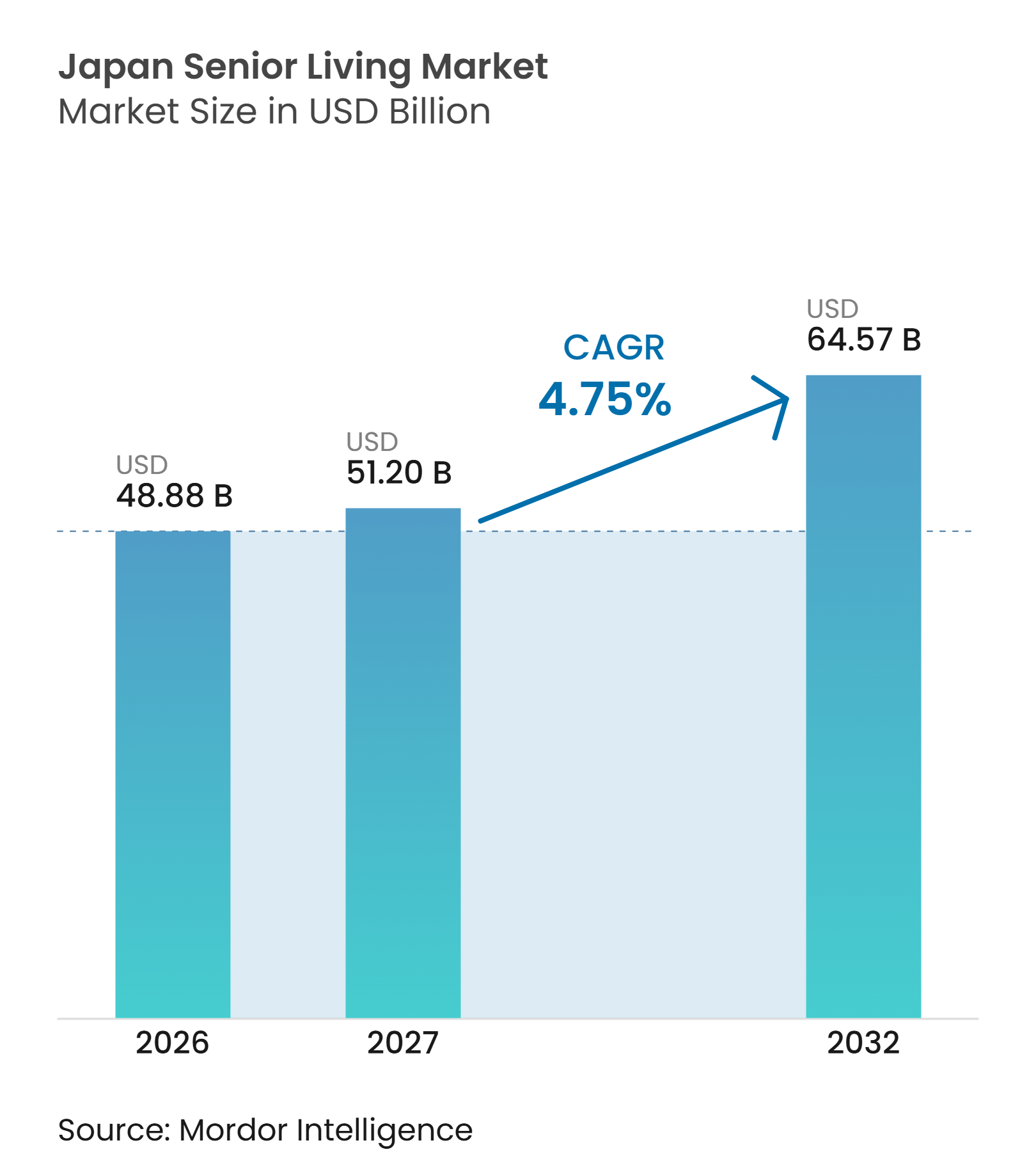
The Japan Senior Living Market size is expected to increase from USD 48.88 billion in 2026 to USD 51.20 billion in 2027 and reach USD 64.57 billion by 2032, growing at a CAGR of 4.75% over 2027-2032.
Population aging continues to raise the need for residential settings that can provide daily support, clinical coordination, and longer-term care. The Cabinet Office’s FY2025 report shows that the elderly share will continue to rise through 2045. The large cohort entering advanced old age is increasing demand for facilities that can manage mobility limitations, cognitive conditions, and complex care needs. Operators are responding through care technology, closer ties with medical providers, and formats that serve residents before they need intensive nursing care. Capital is moving toward established assets and selective new developments, but staff shortages, high building costs, and affordability constraints continue to limit the pace of new supply.
Key Report Takeaways
- By property type, nursing care accounted for 44.7% of the Japan senior living market share in 2026, representing the largest segment of the Japan senior living market size, while memory care is forecast to grow at a 5.47% CAGR through 2032.
- By business model, long-lease / rental accounted for 81.2% of the Japan senior living market size in 2026, representing the largest market share, and is forecast to grow at a 5.29% CAGR through 2032.
- By age group, residents above 85 years accounted for a 51.2% share of the Japan senior living market and are forecast to grow at a 5.71% CAGR through 2032.
- By city, Tokyo accounted for a 32.3% share of the Japan senior living market, while the rest of Japan is forecast to grow at a 5.91% CAGR through 2032.
Note: Market numbers in this report are based on Mordor Intelligence's proprietary estimation framework, which combines nine months of actuals with Q4 projections for base year 2026.
Market Trends and Insights
Drivers Impact Analysis of Japan Senior Living Market of Japan Senior Living Market*
| Drivers | (~) % Impact on CAGR Forecast | Geographic Relevance | Impact Timeline |
|---|---|---|---|
| Expanding Elderly Population and Purpose-Built Housing Demand | +1.4% | National, with concentration in Tokyo, Osaka, and Nagoya | Long term (≥ 4 years) |
| Growth in Solo-Dwelling Older Adults and Managed Housing Demand | +0.9% | National, with early gains in Tokyo and large urban clusters | Medium term (2-4 years) |
| Preference for Active Retirement and Independent Living | +0.7% | National, with early uptake in Tokyo, Osaka, Nagoya, and prefectural capitals | Medium term (2-4 years) |
| Medical and Nursing Care Integration | +0.6% | National, with early concentration in Greater Tokyo and Kinki | Medium term (2-4 years) |
| Institutional Investment in Senior Housing Assets | +0.5% | National, concentrated in first-tier and second-tier cities | Long term (≥ 4 years) |
| Smart Monitoring and Care Automation Adoption | +0.4% | National, led by Tokyo and technology-focused operators | Short term (≤ 2 years) |
| Source: Mordor Intelligence | |||
Japan’s Population Aging Creates Sustained Demand
Japan’s older population will require a larger stock of residences that can support people with higher care intensity. The Cabinet Office projects that 1 in 2.6 residents will be aged 65 or older by 2070, while 1 in 4 will be aged 75 or older[1]. Dementia is expected to affect 5.842 million people aged 65 or older by 2040, which strengthens the case for specialist memory care and care settings with stronger clinical support. This demographic pattern favors operators that can adapt unit design, staff training, and care pathways for residents with more complex needs. The Japan senior living market will require more capacity that is equipped for this level of care. It also makes capacity planning a longer-term issue rather than a response to a short-lived demand cycle.
Rising Solo-Elder Households Deepen Managed Housing Demand
More older residents are living without an adult family member in the same home, which increases the need for managed housing with routine support and welfare checks. The Japan senior living market is benefiting as some residents consider a move before a crisis makes a housing decision harder. These households may value daily monitoring, shared amenities, and access to staff even when they do not require full nursing care. The Cabinet Office has identified concern about admission charges and moving costs among older people who may later be unable to live alone. That concern keeps affordability central to the design of lower-fee and mid-priced residences. Operators that offer clear service packages and transparent monthly charges can address a need that is practical rather than discretionary. This part of the Japan senior living market also needs options that residents can understand before they make a move.
Active Retirement Preference Supports Independent Living
A larger group of healthier older adults is seeking residences that support independence, social contact, and continued participation in daily life. The Japan senior living market can serve this group through apartments and communities that combine safety features with shared activities and access to services. Mitsui Fudosan Residential reported in 2025 that residents at its Park Well State properties maintained 5.5 friendships on average, compared with 4.4 among non-resident peers, and were 1.5 times more likely to participate in weekly social activities. The result supports the role of common spaces, programs, and resident interaction in a product category often defined mainly by care provision. These features can help residences attract early movers and support longer stays across changing care needs. They also give operators a way to differentiate independent living formats where basic accommodation can otherwise appear similar.
Medical and Nursing Care Integration Reshapes Care Delivery
The simultaneous revision of medical and nursing care fees strengthened the policy focus on coordination between hospitals and long-term care providers[2]. The Japan senior living market is responding with formats that bring nursing, rehabilitation, medication management, and end-of-life support closer to the resident. Panasonic Age-Free launched its AgeFree House Premier Medical series in Setagaya in April 2025, adding small-scale multifunctional home nursing care and year-round nursing coverage to an existing senior residence. Better links with hospitals and care managers can improve discharge planning for people whose conditions no longer require acute treatment but still need clinical support. The Long-Term Care Insurance Act and the revised fee schedules continue to shape staffing, licensing, and reimbursable service decisions. In the Japan senior living market, facilities that can demonstrate reliable medical coordination may be better positioned to serve residents with complex conditions.
Restraints Impact Analysis of Japan Senior Living Market of Japan Senior Living Market*
| Restraints | (~) % Impact on CAGR Forecast | Geographic Relevance | Impact Timeline |
|---|---|---|---|
| Qualified Caregiver and Nursing Professional Shortages | -0.8% | National, with greatest pressure in rural prefectures and outer urban areas | Short term (≤ 2 years) |
| High Land Acquisition and Construction Costs | -0.7% | Tokyo core, with effects in Osaka, Nagoya, and other urban markets | Medium term (2-4 years) |
| High Accommodation Fees and Recurring Service Charges | -0.4% | National | Medium term (2-4 years) |
| Care Facility Licensing and Compliance Requirements | -0.3% | National | Long term (≥ 4 years) |
| Source: Mordor Intelligence | |||
Caregiver Shortfall Undermines Capacity Even as Demand Rises
A lack of qualified caregivers is limiting the ability of facilities to accept residents and expand services. A 2025 survey found that 89.4% of facility managers had declined service requests because of inadequate staffing. The shortage increases labor costs and makes compliance with staffing standards more difficult for smaller operators. Japan’s official aging report estimates that the long-term care workforce will need 570,000 additional workers by fiscal 2040. Care automation can reduce administrative work, but it cannot fully replace direct care for residents with high dependency. The constraint is particularly important outside major cities, where labor pools are smaller, and recruitment is more difficult.
Construction and Land Costs Narrow Development Feasibility
High development costs are making new facilities harder to finance at price points accessible to many older households. Land near hospitals, public transport, and family support networks is particularly costly in Tokyo and other large urban areas. The resulting pressure can shift projects toward premium formats, which may leave a gap in lower-fee and mid-priced accommodation. It can also encourage operators to renovate suitable existing buildings rather than pursue every opportunity through new construction. Akiya Corporation launched its Akiya no Kaigo and Akiya no Fukushi services in August 2026 to convert vacant homes into licensed care facilities and group homes. This approach shows how property conversion may reduce site acquisition pressure, although it will not resolve the broader shortage of appropriate care capacity by itself.
*Our forecasts treat driver/restraint impacts as directional, not additive. The impact forecasts reflect baseline growth, mix effects, and variable interactions.
Japan Senior Living Market Segment Analysis
By Property Type:
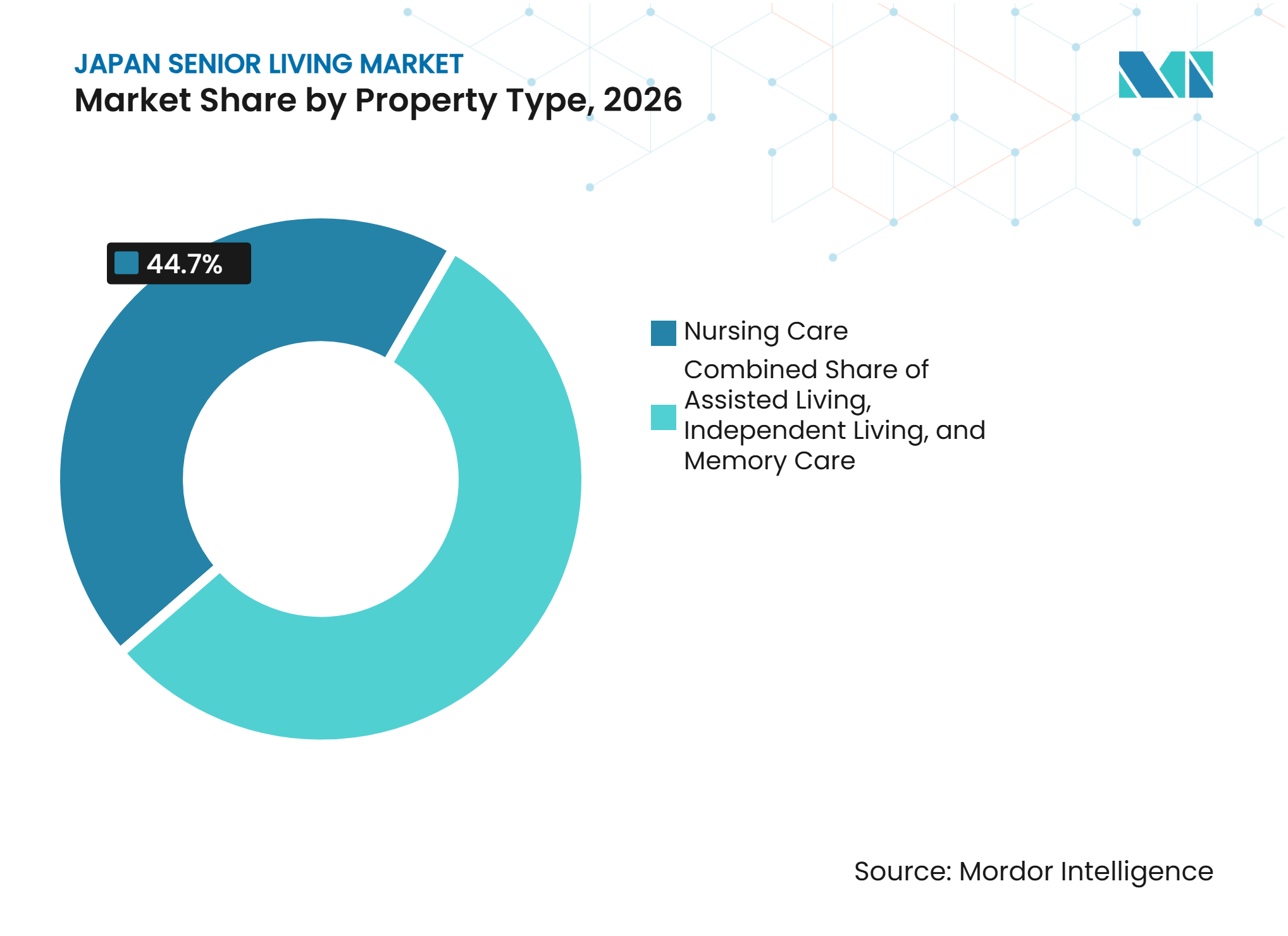
Nursing Care Anchors Scale While Memory Care ExpandsNursing care held 44.7% of the Japan senior living market in 2026, reflecting the high share of residents who need regular assistance and clinical support. This format serves people with substantial mobility limitations, chronic conditions, and higher daily care needs. The growing number of people in advanced age raises the importance of staffing models that can provide consistent personal care. Japan’s aging report indicates that dementia among people aged 65 or older could reach 5.842 million cases by 2040. Nursing operators therefore need to combine residential services with stronger cognitive and behavioral support. Larger facilities can spread some operational costs across more beds, but direct care quality remains central to resident and family decisions.
Memory care is forecast to grow at a 5.47% CAGR through 2032, making it the fastest-growing property type. The Japan senior living industry is moving toward more specialized settings for residents whose cognitive conditions make a conventional residence unsuitable. A 2025 scientific review noted that dementia will affect more than 17% of Japan’s elderly population by 2060. These tools can support monitoring and routine tasks when used alongside trained staff. Assisted living and independent living remain relevant for residents with lower support needs, but they may require clear pathways to more intensive care as residents age.



By Business Model:
Long-Lease / Rental Retains Its Lead Through FlexibilityThe long-lease / rental model accounted for 81.2% of the Japan senior living market in 2026 and remains the leading commercial model. Renting gives residents access to accommodation and services without requiring property ownership at a stage when mobility and care needs can change quickly. It also fits the operating structure of service-attached senior housing, where monthly payments are linked to accommodation and support services. The model can allow families to compare options based on location, care availability, and recurring cost. Rental communities can also modify service offerings as residents become more dependent. This flexibility is important where an older resident wants to move into managed housing before needing institutional nursing care.
Long-lease / rental is also forecast to grow at a 5.29% CAGR through 2032. The Japan senior living industry is likely to face more pricing competition as rental inventory develops in major urban areas. LIFULL’s 2025 data highlights the challenge of balancing occupancy fees with upfront charges. Higher labor and site costs can place pressure on monthly charges, while residents remain sensitive to entry costs and recurring affordability. Outright sale formats continue to appeal to a smaller group seeking ownership, while hybrid arrangements can combine an initial stake with continuing service payments. Operators with several tenure options can support residents whose financial preferences differ, but they still need simple pricing and a clear explanation of what care is included.
By Age Group:
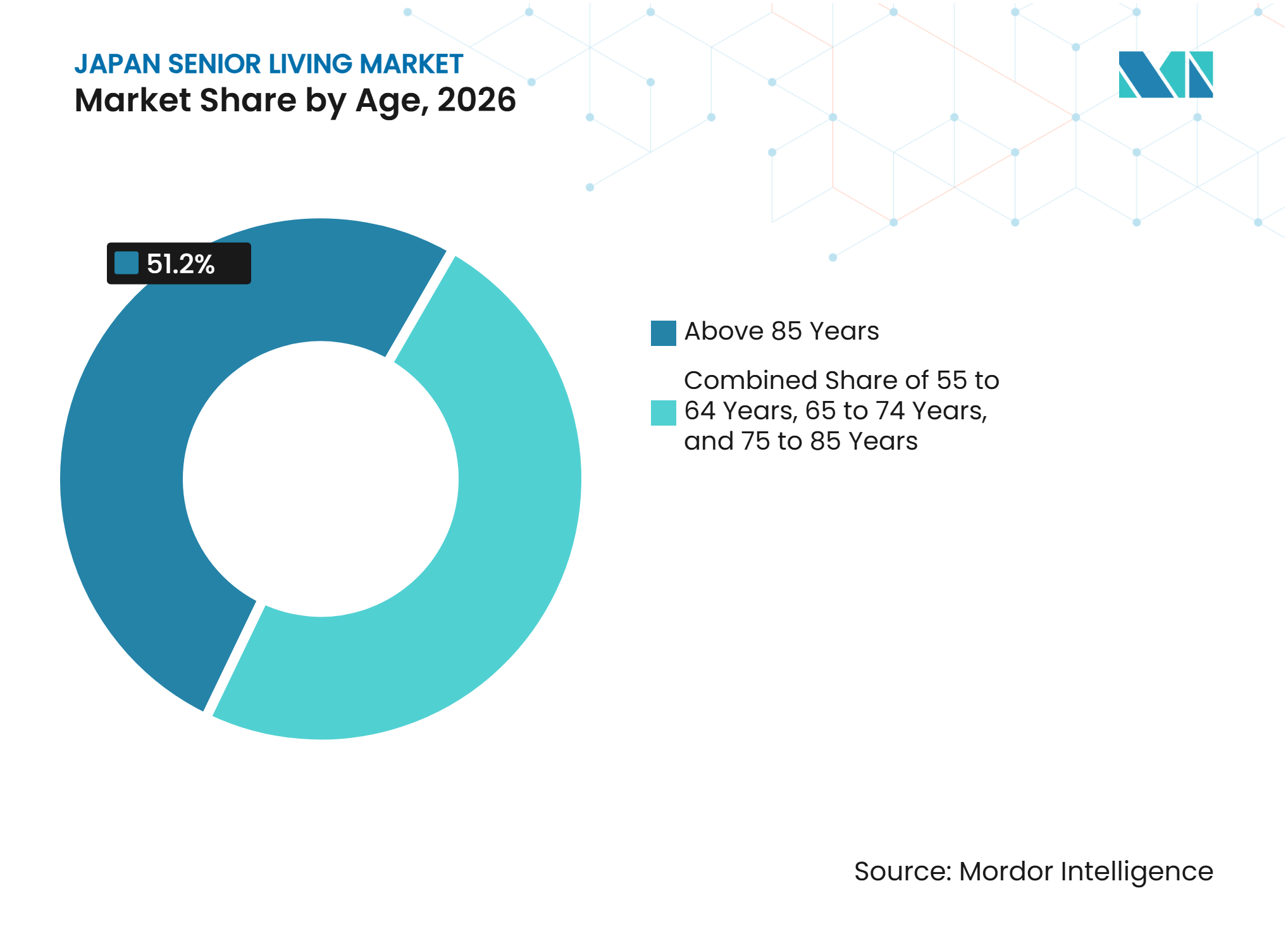
Residents Above 85 Years Shape Care DemandResidents above 85 years represented 51.2% of the Japan senior living market size in 2026, making this the largest age segment by value. The concentration reflects a sharp increase in care needs as residents move from their late 70s into their late 80s and 90s. Residents in the oldest group are more likely to require support with medication, movement, meals, and personal care. They may also remain in a facility longer than younger residents, which raises the importance of staffing stability and family communication. Care providers that focus on this group need detailed clinical links and dependable escalation procedures.
The above-85 years group is forecast to expand at a 5.71% CAGR through 2032, which makes it the fastest-growing age segment as well as the largest. The Japan senior living market share held by this group emphasizes the need for formats that can serve higher-acuity residents without repeated transfers. The 75 to 85 age group remains an important pipeline because it includes residents who may move before their care needs intensify. Mitsui Fudosan Residential found in 2025 that residents aged 75 and older who moved proactively maintained stronger social connections and higher health engagement than non-resident peers[3]. Early moves can allow residents and families to make a considered decision while the resident can still participate fully. Providers that retain residents as care needs change can reduce disruptions and improve use of their existing capacity.

Geography Analysis
Tokyo and the Greater Tokyo Area
Tokyo accounted for a 32.3% share of the Japan senior living market in 2026, supported by a dense elderly population and a large network of professional care providers. The area’s broad range of residences and high land costs shape the type of supply that can be delivered, especially in central wards. Providers are expanding into suburban parts of Tokyo, Kanagawa, and Saitama, where site economics can be more workable. Panasonic Age-Free’s April 2025 Setagaya launch shows the value placed on combining residential services with on-site nursing support in the capital region. Compliance factors under the Long-Term Care Insurance Act influence how operators plan staffing and service coverage.
Rest of Japan
The rest of Japan is forecast to grow at a 5.91% CAGR from 2027 to 2032, the fastest rate among the city segments. Non-metropolitan areas can offer lower development costs and less competition than central Tokyo, but they face more serious caregiver recruitment challenges. Operators need to distinguish between locations with enough elderly residents and healthcare links and places where population decline weakens long-term occupancy. The senior living market in these areas will depend on whether providers can match care capacity with local labor and healthcare resources.
Osaka, Nagoya, and Other Regional Centers
Osaka has a mature private care supply base, which increases the need for operators to compete on care quality, price, and service differentiation. Nagoya has lower land costs than Tokyo and Osaka, which can support facilities aimed at middle-income residents. These regional centers offer a practical route for chains that want to balance growth across different cost structures. Sumitomo Corporation completed deployment of its FIKAIGO platform across 290 SOMPO Care residential homes in June 2025, targeting a 90% reduction in time spent on shift scheduling and statutory documentation. JaOperators in Japan’s senior living market can use these systems to support staff productivity while meeting local licensing and staffing requirements.
Competitive Landscape
Market Concentration
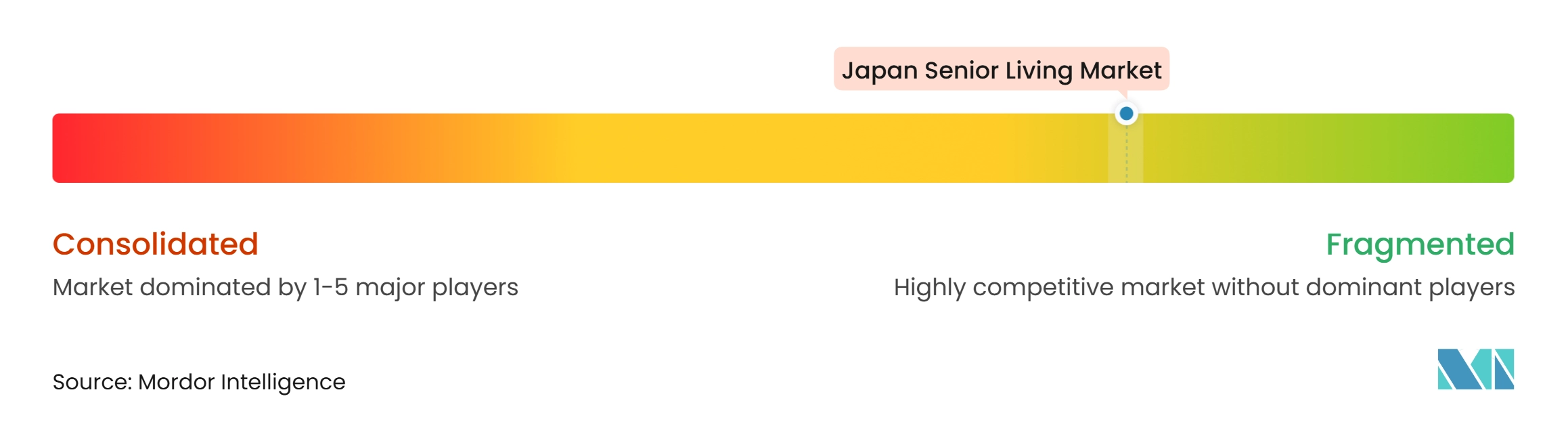
The Japan senior living market is fragmented, with large national chains, regional specialists, and newer care-focused businesses operating alongside each other. No individual operator has been identified in the supplied material as holding a dominant national share. Larger groups can benefit from broader care networks, purchasing scale, and the ability to invest in training and technology. Smaller regional operators can compete through local knowledge, established referral relationships, and service models suited to their communities. The competitive difference is increasingly linked to whether an operator can maintain care quality despite staff shortages and rising operating costs.
Technology is becoming a clearer point of competition. Sumitomo Corporation stated that its FIKAIGO platform was deployed across all 290 SOMPO Care residential homes in June 2025. The platform automates shift scheduling and statutory documentation, which can reduce the administrative load on facility teams. Panasonic Age-Free’s Setagaya development also demonstrates a strategic move toward integrated nursing care within a senior residence. These initiatives show that leading providers are seeking to improve both care delivery and operational resilience rather than treating technology as a separate pilot activity.
The competitive opportunity is strongest in affordable and mid-priced accommodation, selected provincial cities, and specialist care formats such as hospice and memory care. Beads raised USD 6.7 million in a January 2025 Series A round to expand its hospice housing network toward 100 facilities by 2030. Akiya Corporation is pursuing another route by converting vacant homes into licensed care facilities and group homes. These strategic moves show that newer participants are addressing gaps in late-stage care and development feasibility. Larger chains remain better placed to scale standardized systems, but specialized providers can compete where conventional facilities do not serve local needs well.
Japan Senior Living Industry Leaders
-
Benesse Style Care Co., Ltd.
-
SOMPO Care Inc.
-
Best Life Co., Ltd.
-
Nichii Care Palace Co., Ltd.
-
Gakken Holdings
- *Disclaimer: Major Players sorted in no particular order
Japan Senior Living Market Companies Covered in this Report
- Benesse Style Care Co., Ltd.
- SOMPO Care Inc.
- Best Life Co., Ltd.
- Nichii Care Palace Co., Ltd.
- Gakken Holdings
- Kinoshita Care Co., Ltd.
- HITOWA Co., Ltd.
- ALSOK Care Co., Ltd.
- Charm Care Corporation
- Sawayaka Club Co., Ltd.
- Care 21 Corporation
- Green Life Co., Ltd.
- Frontier Co., Ltd.
- Japan Amenity Life Association Co., Ltd.
- Starts Care Service Co., Ltd.
- Living Platform, Ltd.
- ORIX Living Corporation
- Panasonic Age-Free Co., Ltd.
- Secom Medical System Co., Ltd.
- Watami No Kaigo Co., Ltd.
Recent Industry Developments in Japan Senior Living Market
- August 2026: Healthcare & Medical Investment Corporation, Japan's only J-REIT specializing in healthcare-facility investments, announced the acquisition of 14 properties for approximately USD 134.3 million. The portfolio includes nine fee-based elderly homes, three serviced senior housing complexes, one dementia group home and one hospital land asset. Following the acquisitions and an asset disposal, the REIT expanded its portfolio to 70 properties, exceeding its USD-equivalent JPY 100 billion growth target. The expansion highlights growing institutional investment in Japan's senior living and healthcare real estate sectors.
- June 2026: Advent International agreed to acquire Japan Well-being Corp. from MBK Partners in a transaction valued at approximately USD 1.24 billion, including debt. The company, formed through the combination of Tsukui Corporation and Soyokaze, operates over 1,100 care locations and serves approximately 110,000 users monthly. Advent plans to support facility expansion and technology adoption, highlighting growing institutional investment and consolidation in Japan's elderly-care sector.
- June 2026: ALSOK, through its subsidiary ALSOK Care, acquired Daiwa House Life Support and Daiwa Living Care from Daiwa House Industry in June 2026, adding 34 elderly-care facilities across 10 Japanese prefectures. The acquisition expanded ALSOK Care's network to approximately 245 facilities. The company aims to strengthen its elderly-care operations, while reported plans include leveraging its security and monitoring technologies.
Japan Senior Living Market Report Scope
Segmentation Overview
| Assisted Living |
| Independent Living |
| Memory Care |
| Nursing Care |
| Outright Sale (Freehold) |
| Long-Lease / Rental |
| Hybrid (Sale + Lease) |
| 55 to 64 Years |
| 65 to 74 Years |
| 75 to 85 Years |
| Above 85 Years |
| Tokyo |
| Osaka |
| Nagoya |
| Rest of Japan |
| By Property Type | Assisted Living |
| Independent Living | |
| Memory Care | |
| Nursing Care | |
| By Business Model | Outright Sale (Freehold) |
| Long-Lease / Rental | |
| Hybrid (Sale + Lease) | |
| By Age | 55 to 64 Years |
| 65 to 74 Years | |
| 75 to 85 Years | |
| Above 85 Years | |
| By City | Tokyo |
| Osaka | |
| Nagoya | |
| Rest of Japan |
Key Questions Answered in the Report
What is the projected value of Japan senior living by 2032?
The Japan senior living market is projected to reach USD 64.57 billion by 2032, rising from USD 51.2 billion in 2027 at a 4.75% CAGR.
Which property type leads senior living in Japan?
Nursing care led by value with a 44.7% share in 2026, reflecting the high need for regular support among older residents.
Which senior housing format is growing the fastest in Japan?
Memory care is the fastest-growing property type, with a projected CAGR of 5.47% through 2032.
Why is demand for managed senior residences increasing in Japan?
Population aging, more solo-dwelling older adults, and the need for medical and daily living support are increasing the need for professionally managed residences.
Which resident age group accounts for the greatest value?
Residents above 85 years held 51.2% of value in 2026 and are also forecast to grow the fastest at a 5.71% CAGR through 2032.
Which locations offer the strongest growth prospects for senior living providers?
Tokyo provides the largest city segment at 32.3% of 2026 value, while the rest of Japan is forecast to grow fastest at a 5.91% CAGR through 2032.