
Japan Commercial Greenhouse Market Size and Share
Market Overview
| Study Period | 2021 - 2031 |
|---|---|
| Forecast Data Period | 2026 - 2031 |
| Base Year Market Size (2025) | USD 440 Million |
| Market Size (2026) | USD 480 Million |
| Market Size (2031) | USD 770 Million |
| Growth Rate (2026 - 2032) | 9.80 % |
| Market Concentration | Low |
Major Players *Disclaimer: Major Players sorted in no particular order Image © Mordor Intelligence. Reuse requires attribution under CC BY 4.0. | |
Japan Commercial Greenhouse Market Analysis by Mordor Intelligence
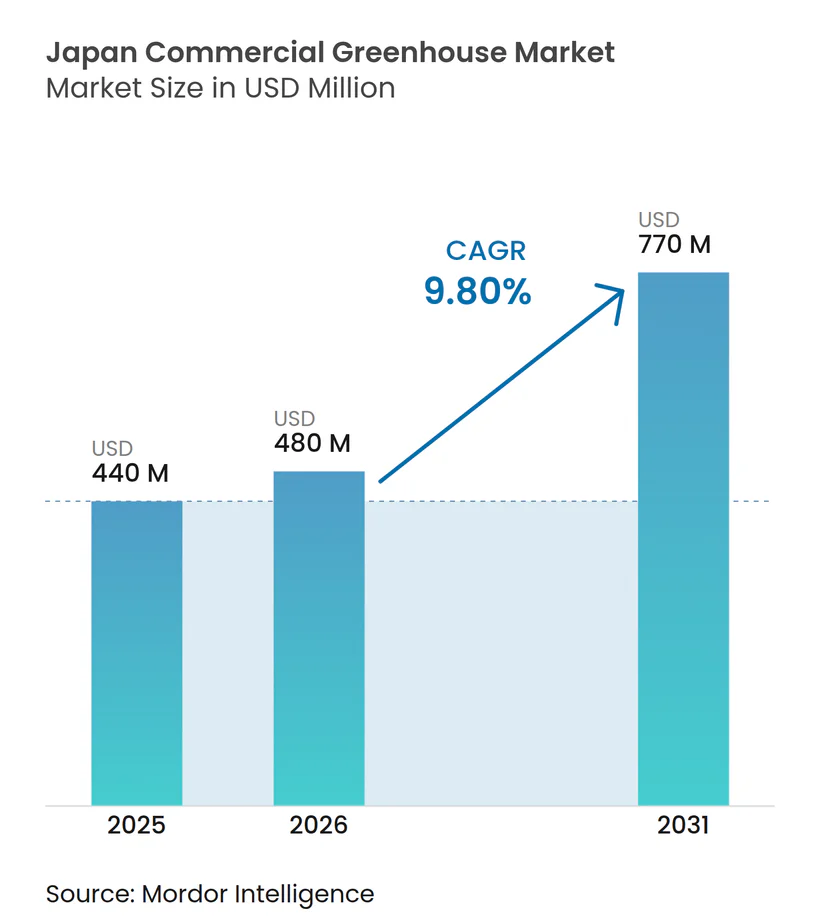
The Japan commercial greenhouse market size was valued at USD 440 million in 2025 and is estimated to grow from USD 480 million in 2026 to reach USD 770 million by 2031, at a CAGR of 9.80% during the forecast period (2026-2031). Investment is increasingly focused on controlled production systems and equipment upgrades. Japan’s low food self-sufficiency rate is strengthening the case for reliable domestic horticultural output, while policy support is directing attention toward smart greenhouse upgrades, traceable production, and technologies that improve the reliability of fresh-produce supply[1]. The shrinking farm workforce is also raising demand for systems that reduce manual labor, particularly controls, sensors, automated irrigation, monitoring tools, and harvesting equipment that help operators maintain crop routines with fewer workers[2]. As a result, the market is moving toward upgrades within existing facilities rather than relying solely on new construction, as the installed base can be fitted with more capable climate, energy, and crop management systems. Climate exposure supports demand for protected growing, although higher cooling, heating, and electricity costs make energy efficiency central to investment decisions and reinforce interest in heat pumps, shading, and other systems that reduce resource use. Suppliers that combine structures, environmental controls, and cultivation support can address a wider set of grower needs, however, the presence of specialized vendors across software, lighting, irrigation, screens, and greenhouse structures limits pricing power and keeps the competitive landscape fragmented.
Key Report Takeaways
- By equipment type, climate control and automation software accounted for 18% of the Japan commercial greenhouse market share in 2025 and is forecast to grow at a CAGR of 13.8% from 2026 to 2031.
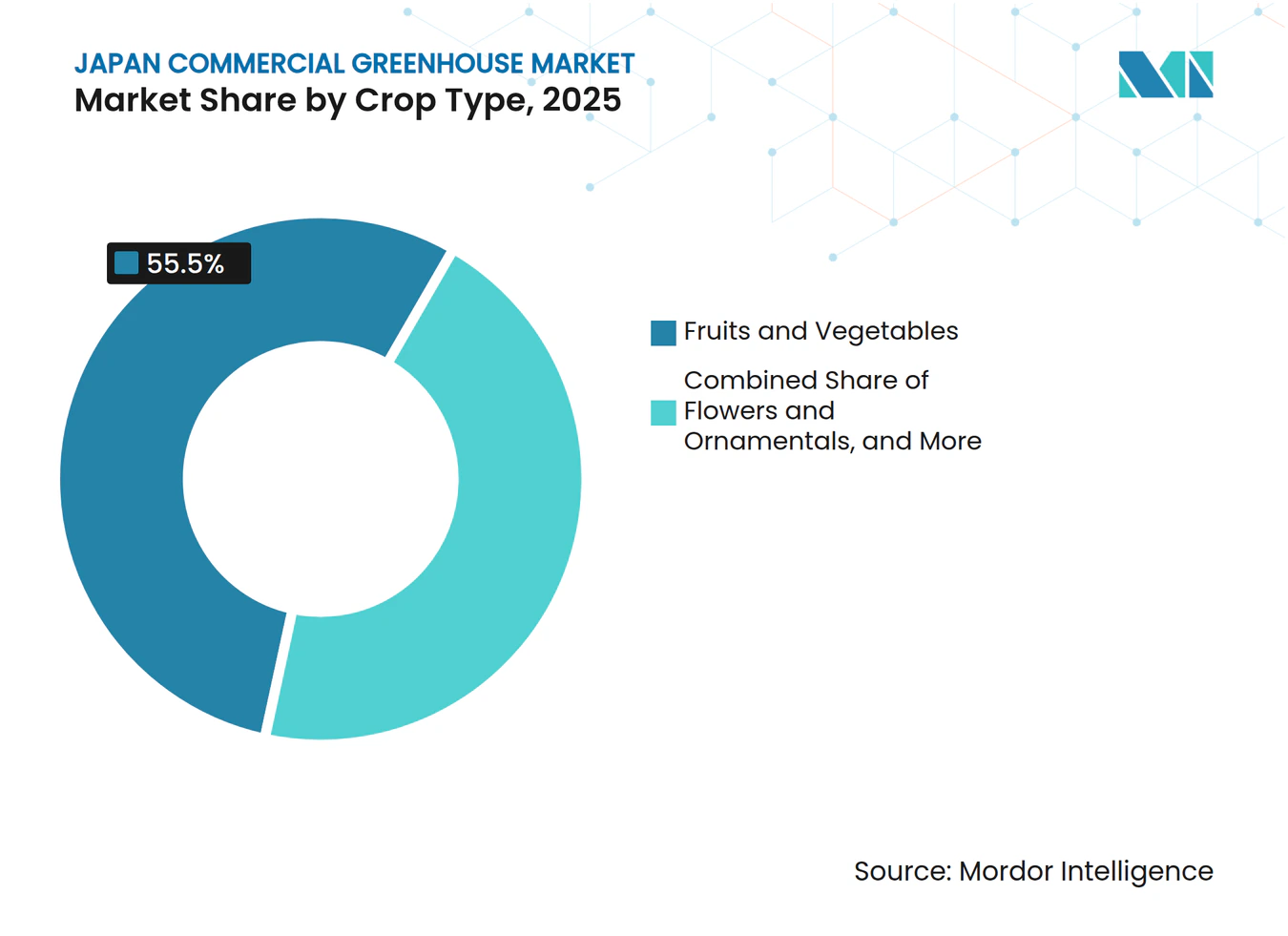
- By crop type, fruits and vegetables accounted for 55.5% of the Japan commercial greenhouse market share in 2025, while cannabis and specialty crops are forecast to grow at a CAGR of 14.5% from 2026 to 2031.
- By greenhouse type, plastic-film greenhouses accounted for 58% of the Japan commercial greenhouse market share in 2025, while glass greenhouses are forecast to grow at a CAGR of 12.2% from 2026 to 2031.
- By cultivation technology, hydroponic systems accounted for 54.4% of the Japan commercial greenhouse market share in 2025, while hybrid and vertical integration are forecast to grow at a CAGR of 11.2% from 2026 to 2031.
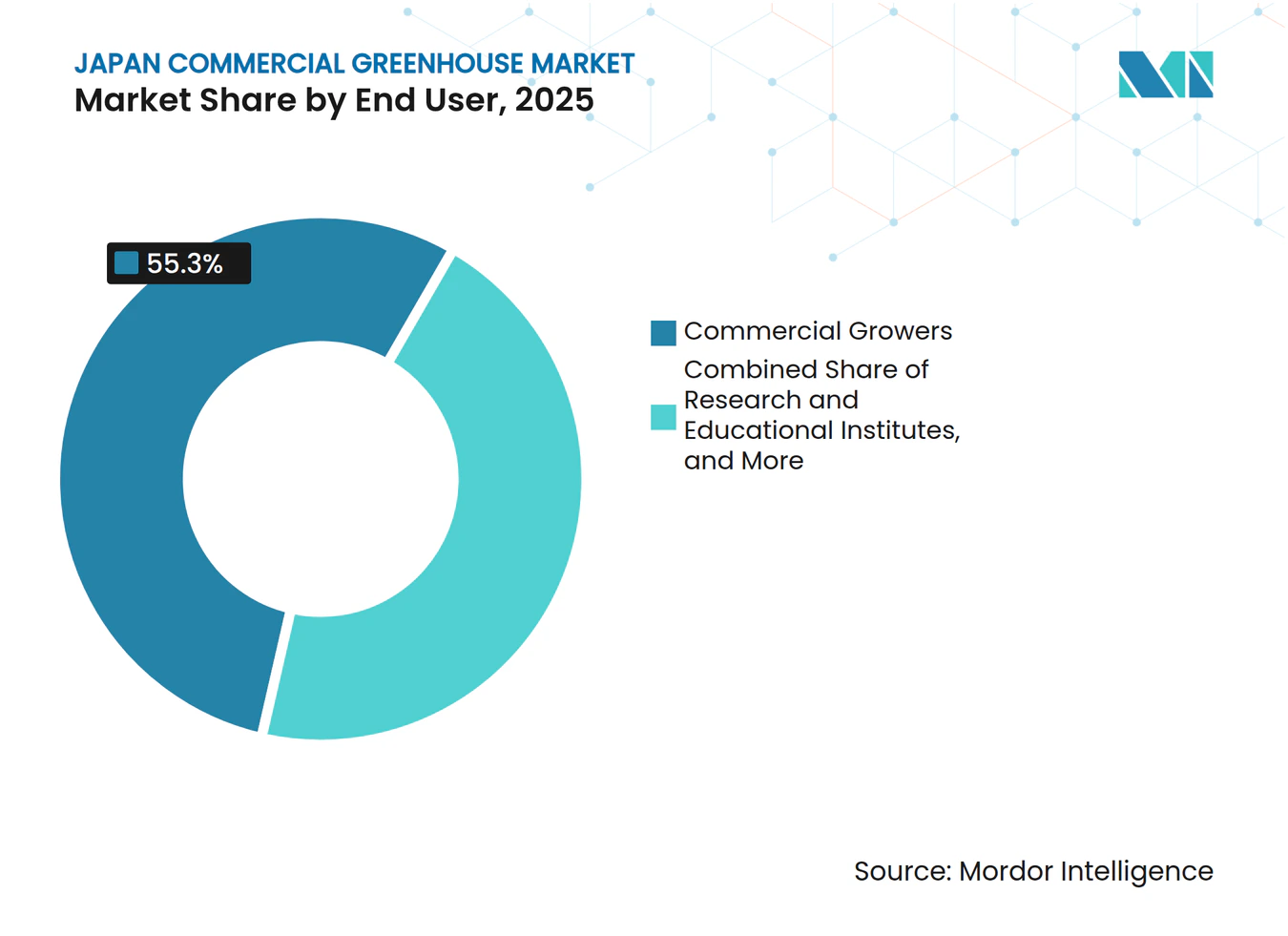
- By end user, commercial growers accounted for 55.3% of the Japan commercial greenhouse market share in 2025, while research and educational institutes are forecast to grow at a CAGR of 13.5% from 2026 to 2031.
Note: Market size and forecast figures in this report are generated using Mordor Intelligence’s proprietary estimation framework, updated with the latest available data and insights as of January 2026.
Market Trends and Insights
Drivers Impact Analysis of Japan Commercial Greenhouse Market*
| Driver | (~) % Impact on CAGR Forecast | Geographic Relevance | Impact Timeline |
|---|---|---|---|
| Year-Round Local Produce Demand | +1.8% | Kanto, Kansai and Kinki | Short term (≤ 2 years) |
| Labor-Saving Automation Adoption | +2.2% | Central and Chubu, Kanto | Medium term (2-4 years) |
| Food Security and Self-Sufficiency Priorities | +1.5% | National, with early gains in urban supply basins | Medium term (2-4 years) |
| Climate-Resilient Crop Production | +1.2% | Kyushu and Okinawa, Tohoku | Short term (≤ 2 years) |
| CO2 Recovery from Direct-Air-Capture Systems | +0.8% | Kanto and Central and Chubu | Long term (≥ 4 years) |
| Retail Traceability and Premium Produce Contracts | +1.4% | Kanto, Kansai and Kinki | Medium term (2-4 years) |
| Source: Mordor Intelligence | |||
Year-Round Local Produce Demand
Consumer demand for domestic produce with controlled residues has become increasingly relevant to mainstream retail procurement in Japan, particularly where buyers require stable quality, clear production records, and predictable deliveries that meet regular supermarket and food-service schedules. Retailers value greenhouse vegetables because production can offer more consistent size, color, and seasonal availability than open-field supply exposed to weather variability, allowing buyers to reduce reliance on short-notice purchases when harvests are disrupted. Weather disruptions in Kyushu and Tohoku during 2024 and 2025 increased the appeal of contracted supply that is less exposed to field production shortfalls and can support planned purchasing cycles for tomatoes, cucumbers, leafy greens, and other regular fresh-produce lines. The March 2024 revision to Japanese Agricultural Standards expanded food-chain information requirements to strawberries and rice, in addition to lettuce, melons, and grapes, increasing the documentation needed for premium contract eligibility. The Japan commercial greenhouse market benefits when producers can document growing practices, manage crop conditions consistently, and provide a steady supply to retailers that need fewer weather-related interruptions across their stores. The Japan GAP Foundation reported 2,963 JGAP and ASIAGAP certified farms in March 2025, 7% higher than a year earlier, supporting the broader shift toward traceable supply and making certification more relevant to regular retail procurement.[3]
Labor-Saving Automation Adoption
Japan's greenhouse operators are adopting automation as the agricultural workforce continues to contract, increasing the operational value of equipment that can reduce repetitive manual tasks in monitoring, irrigation, scouting, and harvesting. MAFF’s MIDORI Strategy targets a 30% improvement in food-production labor productivity by 2030, supporting automated greenhouse systems that can improve the consistency of routine monitoring, crop handling, and environmental adjustments. More than 200 smart agriculture demonstration projects had generated operating evidence by 2024, reducing uncertainty around investments in sensors, climate computers, automated fertigation, and other systems that replace manual checks. The Japan commercial greenhouse market is likely to place greater value on equipment that combines monitoring, irrigation, pest-response functions, and data records in a single operating system. This shift favors upgrades that improve labor productivity, shorten response times to crop stress, support decision-making, and preserve production records, even where total greenhouse area is declining.
Food Security and Self-Sufficiency Priorities
Japan’s calorie-based food self-sufficiency ratio reached 37.1% in fiscal year 2025, widening the gap with the government’s fiscal year 2030 target of 45% and keeping domestic production capacity high on the policy agenda. The Act on Countermeasures for Difficult Food Supply Situations, enacted in June 2024, established emergency protocols and supported investment in domestic production capacity when supply conditions worsen. Commercial greenhouses are relevant to this policy direction because they can provide more stable horticultural output than open-field production and give growers greater control over the growing environment, production timing, and input use. The Basic Plan for Food, Agriculture, and Rural Areas, published in May 2025, identified greenhouse carbon dioxide supplementation using biogas power generation as a supported technology route, linking productivity needs with resource efficiency and local industrial activity. This alignment connects greenhouse efficiency with food-security and carbon-reduction priorities in industrial prefectures such as Aichi and Hyogo, where food-processing activity can support related technology pathways. The Japan commercial greenhouse market can therefore draw support from agricultural, food supply, and environmental policy objectives rather than depending on a single program.
Climate-Resilient Crop Production
Typhoons, flooding, and high summer temperatures have made open-field production less predictable across several Japanese regions, particularly where weather events disrupt harvest schedules, crop quality, and planned supply to buyers. Greenhouse systems allow operators in Kyushu, Okinawa, and Tohoku to maintain production during weather conditions that can damage field crops, making protected cultivation relevant to regional supply planning and risk management. This production reliability is becoming increasingly important in retail contracts that require dependable deliveries, stable quality, and fewer supply interruptions during adverse weather, especially for produce lines supplied year-round. Climate conditions also increase summer cooling loads, which can reduce margins without shading, evaporative cooling, or demand-response systems to manage energy use and avoid unnecessary pressure on the facility. The Japan commercial greenhouse market therefore has an equipment replacement opportunity in efficient climate-control systems that can protect crops while helping operators manage energy requirements.
Restraints Impact Analysis of Japan Commercial Greenhouse Market*
| Restraint | (~) % Impact on CAGR Forecast | Geographic Relevance | Impact Timeline |
|---|---|---|---|
| High Capital Cost and Long Payback Periods | -2.1% | National | Short term (≤ 2 years) |
| Energy Price Exposure from Heating, Cooling and Lighting | -1.8% | Hokkaido, Tohoku and Central and Chubu | Short term (≤ 2 years) |
| Limited Interoperability Across Automation Stacks | -1.2% | National, with older facilities most affected | Medium term (2-4 years) |
| Succession Risk and Fragmented Operator Base | -1.4% | Rural parts of Tohoku, Shikoku, Hokkaido and Kyushu | Long term (≥ 4 years) |
| Source: Mordor Intelligence | |||
High Capital Cost and Long Payback Periods
Commercial greenhouse facilities that combine glass or rigid polycarbonate structures, LED lighting, climate computers, irrigation, fertigation, and harvesting robots require substantial capital, particularly when operators seek integrated rather than basic equipment and need to upgrade several systems simultaneously. MAFF programs can fund up to one-third of eligible capital costs, but matching funds remain difficult to secure for small and mid-sized operators with limited balance-sheet capacity that also need to preserve funds for seasonal production expenses. By OECD standards, Japan's farm-management entities are small, which can limit their ability to finance large greenhouse projects, accept longer payback periods, or make investment decisions without access to subsidies. Consolidation could improve financing capacity over time, but it also reduces the pool of potential new operators and limits immediate demand from smaller entrants. Modular greenhouse packages and equipment leasing could help address this constraint in the Japan commercial greenhouse market by spreading initial costs over a longer period and making technology upgrades more practical for smaller facilities.
Energy Price Exposure from Heating, Cooling and Lighting
Heating with heavy-oil or kerosene boilers is a major variable cost for Japanese greenhouse operators, making operating margins sensitive to fuel price changes and exposing facilities to conditions outside their direct control. Japan Greenhouse Horticulture Association case studies identified heating as the largest single cost item in protected horticulture operating budgets, particularly in facilities with long cold-weather operating periods and large areas to maintain. Heat-pump hybrid systems can reduce heavy-oil consumption, but the initial investment can be difficult for smaller operators that need to preserve cash for regular crop operations, maintenance, and labor. Electricity costs also affect LED lighting, cooling, and climate-control equipment, meaning operators can face higher costs across several essential systems simultaneously rather than in a single part of the facility. This combination of fuel and power costs is particularly challenging for facilities in Hokkaido and northern Tohoku, where heating needs are greater, growing seasons are demanding, and cold conditions can persist. MAFF's target to transition 50% of heated greenhouse area to hybrid non-fossil systems by 2030 requires operators to plan capital expenditure regardless of current fuel prices or their ability to delay equipment upgrades.
*Our forecasts treat driver/restraint impacts as directional, not additive. The impact forecasts reflect baseline growth, mix effects, and variable interactions.
Japan Commercial Greenhouse Market Segment Analysis
By Equipment Type:
Climate Control and Automation Software Leads and is the Fastest-Growing SegmentClimate Control and Automation Software accounted for 18% of the Japan commercial greenhouse market share in 2025 and is forecast to grow at a CAGR of 13.8% from 2026 to 2031, making it the fastest-growing equipment type during the forecast period. Labor shortages and lower sensor costs have strengthened the case for software-based crop management. Operators are adopting systems that support irrigation scheduling, pest monitoring, and environmental response. These systems can reduce routine crop-contact work and provide the records required under traceability frameworks. DENSO Corporation's Profarm T-Cube monitors six growing parameters through connected sensors, while Hoogendoorn Growth Management B.V.'s IIVO system provides integrated greenhouse control. These offerings reflect demand for platforms that connect data collection with operational decisions.
Heating Systems, Cooling and Ventilation Systems, and LED Grow Lighting account for the largest installed equipment base in terms of revenue. Screening and Shading Systems and Irrigation and Fertigation Systems continue to receive replacement demand as growers address water efficiency and fossil-fuel use. Structural Components, including glazing, frames, and trusses, represent a substantial part of the Japan commercial greenhouse market size, but their growth is slower than technology upgrades. A contracting greenhouse footprint is shifting spending toward retrofits rather than new structures. Palram Industries Ltd.'s SUNTUF Plus polycarbonate panels are relevant to renovation projects where operators need to improve existing facilities. The Japan commercial greenhouse market is consequently placing more weight on performance upgrades than on basic mechanical replacement.
By Crop Type:
Fruits and Vegetables Lead, While Cannabis and Specialty Crops Are the Fastest-Growing SegmentFruits and Vegetables accounted for 55.5% of the Japan commercial greenhouse market share in 2025. Tomatoes, cucumbers, lettuce, peppers, and strawberries support this position because retailers seek predictable quality and regular supply. Tomatoes are a high-value greenhouse crop, particularly in hydroponic truss-tomato systems with automated harvest support. Cucumbers and lettuce remain important high-volume products for commercial operators. MAFF recorded 432 fully closed plant factories using artificial light in February 2024, compared with 93 in March 2011. The March 2024 food-chain information revision also supported certified strawberry production by adding strawberries to traceable produce categories.
Cannabis and Specialty Crops are forecast to grow at a CAGR of 14.5% from 2026 to 2031. Its growth reflects selective regulatory expansion for licensed medical cannabis cultivation and continuing demand for seedlings and propagation crops. Flowers and Ornamentals retain a meaningful share of greenhouse acreage, especially in Kanto, Kansai, and Kinki. Herbs and Microgreens serve food-service and premium retail channels through compact systems with rapid growing cycles. Such systems can improve the utilization of LED equipment where crops turn over quickly. Sakata Seed Corporation's Scarlet Star F1 and Chocostar F1 varieties demonstrate how controlled-environment crop genetics can influence grower production choices.



By Greenhouse Type:
Plastic Film Leads While Glass Gains GroundPlastic-Film Greenhouses accounted for 58% of the Japan commercial greenhouse market share in 2025. Their position reflects lower construction cost, broad regional use, and eligibility for affordable weather-resistant greenhouse programs. They are widely used in Kyushu, southern Kanto, and Shizuoka, where milder winters reduce heating requirements. The category ranges from single-span polyethylene structures to multi-span facilities with climate controls and fertigation. This variation means plastic-film facilities serve operators with different capital budgets and production methods. Rigid Polycarbonate Greenhouses, including Palram Industries Ltd.'s DYNAGLAS and SUNLITE panels, provide a middle option between film and glass.
Glass Greenhouses are forecast to grow at a CAGR of 12.2% from 2026 to 2031. They provide high light transmission and more precise climate control for high-value crops. Glass structures can support multi-zone heating, supplemental LED lighting, and enclosed carbon dioxide dosing at scale. Hybrid and Semi-Closed Greenhouses are also gaining interest because they combine natural-ventilation savings with active environmental control. DENSO Corporation offers a medium-scale semi-closed greenhouse designed for Japan, and Richel Group SAS supplies a semi-closed system. KUBO Group B.V.’s Ultra-Clima concept combines Smart Growing software with climate screens for operators seeking precise control and modular expansion.
By Cultivation Technology:
Hydroponic Systems Lead, While Hybrid and Vertical Integration is the Fastest-Growing SegmentHydroponic Systems accounted for 54.4% of the Japan commercial greenhouse market share in 2025. The format is widely used for the commercial production of leafy greens, tomatoes, and cucumbers because farmland is limited. Nutrient Film Technique and Drip Hydroponics are common commercial systems, while Deep Water Culture is used selectively for lettuce in vertical settings. Hydroponic systems also generate nutrient-solution, pH, and flow records that can support traceability documentation. This connection between crop control and recorded information supports their commercial role. Non-Hydroponic Soil and Substrate Systems, including coco coir and rockwool, remain useful where root-zone requirements or flavor considerations favor a substrate.
Hybrid and vertical integration are forecast to grow at a CAGR of 11.2% from 2026 to 2031. Multilayer systems can increase output per square meter in areas with limited land. Mebiol Inc.’s Imec Film Farming uses a hydrogel membrane to manage water and nutrient delivery with precision. The system produces high-sugar fruit under water-stressed conditions and supports a differentiated offer for premium retailers. The National Agriculture and Food Research Organization has more than 1,700 researchers within a staff of 3,200 and has an annual budget of JPY 74 billion (USD 526 million). Its cultivation research can inform adoption decisions among greenhouse operators.
By End User:
Commercial Growers Lead While Research and Educational Institutes Are the Fastest-Growing SegmentCommercial Growers accounted for 55.3% of the Japan commercial greenhouse market share in 2025. This category includes large vegetable producers, cut-flower operations, and corporate-run plant factories. Relaxed corporate-farming land acquisition rules have enabled professionally managed operators to participate more widely. These buyers can have stronger financing capacity than traditional family farms and can raise average equipment transaction values. Retail Garden Centers and Nurseries purchase structures and climate-control equipment for propagation and display. Their demand is less tied to food traceability rules, which provides some diversification for suppliers.
Research and Educational Institutes are forecast to grow at a CAGR of 13.5% from 2026 to 2031. MAFF’s 2023 and 2024 Innovation Strategies prioritized smart greenhouse research and development. University-affiliated farms are purchasing commercial-grade equipment for applied work rather than only laboratory prototypes. Signify N.V.’s collaboration with the Miyagi Agricultural and Horticultural Research Center evaluated LED supplemental lighting for bell pepper production in northern conditions. Such trials can provide nearby growers with operating evidence before they make their own investments. Requirements for documented productivity outcomes in funded projects create a channel for procuring commercial equipment.

Geography Analysis
The Central and Chubu region represents the largest regional market for commercial greenhouses in Japan, supported by a substantial base of commercial greenhouse facilities and diverse horticultural production. Aichi has a strong vegetable production base, while Shizuoka supports strawberry and tomato cultivation, and Nagano supports specialty crop production in higher-altitude areas. The region also benefits from established agricultural infrastructure and demand for protected cultivation technologies. The GX-ETS carbon-trading framework, which became effective in fiscal year 2026, is encouraging investment planning among large greenhouse operators, with larger facilities better positioned to invest in energy efficiency and emissions management.
Kanto is another major commercial greenhouse region, supported by its proximity to Tokyo and other large urban consumption centers. Ibaraki and Chiba have established greenhouse vegetable operations supplying supermarkets, convenience-store chains, and food-service buyers. The region also benefits from major transport and port infrastructure, which facilitates the distribution of agricultural products and the import of specialized greenhouse equipment. Kansai and Kinki represent an additional important demand base, particularly around Osaka and Hyogo. The concentration of urban consumers, food-service businesses, and retail channels supports demand for locally produced vegetables and other high-value crops. Protected cultivation allows commercial growers in these areas to maintain production closer to major consumption centers.
Kyushu and Okinawa have favorable conditions for protected cultivation due to typhoon exposure, high summer temperatures, and fragmented agricultural land. Kumamoto, Miyazaki, and Fukuoka have established greenhouse cultivation activities, and greenhouse technologies help growers manage weather-related production risks. The Japan Greenhouse Horticulture Association reported 330.2 hectares of heat-pump installations in Kyushu, reflecting the region's adoption of energy-efficient greenhouse heating technologies. Japan Greenhouse Horticulture Association Tohoku has greater heating requirements due to its colder climate, which creates demand for energy-efficient greenhouse systems and increases operating costs for growers. Hokkaido has a large agricultural land base and potential for larger energy-efficient greenhouse facilities as the economics of heating and energy management improve. Government support for biomass heating can also support the use of waste heat in greenhouse operations.
Chugoku and Shikoku have smaller commercial greenhouse bases but continue to offer opportunities for technology adoption and modernization. Chugoku benefits from logistical connections via Hiroshima and Okayama, while Shikoku faces greater challenges with farm succession and land fragmentation. Smart-greenhouse demonstrations, modernization initiatives, and evolving land-use policies could support greater corporate participation in these regions. Overall, regional demand for commercial greenhouse technologies in Japan is shaped by differences in horticultural production, proximity to consumption centers, climatic conditions, energy requirements, and the availability of agricultural infrastructure. These factors create varying opportunities for greenhouse construction, modernization, and technology upgrades across the country.
Competitive Landscape
Market Concentration
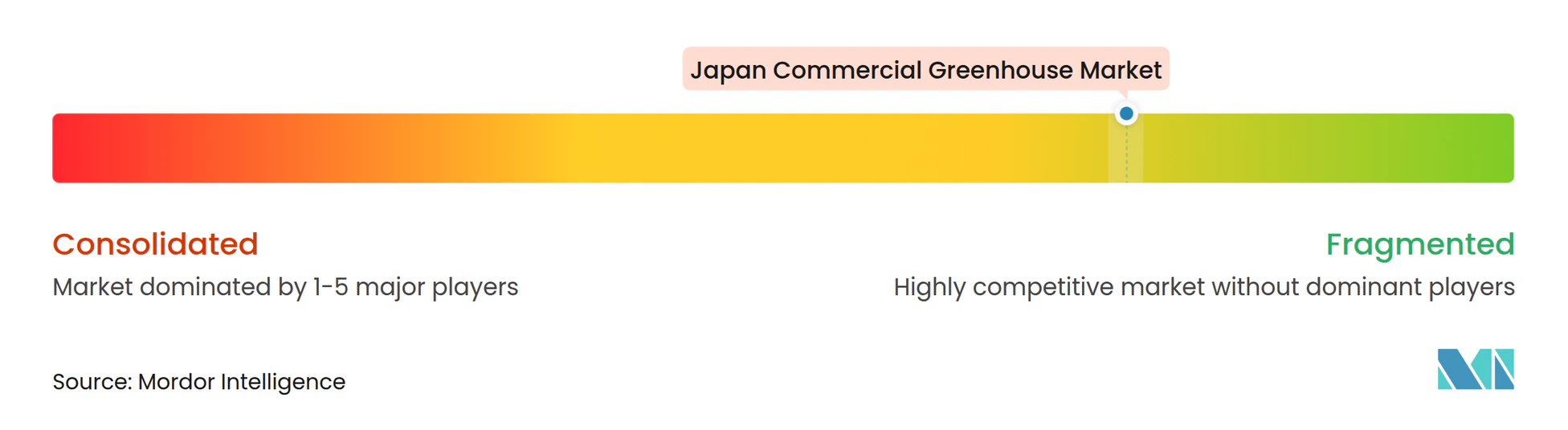
The Japan commercial greenhouse market is moderately fragmented, with competition distributed across multiple value-chain layers. Structure specialists, software providers, irrigation companies, screen manufacturers, and grower-operators each address different parts of a greenhouse project, so customers typically evaluate suppliers based on the specific equipment or service required. KUBO Group B.V. and Richel Group SAS compete in turnkey structure and facility design, where project design, climate requirements, and operating configuration are closely connected. Priva Holding B.V. and Hoogendoorn Growth Management B.V., part of Batenburg Techniek N.V., compete through climate software and sensor integration, which are important to operators seeking more detailed control of crop conditions. DENSO Corporation operates across structures, environmental control, and harvesting robotics, giving it exposure to several parts of an operator's investment plan.
In April 2025, DENSO Corporation and DELPHY GROEP BV signed a memorandum of understanding for data-driven smart horticulture, indicating a move toward combining equipment provision with cultivation support. This combined DENSO Corporation's environmental control and IoT capabilities with DELPHY GROEP BV's cultivation consulting services, addressing a part of the customer need that equipment-focused suppliers may not cover directly. Argus Control Systems Limited positions its Argus Axia platform as an open-architecture environmental control option for operators that need systems to work across different equipment suppliers. This approach addresses concerns about vendor lock-in at facilities using older and mixed automation systems, where integration costs can slow replacement decisions. In 2024, DENSO Corporation and Certhon launched Artemy, an automated cherry truss tomato harvesting robot with machine-vision and crate-management functions for high-production greenhouse operations.
Mebiol Inc. and Spread Co., Ltd. demonstrate how specialized cultivation technologies can influence equipment development beyond traditional greenhouse structures, particularly where production methods require different approaches to water, nutrients, and growing environments. Their role shows that commercial growers can also shape supplier roadmaps through operating experience, proven cultivation practices, and the performance requirements of a working facility. Compliance with the MIDORI Strategy and the GX-ETS framework favors vendors that can document energy-reduction performance and can support customers as they plan required equipment changes. The Japan commercial greenhouse market is therefore competitive in specialized applications, with no supplier able to control the full range of customer requirements from structures and controls to cultivation systems and operating support.
Japan Commercial Greenhouse Industry Leaders
-
DENSO Corporation
-
Netafim Ltd. (Orbia Advance Corporation, S.A.B. de C.V.)
-
Signify N.V.
-
Priva Holding B.V.
-
Spread Co., Ltd.
- *Disclaimer: Major Players sorted in no particular order
Japan Commercial Greenhouse Market Companies Covered in this Report
- DENSO Corporation
- Netafim Ltd. (Orbia Advance Corporation, S.A.B. de C.V.)
- Signify N.V.
- Priva Holding B.V.
- Spread Co., Ltd.
- Mirai Co., Ltd.
- KUBO Group B.V.
- Richel Group SAS
- Hoogendoorn Growth Management B.V. (Batenburg Techniek N.V.)
- Ridder Drive Systems B.V.
- AB Ludvig Svensson
- Palram Industries Ltd.
- Sakata Seed Corporation
- Mebiol Inc.
- Argus Control Systems Limited (Controlled Environments Limited)
Recent Industry Developments in Japan Commercial Greenhouse Market
- February 2026: MIRAI Co., Ltd. signed memoranda of understanding with four companies across Mongolia, Tajikistan, and the Philippines between December 2025 and February 2026 to expand its artificial-light plant factory projects overseas. The agreements cover plant factory cultivation systems, project planning, and operational and cultivation support, with MIRAI providing feasibility studies and consulting for projects in the three countries.
- April 2025: DENSO Corporation and DELPHY GROEP BV signed a memorandum of understanding to collaborate on data-driven smart horticulture, combining DENSO Corporation's greenhouse environmental control and IoT sensing technologies with DELPHY GROEP BV's cultivation expertise to develop integrated technology and agronomy solutions for commercial greenhouse operations.
- May 2024: DENSO Corporation and Certhon commercially launched Artemy, an automated cherry truss tomato harvesting robot equipped with machine-vision technology for crop maturity detection, automatic crate management, and trackless lane-change navigation. The system is designed for high-production tomato greenhouse operations and supports the automation of harvesting activities in commercial greenhouses.
Japan Commercial Greenhouse Market Report Scope
The commercial greenhouse market refers to the cultivation of crops in enclosed or partially enclosed structures that provide controlled or modified growing conditions. The market includes greenhouse structures and associated equipment and systems used for commercial crop production.
The Japan Commercial Greenhouse Market Report is Segmented by Equipment Type (Heating Systems, Cooling and Ventilation Systems, LED Grow Lighting, Irrigation and Fertigation Systems, Climate Control and Automation Software, Screening and Shading Systems, and Structural Components), by Crop Type (Fruits and Vegetables, Flowers and Ornamentals, Herbs and Microgreens, and Cannabis and Specialty Crops), by Greenhouse Type (Plastic-Film Greenhouses, Glass Greenhouses, Rigid Polycarbonate Greenhouses, and Hybrid and Semi-Closed Greenhouses), by Cultivation Technology (Hydroponic Systems, Non-Hydroponic Soil and Substrate Systems, Hybrid and Vertical Integration), and by End User (Commercial Growers, Research and Educational Institutes, and Retail Garden Centers and Nurseries). The Market Forecasts are Provided in Terms of Value (USD).
Segmentation Overview
| Heating Systems | |
| Cooling and Ventilation Systems | |
| LED Grow Lighting | |
| Irrigation and Fertigation Systems | |
| Climate Control and Automation Software | |
| Screening and Shading Systems | |
| Structural Components | Glazing Systems |
| Frames and Trusses |
| Fruits and Vegetables | Tomatoes |
| Cucumbers | |
| Lettuce and Leafy Greens | |
| Peppers | |
| Strawberries and Berries | |
| Flowers and Ornamentals | Cut Flowers |
| Potted Plants and Bedding Plants | |
| Herbs and Microgreens | |
| Cannabis and Specialty Crops | Medical Cannabis |
| Seedlings and Propagation Crops |
| Plastic-Film Greenhouses |
| Glass Greenhouses |
| Rigid Polycarbonate Greenhouses |
| Hybrid and Semi-Closed Greenhouses |
| Hydroponic Systems | Nutrient Film Technique |
| Deep Water Culture | |
| Drip Hydroponics | |
| Non-Hydroponic Soil and Substrate Systems | Soil-Based Systems |
| Coco Coir and Rockwool Substrate | |
| Hybrid and Vertical Integration |
| Commercial Growers |
| Research and Educational Institutes |
| Retail Garden Centers and Nurseries |
| By Equipment Type | Heating Systems | |
| Cooling and Ventilation Systems | ||
| LED Grow Lighting | ||
| Irrigation and Fertigation Systems | ||
| Climate Control and Automation Software | ||
| Screening and Shading Systems | ||
| Structural Components | Glazing Systems | |
| Frames and Trusses | ||
| By Crop Type | Fruits and Vegetables | Tomatoes |
| Cucumbers | ||
| Lettuce and Leafy Greens | ||
| Peppers | ||
| Strawberries and Berries | ||
| Flowers and Ornamentals | Cut Flowers | |
| Potted Plants and Bedding Plants | ||
| Herbs and Microgreens | ||
| Cannabis and Specialty Crops | Medical Cannabis | |
| Seedlings and Propagation Crops | ||
| By Greenhouse Type | Plastic-Film Greenhouses | |
| Glass Greenhouses | ||
| Rigid Polycarbonate Greenhouses | ||
| Hybrid and Semi-Closed Greenhouses | ||
| By Cultivation Technology | Hydroponic Systems | Nutrient Film Technique |
| Deep Water Culture | ||
| Drip Hydroponics | ||
| Non-Hydroponic Soil and Substrate Systems | Soil-Based Systems | |
| Coco Coir and Rockwool Substrate | ||
| Hybrid and Vertical Integration | ||
| By End User | Commercial Growers | |
| Research and Educational Institutes | ||
| Retail Garden Centers and Nurseries | ||
Key Questions Answered in the Report
What is the Japan commercial greenhouse market size?
The Japan commercial greenhouse market is estimated at USD 480 million in 2026 and is forecast to reach USD 770 million by 2031, growing at a CAGR of 9.80% from 2026 to 2031
What is driving the adoption of commercial greenhouses in Japan?
Food-security priorities, labor shortages, demand for traceable produce, and climate-related production risks are supporting the adoption of commercial greenhouses in Japan.
Which equipment type is growing fastest in the Japan commercial greenhouse market?
Climate Control and Automation Software is the fastest-growing equipment type in the Japan commercial greenhouse market, with a forecast CAGR of 13.8% from 2026 to 2031.
Which crop type accounts for the largest share of the Japan commercial greenhouse market?
Fruits and Vegetables accounted for 55.5% of the Japan commercial greenhouse market share in 2025, making it the largest crop type.