
Iran Liquid Packaging Cartons Market Size and Share
Market Overview
| Study Period | 2021 - 2032 |
|---|---|
| Forecast Data Period | 2027 - 2032 |
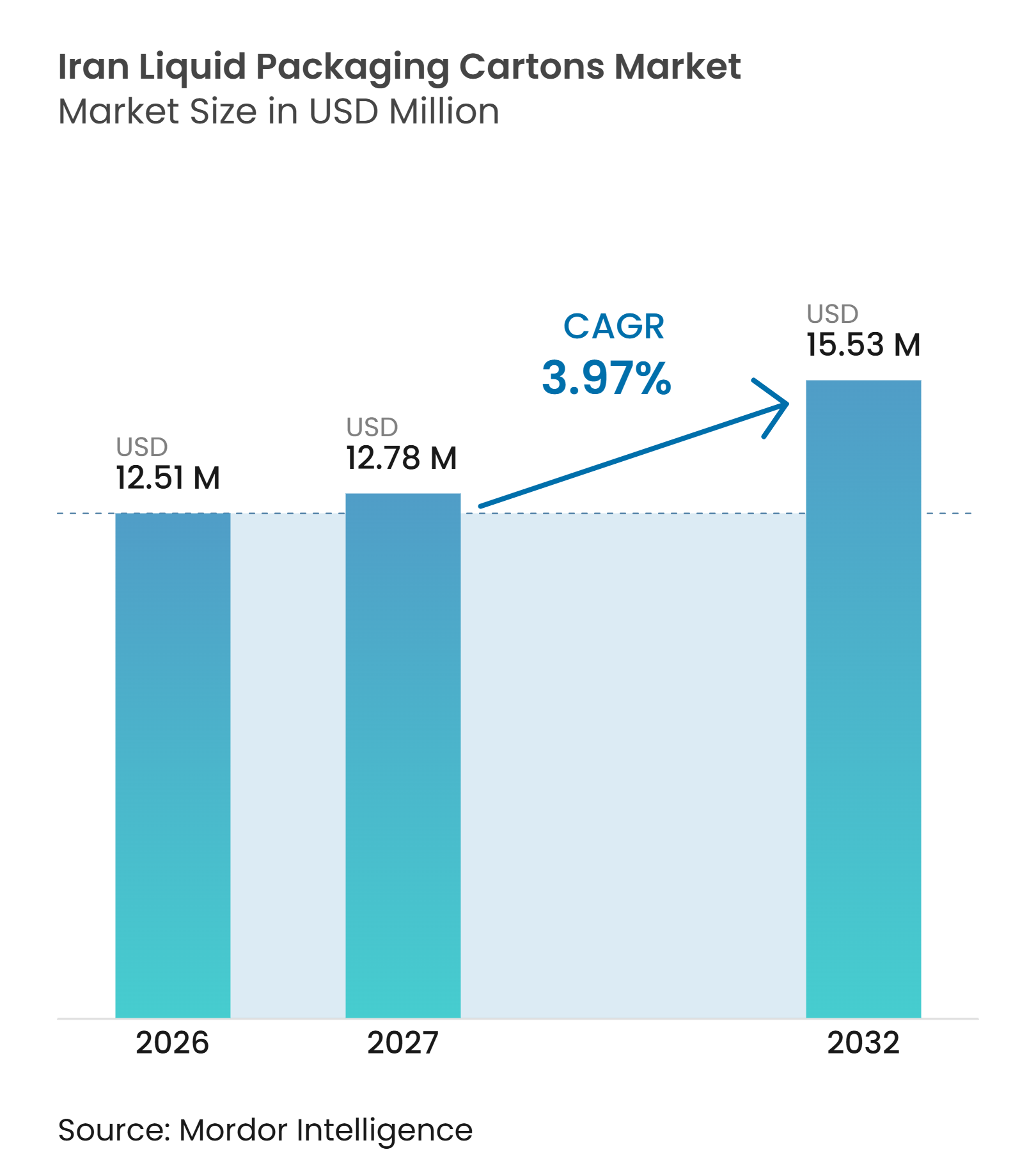
| Base Year Market Size (2026) | USD 12.51 Million |
| Market Size (2027) | USD 12.78 Million |
| Market Size (2032) | USD 15.53 Million |
| Growth Rate (2027 - 2032) | 3.97 % |
| Market Concentration | Medium |
Major Players *Disclaimer: Major Players sorted in no particular order Image © Mordor Intelligence. Reuse requires attribution under CC BY 4.0. | |
Iran Liquid Packaging Cartons Market Analysis by Mordor Intelligence
The Iran liquid packaging cartons market size is projected to be USD 12.51 million in 2026, USD 13.01 million in 2027, and reach USD 15.53 million by 2032, growing at a CAGR of 3.97% from 2027 to 2032. The Iran liquid packaging cartons market is supported by dairy processing volumes, established UHT filling capacity, and distribution routes that require products to remain safe and saleable without continuous refrigeration, especially in rural, semi-urban, and provincial areas that cannot rely on uniform cold-chain coverage. Aseptic formats remain closely matched to retail outlets and regional routes with uneven refrigeration because they help processors distribute UHT milk, juices, functional drinks, and selected liquid foods over longer distances, while giving retailers more flexibility in stock handling and reducing the practical dependence on chilled display infrastructure. Local converting activity is changing the supply structure as domestic producers replace some imported sleeves, and this shift can reduce exposure to procurement delays for finished formats even though converter operations still rely on imported aluminum foil and other barrier inputs needed to maintain standard aseptic performance.
Key Report Takeaways
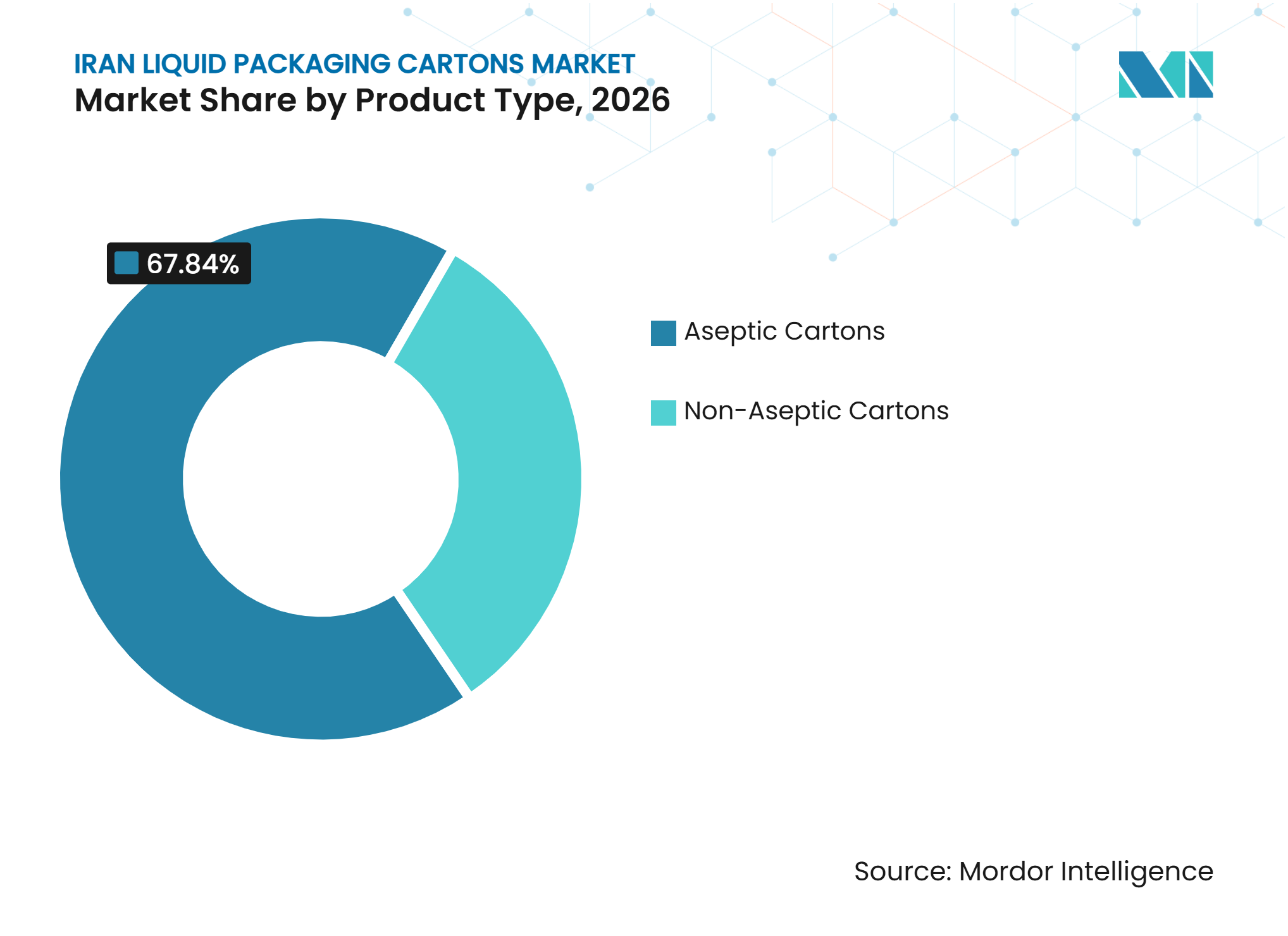
- By product type, aseptic cartons held 67.84% of the Iran liquid packaging cartons market share in 2026 and are projected to expand at a 4.76% CAGR through 2032.
- By application, milk accounted for 38.92% of the Iran liquid packaging cartons market size in 2026, while plant-based beverages are projected to expand at a 4.57% CAGR through 2032.
- By pack size, 250-500 ml formats held 43.69% of the Iran liquid packaging cartons market share in 2026, while below-250 ml formats are projected to expand at a 4.82% CAGR through 2032.
Note: Market numbers in this report are based on Mordor Intelligence's proprietary estimation framework, which combines nine months of actuals with Q4 projections for base year 2026.
Market Trends and Insights
Drivers Impact Analysis of Iran Liquid Packaging Cartons Market*
| Driver | (~) % Impact on CAGR Forecast | Geographic Relevance | Impact Timeline |
|---|---|---|---|
| Expansion of Ambient Dairy Distribution | +1.3% | National, with higher intensity in suburban and semi-urban corridors | Medium term (2-4 years) |
| Demand for Convenient Single-Serve Formats | +0.8% | National, with early gains in Tehran, Isfahan, and Mashhad | Short term (≤ 2 years) |
| Packaged Juice and Functional Beverage Premiumization | +0.7% | National, concentrated in urban organized retail | Medium term (2-4 years) |
| Sustainability-Led Substitution From Rigid Plastics | +0.5% | National, with early traction in organized retail and export-linked processors | Medium term (2-4 years) |
| Local Aseptic Converting and Import Substitution | +0.4% | National, centered in Tehran and Payam Special Economic Zone | Short term (≤ 2 years) |
| Rising Need for Longer Shelf Life in Weak Cold-Chain Channels | +0.3% | Rural and regional, with spillover to semi-urban distribution | Short term (≤ 2 years) |
| Source: Mordor Intelligence | |||
Expansion of Ambient Dairy Distribution
Iran’s UHT milk supply chain is a central source of demand for the Iran liquid packaging cartons market because processors must deliver perishable nutrition products across a large country with uneven refrigerated distribution. Dairy processors handle 8.5 million metric tons of raw milk annually, creating recurring demand for shelf-stable packaging through established collection, processing, filling, wholesale, and retail channels. Refrigerated transport is less available on rural and semi-urban routes, making ambient distribution necessary for processors that need dependable national reach and for distributors that cannot maintain uninterrupted temperature control. Iran exports UHT milk, cheese, and doogh to more than 30 countries, with Iraq accounting for more than 53% of dairy export volume during 2023-2025. UHT milk in aseptic cartons can retain sterility at no more than 25°C for 6-9 months, supporting commercial routes to Pakistan, Afghanistan, the Gulf states, and CIS markets, where transit times and local refrigeration capacity can vary. New export corridors can add carton volumes beyond domestic consumption, while the same packaging capability helps dairy processors maintain availability in provincial markets and manage inventories with fewer cold-chain interruptions.
Demand for Convenient Single-Serve Formats
Urban consumption patterns support single-serve cartons in the Iran liquid packaging cartons market because institutional buyers need hygienic, transportable, and easily portioned beverage formats. Iran’s urbanization rate is 76%, and school nutrition programs, hospital catering, office canteens, and similar settings have serving patterns that differ from rural household purchases. These settings support 125 ml to 250 ml aseptic cartons that can be stored before use, distributed in quantity, and consumed without requiring an on-site refrigeration system. Institutional orders can provide converters with a demand stream less dependent on supermarket traffic, which may help maintain volumes across varying retail conditions. Small cartons can reduce product waste when beverages are consumed outside the home and simplify stock handling for operators who serve many individual users in a short period. Food-contact material requirements set a quality threshold for these packs and limit competition based solely on lower prices, especially where buyers prioritize hygiene, printing quality, barrier consistency, and reliable carton sealing.
Packaged Juice and Functional Beverage Premiumization
Urban demand for packaged juice and functional beverages creates another source of growth for the Iran liquid packaging cartons market as beverage producers seek formats that protect products during storage and retail display. Premium beverage spending is concentrated in juices, functional drinks, and fortified dairy alternatives because alcohol is prohibited in Iran, which directs certain consumer occasions toward nonalcoholic packaged liquids. Plant-based beverages are projected to grow at a 4.57% CAGR through 2032 and draw on soy, sesame, and almond inputs available domestically. Domestic inputs can reduce exposure to imported ingredients when compared with categories that rely on tropical crops, while local sourcing can make supply planning less dependent on external procurement cycles. Aseptic cartons protect light-sensitive products and enable shelf-stable distribution, making them useful for functional beverages sold through retail outlets with varied handling conditions. Energy and functional drinks also compete with PET bottles in portion-controlled formats, allowing processors to use cartons where opaque packaging, measured servings, and longer ambient storage support the intended product position.
Sustainability-Led Substitution from Rigid Plastics
Cartons are competing with polypropylene containers and single-use plastic bottles in food-service and retail channels, although the commercial decision in Iran is shaped more by landed cost and input availability than by consumer willingness to pay for environmental features. This change can reduce the foreign-exchange burden associated with carton inputs compared with systems that rely more heavily on imported plastics and can provide converters with a more stable base for local procurement. Export-oriented processors also face closer scrutiny over packaging documentation, which can strengthen interest in materials with a clearer resource profile and strengthen the case for cartons in export-linked product lines. The substitution opportunity still depends on reliable barrier materials, hygienic converting, and suitable end-of-life arrangements, rather than on material substitution alone. The Iran liquid packaging cartons industry needs collection and recycling capacity before environmental claims become a broad competitive advantage, particularly for processors that need credible documentation for buyers in the European Union and Gulf Cooperation Council.
Restraints Impact Analysis of Iran Liquid Packaging Cartons Market*
| Restraint | (~) % Impact on CAGR Forecast | Geographic Relevance | Impact Timeline |
|---|---|---|---|
| Foreign-Exchange and Sanctions Exposure for Barrier Inputs | -0.4% | National | Short term (≤ 2 years) |
| Limited Carton Collection and Hydrapulping Infrastructure | -0.2% | National, most acute in mid-sized cities | Medium term (2-4 years) |
| Energy Rationing and Water Constraints at Converting Sites | -0.1% | National, most acute in converting hubs | Short term (≤ 2 years) |
| Low Consumer Willingness to Pay for Premium Pack Features | -0.07% | National | Long term (≥ 4 years) |
| Source: Mordor Intelligence | |||
Foreign-Exchange and Sanctions Exposure for Barrier Inputs
Iran does not produce pinhole-free 6-micron aluminum foil, a barrier layer used in standard aseptic cartons, so converters depend on imported laminate rolls and remain exposed to foreign-exchange allocation limits, trade-flow disruption, and procurement uncertainty. This dependence affects the Iran liquid packaging cartons market because barrier material is essential to the shelf-life performance that makes aseptic formats commercially viable. Procurement delays for laminate rolls have affected production scheduling.[1] The Iran Liquid Dairy Cooperative Union reported shortages of packaging materials, including Tetra Pak-style sleeves, at prices above earlier levels. Higher input costs can narrow converter margins, constrain working capital, and reduce resources available for domestic material investment, even when final demand for UHT products remains stable. Localized aseptic sleeve production was estimated to prevent USD 15 million in annual foreign-currency outflows, but it does not resolve dependence on aluminum foil or the need for reliable imported laminate inputs.
Limited Carton Collection and Hydrapulping Infrastructure
Iran lacks the collection-point density and hydrapulping capacity needed to recover liquid cartons at a meaningful scale, leaving a gap between carton production and post-consumer material recovery. Aseptic cartons contain 75% paperboard, 20% polyethylene, and 5% aluminum foil by weight, requiring dedicated hydrapulping equipment to separate the fiber from the poly-aluminum fraction. Domestic self-sufficiency in corrugated and folding cartons does not establish a comparable recovery system for post-consumer liquid cartons, since these materials need separate collection and specialized processing. This gap limits the sustainability position of the Iran liquid packaging cartons market in export-facing procurement and prevents converters from presenting a complete end-of-life proposition. Export buyers in the European Union and the Gulf Cooperation Council increasingly consider packaging-compliance evidence, thereby raising the value of collection, sorting, and recovery arrangements. Converters without a credible recovery pathway may face a weaker position with buyers seeking environmental documentation, even where cartons remain operationally suitable for product protection and ambient distribution.
*Our forecasts treat driver/restraint impacts as directional, not additive. The impact forecasts reflect baseline growth, mix effects, and variable interactions.
Iran Liquid Packaging Cartons Market Segment Analysis
By Product Type:
Aseptic Cartons Hold a Commanding LeadAseptic cartons held 67.84% of the Iran liquid packaging cartons market share in 2026 and are projected to expand at a 4.76% CAGR through 2032. Their lead reflects the need to distribute milk, juice, and liquid foods across routes without consistent refrigeration. Aseptic filling preserves product quality during long ambient routes and supports national retail reach. The format is therefore part of the distribution system, not simply a retail container. It allows processors to serve rural, regional, and urban channels from related product lines.
Domestic converting capacity is increasing in the Iranian liquid packaging cartons market, reducing dependence on imported sleeves. Local producers can supply several format sizes to match different retail and institutional uses. Iranian National Standards Organization food-contact rules apply to domestic and imported cartons and establish a quality threshold. European platforms maintain operating equipment effectiveness of 85-94%, compared with 60-75% for Chinese-assembled alternatives, as reported in the supplied research. Non-aseptic gable-top cartons retain a role for fresh dairy and chilled juices in Tehran and other cities with developed refrigerated retail. Their geographic reach remains narrower, so aseptic formats should continue to lead while cold-chain investment outside large cities progresses slowly.


By Applications:
Dairy Volumes Anchor Demand, Plant-Based Categories AccelerateMilk accounted for 38.92% of the Iran liquid packaging cartons market size in 2026. A developed UHT processing base allows processors to distribute aseptically packed milk into areas where fresh pasteurized products are less practical. This creates a recurring volume base for converters across retail and institutional channels. Cartons are also used for flavored milk, cream, and drinking yogurt. Food-contact requirements influence the barrier materials and polymer specifications used in these applications.
Plant-based beverages are projected to grow at a 4.57% CAGR through 2032. Soy, sesame, and almond have domestic supply bases that can reduce reliance on imported ingredients. Producers position these drinks around health and lactose-intolerance needs among urban consumers. Juices remain the second-largest application and require light protection and stable retail handling, while functional and energy drinks compete with PET bottles in portion-controlled formats. Soups, broths, and sauces remain underpenetrated applications, but ambient cartons can reduce refrigeration needs across uneven logistics routes. This mix broadens carton use beyond liquid milk and increases the value of flexible converting capability.
By Pack Size:
Mid-Sized Formats Lead as Small Packs ExpandThe 250-500 ml segment held 43.69% of the Iran liquid packaging cartons market size in 2026. School meal channels and corner-store dairy retail have reinforced this format over many years. Institutional specifications have helped maintain its role in regular beverage purchases. The format balances individual consumption with household needs. It is used for milk, flavored dairy, juice, and other ready-to-drink products.
Below-250 ml cartons are projected to grow at a 4.82% CAGR through 2032. Growth is linked to single-serve consumption, hospital catering, children’s beverage programs, and institutional food service. Small cartons support precise portions and can reduce handling needs compared with larger packs. Local production can reduce exposure to imported finished formats, while lower ticket purchases are relevant in a currency-sensitive consumer environment. Above-500 ml cartons hold the remaining share and grow more slowly, although they remain useful for household purchases and selected food-service requirements. This pack-size pattern favors converters that can manage several formats rather than a single production configuration.



Geography Analysis
Tehran and Central Iran
Tehran and Central Iran hold the country’s highest concentration of aseptic filling lines and carton converters. Tehran province accounts for 1-third of Iran’s manufacturing output and supports UHT production by Pegah Tehran, Mihan, and Kalleh. These processors create carton demand for milk, flavored milk, cream, and drinking yogurt. Modern retail supports both single-serve and 250-500 ml products. Online grocery services have widened access to carton-packed dairy and beverages in suburban districts. Tehran municipality’s fiber-recovery pilots could provide an early basis for a local recovery value chain. This creates a possible link between converter supply and municipal collection efforts.
Northwest Iran
Northwest Iran is a major dairy production area, with East Azerbaijan and Tabriz serving as a key source of UHT milk cartons. The region supplies northern and western routes and supports exports to Iraq and CIS markets. Iraq accounted for more than 53% of Iranian dairy export volume during 2023-2025.[2] Proximity to Turkey, Armenia, and Azerbaijan makes the region a cross-border logistics corridor. Local filling lines operate at higher utilization because processors combine domestic distribution with export requirements. Export revenue increases the commercial pressure to secure alternative barrier inputs during disruptions. This gives the region a faster response to supply risks than operations serving only domestic buyers.
Eastern, Southern, and Rural Iran
Eastern, southern, and rural areas depend on ambient aseptic formats because refrigerated distribution is uneven. Khorasan Razavi, Fars, and other provinces require shelf-stable milk and juice for provincial routes. Rural distribution often lacks refrigerated vehicles, leaving UHT cartons as a commercially practical option. Kerman and Yazd have attracted food-processing investment through agri-business zone incentives. Ahvaz and Shiraz have demand for functional beverages and premium juices linked to oil and gas-sector purchasing power. These products use aseptic formats in the supplied research. The regional pattern ties carton demand closely to infrastructure conditions as well as consumer choice.
Competitive Landscape
Market Concentration
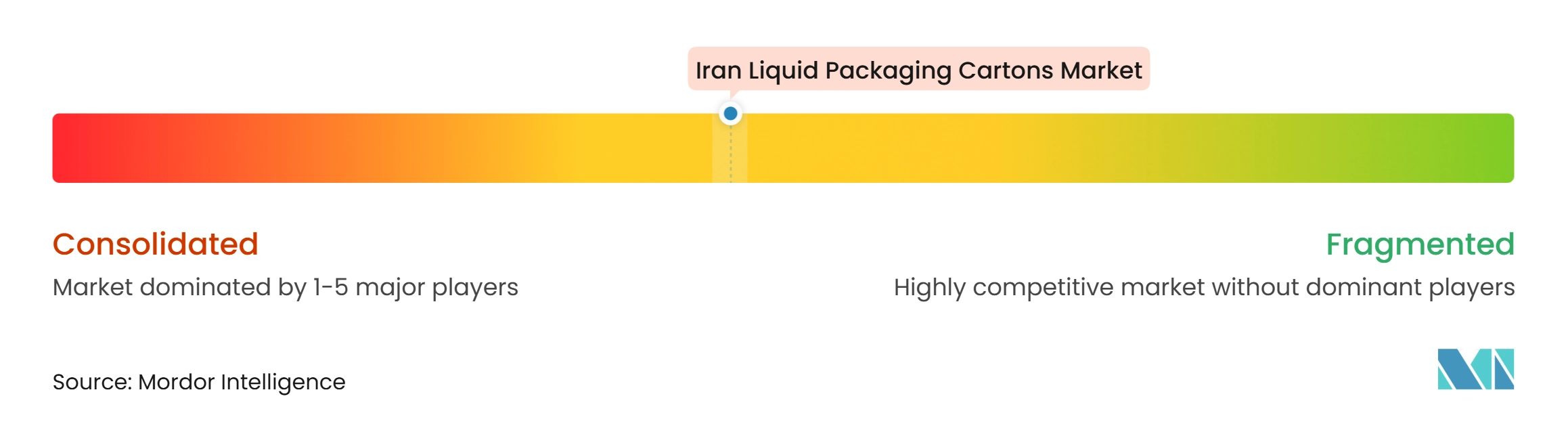
The Iran liquid packaging cartons market is moderately concentrated at the technology layer. Tetra Pak and SIG Group provide filling equipment and proprietary laminate systems, while domestic converters and Chinese producers contest conversion volumes. Chinese suppliers, including Greatview Aseptic Packaging and Xiamen Hexing Packaging, compete on equipment lead times and access to spare parts. The supplied research places their operating equipment effectiveness at 60-75%, compared with 85-94% for European platforms. This performance gap favors suppliers that offer reliable throughput and hygienic operating conditions.
SIG introduced Terra Alu-free + Full barrier, which removes aluminum from full-barrier aseptic cartons. The company reported up to 61% lower CO₂ emissions per carton under an ISO-compliant life-cycle assessment and up to 12 months’ shelf life on existing SIG filling lines. This technology is relevant to Iran's aluminum-dependence challenge. It also lets compatible filling lines remain in service without equipment replacement. The approach strengthens differentiation around supply resilience and environmental documentation.
Domestic converters, including Pad Alvan Pack Company, are capturing sleeve and carton volumes that were previously imported. Iran’s converter base exports multi-layer sleeves to more than 10 countries. National Standards Organization requirements discourage low-investment entrants that cannot meet food-contact, hygiene, and barrier requirements. No domestic player has built a broad post-consumer fiber-recovery offering for liquid cartons. SIG and ITT Flow Technologies expanded their Dubai test-center collaboration in July 2025 with a 1,000-liter fermentation line to support trials of viscous dairy and plant-based products before a full-scale investment.[3] Partnerships with municipal waste authorities remain an open route for domestic converters seeking a stronger export-facing proposition.
Iran Liquid Packaging Cartons Industry Leaders
-
Tetra Pak International S.A.
-
SIG Group AG
-
Pad Alvan Pack Co.
-
Keysun Pak Packaging Industry Co.
-
Nippon Paper Industries Co., Ltd.
- *Disclaimer: Major Players sorted in no particular order
Iran Liquid Packaging Cartons Market Companies Covered in this Report
- Tetra Pak International S.A.
- SIG Group AG
- Pad Alvan Pack Co.
- Keysun Pak Packaging Industry Co.
- Nippon Paper Industries Co., Ltd.
- UFlex Limited
- IPI S.r.l.
- Lami Packaging (Kunshan) Co., Ltd.
- Novolex Holdings, LLC
- Obeikan Investment Group
- Italpack S.r.l.
- Parksons Packaging Ltd.
- Shandong Bihai Packaging Materials Co., Ltd.
- Southern Packaging Group Ltd.
- Lamipak (Suzhou) Co., Ltd.
- Xiamen Hexing Packaging Group Co., Ltd.
- Pad Alvan Pack Company
Recent Industry Developments in Iran Liquid Packaging Cartons Market
- October 2026: Industry stakeholders convened in Tehran for IPAP & pacprocess 2026, Iran’s 13th International Printing, Packaging and Processing Exhibition, to address supply chain localization and barrier-material alternatives for liquid food and beverage lines. Amid ongoing foreign-exchange constraints on European Tetra Pak and SIG spare parts, domestic converters and beverage fillers focused on qualifying Asian-assembled aseptic filling components and on optimizing cartonboard grammage to reduce dependence on imported polymer and foil.
- September 2026: Iranian trade and customs authorities reinforced the "import-for-export" foreign exchange allocation framework under Export FX Return Taskforce guidelines, granting processed food and beverage exporters up to 70% foreign-currency repatriation exemptions to procure imported aseptic packaging materials and machinery spare parts.
- April 2026: Maritime blockades and port restrictions across the Persian Gulf during the Strait of Hormuz crisis disrupted seaborne imports of virgin bleached paperboard, multi-layer aseptic laminate rolls, and 6-micrometer pinhole-free aluminum barrier foil.
- March 2026: The Government of Iran enacted an emergency export ban on targeted food and dairy commodities to stabilize domestic supply following the outbreak of regional conflict and disruptions across the Strait of Hormuz. Because Iran's dairy processors rely on aseptic brick cartons to ship UHT milk, cream, and flavored dairy products to primary export markets such as Iraq, Russia, and Central Asia, the restriction curtailed export-oriented carton filling runs and shifted converter output toward domestic retail formats.
Iran Liquid Packaging Cartons Market Report Scope
The Iran liquid packaging cartons market comprises the production, distribution, and sale of carton-based packaging solutions used for liquid food and beverage products, including milk, juices, dairy drinks, and other beverages. These cartons typically consist of paperboard combined with layers of plastic and, in some cases, aluminum to protect product quality and extend shelf life.
The Iran Liquid Packaging Cartons Market Report is Segmented by Product Type (Aseptic Cartons, and Non-Aseptic Cartons), Applications (Milk, Juices, Plant Based Beverages, Dairy Products Excluding Milk, Energy and Functional Drinks, Liquid Food, and Other Applications), and Pack Size (Below 250 Ml, 250-500 Ml, and Above 500 Ml). The Market Forecasts are Provided in Terms of Value (USD).
Segmentation Overview
| Aseptic Cartons |
| Non-Aseptic Cartons |
| Milk |
| Juices |
| Plant Based Beverages |
| Dairy Products (Excluding Milk) |
| Energy and Functional Drinks |
| Liquid Food |
| Other Applications |
| Below 250 ml |
| 250-500 ml |
| Above 500 ml |
| By Product Type | Aseptic Cartons |
| Non-Aseptic Cartons | |
| By Applications | Milk |
| Juices | |
| Plant Based Beverages | |
| Dairy Products (Excluding Milk) | |
| Energy and Functional Drinks | |
| Liquid Food | |
| Other Applications | |
| By Pack Size | Below 250 ml |
| 250-500 ml | |
| Above 500 ml |
Key Questions Answered in the Report
What is the size of the Iran liquid packaging cartons market?
The Iran liquid packaging cartons market size is projected to be USD 12.51 million in 2026 and USD 13.01 million in 2027. It is forecast to reach USD 15.53 million by 2032 at a 3.97% CAGR.
Which product type leads liquid carton demand in Iran?
Aseptic cartons lead with 67.84% share in 2026 and are projected to expand at a 4.76% CAGR through 2032.
What applications support liquid carton demand in Iran?
Milk is the largest application with 38.92% share in 2026. Plant-based beverages are the fastest-growing application at a projected 4.57% CAGR through 2032.
Which pack size is growing fastest in Iran?
Below-250 ml cartons are projected to expand at a 4.82% CAGR through 2032, supported by single-serve and institutional consumption.
What limits liquid carton supply in Iran?
Converters rely on imported pin-hole-free 6-micron aluminum foil and laminate rolls, while recovery capacity remains limited.