
IoT ESIM Remote Provisioning Market Size and Share
Market Overview
| Study Period | 2021 - 2032 |
|---|---|
| Market Size (2027) | USD 2.24 Billion |
| Market Size (2032) | USD 6.17 Billion |
| Growth Rate (2027 - 2032) | 22.46 % |
| Fastest Growing Market | Asia-Pacific |
| Largest Market | Europe |
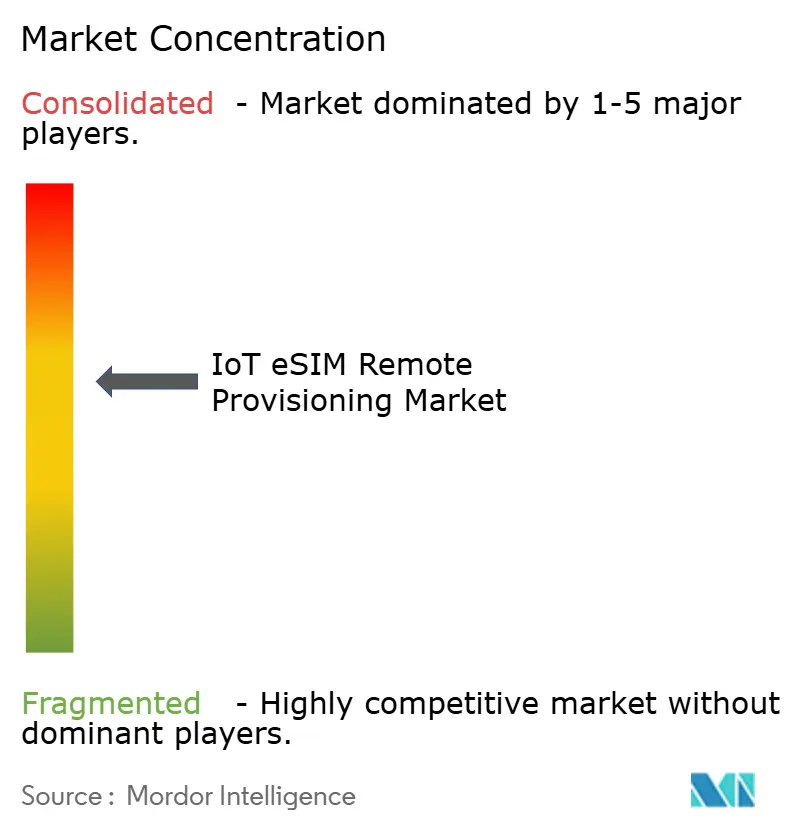
| Market Concentration | Medium |
Major Players *Disclaimer: Major Players sorted in no particular order Image © Mordor Intelligence. Reuse requires attribution under CC BY 4.0. | |
IoT ESIM Remote Provisioning Market Analysis by Mordor Intelligence
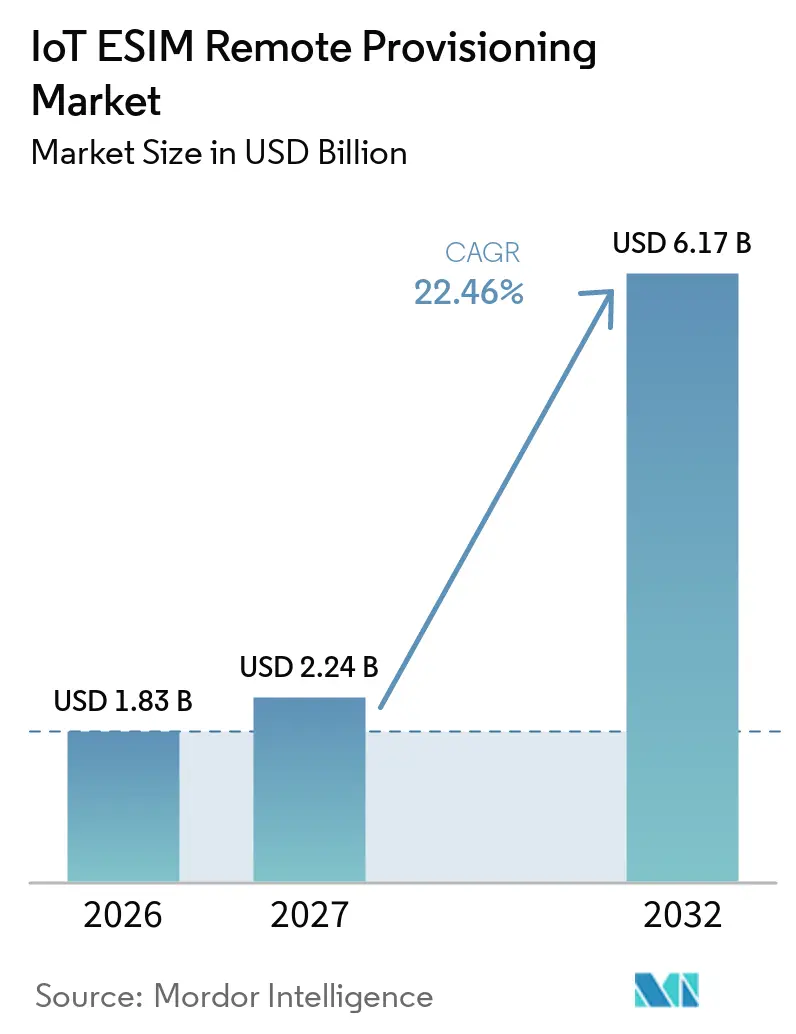
The IoT eSIM Remote Provisioning Market size is projected to expand from USD 1.83 billion in 2026 and USD 2.24 billion in 2027 to USD 6.17 billion by 2032, registering a CAGR of 22.46% between 2027 and 2032. Commercial adoption of the GSMA SGP.32 specification is moving provisioning away from SMS-based processes toward an IP-native model that suits unattended IoT devices. The Trusted Connectivity Alliance reported a fivefold increase in the number of Subscription Manager platforms capable of downloading SGP.32 profiles in the first half of 2026, compared with all of 2025, pointing to a shift from trials to deployable infrastructure. The IoT eSIM remote provisioning market is also benefiting from connected fleets that need local profiles across borders without replacing physical SIMs. Certification, platform interoperability, and access to SM-DP+ systems will shape how quickly suppliers convert technical readiness into revenue. Providers that combine compliant eUICC technology, orchestration, and operator partnerships are likely to be better positioned as large deployments move from planning to fleet operations.
Key Report Takeaways
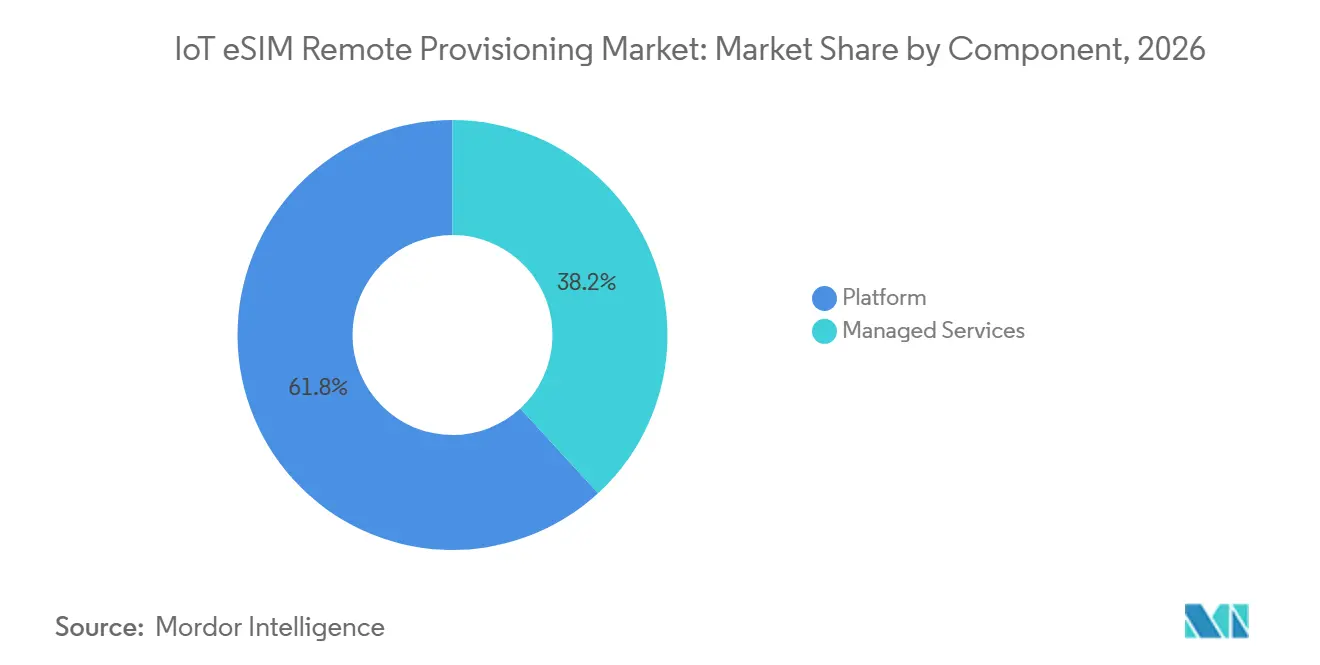
- By component, platforms held 61.84% of the IoT eSIM remote provisioning market share in 2026 and are projected to expand at a 24.13% CAGR through 2032.
- By enterprise size, large enterprises accounted for 69.37% of the IoT eSIM remote provisioning market share in 2026, while small and medium enterprises are projected to expand at a 24.08% CAGR through 2032.
- By deployment, cloud held 60.72% of the IoT eSIM remote provisioning market share in 2026, while hybrid deployment is projected to expand at a 24.21% CAGR through 2032.
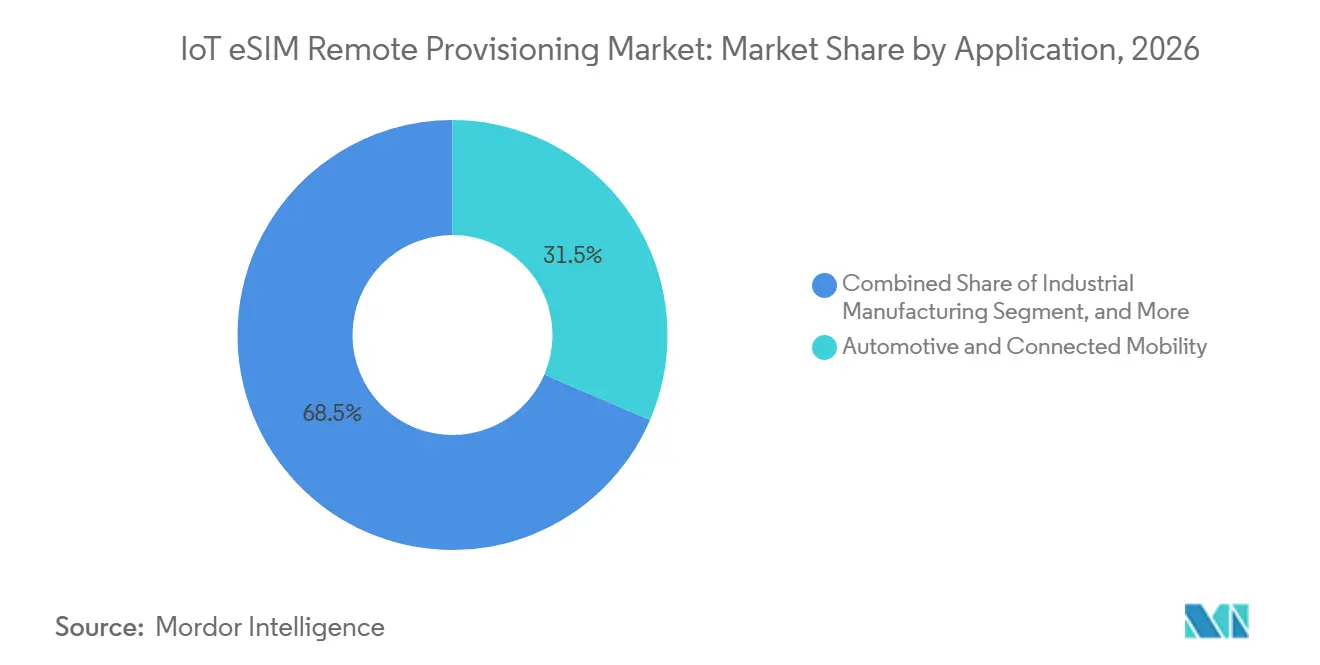
- By application, automotive and connected mobility held 31.46% of the IoT eSIM remote provisioning market share in 2026, while energy and utilities are projected to expand at a 24.32% CAGR through 2032.
- By end-user, mobile network operators held 30.68% of the IoT eSIM remote provisioning market share in 2026, while MVNOs and IoT connectivity providers are projected to expand at a 24.17% CAGR through 2032.
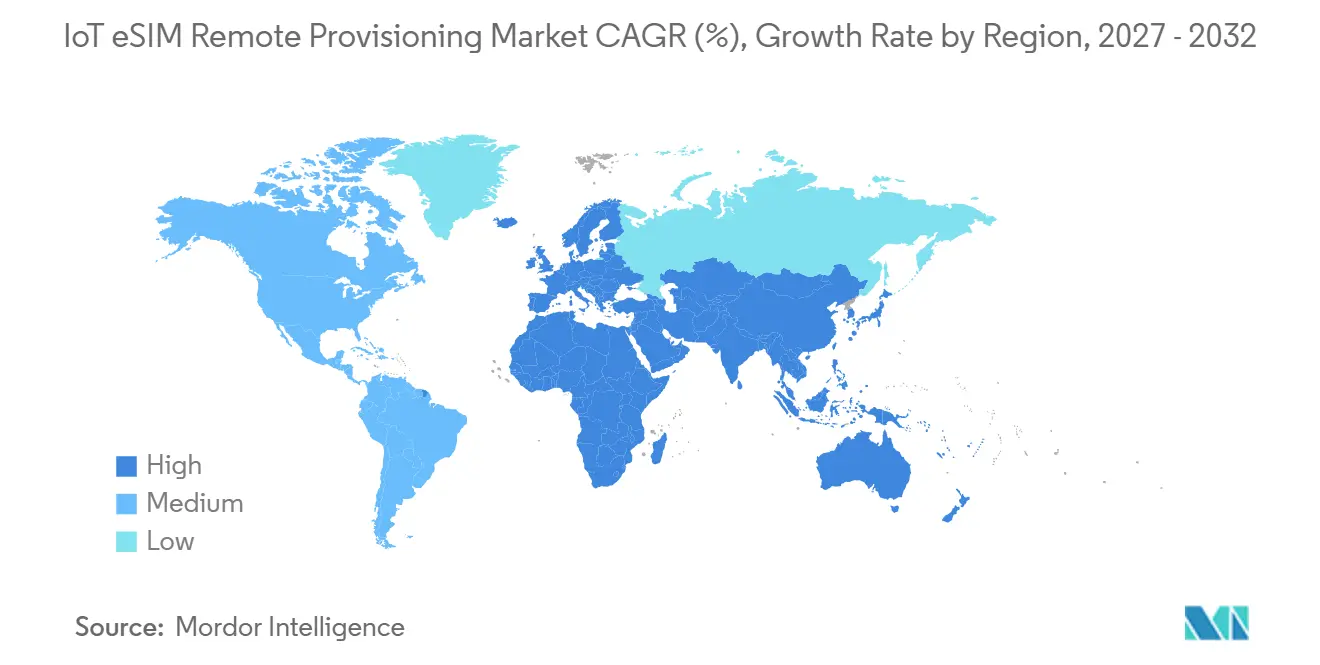
- By geography, Europe held 34.82% of the IoT eSIM remote provisioning market share in 2026, while Asia-Pacific is projected to expand at a 24.36% CAGR through 2032.
Note: Market numbers in this report are based on Mordor Intelligence's proprietary estimation framework, which combines nine months of actuals with Q4 projections for base year 2026.
Market Trends and Insights
Drivers Impact Analysis of IoT ESIM Remote Provisioning Market*
| Driver | (~) % Impact on CAGR Forecast | Geographic Relevance | Impact Timeline |
|---|---|---|---|
| SGP.32 Standardization and Certification Momentum | +7.5% | Global | Short term (≤ 2 years) |
| Cross-Border Cellular IoT Deployments | +5.8% | Global, especially Asia-Pacific and Europe | Medium term (2-4 years) |
| Remote Lifecycle Management and Lower Total Cost of Ownership | +4.2% | North America and Europe core, global spill-over | Medium term (2-4 years) |
| Connected Vehicles and Industrial IoT Fleets | +3.6% | North America, Europe, Asia-Pacific | Medium term (2-4 years) |
| Legacy SGP.02 Fleet Replacement Window | +2.4% | Europe, North America, Asia-Pacific core | Long term (≥ 4 years) |
| Indirect Profile Download for NB-IoT and LPWAN Devices | +1.8% | Asia-Pacific core, Europe, spill-over to Middle East | Long term (≥ 4 years) |
| Source: Mordor Intelligence | |||
SGP.32 Standardization and Certification Momentum
The SGP.32 specification is a central driver of the IoT eSIM remote provisioning market because it establishes a standardized link between eSIM and SM-DP+ systems. It replaces proprietary, bilateral SM-SR integrations that limited interoperability across vendors. Secure Transactions became the first company to certify both an eUICC and an eIM under the GSMA IoT Compliance Scheme in August 2025.[1] Valid received GSMA eSA certification for its SGP.32 IoT eUICC in August 2026, using Infineon's TEGRION SLx22 secure element.[2] As more products achieve certification, MNOs face greater pressure to open SM-DP+ access to compatible eIM providers. This makes the IoT eSIM remote provisioning market more accessible to operators and device makers seeking multi-vendor deployment options.
Growth of Cross-Border Cellular IoT Deployments
Cross-border deployments support the IoT eSIM remote provisioning market because physical SIM logistics become difficult when fleets operate across national boundaries. Long-lived assets can encounter permanent roaming limits that require a local connectivity profile or a different commercial arrangement. GSMA expects IoT connections to increase from 4 billion to 6 billion by 2030, with more than half of new connections using eSIM and remote SIM provisioning. Locally hosted profile management has gained relevance in countries where data residency rules affect connectivity design, including Brazil. BICS launched its eSIM Hub in April 2025 to manage connectivity across 190 countries and 700+ operators.[3] Such platforms allow fleet managers to treat profile selection as an operational task rather than a device-replacement project.
Remote Lifecycle Management Reducing Truck Rolls and Total Cost of Ownership
Remote lifecycle management is strengthening the IoT eSIM remote provisioning market by allowing fleet owners to change profiles without sending technicians to devices. This benefit is most important for meters, industrial assets, and sealed equipment that are expensive to reach. Utilities are assessing remote provisioning for smart-meter fleets because profile changes can otherwise require a physical intervention. This use case gives operational scale to the value of secure, long-lived connectivity management. Metering buyers can therefore evaluate connectivity choices across the full operating life of an asset, rather than only at installation. This raises the importance of platform reliability, certified security, and operator flexibility in procurement decisions.
Expansion of Connected Vehicles and Industrial IoT Fleets
Connected vehicle programs support the IoT eSIM remote provisioning market because manufacturers need devices that can operate in multiple countries over long product lifecycles. A single hardware configuration can reduce complexity when local operator and roaming conditions differ among export markets. The need to distribute vehicles internationally illustrates how in-vehicle profile management can support a common eSIM hardware design. SGP.32 can also support software-defined vehicles by linking connectivity policies with over-the-air software updates. Industrial equipment makers are following the same approach as they seek durable, remotely manageable connectivity for gateways and field devices.
Restraints Impact Analysis of IoT ESIM Remote Provisioning Market*
| Restraint | (~) % Impact on CAGR Forecast | Geographic Relevance | Impact Timeline |
|---|---|---|---|
| Certification and Commercial Agreement Bottlenecks | -1.5% | Global | Short term (≤ 2 years) |
| Fragmented Operator Support and Buyer Concern About Vendor Lock-In | -1.1% | Asia-Pacific, South America, Africa | Medium term (2-4 years) |
| Interoperability Gaps at eUICC, eIM, and SM-DP+ Seams | -0.7% | Global, more acute in Asia-Pacific and South America | Medium term (2-4 years) |
| Fixed eUICC Operating Systems Preventing Over-the-Air Migration to SGP.32 | -0.4% | North America, Europe, legacy fleet | Long term (≥ 4 years) |
| Source: Mordor Intelligence | |||
Certification and Commercial Agreement Bottlenecks
Certification and commercial agreements limit the speed of adoption in the IoT eSIM remote provisioning market. Technical readiness alone does not grant an eUICC vendor access to an operator's SM-DP+ platform. GSMA reported in 2025 that only a small number of eUICC products had completed eSA certification, while many more remained in the process.[4] The scheme requires rigorous evaluation and relies on a limited set of accredited laboratories. Vendors must also negotiate profile-download terms with individual platform operators after certification. This can favor larger suppliers that have the legal resources, established relationships with operators, and commercial scale to manage many parallel agreements.
Fragmented Operator Support and Buyer Concern About Vendor Lock-In
Operator readiness remains uneven, which can restrain the IoT eSIM remote provisioning market despite the standard's multi-vendor design. In some regions, operators may not yet have the technical capability or commercial reason to expose SM-DP+ endpoints to external eIM platforms. Buyers must also assess whether moving an in-field fleet to a different platform will be practical under the existing eUICC operating system and agreement conditions. Proprietary analytics and lifecycle tools can introduce switching costs beyond basic provisioning. The result is a cautious procurement approach among large enterprises that want more than one viable operator and platform option. It also creates demand for clear interoperability commitments before a buyer selects a provider for a long-lived fleet.
*Our forecasts treat driver/restraint impacts as directional, not additive. The impact forecasts reflect baseline growth, mix effects, and variable interactions.
IoT ESIM Remote Provisioning Market Segment Analysis
By Component:
Platform Architecture Anchors Value CreationThe platform segment held 61.84% of the market in 2026. This position reflects the investment required to develop and maintain certified SM-DP+, eIM, and orchestration capabilities. Enterprises increasingly favor full-stack platforms that combine eUICC lifecycle control, profile orchestration, and analytics. That preference reduces the appeal of managed-service offerings that only sit around the provisioning layer. The IoT eSIM remote provisioning market size for platforms is projected to expand at a 24.13% CAGR through 2032. This indicates that platform deployments are still accelerating as SGP.32 commercial use widens.
Managed services continue to serve customers without dedicated IoT connectivity teams. Their role is important for buyers who need operational support but do not wish to manage provisioning tools directly. At the same time, easier access to cloud platforms is enabling more self-service implementations. Aeris introduced eIM-as-a-Service capabilities in October 2026 for MNOs, OEMs, and enterprises that need SGP.32 orchestration without having to build bespoke infrastructure. G+D expanded its cloud collaboration in March 2025 to support eSIM services through its AirOn360 platform. These offerings can lower entry barriers while retaining the importance of secure, certified platform operations.
By Enterprise Size:
SME Access Broadens the Customer BaseLarge enterprises accounted for 69.37% of the IoT eSIM remote provisioning market in 2026. Automotive OEMs, multinational logistics companies, and global utilities were early users because their fleet sizes could justify integration costs. Many of these organizations also operated legacy SGP.02 and SGP.22 fleets that require coordinated management. SMEs are projected to expand at a 24.08% CAGR through 2032. Platform-as-a-service and eIM-as-a-Service models are making remote provisioning more accessible to smaller product companies. The IoT eSIM remote provisioning industry is therefore reaching customers that may not have negotiated direct MNO integrations in the past.
Cloud-native service models can support fleets of 1,000 to 10,000 devices without the earlier burden of custom backend work. This changes the commercial threshold for connected-product companies that need multi-country service. Tata Communications' MOVE platform is integrated with Cisco's IoT Control Center, which supports more than 270 million SIM IoT devices across 32,000 enterprises. The example shows how existing enterprise platforms can add SGP.32 capabilities without requiring a separate procurement path. Larger organizations, meanwhile, are seeking a common interface for several eSIM standards. This puts a premium on orchestration tools that can work across old and new device fleets. The IoT eSIM remote provisioning market is therefore broadening beyond early adopters with large connectivity teams.
By Deployment:
Cloud Leadership Meets Regulated-Use RequirementsCloud deployments commanded 60.72% of the market in 2026. Cloud-hosted SM-DP+ and eIM platforms can accommodate peak profile downloads when fleets are activated. They also reduce the capital commitment associated with on-premises hardware and certification. On-premises deployments remain relevant where data sovereignty or critical-infrastructure rules restrict cloud traffic. Hybrid deployment is projected to expand at a 24.21% CAGR through 2032. The IoT eSIM remote provisioning market is adopting hybrid models that combine local control over sensitive decisions with certified cloud-based profile storage.
Utilities, defense organizations, and critical-infrastructure operators are key users of this model. BICS explains that SGP.32 separates roles that can be distributed across enterprise and service-provider environments. Telefónica has shown how the SGP.32 design can be combined with post-quantum cryptographic certificates for smart-meter provisioning. European device manufacturers are also placing greater emphasis on lifecycle security and documentation. This makes hybrid architecture a practical choice for compliance, as well as for technology and cost.
By Application:
Automotive Scale Meets Utility RequirementsAutomotive and connected mobility held 31.46% of the market in 2026. Global vehicle programs need a common eSIM design that can be deployed across countries with different operator environments. Automotive OEMs also need a connectivity approach that lasts through long vehicle lifecycles. Industrial manufacturing, logistics, and transportation remain important applications because asset location and service continuity affect operations. Energy and utilities are projected to expand at a 24.32% CAGR through 2032. The IoT eSIM remote provisioning market size for this application benefits from the advanced metering infrastructure that requires remote profile management over the years of use.
Smart-meter programs use cellular connectivity for assets that can remain in the field for 15 to 20 years. Kigen describes how in-factory profile provisioning can bind utility meter profiles at production and allow remote reprovisioning later. This gives utilities a way to respond when network arrangements or operator coverage change. Healthcare and medical devices are currently the smallest application group. They present an opportunity where security assurance and device authentication are important. Demand in these areas will depend on suppliers demonstrating secure lifecycle management that fits established medical-device controls.

By End User:
Operator Scale and MVNO Entry Reshape CompetitionMobile network operators held 30.68% of the market in 2026. They act as both identity issuers and connectivity resellers, which makes provisioning platforms important to enterprise IoT programs. Device OEMs are also increasing their involvement as eSIM lifecycle management becomes part of product design. IoT solution providers and system integrators contribute by embedding orchestration within wider smart-city, logistics, and industrial platforms. MVNOs and IoT connectivity providers are projected to expand at a 24.17% CAGR through 2032. This is changing the IoT eSIM remote provisioning industry by allowing non-facilities-based providers to offer multi-operator connectivity without owning radio infrastructure.
SGP.32 separates eIM orchestration from SM-DP+ ownership, which gives independent providers a clearer role in the value chain. emnify introduced its SGP.32 eSIM at Mobile World Congress 2026 with support for third-party operator profiles through its IoT SuperNetwork. The model focuses on competition on orchestration flexibility and programmable integration rather than only on network coverage. Enterprises remain a smaller group of direct end users. However, some large industrial companies are building internal eIM capabilities for asset tracking and distributed energy resource management. Their participation can increase demand for platforms that connect to multiple operator relationships from a single control point. The IoT eSIM remote provisioning market benefits when those connections can be managed without separate tools for each operator.
Geography Analysis
Europe IoT ESIM Remote Provisioning Market
Europe held 34.82% of the market in 2026. The region benefits from a regulatory environment that places greater weight on security, product lifecycle management, and data portability. European connected-product requirements raise the compliance burden for proprietary or non-upgradeable connectivity stacks. They make certified, lifecycle-managed architectures more relevant to manufacturers. Germany, the United Kingdom, France, and Italy have large concentrations of industrial IoT and automotive activity. Telenor IoT announced in February 2026 that it would begin commercial deliveries of SGP.32 SIM cards on April 17, 2026.
APAC IoT ESIM Remote Provisioning Market
Asia-Pacific is projected to expand at a 24.36% CAGR through 2032. China's domestic eSIM module ecosystem, India's digital infrastructure agenda, and the region's permanent-roaming constraints support adoption. In 2025, Tata Communications stated that it was supporting BSNL's pan-India eSIM services. South Korea, Japan, and Australia have established MNO roadmaps for SGP.32. Southeast Asian markets are also responding to national data-residency requirements that favor locally hosted eSIM profiles. The IoT eSIM remote provisioning market in the region, therefore, depends on both fleet expansion and the ability to meet local connectivity rules.
The Americas and MEA IoT ESIM Remote Provisioning Market
North America remains a large, technologically advanced segment of the IoT eSIM remote provisioning market, driven by demand from automotive, utilities, and industrial automation. Suppliers in the region are developing SGP.32 platforms that support globally shipped devices and local profile activation without physical access. Canada and Mexico extend demand from United States-based IoT programs, while Mexico's manufacturing exports support automotive supply-chain use cases. South America, the Middle East, and Africa remain smaller opportunity areas. Brazil's locally hosted SGP.32 eIM arrangement illustrates how national requirements shape platform adoption. Utility smart-meter deployments in the Gulf Cooperation Council also provide a near-term entry point for suppliers with energy-focused offerings.
Competitive Landscape
The IoT eSIM remote provisioning market is moderately concentrated at the eUICC and SM-DP+ platform level. Thales S.A., Giesecke+Devrient GmbH, and IDEMIA Secure Transactions form the leading group, supported by certified technology, operator relationships, and large deployment experience. Their position is reinforced by the cost and time required to achieve security certification and commercial access. A second group of IoT MVNOs, cloud-native connectivity providers, and orchestration specialists creates more fragmented competition below this tier. These providers compete through API-led integration, analytics, and multi-operator flexibility. The IoT eSIM remote provisioning market, therefore, combines a concentrated infrastructure layer with a broader group of service and orchestration competitors.
Kigen has developed a differentiated position around iSIM integration and eIM software, rather than traditional physical SIM manufacturing. Its eIM achieved GSMA SAS-SM accreditation, and Kigen Pulse offers a unified management interface across several eSIM generations. Cisco and Tata Communications provide another strategic example by integrating the MOVE platform with Cisco's IoT Control Center. This approach builds customer retention around enterprise workflows instead of hardware alone. Aeris also launched an eSIM Orchestrator in October 2026 with open eIM integration across Thales, G+D, Kigen, and IDEMIA. These moves show why interoperability and management depth are becoming key sources of differentiation.
Healthcare and smart agriculture remain areas where providers can develop more specialized workflows for constrained devices. Indirect profile download can be useful where devices have limited power or bandwidth for direct SM-DP+ communication. The next competitive phase also includes in-factory profile provisioning for automotive and consumer electronics programs. Suppliers that qualify early can seek design wins before production decisions are finalized. Certification alone will not guarantee success because buyers also need practical access to multiple operator profiles. The IoT eSIM remote provisioning market will continue to be shaped by the balance among vendor openness, commercial agreements, and the operational value delivered to fleet owners.
IoT ESIM Remote Provisioning Industry Leaders
-
Thales S.A.
-
Giesecke+Devrient GmbH
-
IDEMIA Secure Transactions
-
Kigen (UK) Limited
-
Tata Communications Limited
- *Disclaimer: Major Players sorted in no particular order
IoT ESIM Remote Provisioning Market Companies Covered in this Report
- Thales S.A.
- Giesecke+Devrient GmbH
- IDEMIA Secure Transactions
- Kigen (UK) Limited
- Tata Communications Limited
- 1NCE GmbH
- Aeris Communications, Inc.
- Valid Solucoes S.A.
- Workz Group Limited
- Redtea Mobile Pte. Ltd.
- 1GLOBAL Limited
- BICS SA/NV
- Eseye Limited
- emnify GmbH
- Soracom, Inc.
- Cisco Systems, Inc.
- KORE Group Holdings, Inc.
- Eastcompeace Technology Co., Ltd.
- Transatel S.A.S.
- Vodafone Group Plc
Recent Industry Developments in IoT ESIM Remote Provisioning Market
- October 2026: Aeris launched its next-generation Aeris eSIM Orchestrator with full GSMA SGP.32 support, introducing eIM-as-a-Service (eIMaaS), single-SKU eSIM, and multi-eIM integration for MNOs, OEMs, and enterprises to scale global IoT deployments; the platform supports open eIM integrations with Thales, G+D, Kigen, and IDEMIA, positioning Aeris as a neutral orchestration layer rather than a closed ecosystem.
- August 2026: Valid achieved GSMA eSA certification for its SGP.32 IoT eUICC based on Infineon's TEGRION SLx22 secure element, becoming the first company globally to certify an eUICC using that chip family; the achievement advances Valid's broader SGP.32 proposition, including its eIM for standards-based remote profile and lifecycle management.
- April 2026: KORE Group Holdings and Kigen announced a partnership to deliver next-generation SGP.32-compliant IoT connectivity solutions, with commercial availability planned for the second half of 2026. The partnership combines KORE's global IoT hyperscaler platform with Kigen's GSMA-certified eSIM and iSIM technology, reaching 200+ terrestrial and satellite networks.
- March 2026: Tele2 IoT, IDEMIA Secure Transactions, and Cisco launched one of the first commercially available end-to-end IoT solutions based on GSMA SGP.32 at Mobile World Congress in Barcelona, combining IDEMIA's certified SGP.32 eSIM ecosystem, Cisco's IoT Control Center with SGP.32 orchestration, and Tele2 IoT's global connectivity into a single-platform, single-SKU offering for enterprise IoT deployments worldwide.
Global IoT ESIM Remote Provisioning Market Report Scope
The IoT eSIM Remote Provisioning Market Report is Segmented by Component (Platform and Managed Services), Enterprise Size (Large Enterprises, and Small and Medium Enterprises), Deployment (Cloud, On-Premises, and Hybrid), Application (Automotive and Connected Mobility, Industrial Manufacturing, Logistics and Transportation, Energy and Utilities, Healthcare and Medical Devices, and Other Applications), End-User (Mobile Network Operators, MVNOs and IoT Connectivity Providers, Device OEMs, IoT Solution Providers and System Integrators, and Enterprises), and Geography (North America, South America, Europe, Asia-Pacific, Middle East, and Africa). The Market Forecasts are Provided in Terms of Value (USD).
Segmentation Overview
| Platform |
| Managed Services |
| Large Enterprises |
| Small and Medium Enterprises |
| Cloud |
| On-Premises |
| Hybrid |
| Automotive and Connected Mobility |
| Industrial Manufacturing |
| Logistics and Transportation |
| Energy and Utilities |
| Healthcare and Medical Devices |
| Other Applications |
| Mobile Network Operators |
| MVNOs and IoT Connectivity Providers |
| Device OEMs |
| IoT Solution Providers and System Integrators |
| Enterprises |
| North America | United States |
| Canada | |
| Mexico | |
| South America | Brazil |
| Argentina | |
| Rest of South America | |
| Europe | Germany |
| United Kingdom | |
| France | |
| Italy | |
| Russia | |
| Rest of Europe | |
| Asia-Pacific | China |
| Japan | |
| South Korea | |
| India | |
| Australia | |
| Rest of Asia-Pacific | |
| Middle East | United Arab Emirates |
| Saudi Arabia | |
| Rest of Middle East | |
| Africa | South Africa |
| Nigeria | |
| Rest of Africa |
| By Component | Platform | |
| Managed Services | ||
| By Enterprise Size | Large Enterprises | |
| Small and Medium Enterprises | ||
| By Deployment | Cloud | |
| On-Premises | ||
| Hybrid | ||
| By Application | Automotive and Connected Mobility | |
| Industrial Manufacturing | ||
| Logistics and Transportation | ||
| Energy and Utilities | ||
| Healthcare and Medical Devices | ||
| Other Applications | ||
| By End-User | Mobile Network Operators | |
| MVNOs and IoT Connectivity Providers | ||
| Device OEMs | ||
| IoT Solution Providers and System Integrators | ||
| Enterprises | ||
| By Geography | North America | United States |
| Canada | ||
| Mexico | ||
| South America | Brazil | |
| Argentina | ||
| Rest of South America | ||
| Europe | Germany | |
| United Kingdom | ||
| France | ||
| Italy | ||
| Russia | ||
| Rest of Europe | ||
| Asia-Pacific | China | |
| Japan | ||
| South Korea | ||
| India | ||
| Australia | ||
| Rest of Asia-Pacific | ||
| Middle East | United Arab Emirates | |
| Saudi Arabia | ||
| Rest of Middle East | ||
| Africa | South Africa | |
| Nigeria | ||
| Rest of Africa | ||
Key Questions Answered in the Report
What is the size of the IoT eSIM remote provisioning market?
The IoT eSIM remote provisioning market was valued at USD 1.83 billion in 2026 and is projected to reach USD 6.17 billion by 2032, at a CAGR of 22.46% during 2027-2032.
What is driving demand for IoT eSIM remote provisioning?
SGP.32 standardization, cross-border fleet requirements, and remote lifecycle management are expanding demand for certified provisioning platforms.
Which component leads IoT eSIM remote provisioning?
Platforms led with 61.84% share in 2026 and are projected to expand at a 24.13% CAGR through 2032.
Which deployment approach is gaining the most traction?
Cloud held 60.72% share in 2026, while hybrid deployments are projected to expand at a 24.21% CAGR through 2032 as regulated users seek greater control.
Which application is expected to expand fastest?
Energy and utilities is projected to expand at a 24.32% CAGR through 2032, supported by long-life smart-meter programs.
Which region is projected to expand fastest?
Asia-Pacific is projected to expand at a 24.36% CAGR through 2032, supported by device manufacturing, digital infrastructure, and cross-border connectivity requirements.