
Invert Sugar Market Size and Share
Market Overview
| Study Period | 2027 - 2032 |
|---|---|
| Market Size (2027) | USD 2.74 Billion |
| Market Size (2032) | USD 3.46 Billion |
| Growth Rate (2027 - 2032) | 4.77 % |
| Fastest Growing Market | Asia-Pacific |
| Largest Market | Asia-Pacific |
| Market Concentration | Medium |
Major Players *Disclaimer: Major Players sorted in no particular order Image © Mordor Intelligence. Reuse requires attribution under CC BY 4.0. | |
Invert Sugar Market Analysis by Mordor Intelligence
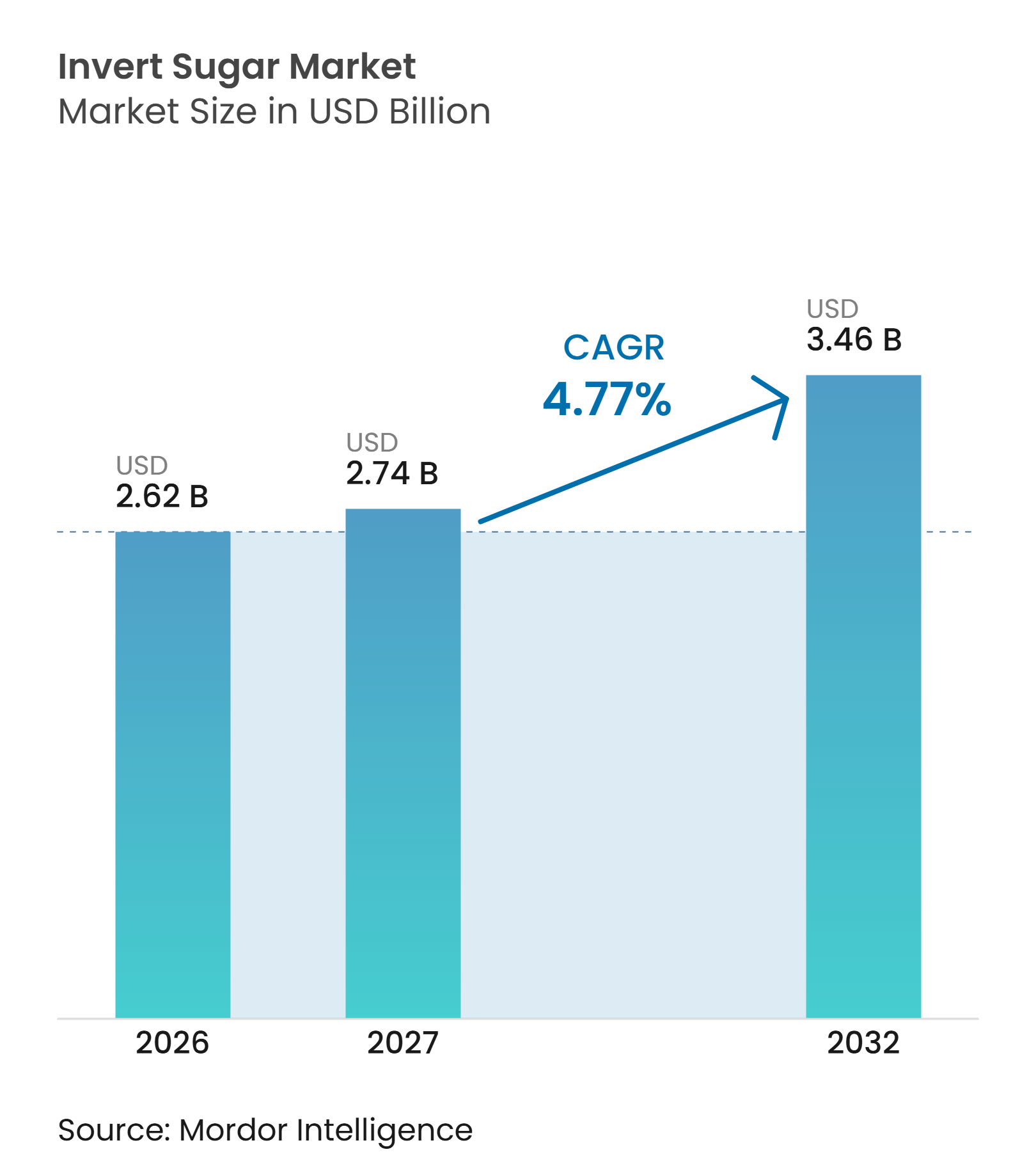
The Invert Sugar Market size is expected to increase from USD 2.62 billion in 2026 to USD 2.74 billion in 2027 and reach USD 3.46 billion by 2032, growing at a CAGR of 4.77% over 2027–2032. Growth is supported by rising demand for invert sugar in bakery and confectionery applications, expanding processed food production, and its functional benefits in moisture retention, texture, and shelf life. Liquid invert sugar dominates the market, while powdered invert sugar is expected to register faster growth. Food and beverages remain the largest application segment, whereas pharmaceuticals are projected to grow at the fastest rate. However, raw sugar price volatility, competition from alternative sweeteners, and health concerns related to excessive sugar consumption may restrain market growth. Geographically, Asia-Pacific leads the market and is also expected to record the fastest growth, supported by expanding food processing industries and rising demand for packaged food products.
Key Report Takeaways
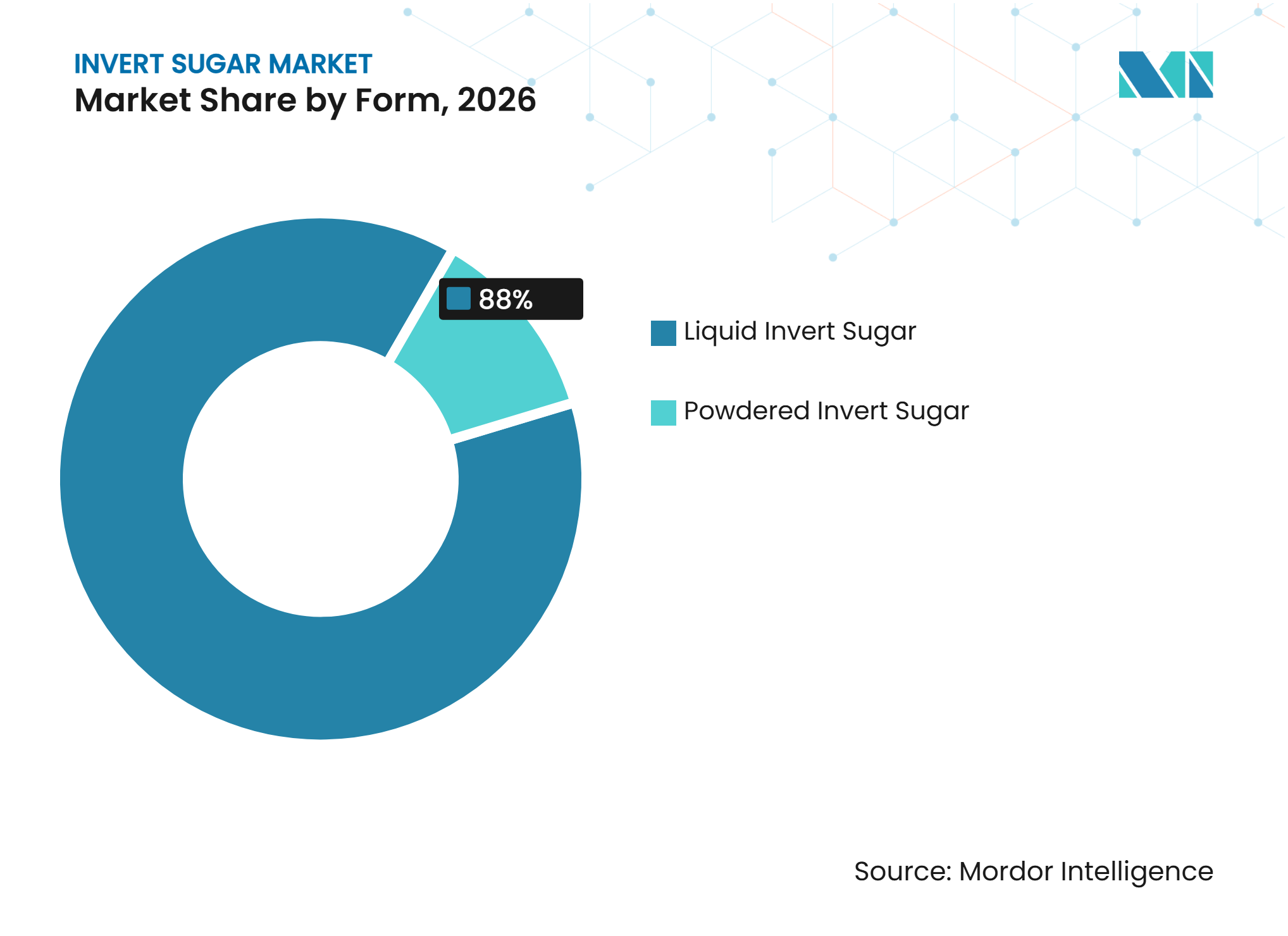
- By form, liquid invert sugar accounted for the largest share of the invert sugar market at 88.00% in 2026, while powdered invert sugar is forecast to grow fastest at a 5.20% CAGR over 2027–2032.
- By application, food and beverages dominated with an 84.50% market share in 2026, while pharmaceuticals are projected to record the fastest growth at a 5.30% CAGR over 2027–2032.
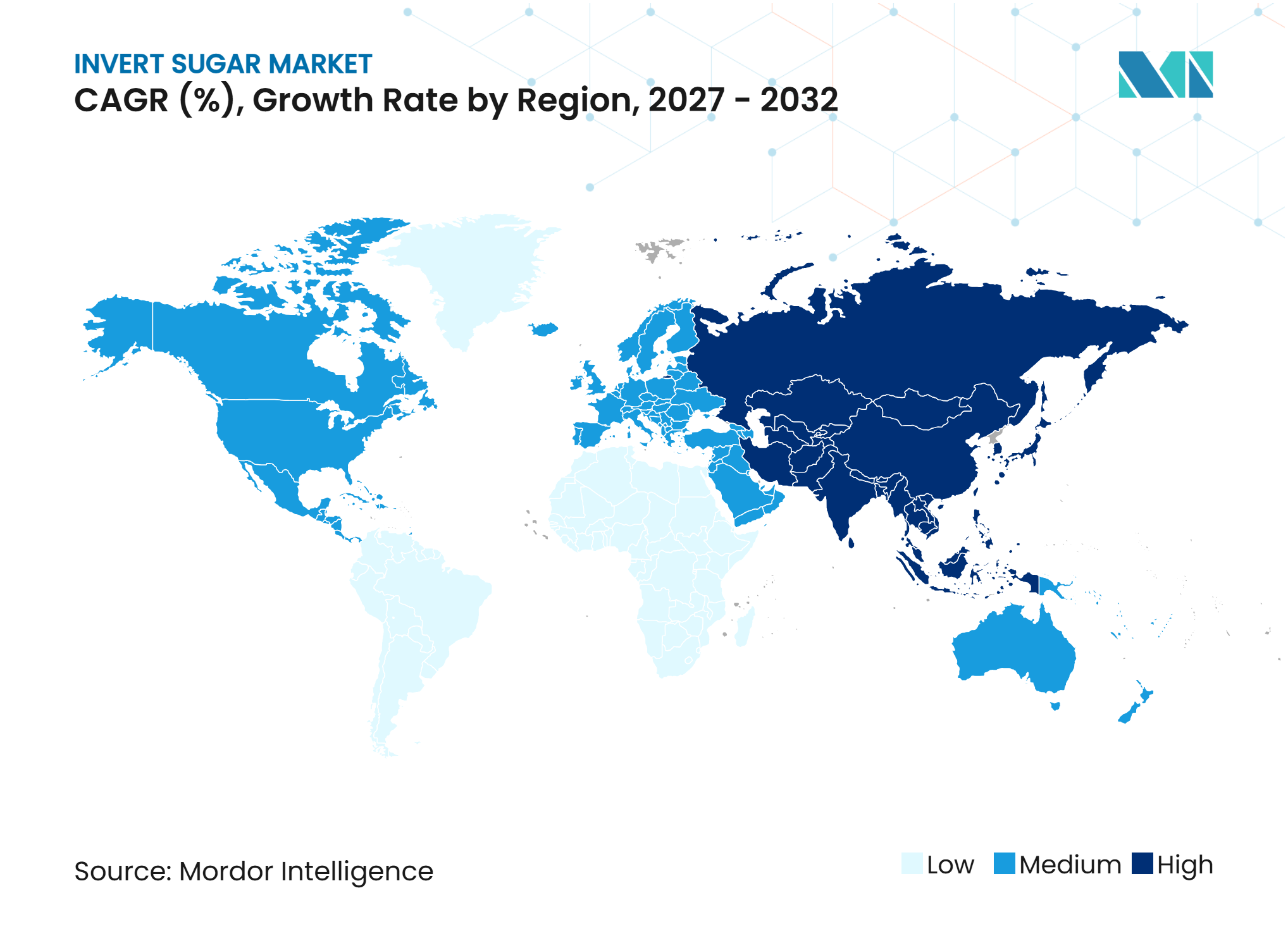
- Among geographies, Asia-Pacific led with a 43.00% share of the invert sugar market in 2026 and is also projected to grow fastest at a 5.40% CAGR over 2027–2032.
Note: Market numbers in this report are based on Mordor Intelligence's proprietary estimation framework, which combines nine months of actuals with Q4 projections for base year 2026.
Market Trends and Insights
Increasing Demand for Invert Sugar in Bakery and Confectionery Applications
The growing production of bakery and confectionery products is supporting demand for invert sugar as a functional sweetening ingredient. Invert sugar helps retain moisture, improve softness, control crystallization, and maintain product quality in applications such as cakes, pastries, biscuits, fondants, candies, and fillings. Its glucose and fructose composition also provides a sweetness profile suitable for various confectionery formulations. Manufacturers increasingly use invert sugar to improve product consistency and extend the shelf life of baked goods and confectionery products. These functional properties strengthen its adoption among commercial bakeries and confectionery manufacturers.[1]
Growing Preference for Invert Sugar as a Functional Sweetener in Food and Beverages
The versatility of invert sugar in food and beverage formulations is supporting its adoption as an alternative to conventional sucrose in industrial applications. Its glucose and fructose composition provides high solubility and sweetness, making it suitable for beverages, dairy products, sauces, syrups, and processed foods. Invert sugar syrup also functions as a humectant and formulation aid, supporting moisture retention and product stability.[2] The US Food and Drug Administration (FDA) recognizes invert sugar as a nutritive sweetener and flavor-enhancing ingredient, supporting its established use in food formulations. These functional characteristics encourage manufacturers to incorporate invert sugar into diverse product categories.
Expansion of Processed Food and Ready-to-Drink Beverage Manufacturing
The expansion of processed food and beverage manufacturing is creating additional demand for industrial sweetening ingredients, including invert sugar. Manufacturers use invert sugar in beverages, dairy products, confectionery, and processed foods to provide consistent sweetness and support formulation requirements. India's food processing sector recorded an increase in gross value added from INR 1.34 lakh crore in 2014–15 to INR 2.24 lakh crore in 2023–24, reflecting the sector's expanding industrial contribution. Additionally, the share of processed food exports in India's agricultural exports increased from 13.7% in 2014–15 to 20.4% in 2024–25. This expansion in food processing capacity and output supports opportunities for invert sugar suppliers serving industrial food and beverage manufacturers.[3]
Rising Demand for Improved Moisture Retention, Texture and Shelf Life in Food Products
Food manufacturers are increasingly focusing on ingredients that improve product texture, moisture retention, and storage stability. Invert sugar supports these requirements through its hygroscopic properties, helping retain moisture in baked goods, confectionery, and other food applications. Its ability to reduce sucrose crystallization also makes it useful in products such as fondants, fillings, candies, and syrups that require smooth and consistent textures. These characteristics help manufacturers maintain product quality during storage and distribution while meeting consumer expectations for freshness and consistency. Consequently, demand for functional sweetening ingredients with moisture-management properties continues to support invert sugar adoption.[4]
Technological Advancements in Sugar Processing and Invert Sugar Production
Technological improvements in sugar processing and enzymatic hydrolysis are supporting more efficient invert sugar production. Manufacturers can produce invert sugar through acid-based or enzyme-based hydrolysis of sucrose, with invertase technology offering opportunities for improved process control and conversion efficiency. Research on immobilized invertase and continuous-flow reactor systems has demonstrated the potential for enzyme reuse, operational stability, and continuous sucrose conversion. Such developments can improve production consistency and support industrial-scale manufacturing while reducing process inefficiencies. Continued advancements in enzyme immobilization, reactor design, and production optimization are expected to create opportunities for invert sugar manufacturers.[5]
Restraints of Invert Sugar Market*
| Restraint | (~) % Impact on CAGR Forecast | Geographic Relevance | Impact Timeline |
|---|---|---|---|
| Volatility in raw sugar prices and sugarcane and sugar beet supply | −0.8% | Global, particularly Asia-Pacific, Europe and South America, where sugar production fluctuations and agricultural supply conditions influence invert sugar manufacturing costs | Short term (Less than 2 years) |
| Competition from alternative sweeteners and sugar syrups | −0.7% | Global, particularly North America and Europe, where manufacturers have access to glucose syrups, high-fructose corn syrup, and other alternative sweetening ingredients | Medium term (2–4 years) |
| Health concerns associated with excessive sugar consumption | −0.6% | Global, particularly North America and Europe, where growing consumer awareness of obesity, diabetes, and sugar intake influences demand for conventional sweeteners | Long term (More than 4 years) |
| Regulatory restrictions on sugar content and product labelling | −0.5% | Global, particularly Europe and North America, where sugar-related labelling requirements, nutritional guidelines, and public health policies influence food and beverage formulations | Medium term (2–4 years) |
| Source: Mordor Intelligence | |||
Volatility in Raw Sugar Prices and Sugarcane and Sugar Beet Supply
The invert sugar market is exposed to fluctuations in raw sugar prices and variations in sugarcane and sugar beet production, which can increase manufacturing costs and affect profit margins. Changes in weather conditions, agricultural yields, input costs, and global sugar trade flows influence the availability and pricing of sucrose, the primary raw material used in invert sugar production. Supply disruptions caused by droughts, excessive rainfall, and changing agricultural conditions can further affect procurement stability. These fluctuations create challenges for manufacturers in maintaining consistent production costs and competitive pricing, particularly in regions dependent on seasonal sugarcane or sugar beet harvests. Smaller producers may face greater difficulties managing sudden increases in raw material expenses due to limited procurement flexibility. Consequently, raw material price volatility and agricultural supply uncertainties can constrain production planning and market expansion.
Competition from Alternative Sweeteners and Sugar Syrups
The availability of alternative sweeteners and sugar syrups creates competitive pressure for invert sugar manufacturers across food and beverage applications. Ingredients such as glucose syrup, high-fructose corn syrup, dextrose, and other liquid sweeteners offer manufacturers different cost, sweetness, and functional characteristics. Food processors may select these alternatives based on formulation requirements, raw material availability, and production economics. Additionally, growing interest in reduced-sugar formulations and alternative sweetening ingredients provides further competition for conventional sugar-based products. Manufacturers of invert sugar must therefore demonstrate advantages in moisture retention, crystallization control, solubility, and product texture to maintain their position in industrial formulations. This availability of substitutes can limit pricing flexibility and restrict adoption in applications where alternative sweeteners provide comparable functionality at lower costs.
*Our forecasts treat driver/restraint impacts as directional, not additive. The impact forecasts reflect baseline growth, mix effects, and variable interactions.
Invert Sugar Market Segment Analysis
By Form:
Liquid Invert Sugar Leads While Powdered Invert Sugar Expands FasterIn 2026, liquid invert sugar accounted for an estimated 88.00% of the Invert Sugar Market, making it the leading form segment. Its dominance reflects widespread use in food and beverage manufacturing, particularly in bakery, confectionery, beverages, and processed food applications. Liquid invert sugar offers high solubility, ease of handling, and convenient integration into industrial production processes. Its moisture-retention properties and ability to prevent sugar crystallization further support its adoption in formulations requiring consistent texture and product stability. Meanwhile, powdered invert sugar is projected to record the fastest growth, at an estimated CAGR of 5.20% through 2032. Its dry format offers advantages in storage, transportation, handling, and applications requiring precise ingredient dosing.
Liquid invert sugar continues to benefit from established industrial processing infrastructure and its suitability for large-scale manufacturing. Powdered formulations provide manufacturers with additional flexibility in dry mixes, bakery preparations, confectionery products, and specialized food applications. However, producers across both categories need to maintain consistent sweetness, quality, and functional performance while managing production costs and raw material availability.


By Application:
Food and Beverages Lead While Pharmaceuticals Expand FasterIn 2026, food and beverages accounted for an estimated 84.50% of the Invert Sugar Market, making it the largest application segment. Its dominance is supported by the widespread use of invert sugar in bakery, confectionery, beverages, dairy products, and processed foods. Its ability to improve moisture retention, prevent crystallization, and provide consistent sweetness makes it suitable for various industrial food formulations. Bakery and confectionery manufacturers use invert sugar to maintain softness, improve texture, and extend product shelf life, while beverage producers benefit from its solubility and ease of incorporation. Meanwhile, pharmaceuticals are projected to record the fastest growth, at an estimated CAGR of 5.30% through 2032. Its potential use as a sweetening ingredient in oral liquid formulations and pharmaceutical preparations supports demand from pharmaceutical manufacturers.
Food and beverage applications are expected to benefit from expanding processed food production and continued demand for functional sweetening ingredients. Pharmaceutical applications provide additional opportunities through the use of invert sugar in suitable formulations requiring sweetness and specific ingredient characteristics. Other applications also contribute to demand through specialized industrial uses. However, manufacturers must address formulation requirements, product quality standards, and regulatory considerations across different end-use industries.
Geography Analysis
Asia-Pacific Invert Sugar Market
Asia-Pacific accounted for an estimated 43.00% of the Invert Sugar Market in 2026, making it the largest regional market. The region benefits from expanding food processing industries, growing bakery and confectionery production, and increasing consumption of packaged food and beverages. Countries such as China, India, Japan, Thailand, Indonesia, and South Korea provide opportunities for invert sugar manufacturers through established food manufacturing industries and rising demand for industrial sweetening ingredients. The availability of sugarcane as a major agricultural raw material in countries such as India, Thailand, and Indonesia also supports regional sugar processing capabilities. However, manufacturers must manage raw material price fluctuations, production costs, and varying food safety and labelling regulations across regional markets.
Asia-Pacific Invert Sugar Market Growth Outlook
Asia-Pacific is projected to remain the fastest-growing regional market, with an estimated CAGR of 5.40% over 2027–2032. Expanding processed food manufacturing, urbanization, and changing consumption patterns are creating opportunities for invert sugar suppliers across China, India, Japan, Thailand, Indonesia, and Australia. Growth in bakery products, confectionery, dairy products, and ready-to-drink beverages is supporting demand for functional sweetening ingredients. The region's expanding food processing infrastructure and investments in industrial production capabilities further strengthen opportunities for liquid and powdered invert sugar. However, manufacturers need to address sugar price volatility, competition from alternative sweeteners, and differences in regulatory requirements to expand their regional presence.
North America, Europe, South America, and Middle East and Africa
North America represents an established market for invert sugar, supported by developed bakery, confectionery, beverage, and processed food industries, particularly in the United States and Canada. Europe offers opportunities through its established confectionery, bakery, dairy, and food processing sectors, with Germany, the United Kingdom, France, Italy, and the Netherlands representing important markets. South America benefits from its strong sugarcane production base, particularly in Brazil and Argentina, which supports raw material availability and sugar processing activities. In the Middle East and Africa, expanding packaged food manufacturing and growing demand for processed bakery and confectionery products create opportunities for invert sugar suppliers, particularly in South Africa and Saudi Arabia. Across these regions, manufacturers need to manage raw material costs, regulatory compliance, and competition from alternative sweetening ingredients to strengthen market penetration.
Competitive Landscape
Market Concentration
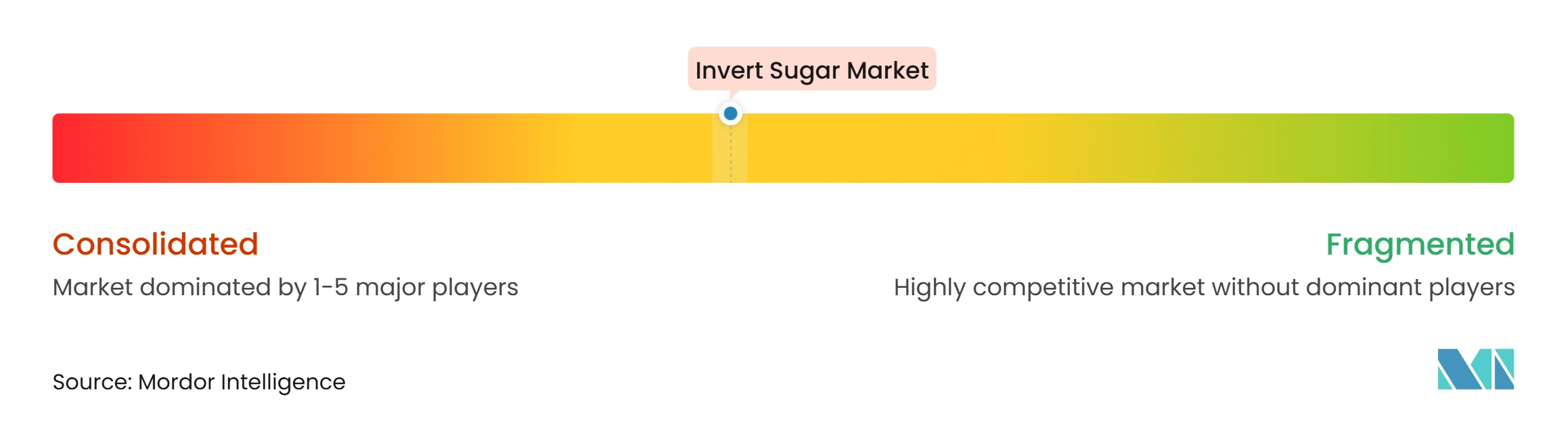
The Invert Sugar Market includes multinational food ingredient companies, established sugar producers, specialty sweetener manufacturers, and regional sugar processors competing through product quality, processing capabilities, pricing, and distribution reach. Companies participate in the market through liquid and powdered invert sugar supplied to food and beverage manufacturers, pharmaceutical companies, and other industrial users. Large ingredient suppliers benefit from established sugar sourcing networks, extensive manufacturing capabilities, and broad customer relationships, while specialist producers focus on customized formulations, product consistency, and application-specific solutions. The competitive landscape therefore reflects varying levels of participation across product forms, end-use applications, and regional markets.
Competitive strategies in the Invert Sugar Market focus on expanding specialty sweetener portfolios, improving production efficiency, and strengthening relationships with industrial customers. For example, Cargill supplies sweetening ingredients for food and beverage applications, while Archer Daniels Midland (ADM) participates in the broader sweeteners and food ingredient sector. Ingredion and Tate & Lyle leverage their ingredient portfolios and application expertise to serve manufacturers across food and beverage categories. Similarly, Südzucker and Tereos draw on their sugar processing capabilities to participate in sweetener markets. These strategies allow companies to serve demand for liquid and powdered formats while addressing the formulation and processing requirements of different industrial customers.
Raw material sourcing, production efficiency, product consistency, and distribution capabilities remain important competitive considerations. Companies with established access to sugarcane and sugar beet supplies can strengthen their procurement positions, while integrated manufacturing operations may support cost management and reliable product availability. Relationships with bakery, confectionery, beverage, dairy, processed food, and pharmaceutical manufacturers also help suppliers maintain customer reach across applications. However, fluctuations in raw sugar prices, competition from glucose syrups and alternative sweeteners, and regulatory requirements related to sugar content and food labelling can influence operating conditions. Manufacturers must also maintain consistent product specifications and meet application-specific quality and safety requirements. These factors make supply chain management, portfolio diversification, production efficiency, and customer relationships important areas of competition.
Invert Sugar Industry Leaders
-
Archer Daniels Midland Company (ADM)
-
Cargill, Incorporated
-
Südzucker AG
-
Tereos Group
-
Nordzucker AG
- *Disclaimer: Major Players sorted in no particular order
Invert Sugar Market Companies Covered in this Report
- Archer Daniels Midland Company (ADM)
- Cargill, Incorporated
- Ingredion Incorporated
- Tate & Lyle PLC
- Südzucker AG
- Tereos Group
- Nordzucker AG
- Rogers Sugar Inc.
- Cosun Beet Company
- International Flavors & Fragrances Inc.
- Kerry Group plc
- Bunge Limited
- Wilmar International Limited
- ASR Group International, Inc.
- AGRANA Beteiligungs-AG
- House Foods Group Inc.
- MGP Ingredients, Inc.
- Zeeland Farm Services, Inc.
- Soy Austria
- Grain Millers, Inc.
Recent Industry Developments in Invert Sugar Market
- June 2026: Ingredion Incorporated announced a recommended all-cash acquisition of Tate & Lyle PLC, expanding its specialty ingredients portfolio across sweetening, texturants, and fortification. The proposed transaction is expected to combine complementary ingredient technologies, formulation capabilities, and global supply networks, strengthening Ingredion's position in food and beverage ingredient solutions.
- May 2026: Nordzucker AG reported investments of approximately EUR 160 million across its European production sites during the 2025/2026 financial year. The investment programme included efficiency improvements, production modernization, and the centralization of liquid sugar production at its Nordstemmen facility in Germany, supporting operational efficiency and strengthening its liquid sugar manufacturing capabilities.
- August 2026: Nordzucker AG inaugurated a new extraction tower at its Schladen factory in Germany to improve sugar extraction efficiency and reduce energy consumption. The 39-meter facility is designed to support the factory's processing capacity of approximately 10,500 tonnes of sugar beet per day, strengthening the company's production infrastructure and operational efficiency.
- March 2025: Saraswati Sugar Mills commenced production of invert liquid sugar at its Yamunanagar facility in Haryana, India. The new production plant was established by Indian Sugar and General Engineering Corporation (ISGEC) with an investment of approximately INR 3 crore.
Global Invert Sugar Market Report Scope
For this study, the Invert Sugar Market is defined as the sales value of commercially produced invert sugar, a liquid or powdered sweetening ingredient manufactured through the hydrolysis of sucrose into glucose and fructose. The market covers liquid invert sugar and powdered invert sugar, segmented by application into food and beverages, pharmaceuticals, and other applications. The food and beverages segment includes bakery, confectionery, beverages, dairy products, processed foods, and other food applications where invert sugar is used for its sweetness, moisture retention, texture enhancement, crystallization control, and shelf-life improvement. The market also includes invert sugar used in pharmaceutical formulations and other industrial applications. The market is analyzed across North America, Europe, Asia-Pacific, South America, and the Middle East and Africa, with country-level coverage as specified in the report. Market sizing and forecasts are presented in value terms (USD) across the defined forms, applications, and geographies.
Segmentation Overview
| Liquid Invert Sugar |
| Powdered Invert Sugar |
| Food and Beverages | Bakery |
| Confectionery | |
| Beverages | |
| Dairy Products | |
| Processed Foods | |
| Others | |
| Pharmaceuticals | |
| Other Applications |
| North America | United States |
| Canada | |
| Mexico | |
| Rest of North America | |
| Europe | United Kingdom |
| Germany | |
| France | |
| Italy | |
| Spain | |
| Sweden | |
| Belgium | |
| Poland | |
| Netherlands | |
| Europe | |
| Asia-Pacific | China |
| Japan | |
| India | |
| Thailand | |
| Indonesia | |
| South Korea | |
| Australia | |
| Rest of Asia-Pacific | |
| South America | Brazil |
| Argentina | |
| Rest of South America | |
| Middle East and Africa | South Africa |
| Saudi Arabia | |
| Rest of Middle East and Africa |
| By Form | Liquid Invert Sugar | |
| Powdered Invert Sugar | ||
| By Application | Food and Beverages | Bakery |
| Confectionery | ||
| Beverages | ||
| Dairy Products | ||
| Processed Foods | ||
| Others | ||
| Pharmaceuticals | ||
| Other Applications | ||
| By Geography | North America | United States |
| Canada | ||
| Mexico | ||
| Rest of North America | ||
| Europe | United Kingdom | |
| Germany | ||
| France | ||
| Italy | ||
| Spain | ||
| Sweden | ||
| Belgium | ||
| Poland | ||
| Netherlands | ||
| Europe | ||
| Asia-Pacific | China | |
| Japan | ||
| India | ||
| Thailand | ||
| Indonesia | ||
| South Korea | ||
| Australia | ||
| Rest of Asia-Pacific | ||
| South America | Brazil | |
| Argentina | ||
| Rest of South America | ||
| Middle East and Africa | South Africa | |
| Saudi Arabia | ||
| Rest of Middle East and Africa | ||
Key Questions Answered in the Report
What is the size of the Invert Sugar Market?
The Invert Sugar Market is estimated at USD 2.62 billion in 2026 and is projected to reach USD 3.46 billion by 2032, growing at a CAGR of 4.77% over 2027–2032.
Which segment holds the largest share of the Invert Sugar Market?
The liquid invert sugar segment holds the largest share of the Invert Sugar Market, accounting for 88.00% in 2026, driven by its widespread use in food and beverage formulations.
Which is the fastest-growing segment in the Invert Sugar Market?
The powdered invert sugar segment is expected to be the fastest-growing form, registering a CAGR of 5.20% over 2027–2032. Within applications, pharmaceuticals is projected to grow at a CAGR of 5.30% during the same period.
Which region dominates the Invert Sugar Market?
Asia-Pacific dominates the Invert Sugar Market, accounting for 43.00% of the global market share in 2026. The region is also projected to be the fastest-growing market, registering a CAGR of 5.40% over 2027–2032.