
Inorganic Rheology Modifiers Market Size and Share
Market Overview
| Study Period | 2021 - 2031 |
|---|---|
| Market Size (2026) | USD 2.21 Billion |
| Market Size (2031) | USD 2.74 Billion |
| Growth Rate (2026 - 2031) | 4.32 % |
| Fastest Growing Market | Asia-Pacific |
| Largest Market | Asia-Pacific |
| Market Concentration | Low |
Major Players *Disclaimer: Major Players sorted in no particular order Image © Mordor Intelligence. Reuse requires attribution under CC BY 4.0. | |
Inorganic Rheology Modifiers Market Analysis by Mordor Intelligence
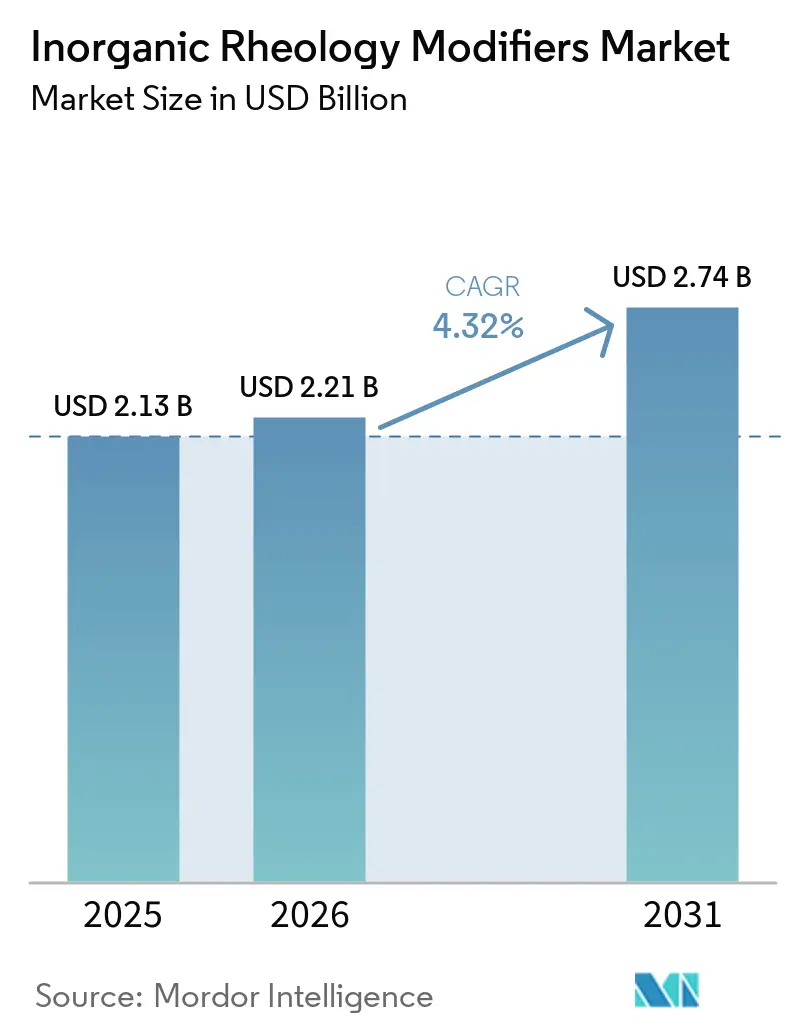
The Inorganic rheology modifiers market size was estimated at USD 2.13 billion in 2025 and is estimated to grow from USD 2.21 billion in 2026 to USD 2.74 billion by 2031, at a CAGR of 4.32% during the forecast period (2026-2031). The inorganic rheology modifiers market is supported by stricter requirements for low-volatile organic compound (VOC) waterborne coatings, increasing the need for viscosity control without adding solvent content. The demanding material requirements of electric vehicle (EV) batteries and electronics, where thermal stability and chemical purity favor inorganic materials over organic alternatives, further support the market. These requirements create demand across different end uses but lead to a common need for dependable thixotropy, pigment suspension, and sag resistance. Regulatory requirements support longer-term adoption, as compliance programs often remain in place after implementation. Suppliers are balancing broad demand for coatings with investment in higher-purity products for applications requiring closer technical qualification.
Key Report Takeaways
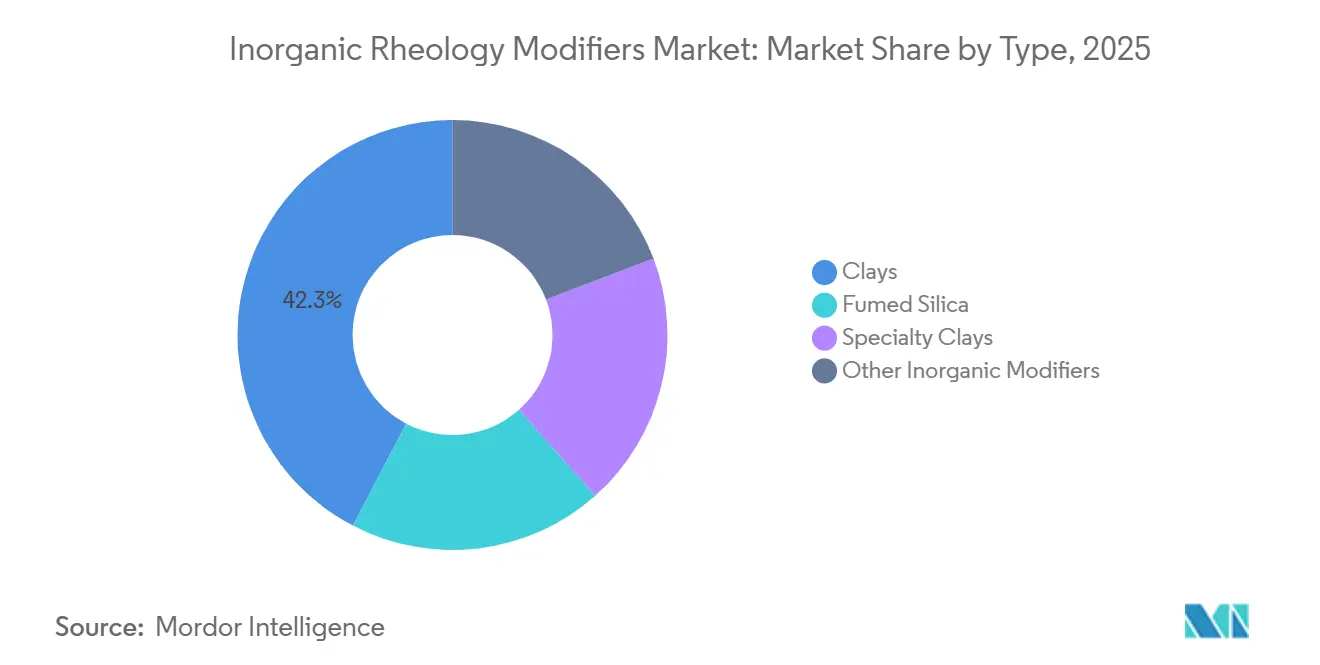
- By type, clays held 42.34% of the Inorganic rheology modifiers market share in 2025, while fumed silica is forecast to record the highest CAGR of 5.21% through 2031.
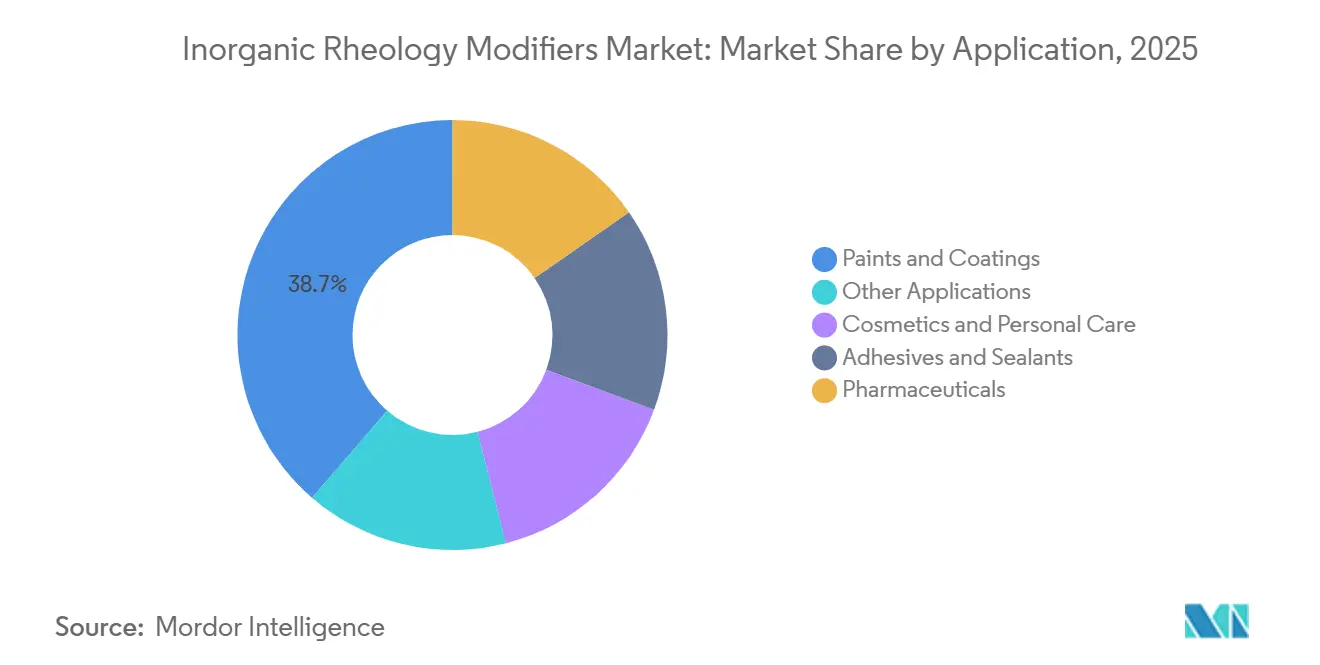
- By application, paints and coatings accounted for 38.67% of the Inorganic rheology modifiers market size in 2025, while cosmetics and personal care are forecast to expand at a CAGR of 5.56% through 2031.
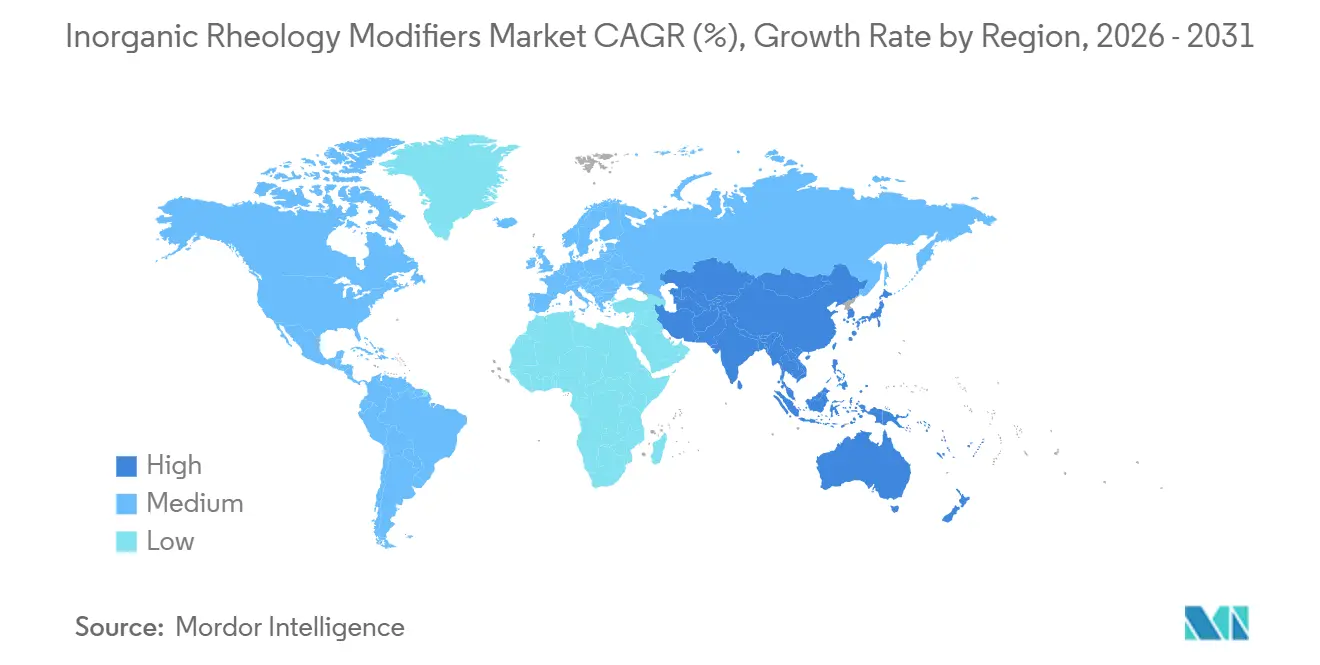
- By geography, Asia-Pacific captured 35.21% of revenue in 2025 and is forecast to grow at a CAGR of 5.05% through 2031.
Note: Market size and forecast figures in this report are generated using Mordor Intelligence’s proprietary estimation framework, updated with the latest available data and insights as of January 2026.
Market Trends and Insights
Drivers Impact Analysis of Inorganic Rheology Modifiers Market*
| Drivers | (~) % Impact on CAGR Forecast | Geographic Relevance | Impact Timeline |
|---|---|---|---|
| Waterborne and Low-Volatile Organic Compound (VOC) Coating Adoption | +1.2% | Global, concentrated in Europe, North America, and Asia-Pacific tier-1 markets | Short term (≤ 2 years) |
| Construction and Infrastructure Coatings Demand | +0.9% | Asia-Pacific core, with spillover to the Middle East, Africa, and South America | Medium term (2-4 years) |
| EV, Battery, and Electronics Coating Complexity | +0.8% | Global, led by the Asia-Pacific manufacturing belt and North America | Medium term (2-4 years) |
| Specialty-Clay Performance Upgrades | +0.6% | Global, with European innovation clusters and Asia-Pacific production scale | Long term (≥ 4 years) |
| Mineral Additives in High-Shear and Digital-Formulation Workflows | +0.5% | North America and Europe | Long term (≥ 4 years) |
| Source: Mordor Intelligence | |||
Waterborne and Low-Volatile Organic Compound (VOC) Coating Adoption
The inorganic rheology modifiers market is supported by the shift from solvent-borne to waterborne coatings in the United States, Europe, China, and other regulated markets. This shift increases the need for additives that provide viscosity control, anti-sag behavior, and pigment suspension without increasing the solvent load. Waterborne systems respond differently to dispersants, pigments, binders, and processing conditions, so the modifier must contribute to a stable overall formulation rather than only increase viscosity. This makes the transition a formulation-design issue as well as a compliance issue. Organophilic clays and fumed silica provide these functions in waterborne systems, where some organic thickeners are sensitive to surfactant interference. Compliance requirements across major markets direct formulators toward lower-VOC products and more consistent testing practices. Saudi Arabia's May 2026 change to Technical Regulation TR-IND-2026-04 removed the VOC exemption for water-based industrial coatings and required compliance testing under Saudi Standards, Metrology and Quality Organization (SASO) 2511:2024, extending exporter testing periods to 28 days. The requirement for reliable waterborne performance keeps mineral-based rheology control relevant to coatings producers serving regulated applications, particularly when product lines are sold across multiple regulatory jurisdictions and a single formulation approach reduces the need for separate regional versions. Formulators must retain film build, storage stability, application consistency, and surface appearance after the change. This keeps additive selection central to formulation work for both established coating grades and newly developed waterborne products.
Construction and Infrastructure Coatings Demand
Construction and infrastructure activity sustains baseline demand in the inorganic rheology modifiers market because architectural and protective coatings require stable application properties on large surfaces. Projects across Asia-Pacific and the Middle East span railways, airports, housing, and industrial facilities that require durable paint systems. International project specifications increasingly reference ISO 12944 corrosion-protection requirements, raising the required performance level for protective coatings. In India, the Smart Cities Mission and related industrial estate programs expand the installed base of newly painted surfaces and support domestic demand for architectural coatings. Large public projects often use low-VOC or green-building specifications, increasing the performance requirements of coating formulations. Higher specification requirements support the use of better-performing inorganic thixotropes. Protective coatings must remain workable during application while resisting settling in storage and sagging on vertical surfaces, making rheology control a direct part of project performance. Demand remains connected to the quality level of construction activity, not only to the number of new buildings or infrastructure assets. Suppliers with established technical support benefit where contractors and coatings producers need to match a specification across varied site conditions.
EV, Battery, and Electronics Coating Complexity
EV batteries and electronics create a higher-specification outlet for the inorganic rheology modifiers market, particularly for fumed silica and surface-modified alumina. Evonik states that its AEROSIL fumed silica grades are used as ceramic fillers in battery separators to support thermal barriers within battery systems. The company also applies microporous silica cores in TEGO Therm coatings for EV battery housing designed to meet Underwriters Laboratories (UL) 94 V-0 fire-safety requirements. These uses depend on controlled purity, heat resistance, and repeatable processing, which standard commodity grades cannot meet. Qualification-grade fumed silica for EV platforms may require metal-contamination thresholds below 10 ppm, concentrating demand among suppliers capable of maintaining ultra-high-purity production. Wacker's presence at Battery Show Detroit 2026, focused on silicone technologies for thermal barriers and busbar coatings, reflects the integration of silica-related materials into battery supply chains. Battery manufacturers must manage heat, insulation, fire resistance, and controlled material flow in a compact assembly. These requirements link battery growth to a narrower group of mineral products that can meet detailed process and purity specifications, favoring suppliers that work with customers through qualification rather than competing solely on price.
Specialty-Clay Performance Upgrades
The inorganic rheology modifiers market benefits when specialty clays deliver a target viscosity profile at lower use levels. A 2025 study in the Journal of Coatings Technology and Research found that inline dispersers and ultrasonic probes improved bentonite activation in organic coatings compared with conventional high-speed dissolvers. The study proposed a standardized bentonite intermediate to help formulators optimize performance during formulation. Lower loading requirements reduce material use for coatings producers while allowing specialty-clay suppliers to compete on effective performance rather than only price. Nordmann describes organophilic layered silicates in its NORRHEO line as additives that improve low-shear viscosity and anti-settling behavior in solvent-based and solvent-free systems[1]Nordmann Global, “Rheology Additives for Solvent-Based and Solvent-Free Systems,” Nordmann Global, nordmann.global.. Such properties broaden the use of specialty clays in aerospace coatings, lithographic systems, and digital formulation workflows that require dependable rheological control under varying shear conditions. A formulation must remain stable during storage, respond predictably during mixing, and flow in a controlled way during application. Process variability can affect coating appearance, application yield, and the ability to meet customer specifications, giving specialty producers room to differentiate even where lower-cost clay supplies are readily available.
Restraints Impact Analysis of Inorganic Rheology Modifiers Market*
| Restraints | (~) % Impact on CAGR Forecast | Geographic Relevance | Impact Timeline |
|---|---|---|---|
| Mineral and Silica Feedstock Price Volatility | -0.7% | Global | Short term (≤ 2 years) |
| Competition from Organic and Bio-Based Modifiers | -0.6% | Global, with Europe and North America leading and Asia-Pacific emerging | Medium term (2-4 years) |
| Mining, Energy, and Environmental Compliance Burden | -0.5% | Global, particularly Asia-Pacific and Europe | Medium term (2-4 years) |
| Source: Mordor Intelligence | |||
Mineral and Silica Feedstock Price Volatility
The inorganic rheology modifiers market remains exposed to changes in the cost of quartz sand, bentonite, attapulgite, and kaolin. These inputs are affected by regional energy costs, mining permits, and shipping logistics, even when downstream coatings demand is stable. Fumed silica production is particularly energy-intensive, as flame hydrolysis requires substantial energy input. European natural gas price increases in 2024 raised production costs faster than contracted product prices for some suppliers. Coatings formulators can respond by qualifying regional and global alternatives, but dual sourcing adds procurement work and may require grade requalification under ISO or customer-specific standards. A change in mineral grade can affect mixing time, viscosity build, color development, and application behavior, even when the replacement serves the same general purpose. This additional work can slow a purchasing response to a feedstock cost increase. For mid-tier producers without long-term supply agreements, spot market exposure can pressure working capital and make organic alternatives with more stable feedstock costs more attractive.
Competition from Organic and Bio-Based Modifiers
Organic and bio-based rheology modifiers compete with inorganic grades in several mid-tier applications, particularly where downstream brand owners emphasize lower scope 3 emissions. BASF completed the transition of its Rheovis HASE modifier range to bio-based ethyl acrylate in June 2025. The company reported a biogenic content of up to 35% under ASTM D6866-18 and a product carbon footprint reduction of up to 30% relative to fossil-feedstock versions[2]BASF SE, “BASF’s Rheovis Range Transitions to Bio-Based Ethyl Acrylate (EA),” BASF Global, basf.com.. In July 2026, BASF expanded its portfolio with biomass-balanced Rheovis PU 1333 MB and Rheovis HS 1169 MB grades for architectural coatings, with a reduced carbon footprint recognized under ISO 14067:2018. Mineral-derived modifiers are not subject to the EU REACH Microplastics Restriction's reporting requirements for intentionally added synthetic polymer microparticles, which supports their position in European formulation decisions. The restriction does not eliminate competition from organic materials, but it adds compliance considerations for some polymer-carrier systems. This is relevant when a formulator weighs carbon-footprint claims against reporting requirements, documentation, and potential reformulation needs. Inorganic products retain an advantage where customers place equal value on mineral origin, stable performance, and a simpler regulatory profile.
*Our forecasts treat driver/restraint impacts as directional, not additive. The impact forecasts reflect baseline growth, mix effects, and variable interactions.
Inorganic Rheology Modifiers Market Segment Analysis
By Type:
Clays Lead by Share While Fumed Silica Gains in High-Specification ApplicationsClays accounted for 42.34% of revenue by type in 2025. Their position reflects competitive pricing, broad availability of bentonite, attapulgite, and kaolin, and established use in architectural and industrial coatings. These materials have a long record of use in formulations where producers require a reliable and scalable method for controlling flow. Their supply base supports use in high-output products where additives must be available in consistent commercial quantities. Clays provide thixotropic control across a wide range of coating systems. Organophilic clays are surface-modified sodium bentonite products compatible with organic solvents. They are used in protective coatings, grease, and solvent-borne adhesives where water-based alternatives do not meet application requirements. This subset commands premium pricing due to its low-shear viscosity and anti-settling behavior in demanding systems.
Fumed silica is forecast to grow at a CAGR of 5.21% through 2031, the fastest rate among type segments in the inorganic rheology modifiers market. Demand is driven by electric vehicle (EV) battery separator coatings, thermal interface materials, and semiconductor encapsulants that require high-purity, surface-functionalized grades. Evonik's AEROSIL portfolio addresses both hydrophilic and hydrophobic applications across adhesives, personal care, and advanced battery systems. Specialty clays, including synthetic hectorite and Laponite, are used in water-based automotive-refinish and effect-pigment coatings. Their low-shear gelation helps orient metallic pigments and supports a stable appearance. The inorganic rheology modifiers market serves formulations where appearance, controlled flow, and repeatable application are central to product specifications, beyond high-output architectural applications. Production proximity in Asia and Europe is becoming more important as battery and personal care supply chains regionalize. This favors producers able to supply consistent grades near customers, reducing lead times and requalification risks. Local technical service is also increasingly relevant as users adjust formulations for specific processing equipment or customer standards.



By Application:
Paints and Coatings Anchor Demand as Cosmetics and Personal Care AcceleratePaints and coatings accounted for 38.67% of the inorganic rheology modifiers market in 2025. The segment depends on inorganic thixotropes for sag resistance, pigment anti-settling, and consistent behavior under brush, roller, and spray application. These functions are important across the full coating life cycle, from storage and transport through mixing, application, and final film formation. Construction activity in Southeast Asia and the Middle East supports architectural coatings demand. Industrial and protective coatings for bridges, pipelines, and marine structures require dependable application and corrosion-protection performance. Formulators increasingly combine anti-microbial, heat-reflective, and anti-corrosive functions in a single coating, raising rheological complexity. Fumed silica and specialty clays are selected when a product requires a controlled balance of flow, film build, settling resistance, and pigment handling.
Cosmetics and personal care are forecast to grow at a CAGR of 5.56% through 2031, making them the fastest-growing application in the inorganic rheology modifiers market. Premium skincare and color cosmetics in Asia-Pacific, the Middle East, and Latin America use mineral-derived actives to support natural and clean-beauty product positioning. Bentonite, hectorite, and surface-treated fumed silica support sensory properties, pigment suspension, and emulsion stability in high-Sun Protection Factor (SPF) sunscreens and long-wear makeup. Elementis introduced BENTONE ULTIMATE CCC, a naturally derived clay-based modifier for color cosmetics, at In-cosmetics Global 2026 in Paris. Pharmaceuticals remain the smallest application segment but require high-purity fumed silica as a glidant and tablet anti-caking material. United States Pharmacopeia (USP), Ph.Eur., and FDA 21 Code of Federal Regulations (CFR) Part 182 requirements establish a quality threshold, limiting participation to qualified suppliers.
Geography Analysis
APAC Inorganic Rheology Modifiers Market
Asia-Pacific accounted for 35.21% of the inorganic rheology modifiers market share in 2025 and is forecast to grow at a CAGR of 5.05% through 2031. China, India, and ASEAN countries drive demand through construction-linked coatings and personal care manufacturing. These markets combine large local consumer bases with manufacturing capacity, generating demand for both basic architectural coatings and specialized personal care formulations. This mix gives suppliers exposure to high-quantity applications as well as opportunities in grades that address more demanding performance requirements. China's architectural coatings sector is shifting from rapid expansion toward more demanding product-quality requirements as urbanization matures, increasing the need for higher-grade inorganic modifiers. India's housing construction, urbanization, Smart Cities Mission, and infrastructure programs support paint and coatings consumption. ASEAN public infrastructure projects also increase demand for coatings and may require corrosion protection that meets ISO 12944.
North America and Europe Inorganic Rheology Modifiers Market
North America holds an established position in the inorganic rheology modifiers market, with demand from automotive original equipment manufacturers (OEMs), industrial maintenance, and architectural coatings requiring technically sophisticated formulations. Stricter volatile organic compound (VOC) requirements support waterborne formulation development and the use of additives that preserve application quality. The North American electric vehicle (EV) battery supply chain also generates local demand for fumed silica in separator coatings and thermal interface materials. Europe is shaped by the Decopaint Directive and Registration, Evaluation, Authorisation and Restriction of Chemicals (REACH) regulations, which support low-VOC formulations and product disclosure practices. Germany's automotive OEM coatings base makes it a major European center for technically demanding specialty inorganic modifiers. Mineral-based products can gain differentiation when formulators seek alternatives to synthetic polymer microparticle carriers subject to information obligations. This does not make every mineral product a direct substitute for an organic additive, as rheological behavior remains formulation-specific. It does, however, give formulators an additional reason to evaluate mineral options when reviewing product documentation and ingredient choices.
South America and MEA Inorganic Rheology Modifiers Market
South America, the Middle East, and Africa are smaller markets within the inorganic rheology modifiers market but support incremental demand. Brazil's construction activity and expanding personal care manufacturing support demand in South America. The Gulf Cooperation Council (GCC) infrastructure pipeline, including Saudi Arabia's Vision 2030 projects, supports demand for protective and architectural coatings across the Middle East and Africa. Saudi Arabia's May 2026 regulation for water-based industrial coatings raises specification requirements for imported waterborne formulations. South Africa and sub-Saharan Africa remain early-stage markets that depend primarily on construction paints. Imerys's mineral production footprint in southern Africa can reduce logistics costs for local specialty mineral demand compared with suppliers shipping from Europe or North America. Local access to minerals is particularly important in applications where transportation costs and supply continuity affect the delivered cost of a formulation, supporting producers competing for local construction and industrial demand while global suppliers focus on technically demanding grades.

Competitive Landscape
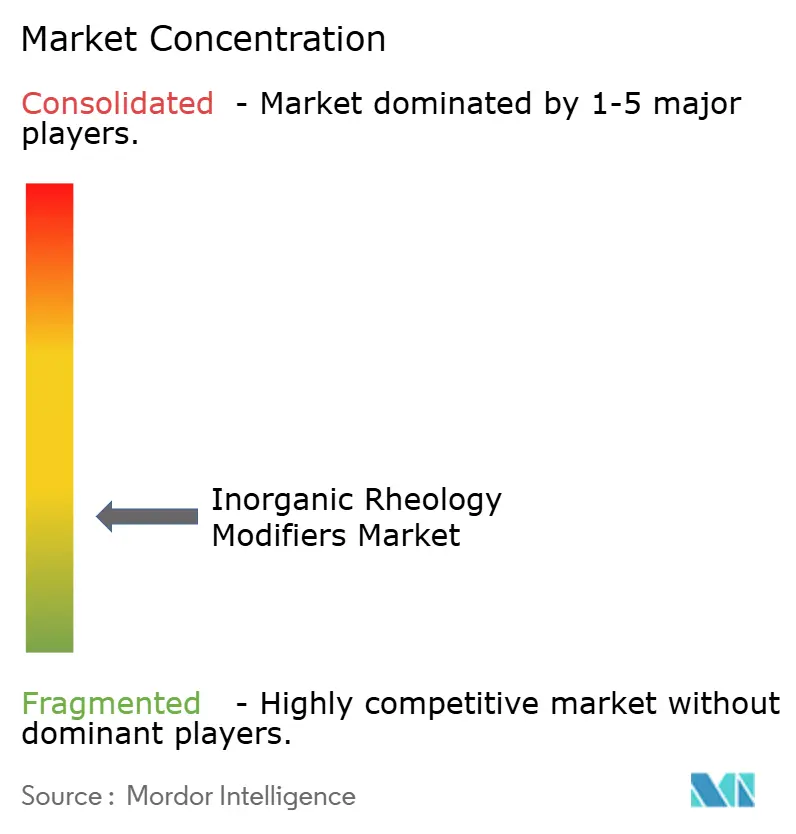
The inorganic rheology modifiers market is fragmented. Evonik Industries and Cabot Corporation hold prominent positions in fumed silica and invest in high-purity products for electric vehicle (EV) and electronics applications. These applications require technical qualifications, which create a barrier for suppliers offering standard grades. Elementis has a differentiated position in organophilic clays through its BENTONE platform for coatings, personal care, and oil-field uses. Imerys and Minerals Technologies draw on integrated mining operations that supply talc, kaolin, and calcium carbonate to coatings customers. ALTANA, through BYK, competes through surface modification and formulation support rather than through product pricing alone. Customers in this market often need assistance balancing viscosity, dispersion, surface quality, and processing speed. Application support can make a supplier more difficult to replace, particularly in formulations that have already passed customer approval or regulatory testing.
Leading companies are pursuing strategies focused on geographic capacity, technical performance, and sustainability. Wacker has expanded its silicone capacity in the Czech Republic and India, supporting production closer to European and Asian demand centers. BASF's transition of Rheovis materials to bio-based ethyl acrylate targets customers managing product carbon footprints. BASF's July 2026 biomass-balanced Rheovis additions extend this offering to architectural coatings. Elementis's acquisition of Alchemy Ingredients broadens its natural-ingredient capability for personal care formulations, aligning with demand for mineral-derived ingredients in color cosmetics and skincare.
The inorganic rheology modifiers market also presents unmet needs in solid-state battery separators and digital printing inks. Solid-state batteries may require surface functionalization that standard fumed silica grades do not consistently provide. Digital printing inks require low-shear thickening without jetting instability at scale. Chinese organoclay producers are increasing capacity and improving quality consistency, with the most impact in applications where customers accept products meeting established industrial specifications without requiring the highest purity or specialized surface treatment. As these suppliers become more consistent, buyers in price-sensitive applications have more options when negotiating supply contracts, narrowing the gap with Western suppliers in mid-tier architectural and industrial coatings. This puts pressure on margins in commodity-grade segments while global suppliers focus on higher-specification products. The result is a two-tier market where global suppliers compete on performance and regional suppliers compete on cost and raw-material proximity.
Inorganic Rheology Modifiers Industry Leaders
Evonik Industries AG
Cabot Corporation
BASF
ALTANA AG
Wacker Chemie AG
- *Disclaimer: Major Players sorted in no particular order
Inorganic Rheology Modifiers Market Companies Covered in this Report
- ALTANA AG
- BASF
- Cabot Corporation
- CLARIANT
- Dow
- Elementis PLC
- Evonik Industries AG
- Imerys
- Laviosa Minerals S.p.A.
- Lhoist Group
- Lubrizol
- Minerals Technologies Inc.
- Tokuyama Corporation
- Tolsa
- Wacker Chemie AG

Recent Industry Developments in Inorganic Rheology Modifiers Market
- July 2026: BASF expanded its certified biomass-balanced (BMB) additives portfolio for architectural coatings, launching Rheovis PU 1333 MB and Rheovis HS 1169 MB. The new grades deliver controlled rheology with Product Carbon Footprint (PCF) reductions recognized under ISO 14067:2018, addressing Scope 3 procurement mandates from major paint manufacturers.
- April 2026: Elementis unveiled BENTONE ULTIMATE CCC, a naturally derived clay-based rheology modifier for color cosmetics, at in-cosmetics Global 2026 in Paris. The product offers pigment suspension and formulation stability at low use levels, targeting applications where performance and clean-beauty requirements apply.


Global Inorganic Rheology Modifiers Market Report Scope
Inorganic rheology modifiers are mineral-based additives used to control the flow, sag, or settling behavior of liquids. They increase viscosity when a mixture is at rest and reduce it when agitated, enabling products such as paint to be applied smoothly without dripping.
The inorganic rheology modifiers market is segmented by type, application, and geography. By type, the market is segmented into clays, fumed silica, specialty clays, and other inorganic modifiers. By application, the market is segmented into paints and coatings, cosmetics and personal care, adhesives and sealants, pharmaceuticals, and other applications. The report also covers market size and forecasts for the inorganic rheology modifiers across 15 countries in major regions. The market sizes and forecasts are provided in terms of value (USD).
| Clays |
| Fumed Silica |
| Specialty Clays |
| Other Inorganic Modifiers |
| Paints and Coatings |
| Cosmetics and Personal Care |
| Adhesives and Sealants |
| Pharmaceuticals |
| Other Applications |
| Asia-Pacific | China |
| India | |
| Japan | |
| South Korea | |
| ASEAN Countries | |
| Rest of Asia-Pacific | |
| North America | United States |
| Canada | |
| Mexico | |
| Europe | Germany |
| United Kingdom | |
| France | |
| Italy | |
| NORDIC Countries | |
| Rest of Europe | |
| South America | Brazil |
| Argentina | |
| Rest of South America | |
| Middle East and Africa | Saudi Arabia |
| South Africa | |
| Rest of Middle East and Africa |
| By Type | Clays | |
| Fumed Silica | ||
| Specialty Clays | ||
| Other Inorganic Modifiers | ||
| By Application | Paints and Coatings | |
| Cosmetics and Personal Care | ||
| Adhesives and Sealants | ||
| Pharmaceuticals | ||
| Other Applications | ||
| By Geography | Asia-Pacific | China |
| India | ||
| Japan | ||
| South Korea | ||
| ASEAN Countries | ||
| Rest of Asia-Pacific | ||
| North America | United States | |
| Canada | ||
| Mexico | ||
| Europe | Germany | |
| United Kingdom | ||
| France | ||
| Italy | ||
| NORDIC Countries | ||
| Rest of Europe | ||
| South America | Brazil | |
| Argentina | ||
| Rest of South America | ||
| Middle East and Africa | Saudi Arabia | |
| South Africa | ||
| Rest of Middle East and Africa | ||


Key Questions Answered in the Report
What is current market size of Inorganic Rheology Modifiers Market?
The Inorganic rheology modifiers market size was estimated at USD 2.13 billion in 2025 and is estimated to grow from USD 2.21 billion in 2026 to USD 2.74 billion by 2031, at a CAGR of 4.32% during the forecast period (2026-2031).
Which material type is expected to grow fastest through 2031?
Fumed silica is forecast to grow at a CAGR of 5.21%, supported by battery, thermal-management, and electronics applications.
Why are waterborne coatings important for rheology modifier demand?
Waterborne coatings require additives that ensure stable viscosity, pigment suspension, and anti-sag behavior while avoiding additional solvent content. This requirement becomes more important as coatings producers move toward waterborne systems and must maintain application quality.
Which application leads to demand for inorganic rheology modifiers?
Paints and coatings held 38.67% of revenue in 2025 because they require reliable rheological control across brush, roller, and spray applications.
Page last updated on:





