
Inkjet Inks Market Size and Share
Market Overview
| Study Period | 2022 - 2032 |
|---|---|
| Market Size (2027) | USD 8.85 Billion |
| Market Size (2032) | USD 11.92 Billion |
| Growth Rate (2027 - 2032) | 6.13 % |
| Fastest Growing Market | Asia-Pacific |
| Largest Market | Asia-Pacific |
| Market Concentration | Medium |
Major Players *Disclaimer: Major Players sorted in no particular order Image © Mordor Intelligence. Reuse requires attribution under CC BY 4.0. | |
Inkjet Inks Market Analysis by Mordor Intelligence
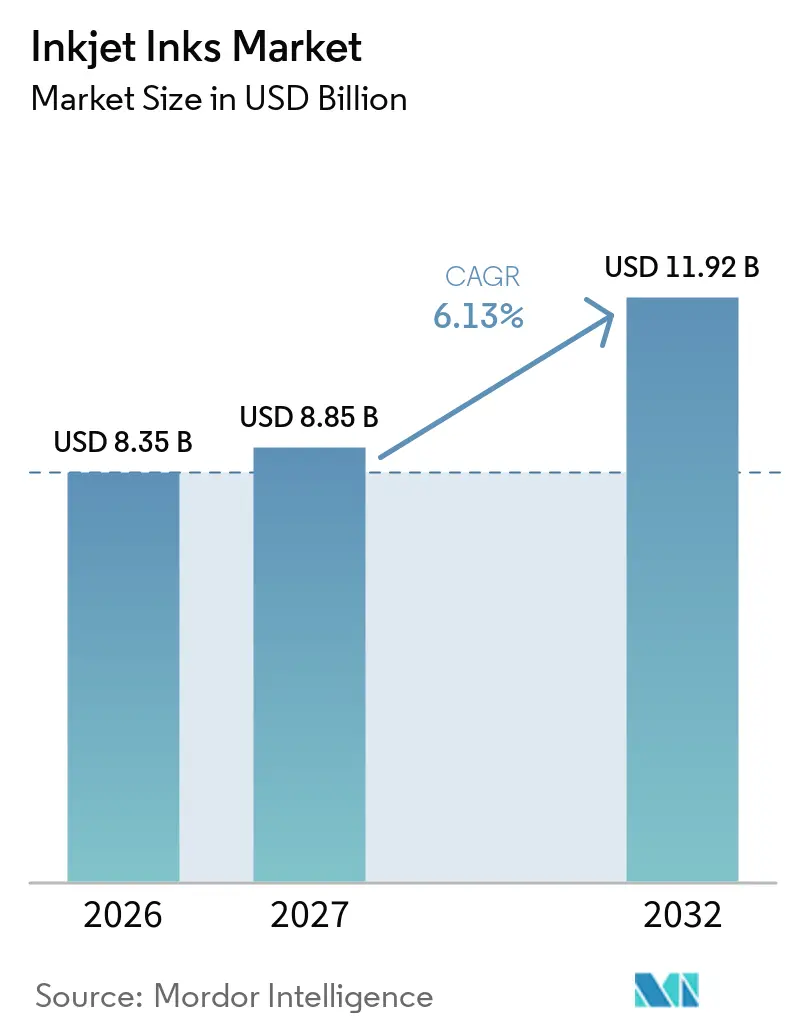
The Inkjet Inks Market size was valued at USD 8.35 billion in 2026 and is estimated to grow from USD 8.85 billion in 2027 to USD 11.92 billion by 2032, at a CAGR of 6.13% during the forecast period (2027-2032). Demand is primarily driven by digital conversion in packaging, textiles, and industrial coding. Plate-free production and variable-data printing make shorter print runs more practical for converters and brand owners. Packaging buyers in Europe are also raising requirements for low-migration and food-contact compliant formulations. Growth in stock-keeping units and frequent artwork changes are extending digital printing from labels into corrugated, flexible, and direct-to-shape packaging. The inkjet inks market, therefore, depends on both higher digital print output and continued reformulation for performance, safety, and compliance.
Key Report Takeaways
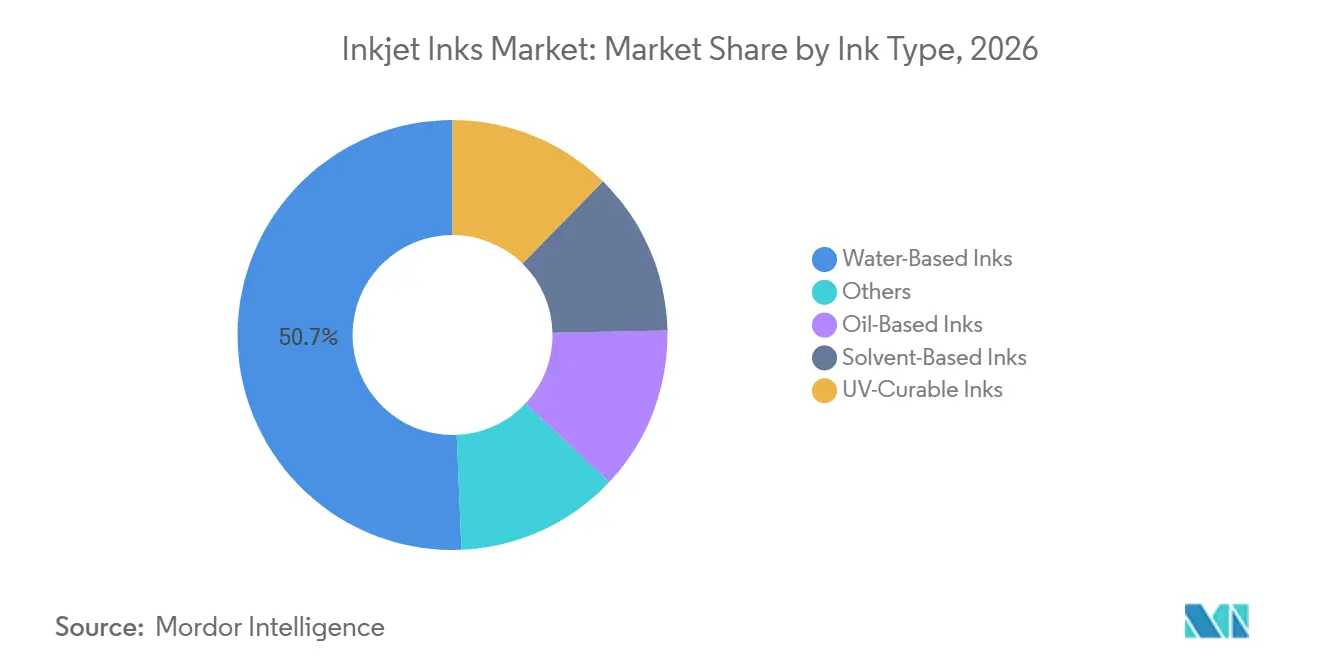
- By ink type, water-based inks held 50.67% of the global market share in 2026, while UV-curable inks are forecast to grow at a 6.86% CAGR through 2032.
- By printing technology, drop-on-demand held 45.13% of the global market share in 2026, while continuous inkjet is forecast to grow at a 7.13% CAGR through 2032.
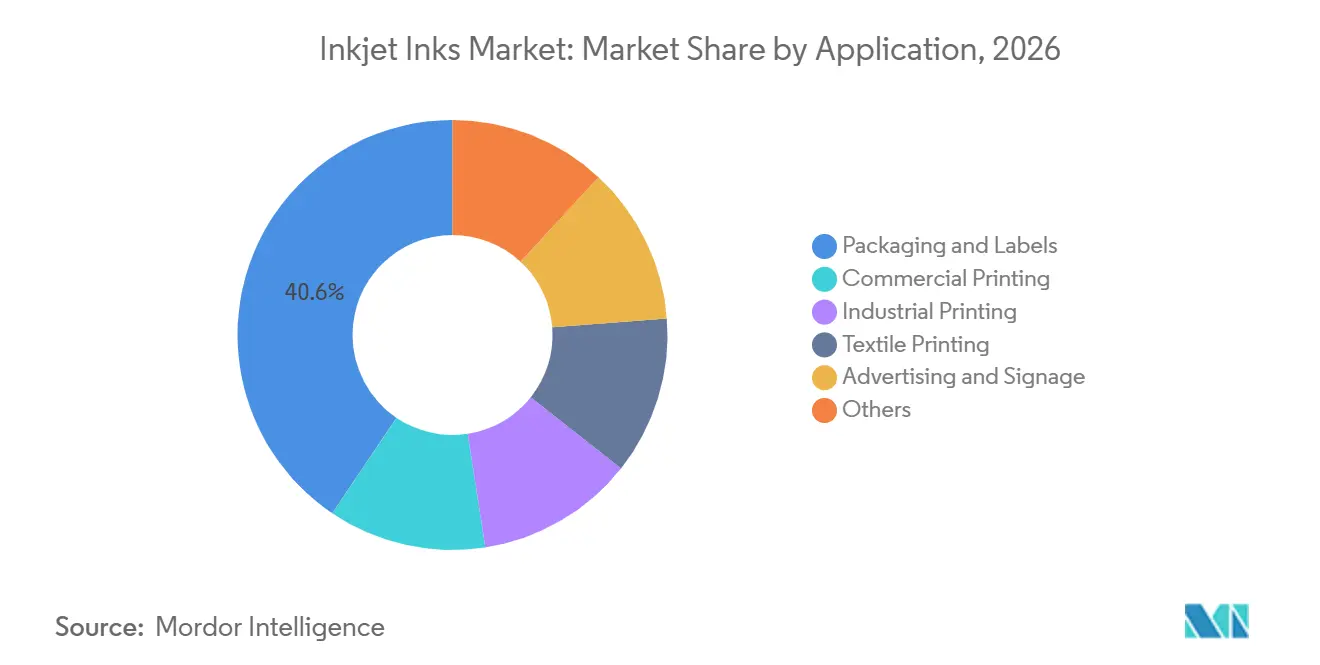
- By application, packaging and labels accounted for 40.55% of the inkjet inks market share in 2026, while textile printing is forecast to grow at a 7.64% CAGR through 2032.
- By geography, Asia-Pacific held 42.32% of the global market share in 2026 and is forecast to grow at a 7.28% CAGR through 2032.
Note: Market numbers in this report are based on Mordor Intelligence's proprietary estimation framework, which combines nine months of actuals with Q4 projections for base year 2026.
Global Inkjet Inks Market Trends and Insights
Drivers Impact Analysis*
| Drivers | (~) % Impact on CAGR Forecast | Geographic Relevance | Impact Timeline |
|---|---|---|---|
| Digital Conversion of Short-Run and Variable-Data Printing | +1.4% | Global, concentrated in North America and Europe | Short term (≤ 2 years) |
| Expansion of Digital Packaging and Label Production | +1.2% | Global, led by Europe and APAC | Short term (≤ 2 years) |
| Growth of Digital Textile Printing and On-Demand Apparel | +1.0% | APAC core, spillover to North America and Europe | Medium term (2–4 years) |
| Adoption of Low-Volatile Organic Compound (VOC), Water-Based and UV-Curable Formulations | +0.9% | EU and North America primarily, with APAC convergence | Medium term (2–4 years) |
| Industrial Coding, Serialization, and Traceability Requirements | +0.7% | Global, with early gains in regulated pharmaceutical and food markets | Short term (≤ 2 years) |
| Source: Mordor Intelligence | |||
Digital Conversion of Short-Run, Variable-Data, and Traceability Printing
Inkjet economics favor short jobs because printers can avoid plates, cylinders, and lengthy setup sequences. This allows production teams to accept smaller orders and make late artwork changes without the traditional prepress burden. Brand owners are adding more product information, QR codes, and item-level identifiers to packaging, which increases demand for variable printing. This need is especially clear where traceability, consumer engagement, and timely changes to product information matter. The FUJIFILM Jet Press 750S High Speed Model produces 5,400 variable-data sheets per hour on uncoated paper, with no plates or setup waste. Once a press-and-ink combination is qualified, the inkjet inks market benefits from recurring demand because the press operator must continue to use approved chemistry.
Expansion of Digital Packaging and Label Production
Intergraf identified digital packaging and label production as the fastest-growing segment of European commercial printing. Digital production gives converters a way to manage stock-keeping unit growth without carrying large inventories of printed packaging. It also supports serialization, QR codes, and product authentication features in food and pharmaceutical packaging. Water-based pigment systems are extending digital production into corrugated board and other formats traditionally served by analog presses, broadening the range of packaging formats that can move from analog to digital workflows.
Growth of Digital Textile Printing and On-Demand Apparel
On-demand digital production can support customized orders and shorter delivery expectations without the minimum quantities required for screen printing. Kornit Digital reported that Printeez adopted Atlas MAX POLY systems in 2025 to replace its analog screen-printing capacity[1]. Mimaki introduced the waterless Tx330-1800 direct-to-fabric printer in February 2025, removing a water-intensive dyeing step from the production process. The inkjet inks market stands to benefit where brands value lower pre-production inventory and direct-to-fabric manufacturing. Formulators that deliver reliable color on blended fabrics without primer steps are likely to be more relevant to this transition.
Adoption of Low-Volatile Organic Compound (VOC), Water-Based, and UV-Curable Formulations
Regulatory requirements have made formulation compliance a condition for retaining packaging contracts. The German Printing Ink Ordinance took full effect in January 2026, increasing demand for low-migration materials in European food-contact packaging. FUJIFILM launched AQUAFUZE technology at FESPA 2025 and introduced it in the United States in October 2025. The technology combines water-based and UV-curing attributes, reduces nozzle clogging, and avoids solvent emissions. Lubrizol reported in August 2025 that its High Stability Dispersion technology enables water-based inkjet production at speeds up to 150 meters per minute. These developments increase the importance of dispersion quality and compliant chemistry in the inkjet inks market.
Restraints Impact Analysis*
| Restraints | (~) % Impact on CAGR Forecast | Geographic Relevance | Impact Timeline |
|---|---|---|---|
| Nozzle Clogging and Dispersion-Stability Risk | -0.6% | Global | Short term (≤ 2 years) |
| Compatibility Constraints Across Printheads and Substrates | -0.5% | Global, more acute in the fragmented APAC mid-market | Medium term (2-4 years) |
| Specialty-Pigment, Solvent, and Additive Price Volatility | -0.4% | Global, structurally elevated in Europe post-2026 | Long term (≥ 4 years) |
| Source: Mordor Intelligence | |||
Nozzle Clogging and Dispersion-Stability Risk
Nozzle clogging remains a persistent technical challenge in industrial inkjet operations. Pigment aggregation can disrupt print quality, reduce uptime, and increase equipment maintenance costs. Research published in 2025 identified viscosity control as a factor in the jetability of high-viscosity printing resins. Thermal inkjet systems are also susceptible to clogging, with residue accumulating on heating elements and reducing ejection efficiency. While formulation advances can improve stability, each new ink system still requires printhead testing and qualification. The inkjet inks market faces constraints when a system change requires six to twelve months of validation for a single printhead model.
Compatibility Constraints Across Printheads and Substrates
Ink formulations must be adjusted for different piezoelectric, thermal resistive, and continuous inkjet printhead designs. Viscosity, surface tension, particle size, and curing behavior must align with both the equipment and the intended substrate. This alignment becomes more difficult when printers use recycled corrugated board, biodegradable films, metalized laminates, and technical textiles. In September 2026, FUJIFILM Dimatix announced the STARFIRE PhaseMaster hot-melt inkjet printhead for demanding scanning and single-pass industrial applications[2]. New hardware platforms can increase the reformulation burden for ink suppliers. Smaller producers without application development capacity may face longer qualification cycles and fewer early-stage original equipment manufacturer (OEM) opportunities.
*Our forecasts treat driver/restraint impacts as directional, not additive. The impact forecasts reflect baseline growth, mix effects, and variable interactions.
Segment Analysis
By Ink Type: Water-Based Inks Lead as UV-Curable Formulations Gain Ground
Water-based inks accounted for 50.67% of the inkjet inks market in 2026. Their position reflects tighter volatile organic compound (VOC) limits and food-packaging requirements that favor aqueous systems on relevant substrates. Water-based products also align with packaging designs that prioritize recyclability and lower solvent use. Solvent-based inks continue to serve outdoor signage and nonporous flexible materials where adhesion requirements remain demanding. UV-curable inks are expected to grow at a 6.86% CAGR from 2027 to 2032. The German Printing Ink Ordinance has increased demand for compliant formulations in European food and pharmaceutical packaging. Artience, formerly Toyo Ink, completed its German Printing Ink Ordinance-compliant portfolio in 2025, strengthening its position with accounts that require compliance documentation during procurement.
The boundary between water-based and UV-curable products is becoming less distinct. FUJIFILM's AQUAFUZE uses a water-based carrier with UV-curing performance for selected wide-format applications, addressing concerns about solvent emissions and photoinitiator migration. Ink suppliers with both water-based and UV-curable platforms can serve more applications from a single technical base, which can improve their standing with OEM partners that require several approved chemistries. The inkjet inks market is consequently shifting toward hybrid capabilities rather than strict separation between chemistry categories. Oil-based materials remain relevant in offset-adjacent commercial applications, though their role is less likely to keep pace with the growth of water-based and UV-curable formulations.

By Printing Technology: Drop-on-Demand Leads While Continuous Inkjet Gains in Coding
Drop-on-demand accounted for 45.13% of global revenue in 2026. The technology is widely used for high-resolution graphics, variable data, and printing across multiple substrates. Piezoelectric drop-on-demand systems suit industrial applications because they can handle a wider range of viscosities and chemistries, supporting use with water-based and UV-curable inks in packaging, label, and commercial print settings. Thermal inkjet remains relevant in office and lower-output applications, where lower equipment costs can offset cartridge-based ink costs. FUJIFILM Dimatix's STARFIRE PhaseMaster, planned for early 2027 availability, points to further development in high-speed industrial drop-on-demand systems. Demand remains supported by graphic arts and label production, where existing ink and printhead qualifications retain value.
Continuous inkjet is forecast to record a 7.13% CAGR from 2027 to 2032, driven by coding and serialization requirements across the food, pharmaceutical, and consumer goods industries. Continuous inkjet can print without contact at line speeds above 250 meters per minute on surfaces including glass bottles and flexible films. Domino Printech India introduced the K300 in November 2025 for GS1 DataMatrix coding at 250 meters per minute and 600 dpi resolution. Such deployments raise technical requirements for stable droplet formation during long production runs, as inks need to recirculate without settling or viscosity drift. This makes specialized chemistry knowledge a meaningful entry requirement in this segment of the inkjet inks market.
By Application: Packaging and Labels Lead While Textile Printing Advances Fastest
Packaging and labels accounted for 40.55% of the inkjet inks market in 2026. The segment benefits from growth in stock-keeping units, demand for unit-level information, and shorter product revision cycles. Digital systems allow brands to revise graphics without the minimum-volume requirements associated with analog processes. Intergraf reported that European inkjet printing revenue rose 6.9% in 2024, led by packaging and labels. INX International launched INXJet MDLM in July 2025 as a no-VOC, low-migration UV-curable inkjet ink for beverage cans, illustrating how suppliers can target specific packaging needs. Industrial printing also includes marking for electronics, ceramic decoration, glass coating, and specialty materials.
Textile printing is forecast to grow at a 7.64% CAGR from 2027 to 2032, reflecting an apparel industry shift toward made-to-order production and lower inventory exposure. Kornit Digital reported that Promos Ink moved production from 60 analog screen-printing systems to Kornit Digital on-demand platforms in September 2025. Advertising and signage also benefit when campaigns require frequent artwork changes and localized graphics, use cases that align with digital printing's ability to run without traditional setup requirements. Commercial printing retains a secondary position, as variable-data direct mail and transactional work grow more slowly than the textiles and packaging segments. The inkjet inks market retains further application potential as manufacturers adopt inkjet for more high-speed production processes.
Geography Analysis
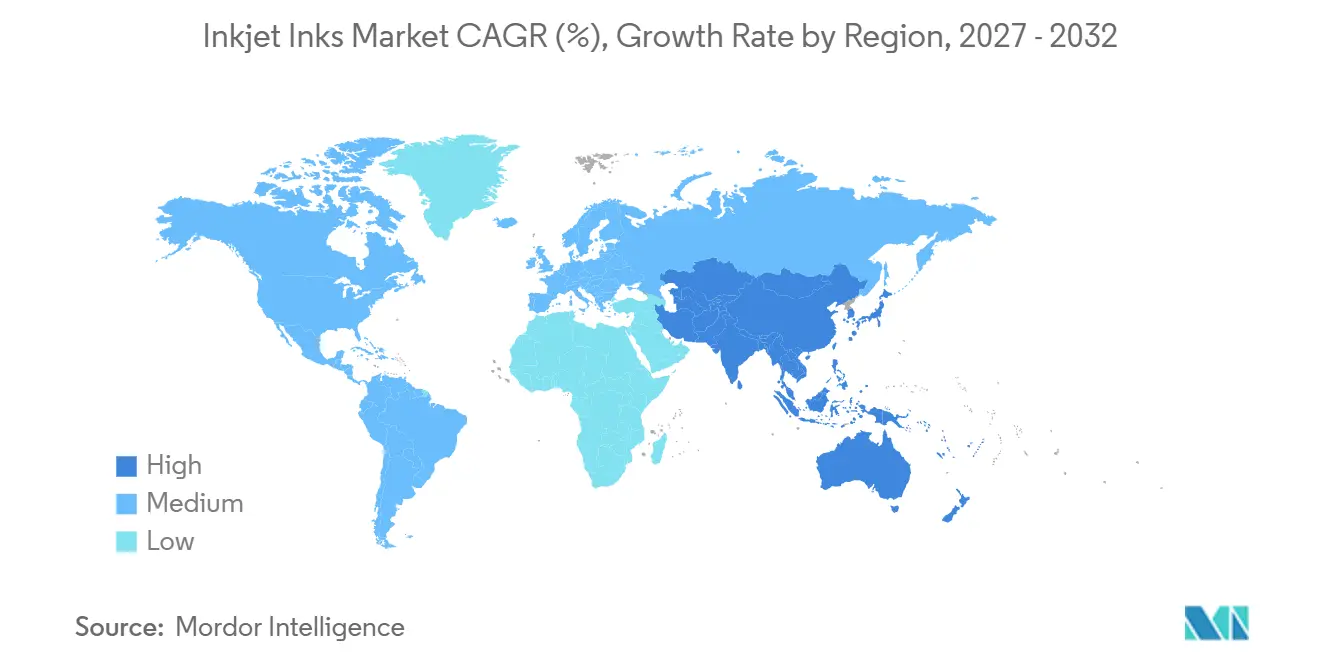
Asia-Pacific accounted for 42.32% of global revenue in 2026 and is forecast to grow at a 7.28% CAGR through 2032. China supports regional-scale water-based ink production, while the region remains dependent on imported high-performance UV-curable formulations. Japan's materials expertise supports printhead development and advanced manufacturing. Seiko Epson completed a JPY 5.1 billion (~USD 0.03 billion) investment in new Tohoku Epson printhead capacity in October 2025, with full operations scheduled from May 2026. Epson also opened its first ink-tank printer facility in Chennai in July 2025 to serve domestic demand. India's pharmaceutical serialization and consumer goods packaging requirements support local demand for digital print equipment and related inks.
North America remains a mature but technology-driven part of the inkjet inks market. The United States is a significant launch market for new products from INX International, Sun Chemical, and FUJIFILM North America. INXJet MDLM addresses metal can decoration, while AQUAFUZE targets wide-format substrates. Europe is shaped more directly by regulatory requirements for food-contact packaging. The German Printing Ink Ordinance has made reformulation of photoinitiators important for suppliers serving the region. Siegwerk's SICURA NutriJet and SICURA Jet product lines emphasize Carcinogenic, Mutagenic, or Reprotoxic (CMR)-free formulations developed for Original Equipment Manufacturer (OEM) partners. This regulatory environment favors suppliers that can provide complete compliance documentation.
South America, the Middle East, and Africa remain smaller revenue areas in the inkjet inks market. Brazil's e-commerce activity drives demand for labels from consumer goods companies that require fast artwork updates. Argentina's packaging sector is also investing in digital capability to improve production flexibility. In the Middle East, Saudi Arabia's industrial diversification supports longer-term demand for coding and marking in food processing and pharmaceutical packaging. In Africa, pharmaceutical packaging is subject to unit-level serialization requirements set by health authorities. These requirements give continuous inkjet suppliers a defined route into regulated packaging applications. Local success depends on reliable technical support, compliant chemistry, and service coverage.
Competitive Landscape
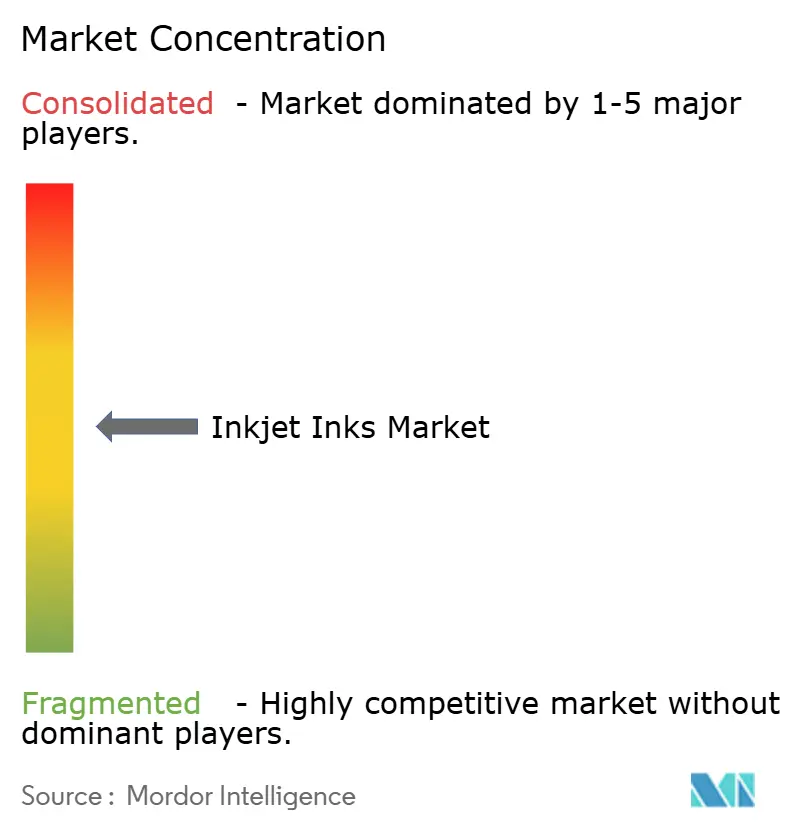
The global inkjet inks market is moderately fragmented among large chemistry and printing technology suppliers. Sun Chemical, FUJIFILM, Seiko Epson, HP, and Agfa operate alongside focused suppliers, including Marabu, INX International, Siegwerk, and Nazdar. Scale is a factor, but OEM co-development provides a stronger basis for commercial positioning. An ink approved for a specific printhead platform can remain in use for the working life of that press. Siegwerk's CMR-free SICURA NutriJet and SICURA Jet products demonstrate that food-contact compliance is also a threshold requirement for partnership selection.
Growth opportunities exist in bio-based inks, functional inks for smart packaging, and continuous inkjet products for nonporous industrial substrates. Bio-based materials can support brand owners managing Scope 3 commitments. Conductive formulations may enable applications such as printed RFID antennas. Specialized continuous inkjet products can address surfaces that water-based systems do not wet reliably. Some new entrants are developing pigment dispersions rather than finished inks, an approach that can improve stability and color range without requiring a full finished-ink portfolio. The inkjet inks market is likely to favor suppliers that combine dispersion technology, compliant chemistry, and close OEM integration.
Sun Chemical partnered with Onlineprinters in October 2025 to optimize its SunLit ProPace ink range and announced a narrow-web co-branding partnership with Cyngient in 2025 for tag and label converters. These actions illustrate how suppliers use product optimization and partnership models to protect customer access. Production monitoring and formulation optimization are increasingly relevant for suppliers supporting demanding industrial applications. The inkjet inks market is also shaped by the difficulty of replacing approved formulations once a press is in regular production. This makes application support, testing capability, and reliable supply important factors alongside price competition. Suppliers that can support qualification across multiple printhead systems and substrate types are better positioned in this market. Food-contact packaging introduces an additional requirement, as printers and brand owners need documentation demonstrating compliance with food-contact regulations. The market is more defensible where a supplier's chemistry is embedded in an OEM system or a tightly specified industrial workflow. Suppliers focused on water-based dispersions, UV-curable systems, and continuous inkjet products address different technical needs but often compete for the same converter relationships.
Inkjet Inks Industry Leaders
-
HP Development Company, L.P.
-
Canon Inc.
-
Seiko Epson Corporation
-
Sun Chemical
-
FUJIFILM Corporation
- *Disclaimer: Major Players sorted in no particular order
Recent Industry Developments
- September 2026: FUJIFILM Dimatix announced the STARFIRE PhaseMaster hot-melt inkjet printhead, designed for high-speed scanning and single-pass industrial applications, with or without ink recirculation. Global availability is targeted for early 2027, with applications spanning graphic arts and industrial manufacturing.
- September 2026: Sun Chemical and Cyngient announced a narrow web co-branding partnership, combining Sun Chemical's SunJet digital inkjet technologies with Cyngient's specialty coatings and adhesives into a joint product range for narrow web, tag, and label converters.
Global Inkjet Inks Market Report Scope
Inkjet inks are specialized liquid or paste formulations designed to be propelled as microscopic droplets from printer nozzles onto surfaces such as paper, plastic, metal, or fabric to reproduce digital images and text without physical contact.
The inkjet inks market is segmented by ink type, printing technology, application, and geography. By ink type, the market is segmented into water-based inks, oil-based inks, solvent-based inks, UV-curable inks, and others. By printing technology, the market is segmented into drop-on-demand inkjet, continuous inkjet, thermal inkjet, and others. By application, the market is segmented into packaging and labels, commercial printing, industrial printing, textile printing, advertising and signage, and others. The report also covers the market size and forecasts for inkjet inks in 16 countries across major regions. The market sizes and forecasts are provided in terms of value (USD).
| Water-Based Inks |
| Oil-Based Inks |
| Solvent-Based Inks |
| UV-Curable Inks |
| Others |
| Drop-on-Demand Inkjet |
| Continuous Inkjet |
| Thermal Inkjet |
| Others |
| Packaging and Labels |
| Commercial Printing |
| Industrial Printing |
| Textile Printing |
| Advertising and Signage |
| Others |
| Asia-Pacific | China |
| India | |
| Japan | |
| South Korea | |
| ASEAN Countries | |
| Rest of Asia-Pacific | |
| North America | United States |
| Canada | |
| Mexico | |
| Europe | Germany |
| United Kingdom | |
| France | |
| Italy | |
| NORDIC Countries | |
| Rest of Europe | |
| South America | Brazil |
| Argentina | |
| Rest of South America | |
| Middle East and Africa | Saudi Arabia |
| South Africa | |
| Rest of Middle East and Africa |
| By Ink Type | Water-Based Inks | |
| Oil-Based Inks | ||
| Solvent-Based Inks | ||
| UV-Curable Inks | ||
| Others | ||
| By Printing Technology | Drop-on-Demand Inkjet | |
| Continuous Inkjet | ||
| Thermal Inkjet | ||
| Others | ||
| By Application | Packaging and Labels | |
| Commercial Printing | ||
| Industrial Printing | ||
| Textile Printing | ||
| Advertising and Signage | ||
| Others | ||
| By Geography | Asia-Pacific | China |
| India | ||
| Japan | ||
| South Korea | ||
| ASEAN Countries | ||
| Rest of Asia-Pacific | ||
| North America | United States | |
| Canada | ||
| Mexico | ||
| Europe | Germany | |
| United Kingdom | ||
| France | ||
| Italy | ||
| NORDIC Countries | ||
| Rest of Europe | ||
| South America | Brazil | |
| Argentina | ||
| Rest of South America | ||
| Middle East and Africa | Saudi Arabia | |
| South Africa | ||
| Rest of Middle East and Africa | ||
Key Questions Answered in the Report
What is current market size of Inkjet Inks Market?
The Inkjet Inks Market size was valued at USD 8.35 billion in 2026 and is estimated to grow from USD 8.85 billion in 2027 to USD 11.92 billion by 2032, at a CAGR of 6.13% during the forecast period (2027-2032).
Which printing technology is growing fastest?
Continuous inkjet is forecast to grow at a 7.13% CAGR through 2032, supported by coding and serialization requirements.
What is driving textile printing demand?
Textile printing is projected to grow at a 7.64% CAGR through 2032 as apparel production shifts toward on-demand manufacturing.
Which region has the largest share?
Asia-Pacific held a 42.32% share in 2026 and is forecast to expand at a 7.28% CAGR through 2032.