
India Infrastructure Market Analysis by Mordor Intelligence
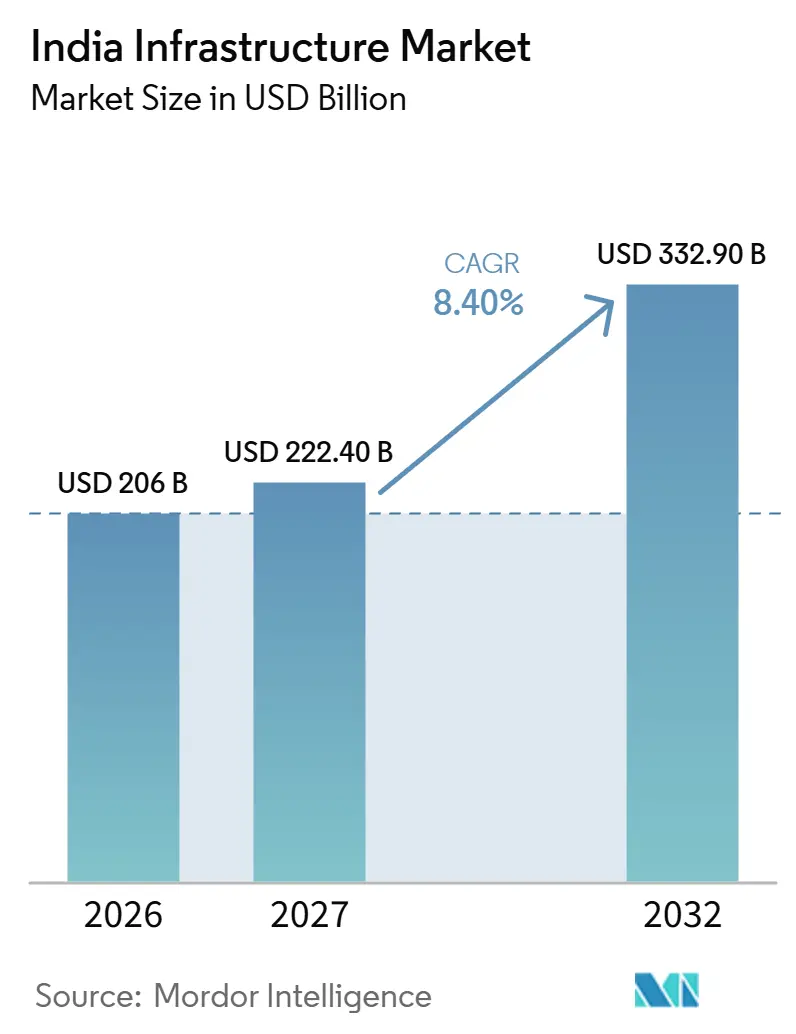
The India infrastructure market size is expected to increase from USD 206 billion in 2026 to USD 222.4 billion in 2027 and reach USD 332.9 billion by 2032, growing at a CAGR of 8.4% over 2027-2032.
India's publicly funded transport programs combine with power-network demand from renewable generation and concentrated industrial loads. Green financing supports eligible metro investment, creating routes for developers to organize the capital needed for construction. Contractors compete by integrating civil and systems delivery, linking their commercial role to the usability of completed infrastructure. Labor-cost pressure and financing exclusions for coal-linked assets constrain how readily proposed projects can become executable work. Metro and transmission packages offer integrated contractors stronger openings, while coal-linked developers face restricted financing choices and labor-intensive contractors face higher delivery costs.
Key Report Takeaways
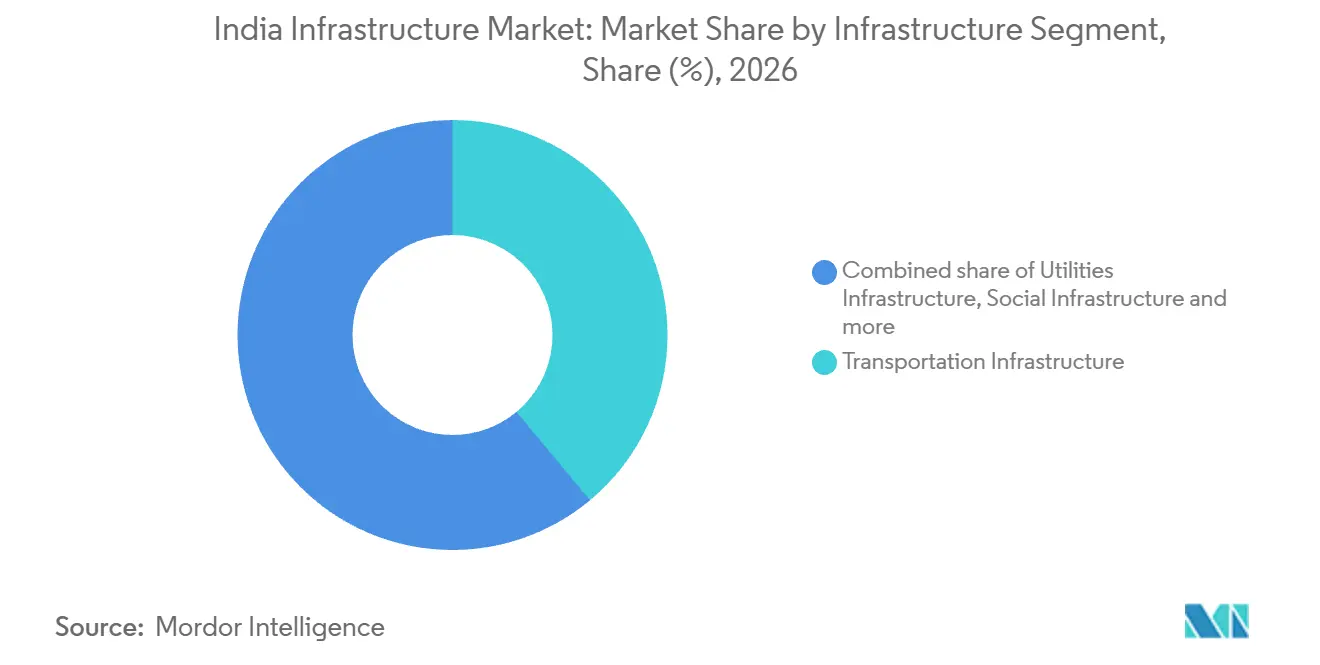
- Across infrastructure segments, transportation infrastructure held a 38.96% India infrastructure market share in 2026, while utilities infrastructure is forecast to grow fastest at a CAGR of 10.4% over 2027-2032.
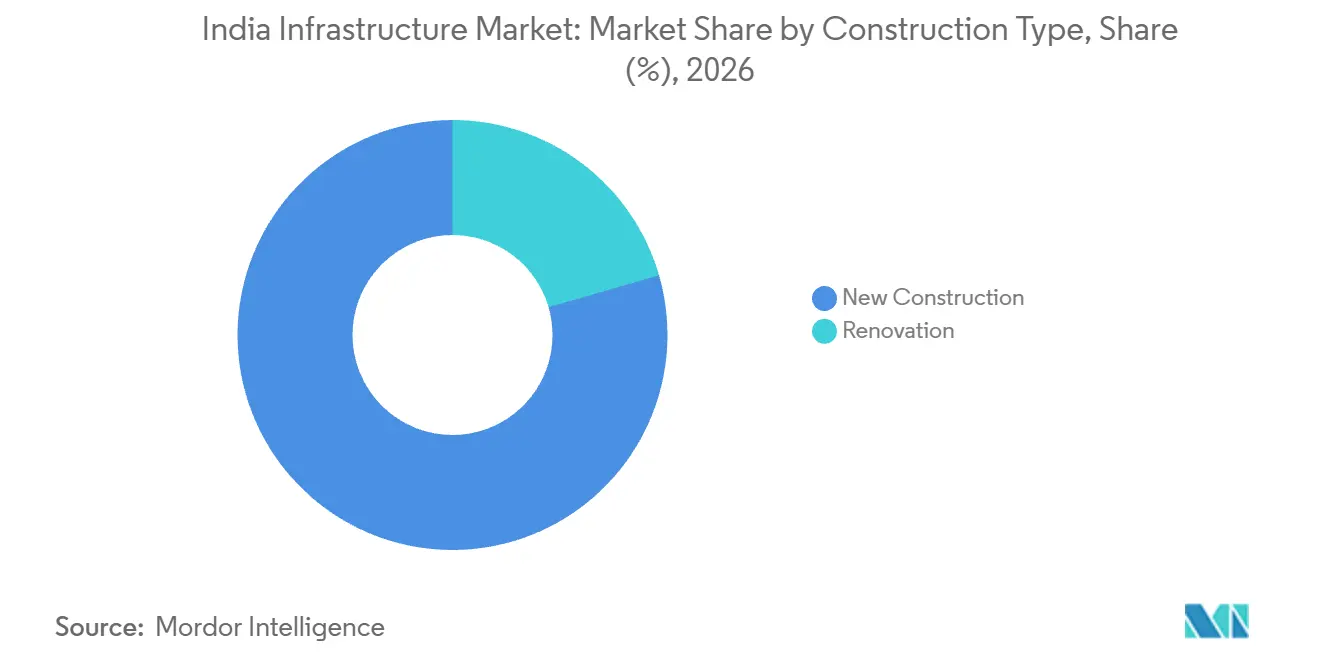
- By construction type, new construction accounted for a 79.48% share of the India infrastructure market size in 2026, with renovation forecast to grow fastest at a CAGR of 10.1% over 2027-2032.
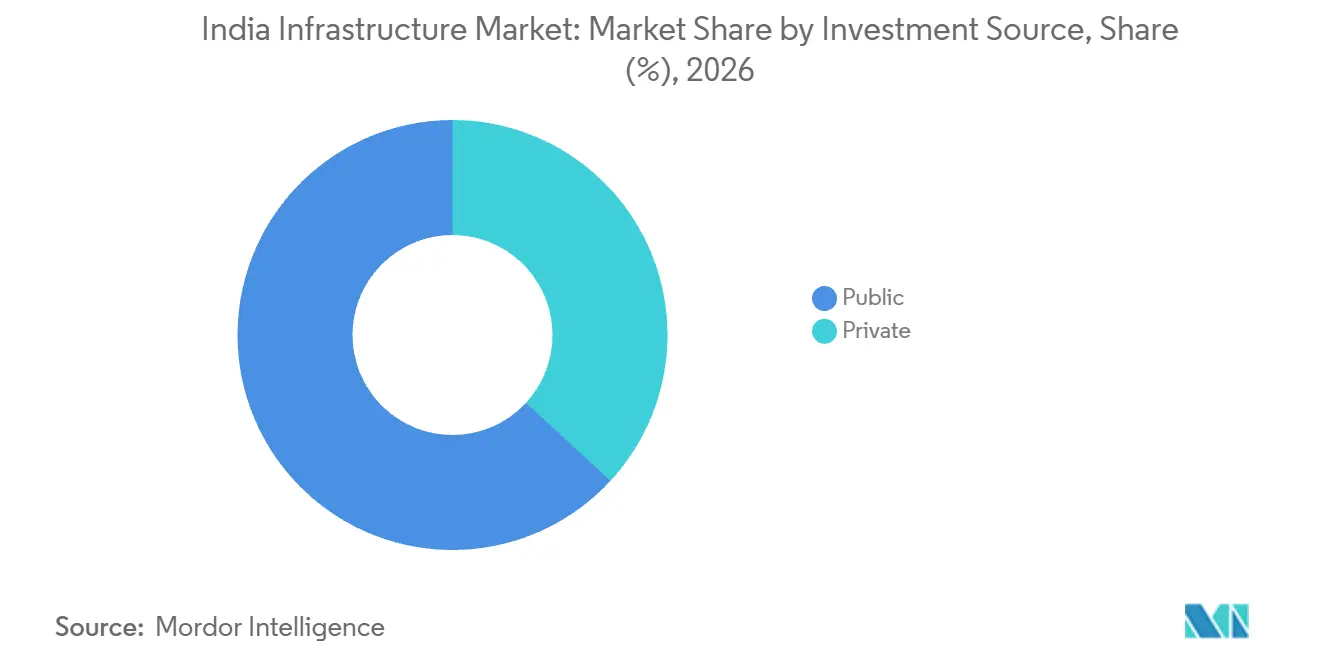
- Among investment sources, public funding led with a 63.14% share of infrastructure spending in 2026, and private investment is forecast to grow fastest at a CAGR of 10.9% over 2027-2032.
- Geographically, Mumbai Metropolitan Region led with 15.39% of Indian infrastructure spending in 2026, while Hyderabad is forecast to grow fastest at a CAGR of 11.7% over 2027-2032.
Note: Market numbers in this report are based on Mordor Intelligence's proprietary estimation framework, which combines nine months of actuals with Q4 projections for base year 2026.
Market Trends and Insights
Drivers Impact Analysis of India Infrastructure Market*
| Driver | (~) % Impact on CAGR Forecast | Geographic Relevance | Impact Timeline |
|---|---|---|---|
| PM GatiShakti National Master Plan shortening infra approval cycles | +3.3% | Nationwide | Short term (≤ 2 years) |
| Green Hydrogen Mission driving pipeline, port & storage infrastructure build-out | +1.8% | Paradip Port, Odisha | Long term (≥ 4 years) |
| Sovereign Green Bonds mobilizing capital for metro & EV charging projects | +2% | Nationwide | Medium term (2-4 years) |
| Surging hyperscale data-center demand catalyzing renewable-powered industrial parks | +2.2% | Navi Mumbai, Pendurthi and Vizag | Medium term (2-4 years) |
| Second wave of airport privatization boosting regional airport EPC contracts | +0.7% | Amritsar, Varanasi, Raipur and Tiruchirappalli | Long term (≥ 4 years) |
| Source: Mordor Intelligence | |||
PM GatiShakti National Master Plan shortening infra approval cycles
Under PM GatiShakti, the Network Planning Group had evaluated 396 central-government infrastructure projects as of August 11, 2026. In February 2026, the government reported that integrating the PM GatiShakti National Master Plan with the Project Monitoring Group had expedited resolution of issues and regulatory bottlenecks.[1] The Project Monitoring Group tracks project milestones and escalates implementation issues. In the August snapshot, 198 of the 256 sanctioned projects were under implementation, making delivery coordination relevant to a substantial construction pipeline. For an owner, resolving a regulatory bottleneck can release an affected work package for execution, bringing planned connectivity closer to billable construction activity.
Green Hydrogen Mission driving pipeline, port & storage infrastructure build-out
Hydrogen-oriented port development creates demand for connected handling assets beyond the production plant itself. In February 2026, the Ministry of Ports, Shipping and Waterways approved a Paradip Port jetty with planned storage, pipelines and handling equipment. The proposed facility would handle 4 million metric tons annually of green hydrogen, ammonia and other liquid cargo, with Paradip Port Authority implementing a build-operate-transfer arrangement. For terminal developers, this combination creates a construction opportunity spanning the berth and its associated cargo systems, with each component contributing to usable handling capacity. Coordinated delivery becomes essential to the terminal's commercial value, since an isolated berth cannot supply its approved cargo-handling function.
Sovereign Green Bonds mobilizing capital for metro & EV charging projects
Metro financing benefits when eligible public projects can draw on a defined green financing channel. India's FY2024-25 expenditure statement recorded actual metro-project equity investment among schemes eligible for Sovereign Green Bond financing. Eligible-scheme spending exceeded sovereign issuance, with the excess funded from general revenue. Public equity can help developers organize a metro's financing before committing its associated civil and systems works. Separately, the New Development Bank reported allocating USD 65.31 million of its own green-bond proceeds to Mumbai Metro lines 2A, 2B and 7 by year-end 2025.[2] This creates an opening for metro developers to structure construction financing around public equity support and project-linked green capital from distinct issuers.
Surging hyperscale data-center demand catalyzing renewable-powered industrial parks
Data-center expansion creates infrastructure demand through the grid connections needed to supply concentrated loads. A 2025 PFC Consulting Ltd bid document reported 3.5 GW of phased data-center grid-connectivity applications in Navi Mumbai and around 800 MW of issued connectivity. These measures provide a basis for sizing physical networks and staging construction around requested connections. In July 2026, Adani Energy Solutions Ltd won an interstate transmission project principally for proposed Vizag green hydrogen and ammonia projects. The company said the system would also support expected data-center load in the Pendurthi-Vizag region, with delivery contracted over 30 months. Shared transmission assets and high-capacity connections therefore form the construction opportunity, allowing physical utility works to serve industrial and digital customers together.
Restraints Impact Analysis of India Infrastructure Market*
| Restraint | (~) % Impact on CAGR Forecast | Geographic Relevance | Impact Timeline |
|---|---|---|---|
| Tightening ESG financing norms restricting funding for fossil-linked projects | -0.5% | Nationwide | Medium term (2-4 years) |
| Skilled labor shortages amid concurrent mega-projects spiking wage bills | -1.1% | Nationwide | Short term (≤ 2 years) |
| Source: Mordor Intelligence | |||
Tightening ESG financing norms restricting funding for fossil-linked projects
Coal-linked infrastructure faces a financing obstacle when a project falls outside a lender's environmental eligibility rules. In March 2025, the Asian Infrastructure Investment Bank approved India on-lending facility terms excluding coal mining, coal transportation, coal-fired plants and infrastructure dedicated exclusively to those activities. Aditya Birla Capital Limited is the facility's financial intermediary, placing the restriction within a defined route to project finance. For an affected developer, improving a project's engineering or credit profile cannot by itself remove an activity-based exclusion. The commercial constraint is therefore that coal-dedicated works cannot draw on this financing channel, which leaves them dependent on securing eligible funding elsewhere.
Skilled labor shortages amid concurrent mega-projects spiking wage bills
Skilled-worker availability limits how readily infrastructure contractors can convert new awards into work performed on site. In H1 2026, WT India reported rising skilled and unskilled labor costs across construction amid skill-availability constraints and Tier-1 cost-of-living pressures.[3] For labor-intensive civil works, these pressures raise the cost of delivering work already awarded. A contractor can therefore face a wider gap between the value of work secured and the resources needed to execute it. In FY2026, Tata Projects Ltd and the Construction Industry Development Council offered unemployed youth on-site training, vocational education and employment assurance through Kaushal Nayak. The immediate commercial limit is how much work a contractor can staff profitably while new workers acquire the necessary skills.
*Our forecasts treat driver/restraint impacts as directional, not additive. The impact forecasts reflect baseline growth, mix effects, and variable interactions.
India Infrastructure Market Segment Analysis
By Infrastructure Segment:
Roads Anchor Scale as Power Networks ExpandTransportation infrastructure accounted for a 38.96% share of the India infrastructure market size in 2026. It was the largest segment, with India's national highway authority, NHAI, constructing 5,313 kilometers of national highways during FY2025-26. In September 2025, NHAI said subcontracting beyond permitted limits in engineering, procurement and construction projects would be classified as an undesirable practice, with penalties on par with fraudulent practices. For road contractors, adding delivery capacity through subcontractors therefore requires attention to the limits attached to their work packages. Disciplined subcontracting becomes a commercial capability in a large highway program, because expansion through outside firms carries contract-specific constraints and potential sanctions.
Utilities infrastructure is forecast to be the fastest-growing segment, at a CAGR of 10.4% over 2027-2032. On January 14, 2026, India's national grid commissioned the 765 kV Bhadla II-Sikar II line, enabling an additional 1,100 MW of renewable-power evacuation in Rajasthan. The added evacuation capacity was for power from the Bhadla, Ramgarh and Fatehgarh solar complexes. For generation owners, the line expands the ability to move power to the grid, linking the commercial use of renewable assets to transmission delivery. That relationship creates construction demand where evacuation capacity must accompany generation, giving utility contractors a role in resolving a network constraint beyond the power plant itself.

By Construction Type:
Replacement Assets Broaden New Construction DemandNew construction represented a 79.48% India infrastructure market share in 2026. As the largest segment, its opportunity extends to full replacement of infrastructure that already serves an established route. On April 6, 2025, Prime Minister Narendra Modi inaugurated the 2.08-kilometer New Pamban railway bridge in Tamil Nadu, which replaced a 110-year-old cantilever bridge. Rail Vikas Nigam Ltd constructed the bridge, linking Rameswaram with the mainland through a new physical asset. For project owners, replacement construction can therefore sustain full-asset delivery opportunities even where a transport connection already exists.
Renovation is forecast to be the fastest-growing segment, at a CAGR of 10.1% over 2027-2032. Indian Railways renewed approximately 54,600 kilometers of track across its network from 2014 through February 2026. Renewal was based on age, traffic carried and track condition, with work prioritized to maintain safe running at permitted speeds. Such condition-led interventions can sustain construction demand on existing rail assets without requiring an entirely new corridor. For rail owners, the valuable construction capability is restoring track condition while preserving the service function of the existing route.
By Investment Source:
Public Scale Meets Private Financing FlexibilityPublic investment was the largest segment, accounting for 63.14% of infrastructure spending in 2026. In the FY2026-27 budget, the Ministry of Finance proposed Union Government capital expenditure of INR 12.2 trillion (USD 134.7 billion). Because the INR 12.2 trillion is a budget proposal rather than outturn, it signals planned fiscal capacity for future packages. Suppliers serving public clients therefore depend on how quickly capital allocations convert into awarded work.
Private investment is forecast to be the fastest-growing segment, at a CAGR of 10.9% over 2027-2032. On June 24, 2025, Adani Airports Holdings Limited secured Mumbai International Airport financing combining USD 750 million of refinancing notes with provision to raise an additional USD 250 million. The framework was intended to give the airport's development, modernization and capacity-enhancement program greater financial flexibility. Refinancing existing obligations and providing for further funding serve different roles within the same private capital strategy. Because the USD 750 million of notes is for refinancing existing debt, the construction opportunity for contractors depends on how much of the additional USD 250 million provision is drawn for the airport's capital program.
Geography Analysis
Mumbai Metropolitan Region Infrastructure Market
Mumbai Metropolitan Region accounted for a 15.39% share of the India infrastructure market size in 2026. In its February 2026 FY2026-27 budget, the Mumbai Metropolitan Region Development Authority allocated 87% of proposed expenditure to infrastructure projects. For civil works and installation contractors serving the region, the authority's infrastructure-heavy allocation creates a focused public client base whose planned resources can underpin multiple work packages across the metropolitan area. The region's commercial weight therefore combines a large project base with concentrated public investment, leaving access to construction work sensitive to the authority's execution priorities and procurement sequencing.
Hyderabad Infrastructure Market
Hyderabad is forecast to be the fastest-growing city, with a CAGR of 11.7% over 2027-2032. On June 21, 2025, Hyderabad Metro Rail Limited said its Phase 2(B) proposal for 3 corridors, approved by the Telangana state cabinet, had been submitted to the Government of India. The 86.1-kilometer proposal included metro connections to Bharat Future City, Medchal and Shamirpet, giving the planned network a construction scope spanning several urban destinations. If authorized and funded, these extensions would create additional corridor and systems packages for contractors, giving the proposed metropolitan network a direct route to construction demand.
Within Delhi NCR, Delhi Metro's corridors inaugurated March 8, 2026, were expected to improve connectivity in Burari and Yamuna Vihar. The Union Cabinet approved Pune's 2 suburban metro corridors on June 25, 2025, and Ahemadabad's Koteshwar Road-airport corridor on June 10, 2026. Chennai Metro Rail Limited's May 2, 2025 contract award to Bridge & Roof Company India Ltd covered Broadway's multimodal complex with Kuralagam, while Bengaluru's BWSSB awarded VA TECH WABAG wastewater design-build-operate work in July 2026. Kolkata's ADB-approved 2025 project planned 84 kilometers of trunk and secondary sewerage and drainage pipelines, 176 kilometers of lateral pipelines and 50,000 household sewer connections, spanning bulk networks and household access. Rest of India's freight-continuity needs differ, illustrated by Bihar's Aunta-Simaria bridge, inaugurated August 22, 2025, linking Mokama and Begusarai for heavy vehicles bypassing deteriorated Rajendra Setu.
Regulatory Framework and Outlook
The comparison covers selected jurisdictions from the perspective of infrastructure developers preparing new projects and covered reconstruction following demolition. National environmental-clearance duties depend on a project's scheduled category, and 2024 notifications removed a separate Consent to Establish (CTE) requirement for projects already requiring prior clearance. Within Maharashtra, the comparison focuses on the Pune Metropolitan Region Development Authority's (PMRDA) jurisdiction, where July 2026 rules extended the unified development-control framework. State pollution control boards can offer appraisal comments or conditions, and Consent to Operate provides a separate operational mechanism.
Regulatory Table of India Infrastructure Market
| Decision factor | India | Maharashtra (PMRDA area) |
|---|---|---|
| Primary authority | Ministry of Environment, Forest and Climate Change for Category A clearance; state and union territory authorities for Category B clearance; local or development authorities for recyclable-waste assessment | PMRDA administers development-permission review |
| Key instruments or direction | EIA Notification 2006; separate-CTE exemption; Environment (Construction and Demolition) Waste Management Rules, 2025 | Unified Development Control and Promotion Regulations extended to PMRDA in July 2026 |
| Commercial effect | Prior clearance for scheduled new projects and threshold-crossing expansions; producer recycling duties for covered reconstruction | Building and structural compliance review under the applicable development-control framework |
| Current policy attractiveness | Medium | Medium |
| Future direction of policy attractiveness | Hardening | Easing |
| Source: Mordor Intelligence | ||
India's Medium rating balances the prior-clearance process and separate-consent exemption against producer-responsibility requirements for covered reconstruction projects. Under the 2025 rules, effective April 1, 2026, reconstruction-producer recycling targets rise from 50% for 2026-27 to 75% for 2027-28 and 100% from 2028-29 onward. Local or development authorities assess the prior-year recyclable waste forming the target base, supporting a Hardening outlook as phased producer obligations increase. Maharashtra's Pune-region Medium rating and Easing direction reflect the July 2026 shift to a unified framework, while PMRDA's building and structural compliance review preserves the permission burden.
Value Chain Stages
The value chain compares how engineering providers, materials suppliers and construction contractors earn revenue from physical infrastructure delivery. Tata Projects Ltd combines civil works with track, substations, electrification and signaling capabilities across its Indian infrastructure activities. Larsen & Toubro Ltd received a domestic high-speed rail track package in FY2025-26, illustrating the construction stage's project-based revenue opportunity. Integrating engineering and execution can extend a contractor's revenue scope, while responsibility for interfaces determines how much delivery risk accompanies that opportunity.
Value Chain Analysis Table of India Infrastructure Market
| Primary activity | Key participants | Value capture | Bottleneck | Resilience response |
|---|---|---|---|---|
| Engineering and interface planning | Engineering and systems providers such as Tata Projects Ltd | Engineering and integration fees | Unresolved civil and systems interfaces | Define interface responsibilities before installation |
| Construction materials supply | Cement and concrete suppliers such as UltraTech Cement Limited; steel suppliers such as Tata Steel Limited | Material sales | Input-price exposure between bidding and consumption | Align deliveries with work sequencing and applicable adjustment terms |
| Construction and systems installation | Infrastructure contractors such as Larsen & Toubro Ltd and Tata Projects Ltd | Construction and installation billings | Coordinating civil completion with systems installation | Sequence work packages around agreed installation interfaces |
| Source: Mordor Intelligence | ||||
Price-adjustment provisions can protect construction cash flows only within their contractual eligibility conditions. The Ministry of Road Transport and Highways' April 2026 circular provided monthly bitumen adjustments for eligible National Highway work from April 1 to June 30, 2026. Eligibility required bids due by March 31, 2026 and an existing escalation clause, with quantities limited to actual consumption under the approved job-mix formula. Resilience therefore depends on matching input records and contract terms to the specific work period, alongside coordinating materials with installation.
Competitive Landscape
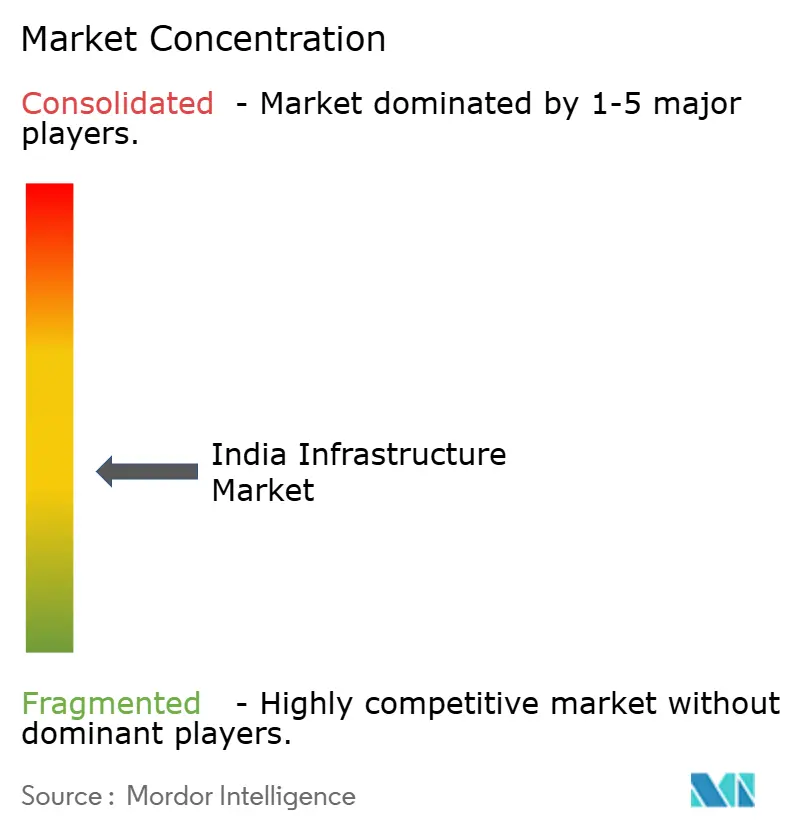
The moderately fragmented contractor base includes Larsen & Toubro Ltd in metro electrification and systems, and Tata Projects Ltd with FY2026 orders from Adani and Torrent across its wider portfolio. Hindustan Construction Company Ltd undertakes railway, metro and water contracts, while NCC Ltd performs government healthcare construction. Shapoorji Pallonji Engineering & Construction, a division of Shapoorji Pallonji And Company Private Limited, provides general contracting and design-build services. This mix centers competition on matching delivery capabilities to each owner's physical asset and procurement scope, leaving room for established firms with expertise suited to particular construction and installation packages.
Systems integration gives contractors a route to a larger scope of technically connected metro work. In December 2025, Larsen & Toubro Ltd won Mumbai Metro Line 4 electrification work covering 24.72 route kilometers and 22 elevated stations. The package encompassed design, manufacture, supply, installation, integration, testing and commissioning of power-supply and traction systems. Combining these responsibilities allows a metro authority to place connected equipment and delivery obligations within one contractor's scope. The competitive benefit is accountability through commissioning, since the buyer needs the installed power and traction systems to function together before the package can fulfill its intended transport role.
Competitive direction also reflects the qualification conditions public owners attach to work on existing assets. Delhi Metro's January 22, 2026 tender required similar steel-structure painting work completed or substantially completed on an operating metro network within the prior 5 years. Bids for the viaduct-railing painting contract were scheduled for February 4 to 10, 2026. Older experience or general steel-painting capability alone cannot meet these contract-specific conditions. Operating-network painting experience therefore acts as an entry barrier for challengers and favors contractors that have already painted steel structures on live metro systems.
India Infrastructure Industry Leaders
-
Larsen & Toubro Ltd
-
Tata Projects Ltd
-
Hindustan Construction Company Ltd
-
NCC Ltd
-
Shapoorji Pallonji Engineering & Construction
- *Disclaimer: Major Players sorted in no particular order
India Infrastructure Market Companies Covered in this Report
- Larsen & Toubro Ltd
- Tata Projects Ltd
- Hindustan Construction Company Ltd
- NCC Ltd
- Shapoorji Pallonji Engineering & Construction
- Afcons Infrastructure Ltd
- GMR Airports Ltd
- IRB Infrastructure Developers Ltd
- Adani Ports & SEZ Ltd
- Reliance Infrastructure Ltd
- Dilip Buildcon Ltd
- KEC International Ltd
- Ashoka Buildcon Ltd
- JSW Infrastructure Ltd
- Kalpataru Projects International Ltd
- Power Grid Corporation of India Ltd
- Megha Engineering & Infrastructures Ltd
- G R Infraprojects Ltd
- Welspun Enterprises Ltd
- Rail Vikas Nigam Ltd
- NBCC (India) Ltd
- Cemindia Projects Ltd
- Capacit'e Infraprojects Ltd
Key Opportunities for Market Participants
The opportunities compare specialized road and tunnel construction packages for public transport infrastructure buyers. National Highways & Infrastructure Development Corporation Ltd (NHIDCL) issued August and September 2026 tenders combining major structures with adjoining transport works or ground treatment. Larsen & Toubro Ltd and Hindustan Construction Company Ltd have relevant rail, road or tunnel capabilities that make them potential beneficiaries within applicable tender requirements. For the Brahmaputra package, bid-stage participation is restricted to prequalified applicants and is subject to national security clearance.
Market Opportunities Table of India Infrastructure Market
| Opportunity | Why now | Buyer / lead segment | Recommended play | Main barrier | Likely beneficiaries |
|---|---|---|---|---|---|
| Brahmaputra 4-lane twin-tube road-and-rail tunnel and approaches | August 2026 tender with bid-stage deadline November 2, 2026 | NHIDCL / transportation infrastructure | Coordinate approaches and railway infrastructure in one tunnel tube | Prequalification and national security clearance | Potentially Larsen & Toubro Ltd, subject to qualification |
| Sudhmahadev-Dranga twin-tube tunnels and approach roads in Jammu and Kashmir | August 2026 tender with bids due October 30, 2026 | NHIDCL / transportation infrastructure | Package tunnel excavation with approach-road delivery | Coordinating twin-tube and approach-road works | Potentially Hindustan Construction Company Ltd |
| Rangpo-Ranipool NH-10 widening, tunnels and viaducts in Sikkim | September 2026 tender with bids due November 16, 2026 | NHIDCL / road upgrades | Combine 2-lane paved-shoulder widening with tunnels, viaducts and ground treatment | Vulnerable sliding and sinking zones | Potentially Hindustan Construction Company Ltd and Larsen & Toubro Ltd |
| Source: Mordor Intelligence | |||||
The central opening is responsibility for the interfaces around major civil structures. Across these packages, approaches, railway works or vulnerable-ground treatment sit inside the construction scope and affect the resources needed for delivery. Commercial advantage therefore rests on pricing those connected obligations together, because a tunnel-only estimate can leave corridor-wide execution costs uncovered.
Recent Industry Developments in India Infrastructure Market
- Oct 2026: The Prime Minister inaugurated the Poonamallee-Vadapalani stretch of Chennai Metro Phase II in Tamil Nadu on October 11.
- Sep 2026: Union Home Minister Amit Shah dedicated Barapullah Elevated Road Phase 3 to Delhi residents on September 29.
- Sep 2026: Road Transport and Highways Minister Nitin Gadkari inaugurated the 6-lane, 5.15-kilometer elevated corridor at Porvorim on NH-66 in Goa on September 9.
India Infrastructure Market Report Scope and Research Methodology
Market Definition and Coverage
The India infrastructure market measures annual spending on infrastructure build and upgrade activity executed in India. It covers core civil works and the installation and commissioning of physical infrastructure equipment across public and private projects.
Scope exclusions: Land acquisition costs, purely digital assets, telecom towers, data center fit-outs and cloud facilities are excluded.
Segments Covered in This Report
- By Infrastructure Segment
- Transportation Infrastructure
- Utilities Infrastructure
- Social Infrastructure
- Extraction Infrastructure
- By Construction Type
- New Construction
- Renovation
- By Investment Source
- Public
- Private
- By Geography
- Mumbai Metropolitan Region
- Delhi NCR
- Pune
- Bengaluru
- Hyderabad
- Chennai
- Kolkata
- Ahemadabad
- Rest of India
Data Sources, Market Sizing, and Validation
Desk Research
The Ministry of Finance budget documents and Economic Survey describe public capital outlays and sector investment priorities, while the Press Information Bureau's Economic Survey releases track road awards, logistics parks and railway infrastructure expansion. The Ministry of Road Transport and Highways' publications provide road network, construction and project execution context, and the Asian Development Bank's India PPP Monitor provides public-private financing and planned sector investment context for transport, utilities and social infrastructure.
Company annual reports, exchange filings, investor presentations, tender documents and reputable business press can add project awards, expenditure timing, input costs and contractor capacity details for India. These named sources are illustrative and not exhaustive, and further sources inform collection, validation and clarification.
Primary Interviews and Surveys
Structured interviews and questionnaires would cover Indian public and private project owners, contractors, engineering, procurement and construction providers, equipment suppliers and sector specialists across transport, utilities, social and extraction infrastructure. Respondents would help check secondary-source interpretation of billing stages, project execution, funding and segment assignment, while unresolved differences would be traced to project records or independent indicators and triangulated before use.
Distribution of primary research fieldwork respondents
| Company type | Respondent position | Region |
|---|---|---|
| Top tier: 32% | CXOs: 21% | |
| Mid tier: 46% | Functional/Unit leaders: 39% | |
| Smaller Players: 22% | Managers: 40% |
Market-Sizing & Forecasting
A top-down model estimates annual India spending on eligible infrastructure work in USD, using central and state capital outlays, sector investment plans, project-level expenditure and award progress, and construction input-cost indicators. Multivariate regression relates historical spending to these demand and execution indicators, with scenario analysis for changes in project timing, funding and delivery. Public monitoring data and disclosed project budgets provide selective bottom-up checks through annual work-package roll-ups, while missing project values are estimated from comparable disclosed contracts and checked against sector totals. Where contract awards span several years, the model includes only the year's supported work value in the annual estimate.
Segment shares are built by assigning observed spending and project evidence to transport, utilities, social or extraction infrastructure, new construction or renovation, public or private funding, and the specified Indian cities or rest of India. Analysts compare the resulting shares with official budget and investment allocations, contract activity and regional project data, then ask Indian sector experts to challenge the main variable assumptions and forecast direction. Gaps are bridged with the closest sector, project-stage and cost indicators, with assumptions revisited when evidence conflicts.
Data Validation & Update Cycle
Analysts triangulate project outlays and expenditure with budget allocations, contract awards, company disclosures, sector indicators and interview evidence, checking whether each signal refers to planned or executed work and avoids double counting installed equipment in EPC bills. They investigate unusual movements and material differences across sources, document the resolution, and conduct multi-step review of source extraction, calculations, segment assignments and forecast assumptions before sign-off. Re-contact is triggered when an expert's evidence conflicts with newer project records or a material assumption remains unclear. When project records and company disclosures disagree, analysts trace the item back to its source and test it against an independent signal. The dataset is refreshed annually, reviewed between cycles after material budget, policy or project events, and given a fresh source and calculation pass before delivery.
Mordor Intelligence's India Infrastructure Sector Market Size Measured Against Other Published Estimates
Published estimates can differ in the transactions and products they count and the inputs used to model demand. The India infrastructure market measures annual spending on infrastructure build and upgrade activity executed in India.
Key Gap Drivers include the study's defined coverage and market-specific modeling choices. A top-down model estimates annual India spending on eligible infrastructure work in USD, using central and state capital outlays, sector investment plans, project-level expenditure and award progress, and construction input-cost indicators.
Benchmark comparison
| Source | Market Size | Gaps in Research Methodology |
|---|---|---|
| Mordor Intelligence | USD 222.4 B (2027) | |
| Regional Consultancy A | USD 262 B (2024) | At its 2024 base, this estimate is 17.8% above this report's 2027 value of USD 222.4 B, 3 years later. Its stated value chain includes commercially deployed products, technologies and services across industrial, commercial and consumer end uses, widening the measured pool beyond annual project construction billings. |
| Regional Research Publisher B | USD 137 B (2025) | At its 2025 base, this estimate is 38.4% below this report's 2027 value of USD 222.4 B, 2 years later. The source's rising infrastructure construction projection places this estimate earlier in the series than the report's current-year measure. |
Mordor Intelligence's analysts triangulate project outlays and expenditure with budget allocations, contract awards, company disclosures, sector indicators and interview evidence, checking whether each signal refers to planned or executed work and avoids double counting installed equipment in EPC bills.
Key Questions Answered in the Report
What is the India infrastructure market size and growth outlook?
The size is expected to reach USD 222.4 billion in 2027 and USD 332.9 billion by 2032, growing at a CAGR of 8.4% over 2027-2032.
Which forces support infrastructure construction demand?
PM GatiShakti coordination, eligible green metro financing and data-center grid demand support construction. A 2025 bid document reported 3.5 GW of phased data-center connectivity applications in Navi Mumbai.
Which infrastructure segment has the largest spending share?
Transportation infrastructure led with 38.96% of infrastructure spending in 2026.
Which companies compete in the infrastructure sector?
Major companies include Larsen & Toubro Ltd, Tata Projects Ltd, Hindustan Construction Company Ltd, NCC Ltd and Shapoorji Pallonji Engineering & Construction.
What is a main execution challenge for infrastructure contractors?
Labor availability and cost constrain delivery. In H1 2026, WT India reported rising skilled and unskilled labor costs across construction amid skill-availability constraints and Tier-1 cost-of-living pressures.
Which Indian locations lead infrastructure spending and forecast growth?
Mumbai Metropolitan Region led with 15.39% of spending in 2026. Hyderabad is forecast to grow fastest at a CAGR of 11.7% over 2027-2032.