
Infection Prevention Devices Market Size and Share
Market Overview
| Study Period | 2020 - 2031 |
|---|---|
| Market Size (2026) | USD 24.38 Billion |
| Market Size (2031) | USD 33.02 Billion |
| Growth Rate (2026 - 2031) | 6.25 % |
| Fastest Growing Market | Asia-Pacific |
| Largest Market | North America |
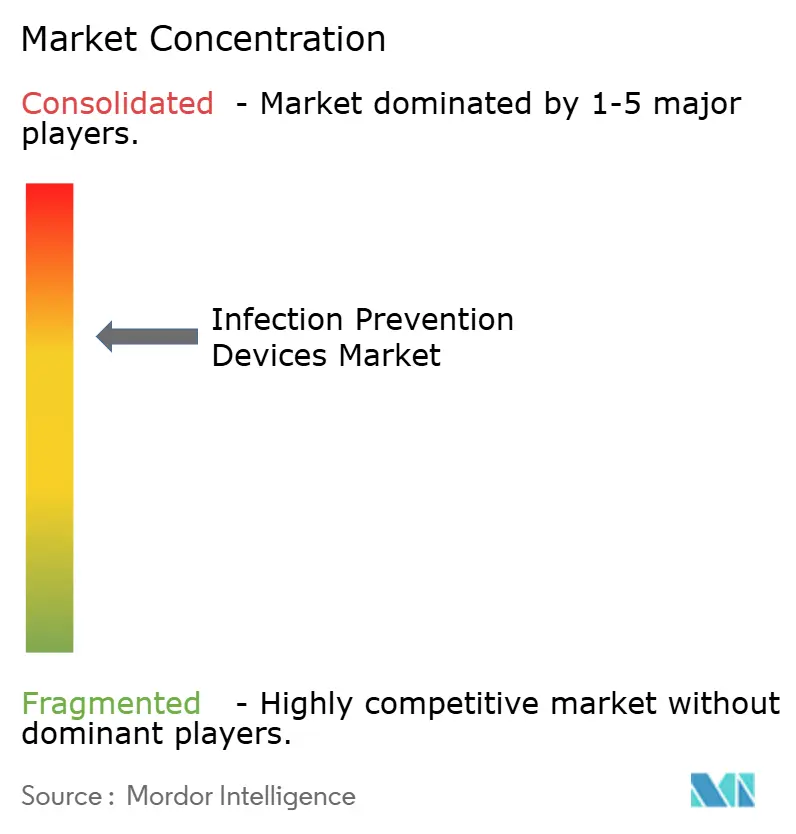
| Market Concentration | Medium |
Major Players *Disclaimer: Major Players sorted in no particular order Image © Mordor Intelligence. Reuse requires attribution under CC BY 4.0. | |
Infection Prevention Devices Market Analysis by Mordor Intelligence
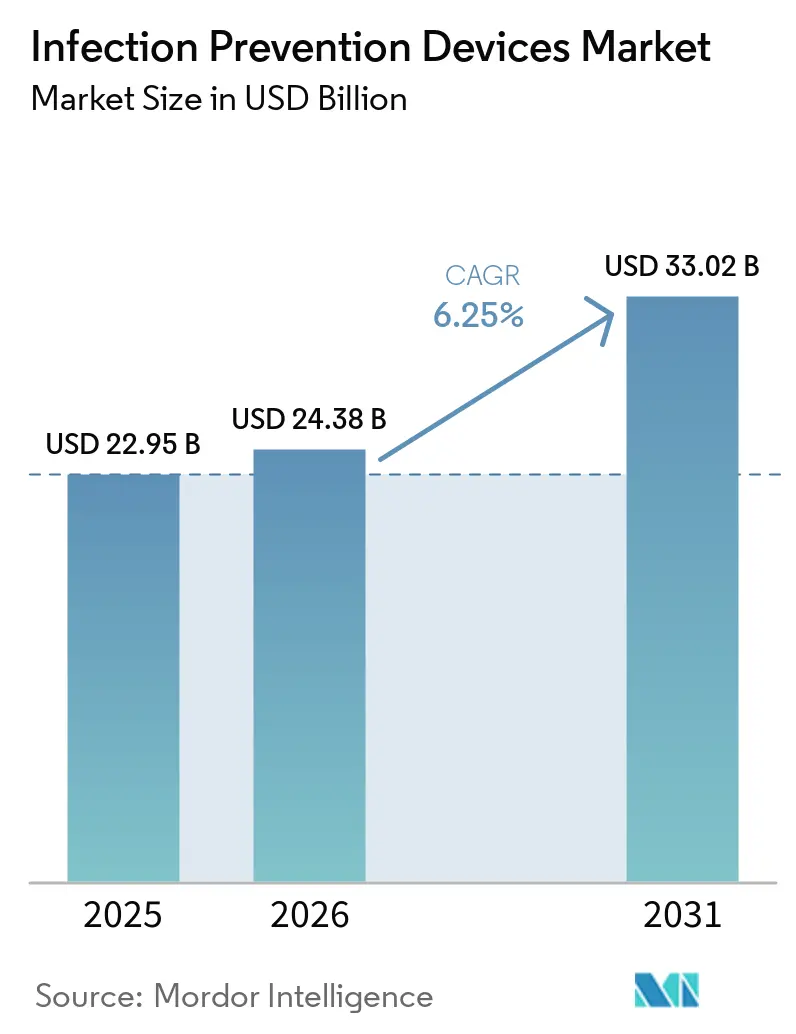
The Infection Prevention Devices Market size is expected to grow from USD 22.95 billion in 2025 to USD 24.38 billion in 2026 and is forecast to reach USD 33.02 billion by 2031 at 6.25% CAGR over 2026-2031.
The infection prevention devices market is supported by demand for validated sterilization, disinfection, and monitoring solutions in hospitals and ambulatory care networks. Only 6% of countries met all World Health Organization infection prevention and control minimum requirements in 2023-2024, while 39% had fully implemented national programs, leaving substantial need for compliant infrastructure. Procurement is increasingly shaped by accreditation, traceability, and the ability to document each reprocessing cycle. Vendors are responding through integrated equipment, consumables, service, and software offerings that can retain customers beyond an initial hardware sale. The infection prevention devices market also faces uncertainty around ethylene oxide sterilization rules and capital limits in lower-resource health systems, even as national policy commitments support wider spending.
Key Report Takeaways
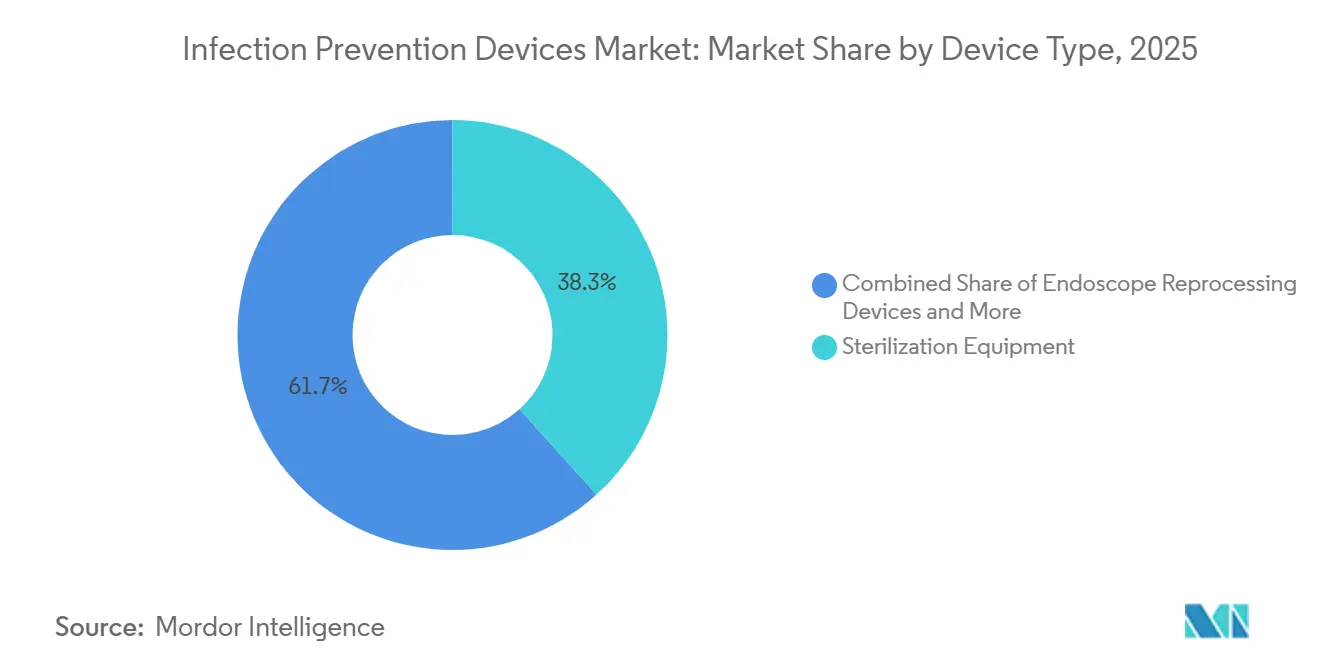
- By device type, Sterilization Equipment held 38.31% revenue share in 2025, while Endoscope Reprocessing Devices are expected to have a CAGR at 9.15% through 2031.
- By technology, Heat and High-Temperature Sterilization held 45.24% revenue share in 2025, while Low-Temperature Sterilization is projected to have a CAGR at 8.22% through 2031.
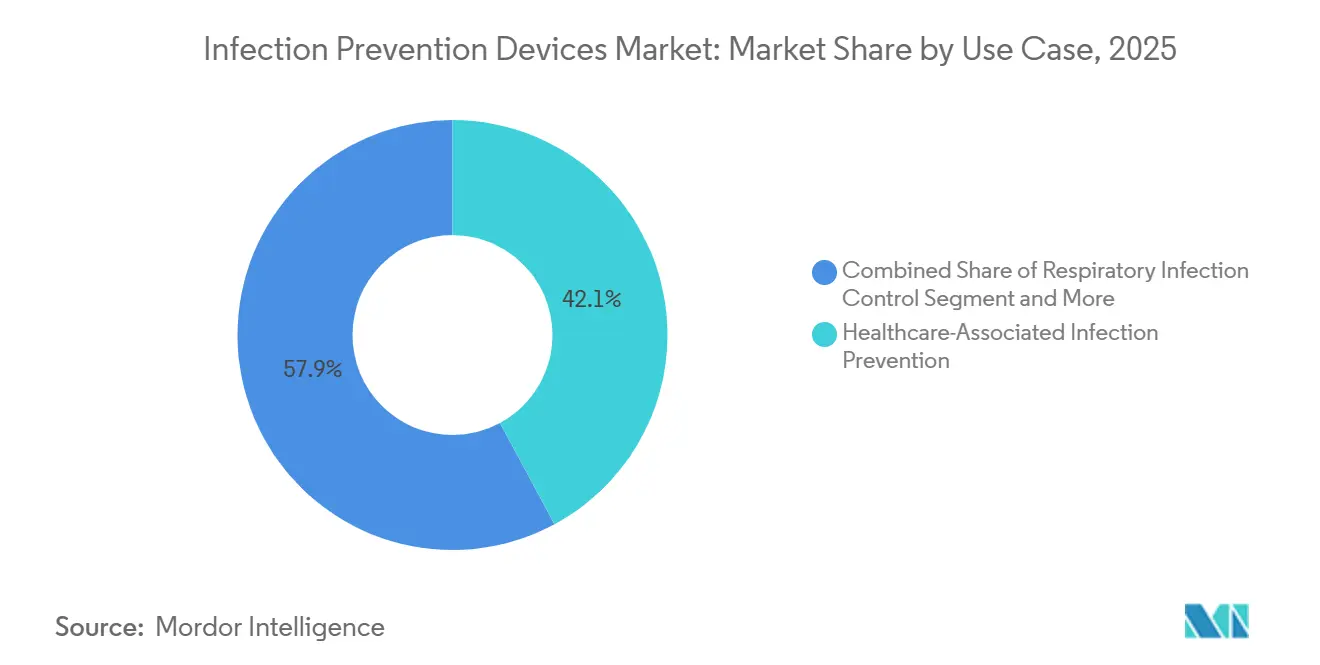
- By use case, Healthcare-Associated Infection Prevention held 42.14% revenue share in 2025, while Respiratory Infection Control is expected to record a CAGR at 7.42% through 2031.
- By end user, Hospitals and Clinics held 52.54% revenue share in 2025, while Diagnostic Centers and Clinical Laboratories are expected to have a CAGR at 8.12% through 2031.
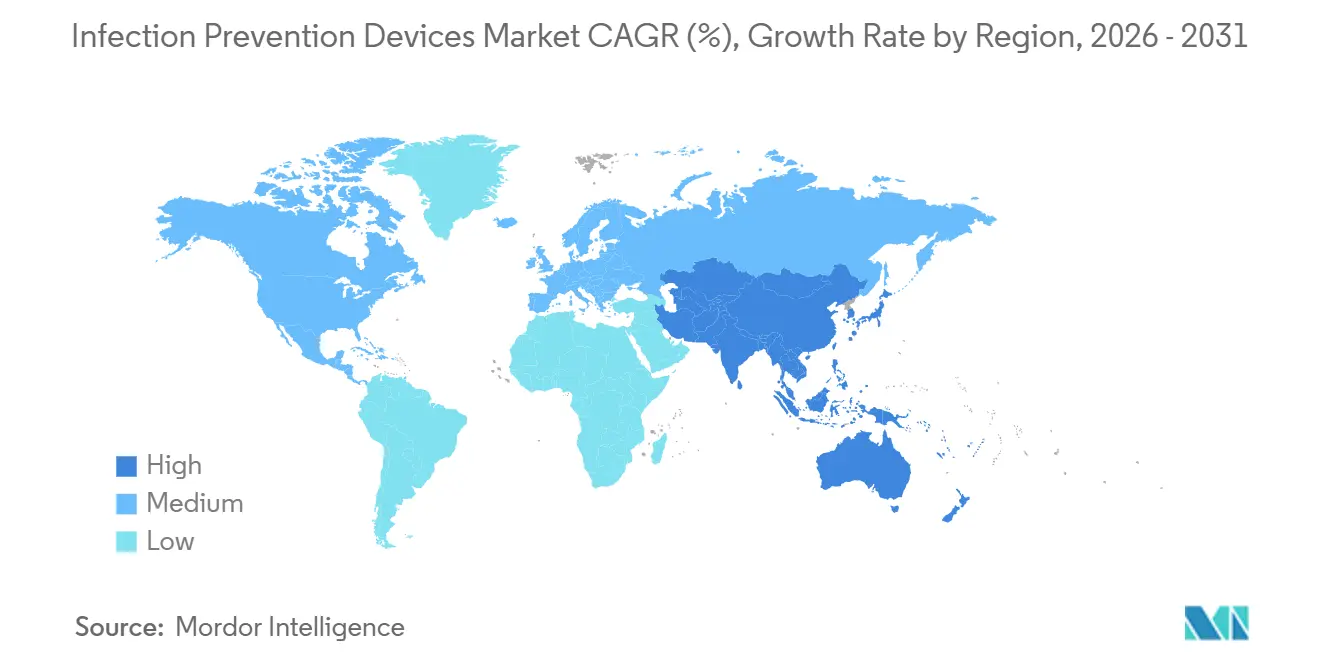
- By geography, North America held 36.61% revenue share in 2025, while Asia-Pacific is expected to record 7.45% CAGR through 2031.
Note: Market size and forecast figures in this report are generated using Mordor Intelligence’s proprietary estimation framework, updated with the latest available data and insights as of January 2026.
Market Trends and Insights
Drivers Impact Analysis of Infection Prevention Devices Market*
| Driver | (~) % Impact on CAGR Forecast | Geographic Relevance | Impact Timeline |
|---|---|---|---|
| Rising Healthcare-Associated Infection Prevention Spending | +1.5% | Global, with concentrated gains in North America, Europe, and China | Short term (≤ 2 years) |
| Increasing Surgical and Interventional Procedure Volumes | +1.2% | North America, APAC core, including China, India, and South Korea | Short term (≤ 2 years) |
| Expansion of Low-Temperature Sterilization for Heat-Sensitive Devices | +0.8% | North America and the EU, with spillover to advanced APAC | Medium term (2-4 years) |
| Stricter Sterilization Validation and Traceability Requirements | +0.6% | EU, North America, and Australia | Medium term (2-4 years) |
| Outpatient and Ambulatory Care Migration | +0.7% | North America, with emerging APAC and EU gains | Short term (≤ 2 years) |
| Digitization of Sterilization Assurance and Instrument Tracking | +0.5% | North America and the EU core, with early traction in APAC and GCC | Long term (≥ 4 years) |
| Source: Mordor Intelligence | |||
Rising Healthcare-Associated Infection Prevention Spending
Underfunded national infection prevention and control systems are converting policy commitments into procurement for validated infrastructure. The World Health Organization reported that 71% of countries had an active infection prevention and control program, but only 6% met all minimum requirements in 2023-2024[1]. Its 2024-2030 action plan seeks to raise the share of countries meeting those requirements above 90% by 2030. Patients in low- and middle-income countries faced up to 20 times the healthcare-associated infection risk seen in high-income countries. This gap directs funding toward categories that offer documented audit results, including sterilization monitoring, biological indicators, and assurance consumables. The infection prevention devices market can therefore benefit as national programs in Southeast Asia and Sub-Saharan Africa move from policy adoption toward facility-level implementation. These procurement cycles can widen the addressable base for the infection prevention devices market.
Increasing Surgical and Interventional Procedure Volumes
Higher procedure volumes raise sterilization throughput needs within facilities and increase demand for reprocessing equipment, consumables, and monitoring devices. Outpatient care has moved more surgical activity into smaller settings that require dependable sterile processing capacity. Many ambulatory surgery centers have fewer than 3 operating rooms and do not maintain dedicated sterile processing staff. This setting favors compact and automated infection prevention devices that require limited operator training. A concentrated range of procedures can also make procedure-specific sterilization specifications more important in purchasing decisions. The infection prevention devices market has an opportunity where providers need standardized equipment and service support across distributed sites. This setting places ease of operation at the center of the purchasing of infection prevention devices.
Expansion of Low-Temperature Sterilization for Heat-Sensitive Devices
Complex multi-lumen instruments, flexible robotic components, and reusable endoscopes cannot always tolerate conventional steam cycles. Vaporized hydrogen peroxide sterilization operates at reduced pressure and can provide validated sterilization without the moisture or heat damage associated with saturated steam. FDA guidance and EU Medical Device Regulation requirements have made validation more important for thermolabile devices. ISO 11138 biological indicator protocols raise validation requirements but also strengthen the position of suppliers with certified systems. Hospitals that install these systems also need compatible monitoring consumables and validation software. This bundled need supports vertically integrated suppliers in the infection prevention devices market, where certified equipment, monitoring supplies, and validation software are increasingly considered together.
Digitization of Sterilization Assurance and Instrument Tracking
Digital tracking makes sterilization documentation more visible and easier to audit at high-volume facilities. The main requirement is liability management because incomplete instrument-level records can expose facilities to accreditation findings and contractual pressure. Getinge launched the Aquadis Endo 110 in June 2026 with RFID integrated into each reprocessing cycle and connections to FleetView and T-DOC Endo platforms. The system illustrates how workflow information can be connected to equipment rather than handled as a separate administrative process in the infection prevention devices market. Interoperable data links can make compliance visible at the patient episode level. This raises the competitive threshold for suppliers offering stand-alone analog products in the infection prevention devices market, especially where facilities require auditable cycle records across connected workflows.
Restraints Impact Analysis of Infection Prevention Devices Market*
| Restraint | (~) % Impact on CAGR Forecast | Geographic Relevance | Impact Timeline |
|---|---|---|---|
| High Capital and Lifecycle Costs of Advanced Systems | -0.9% | Global, with disproportionate effects in MEA, South America, and Southeast Asia | Long term (≥ 4 years) |
| Complexity of Reprocessing and Protocol Compliance | -0.5% | Global, with the sharpest effect in mid-tier hospitals and ambulatory settings | Medium term (2-4 years) |
| Ethylene Oxide Emission Controls and Sterilization Capacity Risk | -0.7% | North America, with regulatory spillover to the EU and other markets | Medium term (2-4 years) |
| Single-Use Device Waste and Sustainability Trade-Offs | -0.4% | EU and North America, driven by sustainability mandates | Long term (≥ 4 years) |
| Source: Mordor Intelligence | |||
Ethylene Oxide Emission Controls and Sterilization Capacity Risk
Ethylene oxide is an essential sterilization method for medical devices, but it is also classified as a carcinogen. The EPA finalized amendments in April 2024 that required more than 90% reductions in ethylene oxide emissions at commercial sterilization facilities[2]. The agency stated that the action addressed facilities that sterilize roughly 50% of U.S. medical devices, or 20 billion devices annually. In March 2026, the EPA proposed reconsidering the 2024 commercial sterilizer rule on medical supply-chain grounds. This uncertainty complicates investment planning for sterilization operators and alternative technology developers. It can promote low-temperature alternatives while limiting new capacity for a method that has no complete substitute for many complex multi-lumen devices.
High Capital and Lifecycle Costs of Advanced Systems
Fully automated low-temperature systems and digital assurance suites require more than an initial equipment purchase. Facilities also fund installation, operational, and performance qualification studies, staff training, service agreements, chemical indicators, biological indicators, and single-use cassettes. These costs accumulate across a 7-to-10-year lifecycle and create a difficult case when procedure volumes are unstable. The constraint is strongest in MEA, parts of South America, and rural Southeast Asia, where healthcare financing and long-term contracting can be limited. Pay-per-cycle and outcome-based service models address some budget concerns, but their use remains constrained where reimbursement and operating budgets are uncertain. This can direct the infection prevention devices market toward lower-cost chemical disinfectants and protective barriers instead of capital-intensive sterilization systems in the fastest-growing geographies. It also shapes the product mix pursued within the infection prevention devices market.
*Our forecasts treat driver/restraint impacts as directional, not additive. The impact forecasts reflect baseline growth, mix effects, and variable interactions.
Infection Prevention Devices Market Segment Analysis
By Device Type:
Endoscope Reprocessing Supports Faster GrowthEndoscope Reprocessing Devices are projected to grow at a 9.15% CAGR through 2031, ahead of the 6.25% overall forecast. Sterilization Equipment held 38.31% of revenue share in 2025 and remains the largest revenue category. Its broad role spans hospital central sterile supply departments, pharmaceutical manufacturing facilities, and ambulatory care settings. Disinfection Devices support environmental hygiene in intensive care units, isolation rooms, and procedure suites. Sterilization Monitoring and Assurance Devices are becoming more important as providers formalize every-load monitoring under accreditation and audit requirements.
Protective Infection-Prevention Devices provide staff protection, while Medical Waste and Containment Devices support biohazard management. Standards including ISO 374 and EN 374 establish requirements for protective barrier performance. Endoscopy units are processing the same scope fleets more often as procedure backlogs continue, which makes throughput a central purchasing requirement. Getinge's Aquadis Endo 110 delivers 36% higher throughput than its predecessor and a 20-minute standard cycle. The system also provides RFID-enabled traceability through its FleetView and T-DOC Endo connections. Advanced Sterilization Products acquired UVSmart, bringing endoscope high-level disinfection closer to environmental photonic disinfection within a single portfolio[3].

By Technology:
Heat Sterilization Remains Established, Low-Temperature Systems Gain GroundHeat and High-Temperature Sterilization accounted for 45.24% of revenue share in 2025. It remains established in central sterile supply departments because stainless-steel surgical instruments continue to make up much of the surgical kit inventory. Low-Temperature Sterilization is forecast to record an 8.22% CAGR through 2031 as thermolabile instruments become more common in robotic surgery, minimally invasive procedures, and flexible endoscopy. Radiation Sterilization, including gamma and electron beam methods, remains important for contract sterilization of single-use devices. Chemical Sterilization and Disinfection includes peracetic acid and liquid chemistries used in endoscope reprocessing and environmental cleaning.
X-ray radiation processing is gaining attention as a more precise alternative to ethylene oxide for some applications. STERIS Applied Sterilization Technologies completed an expansion of its X-ray radiation processing facility in Höchstadt, Germany, in July 2026, increasing regional processing capacity for medical device manufacturers. UV-C and photonic disinfection are smaller technologies that are moving from supplementary use toward more central roles in selected clinical settings. A phase II trial conducted from November 2024 to April 2025 in 12 long-term care facilities in Denmark reported 10.4 hospital-treated infections per 10,000 resident-days in far-UVC common rooms, compared with 86.2 under standard care. The adjusted incidence rate ratio was 0.12, with a 95% confidence interval of 0.04-0.34. Developing compliance frameworks and the need for clinical validation make early regulatory clarity important for suppliers in this part of the infection prevention devices market, where equipment performance must be matched with practical adoption requirements.
By Use Case:
Healthcare-Associated Infection Prevention Holds the Largest PositionHealthcare-Associated Infection Prevention represented 42.14% of revenue in 2025. The use case is supported by institutional liability related to healthcare-associated infections and quality reporting systems that can penalize facilities for higher infection rates. The World Health Organization identifies healthcare-associated infections as the most frequent adverse events in healthcare delivery worldwide. Respiratory Infection Control is projected to grow at a 7.42% CAGR through 2031. Spending in this area includes ventilator-associated pneumonia prevention, UV-C air disinfection in respiratory isolation units, and stronger respiratory hygiene procedures.
Surgical Site Infection Prevention is tied to established specifications for skin antisepsis, surgical barrier drapes, and air filtration. Endoscope-Associated Infection Prevention is receiving more attention after outbreak investigations associated with inadequately reprocessed complex-channel scopes. Environmental and Surface Hygiene includes UV-C robotic disinfection and EPA-registered surface disinfectants used during terminal cleaning. Better respiratory hygiene can also reduce antibiotic use, which links infection prevention to antimicrobial stewardship objectives. In the Danish far-UVC trial, antibiotic prescriptions in the treated group were 48% lower than under standard care. The adjusted incidence rate ratio for those prescriptions was 0.52, with a 95% confidence interval of 0.29-0.96.
By End User:
Hospitals Lead While Diagnostic Laboratories Expand FasterHospitals and Clinics accounted for 52.54% of end-user revenue in 2025. They are the main deployment setting for central sterile supply departments, endoscope reprocessing units, and air filtration systems across many infection risk settings. Ambulatory surgery centers require a different approach because they often need smaller equipment footprints and service-bundled models. Their staff may also require interfaces designed for non-specialist operation. Long-Term Care Facilities are expanding as infection risks in residential care settings attract greater regulatory attention. Pharmaceutical and Medical Device Manufacturers remain exposed to ethylene oxide rule changes because they rely on contract sterilization for production validation.
Diagnostic Centers and Clinical Laboratories are projected to grow at an 8.12% CAGR through 2031. Growth in molecular diagnostics, histopathology, and point-of-care testing creates continuing instrument reprocessing needs. Many laboratories are moving from basic chemical disinfection to validated low-temperature or UV-C systems under accreditation and quality management requirements. Laboratory instruments can undergo reprocessing many times each day, which can raise consumable demand per instrument. Suppliers can address this need with compact systems, frequent cycle capability, and fewer operator steps. This creates a clearer growth opportunity for the infection prevention devices industry and the infection prevention devices market among laboratories that previously bought these devices on an opportunistic basis.
Geography Analysis
North America Infection Prevention Devices Market
North America held 36.61% of the revenue share in 2025. Device reprocessing validation standards, healthcare-associated infection reporting requirements, and Joint Commission accreditation obligations support the United States. These requirements make procurement difficult to defer when facilities need documented compliance. Canada aligns closely with comparable sterilization expectations through provincial health authorities. Mexico is reinforcing infection prevention requirements as hospital capacity expands under national healthcare access programs.
APAC Infection Prevention Devices Market
Asia-Pacific is projected to grow at a 7.45% CAGR through 2031. China’s hospital construction and renovation commitments, and India’s Ayushman Bharat digital health infrastructure program, are extending secondary and tertiary care access. A 10-year study published in 2026 at a major healthcare institution in Southwestern China found declining healthcare-associated infection rates while antimicrobial use stabilized. The finding supports the value of sustained institution-wide infection prevention investment. It also supports the continued adoption of validated systems in the infection prevention devices market. Japan’s hospital accreditation framework supports replacement cycles for sterilization and reprocessing equipment. South Korea and Australia also contribute through mature private hospital sectors with stringent infection control requirements.
MEA and South America Infection Prevention Devices Market
MEA and South America remain smaller contributors but can grow faster as hospital construction and quality improvement programs continue. GCC countries are investing in hospital infrastructure under Vision 2030 and related diversification programs. Their higher-income base can support advanced low-temperature sterilization systems that remain less accessible in other MEA countries. South Africa and the wider Sub-Saharan Africa region represent a longer-term opportunity as World Health Organization program rollout and development funding support structured procurement. Brazil is modernizing public hospital infection control infrastructure, while Argentina’s private hospital sector is upgrading sterilization capacity. The infection prevention devices market size in these regions remains smaller, but their growth can become more relevant to the infection prevention devices market later in the forecast period.
Competitive Landscape
The infection prevention devices market is moderately concentrated among global specialist manufacturers, with fragmentation continuing below the leading tier and different competitive conditions across device categories. STERIS plc, Getinge AB, Sotera Health, Solventum, and Advanced Sterilization Products hold strong positions through service infrastructure, regulatory approvals, and device portfolios. Consumables, service agreements, and software can retain customers after the initial equipment purchase. Biological indicators, chemical indicators, sterility assurance consumables, and service contracts create recurring revenue for leading suppliers. These recurring needs make customer switching more difficult and provide challengers with the clearest openings in newer categories such as UV-C, far-UVC, and digital compliance platforms. The infection prevention devices market rewards suppliers that can support those categories with service capability.
Getinge acquired Pennamed in April 2026 to strengthen its endoscopy offering in the United Kingdom. STERIS announced 2 tuck-in acquisitions in May 2026, MEDglas and a GI consumables family, to deepen its installed-base presence in specific procedure areas. These moves favor targeted additions over large transformative transactions. Patent filings and participation in standards activities, including ISO TC 198, can expand the technical barrier around established suppliers. Competition also depends on local service availability and the ability to meet country-specific regulatory requirements. This is particularly relevant to the infection prevention devices market in Europe and emerging economies.
Digital capability is becoming a more visible differentiator among suppliers. Getinge’s T-DOC Endo and FleetView integrations link equipment use to compliance tracking and workflow management. Far-UVC suppliers could alter established surface cleaning approaches in operating rooms and intensive care units, but they must establish viable reimbursement models before hospitals support wider capital spending. MATACHANA GROUP, MMM Group, and Belimed within SteelcoBelimed compete in European and emerging sterilization equipment segments. Their local service networks and regulatory localization can matter where global suppliers invest less heavily. Solventum’s announced separation of its Health Information Systems segment in 2026 positions the company as a more focused MedSurg and infection prevention supplier. The move reflects the focus that the infection prevention devices market places on specialized portfolios.
Infection Prevention Devices Industry Leaders
-
STERIS plc
-
Getinge AB
-
Solventum Corporation
-
Advanced Sterilization Products
-
Sotera Health Company
- *Disclaimer: Major Players sorted in no particular order
Infection Prevention Devices Market Companies Covered in this Report
- Advanced Sterilization Products
- ANSELL LTD.
- Belimed
- Cardinal Health
- Ecolab
- Getinge
- Kimberly-Clark Worldwide
- MATACHANA GROUP
- Medline Industries
- Midmark
- MMM Group
- Olympus
- Hartmann Group
- PDI Healthcare
- Solventum Corporation
- Sotera Health Company
- SteelcoBelimed
- STERIS
- Tuttnauer
Recent Industry Developments in Infection Prevention Devices Market
- July 2026: STERIS Applied Sterilization Technologies completed the expansion of its X-ray radiation processing facility in Höchstadt, Germany, adding processing capacity for medical device manufacturers in the region and reinforcing ethylene oxide alternative sterilization capabilities across Europe’s medical device supply chain. The expansion strengthens sterilization resilience for manufacturers navigating shifting ethylene oxide regulatory conditions.
- June 2026: Getinge launched the Aquadis Endo 110, a next-generation automated endoscope reprocessor delivering 36% higher throughput than its predecessor and a 20-minute standard cycle, with embedded RFID for automated program selection and full cycle traceability integrated with the FleetView and T-DOC Endo platforms.
Global Infection Prevention Devices Market Report Scope
As per the scope of the report, infection prevention devices are specialized tools and equipment designed to reduce or eliminate the risk of infection transmission in healthcare settings and other environments. These devices help prevent the spread of infectious agents by providing barriers, controlling contamination, or facilitating safe handling of pathogens.
The infection prevention devices market is segmented by device type into sterilization equipment, disinfection devices, endoscope reprocessing devices, sterilization monitoring and assurance devices, protective infection prevention devices, and medical waste management and containment devices. By technology, the market is segmented into heat and high-temperature sterilization, low-temperature sterilization, radiation sterilization, chemical sterilization and disinfection, UV-C and photonic disinfection, and other technologies. By use case, the market is segmented into healthcare-associated infection prevention, surgical site infection prevention, respiratory infection control, endoscope-associated infection prevention, environmental and surface hygiene, and other use cases. By end user, the market is segmented into hospitals and clinics, ambulatory surgery centers, diagnostic centers and clinical laboratories, long-term care facilities, pharmaceutical and medical device manufacturers, and other end users. By geography, the market is segmented into North America, Europe, Asia-Pacific, the Middle East and Africa, and South America. The market report also covers the estimated market sizes and trends for 17 countries across major regions globally. For each segment, the market size and forecast are provided in terms of value (USD).
Segmentation Overview
| Sterilization Equipment |
| Disinfection Devices |
| Endoscope Reprocessing Devices |
| Sterilization Monitoring and Assurance Devices |
| Protective Infection-Prevention Devices |
| Medical Waste and Containment Devices |
| Heat and High-Temperature Sterilization |
| Low-Temperature Sterilization |
| Radiation Sterilization |
| Chemical Sterilization and Disinfection |
| UV-C and Photonic Disinfection |
| Other Technologies |
| Healthcare-Associated Infection Prevention |
| Surgical Site Infection Prevention |
| Respiratory Infection Control |
| Endoscope-Associated Infection Prevention |
| Environmental and Surface Hygiene |
| Other Use Cases |
| Hospitals and Clinics |
| Ambulatory Surgery Centers |
| Diagnostic Centers and Clinical Laboratories |
| Long-Term Care Facilities |
| Pharmaceutical and Medical Device Manufacturers |
| Other End Users |
| North America | United States |
| Canada | |
| Mexico | |
| Europe | Germany |
| United Kingdom | |
| France | |
| Italy | |
| Spain | |
| Rest of Europe | |
| Asia-Pacific | China |
| Japan | |
| India | |
| Australia | |
| South Korea | |
| Rest of Asia-Pacific | |
| Middle East and Africa | GCC |
| South Africa | |
| Rest of Middle East and Africa | |
| South America | Brazil |
| Argentina | |
| Rest of South America |
| By Device Type | Sterilization Equipment | |
| Disinfection Devices | ||
| Endoscope Reprocessing Devices | ||
| Sterilization Monitoring and Assurance Devices | ||
| Protective Infection-Prevention Devices | ||
| Medical Waste and Containment Devices | ||
| By Technology | Heat and High-Temperature Sterilization | |
| Low-Temperature Sterilization | ||
| Radiation Sterilization | ||
| Chemical Sterilization and Disinfection | ||
| UV-C and Photonic Disinfection | ||
| Other Technologies | ||
| By Use Case | Healthcare-Associated Infection Prevention | |
| Surgical Site Infection Prevention | ||
| Respiratory Infection Control | ||
| Endoscope-Associated Infection Prevention | ||
| Environmental and Surface Hygiene | ||
| Other Use Cases | ||
| By End User | Hospitals and Clinics | |
| Ambulatory Surgery Centers | ||
| Diagnostic Centers and Clinical Laboratories | ||
| Long-Term Care Facilities | ||
| Pharmaceutical and Medical Device Manufacturers | ||
| Other End Users | ||
| By Geography | North America | United States |
| Canada | ||
| Mexico | ||
| Europe | Germany | |
| United Kingdom | ||
| France | ||
| Italy | ||
| Spain | ||
| Rest of Europe | ||
| Asia-Pacific | China | |
| Japan | ||
| India | ||
| Australia | ||
| South Korea | ||
| Rest of Asia-Pacific | ||
| Middle East and Africa | GCC | |
| South Africa | ||
| Rest of Middle East and Africa | ||
| South America | Brazil | |
| Argentina | ||
| Rest of South America | ||
Key Questions Answered in the Report
What is driving demand for infection prevention devices?
Compliance requirements, higher procedure volumes, and gaps in national infection prevention programs support demand for validated sterilization, disinfection, and monitoring solutions.
How large is the infection prevention devices market in 2026?
The infection prevention devices market size is USD 24.38 billion in 2026 and is forecast to reach USD 33.02 billion by 2031 at a 6.25% CAGR.
Which infection prevention device category is growing fastest?
Endoscope Reprocessing Devices are projected to grow at a 9.15% CAGR through 2031.
Which technology is expanding fastest in infection prevention?
Low-Temperature Sterilization is forecast to grow at an 8.22% CAGR through 2031.
Which region leads infection prevention device spending?
North America led with 36.61% revenue share in 2025, while Asia-Pacific is forecast to grow fastest at a 7.45% CAGR through 2031.