
Industrial Water Treatment Equipment Market Size and Share
Market Overview
| Study Period | 2022 - 2032 |
|---|---|
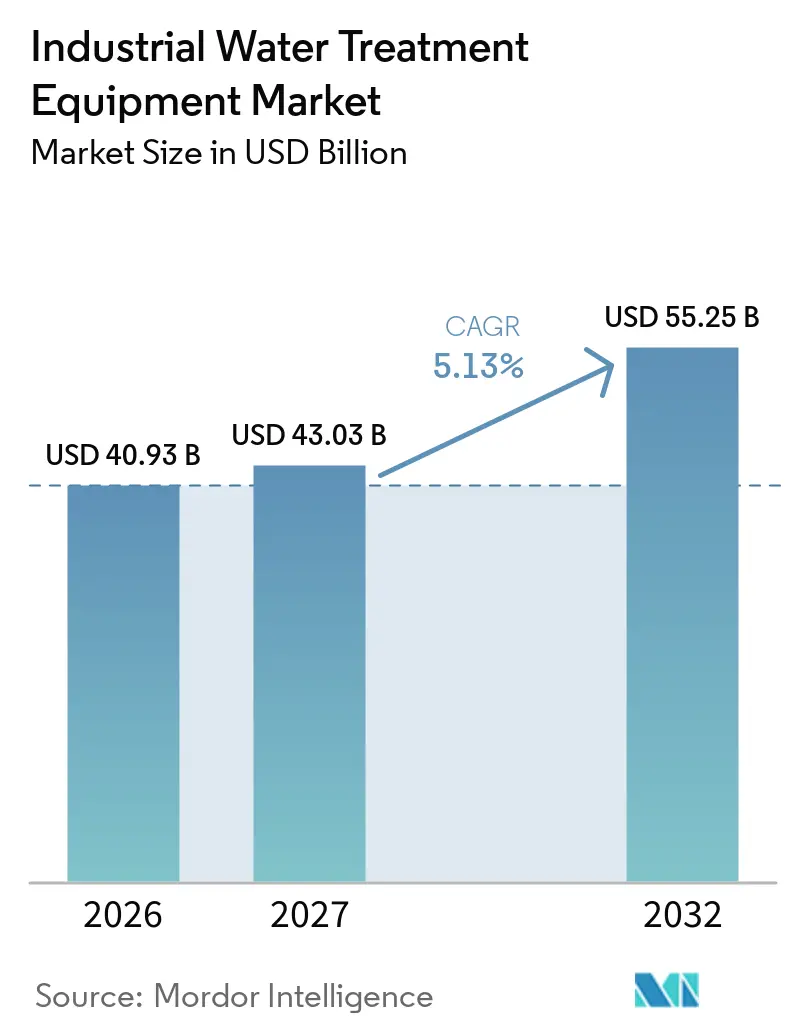
| Market Size (2027) | USD 43.03 Billion |
| Market Size (2032) | USD 55.25 Billion |
| Growth Rate (2027 - 2032) | 5.13 % |
| Fastest Growing Market | Asia-Pacific |
| Largest Market | Asia-Pacific |
| Market Concentration | Low |
Major Players *Disclaimer: Major Players sorted in no particular order Image © Mordor Intelligence. Reuse requires attribution under CC BY 4.0. | |
Industrial Water Treatment Equipment Market Analysis by Mordor Intelligence
The Industrial Water Treatment Equipment Market size was valued at USD 40.93 billion in 2026 and is estimated to grow from USD 43.03 billion in 2027 to reach USD 55.25 billion by 2032, at a CAGR of 5.13% during the forecast period (2027-2032). Growth is tied to a practical change in how industrial sites manage water, with reuse systems becoming part of production planning rather than a narrow compliance purchase. Water-stressed basins, tougher discharge rules, and new manufacturing plants are pushing operators to recover process water and reduce freshwater withdrawals. This creates opportunities for suppliers that can combine equipment, process chemicals, digital monitoring, and long-term operating support. Competitive activity is also moving toward high-purity water, brine management, and treatment systems that can be adapted for new facilities and older plants. The Global industrial water treatment equipment market therefore depends on both regulation and the ability of customers to achieve acceptable lifecycle costs.
Key Report Takeaways
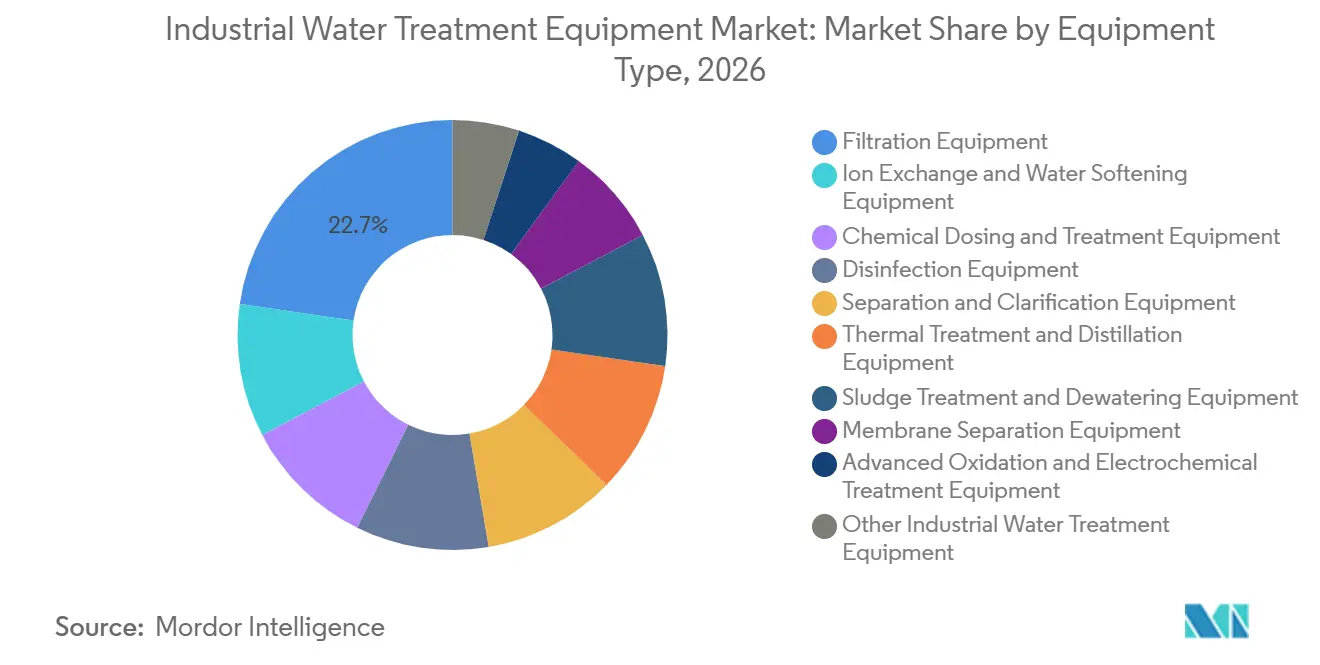
- By equipment type, Filtration Equipment held 22.7% of the Global industrial water treatment equipment market share in 2026, while Membrane Separation Equipment is projected to grow at a 6.2% CAGR through 2032.
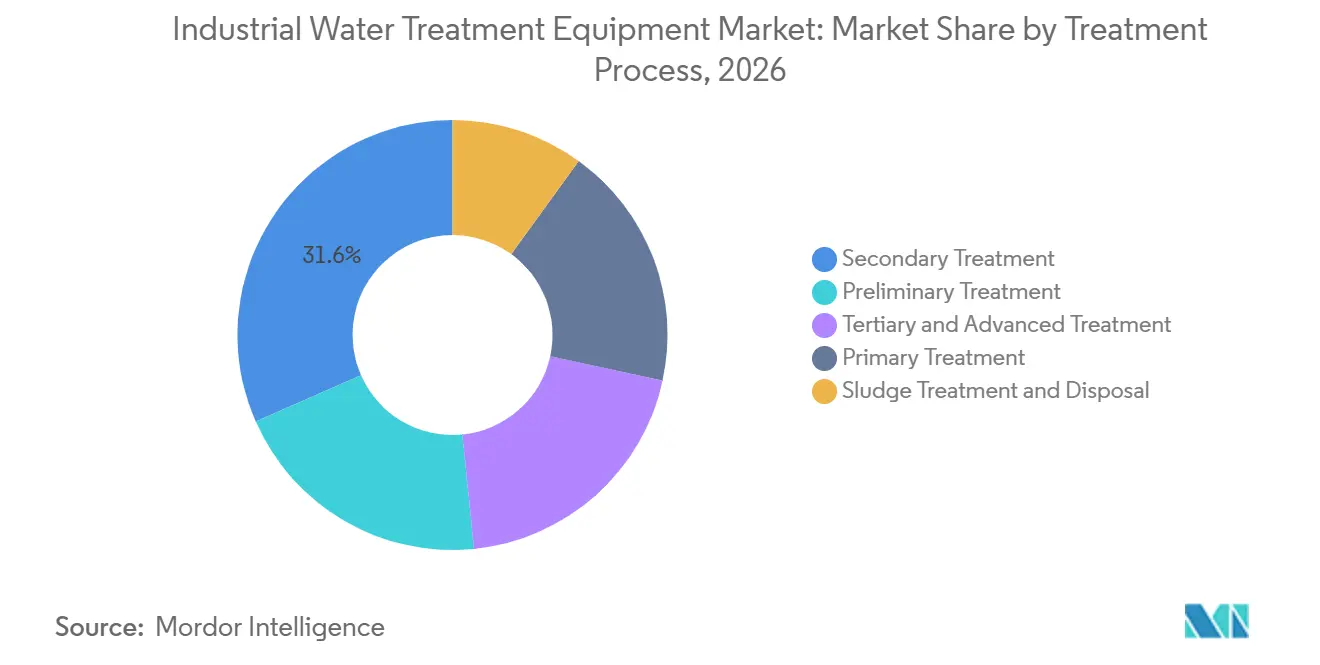
- By treatment process, Secondary Treatment accounted for 31.6% of the Global industrial water treatment equipment market share in 2026, while Tertiary and Advanced Treatment is forecast to expand at a 5.8% CAGR through 2032.
- By end-use industry, Power Generation held 17.2% revenue share in 2026, while Electronics and Semiconductors is projected to advance at a 6.1% CAGR through 2032.
- By geography, Asia-Pacific held 31.5% revenue share in 2026 and is forecast to grow at a 5.9% CAGR through 2032.
Note: Market numbers in this report are based on Mordor Intelligence's proprietary estimation framework, which combines nine months of actuals with Q4 projections for base year 2026.
Market Trends and Insights
Drivers Impact Analysis of Industrial Water Treatment Equipment Market*
| Driver | (~) % Impact on CAGR Forecast | Geographic Relevance | Impact Timeline |
|---|---|---|---|
| Water Scarcity and Industrial Water Reuse | +1.0% | Global, with concentration in Asia-Pacific, Middle East and Africa, and western United States | Long term (≥ 4 years) |
| Tightening Industrial Effluent and PFAS Compliance | +0.9% | North America and Europe primarily, with spillover to Asia-Pacific through multinational supply chains | Medium term (2-4 years) |
| Expansion of Water-Intensive Manufacturing Capacity | +0.8% | Asia-Pacific core, including China, India, and Vietnam, and North American reshoring hubs | Medium term (2-4 years) |
| Semiconductor and Electronics Ultrapure-Water Build-Out | +0.8% | Taiwan, South Korea, Japan, and U.S. manufacturing hubs | Short term (≤ 2 years) |
| AI-Enabled Automation and Lifecycle Cost Optimization | +0.5% | Global, with early gains in North America and Europe | Medium term (2-4 years) |
| Reclaimed-Water Cooling Demand from AI Data Centers | +0.4% | North America and Europe, especially water-stressed data center clusters | Short term (≤ 2 years) |
| Source: Mordor Intelligence | |||
Water Scarcity and Industrial Water Reuse
Freshwater availability per person fell 7% over the preceding decade, according to the 2025 AQUASTAT Water Data Snapshot.[1] The World Bank expects industrial water reuse to reach 430 million cubic meters per day by 2040 under investment-supporting regulations.[2] For industrial operators, reuse systems can reduce exposure to water allocation limits and rising abstraction costs. The Global industrial water treatment equipment market benefits when facilities treat recycled water as a dependable production input rather than as a residual stream. Plant teams are increasingly weighing avoided withdrawal costs, operating resilience, and discharge obligations when they select recycling equipment. This shift favors systems that can recover water consistently from complex industrial wastewater.
Tightening Industrial Effluent and PER- AND POLYFLUOROALKYL SUBSTANCES (PFAS) Compliance
The U.S. Environmental Protection Agency retained its maximum contaminant levels for perfluorooctanoic acid (PFOA) and perfluoro octane sulfonate (PFOS) in 2025 and expanded Toxics Release Inventory reporting to 205 PFAS compounds for the 2025 reporting year.[3] The agency also extended selected steam-electric effluent guideline deadlines to 2034, which spreads spending on advanced treatment across a longer period.[4] China issued new water pollutant discharge standards for several manufacturing sectors in late 2025, including food processing requirements that took effect in 2026. Compliance with the U.S. Clean Water Act and China’s water pollution control framework can require new filtration, adsorption, oxidation, and monitoring steps. Multinational manufacturers face overlapping investment cycles where U.S. and Chinese sites must update controls at the same time. These requirements support demand in the Global industrial water treatment equipment market, although destruction of captured PFAS remains difficult.
Expansion of Water-Intensive Manufacturing Capacity
Battery plants, chemical facilities, refineries, and steel mills require large and reliable water volumes, so recycling targets increasingly appear in environmental permits and project designs. New industrial clusters in ASEAN and India need filtration, chemical dosing, clarification, and sludge handling from the first phase of development. Greater use of sensors and automated controls can help operators manage chemical consumption and equipment availability across multi-site portfolios. Data center cooling also increases interest in reclaimed-water systems in high water-stress locations, where reliable non-potable supply can reduce competition for freshwater. Industrial sites can avoid production disruption when reuse systems reduce their dependence on constrained freshwater sources. These investments broaden the Global industrial water treatment equipment market beyond conventional discharge compliance.
Semiconductor and Electronics Ultrapure-Water Build-Out
Semiconductor facilities need exceptionally clean water, and equipment specifications become stricter as chip manufacturing advances. ANDRITZ supplied sludge dewatering equipment to Veolia for a wastewater treatment system at a semiconductor plant being built in Texas. Organo Vietnam exported an ultrapure-water system to a U.S. semiconductor facility in October 2025, showing that Asian suppliers are participating in North American fab expansion. Each new fab increases demand for reverse osmosis, ion exchange, electrodeionization, filtration, and compatible piping. System reliability is important because water quality affects yields, equipment life, and plant uptime. The Global industrial water treatment equipment market gains from this demand as fabs build dedicated water supply and recovery systems.
Restraints Impact Analysis of Industrial Water Treatment Equipment Market*
| Restraint | (~) % Impact on CAGR Forecast | Geographic Relevance | Impact Timeline |
|---|---|---|---|
| High Capital and Energy Intensity of Advanced Systems | -0.4% | Global, most acute in emerging-market brownfield sites | Long term (≥ 4 years) |
| Fouling, Sludge Handling, and Skilled-Operator Shortages | -0.3% | Global, with concentration in Asia-Pacific and Middle East and Africa | Medium term (2-4 years) |
| PFAS Concentrate and Brine Destruction Bottlenecks | -0.3% | North America and Europe, where PFAS treatment is mandated and destruction pathways remain limited | Medium term (2-4 years) |
| Brownfield Retrofit and Receiving-Plant Capacity Constraints | -0.2% | Mature industrial corridors in North America and Europe | Long term (≥ 4 years) |
| Source: Mordor Intelligence | |||
High Capital and Energy Intensity of Advanced Systems
Zero liquid discharge systems and electrochemical oxidation equipment usually require greater capital investment than conventional biological treatment. High-throughput reverse osmosis also adds electricity costs, which makes total ownership cost sensitive to energy tariffs. Smaller facilities in textiles and food processing can delay upgrades when enforcement is weak or financing is unavailable. This slows installation rates even where public policy supports reuse and stricter discharge quality. Brownfield plants can face additional space limits, production interruption risks, and receiving-plant capacity constraints during retrofits. These issues limit the speed at which the Global industrial water treatment equipment market can convert regulatory intent into installed capacity.
Fouling, Sludge Handling, and Skilled-Operator Shortages
Membrane biofouling reduces performance in ultrafiltration and reverse osmosis circuits and increases the need for cleaning chemicals and downtime. Tighter discharge requirements can also increase sludge volumes that need dewatering, drying, recovery, or disposal. Germany’s sewage-sludge rules require phosphorus recovery from 2029, increasing interest in mono-incineration and recovery systems. PFAS-bearing concentrates and high-salinity brines are particularly difficult because separation equipment can capture contaminants without providing a final destruction route. Digital treatment plants require trained staff who can interpret diagnostics and adjust chemical dosing, but training capacity does not always keep pace with equipment deployment. These operational limits can delay projects across the Global industrial water treatment equipment market.
*Our forecasts treat driver/restraint impacts as directional, not additive. The impact forecasts reflect baseline growth, mix effects, and variable interactions.
Industrial Water Treatment Equipment Market Segment Analysis
By Equipment Type:
Membrane Systems Expand While Filtration Supports Core DemandMembrane Separation Equipment is forecast to be the fastest-growing equipment category, with the Global industrial water treatment equipment market size for the segment expanding at a 6.2% CAGR through 2032. Reverse osmosis, nanofiltration, and ultrafiltration support reuse, zero liquid discharge, and semiconductor ultrapure-water systems. DuPont expanded its design platform in 2026 to combine reverse osmosis, nanofiltration, ultrafiltration, and ion exchange in one environment. These tools can help users compare water quality, recovery, and energy tradeoffs before construction.
Filtration Equipment held 22.7% of Global industrial water treatment equipment market share in 2026 because pretreatment protects membrane and ion-exchange systems. Media filtration, screening, and cartridge filtration remove solids and biological loading before downstream treatment. Ion exchange, dosing, clarification, disinfection, thermal treatment, and sludge dewatering address different points in the treatment train. In the Global industrial water treatment equipment market, suppliers that integrate this equipment can reduce project coordination risk for industrial users.

By Treatment Process:
Secondary Treatment Holds the Installed Base While Advanced Treatment BuildsSecondary Treatment represented 31.6% of the Global industrial water treatment equipment market share in 2026, reflecting the installed base of activated sludge and membrane bioreactor systems. Industrial parks and stand-alone factories use this process to reduce contaminants before discharge or reuse. It remains the regulatory baseline in many developing industrial zones, supporting replacement and upgrading demand. Aeration, biological treatment, clarification, and controls therefore remain core equipment requirements.
Tertiary and Advanced Treatment is forecast to grow at a 5.8% CAGR through 2032 because secondary effluent often requires further polishing before sensitive reuse. Nanofiltration, activated carbon, ultraviolet treatment, and advanced oxidation can deliver higher water quality. SUEZ issued industrial-park pollution standards guidance in China during 2025, covering upstream treatment requirements in large industrial zones. The Global industrial water treatment equipment market also benefits as tighter requirements increase solids capture and recovery needs.
By End-Use Industry:
Power Generation Retains Scale While Electronics Grows FasterPower Generation held 17.2% revenue share in 2026, supported by needs for boiler feed water, cooling-tower blowdown treatment, and flue-gas desulfurization wastewater control. U.S. steam-electric rule extensions to 2034 preserve a longer demand pipeline for suppliers. Equipment demand includes filtration, demineralization, chemical dosing, wastewater treatment, and sludge management. Reliability and service support are important because power facilities operate over long equipment cycles.
Electronics and Semiconductors are projected to grow at a 6.1% CAGR through 2032, the highest rate among the stated end-use segments. New fabs require dedicated ultrapure-water infrastructure and continuous wastewater treatment. Oil and gas, chemicals and petrochemicals, and food and beverage remain significant because their wastewater streams are difficult to manage. The Global industrial water treatment equipment market also serves pharmaceuticals, mining, pulp and paper, automotive, and textiles as water risk and discharge requirements become more significant.
Geography Analysis
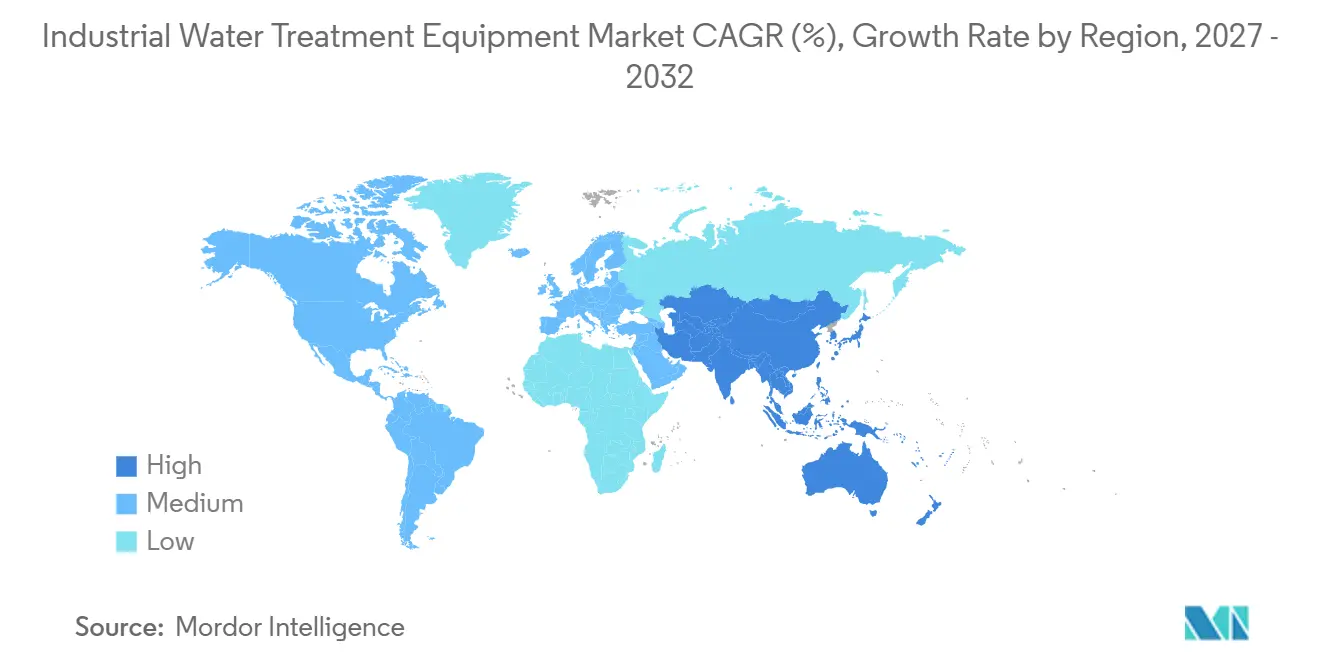
Asia-Pacific held 31.5% of the Global industrial treatment equipment market share in 2026 and is expected to grow at a 5.9% CAGR through 2032. China’s industrial scale and updated discharge standards support retrofit demand across food processing and wastewater treatment. Vietnam, Indonesia, and Thailand are adding industrial parks as manufacturing capacity diversifies across Southeast Asia. SUEZ began wastewater services for more than 100 industrial tenants in Vietnam’s Chau Duc Industrial Park. Semiconductor investment in South Korea, Taiwan, and Japan strengthens demand for high-purity water systems.
North America has a mature equipment base, but semiconductor reshoring, battery manufacturing, and PFAS compliance support new investment. EPA reporting requirements for 205 PFAS compounds increase monitoring and data collection that can precede treatment spending. Grundfos added a dosing-skid production line in Fresno, California, in 2026. Europe’s position is shaped by sludge management and resource recovery under formal compliance factors, including the EU Water Framework Directive. Germany’s phosphorus recovery requirements are supporting investment in sludge incineration and recovery facilities.
South America and Middle East and Africa have opportunities tied to water scarcity, mining, desalination, and industrial park development. The Saudi Water Authority began pilot operation of a reverse-osmosis membrane plant in Dammam in 2025 with annual capacity of 300,000 membranes. Mining in Chile and Brazil supports demand for brine management and water recycling, while the Middle East is scaling desalination and reuse together. In Africa, industrial parks in Egypt, Morocco, and South Africa could add demand as export manufacturing expands.
Competitive Landscape
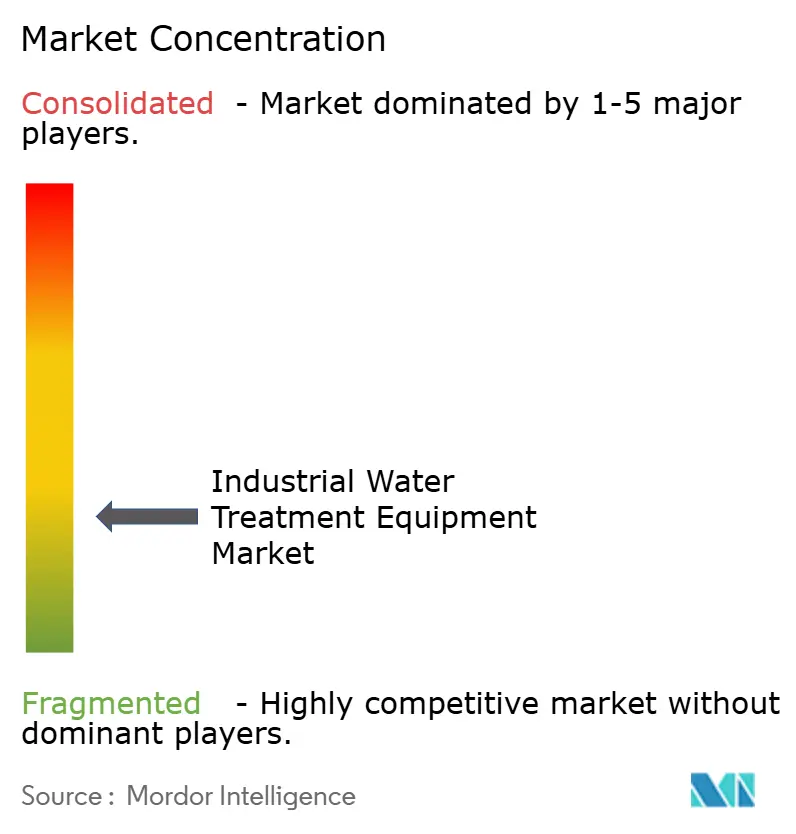
The Global industrial water treatment equipment market is fragmented, with global integrators, membrane suppliers, chemical providers, and regional engineering firms serving different parts of the value chain. Veolia, SUEZ, Xylem, and Ecolab compete through broad technology portfolios and long-term service arrangements. DuPont Water Solutions, Toray Industries, and Kurita Water Industries focus on membranes, resins, and treatment chemicals. WABAG and Thermax use engineering and project delivery expertise in emerging markets. No single firm serves every technology and geography equally.
Veolia acquired the remaining 30% stake in Water Technologies and Solutions from Caisse de dépôt et placement du Québec (CDPQ) for USD 1.75 billion in May 2025. Veolia said the transaction would add EUR 90 million of annual cost synergies by 2027. Ecolab completed its acquisition of Ovivo’s electronics ultrapure-water business for USD 1.8 billion in December 2025. These moves combine technology, operations expertise, and recurring service revenues. They also increase competition for semiconductor, pharmaceutical, and data center water projects.
Product and software development are further points of competition in the Global industrial water treatment equipment market. DuPont expanded WAVE PRO in March 2026 to model four treatment technologies in one design environment. Grundfos expanded U.S. capacity for water-treatment dosing skids. PFAS concentrate destruction and predictive dosing remain areas where suppliers are developing commercial solutions.
Industrial Water Treatment Equipment Industry Leaders
-
Veolia Environnement SA
-
SUEZ SA
-
Xylem Inc.
-
Ecolab Inc.
-
Kurita Water Industries Ltd.
- *Disclaimer: Major Players sorted in no particular order
Industrial Water Treatment Equipment Market Companies Covered in this Report
- Alfa Laval AB
- ANDRITZ AG
- Aquatech International LLC
- Calgon Carbon Corporation
- DuPont de Nemours, Inc.
- Ebara Corporation
- Ecolab Inc.
- Grundfos Holding A/S
- HUBER SE
- Kurita Water Industries Ltd.
- Lenntech B.V.
- Ovivo Inc.
- Pentair plc
- SUEZ SA
- Thermax Limited
- Toray Industries, Inc.
- Veolia Environnement S.A.
- Veolia Environnement S.A.
- WABAG (VA TECH WABAG Limited)
- Xylem Inc.
Recent Industry Developments in Industrial Water Treatment Equipment Market
- April 2026: SUEZ and Salinity Solutions launched the first industrial pilot of Hybrid Batch Reverse Osmosis at the Beziers wastewater treatment plant in France, recovering 90-95% of treated water versus a conventional RO ceiling of 85%, marking a meaningful step toward higher-efficiency municipal-industrial reuse.
- April 2026: Grundfos expanded U.S. manufacturing with a new dosing skid production line at its Fresno, California, facility, strengthening its Americas supply chain for water treatment chemical dosing systems.
- March 2026: DuPont expanded WAVE PRO to include reverse osmosis and nanofiltration alongside ultrafiltration and ion exchange, providing engineers with a single integrated water treatment design platform.
- March 2026: DuPont Water Solutions launched the upgraded FilmTec NF270-400/34 nanofiltration element, delivering 6-10% lower energy consumption and up to 30% lower initial pressure drop compared to prior models, targeting municipal and industrial drinking water utilities.
Global Industrial Water Treatment Equipment Market Report Scope
Industrial water treatment equipment refers to the machinery, systems, and technologies used to physically, chemically, or biologically clean, condition, and purify water before it enters industrial operations or after it is generated as wastewater.
The industrial water treatment equipment market is segmented into equipment type, treatment process, end-use industry, and geography. By equipment type, the market is segmented into filtration equipment, membrane separation equipment, ion exchange and water softening equipment, chemical dosing and treatment equipment, disinfection equipment, separation and clarification equipment, thermal treatment and distillation equipment, sludge treatment and dewatering equipment, advanced oxidation and electrochemical treatment equipment, and other industrial water treatment equipment. By treatment process, the market is divided into preliminary treatment, primary treatment, secondary treatment, tertiary and advanced treatment, and sludge treatment and disposal. By end-use industry, the market is segmented into power generation, oil and gas, chemicals and petrochemicals, food and beverage, pharmaceuticals and biotechnology, metals and mining, pulp and paper, automotive and transportation, electronics and semiconductors, textiles and dyes, cement and building materials, and other industries. The report also covers the market size and forecasts for the global industrial water treatment equipment market across 26 countries in key regions. For each segment, the market sizing and forecasts have been provided on the basis of value (USD).
Segmentation Overview
| Filtration Equipment |
| Membrane Separation Equipment |
| Ion Exchange and Water Softening Equipment |
| Chemical Dosing and Treatment Equipment |
| Disinfection Equipment |
| Separation and Clarification Equipment |
| Thermal Treatment and Distillation Equipment |
| Sludge Treatment and Dewatering Equipment |
| Advanced Oxidation and Electrochemical Treatment Equipment |
| Other Industrial Water Treatment Equipment |
| Preliminary Treatment |
| Primary Treatment |
| Secondary Treatment |
| Tertiary and Advanced Treatment |
| Sludge Treatment and Disposal |
| Power Generation |
| Oil and Gas |
| Chemicals and Petrochemicals |
| Food and Beverage |
| Pharmaceuticals and Biotechnology |
| Metals and Mining |
| Pulp and Paper |
| Automotive and Transportation |
| Electronics and Semiconductors |
| Textiles and Dyes |
| Cement and Building Materials |
| Other Industries |
| North America | United States |
| Canada | |
| Mexico | |
| Europe | Germany |
| France | |
| Italy | |
| Spain | |
| United Kingdom | |
| Poland | |
| Russia | |
| Rest of Europe | |
| Asia-Pacific | China |
| India | |
| Japan | |
| South Korea | |
| Australia | |
| Indonesia | |
| Vietnam | |
| Thailand | |
| Rest of Asia-Pacific | |
| South America | Brazil |
| Argentina | |
| Chile | |
| Rest of South America | |
| Middle East and Africa | Saudi Arabia |
| United Arab Emirates | |
| Egypt | |
| South Africa | |
| Morocco | |
| Rest of Middle East and Africa |
| By Equipment Type | Filtration Equipment | |
| Membrane Separation Equipment | ||
| Ion Exchange and Water Softening Equipment | ||
| Chemical Dosing and Treatment Equipment | ||
| Disinfection Equipment | ||
| Separation and Clarification Equipment | ||
| Thermal Treatment and Distillation Equipment | ||
| Sludge Treatment and Dewatering Equipment | ||
| Advanced Oxidation and Electrochemical Treatment Equipment | ||
| Other Industrial Water Treatment Equipment | ||
| By Treatment Process | Preliminary Treatment | |
| Primary Treatment | ||
| Secondary Treatment | ||
| Tertiary and Advanced Treatment | ||
| Sludge Treatment and Disposal | ||
| By End-Use Industry | Power Generation | |
| Oil and Gas | ||
| Chemicals and Petrochemicals | ||
| Food and Beverage | ||
| Pharmaceuticals and Biotechnology | ||
| Metals and Mining | ||
| Pulp and Paper | ||
| Automotive and Transportation | ||
| Electronics and Semiconductors | ||
| Textiles and Dyes | ||
| Cement and Building Materials | ||
| Other Industries | ||
| By Geography | North America | United States |
| Canada | ||
| Mexico | ||
| Europe | Germany | |
| France | ||
| Italy | ||
| Spain | ||
| United Kingdom | ||
| Poland | ||
| Russia | ||
| Rest of Europe | ||
| Asia-Pacific | China | |
| India | ||
| Japan | ||
| South Korea | ||
| Australia | ||
| Indonesia | ||
| Vietnam | ||
| Thailand | ||
| Rest of Asia-Pacific | ||
| South America | Brazil | |
| Argentina | ||
| Chile | ||
| Rest of South America | ||
| Middle East and Africa | Saudi Arabia | |
| United Arab Emirates | ||
| Egypt | ||
| South Africa | ||
| Morocco | ||
| Rest of Middle East and Africa | ||
Key Questions Answered in the Report
What is the projected value of the global industrial water treatment equipment market by 2032?
The global industrial water treatment equipment market is forecast to reach USD 55.25 billion by 2032, growing at a 5.13% CAGR from 2027.
Which equipment category is expected to grow fastest through 2032?
Membrane Separation Equipment is forecast to grow at a 6.2% CAGR, supported by water reuse, zero liquid discharge, and semiconductor applications.
Why are industrial companies investing in water reuse equipment?
Reuse systems can lower freshwater withdrawals, support production in stressed basins, and help facilities meet tighter discharge requirements. They can also reduce exposure to constrained allocations and provide a more dependable process-water supply where production depends on consistent quality.
Which end-use sector is growing fastest for industrial water treatment equipment?
Electronics and Semiconductors is projected to grow at a 6.1% CAGR through 2032 because fabs need dedicated ultrapure-water and wastewater treatment systems. The required treatment train includes purification, recovery, monitoring, and sludge management equipment.
Which region leads the global industrial water treatment equipment market?
Asia-Pacific held 31.5% revenue share in 2026 and is forecast to grow at a 5.9% CAGR through 2032.
What limits adoption of advanced industrial water treatment systems?
High capital and energy costs, membrane fouling, sludge handling needs, PFAS concentrate management, and shortages of trained operators can delay projects. Brownfield sites can also face space limits and production-interruption risks while treatment capacity is upgraded.