
Indonesia Refrigerated Trucking Market Size and Share
Market Overview
| Study Period | 2020 - 2031 |
|---|---|
| Forecast Data Period | 2026 - 2031 |
| Base Year Market Size (2025) | USD 3.20 Billion |
| Market Size (2026) | USD 3.44 Billion |
| Market Size (2031) | USD 4.68 Billion |
| Growth Rate (2026 - 2031) | 6.38 % |
| Market Concentration | Low |
Major Players *Disclaimer: Major Players sorted in no particular order Image © Mordor Intelligence. Reuse requires attribution under CC BY 4.0. | |
Indonesia Refrigerated Trucking Market Analysis by Mordor Intelligence
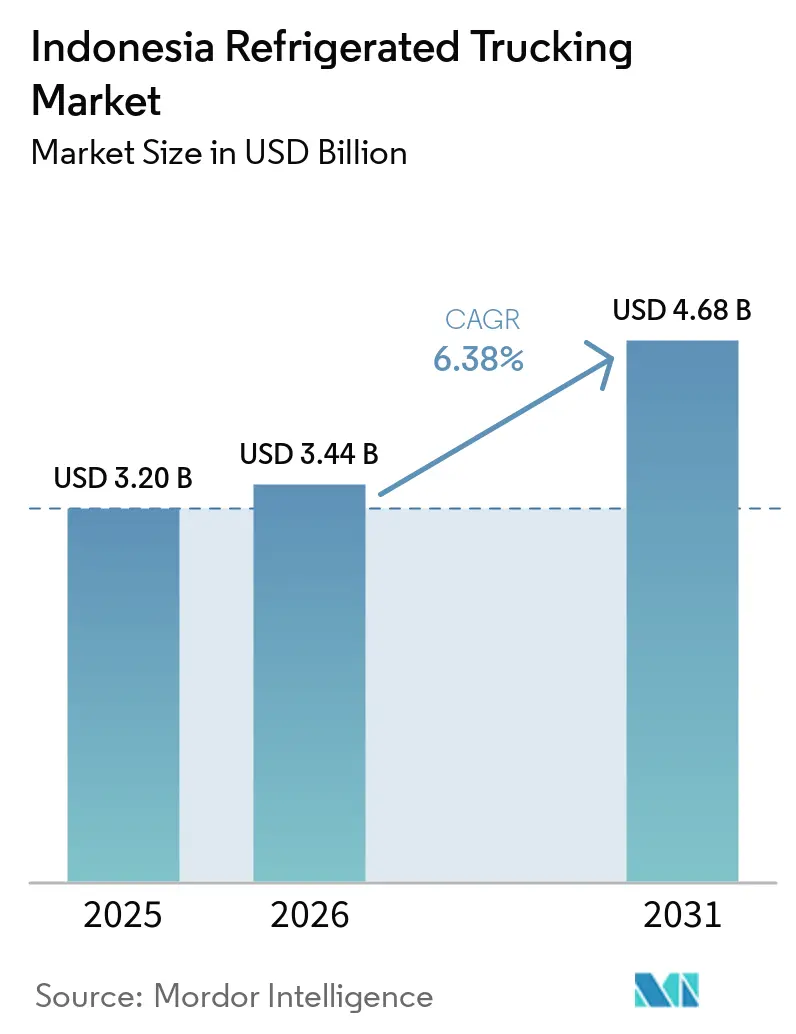
The Indonesia refrigerated trucking market size was valued at USD 3.20 billion in 2025, and is estimated to grow from USD 3.44 billion in 2026 to reach USD 4.68 billion by 2031, at a CAGR of 6.38% during the forecast period (2026-2031).
Demand is supported by the need to move seafood, meat, poultry, frozen food, and temperature-sensitive medicines across a dispersed island network. Modern retail and online grocery delivery are increasing the number of delivery points that require scheduled temperature-controlled replenishment. Pharmaceutical distribution is also raising the required standard for vehicle monitoring, temperature validation, and handling records. Investment in cold storage, refrigerated containers, and multimodal routes is widening the operating base for the Indonesian refrigerated trucking market outside its traditional Java concentration. High vehicle costs, uneven road quality, and electricity constraints continue to limit service coverage in outer islands.
Key Report Takeaways
- By application, meats, poultry, fish, and seafood held 42.25% of the Indonesia refrigerated trucking market share in 2025, while healthcare and pharmaceuticals recorded the highest projected CAGR at 8.23% through 2031.
- By truckload specification, full-truckload held 64.78% of the Indonesia refrigerated trucking market size in 2025, while less-than-truckload recorded the highest projected CAGR at 7.65% through 2031.
- By containerization, non-containerized transport held 72.34% of the Indonesia refrigerated trucking market share in 2025, while containerized transport recorded the highest projected CAGR at 7.89% through 2031.
- By distance, short haul held 64.95% of the Indonesia refrigerated trucking market size in 2025, while long haul recorded the highest projected CAGR at 6.94% through 2031.
- By destination, domestic distribution held 92.37% of the Indonesia refrigerated trucking market share in 2025, while cross-border distribution recorded the highest projected CAGR at 8.56% through 2031.
- By temperature type, frozen held 57.29% of the Indonesia refrigerated trucking market share in 2025, while ambient temperature control recorded the highest projected CAGR at 7.54% through 2031.
- By geography, Java held 62.42% of the Indonesia refrigerated trucking market share in 2025, while Sulawesi recorded the highest projected CAGR at 8.33% through 2031.
Note: Market size and forecast figures in this report are generated using Mordor Intelligence’s proprietary estimation framework, updated with the latest available data and insights as of January 2026.
Indonesia Refrigerated Trucking Market Trends and Insights
Drivers Impact Analysis*
| Driver | (~) % Impact on CAGR Forecast | Geographic Relevance | Impact Timeline |
|---|---|---|---|
| Expansion Of Organized Retail And E-Commerce Grocery | +1.1% | Java and Sumatra core, secondary cities in Kalimantan and Sulawesi | Medium term (2-4 years) |
| Growth In Seafood, Meat, Poultry, And Frozen-Food Distribution | +1.4% | National, with the highest intensity in Java, Sulawesi, and Sumatra | Short term (≤ 2 years) |
| Pharmaceutical And Vaccine Cold-Chain Expansion | +1.0% | National, with early gains in Jakarta, Surabaya, Makassar, and Medan | Medium term (2-4 years) |
| Government-Led Cold-Chain And Fisheries Logistics Modernization | +0.8% | National, with the highest intensity in coastal and Eastern Indonesia | Long term (≥ 4 years) |
| Multi-Temperature Last-Mile Delivery Demand | +0.6% | Java urban centers, expanding to Tier-2 cities in Sumatra and Kalimantan | Medium term (2-4 years) |
| Cold-Chain Outsourcing By Small And Medium-Sized Food Producers | +0.5% | National, with a concentration in Java and Sumatra food-processing clusters | Medium term (2-4 years) |
| Source: Mordor Intelligence | |||
Expansion Of Organized Retail, E-Commerce Grocery, And Multi-Temperature Last-Mile Delivery
Organized retail is increasing the number of locations that need to receive fresh, chilled, and frozen products on a regular schedule. Dark stores and micro-fulfillment sites require several replenishment runs each day, rather than the weekly bulk deliveries used in traditional distribution. This operating pattern supports shared refrigerated capacity and makes LTL services more relevant to the Indonesia refrigerated trucking market. Minimarket networks also require controlled handling for fresh and chilled products as their coverage extends into secondary cities. The demand for multi-temperature delivery adds pressure on operators to deploy vehicles that can protect different cargo conditions in one route. Small food producers can use outsourced refrigerated transport instead of carrying the capital cost of dedicated fleets, which broadens the customer base for established logistics providers.
Growth In Seafood, Meat, Poultry, And Frozen-Food Distribution
Seafood, meat, poultry, and frozen food create a steady volume base for the Indonesia refrigerated trucking market because these products depend on temperature control from collection through delivery. The Ministry of Marine Affairs and Fisheries is strengthening cold-storage information systems to support fisheries downstream activities and more integrated handling[1]Ministry of Marine Affairs and Fisheries, “KKP Siapkan Sistem Informasi Cold Storage Perkuat Hilirisasi Perikanan,” Ministry of Marine Affairs and Fisheries, kkp.go.id. The National Fish Logistics and Traceability System, known as Stelina, is formalizing documentation through seafood supply chains from 2026. The ministry has also stated that cold-chain facilities are being integrated across fishing-village locations, which can create demand for links between collection points, storage sites, and urban buyers. Slurry ice at fishing villages can preserve catch quality at the point of landing, leaving refrigerated transport as the next required connection in the chain. Frozen food also benefits from the growing demand for processed and convenience products in urban retail channels.
Pharmaceutical And Vaccine Cold-Chain Expansion
Pharmaceutical distribution is changing the vehicle standards used in the Indonesia refrigerated trucking market. Temperature-sensitive medicines, vaccines, insulin, biologics, and plasma therapies require validated transport conditions and documented handling procedures. The Ministry of Health has presented Indonesia’s health supply chain work as part of efforts to improve reliable access to health products. These requirements encourage operators to use data loggers, calibrated equipment, and trained staff across their fleets. Controlled room-temperature services also expand the use of refrigerated equipment for products that were previously carried in dry vehicles.
Government-Led Cold-Chain Modernization And Food-Producer Outsourcing
Government programs are making cold-chain investment more relevant to national logistics and fisheries development. The Ministry of Marine Affairs and Fisheries’ 2025-2029 strategic plan places fisheries value-chain development within its formal program direction. The planned integration of cold storage information with traceability systems can improve the visibility of cargo that needs to move from coastal locations to domestic markets. Public facilities alone do not provide last-mile or intercity service, so they create opportunities for private refrigerated carriers. Food producers without fixed distribution networks can outsource transport to reach modern retail, restaurants, and online grocery channels. This approach lets smaller firms use temperature-controlled capacity without purchasing and maintaining specialized assets. The Indonesia refrigerated trucking industry, therefore, has scope for both larger integrated providers and smaller route-focused operators.
Restraints Impact Analysis*
| Restraint | (~) % Impact on CAGR Forecast | Geographic Relevance | Impact Timeline |
|---|---|---|---|
| High Fleet Acquisition And Refrigeration Maintenance Costs | -0.8% | National, most acute for operators outside Java | Short term (≤ 2 years) |
| Archipelagic Transshipment And Uneven Road Infrastructure | -0.7% | Eastern Indonesia, Kalimantan, Maluku, and Papua | Long term (≥ 4 years) |
| Electricity Reliability And Refrigeration Energy Costs | -0.5% | Eastern Indonesia, rural Sumatra, and the Kalimantan interior | Long term (≥ 4 years) |
| Shortage Of Trained Reefer Drivers And Technicians | -0.4% | National, most severe in the outer islands | Medium term (2-4 years) |
| Source: Mordor Intelligence | |||
High Fleet Acquisition, Maintenance, Energy, And Skills Costs
High acquisition costs remain a central barrier for the Indonesia refrigerated trucking market, especially for smaller logistics operators. Refrigerated vehicles require specialized bodies, refrigeration units, monitoring equipment, and preventive maintenance that dry-cargo fleets do not need. Imported parts add cost and can lengthen repair cycles when equipment fails outside major service centers. Fuel use and refrigeration energy costs are more difficult to manage where grid reliability is weak, and operators depend on generator support. GDP-related handling requirements also add recurring costs for calibration, temperature records, and driver training. MGM Bosco Logistics received an IDR 720 billion (USD 41 million) financing facility in June 2026 to support fleet acquisition, cold-storage construction, and national expansion, illustrating the scale of capital required for integrated cold-chain growth.
Archipelagic Transshipment And Uneven Road Infrastructure
Indonesia’s island geography adds handling steps to refrigerated transport and limits the consistency of service outside established corridors. A typical inter-island route can require a truck, a refrigerated container, a ferry or roll-on roll-off vessel, and onward road transport. Each transfer creates the risk of delay or a break in temperature control if equipment and port processes do not align. Uneven roads in Papua, Maluku, and interior Kalimantan make journey times less predictable and increase vehicle wear. Electricity constraints also affect the cold-storage sites that support line-haul trucking routes. These conditions favor dense corridors where population, product volumes, road access, and port connections can support regular services, while many outer-island areas remain underserved.
*Our forecasts treat driver/restraint impacts as directional, not additive. The impact forecasts reflect baseline growth, mix effects, and variable interactions.
Segment Analysis
By Application: Protein Cargo Holds The Largest Position While Healthcare And Pharmaceutical Industries Expand Fastest
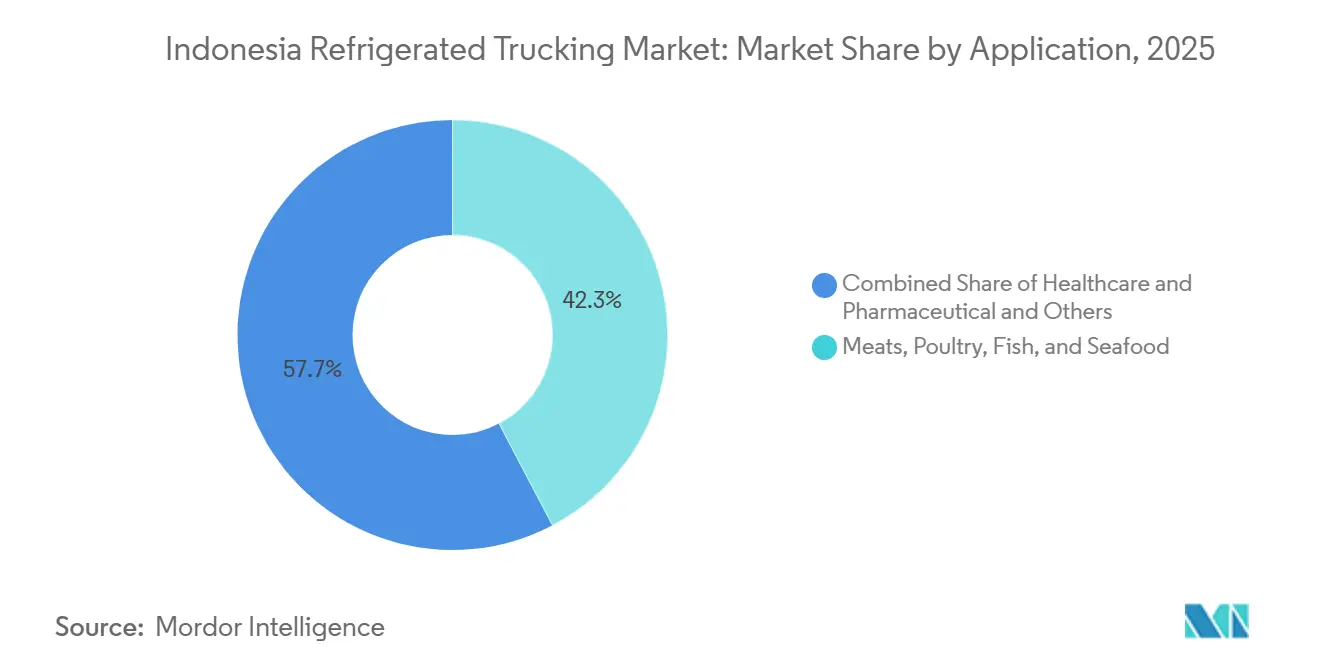
Meats, poultry, fish, and seafood held 42.25% of the Indonesia refrigerated trucking market share in 2025, while healthcare and pharmaceutical is forecast to grow at 8.23% CAGR through 2031, the fastest rate among application segments. The meats, poultry, fish, and seafood segment reflects the importance of protein distribution in domestic food supply chains and the large volume of seafood moving from coastal processing areas. Formal traceability and cold-chain handling can bring cargo that previously moved through informal channels into temperature-controlled networks. Fisheries collection points, cold storage, wholesalers, and retailers all need transport links that preserve product condition. This need makes protein cargo a foundational source of utilization for the Indonesia refrigerated trucking market. The segment also supports regular short-haul deliveries to supermarkets, wet-market suppliers, restaurants, and foodservice customers.
The Indonesia refrigerated trucking market size for this application benefits from requirements for validated temperature handling and recorded delivery conditions. Vaccine, biologic, and specialty medicine shipments frequently require smaller, multi-stop routes to hospitals, clinics, and distributors. The same monitoring equipment used for these contracts can improve the service standard of food and dairy routes. Dairy and Frozen Dessert Products, Horticultural Products, and Processed Food Products form another layer of demand through retail replenishment. Other Applications include chemicals, floriculture, and cosmetics, where controlled conditions can become necessary when product specifications or compliance requirements require them.



By Truckload Specification: Full-Truckload Leads While Less-Than-Truckload Changes Route Design
Full-truckload held 64.78% of the Indonesia refrigerated trucking market share in 2025, while less-than-truckload is expected to advance at 7.65% CAGR through 2031. FTL is preferred by high-volume shippers, such as food manufacturers, fisheries exporters, and supermarket chains, operating regular routes between production sites and distribution centers. Full vehicle utilization spreads refrigeration, fuel, and maintenance costs across larger shipments, improving cost efficiency. Its suitability for planned line-haul operations and predictable delivery schedules is expected to sustain FTL’s leading market position.
The Indonesia refrigerated trucking market size for LTL is supported by online grocery replenishment, smaller producers, and pharmaceutical deliveries that need multiple drops. Shared capacity helps producers use professional refrigerated transport without committing to a full vehicle. Multi-temperature scheduling becomes important because each route can carry products with different handling needs. Pharmaceutical shipments often use smaller consignments across hospitals and clinics, which is consistent with a multi-drop model. Operators that improve load consolidation, routing, and temperature visibility can compete more effectively as this model scales.
By Containerization: Non-Containerized Transport Leads While Containerized Service Supports Inter-Island Routes
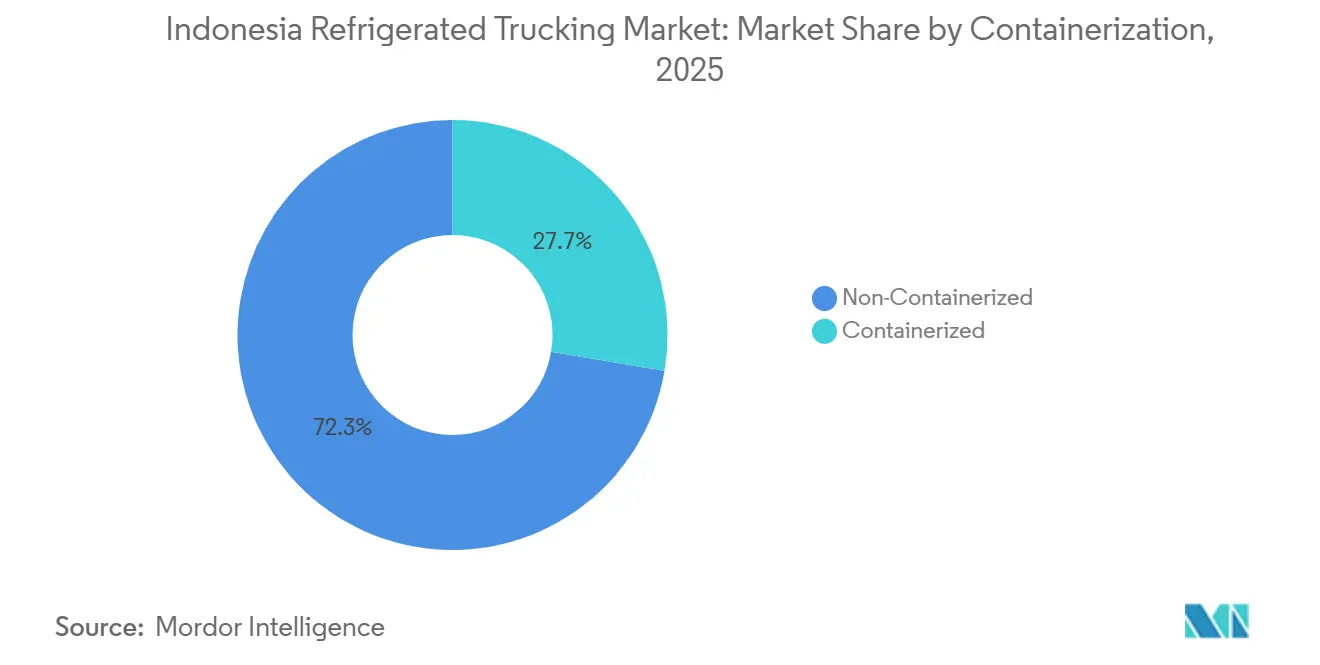
Non-containerized refrigerated trucking held 72.34% of the Indonesia refrigerated trucking market share in 2025, while containerized service is forecast to grow at 7.89% CAGR through 2031. Rigid trucks and trailers with body-mounted refrigeration units remain practical for road-based distribution within Java and major urban areas on other islands. These vehicles support short-haul deliveries, regional transport, and direct store replenishment without an additional container transfer. Operators are familiar with their maintenance needs and can assign them flexibly across domestic routes. This makes non-containerized equipment the workhorse of the Indonesia refrigerated trucking market. It remains suitable where road access is strong and truck-only delivery is commercially viable.
Refrigerated ISO containers can keep cargo in a monitored environment while it transfers between road, port, rail, and vessel operations. KAI Logistik reported refrigerated cargo volumes of 9,352 TEUs by May 2026, up 39% year over year, indicating rising use of intermodal reefer transport. This model can reduce the handling steps that expose cargo to temperature excursions on long inter-island routes. It also supports connections from Java to Kalimantan and Sulawesi, where maritime transport is necessary. Containerized operations require stronger coordination among carriers, ports, warehouses, and vessel schedules.
By Distance: Short Haul Leads Current Volume While Long Haul Follows Commodity Corridors
Short haul held 64.95% of the Indonesia refrigerated trucking market share in 2025, while long haul is forecast to grow at 6.94% CAGR through 2031. Dense urban markets create frequent deliveries to minimarkets, supermarkets, hospitals, restaurants, and foodservice locations. Short routes also support vehicle-day utilization because drivers can complete several deliveries within a local distribution area. The concentration of food retail and pharmaceutical distribution in Greater Jakarta strengthens this pattern. Short-haul operations remain central to the Indonesia refrigerated trucking market because they connect warehouses with the final commercial delivery points. Regular retail replenishment also makes demand less dependent on infrequent long-distance movements.
The growth in long haul is concentrated in selected seafood, food, and pharmaceutical corridors rather than across every national route. Eastern seafood-processing centers can require longer connections to Java-based distribution hubs and export gateways. Pharmaceutical redistribution from Java to provincial health facilities can create similar demand for planned temperature-controlled line-haul services. Linfox Indonesia introduced its ODOL-compliant Project Trailblazer prime mover and trailer fleet with centralized 24-hour tracking for longer-distance freight movements[2]Linfox, “Investing in Linfox Indonesia Fleet, Project Trailblazer,” Linfox, linfox.com. Long-haul carriers need reliable equipment, route-specific planning, and handling practices that protect cargo through each transfer.
By Destination: Domestic Distribution Leads While Cross-Border Growth Raises Compliance Requirements
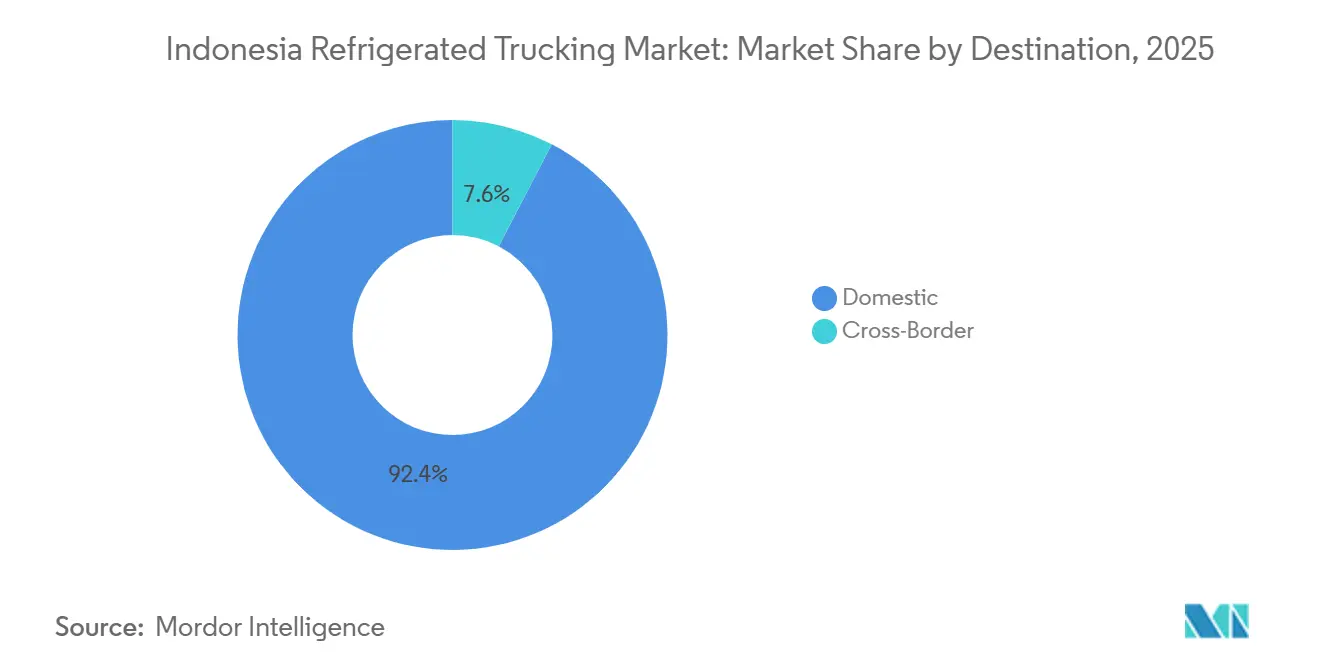
Domestic distribution held 92.37% of the Indonesia refrigerated trucking market share in 2025, while cross-border distribution is forecast to expand at 8.56% CAGR through 2031. The country’s large domestic population and dispersed geography create substantial internal demand for temperature-controlled food and health-product distribution. Modern retail expansion, hospital supply chains, and online grocery activity are key domestic users of refrigerated services. Domestic routes range from city deliveries to multi-island connections supported by ports and warehousing. This broad internal base keeps domestic distribution at the center of the Indonesia refrigerated trucking market. It also means that providers can build scale without relying solely on export volumes.
Seafood, processed food, and vaccine exports require producers and logistics providers to maintain better documentation and consistent product conditions. Traceability systems can link domestic handling standards to the requirements of overseas buyers. Cross-border growth can also encourage exporters to deploy validated vehicles on domestic collection routes before cargo reaches a port or airport. YCH Group and Sitthi Logistics signed a multimodal cross-border cooperation agreement in April 2025 that included real-time temperature monitoring for perishable agricultural and food products across the ASEAN corridor[3]YCH Group, “Sitthi Logistics and YCH Group Cooperate on Multimodal Cross-Border Logistics of Agricultural Products,” YCH Group, ych.com. These requirements raise the value of providers that can manage customs documentation, temperature records, and multimodal transport.
By Temperature Type: Frozen Holds The Largest Position While Ambient Control Gains Importance
Frozen transport held 57.29% of the Indonesia refrigerated trucking market share in 2025, while ambient temperature control is projected to expand at 7.54% CAGR through 2031. Frozen seafood, poultry, imported food, and processed convenience products generate a large share of the transport requirements. The segment needs equipment that can maintain stable low temperatures while handling frequent distribution stops. It is also closely tied to retail freezers, cold storage, and port-based reefer operations. Frozen cargo, therefore, remains a major source of fleet demand in the Indonesian refrigerated trucking market. Its leading position reflects the established role of frozen proteins in domestic and export supply chains.
This ambient temperature service is increasingly relevant for pharmaceuticals, nutraceuticals, and cosmetics that need controlled room-temperature transport. Chilled transport serves fresh seafood, dairy, and produce, while deep-frozen equipment supports smaller high-value biotechnology requirements. Operators need to match the vehicle set point to the product’s stated handling condition rather than rely on one temperature setting. This expands the operational value of fleets with multi-temperature capability. It also increases the importance of monitoring, calibration, and documented delivery procedures.
Geography Analysis
Java held 62.42% of the Indonesia refrigerated trucking market share in 2025. The island concentrates food processing, pharmaceutical manufacturing, modern retail distribution, and major consumer markets. Greater Jakarta provides the most regular flow of warehouse-to-store, warehouse-to-hospital, and warehouse-to-restaurant refrigerated deliveries. Port links through Tanjung Priok and Patimban, stronger road access, and more reliable energy reduce operating risk compared with many other regions.
Kalimantan is becoming more relevant as formal refrigerated distribution expands beyond Java. Balikpapan’s role in supporting Nusantara can create demand for planned food and health-product logistics corridors. MGM Bosco Logistics expanded its cold-chain service network into Balikpapan, Pontianak, and Banjarmasin in August 2026[4]MGM Bosco Logistics, “MGM Bosco Logistics Strengthens National Cold Chain Network Through Expansion into Kalimantan,” MGM Bosco Logistics, mgmbosco.com.. Papua and the Maluku Islands remain difficult operating environments because roads, electricity, and port connections are less consistent.
Sulawesi is forecast to grow at 8.33% CAGR through 2031, the fastest regional rate in the Indonesia refrigerated trucking market. Makassar is a key processing and staging node for tuna, shrimp, crab, and other Eastern Indonesian seafood. Kiat Ananda Group opened a multi-temperature warehouse in Makassar in February 2026, extending its network beyond existing clusters. New capacity can help connect seafood collection, processing, storage, domestic distribution, and export movements. Sulawesi’s opportunity depends on providers establishing dependable service before route volumes become crowded. The geography also needs coordinated road, port, storage, and refrigerated-container capacity rather than vehicle investment alone.
Competitive Landscape
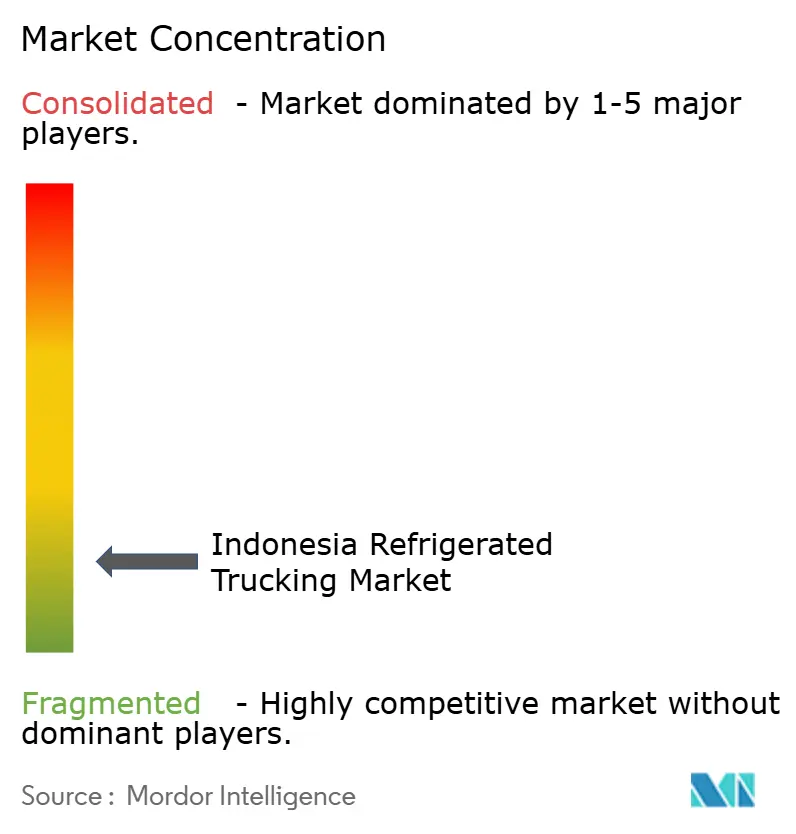
The Indonesia refrigerated trucking market is fragmented. Domestic integrated operators compete with Japanese-affiliated logistics groups, multinational express carriers, and smaller technology-focused providers. Kiat Ananda Group, MGM Bosco Logistics, and Samudera Indonesia, with Adib Cold Logistics, represent an integrated domestic tier that combines storage and refrigerated transport. Large food and pharmaceutical customers often prefer a provider that can take responsibility across warehousing, vehicle dispatch, and delivery records.
Japanese-affiliated providers compete through compliance systems, technology, and cross-border logistics capability. Mitsubishi Logistics Indonesia operates its MM2100 Distribution Park with four temperature zones. Yusen Logistics Indonesia began operations at Patimban Deep Sea Port in April 2026, connecting seaport services with inland logistics. NX Group integrated its Indonesia operations under the ONE NX INDONESIA structure from March 2026. DHL is building a GDP-certified pharmaceutical hub capacity in Jakarta with dedicated 2-8 °C and 15-25 °C zones.
Technology and outer-island coverage remain important competitive areas for the Indonesia refrigerated trucking market. PT Superkul Amerta Indonesia focuses on temperature-monitored cold last-mile delivery using motorcycles and trucks, while Coolkas provides software for cold-storage operations. Certification is a differentiator because operators that meet food, veterinary, and pharmaceutical handling requirements can serve more than one premium cargo category. Linfox’s tracked fleet investment shows how vehicle monitoring is becoming part of service quality on major distribution corridors.
Indonesia Refrigerated Trucking Industry Leaders
Kiat Ananda Group
PT Linfox Logistics Indonesia
MGM Bosco Logistics
Samudera Indonesia Group / Adib Cold Logistics
PT Enseval Putera Megatrading Tbk
- *Disclaimer: Major Players sorted in no particular order

Recent Industry Developments
- August 2026: MGM Bosco Logistics expanded its cold chain service network into Kalimantan with operational presence in Balikpapan, Pontianak, and Banjarmasin, responding to growing demand for temperature-controlled logistics across Kalimantan's FMCG, seafood, and pharmaceutical sectors.
- April 2026: PT Yusen Logistics Indonesia went operational at Patimban Deep Sea Port in Subang Regency, West Java, providing integrated end-to-end logistics linking seaport operations to temperature-controlled inland transport.
- February 2026: Kiat Ananda Group opened a new multi-temperature warehouse in Makassar, Sulawesi, its first dedicated facility in Kota Anging Mamiri, as part of the company's national cold chain expansion beyond its existing Java, Bali, Sumatra, and Kalimantan clusters.
- June 2025: DHL Group committed to building new GDP-certified Pharma Hubs in Indonesia as part of a EUR 500 million (USD 580 million) AsiaPacific life sciences investment through 2030, adding specialized 2-8 °C and 15-25 °C cold chain storage facilities in Jakarta and commissioning new temperature-controlled vehicles for pharmaceutical distribution.


Indonesia Refrigerated Trucking Market Report Scope
| Horticultural Products |
| Dairy and Frozen Dessert Products |
| Meats, Poultry, Fish, and Seafood |
| Processed Food Products |
| Healthcare and Pharmaceutical |
| Other Applications |
| Full-Truckload (FTL) |
| Less-than-Truckload (LTL) |
| Containerized |
| Non-Containerized |
| Long Haul |
| Short Haul |
| Domestic |
| Cross-border |
| Chilled (0–5 °C) |
| Frozen (-20–0 °C) |
| Ambient |
| Deep-Frozen / Ultra-Low (Less than -20 °C) |
| Java (Jakarta & BOD) |
| Sumatra |
| Kalimantan |
| Sulawesi |
| Bali and Nusa Tenggara |
| Papua Region and Maluku Islands |
| By Application | Horticultural Products |
| Dairy and Frozen Dessert Products | |
| Meats, Poultry, Fish, and Seafood | |
| Processed Food Products | |
| Healthcare and Pharmaceutical | |
| Other Applications | |
| By Truckload Specification | Full-Truckload (FTL) |
| Less-than-Truckload (LTL) | |
| By Containerization | Containerized |
| Non-Containerized | |
| By Distance | Long Haul |
| Short Haul | |
| By Destination | Domestic |
| Cross-border | |
| By Temperature Type | Chilled (0–5 °C) |
| Frozen (-20–0 °C) | |
| Ambient | |
| Deep-Frozen / Ultra-Low (Less than -20 °C) | |
| By Region | Java (Jakarta & BOD) |
| Sumatra | |
| Kalimantan | |
| Sulawesi | |
| Bali and Nusa Tenggara | |
| Papua Region and Maluku Islands |


Key Questions Answered in the Report
What is the projected value of the Indonesia refrigerated trucking market by 2031?
The Indonesia refrigerated trucking market is forecast to reach USD 4.68 billion by 2031, at a CAGR of 6.38% during the forecast period (2026-2031).
Which application has the greatest demand for refrigerated trucking in Indonesia?
Meats, poultry, fish, and seafood led application demand with 42.25% share in 2025.
Which refrigerated trucking application is growing fastest in Indonesia?
Healthcare and pharmaceutical is projected to grow at 8.23% CAGR through 2031 as validated temperature handling becomes more important.
Why does Java lead refrigerated transport demand in Indonesia?
Java held 62.42% share in 2025 because it concentrates on food processing, pharmaceutical manufacturing, modern retail, and major consumer markets.
Which Indonesian region has the strongest forecast growth for refrigerated trucking?
Sulawesi is forecast to grow at 8.33% CAGR through 2031, supported by seafood processing and distribution activity centered on Makassar.
What is driving containerized refrigerated transport in Indonesia?
Containerized transport is projected to grow at 7.89% CAGR because it can protect cargo through road, port, rail, and maritime transfers on inter-island routes.
Page last updated on:





