
Indonesia Project Cargo Logistics Market Size and Share
Market Overview
| Study Period | 2020 - 2031 |
|---|---|
| Forecast Data Period | 2026 - 2031 |
| Base Year Market Size (2025) | USD 7.87 Billion |
| Market Size (2026) | USD 8.5 Billion |
| Market Size (2031) | USD 12.34 Billion |
| Growth Rate (2026 - 2031) | 7.74 % |
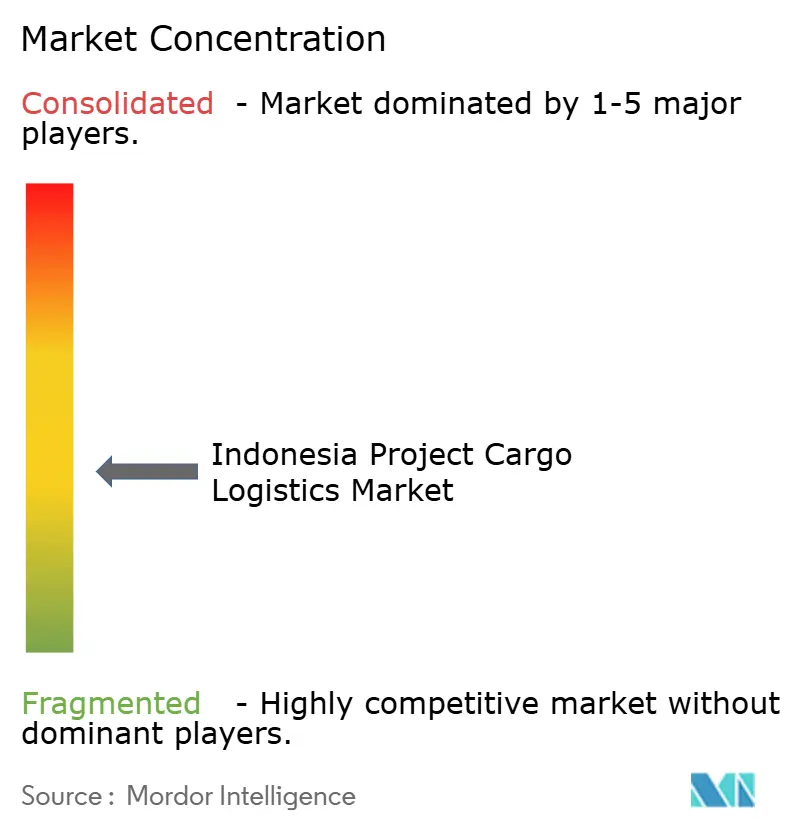
| Market Concentration | Medium |
Major Players *Disclaimer: Major Players sorted in no particular order Image © Mordor Intelligence. Reuse requires attribution under CC BY 4.0. | |
Indonesia Project Cargo Logistics Market Analysis by Mordor Intelligence
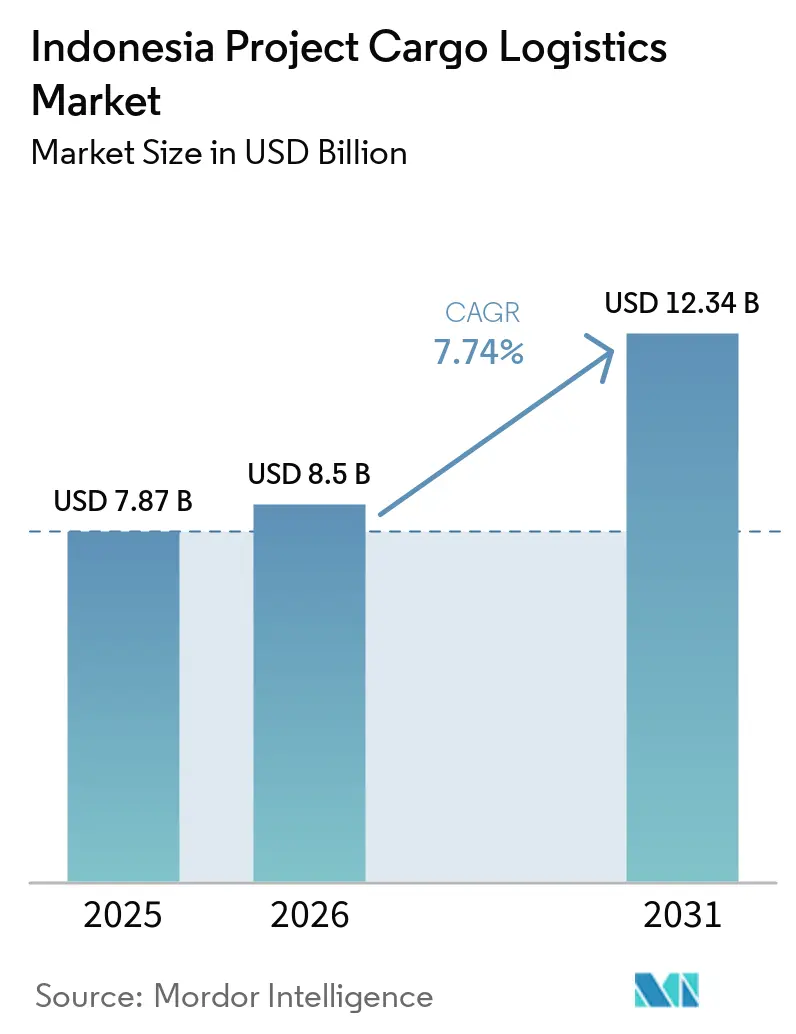
The Indonesia project cargo logistics market size was valued at USD 7.87 billion in 2025 and is estimated to grow from USD 8.50 billion in 2026 to reach USD 12.34 billion by 2031, at a CAGR of 7.74% during the forecast period 2026 to 2031.
Government infrastructure programs and industrial processing investments are creating simultaneous demand for specialized transport across several islands. The Indonesia project cargo logistics market is moving beyond standard transport because equipment size, weight, route conditions, and project schedules shape provider selection. The toll road plan for 2025 to 2029 targets 2,461 km of operational roads and IDR 725 trillion (USD 43.26 billion) in investment, which supports access to heavy-cargo sites beyond established industrial corridors. Local-content requirements are also increasing domestic fabrication activity, which creates more specialized movements between fabrication yards and project sites. Providers with technical planning capabilities and local operating coverage are better positioned as complex industrial projects move into construction and commissioning.
Key Report Takeaways
- By service, transportation held 58.85% of Indonesia project cargo logistics market share in 2025, while value-added services and others recorded the highest projected CAGR at 8.69% through 2031.
- By cargo type, oversized or out-of-gauge cargo held 43.78% of Indonesia project cargo logistics market size in 2025, while heavy-lift cargo recorded the highest projected CAGR at 9.37% through 2031.
- By end-user industry, construction and infrastructure held 32.56% of Indonesia project cargo logistics market share in 2025, while energy generation and transmission recorded the highest projected CAGR at 9.57% through 2031.
- By geography, Java, including Jakarta and BOD, held 61.64% of Indonesia project cargo logistics market size in 2025, while Sulawesi recorded the highest projected CAGR at 10.68% through 2031.
Note: Market size and forecast figures in this report are generated using Mordor Intelligence’s proprietary estimation framework, updated with the latest available data and insights as of January 2026.
Indonesia Project Cargo Logistics Market Trends and Insights
Drivers Impact Analysis*
| Driver | (~) % Impact on CAGR Forecast | Geographic Relevance | Impact Timeline |
|---|---|---|---|
| Infrastructure Projects Increasing Specialized Project Logistics Demand | +2.0% | Java, Kalimantan, and Sumatra, including IKN, toll roads, and port expansion | Medium term (2-4 years) |
| Renewable Energy Expansion Driving Heavy-Lift Transport Requirements | +1.5% | Central and West Java, Sulawesi, Sumatra, and the Papua Region | Long term (≥ 4 years) |
| Mining Downstreaming Expanding Industrial Project Cargo Volumes | +1.2% | Southeast Sulawesi and Kalimantan | Medium term (2-4 years) |
| Manufacturing Localization Increasing Industrial Logistics Project Activity | +0.8% | West Java industrial corridor and Batam FTZ | Short term (≤ 2 years) |
| Heavy-Lift Outsourcing Supporting Specialized Multimodal Logistics Demand | +0.7% | Java, West Papua, and Kalimantan | Medium term (2-4 years) |
| Digital Control Towers Improving Project Cargo Coordination | +0.5% | Java, Sulawesi, and national ports | Short term (≤ 2 years) |
| Source: Mordor Intelligence | |||
Infrastructure Projects Increasing Specialized Project Logistics Demand
Indonesia’s infrastructure investment cycle covers toll roads, ports, airports, power generation, and new capital construction at the same time. The IKN Authority awarded IDR 3 trillion (USD 179.5 million) in November 2025 for legislative and judicial zone infrastructure scheduled through December 2027. These contracts create sustained equipment flows from Java into Kalimantan. PT PP’s USD 143 million New Priok Eastern Access Section II project began in 2025 and connected the Nusantara Bonded Zone with New Priok Container Terminal 1. The project improves the last-mile route for large equipment entering through Tanjung Priok. Each infrastructure project also requires crane mobilization, staging-yard management, permit coordination, and marine assurance, which expands the Indonesia project cargo logistics market beyond conventional freight assignments.
Renewable Energy Expansion Driving Heavy-Lift Transport Requirements
PLN’s RUPTL 2025 to 2034 includes 42.6 GW of new renewable capacity, representing 61% of planned capacity additions. In August 2026, President Prabowo launched construction of the 134 MWp Gajah Mungkur floating solar plant in Central Java, supported by IDR 1.6 trillion (USD 90.2 million) in investment. Renewable equipment has large dimensions, even when individual items weigh less than conventional oil and gas modules. This profile requires flat-bed and RoRo transport, route-clearance permits, and marine-transit planning. Pelindo Regional 2 Banten handled 347,850 MT of windmill tower general cargo through Ciwandan in 2025, and handled 269,006 MT from January through August 2026. The Indonesia project cargo logistics market, therefore, needs operating capabilities that match renewable components rather than only traditional heavy modules.
Mining Downstreaming Expanding Industrial Project Cargo Volumes
Law No. 3 of 2020 restricted exports of unprocessed nickel and bauxite and supported the construction of smelters, HPAL plants, and industrial parks in Indonesia. These facilities require multi-year delivery schedules for autoclaves, process vessels, piping packages, and modular structures. PT Vale Indonesia received the first 2 autoclave units for its Pomalaa HPAL facility in early 2025, which was designed to produce up to 120,000 tonnes of mixed hydroxide precipitate annually[1]. PT Ceria Nugraha Indotama began its first low-carbon ferronickel exports from Kolaka in July 2026 and used Kendari New Port to reduce the route to China to 16 days. These projects favor operators with established capacity near project sites and fabrication links. Demand continues through maintenance and expansion phases after a plant begins operating, supporting recurring work in the Indonesia project cargo logistics market.
Manufacturing Localization Increasing Industrial Logistics Project Activity
TKDN policy and foreign investment are creating project logistics demand for factory installation as well as resource processing. VinFast opened its electric vehicle plant in Subang in December 2025 with a phase-1 investment of USD 300 million[2]. Bosch began construction of an EV component factory in Cikarang in November 2025 with a potential investment of EUR 259 million (USD 304.76 million). Manufacturing investment reached IDR 182 trillion (USD 10.92billion) in the first quarter of 2026. Assembly presses, injection-molding machines, and production-line conveyors create frequent, schedule-sensitive transport work, giving the Indonesia project cargo logistics market a broader base of industrial demand.
Restraints Impact Analysis*
| Restraint | (~) % Impact on CAGR Forecast | Geographic Relevance | Impact Timeline |
|---|---|---|---|
| Archipelagic Transshipment Increasing Project Logistics Cost Complexity | -1.5% | Sulawesi, Papua, Maluku, Kalimantan, and nationwide inter-island freight flows | Long term (≥ 4 years) |
| Permitting and Axle Rules Delaying Cargo Movements | -1.0% | Java and Sumatra toll roads, including Banten, DKJ, and West Java pilot areas | Short term (≤ 2 years) |
| Infrastructure Bottlenecks Restricting Heavy Cargo Site Access | -0.8% | Southeast Sulawesi nickel corridors, the Papua Region, and the outer islands | Medium term (2-4 years) |
| Engineering Talent Shortages Limiting Complex Project Execution | -0.5% | Nationally, with pressure in East Kalimantan and Southeast Sulawesi | Medium term (2-4 years) |
| Source: Mordor Intelligence | |||
Archipelagic Transshipment Increasing Project Logistics Cost Complexity
Indonesia’s geography requires most outer-island project cargo to pass through at least 1 transshipment point. This adds handling steps, delivery time, and cargo risk to movements outside the main western corridors. The Sea Toll program allocated IDR 623.4 billion (USD 35.28 million) across 756 voyages serving 104 ports in 2025. Eastbound and westbound cargo flows remain uneven, which raises empty repositioning costs. The Indonesia project cargo logistics market faces a structural cost floor in eastern locations, where providers need denser networks to improve margins.
Permitting and Axle Rules Delaying Cargo Movements
Zero ODOL enforcement has tightened the road stage of oversized project movements under Law No. 22 of 2009. The Ministry of Transportation set regulatory deregulation for completion by the end of 2025, began enforcement trials in June 2026, and planned for full Zero ODOL implementation in 2027[3]. Operators need to use compliant specialized trailers or divide loads into smaller road movements. Special Cargo Transport Permits require coordination with the transport ministry, regional governments, and the National Police. Imported capital goods also require additional compliance documentation under TKDN and Permendag 47/2025. These requirements create longer project lead times and favor providers that already have compliance systems and established local relationships in the Indonesia project cargo logistics market.
*Our forecasts treat driver/restraint impacts as directional, not additive. The impact forecasts reflect baseline growth, mix effects, and variable interactions.
Segment Analysis
By Service: Transportation Anchors Revenue, Value-Added Services Lead Growth
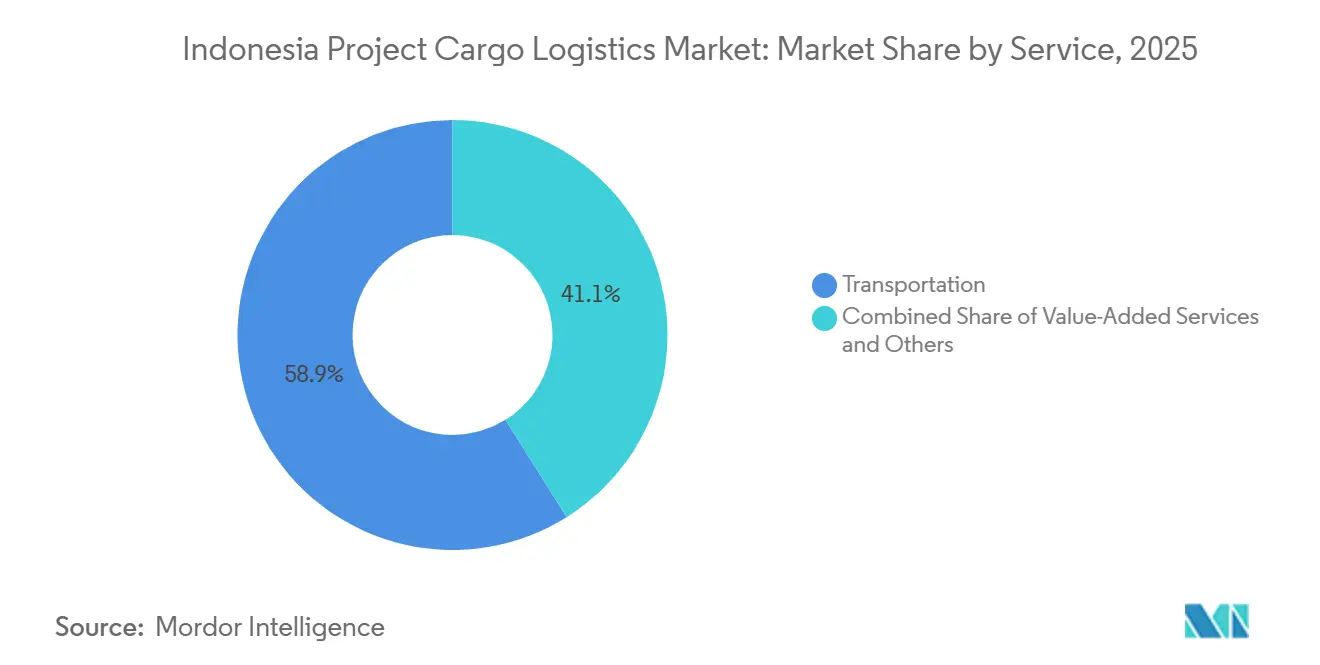
Transportation accounted for 58.85% of Indonesia project cargo logistics market share in 2025, while value-added services and others are projected to record an 8.69% CAGR through 2031, reflecting the continued importance of physical project movements alongside increasing demand for integrated logistics support. Transportation covers road delivery, sea and barge transit, air charters, and emerging rail links in Java, with mode selection depending on cargo dimensions, project location, delivery timelines, and site accessibility. Warehousing, distribution, and inventory management support staging and sequencing before installation, allowing contractors to pre-position equipment closer to remote project sites and reduce delays during project execution.
Value-added services are increasingly being combined with transport contracts and include engineering reviews, route surveys, marine assurance, and on-site supervision. Kuehne+Nagel’s renewed 4-year LNG resupply contract at Lamongan Shorebase, combined with marine assets, staging-yard management, and specialist personnel, illustrated the broader shift toward integrated project logistics solutions. The PLB framework can also support project logistics by deferring import duties and enabling customs processing away from congested port locations, improving inventory and cash-flow management for EPC contractors. The Indonesia project cargo logistics market, therefore, increasingly requires providers to combine transportation with staging, technical support, customs coordination, and on-site execution capabilities.

By Cargo Type: Oversized Cargo Dominates, Heavy-Lift Segment Accelerating
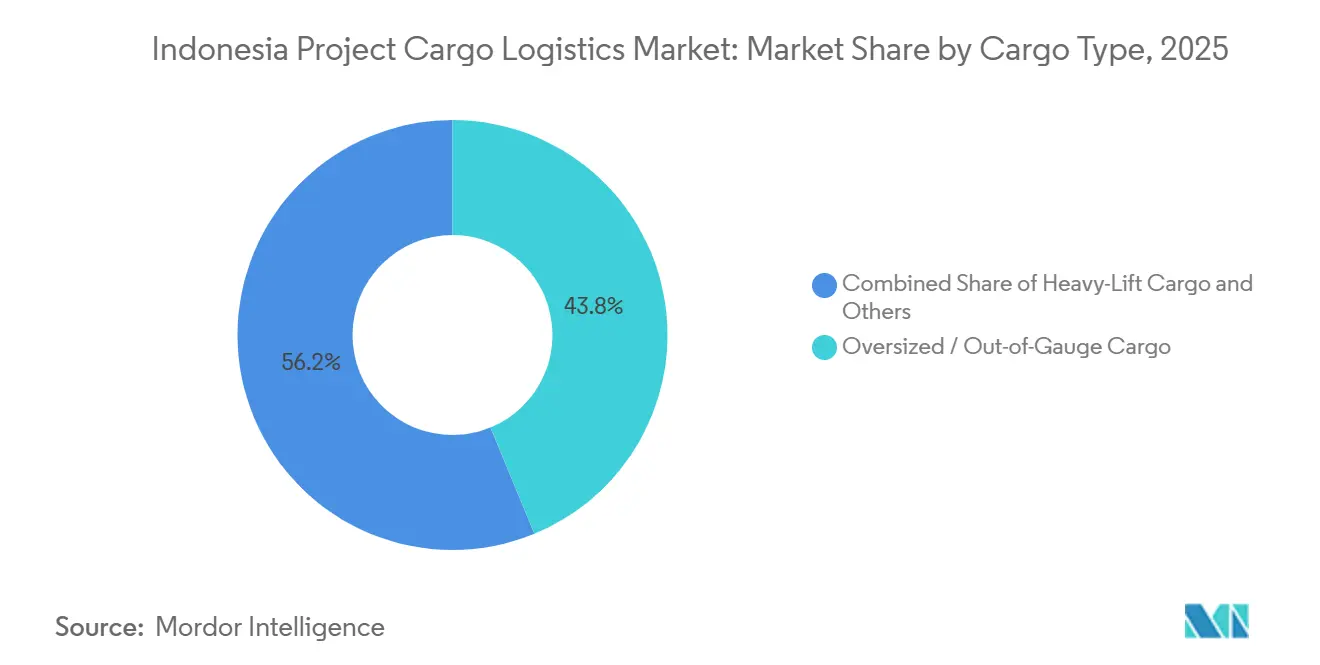
Oversized or out-of-gauge cargo held 43.78% of Indonesia project cargo logistics market size in 2025, while heavy-lift cargo is forecast to record a 9.37% CAGR through 2031, reflecting the continued importance of non-standard project movements alongside rising demand for specialized heavy-lift capabilities. Wind towers, refinery columns, generator stators, HVDC converter equipment, and autoclave vessels exceed standard container dimensions and require specialized transport planning, lifting equipment, route assessments, and site coordination. Pelindo Regional 2 Banten handled 347,850 MT of windmill tower cargo through Ciwandan in 2025, demonstrating the scale of oversized renewable-energy equipment movements[4]. Breakbulk and other specialized cargo include modular process equipment, structural steel packages, and FPSO subassemblies, with volumes closely linked to individual energy, infrastructure, and industrial projects.
Heavy-lift demand is supported by ongoing energy and infrastructure investment, including developments such as Abadi LNG and Mako. GEODIS delivered 8 oversized crane components to McDermott’s Batam yard in August 2026 with a combined weight of 308,920 kg, highlighting the specialized requirements of industrial project cargo movements. SPAB requirements and ODOL enforcement are also encouraging greater use of marine and barge solutions for cargo that faces road transport constraints. The Indonesia project cargo logistics market, therefore, increasingly favors providers with heavy-lift equipment, vessel access, stevedoring capabilities, route-planning expertise, and the ability to coordinate complex multimodal movements.
By End-User Industry: Construction Anchors Demand, Energy Transition Reshapes the Pipeline
Construction and infrastructure represented 32.56% of Indonesia project cargo logistics market share in 2025, while energy generation and transmission is projected to record a 9.57% CAGR through 2031, reflecting continued project cargo demand from large infrastructure programs alongside expanding power-generation and transmission investments. IKN development, toll-road expansion, and port upgrades support recurring deliveries of heavy machinery, construction materials, and specialized equipment across Java, Sumatra, and Kalimantan. Project cargo logistics providers also support these programs through temporary storage, movement planning, route coordination, and site delivery management. Phased project schedules require precise sequencing to ensure equipment and materials reach construction sites according to installation requirements.
Energy generation and transmission demand is supported by PLN’s renewable energy plans and the 100 GWp solar initiative, which are generating requirements for solar panels, inverters, transformer packages, and related equipment. Oil and gas, mining, and quarrying remain important sources of project cargo demand due to ongoing hydrocarbon development and LNG supply-base activity. At the same time, EV and electronics manufacturing plants add industrial equipment requirements. Sarens began work at McDermott’s Batam yard for the TenneT 2GW program in June 2025, illustrating demand for specialized heavy-lift and project logistics services. TKDN requirements also support recurring movements between domestic fabrication yards and project sites. The Indonesia project cargo logistics market, therefore, remains closely linked to infrastructure investment cycles, energy development, and the localization of industrial manufacturing.
Geography Analysis
Java, including Jakarta and BOD, accounted for 61.64% of Indonesia project cargo logistics market share in 2025. Tanjung Priok, industrial estates at Cikarang and Karawang, and coastal barge networks make it the main operating center. A Samudera Indonesia consortium that includes Africa Global Logistics and Toyota Tsusho committed USD 1 billion to Patimban Container Terminal through a 37-year concession. The terminal targets a final capacity of 3.7 million TEUs. The New Priok Eastern Access Section II project, alongside Bosch and VinFast investments, adds equipment demand that remains sensitive to weight and timing.
Sumatra’s demand is supported by oil and gas infrastructure in Riau and North Sumatra, plus plantation downstream processing and mineral projects. Kalimantan’s IKN construction phase is a dependable cargo source through 2027. Legislative and judicial zone contracts worth IDR 3 trillion (USD 179.5 million) are active through December 2027. The eastern Kalimantan corridor connects Balikpapan, Samarinda, and the IKN site. Improved road and port links along this route support the Indonesia project cargo logistics market by improving access from maritime gateways to inland sites.
Sulawesi is forecast to register at 10.68% CAGR through 2031, the highest regional rate. Southeast Sulawesi nickel projects create recurring and overlapping construction deliveries. Direct Kendari shipping to China reduces the need for Java transshipment. Bali and Nusa Tenggara, Papua, and Maluku remained smaller areas, where constrained road, sea, and air access increased delivery costs despite Sea Toll supported for 104 ports through 756 voyages in 2025.
Competitive Landscape
The Indonesia project cargo logistics market is moderately fragmented among specialist providers and general freight operators. Kuehne+Nagel, DHL Global Forwarding Industrial Projects, CEVA Logistics, deugro, and Maersk Project Logistics compete for energy, mining, and manufacturing mandates. Their differentiation rests on heavy-lift vessel chartering, marine assurance, route engineering, and coordinated multimodal execution.
CEVA Logistics acquired a majority stake in Fagioli in March 2026, adding 450 specialists in heavy road transport and engineered hauling. Asset ownership matters when specialized trailers and heavy-lift cranes are scarce. Deugro repositioned itself as a Project Solution Provider in July 2026 and extended its planning role to early engineering stages. The Indonesia project cargo logistics market favors providers that engage before equipment orders and route plans are final. Earlier involvement helps address permits, marine access, and site constraints before they affect delivery schedules.
Domestic operators have an advantage in remote locations and outer-island execution. CKB Logistics operates across 51 locations in 38 cities and 24 provinces, combining project logistics, remote supply-base services, AEO certification, and PLB operator status. Samudera Indonesia allocated USD 300 million in February 2026 for fleet expansion, Patimban terminal development, and the Madura shipyard. Pelindo’s Phinnisi platform and TOS Nusantara system are deployed across 14 container terminals, while engineering-bundled services for floating solar, geothermal, and offshore wind offer another area for differentiation.
Indonesia Project Cargo Logistics Industry Leaders
-
DHL Group
-
DSV A/S
-
Kuehne+Nagel International AG
-
A.P. Moller - Maersk
-
PT Cipta Krida Bahari (CKB Logistics)
- *Disclaimer: Major Players sorted in no particular order
Recent Industry Developments
- April 2026: PT Pelayaran Nasional Indonesia, PELNI, and PT Meratus Line signed a Hub and Spoke Cooperation Agreement for Sea Toll, Tol Laut, routes S4A and S4B, targeting improved cargo optimization, vessel utilization, and distribution efficiency for eastern Indonesia logistics flows.
- March 2026: CEVA Logistics, a CMA CGM subsidiary, completed the acquisition of a majority stake in Fagioli SpA, a specialist in heavy-lift, oversized cargo, and engineered transport with approximately 450 employees. The deal combines CEVA’s global freight-forwarding network with Fagioli’s asset-based execution capability, directly strengthening CEVA’s door-to-door project logistics competitiveness for energy and industrial projects in Southeast Asia, including Indonesia.
- November 2025: The Nusantara Capital City, IKN, Authority signed construction contracts worth IDR 3 trillion (USD 179.5 million), for legislative and judicial zone infrastructure through December 2027, creating sustained project cargo demand into Kalimantan from Java fabrication and supply bases.
- August 2025: Meratus Line ordered 2 additional 700 TEU container ships from CSSC Guangxi Shipbuilding and Offshore Engineering, joining 8 previously ordered vessels of the same class, with delivery planned for 2027 to serve domestic and intra-Asia routes.
Indonesia Project Cargo Logistics Market Report Scope
| Transportation | Road |
| Rail | |
| Air | |
| Sea / Barge | |
| Warehousing, Distribution & Inventory Management | |
| Value-Added Services & Others |
| Oversized / Out-of-Gauge Cargo |
| Heavy-Lift Cargo |
| Breakbulk Project Cargo |
| Other Specialized Project Cargo |
| Oil and Gas, Mining and Quarrying |
| Energy Generation and Transmission (Includes Renewable Energy) |
| Construction and Infrastructure |
| Manufacturing and Industrial Plants |
| Aerospace and Defense |
| Others (Maritime and Shipbuilding, Telecommunications, etc.) |
| Java (Jakarta and BOD) |
| Sumatra |
| Kalimantan |
| Sulawesi |
| Bali and Nusa Tenggara |
| Papua Region and Maluku Islands |
| By Service | Transportation | Road |
| Rail | ||
| Air | ||
| Sea / Barge | ||
| Warehousing, Distribution & Inventory Management | ||
| Value-Added Services & Others | ||
| By Cargo Type | Oversized / Out-of-Gauge Cargo | |
| Heavy-Lift Cargo | ||
| Breakbulk Project Cargo | ||
| Other Specialized Project Cargo | ||
| By End-User Industry | Oil and Gas, Mining and Quarrying | |
| Energy Generation and Transmission (Includes Renewable Energy) | ||
| Construction and Infrastructure | ||
| Manufacturing and Industrial Plants | ||
| Aerospace and Defense | ||
| Others (Maritime and Shipbuilding, Telecommunications, etc.) | ||
| By Region | Java (Jakarta and BOD) | |
| Sumatra | ||
| Kalimantan | ||
| Sulawesi | ||
| Bali and Nusa Tenggara | ||
| Papua Region and Maluku Islands |
Key Questions Answered in the Report
What is the projected value of Indonesia project cargo logistics by 2031?
The Indonesia project cargo logistics market is projected to reach USD 12.34 billion by 2031, growing at a 7.74% CAGR from 2026.
Which service category leads project cargo logistics in Indonesia?
Transportation led revenue with a 58.85% share in 2025, supported by road, sea, barge, air, and rail movements.
Which cargo category is expanding fastest in Indonesia?
Heavy-lift cargo is projected to record a 9.37% CAGR through 2031, supported by LNG, gas, and industrial equipment projects.
Which end-user group creates the most demand for project logistics?
Construction and infrastructure held 32.56% of 2025 revenue, supported by IKN construction, toll roads, and port works.
Which Indonesian region is expected to grow fastest for project cargo services?
Sulawesi is projected to register at a 10.68% CAGR through 2031 because nickel downstreaming projects require recurring equipment deliveries.