
Indonesia Luxury Residential Real Estate Market Size and Share
Market Overview
| Study Period | 2021 - 2032 |
|---|---|
| Forecast Data Period | 2027 - 2032 |
| Base Year Market Size (2026) | USD 5.25 Billion |
| Market Size (2027) | USD 5.51 Billion |
| Market Size (2032) | USD 7.05 Billion |
| Growth Rate (2027 - 2032) | 5.05 % |
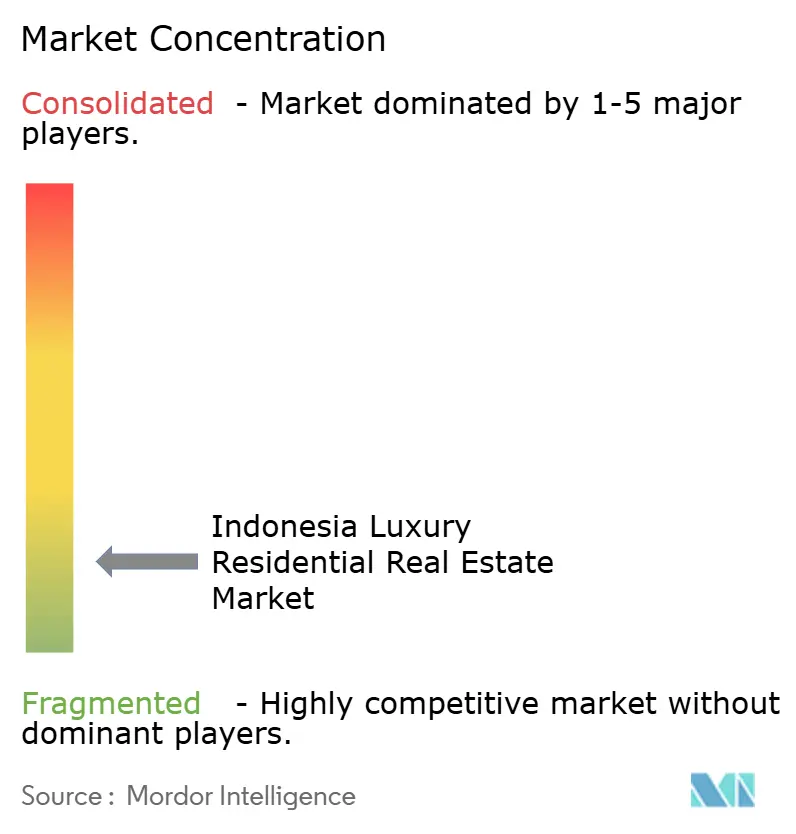
| Market Concentration | Low |
Major Players *Disclaimer: Major Players sorted in no particular order Image © Mordor Intelligence. Reuse requires attribution under CC BY 4.0. | |
Indonesia Luxury Residential Real Estate Market Analysis by Mordor Intelligence
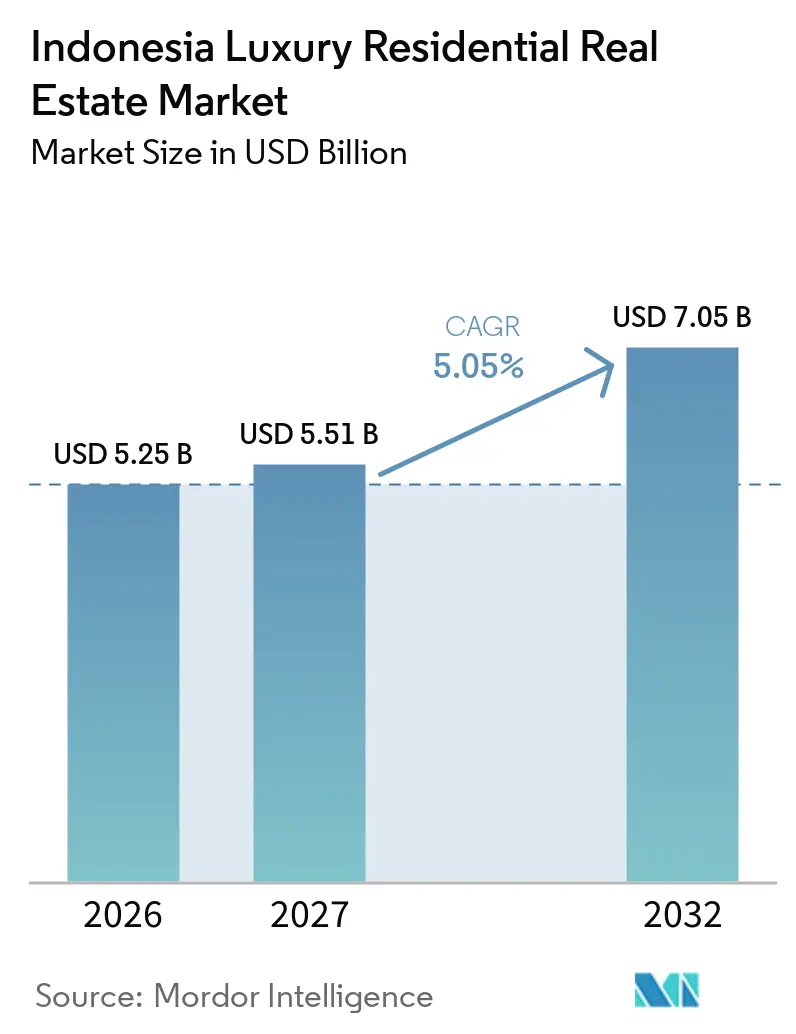
The Indonesia Luxury Residential Real Estate Market size is projected to be USD 5.25 billion in 2026, USD 5.51 billion in 2027, and reach USD 7.05 billion by 2032, growing at a CAGR of 5.05% from 2027 to 2032.
The Indonesia luxury residential real estate market is supported by demand for larger homes, professionally managed residences, and premium resort properties. New supply is increasingly concentrated in established Jakarta townships and Bali resort locations, where developers can combine infrastructure, services, and controlled design standards. Branded residences, smart-home features, and wellness-oriented layouts are becoming important ways to compete for buyers who expect stronger property management and clearer delivery standards. Foreign ownership rules, softer luxury condominium absorption in Jakarta, and pressure on Bali villa supply continue to limit growth in selected locations. The Indonesia luxury residential real estate market also has scope to benefit from new road links, development around the national capital project, and demand from domestic buyers using property as a long-term store of value.
Key Report Takeaways
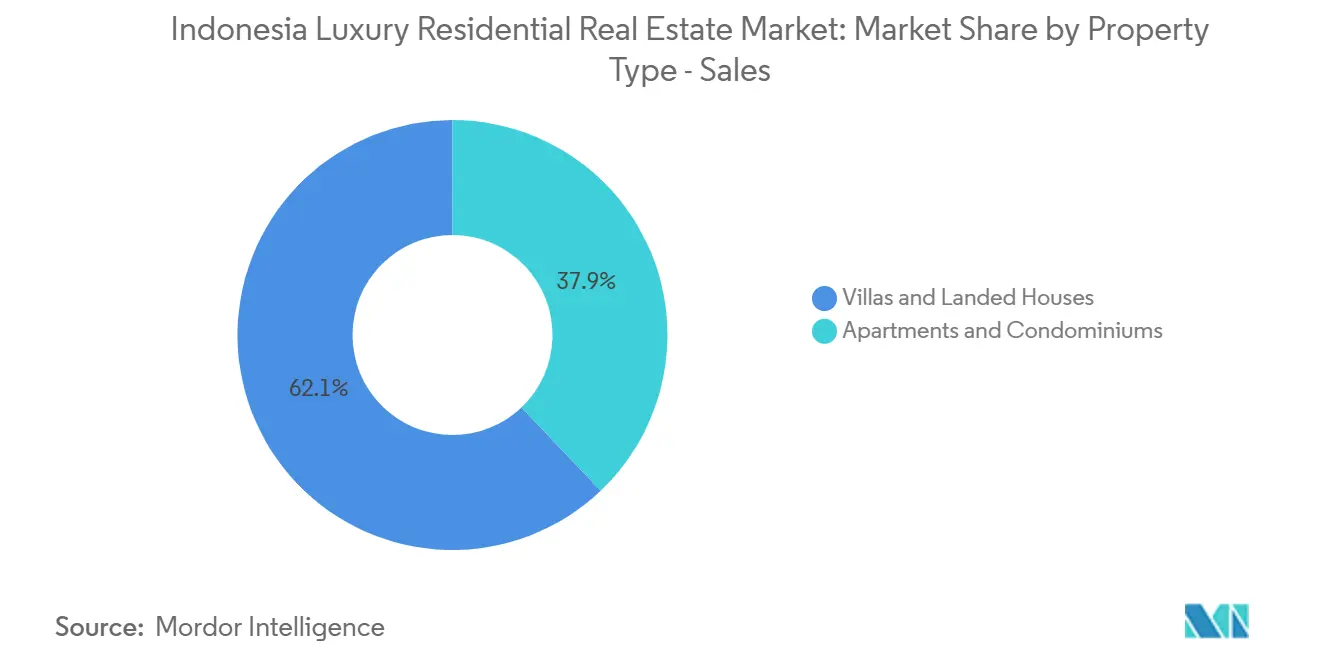
- By property type in sales, villas and landed houses held 62.1% of the Indonesia luxury residential real estate market share in 2026, while apartments and condominiums are projected to grow at a 5.84% CAGR through 2032.
- By mode of sale, secondary existing-home resale held 57.4% of the Indonesia luxury residential real estate market share in 2026, while primary new-build is projected to grow at a 5.90% CAGR through 2032.
- By key region, Java accounted for 43.1% of the Indonesia luxury residential real estate market size in 2026, while the rest of Indonesia is projected to grow at a 5.95% CAGR through 2032.
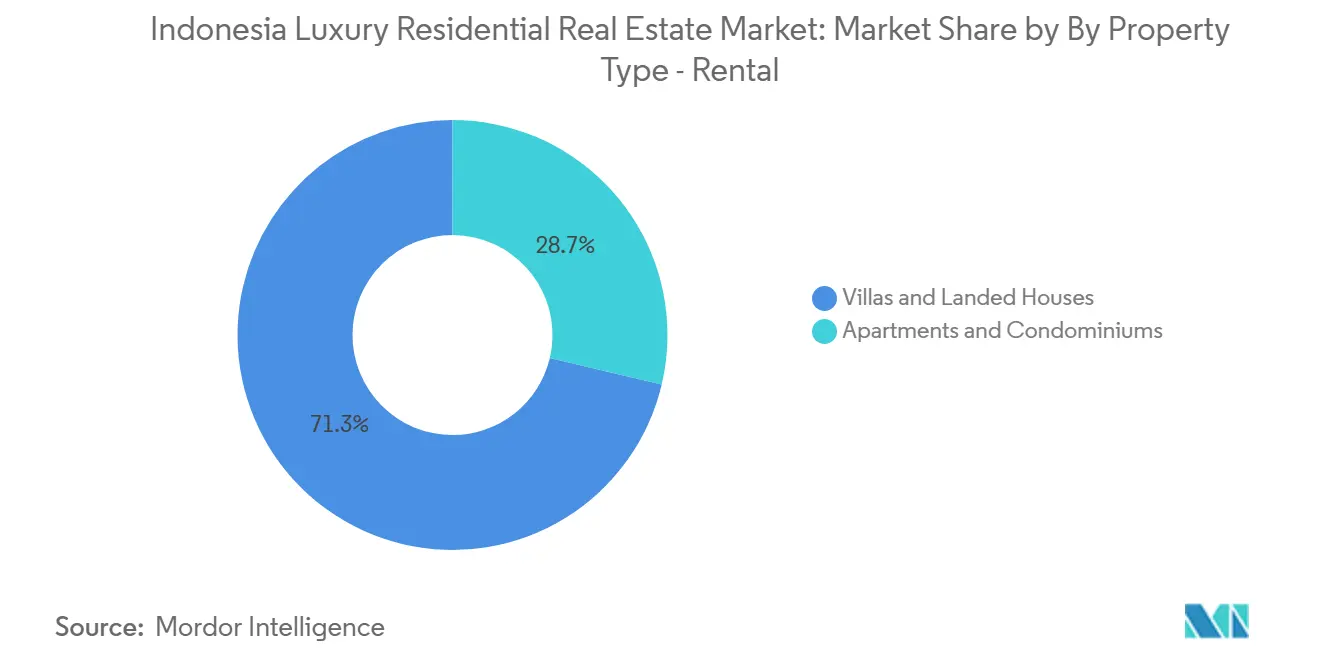
- By property type in rentals, villas and landed houses held 71.3% of the Indonesia luxury residential real estate market share in 2026, while apartments and condominiums are projected to grow at a 6.01% CAGR through 2032.
Note: Market numbers in this report are based on Mordor Intelligence's proprietary estimation framework, which combines nine months of actuals with Q4 projections for base year 2026.
Market Trends and Insights
Drivers Impact Analysis of Indonesia Luxury Residential Real Estate Market*
| Drivers | (~) % Impact on CAGR Forecast | Geographic Relevance | Impact Timeline |
|---|---|---|---|
| Domestic high-net-worth wealth expansion | +1.4% | Jakarta, Bali, and Surabaya | Medium term (2-4 years) |
| Bali tourism supports vacation-home demand | +1.0% | Bali, Flores, and Labuan Bajo | Short term (≤ 2 years) |
| Adoption of internationally branded residences | +0.8% | Jakarta, Bali, and Flores | Medium term (2-4 years) |
| Integrated townships expand upscale landed supply | +0.7% | Greater Jakarta | Medium term (2-4 years) |
| Preference for low-density living | +0.5% | Jakarta suburban ring and Bali | Long term (≥ 4 years) |
| Better transport connectivity | +0.5% | East Kalimantan, Bali-Lombok, and Java | Long term (≥ 4 years) |
| Source: Mordor Intelligence | |||
Domestic High-Net-Worth Wealth Expansion Redefines the Luxury Buyer Profile
The Indonesia luxury residential real estate market is benefiting from new domestic wealth created in nickel processing and digital financial services. These buyers are often younger and more familiar with premium housing in regional cities. Their expectations are raising demand for private lift access, connected home systems, concierge services, and detailed finishing standards. Two Sudirman Private Residences demonstrated the appeal of high-end urban homes when its units attracted buyers seeking an international standard of residential service. This shift gives established developers an advantage when they can offer reliable construction, established communities, and consistent service after handover. It also widens the opportunity for projects that pair locally relevant design with professional management.
Bali Tourism Economy Generates Recurring Villa Investment Demand
The Indonesia luxury residential real estate market continues to draw villa demand from Bali’s role as a tourism and second-home destination. Vacation-home investors assess rental prospects, location quality, and the ability of an operator to manage bookings and maintenance. Licensed and professionally managed villas can stand apart from informal short-stay properties because they provide clearer operating standards. This distinction favors master-planned projects in Nusa Dua, Uluwatu, Seminyak, and other locations with established tourism services. Planned transport improvements between Bali and Lombok can broaden the appeal of connected resort destinations over time. The resulting demand supports investment in properties that can serve both as private residences and managed accommodation.
Internationally Branded Residences Attract Service-Focused Buyers
The Indonesia luxury residential real estate market is seeing greater interest in residences linked to established hotel brands. Buyers value the operating procedures, staff training, and property management associated with hospitality operators. Mandarin Oriental, Aman, and Dusit have active Indonesian development plans that support the visibility of this model. The planned Mandarin Oriental Bali Residences combine private villas with a resort setting, which gives buyers access to hospitality services and a professionally managed environment. Branded projects can also strengthen confidence in handover quality and ongoing maintenance. This approach is particularly relevant where buyers place a premium on clear standards rather than simply the size of a home.
Integrated Townships Expand Upscale Landed Housing Supply
Integrated townships across Greater Jakarta are supporting the Indonesia luxury residential real estate market. These communities bring housing, retail, schools, health services, and local transport into one planned setting. Sinar Mas Land and Sumitomo Forestry began the Kota Wisata Ecovia township through their PT Kurnia Sinergi Mas joint venture in 2025. The 156.5-hectare project is planned for 4,100 homes and carries USD 909 million of investment through 2041[1]. Larger land banks allow developers to release premium clusters in stages and maintain neighborhood quality. This model responds to demand for more space while keeping residents connected to Jakarta’s employment areas.
Restraints Impact Analysis of Indonesia Luxury Residential Real Estate Market*
| Restraints | (~) % Impact on CAGR Forecast | Geographic Relevance | Impact Timeline |
|---|---|---|---|
| Foreign ownership and land-tenure restrictions | -0.8% | Jakarta and Bali | Long term (≥ 4 years) |
| Weak luxury condominium absorption | -0.6% | Greater Jakarta | Short term (≤ 2 years) |
| Rising Bali luxury villa inventory | -0.5% | Canggu, Pererenan, and Uluwatu | Short term (≤ 2 years) |
| Limited resort water and utility infrastructure | -0.4% | Flores, Labuan Bajo, and Raja Ampat | Medium term (2-4 years) |
| Source: Mordor Intelligence | |||
Foreign Ownership Restrictions Create a Ceiling on International Demand
Foreign ownership rules remain a structural restraint for the Indonesia luxury residential real estate market. Indonesia’s land framework limits the forms of tenure that foreign nationals can hold, making transactions more complex than in some regional alternatives. The rules cover Right-to-Use tenure and designated areas for apartment ownership[2]. This framework is especially relevant to Bali villas, where international interest is substantial, and leasehold structures are common. Legal complexity can add cost and reduce buyer confidence in resale outcomes. Developers therefore need to explain tenure, compliance, and operating arrangements clearly to prospective buyers.
Weak Jakarta Luxury Condominium Absorption Limits New Launches
The Indonesia luxury residential real estate market faces a difficult environment for new luxury condominium launches in Greater Jakarta. Buyers have increasingly favored completed homes because they can inspect the product and move in without a construction wait. Developers may defer projects when existing luxury stock needs more time to sell through. This behavior concentrates attention on rare locations with limited competing supply, including established South Jakarta neighborhoods. Savyavasa illustrates that a well-located project can still perform when it provides a differentiated product and credible delivery. Its developer reported USD 220 million in sales revenue and transactions covering 60% of the sellable area as residents began receiving units in 2026[3].
*Our forecasts treat driver/restraint impacts as directional, not additive. The impact forecasts reflect baseline growth, mix effects, and variable interactions.
Indonesia Luxury Residential Real Estate Market Segment Analysis
By Property Type, Sales:
Villas and Landed Houses Lead While Apartments and Condominiums Gain MomentumVillas and landed houses held 62.1% of the Indonesia luxury residential real estate market share in sales during 2026. The category reflects a preference for private outdoor space, lower-density living, and clearer control over a property. Greater Jakarta townships provide a major channel for this demand because they offer security, road access, retail, schools, and recreational amenities. Premium buyers also value the ability to customize larger homes within planned communities. Developers with long-established landbanks can maintain a pipeline of new clusters without relying on isolated plots. This gives them a practical advantage in the Indonesia luxury residential real estate industry, where location and neighborhood execution affect buyer confidence.
Apartments and condominiums are the fastest-growing sales type, with a projected 5.84% CAGR through 2032. Demand is concentrated in scarce urban locations where buyers want proximity to business districts, retail, and professional services. Branded and serviced models can strengthen their appeal by providing formal management and hospitality-linked amenities. Ready-to-occupy homes are likely to retain an advantage while buyers remain cautious about off-plan delivery. Future supply can perform when developers differentiate on location, design quality, and management rather than adding standard high-rise inventory. The Indonesia luxury residential real estate market therefore has room for selective urban condominium projects despite softer broad-based absorption.

By Mode of Sale:
Secondary Existing-Home Resale Leads While Primary New-Build Supply AdvancesSecondary existing-home resale accounted for 57.4% of the Indonesia luxury residential real estate market share in 2026. Completed homes give buyers visible quality, immediate occupancy, and a clearer view of the surrounding neighborhood. This preference has become more important for high-value purchases after earlier delivery delays made some buyers more cautious. Established districts such as Dharmawangsa, Kemang, and other South Jakarta locations can benefit where ready premium stock is limited. Resale transactions also support price discovery because buyers can compare completed properties directly. These conditions keep the existing-home segment central to the Indonesia luxury residential real estate industry.
Primary new-build is the fastest-growing mode of sale and is forecast to record a 5.90% CAGR through 2032. New projects can compete when they combine a strong site, recognized design quality, and credible delivery arrangements. Township launches remain relevant because buyers can see the broader community and services being developed around their homes. Partnerships with international developers or hotel operators can further address concerns about construction quality and post-handover management. Savyavasa shows that a distinctive project can achieve substantial sales even in a cautious urban condominium environment. The Indonesia luxury residential real estate market will likely favor new supply that is limited, well-serviced, and tailored to proven buyer needs.
By Property Type, Rental:
Villas and Landed Houses Lead While Apartments and Condominiums GrowVillas and landed houses held 71.3% of the Indonesia luxury residential real estate market share in rentals during 2026. Bali’s villa economy and Jakarta’s expatriate rental corridors both support this leading position. Tenants choose landed homes for privacy, family space, and access to established residential neighborhoods. Owners increasingly rely on specialized management to handle reservations, upkeep, and guest experience in resort locations. The distinction between licensed operations and informal short-term rentals is becoming more important to investment decisions. This supports professionally managed homes in the Indonesia luxury residential real estate market.
Apartments and condominiums are forecast to be the fastest-growing rental type, with a 6.01% CAGR through 2032. Corporate expatriates and domestic executives support demand for centrally located homes with services and predictable maintenance. Hotel-managed residences can serve tenants who need longer stays but still expect hospitality-level support. Swissôtel Living Jakarta Mega Kuningan opened in 2025 as the first Swissôtel Living property in Southeast Asia, setting a service benchmark for this format. The segment may grow fastest where projects have a clear operator, convenient business-district access, and a well-defined target tenant. The Indonesia luxury residential real estate market can use these formats to build rental income beyond the traditional villa model.
Geography Analysis
Java held 43.1% of Indonesia's luxury residential real estate market share in 2026. Greater Jakarta is the leading center for premium residential demand because it combines corporate activity, affluent households, and large master-planned communities. South Jakarta has scarce high-end residential sites that make location quality especially valuable. Tangerang and Bekasi widen the pool of landed housing choices for buyers seeking more space. Major developers can link new clusters to retail, education, healthcare, and established road networks. This integrated approach makes township development a continuing source of supply in Java.
The rest of Indonesia is projected to grow at a 5.95% CAGR through 2032. Bali is the main driver because it combines tourism demand with a well-developed villa ownership and rental ecosystem. The Bukit Peninsula, including Uluwatu, Nusa Dua, and Jimbaran, remains important for higher-value resort homes. OXO Group Indonesia sold 21 of 24 wellness villas at the June 2025 launch of OXO The Pavilions in Nuanu Creative City. Flores and Labuan Bajo are beginning to attract institutional attention through branded resort-residential proposals. Their growth will depend on utilities, site access, environmental compliance, and reliable local services.
Sumatra has a smaller but developing premium residential base in Medan and Batam. Batam’s investment framework can draw interest from buyers linked to Singapore, although tenure requirements still need careful assessment. East Kalimantan has early-stage potential connected to the national capital project and new road infrastructure. Sulawesi adds longer-term demand through Makassar and other urban centers with expanding higher-income populations. The Indonesia luxury residential real estate market should not treat these areas as a single opportunity because their buyer profiles and infrastructure needs differ. Developers that pace new supply carefully can reduce the risk of limited liquidity in emerging locations.
Competitive Landscape
The Indonesia luxury residential real estate market is fragmented, with competition spread across national developers, regional players, boutique residential specialists, and joint ventures. Sinar Mas Land, Ciputra Development Tbk, Summarecon Agung Tbk, and Pakuwon Jati Tbk compete through their land banks, brand recognition, and integrated development capabilities. Smaller developers and resort specialists differentiate themselves through distinctive designs, personalized services, and access to niche locations. Competitive positioning varies across urban luxury housing, integrated townships, and resort properties, with local market knowledge and project execution playing important roles. The fragmented structure creates opportunities for developers that can tailor their offerings to specific buyer preferences and locations.
Partnerships and joint ventures allow developers to combine local market expertise with international design and development capabilities. Sinar Mas Land and Sumitomo Forestry established a joint venture for Kota Wisata Ecovia, a township planned for 4,100 homes across 156.5 hectares. In July 2026, Agung Podomoro Land Tbk expanded its partnership with Hankyu Hanshin Properties Corp. for Bukit Podomoro Jakarta. These collaborations provide access to development expertise and differentiated residential concepts. International hospitality brands also influence service expectations in urban and resort projects, while environmental compliance and coastal permitting remain important considerations for developers targeting tourism-linked locations.
Fragmented competition also creates opportunities for specialized developers in emerging luxury resort destinations beyond Bali’s established villa markets. Flores, Raja Ampat, and Lombok may attract investment as tourism infrastructure and local utilities improve. OXO Group Indonesia differentiates its offering at Nuanu through wellness-oriented design and automated property-management features. International hospitality partnerships can expand premium residential services, but project performance depends on location, delivery quality, and ongoing operations. Developers must also demonstrate responsible site management and comply with environmental requirements, particularly in ecologically sensitive coastal destinations.
Indonesia Luxury Residential Real Estate Industry Leaders
-
Agung Podomoro Land Tbk
-
Sinar Mas Land
-
Ciputra Development Tbk
-
Pakuwon Jati Tbk
-
PT Lippo Karawaci Tbk
- *Disclaimer: Major Players sorted in no particular order
Indonesia Luxury Residential Real Estate Market Companies Covered in this Report
- Agung Podomoro Land Tbk
- Sinar Mas Land
- Ciputra Development Tbk
- Pakuwon Jati Tbk
- PT Lippo Karawaci Tbk
- Summarecon Agung Tbk
- Paramount Land
- Agung Sedayu Group
- Intiland Development Tbk
- PT Alam Sutera Realty Tbk
- Duta Anggada Realty Tbk
- PP Properti Tbk
- PT Jababeka Tbk
- Wijaya Karya Realty
- Metropolitan Land Tbk
- MNC Land Tbk
- Tokyu Land Indonesia
- PT HK Realtindo
- Oxo Group Indonesia
- JSI Group
- Swire Properties
Recent Industry Developments in Indonesia Luxury Residential Real Estate Market
- July 2026: PT Agung Podomoro Land Tbk formalized an expanded strategic partnership with Japan’s Hankyu Hanshin Properties Corp. on July 17, 2026, for the development of Bukit Podomoro Jakarta. The 9.6-hectare integrated residential precinct comprises 317 landed houses and 115 commercial shophouses. The project uses cross-border partnerships to bring additional planning, development, and long-term delivery capacity to a Jakarta residential community.
- May 2026: Savyavasa, jointly developed by Swire Properties and PT Jakarta Setiabudi Internasional Tbk, commenced resident handover at its Dharmawangsa development in South Jakarta. The 402-apartment project has a 2.8-hectare site and reported USD 220 million in total sales revenue. Tower 1 was fully sold, and 60% of the total sellable area was transacted as the handover began. The development shows the continuing importance of scarce urban sites, completed product, and international-grade management in Jakarta’s luxury housing segment.
- April 2026: PT Perintis Triniti Properti Tbk signed a Memorandum of Understanding to acquire a majority stake in Prime Land on April 8, 2026. The proposed transaction targets expansion into Indonesia’s hospitality real estate sector and is intended to support a more stable recurring-income portfolio. It also shows how a residential developer can seek income from operational properties alongside project sales. The planned move aligns with growing interest in hospitality-linked residential and resort assets.
Indonesia Luxury Residential Real Estate Market Report Scope
Segmentation Overview
| Apartments and Condominiums |
| Villas and Landed Houses |
| By Property Type | Apartments and Condominiums |
| Villas and Landed Houses |
Key Questions Answered in the Report
What is the forecast growth rate for Indonesia luxury residential real estate?
The Indonesia luxury residential real estate market is projected to grow at a 5.05% CAGR from 2027 to 2032 and reach USD 7.05 billion. Growth is shaped by demand for premium landed homes, resort villas, professionally managed urban residences, and projects with clear delivery standards.
Which property type leads luxury residential sales in Indonesia?
Villas and landed houses lead sales with a 62.1% share in 2026. Buyers favor private space, lower-density living, and planned communities with retail, schools, security, road access, and established neighborhood services.
Which sales channel is growing fastest in Indonesia luxury residential real estate?
Primary new-build is projected to grow at a 5.90% CAGR through 2032, while completed resale homes remain the larger sales channel. New projects perform best when delivery credibility, location scarcity, design quality, and management services are clear.
Why is Bali important for high-end residential demand?
Bali combines vacation-home use, tourism, and managed villa rentals. Branded and professionally operated projects can address buyer needs for service, compliance, maintenance, rental support, and a more reliable guest experience.
What limits foreign investment in Indonesian luxury homes?
Foreign buyers face land-tenure and ownership rules that can require leasehold or other permitted structures. This adds legal complexity and requires developers to explain ownership, permitted use, resale considerations, and operating arrangements carefully.
Which rental format is expected to grow fastest?
Apartments and condominiums are forecast to be the fastest-growing rental type, with a 6.01% CAGR through 2032. Serviced and hotel-managed formats appeal to executives and expatriates who need convenient locations, predictable property management, maintenance support, and flexible longer stays across Jakarta’s key business districts and premium residential neighborhoods for tenants.