Indonesia Concrete Admixtures Market Size and Share
Market Overview
| Study Period | 2020 - 2031 |
|---|---|
| Forecast Data Period | 2026 - 2031 |
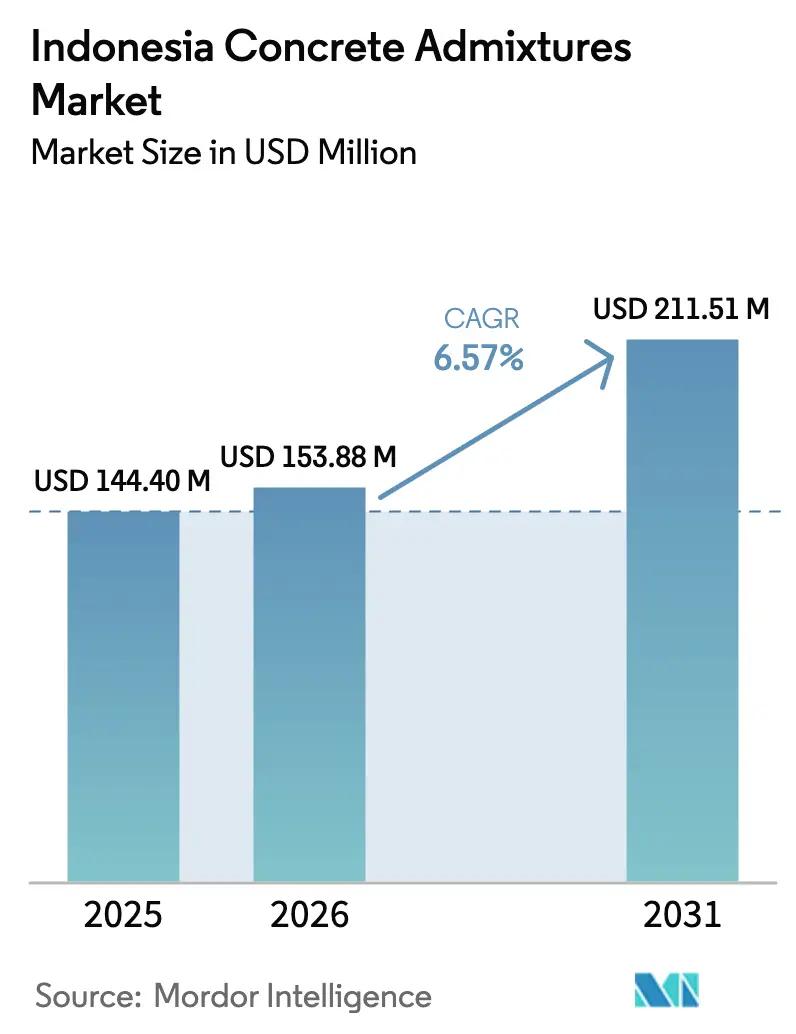
| Base Year Market Size (2025) | USD 144.40 Million |
| Market Size (2026) | USD 153.88 Million |
| Market Size (2031) | USD 211.51 Million |
| Growth Rate (2026 - 2031) | 6.57 % |
| Market Concentration | High |
Major Players *Disclaimer: Major Players sorted in no particular order Image © Mordor Intelligence. Reuse requires attribution under CC BY 4.0. | |
Indonesia Concrete Admixtures Market Analysis by Mordor Intelligence
The Indonesia Concrete Admixtures Market size was valued at USD 144.40 million in 2025 and estimated to grow from USD 153.88 million in 2026 to reach USD 211.51 million by 2031, at a CAGR of 6.57% during the forecast period (2026-2031). Rising public spending on National Strategic Projects, the relocation of the national capital to Nusantara, and a private-sector housing boom collectively underpin demand for higher-performance admixtures that improve workability, durability, and environmental performance. Government procurement rules that privilege SIH-certified and eco-labeled inputs, the rollout of carbon-injected concrete, and rapid precast adoption along the Java–Sumatra corridor are accelerating market premiumization. At the same time, imported polycarboxylate ether polymers, currency volatility, and competition from informal producers add margin pressure and encourage product localization. Players able to combine local manufacturing with technical service and low-carbon innovation are best placed to capture share as project pipelines lengthen.
Key Report Takeaways
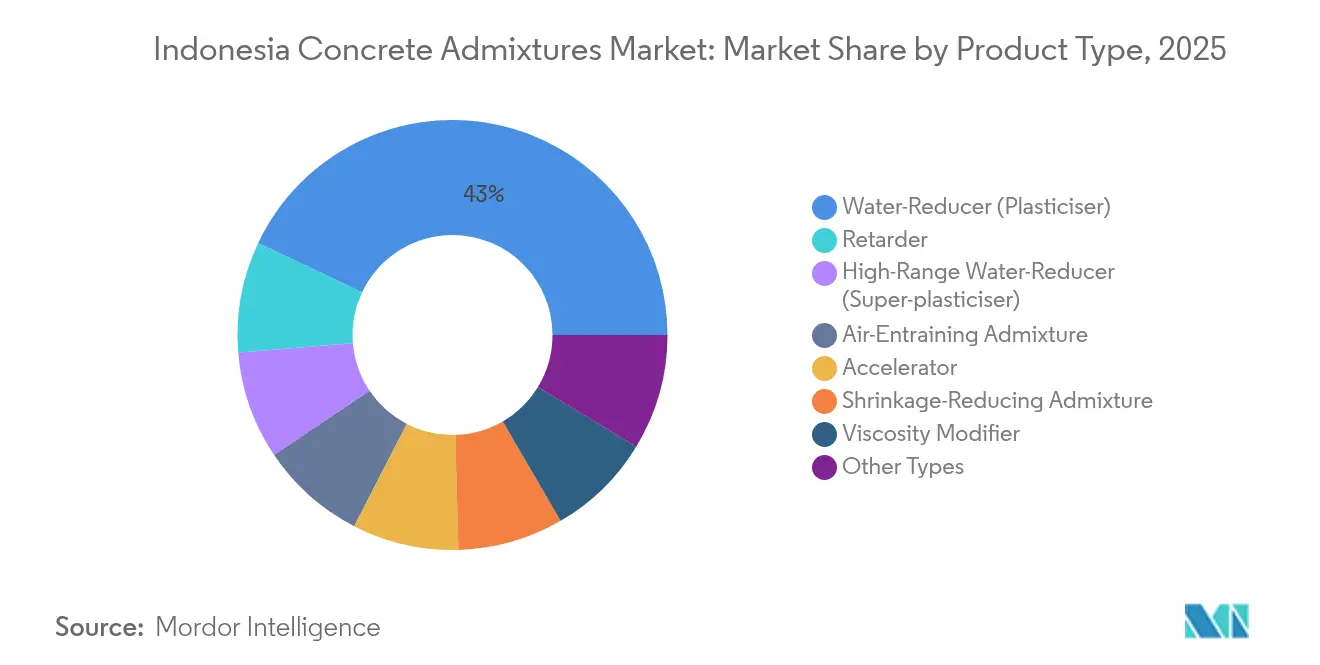
- By product type, water-reducer (plasticiser) led with 42.96% of the Indonesia concrete admixtures market share in 2025, while retarders recorded the fastest projected growth at 7.18% CAGR through 2031.
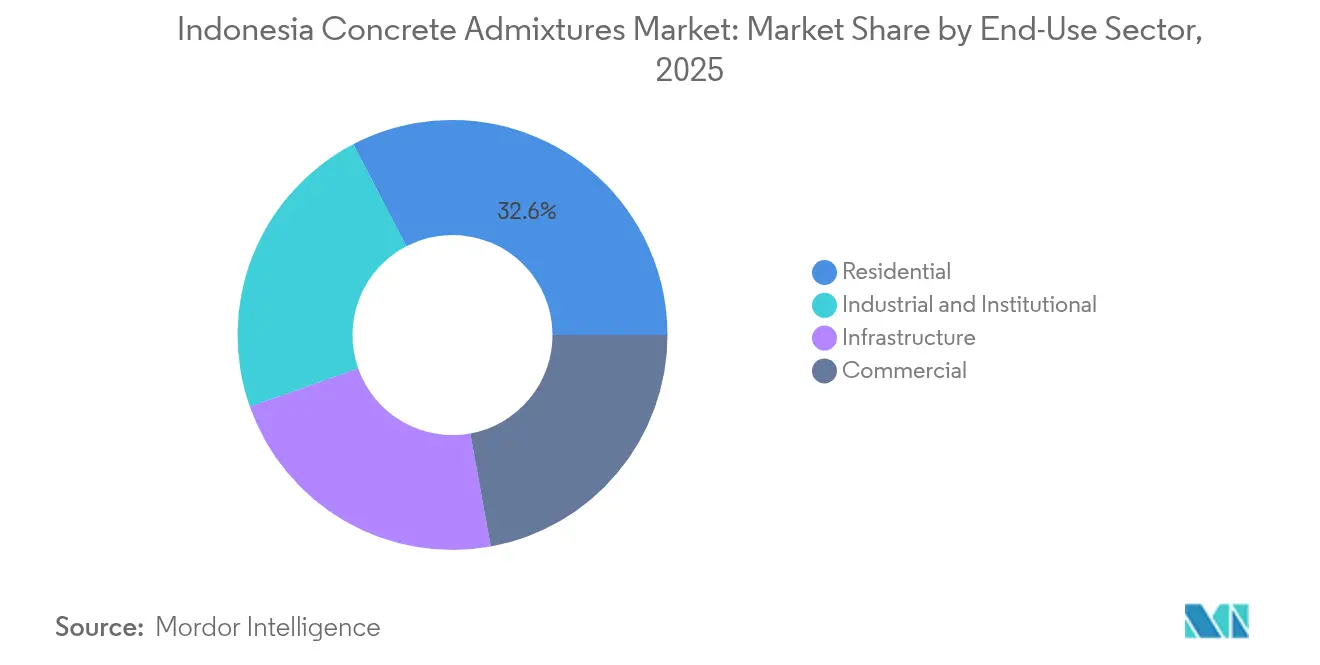
- By end-use sector, residential construction accounted for 32.64% of the Indonesia concrete admixtures market size in 2025; industrial and institutional applications are projected to grow the quickest at 6.93% CAGR to 2031.
Note: Market size and forecast figures in this report are generated using Mordor Intelligence’s proprietary estimation framework, updated with the latest available data and insights as of 2026.
Indonesia Concrete Admixtures Market Trends and Insights
Drivers Impact Analysis*
| Driver | (~) % Impact on CAGR Forecast | Geographic Relevance | Impact Timeline |
|---|---|---|---|
| Government-backed megaproject pipeline | +1.80% | National; Java–Sumatra–Kalimantan hubs | Medium term (2-4 years) |
| Rapid urbanization and private housing boom | +1.50% | Jakarta, Surabaya, Medan | Short term (≤ 2 years) |
| Shift toward high-performance, climate-resilient concrete | +1.20% | Coastal and flood-prone regions | Long term (≥ 4 years) |
| Precast capacity expansion along Java–Sumatra | +0.90% | Java–Sumatra corridor, spillover to Kalimantan | Medium term (2-4 years) |
| Favorable green-procurement policies | +0.70% | National via SIH-certification | Long term (≥ 4 years) |
| Source: Mordor Intelligence | |||
Government-Backed Megaproject Pipeline
Indonesia’s USD 350 billion public-works agenda, anchored by the new capital city of Nusantara, is reshaping demand toward high-range water reducers, shrinkage-reducing agents, and corrosion inhibitors able to perform in humid, tropical environments. Financing commitments of IDR 671.17 trillion by PT Sarana Multi Infrastruktur underscore sustained public-sector appetite for sophisticated materials that conform to international standards. Companies with proven track records on large-scale projects are quickest to win specifications as design consultants gravitate toward established formulations.
Rapid Urbanization and Private Housing Boom
The One Million Houses program and surging private condominium development demand cost-effective plasticizers that shorten project cycles without sacrificing compressive strength. Urban high-rise builders are adopting accelerators for rapid floor-to-floor progression and viscosity modifiers for pumped mixes, while precast wall panels create additional pull for slump-retention admixtures.
Shift Toward High-Performance Concrete for Climate Resilience
Indonesia’s Net Zero 2060 roadmap, combined with frequent coastal flooding, is steering specifications toward multifunctional admixtures that cut embodied carbon and extend asset life. Carbon-injected concrete tested by Beton Merah Putih reports 2-3% strength gains alongside 240-tonne CO2 savings per project, signaling commercial viability of carbonation technologies. The same sustainability focus is encouraging greater fly-ash and slag substitution, hence stronger demand for compatibility-enhancing water reducers.
Favorable Government Policies
Green public-procurement rules now mandate life-cycle emission reporting and SIH certification for state projects, effectively rewarding suppliers whose admixtures enable cement reduction, recycled inputs, or lower water-cement ratios[1].
Restraints Impact Analysis*
| Restraint | (~) % Impact on CAGR Forecast | Geographic Relevance | Impact Timeline |
|---|---|---|---|
| Volatile prices of key chemical feedstocks | -1.10% | Nationwide; import-dependent regions | Short term (≤ 2 years) |
| Intense price competition from informal suppliers | -0.80% | Residential and small commercial segments | Medium term (2-4 years) |
| Import dependence on polycarboxylate ether (PCE) polymers | -0.90% | National, with acute impact on high-performance concrete applications and precast operations | Medium term (2-4 years) |
| Source: Mordor Intelligence | |||
Volatile Prices of Key Chemical Feedstocks
Polycarboxylate ether costs can swing 15–25% quarter-to-quarter, squeezing margins for smaller firms lacking hedging or long-term contracts. Because most specialty inputs are dollar-priced, rupiah depreciation amplifies volatility. Larger players are exploring backward integration or alternative chemistries that use locally available raw materials to buffer risk.
Intense Price Competition from Informal/Local Producers
Unregistered mixers can undercut branded suppliers by 20–30% in basic water-reducer categories, eroding value growth even as volume rises. Quality-control enforcement, ISO certification requirements, and eco-label obligations are expected to filter out low-compliance entrants over time, yet price pressure remains a near-to-mid-term drag on premium adoption.
*Our forecasts treat driver/restraint impacts as directional, not additive. The impact forecasts reflect baseline growth, mix effects, and variable interactions.
Segment Analysis
By Product Type: Plasticizers Anchor Demand While Retarders Accelerate Growth
Water-reducer (plasticiser) accounted for 42.96% of the Indonesia concrete admixtures market share in 2025, highlighting its central role in mitigating water–cement ratios across virtually every jobsite. Contractors prize the segment’s cost-to-benefit profile, especially in mass-housing and routine infrastructure works where budgets are tight yet strength parameters are non-negotiable. High-range water reducers sit at the premium end, capturing complex high-rise and precast orders that require elevated early-age strengths. Meanwhile, retarders are projected to post a 7.18% CAGR through 2031 as ready-mix penetration rises and logistics windows lengthen between batch plants and urban placements. Air-entraining, shrinkage-reducing, and viscosity-modifying admixtures remain niche but essential for climate-resilient structures and factory casting lines, and they stand to benefit from tightening durability codes.
Retarders’ momentum is amplified by the surge in nighttime concrete pours intended to reduce daytime traffic congestion across Jakarta and Surabaya; extended set times ensure on-site consistency despite temperature swings. In parallel, innovation trajectories point toward multi-functional blends that couple retardation with corrosion inhibition or carbonation capacity, reflecting a broadening customer preference for single-skid solutions that simplify dosing. Regulatory favor for SIH-certified products is nudging specifiers toward branded, quality-assured formulations, presenting opportunities for suppliers to upsell on performance and sustainability credentials.

By End-Use Sector: Industrial Builds Gain Pace as Residential Retains Volume Leadership
Residential work generated 32.64% of 2025 revenue, underpinned by continuous government support for affordable housing and vertical living in dense urban cores. Bulk consumption patterns skew toward economical plasticizers and accelerators, though high-rise towers increasingly demand higher-grade super-plasticisers for pumpability across 40-plus floors. Industrial and institutional projects, from data centers to university campuses, are forecast to grow the quickest at 6.93% CAGR, leveraging foreign direct investment and government industrial-park incentives. These builds specify stricter durability, shrinkage, and early-strength targets, fueling uptake of mid-range and premium admixtures.
Commercial malls and offices contribute a steady order book, yet infrastructure holds the highest technical bar. Bridges, ports, and rail upgrades call for complex admixture cocktails that manage heat of hydration, chloride penetration, and extended service life. Suppliers that couple field-based technical service with digital concrete-monitoring tools are cultivating sticky relationships with contractors who prize on-time, on-budget delivery. Diversified application exposure mitigates cyclical risk, positioning vendors with multi-sector portfolios to weather slowdowns in any single category.
Geography Analysis
The Indonesia concrete admixtures market is heavily skewed toward the Java-Sumatra corridor, which absorbs roughly 65% of annual construction spend while representing one-quarter of national landmass. Concentrated economic activity in Jakarta, Surabaya, and Medan yields dense clusters of ready-mix plants, precast yards, and high-rise contractors that collectively consume the bulk of plasticizers, retarders, and high-range water reducers. Proximity to major import ports also reduces logistics overhead for specialty ingredients, giving Western Java suppliers a cost advantage. However, the rise of Nusantara in East Kalimantan is re-routing capital-project flows toward Borneo, creating fresh demand hot-spots where suppliers equipped with mobile batching support and tropical-climate formulations can secure early mover footholds.
Kalimantan’s soft soils and heavy rainfall necessitate admixtures that boost cohesion, manage bleed water, and resist sulfate attack, spurring interest in viscosity modifiers and shrinkage reducers. Further east, infrastructure catch-up in Papua and Maluku is opening previously untapped markets, though high freight costs favor locally blended, entry-level admixtures unless project owners prioritize durability. Coastal job-sites nationwide face chloride-rich environments; hence corrosion-inhibiting blends are gaining traction, particularly for ports and sea-walls that underpin Indonesia’s maritime connectivity plan.
Supply-chain resilience is an emerging strategic concern. Import bottlenecks for PCE, coupled with currency swings, can ripple quickly through Java-centric distribution webs. Firms exploring domestic PCE production or alternative chemistries derived from abundant volcanic ash seek to hedge these vulnerabilities. Regional green-procurement policies further complicate demand patterns. Provinces that aggressively enforce SIH and eco-label requirements effectively channel orders toward audited suppliers, driving a gradual consolidation away from small-scale mixers unable to meet documentation thresholds.
Competitive Landscape
The Indonesia concrete admixtures market is consolidated. Sika, MAPEI, and Saint-Gobain leverage global R&D, branded portfolios, and ISO-certified plants to dominate high-spec segments such as high-rise verticals and climate-resilient infrastructure. Sika’s Bekasi capacity doubling in August 2024 underscores its long-run commitment to local production and proximity service. Local champions like PT Kimia Konstruksi Indonesia and PT Grolen New Building Material Indonesia thrive in residential and smaller commercial niches where price sensitivity overrides performance nuance.
Technical service is a key battleground. Multinationals offer mix-design optimization, onsite slump testing, and IoT-enabled dosing systems that minimize waste and ensure batch-to-batch consistency. Some local players counter with agile customization, rapid delivery through dense distributor networks, and lower overheads that translate into 15-20% price discounts on commodity plasticizers. White-space opportunities center on locally adapted chemistries that incorporate volcanic ash or rice-husk ash, offering both cost and sustainability upside. Successful innovators can meet green-procurement rules while lowering import dependency.
Digitalization is rising across the value chain. Cloud-linked batching, mobile technical-support apps, and AI-based quality monitoring differentiate suppliers capable of integrating hardware and software into turnkey solutions. Regulatory tightening adds further barriers: ISO 9001/14001 compliance and SIH accreditation are increasingly prerequisites for bidding on public works, gradually pushing the market toward better-capitalized operators. Notwithstanding these trends, cottage-level mixers remain entrenched in peri-urban markets where enforcement is lax, reinforcing the need for branded suppliers to articulate clear value propositions beyond price.
Indonesia Concrete Admixtures Industry Leaders
-
MAPEI S.p.A.
-
Saint-Gobain
-
Sika AG
-
MUHU (China) Construction Materials Co., Ltd.
-
Kao Corporation
- *Disclaimer: Major Players sorted in no particular order

Recent Industry Developments
- February 2025: Saint-Gobain has acquired FOSROC, one of the leading global construction chemicals companies specializing in concrete admixtures, with a strong presence in India, the Middle East, and the Asia-Pacific. This acquisition strengthens Saint-Gobain's position in Indonesia's concrete admixtures market by expanding its product portfolio and regional footprint.
- August 2024: Sika announced the expansion of production capacity at its Bekasi plant, Indonesia's largest manufacturing facility. This expansion and improved distribution network position Sika to meet growing demand from infrastructure, residential, and commercial projects in the country.
Indonesia Concrete Admixtures Market Report Scope
Commercial, Industrial and Institutional, Infrastructure, Residential are covered as segments by End Use Sector. Accelerator, Air Entraining Admixture, High Range Water Reducer (Super Plasticizer), Retarder, Shrinkage Reducing Admixture, Viscosity Modifier, Water Reducer (Plasticizer) are covered as segments by Sub Product.| Accelerator |
| Air-Entraining Admixture |
| High-Range Water-Reducer (Super-plasticiser) |
| Retarder |
| Shrinkage-Reducing Admixture |
| Viscosity Modifier |
| Water-Reducer (Plasticiser) |
| Other Types |
| Commercial |
| Industrial and Institutional |
| Infrastructure |
| Residential |
| By Product Type | Accelerator |
| Air-Entraining Admixture | |
| High-Range Water-Reducer (Super-plasticiser) | |
| Retarder | |
| Shrinkage-Reducing Admixture | |
| Viscosity Modifier | |
| Water-Reducer (Plasticiser) | |
| Other Types | |
| By End-Use Sector | Commercial |
| Industrial and Institutional | |
| Infrastructure | |
| Residential |
Market Definition
- END-USE SECTOR - Concrete admixtures consumed in the construction sectors such as commercial, residential, industrial, institutional, and infrastructure are considered under the scope of the study.
- PRODUCT/APPLICATION - Under the scope of the study, the consumption of concrete admixture products such as water reducers (plasticizers), retarders, accelerators, air-entraining admixture, viscosity modifiers, shrinkage-reducing admixture, high-range water reducers (superplasticizers), and other types are considered.
| Keyword | Definition |
|---|---|
| Accelerator | Accelerators are admixtures used to fasten the setting time of concrete by increasing the initial rate and speeding up the chemical reaction between cement and the mixing water. These are used to harden and increase the strength of concrete quickly. |
| Acrylic | This synthetic resin is a derivative of acrylic acid. It forms a smooth surface and is mainly used for various indoor applications. The material can also be used for outdoor applications with a special formulation. |
| Adhesives | Adhesives are bonding agents used to join materials by gluing. Adhesives can be used in construction for many applications, such as carpet laying, ceramic tiles, countertop lamination, etc. |
| Air Entraining Admixture | Air-entraining admixtures are used to improve the performance and durability of concrete. Once added, they create uniformly distributed small air bubbles to impart enhanced properties to the fresh and hardened concrete. |
| Alkyd | Alkyds are used in solvent-based paints such as construction and automotive paints, traffic paints, flooring resins, protective coatings for concrete, etc. Alkyd resins are formed by the reaction of an oil (fatty acid), a polyunsaturated alcohol (Polyol), and a polyunsaturated acid or anhydride. |
| Anchors and Grouts | Anchors and grouts are construction chemicals that stabilize and improve the strength and durability of foundations and structures like buildings, bridges, dams, etc. |
| Cementitious Fixing | Cementitious fixing is a process in which a cement-based grout is pumped under pressure to fill forms, voids, and cracks. It can be used in several settings, including bridges, marine applications, dams, and rock anchors. |
| Commercial Construction | Commercial construction comprises new construction of warehouses, malls, shops, offices, hotels, restaurants, cinemas, theatres, etc. |
| Concrete Admixtures | Concrete admixtures comprise water reducers, air entrainers, retarders, accelerators, superplasticizers, etc., added to concrete before or during mixing to modify its properties. |
| Concrete Protective Coatings | To provide specific protection, such as anti-carbonation or chemical resistance, a film-forming protective coat can be applied on the surface. Depending on the applications, different resins like epoxy, polyurethane, and acrylic can be used for concrete protective coatings. |
| Curing Compounds | Curing compounds are used to cure the surface of concrete structures, including columns, beams, slabs, and others. These curing compounds keep the moisture inside the concrete to give maximum strength and durability. |
| Epoxy | Epoxy is known for its strong adhesive qualities, making it a versatile product in many industries. It resists heat and chemical applications, making it an ideal product for anyone needing a stronghold under pressure. It is widely used in adhesives, electrical and electronics, paints, etc. |
| Fiber Wrapping Systems | Fiber Wrapping Systems are a part of construction repair and rehabilitation chemicals. It involves the strengthening of existing structures by wrapping structural members like beams and columns with glass or carbon fiber sheets. |
| Flooring Resins | Flooring resins are synthetic materials applied to floors to enhance their appearance, increase their resistance to wear and tear or provide protection from chemicals, moisture, and stains. Depending on the desired properties and the specific application, flooring resins are available in distinct types, such as epoxy, polyurethane, and acrylic. |
| High-Range Water Reducer (Super Plasticizer) | High-range water reducers are a type of concrete admixture that provides enhanced and improved properties when added to concrete. These are also called superplasticizers and are used to decrease the water-to-cement ratio in concrete. |
| Hot Melt Adhesives | Hot-melt adhesives are thermoplastic bonding materials applied as melts that achieve a solid state and resultant strength on cooling. They are commonly used for packaging, coatings, sanitary products, and tapes. |
| Industrial and Institutional Construction | Industrial and institutional construction includes new construction of hospitals, schools, manufacturing units, energy and power plants, etc. |
| Infrastructure Construction | Infrastructure construction includes new construction of railways, roads, seaways, airports, bridges, highways, etc. |
| Injection Grouting | The process of injecting grout into open joints, cracks, voids, or honeycombs in concrete or masonry structural members is known as injection grouting. It offers several benefits, such as strengthening a structure and preventing water infiltration. |
| Liquid-Applied Waterproofing Membranes | Liquid-Applied membrane is a monolithic, fully bonded, liquid-based coating suitable for many waterproofing applications. The coating cures to form a rubber-like elastomeric waterproof membrane and may be applied over many substrates, including asphalt, bitumen, and concrete. |
| Micro-concrete Mortars | Micro-concrete mortar is made up of cement, water-based resin, additives, mineral pigments, and polymers and can be applied on both horizontal and vertical surfaces. It can be used to refurbish residential complexes, commercial spaces, etc. |
| Modified Mortars | Modified Mortars include Portland cement and sand along with latex/polymer additives. The additives increase adhesion, strength, and shock resistance while also reducing water absorption. |
| Mold Release Agents | Mold release agents are sprayed or coated on the surface of molds to prevent a substrate from bonding to a molding surface. Several types of mold release agents, including silicone, lubricant, wax, fluorocarbons, and others, are used based on the type of substrates, including metals, steel, wood, rubber, plastic, and others. |
| Polyaspartic | Polyaspartic is a subset of polyurea. Polyaspartic floor coatings are typically two-part systems that consist of a resin and a catalyst to ease the curing process. It offers high durability and can withstand harsh environments. |
| Polyurethane | Polyurethane is a plastic material that exists in various forms. It can be tailored to be either rigid or flexible and is the material of choice for a broad range of end-user applications, such as adhesives, coatings, building insulation, etc. |
| Reactive Adhesives | A reactive adhesive is made of monomers that react in the adhesive curing process and do not evaporate from the film during use. Instead, these volatile components become chemically incorporated into the adhesive. |
| Rebar Protectors | In concrete structures, rebar is one of the important components, and its deterioration due to corrosion is a major issue that affects the safety, durability, and life span of buildings and structures. For this reason, rebar protectors are used to protect against degrading effects, especially in infrastructure and industrial construction. |
| Repair and Rehabilitation Chemicals | Repair and Rehabilitation Chemicals include repair mortars, injection grouting materials, fiber wrapping systems, micro-concrete mortars, etc., used to repair and restore existing buildings and structures. |
| Residential Construction | Residential construction involves constructing new houses or spaces like condominiums, villas, and landed homes. |
| Resin Fixing | The process of using resins like epoxy and polyurethane for grouting applications is called resin fixing. Resin fixing offers several advantages, such as high compressive and tensile strength, negligible shrinkage, and greater chemical resistance compared to cementitious fixing. |
| Retarder | Retarders are admixtures used to slow down the setting time of concrete. These are usually added with a dosage rate of around 0.2% -0.6% by weight of cement. These admixtures slow down hydration or lower the rate at which water penetrates the cement particles by making concrete workable for a long time. |
| Sealants | A sealant is a viscous material that has little or no flow qualities, which causes it to remain on surfaces where they are applied. Sealants can also be thinner, enabling penetration to a certain substance through capillary action. |
| Sheet Waterproofing Membranes | Sheet membrane systems are reliable and durable thermoplastic waterproofing solutions that are used for waterproofing applications even in the most demanding below-ground structures, including those exposed to highly aggressive ground conditions and stress. |
| Shrinkage Reducing Admixture | Shrinkage-reducing admixtures are used to reduce concrete shrinkage, whether from drying or self-desiccation. |
| Silicone | Silicone is a polymer that contains silicon combined with carbon, hydrogen, oxygen, and, in some cases, other elements. It is an inert synthetic compound that comes in various forms, such as oil, rubber, and resin. Due to its heat-resistant properties, it finds applications in sealants, adhesives, lubricants, etc. |
| Solvent-borne Adhesives | Solvent-borne adhesives are mixtures of solvents and thermoplastic or slightly cross-linked polymers such as polychloroprene, polyurethane, acrylic, silicone, and natural and synthetic rubbers. |
| Surface Treatment Chemicals | Surface treatment chemicals are chemicals used to treat concrete surfaces, including roofs, vertical surfaces, and others. They act as curing compounds, demolding agents, rust removers, and others. They are cost-effective and can be used on roadways, pavements, parking lots, and others. |
| Viscosity Modifier | Viscosity Modifiers are concrete admixtures used to change various properties of admixtures, including viscosity, workability, cohesiveness, and others. These are usually added with a dosage of around 0.01% to 0.1% by weight of cement. |
| Water Reducer | Water reducers, also called plasticizers, are a type of admixture used to decrease the water-to-cement ratio in the concrete, thereby increasing the durability and strength of concrete. Various water reducers include refined lignosulfonates, gluconates, hydroxycarboxylic acids, sugar acids, and others. |
| Water-borne Adhesives | Water-borne adhesives use water as a carrier or diluting medium to disperse resin. They are set by allowing the water to evaporate or be absorbed by the substrate. These adhesives are compounded with water as a dilutant rather than a volatile organic solvent. |
| Waterproofing Chemicals | Waterproofing chemicals are designed to protect a surface from the perils of leakage. A waterproofing chemical is a protective coating or primer applied to a structure's roof, retaining walls, or basement. |
| Waterproofing Membranes | Waterproofing membranes are liquid-applied or self-adhering layers of water-tight materials that prevent water from penetrating or damaging a structure when applied to roofs, walls, foundations, basements, bathrooms, and other areas exposed to moisture or water. |
Research Methodology
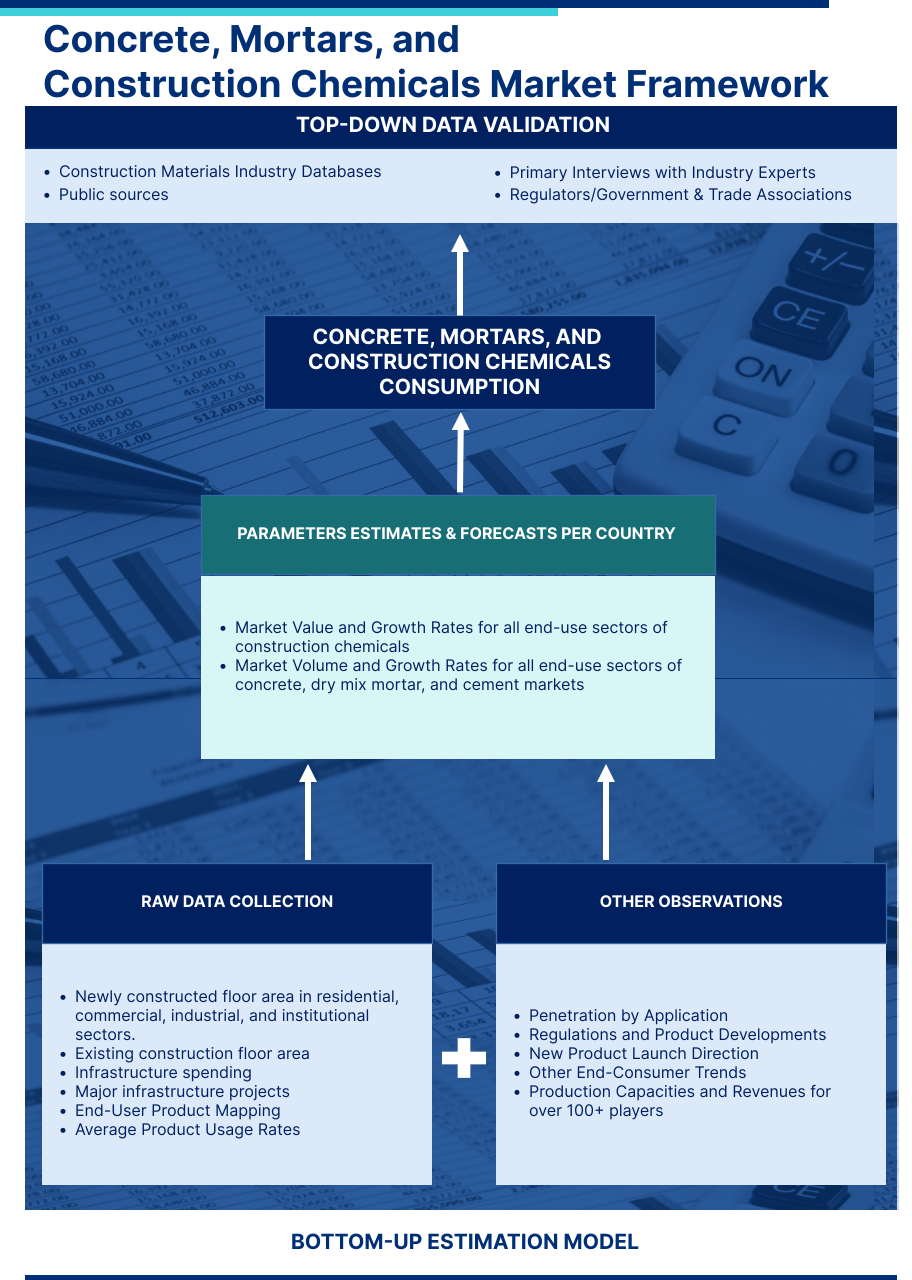
Mordor Intelligence follows a four-step methodology in all our reports.
- Step-1: Identify Key Variables: The quantifiable key variables (industry and extraneous) pertaining to the specific product segment and country are selected from a group of relevant variables & factors based on desk research & literature review; along with primary expert inputs. These variables are further confirmed through regression modeling (wherever required).
- Step-2: Build a Market Model: In order to build a robust forecasting methodology, the variables and factors identified in Step-1 are tested against available historical market numbers. Through an iterative process, the variables required for market forecast are set and the model is built on the basis of these variables.
- Step-3: Validate and Finalize: In this important step, all market numbers, variables and analyst calls are validated through an extensive network of primary research experts from the market studied. The respondents are selected across levels and functions to generate a holistic picture of the market studied.
- Step-4: Research Outputs: Syndicated Reports, Custom Consulting Assignments, Databases & Subscription Platforms