
India Textile Manufacturing Market Size and Share
Market Overview
| Study Period | 2020 - 2031 |
|---|---|
| Forecast Data Period | 2026 - 2031 |
| Base Year Market Size (2025) | USD 54.60 Billion |
| Market Size (2026) | USD 58.14 Billion |
| Market Size (2031) | USD 87.44 Billion |
| Growth Rate (2026 - 2031) | 8.50 % |
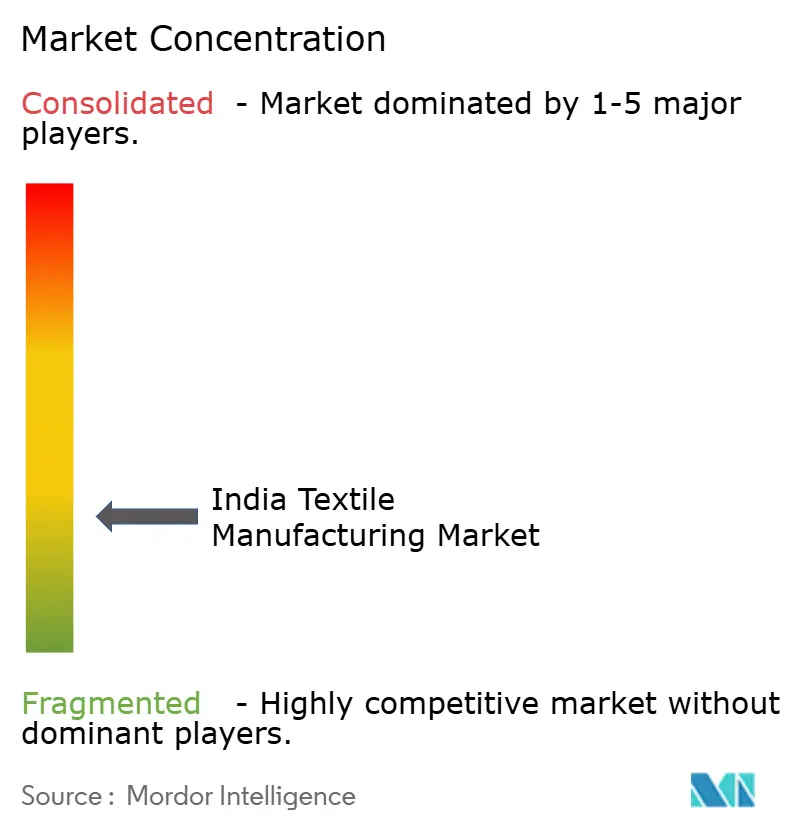
| Market Concentration | Low |
Major Players *Disclaimer: Major Players sorted in no particular order Image © Mordor Intelligence. Reuse requires attribution under CC BY 4.0. | |
India Textile Manufacturing Market Analysis by Mordor Intelligence
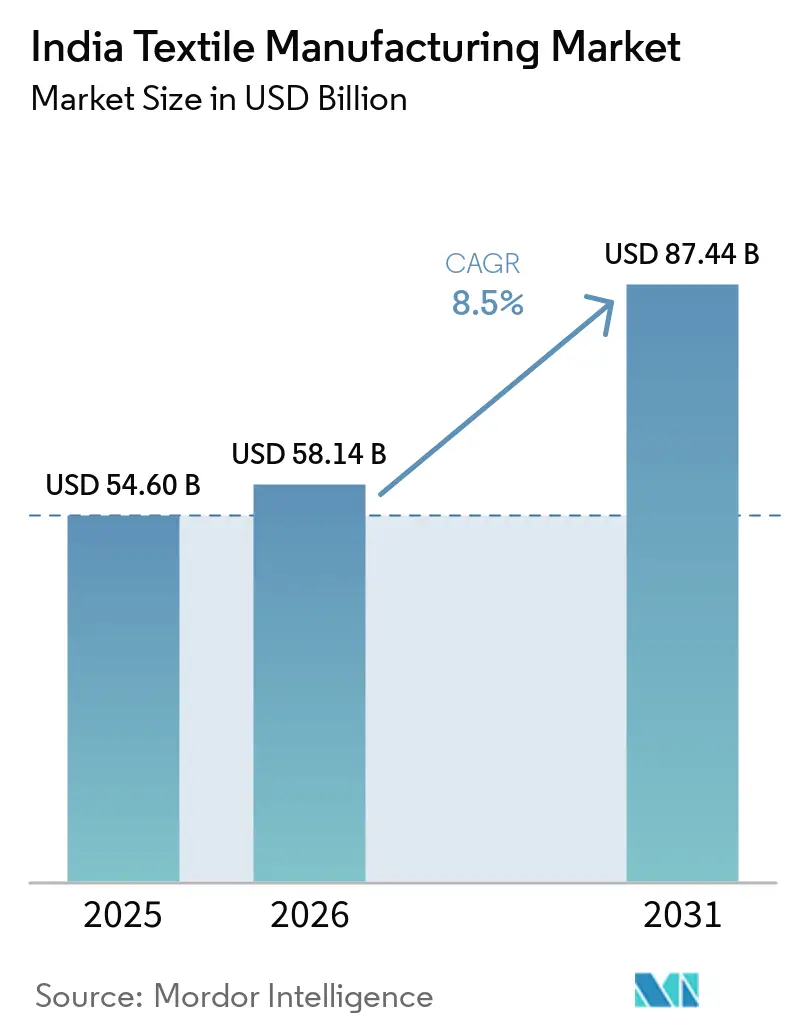
The India Textile Manufacturing Market size is expected to grow from USD 54.60 billion in 2025 to USD 58.14 billion in 2026 and is forecast to reach USD 87.44 billion by 2031 at 8.5% CAGR over 2026-2031.
The India textile manufacturing market covers the industrial conversion of natural and synthetic fibers into yarns, fabrics, nonwovens, coated materials, and other intermediate textile inputs. It includes fiber preparation, spinning, weaving, knitting, nonwoven production, dyeing, printing, finishing, coating, and related fabric processing, from the initial handling of fibers through the creation of saleable intermediate materials. Trade access, cluster investment, and policy support for artificial fibers and technical textiles can strengthen demand for the upstream materials covered by this definition. Rising input costs remain the primary constraint, while uneven processing capacity and fragmented production networks limit scale and operational efficiency. Increasing environmental compliance requirements further raise costs and execution complexity, particularly across production clusters with limited access to modern processing infrastructure.
Key Report Takeaways
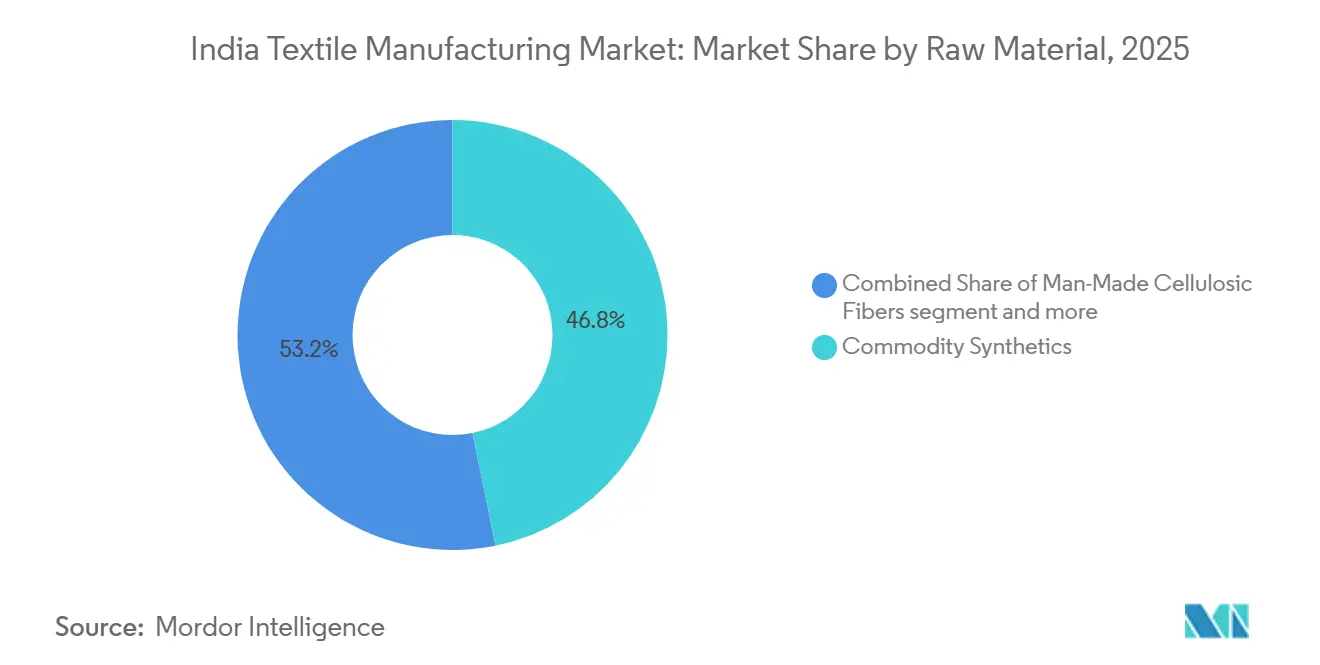
- By raw material, commodity synthetics held 46.8% of the India textile manufacturing market share in 2025, while specialty and high-performance fibers are forecast to grow at an 11.9% CAGR through 2031.
- By manufacturing process and product type, fabric manufacturing held 42.5% of the India textile manufacturing market share in 2025, while textile finishing and surface treatment are forecast to grow at a 9.8% CAGR through 2031.
- By enterprise scale, MSMEs and the unorganized sector held 61.5% of the India textile manufacturing market size in 2025, while large organized manufacturers are forecast to grow at a 10.3% CAGR through 2031.
Note: Market size and forecast figures in this report are generated using Mordor Intelligence’s proprietary estimation framework, updated with the latest available data and insights as of January 2026.
India Textile Manufacturing Market Trends and Insights
Drivers Impact Analysis*
| Driver | (~) % Impact on CAGR Forecast | Geographic Relevance | Impact Timeline |
|---|---|---|---|
| China-Plus-One Sourcing and FTA-Led Export Access | +2.2% | Global, with the strongest near-term relevance for South and West India export clusters | Short term (≤ 2 years) |
| PM MITRA Integrated Park Build-Out and Value-Chain Localization | +1.8% | National, with early activity in Gujarat, Uttar Pradesh, Karnataka, Tamil Nadu, and Maharashtra | Medium term (2-4 years) |
| MMF and Technical-Textile Capacity Incentives | +1.5% | National, with relevance for export supply corridors and European buyers | Medium term (2-4 years) |
| Domestic Demand for Athleisure, Affordable Fashion, and Functional Textiles | +1.2% | National, especially urban and emerging-city demand centers | Short term (≤ 2 years) |
| AI-Enabled Short-Order and Quality-Certified Manufacturing | +0.9% | National, with early relevance in Tiruppur, Surat, and Ludhiana | Medium term (2-4 years) |
| Circularity, Traceability, and Digital Product Passport Readiness | +0.6% | National, especially the South and West India export corridors serving Europe | Long term (≥ 4 years) |
| Source: Mordor Intelligence | |||
China-Plus-One Sourcing and FTA-Led Export Access
The India textile manufacturing market can benefit as buyers reduce reliance on a single sourcing country. The India-United Kingdom Comprehensive Economic and Trade Agreement (CETA), which entered into force on July 15, 2026, provides duty-free access for covered Indian textile and clothing tariff lines in the United Kingdom market.[1] This access is most valuable when manufacturers meet buyer requirements for quality, documentation, and delivery. According to the Ministry of Textiles, textile exports, including handicrafts, stood at INR 3,16,334.9 crore (USD 36,304.8 million) in FY2025-26, while artificial textile exports rose 3.6%.[2] Mid-sized knitwear, performance-fabric, and made-up suppliers can use this access, but they still need coordinated production and strong compliance records. The India textile manufacturing market can convert more trade access into orders when clusters supply textile materials and processed fabrics within buyer lead times.
PM MITRA Integrated Park Build-Out and Value-Chain Localization
PM MITRA parks are intended to reduce the distance between major textile production stages. The government has sanctioned 7 parks with an outlay of INR 4,445 crore (USD 510.1 million) for the program period. The sites combine manufacturing areas with common infrastructure and support services, which can improve coordination between fiber, yarn, fabric, and processing activity. A parliamentary response stated that land acquisition was complete across the 7 sites and Development Capital Support had been released by December 2025. Integrated sites can reduce separate utility arrangements and give manufacturers a more practical setting for buyer audits and digital systems. The India textile manufacturing market should see the strongest benefit where park tenants connect established clusters to downstream processing and material-conversion capacity.
MMF and Technical-Textile Capacity Incentives
The PLI scheme is directing investment toward MMF textile products, MMF fabrics, and technical textiles. In October 2025, the reduced minimum investment thresholds, reduced annual incremental turnover requirements, and added 17 product codes. The official portal recorded 91 selected companies, INR 7,731 crore (USD 887.3 million) of committed investment, and 30,838 jobs as of September 2025.[3] The National Technical Textiles Mission had funded 168 research projects worth INR 509 crore (USD 58.4 million) and issued 8 Quality Control Orders by March 2025. These programs can help manufacturers develop products that need specialized testing, performance standards, and consistent input quality. The India textile manufacturing market can strengthen its supply of MMF-based and technical products as projects reach commercial capacity.
Domestic Demand for Athleisure, Affordable Fashion, and Functional Textiles
Domestic demand is increasing the need for a wider mix of fabrics and intermediate textile materials. Demand from athleisure and functional clothing requires knit structures, artificial fibers, finishing chemistry, and consistent performance at accessible prices. These requirements affect yarn selection, texturing, dyeing, fabric finishing, and quality control, while also favoring suppliers that can manage shorter runs without losing consistency. The PLI scheme includes MMF textile products and fabrics among its eligible categories, linking investment support to this production shift. Demand from value-oriented retail can also increase the value of local sourcing networks and flexible planning across a broader product range. The India textile manufacturing market can respond by strengthening upstream and downstream capabilities for performance-oriented fabrics used by domestic brands and retailers.
Restraints Impact Analysis*
| Restraint | (~) % Impact on CAGR Forecast | Geographic Relevance | Impact Timeline |
|---|---|---|---|
| Fragmented Supplier Interfaces and Weak End-to-End Coordination | -1% | National, with high relevance in North India MSME clusters and semi-integrated South India processing units | Short term (≤ 2 years) |
| Cotton and MMF Input-Price Volatility | -0.8% | National, especially cotton-dependent clusters in Surat, Coimbatore, Tiruppur, and Rajkot | Short term (≤ 2 years) |
| Processing-Capacity, Water, Effluent, and Compliance Bottlenecks | -0.7% | South India, North India, and West India processing clusters | Medium term (2-4 years) |
| Low Value Capture from Exporting Semi-Processed Fabric | -0.5% | National, particularly spinning-intensive North and West India mill belts | Long term (≥ 4 years) |
| Source: Mordor Intelligence | |||
Fragmented Supplier Interfaces and Weak End-to-End Coordination
The India textile manufacturing market remains dispersed across spinning, weaving, processing, coating, and finishing units. The government has responded with the PM MITRA program, which aims to create integrated facilities and shared infrastructure. Separate locations can complicate scheduling, quality coordination, and delivery of materials and processed fabric for smaller firms. The 7 project sites provide a public framework for bringing value-chain stages closer together, and land acquisition was complete by December 2025. Infrastructure completion alone will not create operating links, as firms also need shared planning, reliable specifications, and buyer-facing delivery systems. The India textile manufacturing market needs stronger coordination across production stages to obtain more value from its manufacturing base.
Cotton and MMF Input-Price Volatility
Cotton availability and price movements affect mill planning and working capital. India's projected cotton production stands at 23.5 million bales in 2025-26, down from 24 million bales in 2024-25, and noted higher import volumes in the prior year. The PLI scheme seeks to increase MMF investment, but different cost conditions across cotton and MMF still complicate product pricing. Mills may need to adjust blends, inventories, and sales commitments as raw material conditions change, while smaller businesses have less capacity to absorb volatility. The India textile manufacturing market can reduce this exposure through upstream investment, disciplined purchasing, and better supply-chain coordination.
*Our forecasts treat driver/restraint impacts as directional, not additive. The impact forecasts reflect baseline growth, mix effects, and variable interactions.
Segment Analysis
By Raw Material: Commodity, Synthetics, Lead, Performance Fibers Expand
Commodity synthetics held 46.8% of the India textile manufacturing market share in 2025. Polyester, nylon or polyamide, polypropylene, acrylic, and elastane serve apparel, home textiles, and technical uses. This position reflects the country’s established capacity in synthetic fiber and yarn production, including the preparation and transformation steps that supply weaving, knitting, nonwoven formation, coating, and fabric processing. Natural fibers formed the next major group and continued to support domestic apparel and textile exports. Artificial cellulosic fibers, including viscose, rayon, lyocell, modal, and acetate, occupied an important middle position. Their relevance has grown as customers seek alternatives that combine cellulose content with performance properties, including fabric feel, drape, and sustainability-related product positioning. Their use across several downstream applications supports the India textile manufacturing market size for commodity synthetics. The material mix also gives manufacturers flexibility to serve price-sensitive and performance-led demand through intermediate materials rather than final consumer products. It also allows processors to select inputs suited to strength, stretch, durability, texture, and finishing requirements.
Specialty and high-performance fibers are projected to grow at an 11.9% CAGR through 2031. These materials include aramid, ultra-high-molecular-weight polyethylene (UHMWPE), and other high-performance fibers used in defense, automotive, construction, and medical applications. The National Technical Textiles Mission has funded work in specialty fiber applications, which supports technology development in this area. Grasim approved INR 3,094 crore (USD 355.1 million) for the second phase of its lyocell expansion at Harihar in June 2026. The company stated that the additional capacity would be developed in 2 lines of 55,000 TPA each. Animal-based fibers remained smaller in volume but served premium wool and silk applications. The India textile manufacturing market is moving toward a wider fiber basket as producers address both conventional and specialized requirements.

By Manufacturing Process and Product Type: Fabric Manufacturing Leads, Finishing Gains Momentum
Fabric manufacturing accounted for 42.5% of the India textile manufacturing market share in 2025. The category includes weaving, knitting, crocheting, nonwoven and felt manufacturing, and other fabric-forming processes. Weaving remained important because of the large established loom base. Knitting gained relevance as demand for sportswear, casualwear, and performance fabrics increased. Nonwoven and felt production also serves medical, agricultural, and construction uses. Vardhman Textiles began commercial production at a 31-million-meter processed fabric unit and an 18-million-meter performance fabric unit in March 2026. These additions show continued investment in fabric capacity with defined performance characteristics. The India textile manufacturing market relies on fabric manufacturing as a central link between upstream fiber capacity and processed textile materials.
Textile finishing and surface treatment is forecast to grow at a 9.8% CAGR through 2031. This process covers pre-treatment, bleaching, dyeing, printing, and functional finishes. It converts greige fabrics and other textile substrates into materials with the appearance, performance, and consistency required by industrial buyers and downstream converters. Buyers increasingly require uniform color, fabric feel, durability, and documented chemical management. Those demands raise the importance of finishing capabilities for exporters and domestic suppliers alike, especially where customers require repeatable results across larger production runs. The availability of water, effluent treatment, and compliance systems also shapes the size of the India textile manufacturing market for finishing. Larger, organized facilities can more readily operate in-house treatment infrastructure and meet technical standards. Yarn and thread production remains a substantial category because India has deep cotton and polyester yarn capability. These intermediate outputs feed weaving, knitting, nonwoven activity, and other covered material-production processes. Growth is likely to be stronger downstream, where fabric quality and material specifications create more differentiation.
By End Use Industry: Apparel and Fashion Leads, Technical and Industrial Textiles Expand
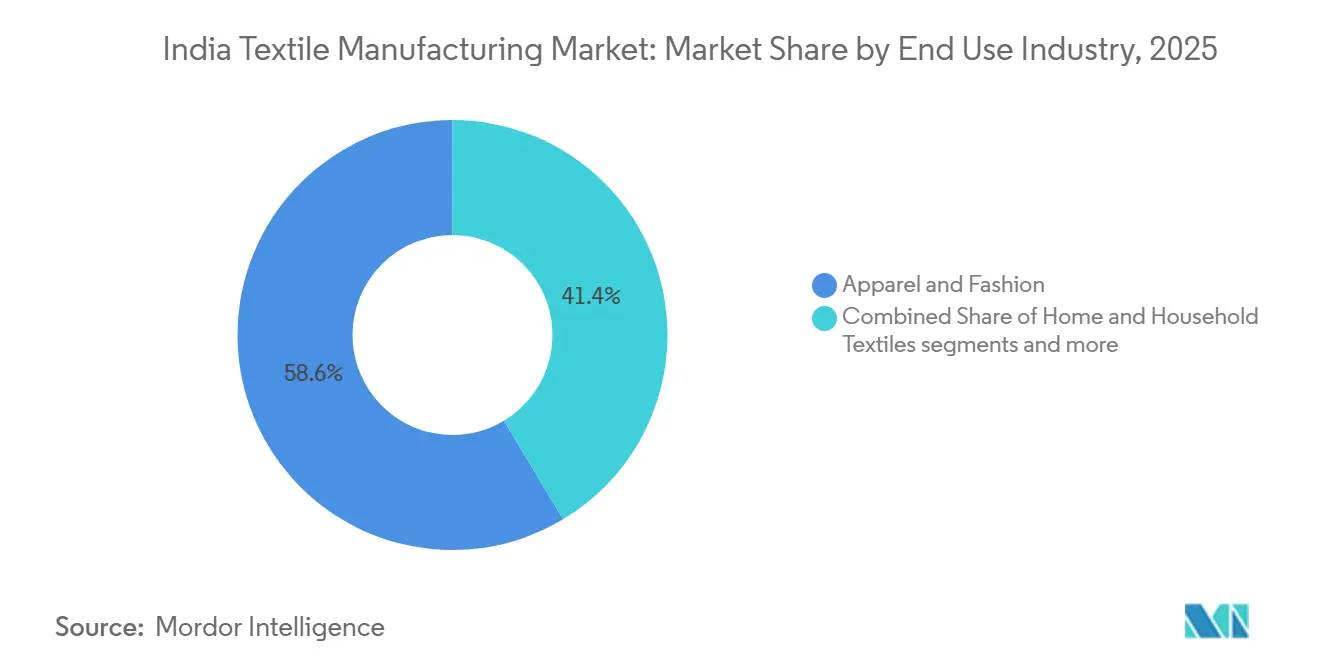
Apparel and fashion accounted for 58.6% of the India textile manufacturing market share in 2025. In this end-use view, the figure describes demand for intermediate textile materials supplied to apparel and fashion converters. It does not include downstream apparel manufacturing, retail, or distribution within the market definition. The segment draws on cotton, man-made cellulosic fibers, commodity synthetics, specialty fibers, yarns, woven fabrics, knitted fabrics, nonwovens, and finished textile materials. Home and household textiles form another important demand area for intermediate materials such as bed-linen fabrics, terry materials, and other furnishing textiles. Other end uses include materials supplied for specialized industrial and commercial requirements. The India textile manufacturing market captures the production and processing of the material inputs serving these uses, rather than the sale of final consumer products. This distinction maintains the focus on industrial textile transformation across the covered value chain.
Technical and industrial textiles are projected to grow at an 11.8% CAGR through 2031. The segment includes transportation and mobility, medical and hygiene, industrial processing and filtration, construction and geotextiles, protective and safety applications, packaging, and agricultural uses. These applications remain within the textile manufacturing definition when production ends with an intermediate textile material. The National Technical Textiles Mission reported investments of INR 5,218 crore (USD 598.9 million) in the technical textiles value chain by March 2025 and more than 8,500 direct jobs. It also reported technical textile exports of USD 2.9 billion in FY2024-25. Testing, standardized inputs, and customer-specific development are important because performance requirements differ across applications. The India textile manufacturing market can expand its value base when producers turn policy-led research and capacity into repeat demand for materials with defined specifications. These factors differentiate technical textile material production from conventional fabric output.
By Enterprise Scale: MSMEs Lead Output, Organized Manufacturers Expand
MSMEs and the unorganized sector accounted for 61.5% of the India textile manufacturing market share in 2025. Their position reflects long-standing specialization across handloom, powerloom, spinning, weaving, and processing clusters. Small-batch production and regional knowledge remain useful advantages for many of these businesses. At the same time, export and institutional customers increasingly ask suppliers for traceability, social documentation, and chemical-use records. Such requirements can be difficult for small units to handle independently. The India textile manufacturing market size represented by MSMEs remains important because these units provide a large share of localized production capability. Greater formalization may occur where firms adopt shared services, supplier pre-qualification, and digital production records. Such measures can help smaller units participate in buyer programs without giving up their regional specialization.
Large organized manufacturers are projected to grow at a 10.3% CAGR through 2031. These firms can use vertical integration, investment capacity, and in-house compliance systems to meet larger customer programs. Arvind Limited stated in 2025 that it planned INR 475 crore (USD 54.5 million) to INR 500 crore (USD 57.4 million) of capital expenditure in FY2026-27 across garment, fabric, and advanced materials operations. The PLI amendments also lowered access barriers for firms prepared to invest in eligible MMF and technical textile products. Organized firms are therefore positioned to absorb compliance costs and introduce new product lines. Their growth does not eliminate the role of small producers, which remain essential to many regional supply networks. The India textile manufacturing market is likely to retain both structures, with different competitive strengths at each scale. Organized capacity may grow faster, while MSMEs can continue to supply local, specialized, and small-batch requirements.
Geography Analysis
South India held 37.2% of the India textile manufacturing market share in 2025. Tamil Nadu remained central through Tiruppur knitwear, Coimbatore spinning, and Madurai textile production. Karnataka, Telangana, and Andhra Pradesh also contributed woven fabrics, technical textiles, and silk. The reported faster growth in artificial textile exports than in cotton-based categories during FY2025-26. This trend supports South Indian producers who are developing MMF and blended fabrics for export customers.
West India is projected to grow at a 9.6% CAGR through 2031. Gujarat and Maharashtra contain major synthetic fiber, denim, processed fabric, and textile material and fabric networks. Surat and Ahmedabad remain important centers for artificial fabrics and woven textiles. Navsari and Amravati are PM MITRA Park locations, which can support a more integrated MMF value chain. Arvind’s plan for a London design studio shows how some regional exporters are building closer links with UK buyers.
North India includes Ludhiana hosiery and woolens, Panipat recycling, Jaipur printed textiles, Varanasi silk, and the planned Lucknow PM MITRA park. East India includes West Bengal jute, silk, and cotton weaving, Assam silk, and Odisha handloom clusters. Processing units in these regions need to meet water, treatment, and buyer documentation requirements. The India textile manufacturing market remains regionally diverse because each area serves a distinct mix of fibers, fabrics, recycling, traditional products, and fabric conversion activity.
Competitive Landscape
The India textile manufacturing market combines a fragmented MSME base with larger integrated material manufacturers that compete through scale, supply reliability, product development, buyer relationships, and compliance systems. Relevant participants include other producers of fibers, yarns, fabrics, and technical textile materials. Their activities span fiber production, yarn formation, fabric manufacturing, processing, and specialized textile inputs. Regional specialists remain important because they serve focused materials, processes, and customer requirements.
Manufacturers are investing in specialized inputs and fabric-processing capability. Grasim approved INR 3,094 crore (USD 355.1 million) in June 2026 for the second phase of lyocell capacity at Harihar, Karnataka. Vardhman started commercial production at the new processed and performance-fabric units in March 2026. These actions seek to improve material differentiation, quality consistency, and supply reliability. Arvind also indicated planned investment across fabric and advanced-material operations in its 2025 update.
Digital records and sustainability requirements are also shaping competition. Export customers may need information on material composition, production location, chemical management, and sustainability attributes. Smaller firms may use shared services or cluster platforms where individual investment is difficult. Common treatment facilities, quality labs, and traceability tools can help regional manufacturers retain access to demanding buyers. The India textile manufacturing market will continue to include integrated leaders and specialized small firms, with performance depending on cost control, compliance, speed, consistent material output, and the ability to meet defined processing specifications.
India Textile Manufacturing Industry Leaders
-
Grasim Industries Limited
-
Vardhman Textiles Limited
-
Welspun Living Limited
-
Arvind Limited
-
Trident Limited
- *Disclaimer: Major Players sorted in no particular order
Recent Industry Developments
- July 2026: The India-United Kingdom Comprehensive Economic and Trade Agreement entered into force on July 15, 2026, providing duty-free access for covered India textile materials and clothing-related tariff lines in the United Kingdom. The arrangement applies across 1,143 textile and clothing tariff lines and removes the 12% duty that had affected India competitiveness in this destination.
- March 2026: Commercial production commenced at a 31-million-meter processed fabric line and an 18-million-meter performance fabric unit at Budhni, Madhya Pradesh. These facilities formed part of a broader INR 3,535 crore (USD 405.7 million) announced capital expenditure program.
- October 2025: The notified changes to the PLI scheme, including lower investment thresholds, a reduced turnover requirement, and 17 additional eligible product codes. The revised criteria halve minimum investment thresholds to INR 150 crore (USD 17.2 million) for Part 1 and INR 50 crore (USD 5.7 million) for Part 2. The application portal was extended to March 31, 2026.
India Textile Manufacturing Market Report Scope
The India Textile Manufacturing Market is Segmented by Raw Material (Natural Fibers, Commodity Synthetics, and More), by Manufacturing Process and Product Type (Fabric Manufacturing, and More), by End Use Industry (Apparel and Fashion, and More), by Enterprise Scale (Large Organized Manufacturers, and More), and by Geography (North India, and More). The Report Offers Market Size and Value (USD) Forecasts for all the Above Segments.
| Natural Fibers | Plant-Based Fibers | Cotton |
| Others (Jute, Flax, Hemp, Ramie, Coir) | ||
| Animal-Based Fibers (wool, silk and other animal fibers) | ||
| Man-Made Cellulosic Fibers (Viscose/Rayon, Lyocell, Modal and Acetate) | ||
| Commodity Synthetics (Polyester, Nylon/Polyamide, Polypropylene, Acrylic and Elastane) | ||
| Specialty and High-Performance Fibers (Aramid, UHMWPE, etc.) |
| Yarn and Thread Manufacturing | |
| Fabric Manufacturing | Weaving |
| Knitting and Crocheting | |
| Nonwoven and Felt Manufacturing | |
| Other Fabric-Formation Processes | |
| Textile Finishing and Surface Treatment (Pretreatment, Bleaching, Dyeing, Printing, etc.) |
| Apparel and Fashion | |
| Home and Household Textiles | |
| Technical and Industrial Textiles | Transportation and Mobility |
| Medical and Hygiene | |
| Industrial Processing and Filtration | |
| Construction and Geotextiles | |
| Protective and Safety | |
| Packaging | |
| Other Technical Applications - Agriculture, etc. | |
| Other End Uses |
| Large Organized Manufacturers |
| Micro, Small, and Medium Enterprises (MSMEs) and the unorganized sector |
| North India (Punjab, Haryana, Delhi, Himachal Pradesh, Uttarakhand, Uttar Pradesh, Jammu & Kashmir, Rajasthan) |
| West India (Maharashtra, Gujarat, Goa) |
| South India (Tamil Nadu, Karnataka, Telangana, Andhra Pradesh, Kerala) |
| East India (West Bengal, Odisha, Bihar, Jharkhand, Chhattisgarh, Assam and Rest of North East India) |
| By Raw Material | Natural Fibers | Plant-Based Fibers | Cotton |
| Others (Jute, Flax, Hemp, Ramie, Coir) | |||
| Animal-Based Fibers (wool, silk and other animal fibers) | |||
| Man-Made Cellulosic Fibers (Viscose/Rayon, Lyocell, Modal and Acetate) | |||
| Commodity Synthetics (Polyester, Nylon/Polyamide, Polypropylene, Acrylic and Elastane) | |||
| Specialty and High-Performance Fibers (Aramid, UHMWPE, etc.) | |||
| By Manufacturing Process and Product Type | Yarn and Thread Manufacturing | ||
| Fabric Manufacturing | Weaving | ||
| Knitting and Crocheting | |||
| Nonwoven and Felt Manufacturing | |||
| Other Fabric-Formation Processes | |||
| Textile Finishing and Surface Treatment (Pretreatment, Bleaching, Dyeing, Printing, etc.) | |||
| By End Use Industry | Apparel and Fashion | ||
| Home and Household Textiles | |||
| Technical and Industrial Textiles | Transportation and Mobility | ||
| Medical and Hygiene | |||
| Industrial Processing and Filtration | |||
| Construction and Geotextiles | |||
| Protective and Safety | |||
| Packaging | |||
| Other Technical Applications - Agriculture, etc. | |||
| Other End Uses | |||
| By Enterprise Scale | Large Organized Manufacturers | ||
| Micro, Small, and Medium Enterprises (MSMEs) and the unorganized sector | |||
| By Geography | North India (Punjab, Haryana, Delhi, Himachal Pradesh, Uttarakhand, Uttar Pradesh, Jammu & Kashmir, Rajasthan) | ||
| West India (Maharashtra, Gujarat, Goa) | |||
| South India (Tamil Nadu, Karnataka, Telangana, Andhra Pradesh, Kerala) | |||
| East India (West Bengal, Odisha, Bihar, Jharkhand, Chhattisgarh, Assam and Rest of North East India) | |||
Key Questions Answered in the Report
What is the size of India textile manufacturing in 2025?
The India textile manufacturing market size was USD 54.6 billion in 2025 and is forecast to reach USD 87.4 billion by 2031 at an 8.5% CAGR.
What is driving textile manufacturing growth in India?
Trade access, PM MITRA parks, PLI support for MMF and technical textiles, and demand for functional fabrics are key factors. These conditions favor producers that can document quality, sustainability, and reliable delivery.
Which materials lead textile production in India?
Commodity synthetics led with a 46.8% share in 2025, while specialty and high-performance fibers are forecast to grow at an 11.9% CAGR through 2031.
Why are technical textiles important for India manufacturers?
Technical and industrial textiles are forecast to grow at an 11.8% CAGR through 2031, supported by applications in medical, construction, agriculture, and transport. The National Technical Textiles Mission supports research, standards, and commercial capability in these uses.
Which region leads textile manufacturing in India?
South India held 37.2% of output in 2025, supported by clusters in Tamil Nadu and other southern states. Tiruppur, Coimbatore, and Madurai provide knitting, spinning, and broader textile capacity.
What are the main challenges for textile material manufacturers in India?
Fragmented production networks, cotton and MMF input-price volatility, and processing compliance needs remain key challenges. These constraints affect working capital, delivery speed, compliance costs, and the ability to secure material orders.