
India Snacks Market Size and Share
Market Overview
| Study Period | 2022 - 2032 |
|---|---|
| Forecast Data Period | 2027 - 2032 |
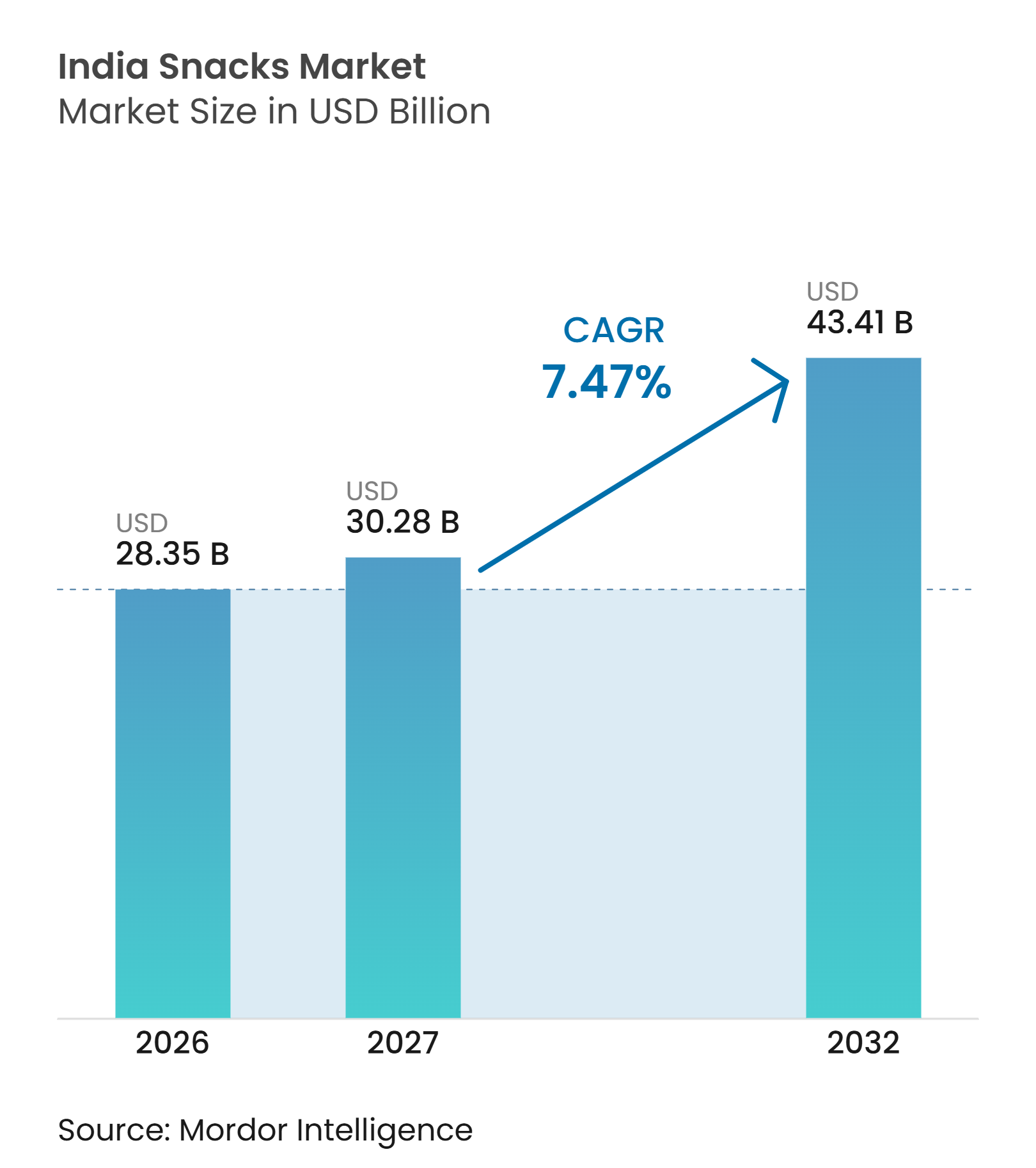
| Base Year Market Size (2026) | USD 28.35 Billion |
| Market Size (2027) | USD 30.28 Billion |
| Market Size (2032) | USD 43.41 Billion |
| Growth Rate (2027 - 2032) | 7.47 % |
| Market Concentration | Low |
Major Players *Disclaimer: Major Players sorted in no particular order Image © Mordor Intelligence. Reuse requires attribution under CC BY 4.0. | |
India Snacks Market Analysis by Mordor Intelligence
The India snacks market size is projected to expand from USD 28.35 billion in 2026 and USD 30.28 billion in 2027 to USD 43.41 billion by 2032, registering a CAGR of 7.47% between 2027 and 2032. Consumption is supported by convenient eating occasions, busy urban routines, and wider access to packaged formats. Traditional savory products remain central to demand, while frozen and health-focused products create separate avenues for product development. Retail expansion and digital ordering improve product visibility, but national coverage still requires strong general-trade execution. The India snacks market also faces cost pressure from edible oil and energy inputs, which is difficult to absorb in small price packs. Foreign investment and acquisition activity show continued interest in regional brands, manufacturing capacity, and distribution networks.
Key Report Takeaways
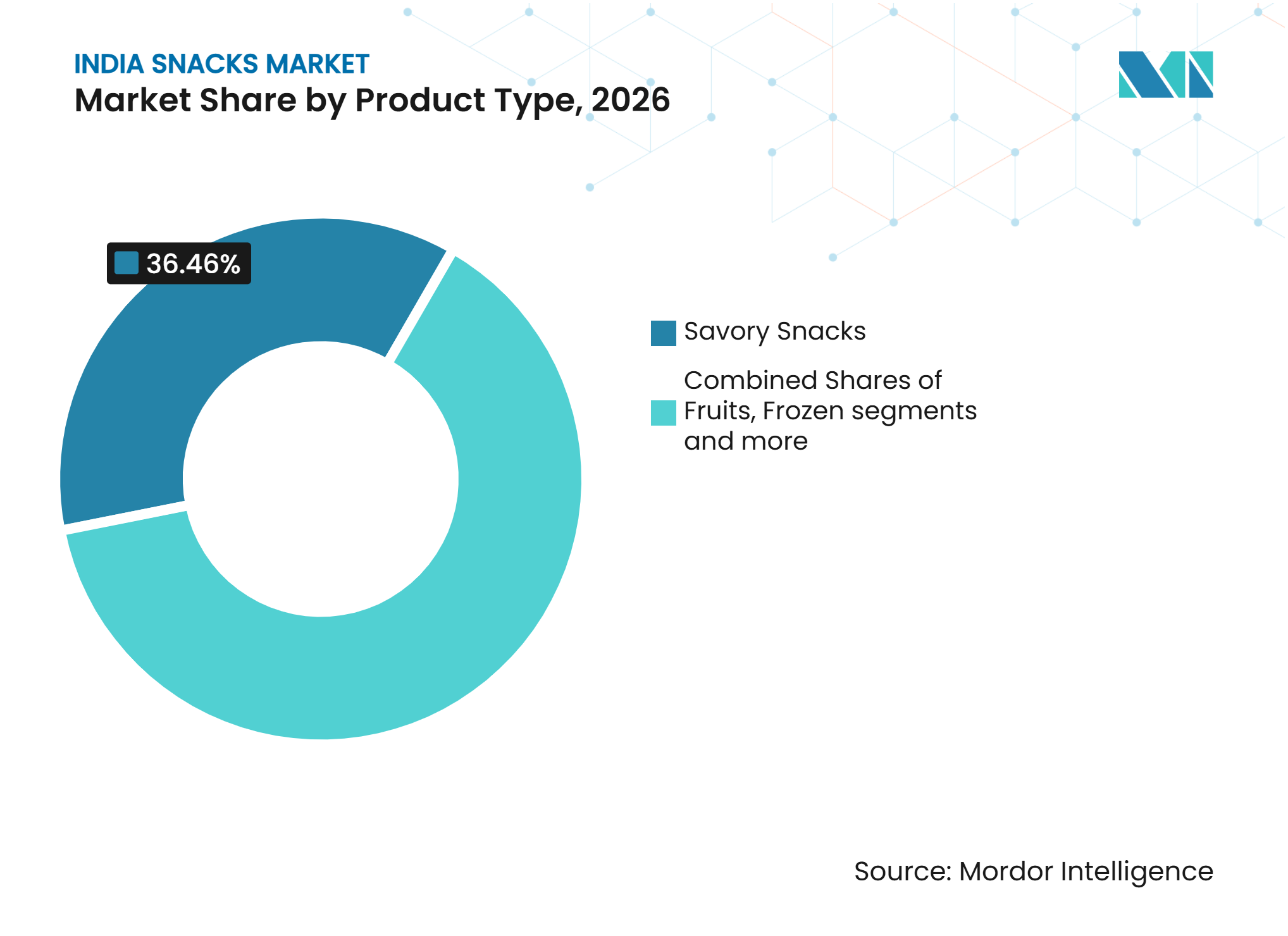
- By product type, savory snacks held a 36.46% share of the India snacks market size in 2026, while frozen snacks are forecast to grow at a 9.18% CAGR through 2032.
- By ingredient type, conventional ingredients held a 67.52% share of the India snacks market size in 2026, while organic and clean-label ingredients are forecast to grow at a 9.27% CAGR through 2032.
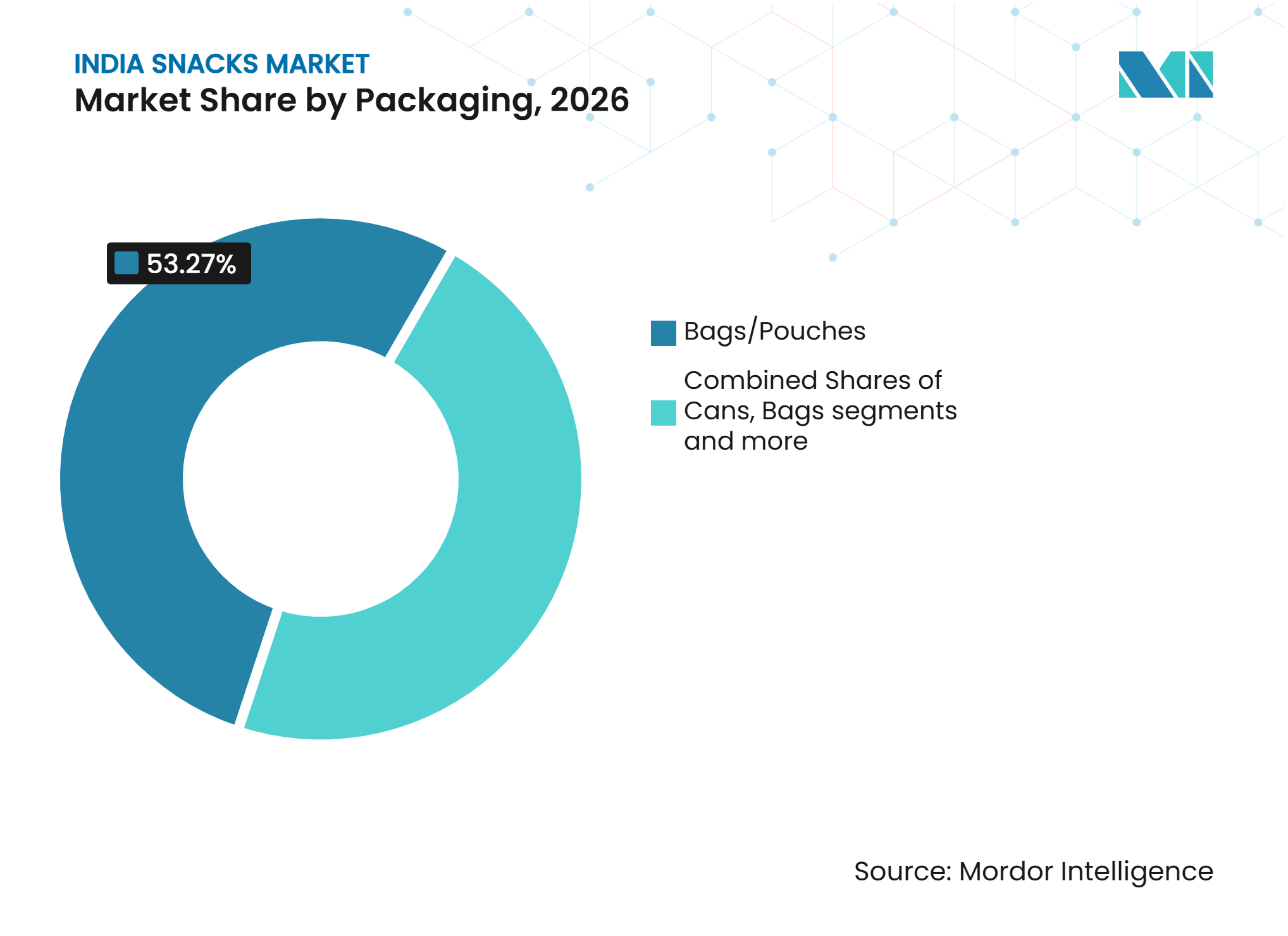
- By packaging type, bags and pouches held a 53.27% share of the India snacks market size in 2026, while jars and tubs are forecast to grow at an 8.57% CAGR through 2032.
- By distribution channel, supermarkets and hypermarkets held a 42.38% share of the India snacks market size in 2026, while online retail is forecast to grow at an 8.62% CAGR through 2032.
Note: Market numbers in this report are based on Mordor Intelligence's proprietary estimation framework, which combines nine months of actuals with Q4 projections for base year 2026.
Market Trends and Insights
Drivers Impact Analysis of India Snacks Market*
| Driver | (~) % Impact on CAGR Forecasts | Geographic Relevance | Impact Timeline |
|---|---|---|---|
| Changing consumer lifestyles and demand for convenient foods | +1.8% | Pan-India; strongest in Tier-1 and Tier-2 cities | Short term (≤ 2 years) |
| Growing popularity of traditional Indian savory snacks | +1.5% | North and West India; spill-over to South and East | Medium term (2-4 years) |
| Product innovation across flavors, ingredients, and formats | +1.2% | Urban India; expanding to Tier-2 | Medium term (2-4 years) |
| Increasing consumer interest in health-oriented snack alternatives | +1.0% | Metro and Tier-2 cities; early rural uptick | Long term (≥ 4 years) |
| Expansion of organized retail and modern distribution networks | +0.9% | Semi-urban and rural India | Medium term (2-4 years) |
| Strong seasonal, festive, and gifting demand | +0.7% | Pan-India; concentrated in North and West during Diwali | Short term (≤ 2 years) |
| Source: Mordor Intelligence | |||
Changing Consumer Lifestyles and Demand for Convenient Foods
India’s urban population reached 34% in 2025, creating more situations where packaged food serves as a practical meal supplement. Household structures, dual-income families, and longer travel times support routine purchases of portable snack products. The India snacks market benefits when consumers need accessible products during travel, work breaks, and short household shopping trips. Quick-commerce services make these purchases easier by placing familiar products within rapid delivery windows. This channel favors products with clear brand recognition, small packs, and regular repeat demand.
Growing Popularity of Traditional Indian Savory Snacks
Traditional savory snacks continue to anchor consumption because namkeen, bhujia, mathri, and related formats fit established eating habits. Their relevance extends beyond routine snacking because they are also used for hosting, gifting, and seasonal occasions. The India snacks market retains a broad base through products that can be sold in small, familiar, affordable packs. Premium regional versions can sit beside mass products without changing the underlying preference for local flavors. This allows manufacturers to offer both everyday products and higher-value assortments through overlapping retail channels.
Increasing Consumer Interest in Health-Oriented Snack Alternatives
Health-oriented alternatives are gaining attention among consumers seeking protein, energy, or less processed ingredient profiles. A July 2025 consumer study found that 72% of Indian respondents sought snacks with functional benefits, including improved energy, mood, or protein content[1]. Demand does not remove the role of indulgent products, because consumers can buy a traditional savory product and a roasted alternative in the same purchase. This pattern supports a broader portfolio rather than a simple replacement of traditional products. Access to online channels matters because health-focused brands need to reach buyers beyond their initial urban customer base. The India snacks market can therefore support health positioning when product claims, pricing, and distribution are aligned.
Expansion of Organized Retail and Modern Distribution Networks
Organized retail provides structured shelf space and a setting where consumers can discover premium formats. It also gives suppliers clearer merchandising standards than fragmented retail outlets can typically provide. The India snacks market still depends heavily on general trade, so modern retail adds to rather than replaces the need for broad physical distribution. Online ordering offers a separate route for reaching smaller cities and for testing a wider range of stock-keeping units. Bikaji Foods reported that its e-commerce channel was growing at 75% year over year while it expanded its offering in Tier-2 cities.
Restraints Impact Analysis of India Snacks Market*
| Restraint | (~) % Impact on CAGR Forecasts | Geographic Relevance | Impact Timeline |
|---|---|---|---|
| Health concerns associated with highly processed snacks | -1.2% | Pan-India; most acute in urban, educated consumer segments | Long term (≥ 4 years) |
| Competition from freshly prepared and homemade snacks | -0.9% | Semi-urban and rural India; Tier-2 and Tier-3 cities | Medium term (2-4 years) |
| Fluctuating edible oil and energy costs | -0.8% | Pan-India; manufacturing-heavy states (UP, Gujarat, Maharashtra) | Short term (≤ 2 years) |
| Price sensitivity and limited scope for premium pricing | -0.7% | Rural India; mass-market price bands nationally | Medium term (2-4 years) |
| Source: Mordor Intelligence | |||
Health Concerns Associated with Highly Processed Snacks
Health concerns may limit demand for products with high levels of sodium, fat, or highly processed ingredients. The proposed Indian Nutrition Rating system could influence how shoppers compare products if mandatory front-of-pack warnings are finalized. The system under consideration would assign ratings from 0.5 to 5 stars based on nutritional content. Manufacturers may need to adjust recipes, packaging, and product claims if the rules take effect. These changes could be harder for smaller regional businesses with limited product-development resources. The India snacks market will need to balance familiar fried formats with products that respond to changing health expectations.
Fluctuating Edible Oil and Energy Costs
Edible oil and energy costs have a direct effect on margins because fried products account for a large part of sales. Smaller packs limit the scope for manufacturers to pass higher costs to consumers without affecting affordability. The India snacks market is especially exposed because USD 0.05 and USD 0.11 packs remain important purchase options. Higher palm oil costs have contributed to reduced product grammage, which can weaken value perceptions among price-sensitive buyers. Prataap Snacks reported a 300-basis-point sequential EBITDA margin contraction in Q3 FY26, which it attributed to higher palm oil costs[2]. Cost control, procurement planning, and manufacturing efficiency remain important when input prices move quickly.
*Our forecasts treat driver/restraint impacts as directional, not additive. The impact forecasts reflect baseline growth, mix effects, and variable interactions.
India Snacks Market Segment Analysis
By Product Type:
Savory Formats Lead While Frozen Products Gain MomentumSavory snacks accounted for 36.46% of the India snacks market size in 2026. Namkeen, chips, and bhujia benefit from broad availability across rural stores, urban outlets, and formal retail. Familiar flavors, small serving sizes, gifting traditions, and household sharing support regular demand across income groups. USD 0.01 to USD 0.11 price points remain important for immediate-consumption products. Strong local manufacturing and regional flavor adaptation protect the category’s leading position.
Frozen snacks are forecast to grow at a 9.18% CAGR from 2027 to 2032. Wider cold-chain capacity and quick-commerce services support demand for ready-to-cook products. ITC invested USD 13.76 million for a 43.75% stake in Ample Foods, gaining access to the Prasuma and Meatigo brands. Extruded, confectionery, bakery, fruit, and meat snacks occupy distinct positions within the category. Companies can combine steady savory volume with faster-growing frozen products and smaller specialized formats.



By Ingredient Type:
Conventional Ingredients Retain Scale While Clean Labels ExpandConventional ingredients held 67.52% of the India snacks market share in 2026. They support mainstream products that rely on large-scale manufacturing and accessible price points. Shoppers are paying closer attention to preservatives, palm oil, and synthetic additives. This creates room for clean-label ranges without displacing conventional formats. Ingredient choices affect product claims, packaging language, and consumer positioning.
Organic and clean-label ingredients are forecast to grow at a 9.27% CAGR from 2027 to 2032. Farmley reported that 55% of consumers seek preservative-free snacks and 52% prefer resealable, environmentally conscious packaging. E-commerce requirements make accurate product descriptions and physical-label alignment more important. Clear product distinctions can help companies serve both value-focused and health-focused buyers.
By Packaging Type:
Pouches Lead, While Jars Gain ShareBags and pouches held 53.27% of the India snacks market in 2026. Their leading role reflects low packaging cost, flexible sizing, and suitability for namkeen and chips. The format accommodates single-serve sachets and family packs weighing 500 g. It supports impulse purchases, household use, and rapid stock turnover in traditional retail. Packaging efficiency links pouch use closely to broad-volume distribution.
Jars and tubs are forecast to grow at an 8.57% CAGR from 2027 to 2032. They are used for roasted nuts, seeds, makhana, and premium snack assortments. Resealable containers support quality perceptions, gifting, and products positioned at higher values. Cans remain associated with premium nuts, while paper-based options attract environmentally conscious urban consumers. Different formats allow suppliers to differentiate products while retaining pouches for scale.

By Distribution Channel:
Supermarkets Support Discovery While Online Retail Expands ReachSupermarkets and hypermarkets held 42.38% of the India snacks market share in 2026. They provide visible shelf placement, planned promotions, and opportunities to compare multiple brands. The channel is useful for premium, frozen, and health-focused products needing stronger explanation. General trade remains essential because everyday purchasing still occurs through local outlets. Manufacturers need both structured retail and neighborhood-store coverage.
Online retail is forecast to grow at an 8.62% CAGR from 2027 to 2032. It helps brands offer wider ranges and reach smaller cities with uneven premium-product availability. Bikaji Foods stated that e-commerce represented 3% of revenue while growing 75% year over year. Convenience stores support urban impulse demand, while general trade continues to handle substantial rural transactions. Online growth works best when companies maintain reliable store-level distribution and inventory.
Geography Analysis
Rajasthan, Uttar Pradesh, and the Delhi National Capital Region have dense demand for established savory formats. DFM Foods generated 80% of revenue from North India and reported FY2025 revenue growth of 27.5% to USD 74.17 million[3]. Intense price competition and mature mass-product categories increase the value of differentiated flavors and strong distribution. Korean-inspired and fusion profiles are entering regional channels for younger consumers.
West India has also shown significant growth over the years. Gujarat and Maharashtra host production bases for Balaji Wafers, Gopal Snacks, and Chheda Specialities. Gopal Snacks reported FY25 revenue of USD 153.21 million and targets USD 189.15 million in FY27. Local taste knowledge, cost discipline, and distributor depth reinforce western brands. The region combines great urban demand with manufacturing and distribution capacity.
South India offers an important opportunity for branded snack producers. Murukku, mixture, and banana chips show the strength of local food identities, while Bengaluru and Chennai support premium formats. Haldiram Snacks Food has identified southern acquisitions as part of its expansion strategy. East India has lower packaged-format penetration, and better retail infrastructure can support longer-term access.
Competitive Landscape
Market Concentration
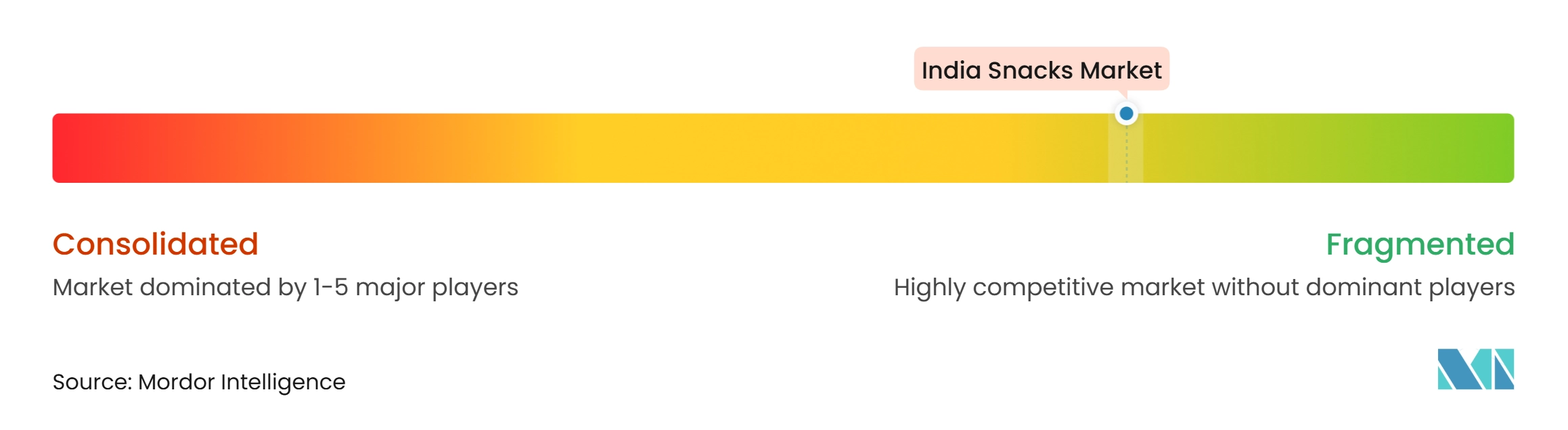
The India snacks market has a low market concentration because regional manufacturers and local producers compete alongside national brands. Haldiram Snacks Food holds a significant share of the savory snacks segment. National companies invest in manufacturing, geographic expansion, and quick-commerce activation. Digital-first challengers use clean-label products and online distribution to reach premium consumers.
Foreign investment is an important competitive development in the India snacks market. In March 2025, Temasek acquired a 10% stake in Haldiram Snacks Food for USD 1 billion. IHC and Alpha Wave Global acquired a combined 6% stake in the same period. Haldiram’s plan for southern acquisitions shows how established brands can enter markets with local food identities. Regional companies can remain attractive because they offer trusted brands and local distribution assets.
PepsiCo has invested USD 367.79 million to USD 420.33 million in Indian manufacturing during the previous 3 years. ITC’s investment in Ample Foods expanded its access to frozen and chilled ready-to-cook brands. Lotte Wellfood announced a USD 300 million India investment in February 2025. These actions show competition through facilities, acquisitions, and category expansion.
India Snacks Industry Leaders
-
Haldiram Snacks Food Pvt. Ltd.
-
Balaji Wafers Private Limited
-
ITC Limited
-
Gopal Snacks Limited
-
Parle Products Private Limited
- *Disclaimer: Major Players sorted in no particular order
India Snacks Market Companies Covered in this Report
- Haldiram Snacks Food Pvt. Ltd.
- PepsiCo Inc.
- Balaji Wafers Private Limited
- ITC Limited
- Bikaji Foods International Limited
- Prataap Snacks Limited
- Gopal Snacks Limited
- DFM Foods Limited
- Bikanervala Foods Private Limited
- Parle Products Private Limited
- Sundrop Brands Limited
- MTR Foods Private Limited
- ADF Foods Limited
- Gopal Namkeens
- Laxmi Snacks Private Limited
- Garden Snacks
- Cornitos
- Too Yumm
- Farmley
- The Whole Truth Foods
- Makino
- Chheda Specialities Foods Pvt. Ltd.
Recent Industry Developments in India Snacks Market
- May 2026: PepsiCo India launched Lay’s Mini Stix, its first stick-format potato snack in India. The product combines the brand's potato base with Indian savoury snacking preferences through fusion-inspired masala flavours.
- May 2026: Jagdish Farshan introduced a range of sev made using avocado oil, expanding its traditional Indian namkeen portfolio with an alternative cooking oil. The range comprises four variants and is positioned to appeal to consumers seeking familiar Indian snacks with ingredient-conscious formulations.
- January 2026: WellBe Foods, a direct-to-consumer brand from Nimida Group, launched a millet-based snack range featuring Millet Nippatu, Millet Kodbale, Millet Chakli, Millet Tengolu, and Millet Chivda. The products reinterpret traditional Indian snacks using a blend of rice flour and millets, offering familiar flavours and textures in alternative grain-based formulations.
- November 2025: PepsiCo India introduced Red Rock Deli, an Australian gourmet snack brand, to the Indian market. The range features globally inspired flavours and uses sunflower oil, with products prepared through kettle-cooking, baking, and popping techniques. Priced from USD 0.63, the snacks were made and manufactured in India for local consumers and initially made available through leading quick-commerce platforms.
India Snacks Market Report Scope
The India snacks market report is segmented by product type, ingredient type, packaging type, and distribution channel. By product type, the market is categorized into frozen snacks, savory snacks, extruded snacks, fruit snacks, confectionery snacks, bakery snacks, meat snacks, and other types of snacks. By ingredient type, the market is divided into conventional and organic/clean-label snacks. By packaging type, the market is segmented into bags/pouches, cans, jars and tubs, and other packaging formats. By distribution channel, the market is categorized into supermarkets/hypermarkets, convenience stores, online retail stores, and other distribution channels. The market sizing has been done in value terms in USD for all the abovementioned segments.
Segmentation Overview
| Frozen Snacks |
| Savory Snacks |
| Extruded Snacks |
| Fruit Snacks |
| Confectionery Snacks |
| Bakery Snacks |
| Meat Snacks |
| Other Type Snacks |
| Conventional |
| Organic/Clean-Label |
| Bags/Pouches |
| Cans |
| Jars and Tubs |
| Others |
| Supermarkets/Hypermarkets |
| Convenience Stores |
| Online Retail Stores |
| Other Distribution Channels |
| Product Type | Frozen Snacks |
| Savory Snacks | |
| Extruded Snacks | |
| Fruit Snacks | |
| Confectionery Snacks | |
| Bakery Snacks | |
| Meat Snacks | |
| Other Type Snacks | |
| Ingredient Type | Conventional |
| Organic/Clean-Label | |
| Packaging Type | Bags/Pouches |
| Cans | |
| Jars and Tubs | |
| Others | |
| Distribution Channels | Supermarkets/Hypermarkets |
| Convenience Stores | |
| Online Retail Stores | |
| Other Distribution Channels |
Key Questions Answered in the Report
What is the forecast growth rate for India snacks through 2032?
The India snacks market is forecast to grow at a 7.47% CAGR from 2027 to 2032, reaching USD 43.41 billion by 2032.
Which product category has the largest share in India snacks?
In 2026, savory snacks hold a 36.46% share of product demand, driven by the widespread availability and popularity of namkeen, chips, and bhujia.
Which snack category is growing fastest in India?
Frozen snacks are forecast to grow at a 9.18% CAGR through 2032, supported by cold-chain development and quick-commerce use.
How important is online retail for packaged snacks in India?
Online retail is projected to grow at an 8.62% CAGR through 2032.