
India Palm Oil Market Size and Share
Market Overview
| Study Period | 2021 - 2031 |
|---|---|
| Forecast Data Period | 2026 - 2031 |
| Base Year Market Size (2025) | USD 14.86 Billion |
| Market Size (2026) | USD 15.56 Billion |
| Market Size (2031) | USD 19.08 Billion |
| Growth Rate (2026 - 2031) | 5.12 % |
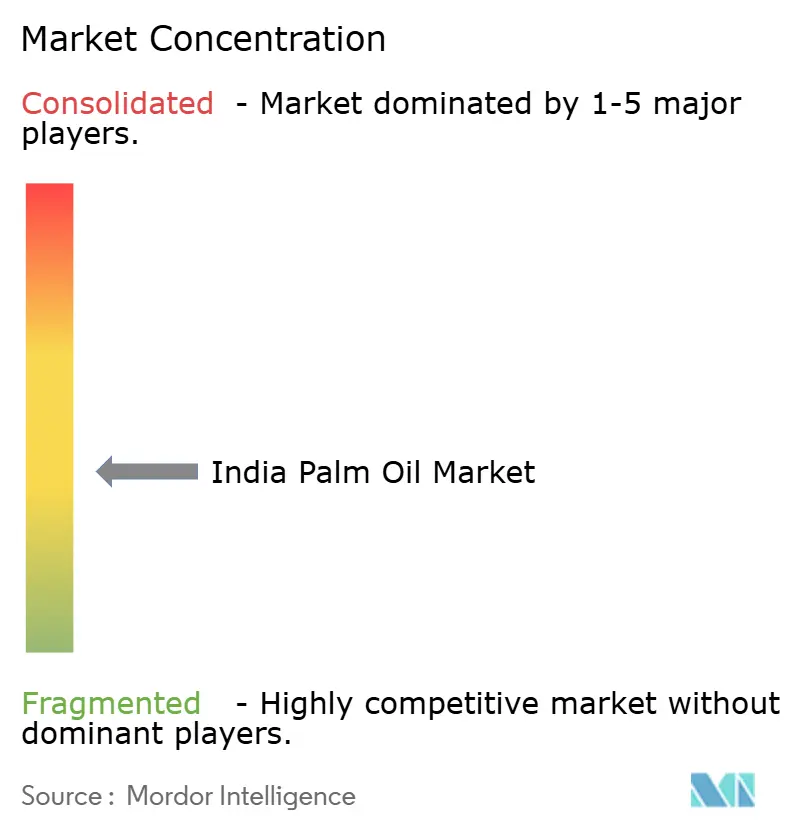
| Market Concentration | Medium |
Major Players
*Disclaimer: Major Players sorted in no particular order Image © Mordor Intelligence. Reuse requires attribution under CC BY 4.0. |
|
India Palm Oil Market Analysis by Mordor Intelligence
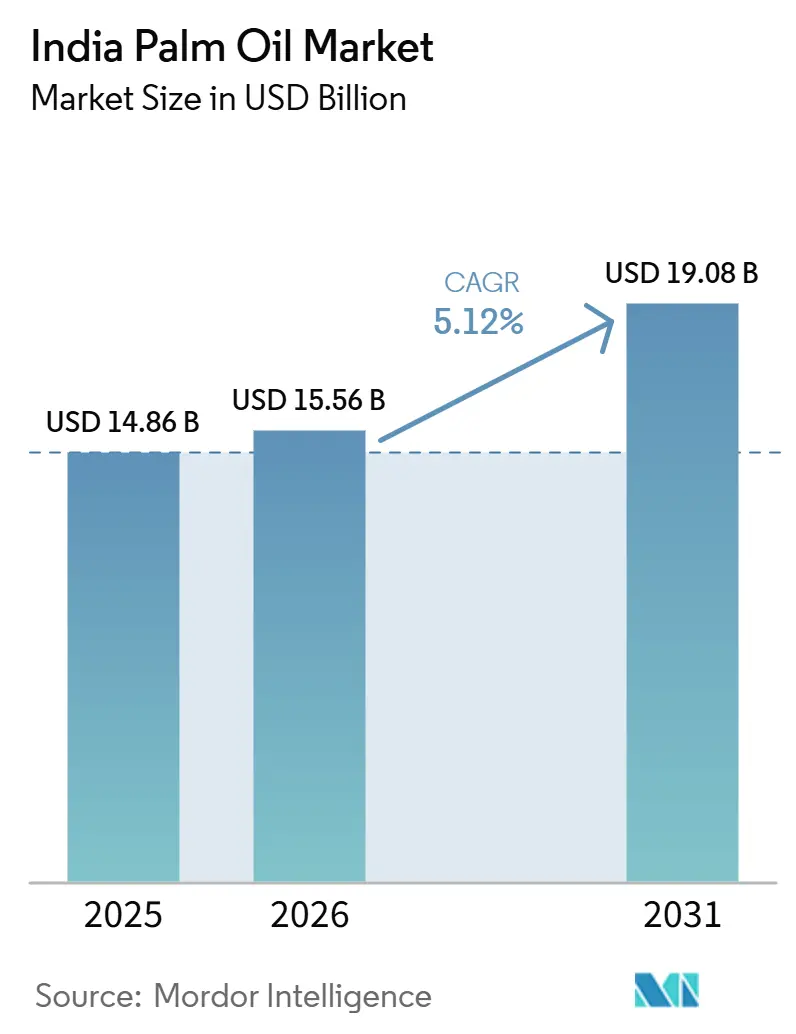
The Indian palm oil market size is expected to increase from USD 14.86 billion in 2025 to USD 15.56 billion in 2026 and reach USD 19.08 billion by 2031, growing at a CAGR of 5.12% over 2026-2031. Robust demand from the food processing, personal care, and emerging oleochemical sectors primarily drives growth in the Indian palm oil market. Manufacturers use palm oil and its derivatives as cost-effective and versatile ingredients in household cooking, commercial frying, packaged foods, soaps, cosmetics, and industrial applications. Refined, bleached, and deodorized (RBD) palm oil and palm olein continue to dominate frying and bakery applications due to their high smoke point, resistance to breakdown during repeated heating, and neutral flavor profile. Fractionated palm oil derivatives, such as palm stearin and mid-fractions, are gaining traction in specialty fats for chocolate compounds, confectionery coatings, dairy alternatives, shortenings, and bakery fats. These derivatives help manufacturers achieve the desired melting behavior and structure without relying solely on more expensive alternatives.
Key Report Takeaways
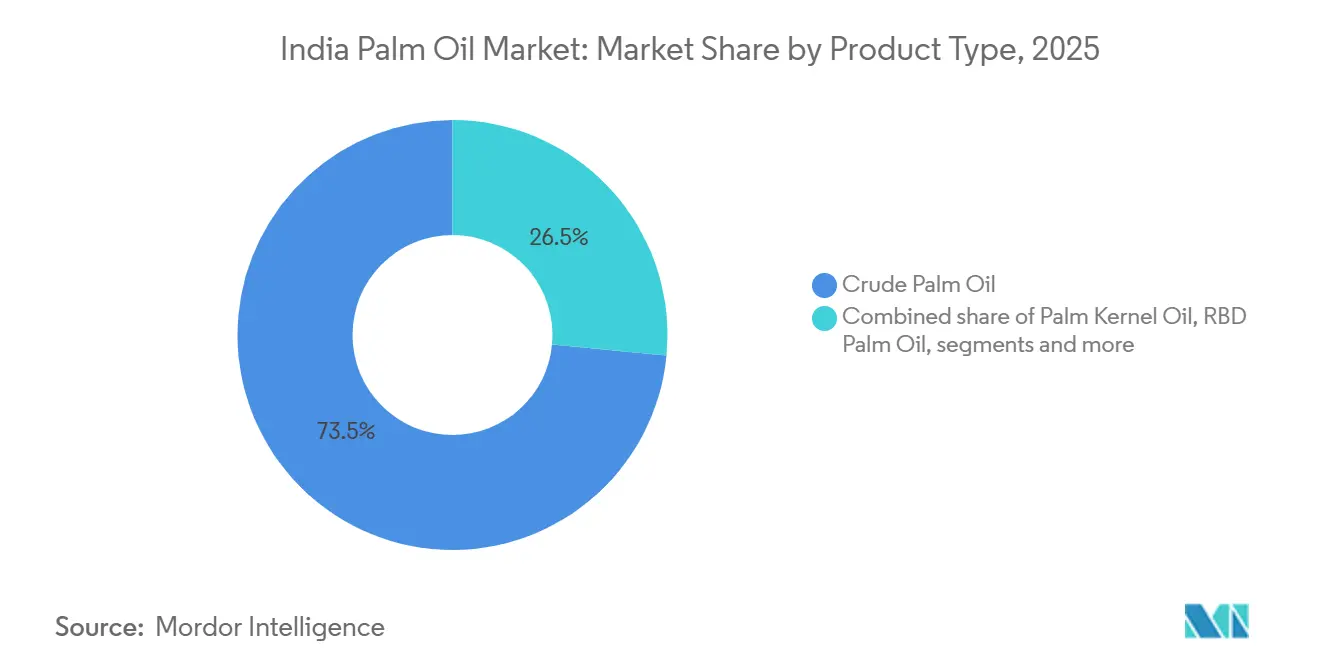
- By product type, crude palm oil held 73.48% of the India palm oil market share in 2025, while fractioned palm oil is forecast to grow at a 4.97% CAGR from 2026-2030 across India.
- By nature, conventional palm oil held 55.79% of the India palm oil market share in 2025, while organic palm oil is forecast to grow at a 5.13% CAGR from 2026-2030 in India.
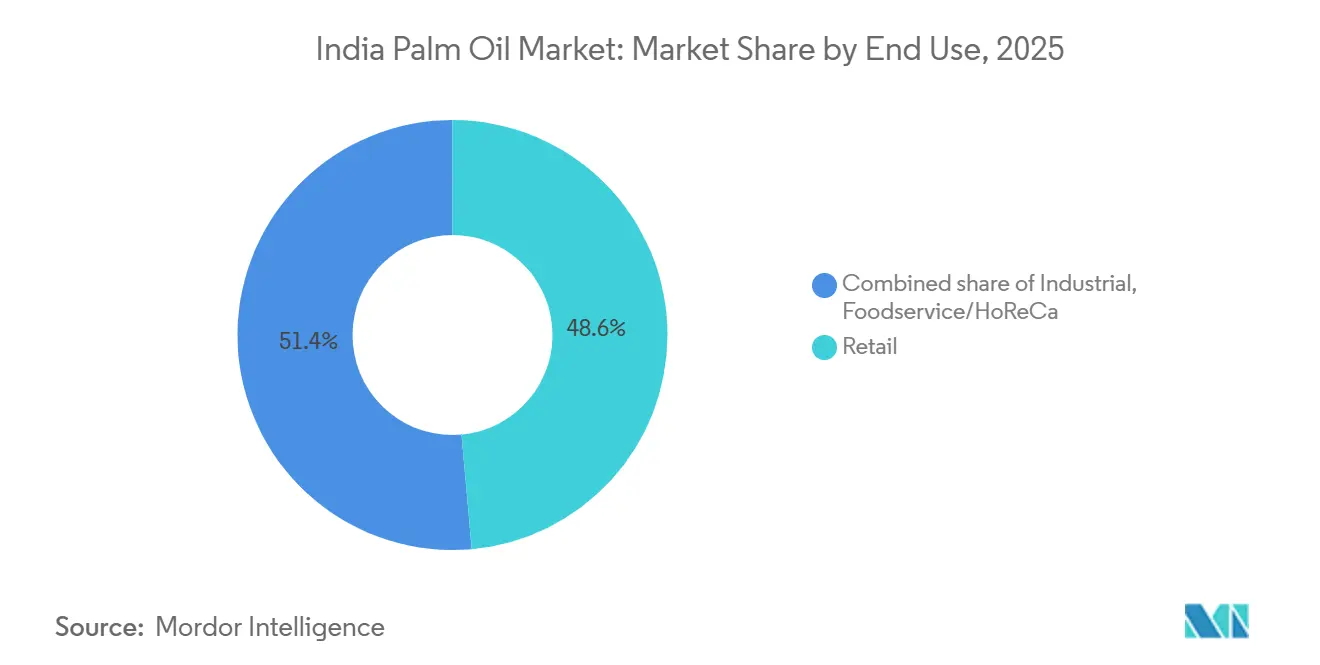
- By end use, retail held 48.57% of the India palm oil market share in 2025, while biofuel is forecast to grow at a 4.94% CAGR from 2026-2030 nationwide.
Note: Market size and forecast figures in this report are generated using Mordor Intelligence’s proprietary estimation framework, updated with the latest available data and insights as of January 2026.
India Palm Oil Market Trends and Insights
Drivers Impact Analysis*
| DRIVER | (~)% IMPACT ON CAGR FORECAST | GEOGRAPHIC RELEVANCE | IMPACT TIMELINE |
|---|---|---|---|
| Affordability advantage versus competing edible oils | +1.4% | National, with peak intensity in price-sensitive rural and Tier-3 markets | Short term (≤ 2 years) |
| Expansion of packaged food, foodservice, and HoReCa demand | +1.1% | National; early gains concentrated in metro and Tier-1/Tier-2 urban centres | Medium term (2–4 years) |
| National Mission on Edible Oils – oil palm and domestic cultivation | +0.7% | Primarily Andhra Pradesh, Telangana, and North-East states (Assam, Arunachal, Tripura) | Long term (≥ 4 years) |
| Growth of palm-based oleochemicals and biofuel applications | +0.5% | National industrial clusters; biofuel spill-over to Maharashtra, Gujarat, TN | Medium term (2–4 years) |
| Digitized smallholder aggregation and mill-level procurement | +0.3% | Focused on NMEO-OP states; widening to NE states where road infrastructure is being built | Long term (≥ 4 years) |
| Processing yield improvements and import-substitution economics | +0.4% | National refining clusters — Kandla, Kakinada, Haldia | Medium term (2–4 years) |
| Source: Mordor Intelligence | |||
Affordability advantage versus competing edible oils
Palm oil’s sustained price competitiveness against alternative edible oils, such as soybean and sunflower oil, remains one of the strongest structural drivers of demand in the Indian market. Crude palm oil frequently trades at a clear discount, making it the most economical major vegetable oil for refiners, food processors, and bulk buyers. When this price advantage widens, Indian importers and manufacturers quickly increase palm oil purchases, and when the discount narrows or reverses, buyers reduce palm oil imports and shift to alternatives. For example, in 2025, India’s Customs reduced the basic import duty on crude edible oils, including crude palm oil, from 20% to 10%. This reduction lowered the effective total import duty from 27.5% to 16.5% and widened the duty gap with refined palm oil from 8.25% to 19.25% in May 2025, which would nearly eliminate refined oil imports and redirect demand toward domestic refiners[1]Source: United States Department of Agriculture, India Cuts Import Tax on Crude Edible Oils - Opportunities for US Soybean Oil", fas.usda.gov. As a result, relative pricing against competing oils remains a key swing factor influencing month-to-month import patterns, refining margins, and overall consumption levels across India’s edible oil complex.
Expansion of packaged food, foodservice and HoReCa demand
The rapid expansion of India’s hotels, restaurants, and catering (HoReCa) sector, along with the steady growth of the organized packaged food industry, is driving strong secondary demand for palm oil. Rising urbanization, higher disposable incomes, and the proliferation of quick-service restaurants, cloud kitchens, and food delivery platforms have increased commercial frying and cooking volumes outside the home. High-volume kitchens widely prefer palm olein for its high oxidative stability, neutral taste, and resistance to repeated heating, making it a practical and economical option. At the same time, India’s packaged food segment, particularly biscuits, namkeens, etc., continues to scale production to meet domestic and export demand. Manufacturers rely heavily on refined palm oil for deep-fat frying, dough shortening, and shelf-life extension. The functional advantages of palm-based oils, along with cost competitiveness, is promoting its large-scale industrial applications.
National Mission on Edible Oils - oil palm and domestic cultivation
The National Mission on Edible Oils–Oil Palm (NMEO-OP) is steadily reshaping India’s upstream palm oil segment by shifting the country’s focus from import dependence to domestic cultivation and processing. The government launched the mission to expand the oil palm area, increase crude palm oil (CPO) output, and reduce India’s large edible oil import bill. The mission has already brought hundreds of thousands of additional hectares under plantation and supported the establishment of new processing mills in key growing regions, particularly in the North-East and other high-potential states. It aims to increase crude palm oil production to 28 lakh tonnes by 2029–30, compared with 3.80 lakh tonnes in 2024–25. Under the combined NMEO-OP and NMEO-Oilseeds missions, India’s domestic edible oil production is forecast to reach 25.45 million tonnes by 2030–31[2]Source: Press Information Bureau, "National Mission on Edible Oils - Strengthening India’s Edible Oil Ecosystem", pib.gov.in. Together, these missions target 72% self-sufficiency in edible oils by 2030–31. By expanding the cultivated base, stabilizing farmer returns, and fostering local processing capacity, the mission is laying the foundation for a more resilient and partially self-reliant palm oil supply system in India.
Growth of palm-based oleochemicals and biofuel applications
Beyond its traditional role in cooking and food processing, palm oil is gaining traction in India’s industrial segment through oleochemicals and emerging biofuel applications. Palm oil and palm kernel oil serve as key feedstocks for basic oleochemicals, including fatty acids, fatty alcohols, glycerine, and methyl esters. Manufacturers use these intermediates in soaps, detergents, surfactants, personal-care formulations, and various industrial chemicals, linking palm oil demand to the growth of India’s household and personal-care product industries. Policy support for biofuels is also creating additional non-food applications. India’s National Policy on Biofuels sets indicative blending targets for biodiesel and recognizes several feedstocks, including used cooking oil, animal fats, and palm-derived fractions such as palm stearin and palm fatty acid distillate (PFAD)[3]Source: Press Information Bureau, "National Mission on Edible Oils - Strengthening India’s Edible Oil Ecosystem", pib.gov.in. As domestic refining capacity processes larger volumes of imported and locally produced palm oil, these by-products become available for biodiesel production, offering refiners an alternative revenue stream and supporting the country’s renewable energy objectives.
Restraints Impact Analysis*
| RESTAINTS | (~)% IMPACT ON CAGR FORECAST | GEOGRAPHIC RELEVANCE | IMPACT TIMELINE |
|---|---|---|---|
| High dependence on imported crude palm oil | -0.9% | National; most acute at coastal refining hubs (Kandla, Kakinada, Haldia) | Short term (≤ 2 years) |
| Exposure to international palm oil prices, freight costs, and currency movements | -0.7% | Global supply-chain impact; sensitivity concentrated in Mumbai and Gujarat refining clusters | Short term (≤ 2 years) |
| Long gestation period and water-management requirements for domestic plantations | -0.5% | Primarily North-Eastern states and rain-shadow regions where infrastructure gaps remain | Long term (≥ 4 years) |
| Health concerns and negative consumer perception of palm oil | -0.3% | Premium retail and urban modern trade channels across metro cities | Medium term (2–4 years) |
| Source: Mordor Intelligence | |||
High dependence on imported crude palm oil
India’s heavy reliance on imported palm oil remains a structural restraint on the domestic market. The country meets a significant share of its edible oil requirements through imports, with palm oil representing the largest component of these purchases, primarily sourced from Indonesia and Malaysia. This concentrated dependence exposes the supply chain to policy changes, production fluctuations, and logistical disruptions in the two major exporting countries. Limited domestic production further increases this vulnerability, as it cannot serve as a rapid buffer during supply disruptions. Although India is implementing programs to expand oil palm cultivation, domestic crude palm oil output still accounts for only a modest share of total consumption. Consequently, any sustained disruption in import flows directly increases wholesale and retail prices, requiring industrial users and household consumers to absorb the impact or switch to alternative oils when relative prices permit.
Exposure to international palm oil prices, freight costs and currency movements
India’s palm oil market remains highly exposed to fluctuations in international crude palm oil prices, ocean freight rates, and the rupee's value. Since India imports most of its palm oil supply, any increase in benchmark prices in Malaysian or Indonesian markets quickly raises CIF (cost, insurance, and freight) values at Indian ports. Industry reports regularly highlight sharp month-on-month swings in landed costs when global prices strengthen, which directly compress refining margins and increase working capital requirements for importers. Freight and logistics costs add another layer of volatility. Shipping rates on the Indonesia/Malaysia–India route, along with insurance premiums, can rise abruptly during periods of geopolitical tension, vessel shortages, or route disruptions. These incremental costs add to already elevated commodity prices, increasing the final import bill even when the underlying oil price remains stable. Recent Middle East-related shipping uncertainties have shown how quickly freight and insurance surcharges can raise the cost of prompt and forward cargoes.
*Our forecasts treat driver/restraint impacts as directional, not additive. The impact forecasts reflect baseline growth, mix effects, and variable interactions.
Segment Analysis
By Product Type: Refining Scale Anchors Crude Palm Oil Dominance
Crude palm oil held the largest share of the palm oil market in 2025, accounting for 73.48%, primarily because of policy incentives that favor domestic refining and the structure of the local processing industry primarily supports this position. India maintains a deliberate duty differential between crude and refined palm oil. Crude palm oil attracts a significantly lower effective import duty than refined, bleached, and deodorized (RBD) palm oil or palm olein. As a result, importers and refiners prefer to import crude palm oil and process it locally into RBD palm oil, olein, stearin, and other fractions.
Fractioned palm oil is expected to grow at a compound annual growth rate (CAGR) of 4.97% through 2031, driven by rising demand from higher-value, application-specific segments within the food industry. Fractionation separates palm oil into solid (stearin) and liquid (olein) components, along with mid-fractions that offer tailored melting points and functional properties. Food manufacturers increasingly use these specialized fractions in bakery shortenings, confectionery fats, chocolate compounds, coatings, fillings, and dairy alternatives.



By Nature: Organic Sub-Segment Outpaces Conventional in Growth Trajectory
Conventional palm oil leads the market, with a 55.79% share in 2025, as it remains the most affordable and widely available form of the commodity for household and industrial users. Conventional palm oil benefits from large-scale global production, efficient import channels, and extensive domestic refining capacity, enabling suppliers to offer it at a significantly lower cost than most alternative edible oils. This cost advantage makes it the default choice for everyday household cooking, commercial frying in the HoReCa segment, and high-volume food processing applications, such as biscuits, snacks, and bakery products.
Organic palm oil is expected to grow at a CAGR of 5.13% through 2031, supported by shifting consumer preferences and retail trends. Rising health awareness among urban and higher-income consumers is increasing demand for food products perceived as cleaner or free from synthetic pesticides and chemical inputs. Organic-certified edible oils, including palm oil where available, are gaining traction in modern retail, specialty stores, and premium packaged food brands that cater to this consumer segment.
By End Use: Retail Leads, but Biofuel Disrupts the Growth Story
The retail segment leads the market, with a 48.57% share in 2025, as household cooking remains the largest end use for edible oils in India. Indian households widely consume palm oil and palm olein as affordable cooking oils in both loose and branded packaged formats. A large population, rising urbanization, and steady growth in per capita edible oil consumption ensure that household demand consistently exceeds demand from other channels. Major brands distribute refined palm-based oils through kirana stores, modern retail outlets, and e-commerce platforms, reinforcing the retail segment’s dominance.
The biofuel segment is expected to grow at a CAGR of 4.94% through 2031, ssupported by favorable policy direction and the search for alternative feedstocks. Although current blending levels remain very low, the policy framework encourages the use of non-food and by-product feedstocks, including palm stearin, palm fatty acid distillate (PFAD), and used cooking oil. As domestic palm oil refining generates these fractions and interest in renewable fuels increases, biodiesel producers are gradually increasing offtake of palm-derived materials.
Competitive Landscape
The Indian palm oil market has a moderately concentrated structure, with a few integrated players controlling refining, branding, distribution, and, increasingly, upstream cultivation. Leading companies, including Adani Wilmar, Patanjali Foods, Cargill India, Bunge India, and Marico Ltd, use their import scale, domestic refining capacity, and nationwide brand reach to influence supply. These companies operate large refining and packaging networks while managing India’s heavy reliance on imports, primarily from Indonesia and Malaysia, and responding to government efforts under the National Mission on Edible Oils–Oil Palm (NMEO-OP) to expand domestic production.
Sustainability, traceability, and alignment with domestic cultivation policies have become key competitive requirements. Major players are strengthening certified and responsible sourcing practices in response to global NDPE (No Deforestation, No Peat, No Exploitation) expectations, Indian regulations, and consumer pressure. Cargill reports high mill-level traceability scores in India and continues to partner with stakeholders to build deforestation-free supply chains. Bunge maintains global commitments to traceable and certified sustainable palm oil, supported by mill lists and monitoring coverage. Adani Wilmar has published sustainability policies to support the availability of certified palm oil for Indian customers and reports progress on ESG metrics linked to its imported volumes. Patanjali Foods emphasizes farmer-centric oil palm models that raise incomes and support India’s push to increase domestic output, while expanding plantation and mill capacity.
Competition is expected to intensify around operational efficiency, domestic sourcing, sustainability credentials, and innovation across commodity and value-added segments. Although imported palm oil continues to dominate supply, companies with strong refining networks, branded retail presence, and active participation in oil palm cultivation or farmer linkages are better positioned to manage price volatility, import duty changes, and rising demand for transparent and responsibly produced oil.
India Palm Oil Industry Leaders
-
Adani Wilmar Ltd.
-
Patanjali Foods Ltd.
-
Cargill India Pvt Ltd.
-
Bunge India Pvt Ltd.
-
Marico Ltd.
- *Disclaimer: Major Players sorted in no particular order

Recent Industry Developments
- July 2026: Godrej Agrovet inaugurated India’s first integrated oil palm complex in Khammam, Telangana, marking a significant milestone in strengthening the country’s domestic edible oil ecosystem. Spread across 130 acres, the facility integrates the entire oil palm value chain, from seed production and genetics to nursery operations, research and development, and oil palm milling. The company plans to add a state-of-the-art refinery in the next phase. Godrej Agrovet has committed approximately ₹300 crore in cumulative investment to the project.
- January 2026: Raj Oil Mills Limited launched PALMRAJ, a refined palmolein oil brand, to strengthen its presence in India’s domestic edible oil market. The launch expands the company’s edible oil portfolio and supports its strategy to capitalize on the rising demand for affordable cooking oils in India. Unlike some product launches targeting export markets, PALMRAJ focuses exclusively on domestic consumers, enabling Raj Oil Mills to strengthen its market share within the country.
- March 2024: India’s first integrated oil palm processing unit under the National Mission on Edible Oils – Oil Palm (NMEO-OP) was launched in Roing, Lower Dibang Valley, Arunachal Pradesh. Developed by 3F Oil Palm, the facility marks a significant step toward strengthening domestic palm oil production and reducing India’s heavy reliance on imported edible oils. The integrated project includes a modern oil palm processing mill, a zero-discharge effluent treatment plant, a palm waste-based power plant, and supporting logistics infrastructure.


India Palm Oil Market Report Scope
| Crude Palm Oil |
| Palm Kernel Oil |
| RBD Palm Oil |
| Fractioned Palm Oil |
| Palm Olein |
| Palm Stearin |
| Organic |
| Conventional |
| Industrial | Food Processing | Bakery and Confectionery |
| Dairy and Dairy Alternatives Products | ||
| RTE/RTC Food Products | ||
| Snacks | ||
| Others | ||
| Personal Care and Cosmetics | ||
| Animal Feed | ||
| Biofuel | ||
| Others | ||
| Foodservice/HoReCa | ||
| Retail | Supermarkets/Hypermarket | |
| Convenience Stores | ||
| Online Retail Stores | ||
| Others |
| By Product Type | Crude Palm Oil | ||
| Palm Kernel Oil | |||
| RBD Palm Oil | |||
| Fractioned Palm Oil | |||
| Palm Olein | |||
| Palm Stearin | |||
| By Nature | Organic | ||
| Conventional | |||
| By End Use | Industrial | Food Processing | Bakery and Confectionery |
| Dairy and Dairy Alternatives Products | |||
| RTE/RTC Food Products | |||
| Snacks | |||
| Others | |||
| Personal Care and Cosmetics | |||
| Animal Feed | |||
| Biofuel | |||
| Others | |||
| Foodservice/HoReCa | |||
| Retail | Supermarkets/Hypermarket | ||
| Convenience Stores | |||
| Online Retail Stores | |||
| Others | |||


Key Questions Answered in the Report
What is the projected value of India’s palm oil sector by 2030?
It is forecast to reach USD 19.08 billion by 2030, from USD 14.86 billion in 2025, at a 5.12% CAGR.
Which palm oil product leads demand in India?*
Crude palm oil led product demand with a 73.48% share in 2025 because India has substantial domestic refining capacity.
Which end-use category is growing fastest?
Biofuel is forecast to grow at a 4.94% CAGR from 2026-2030, supported by palm stearin use in biodiesel
Who are the important companies in India’s palm oil value chain?
AWL Agri Business, Patanjali Foods, Godrej Agrovet, and 3F Oil Palm are notable companies, with several investing in cultivation, milling, refining, or traceability.
Page last updated on:





