
India Organic Food Market Size and Share
Market Overview
| Study Period | 2022 - 2032 |
|---|---|
| Forecast Data Period | 2027 - 2032 |
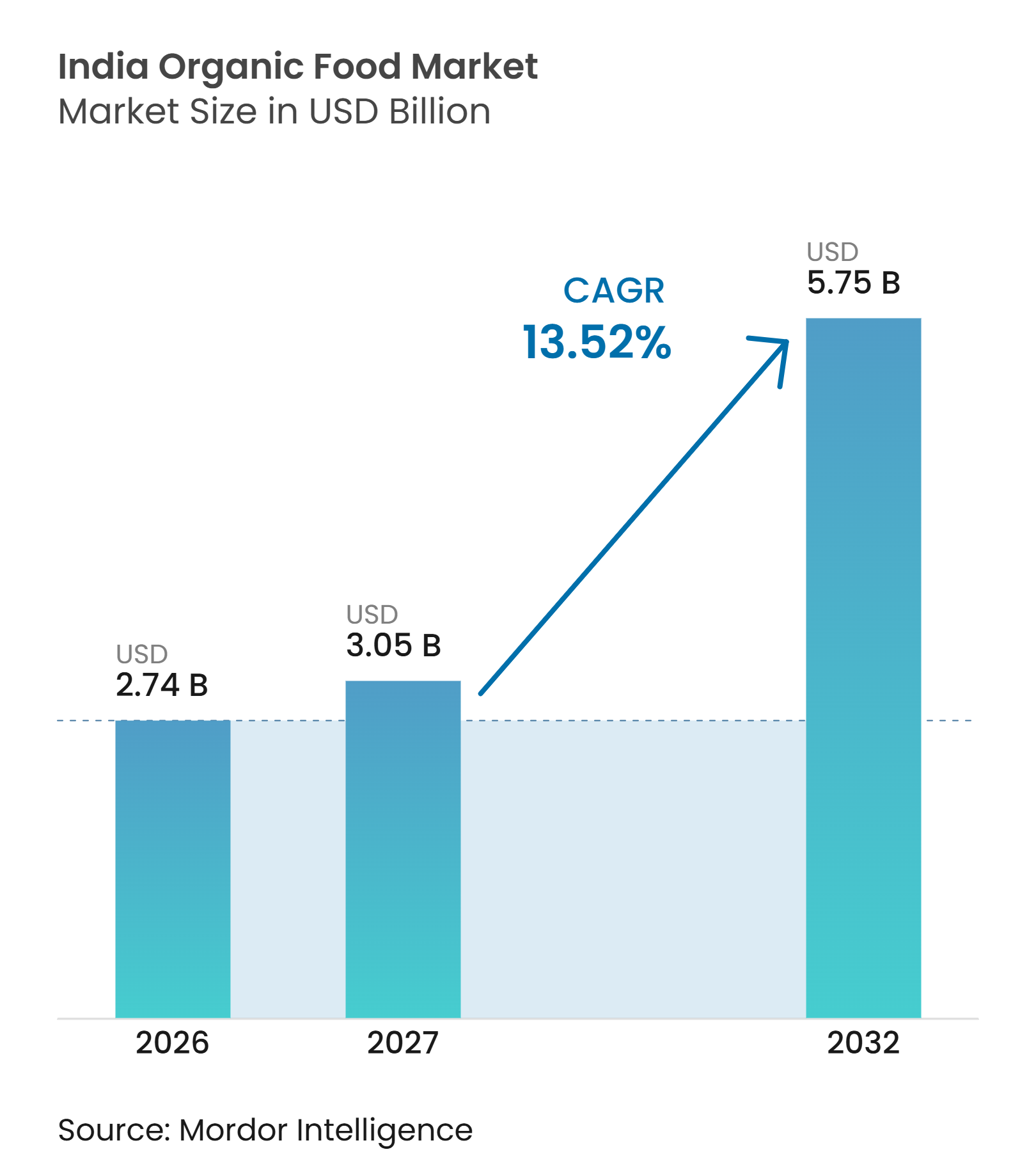
| Base Year Market Size (2026) | USD 2.74 Billion |
| Market Size (2027) | USD 3.05 Billion |
| Market Size (2032) | USD 5.75 Billion |
| Growth Rate (2027 - 2032) | 13.52 % |
| Market Concentration | Low |
Major Players *Disclaimer: Major Players sorted in no particular order Image © Mordor Intelligence. Reuse requires attribution under CC BY 4.0. | |
India Organic Food Market Analysis by Mordor Intelligence
The Indian organic food market is valued at USD 2.74 billion in 2026 and is forecast to reach USD 5.75 billion by 2032, registering a CAGR of 13.52% during 2027–2032. The market is gaining traction due to rising health consciousness, concerns regarding pesticide residues, and growing demand for naturally produced food. According to APEDA, India produced 4.39 million tons of certified organic farm products in FY 2024–25, supported by approximately 2.25 million hectares of organically cultivated farmland. The market includes cereals, millets, pulses, fruits, vegetables, spices, tea, coffee, and processed foods. Furthermore, government initiatives, including the revised National Program for Organic Production (NPOP), implemented in July 2025, are strengthening certification, traceability, and export credibility, thereby supporting broader market development[1].
Key Report Takeaways
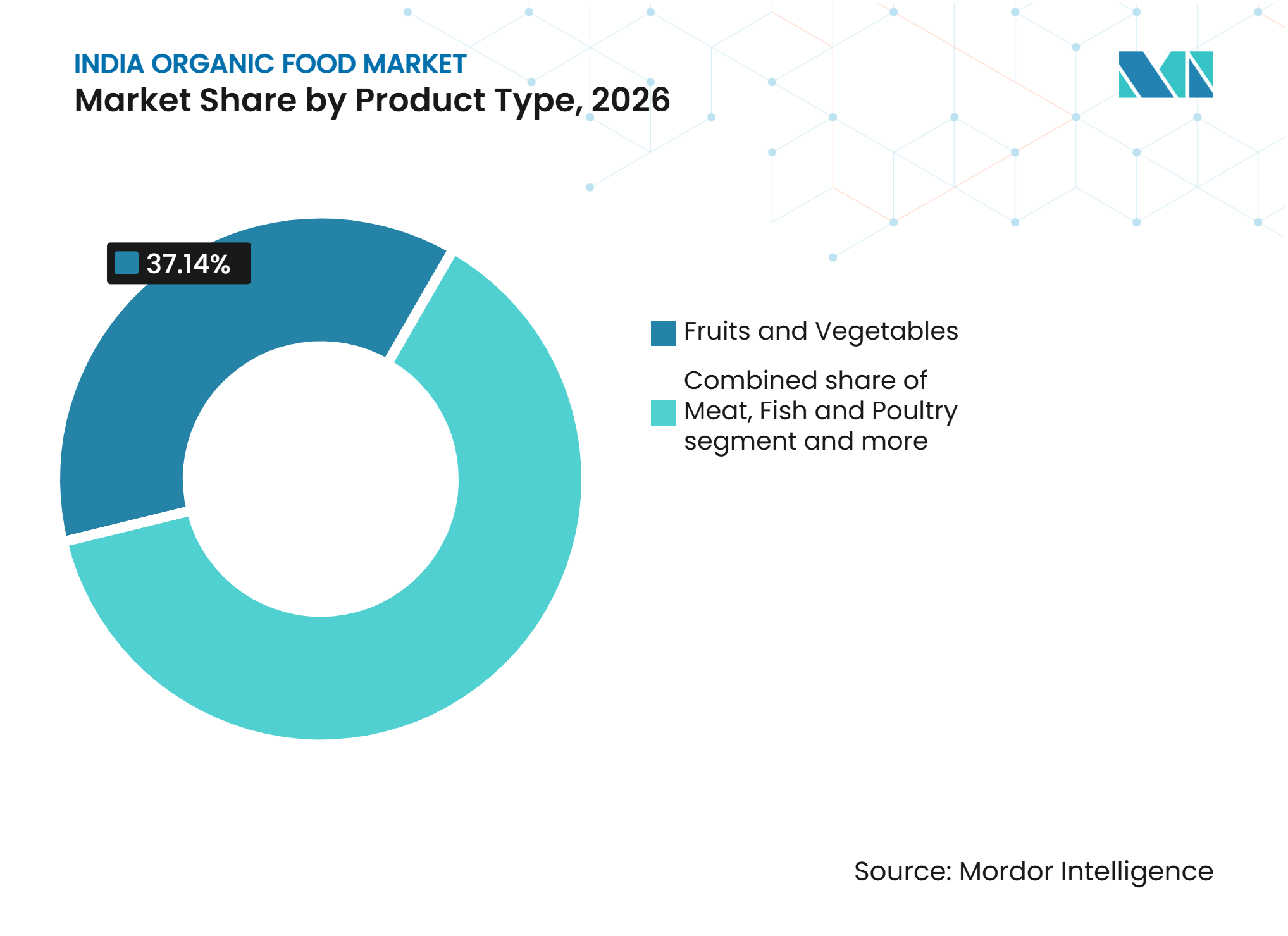
- By product type, fruits and vegetables held 37.14% of the share in the Indian organic food market in 2026, while meat, fish, and poultry is forecast to grow at a CAGR of 14.81% through 2032.
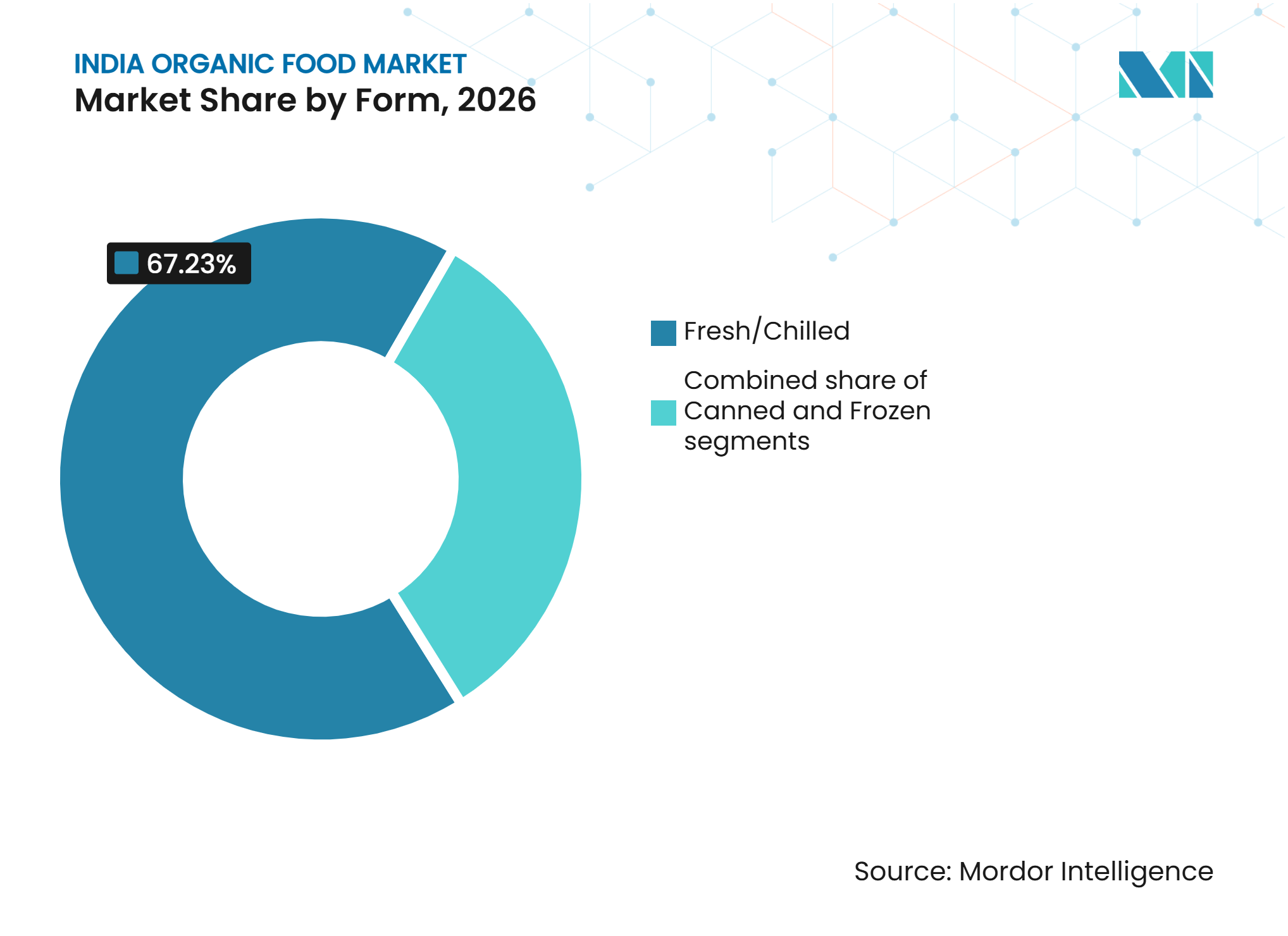
- By form, fresh and chilled products accounted for 67.23% of the share in the Indian organic food market in 2026, while frozen products are projected to expand at a CAGR of 14.79% through 2032.
- By distribution channel, supermarkets and hypermarkets held 46.45% of the share in the Indian organic food market in 2026, while online retail stores are forecast to grow at a CAGR of 15.12% through 2032.
Note: Market numbers in this report are based on Mordor Intelligence's proprietary estimation framework, which combines nine months of actuals with Q4 projections for base year 2026.
Market Trends and Insights
Drivers Impact Analysis of India Organic Food Market*
| Driver | (~) % Impact on CAGR Forecast | Geographic Relevance | Impact Timeline |
|---|---|---|---|
| Government Support for Organic Farming and Certification | +2.8% | National, with concentrated gains in North India, the Northeast, and South India | Short term (≤ 2 years) |
| Growing Demand for Certified Staples and Packaged Foods | +2.5% | National, with early momentum in metro and Tier-1 markets | Medium term (2-4 years) |
| Rising Health and Food-Safety Awareness | +2.2% | National, with Tier-2 and Tier-3 cities supporting the next uptake wave | Medium term (2-4 years) |
| Expansion of Organized Retail and E-Commerce | +2.0% | National, with early gains in Delhi-NCR, Mumbai, Bengaluru, and Hyderabad | Short term (≤ 2 years) |
| Farmer-to-Consumer and Subscription-Based Distribution | +1.0% | Concentrated in South India and Maharashtra, with expansion toward West India | Long term (≥ 4 years) |
| Organic Traceability as a Premiumization Mechanism | +0.8% | National, with early adoption in metro premium and health-focused segments | Long term (≥ 4 years) |
| Source: Mordor Intelligence | |||
Government Support for Organic Farming and Certification
India strengthened its policy support for organic farming after 2024 through farm-cluster development and revised certification processes. For instance, the eighth edition of the National Program for Organic Production (NPOP), implemented in July 2025, introduced web-based TraceNet traceability, simplified grower-group certification, and revised land-conversion provisions. Similarly, the National Mission on Natural Farming, with an outlay of INR 2,481 crore, targets 7.5 lakh hectares through 15,000 clusters and had enrolled more than 10 lakh farmers as of July 2025[2]. As of February 2025, the Paramparagat Krishi Vikas Yojana had disbursed INR 2,265.86 crore and supported 25.30 lakh farmers. These initiatives provide producers with certification pathways under NPOP for export markets and PGS-India for domestic sales. The Indian organic food market can benefit as more farms obtain the documentation required to supply organized retailers and food processors.
Growing Demand for Certified Staples and Packaged Foods
Growing demand for certified organic staples and packaged foods is creating repeat-purchase opportunities beyond fresh produce, as consumers increasingly incorporate organic products into grocery baskets. This shift is encouraging established FMCG companies to expand through wider portfolios and trusted sourcing networks. In 2025, ITC completed its acquisition of Sresta Natural Bioproducts, owner of the 24 Mantra Organic brand, for INR 472.5 crore. The transaction gave ITC access to more than 100 organic stock-keeping units and a network of 27,000 farmers, strengthening its reach across certified food categories. A broader portfolio enables brands to address price points while leveraging procurement, certification and distribution capabilities. It also allows consumers to purchase organic staples, snacks, beverages and wellness products, reducing the need to switch suppliers. Tata Consumer Products reported growth for Organic India in FY2025 and continued developing its health and wellness portfolio and pharmacy distribution. These investments indicate rising strategic interest among established consumer companies. Wider product availability, consistent quality, and trusted certification can encourage repeat purchases, improve retailer confidence, and support dedicated organic shelf space across supermarkets and online grocery platforms.
Rising Health and Food-Safety Awareness
Health and food-safety concerns are shaping interest in organic products across a wider range of buyers. A 2025 study of Indian consumers found that health cognition and product knowledge were important drivers of attitudes toward organic food, while price sensitivity remained a major constraint. Another 2025 study found that high prices were the leading barrier cited by respondents, even when future purchase preferences exceeded current consumption. Research on online purchase intentions also identified food-safety concerns and electronic word-of-mouth as important influences on consumer behavior. These findings support the use of clear labels, test records, and product information rather than broad health claims. The Indian organic food market can reach more first-time buyers when information is easy to understand, and prices are closer to conventional alternatives. Clear product information is particularly relevant when buyers are comparing certification claims for the first time. It can help distinguish verified organic products from broad natural or health-oriented positioning. Retailers and brands therefore have a practical role in explaining what certification means at the point of purchase. That effort is likely to matter across both physical stores and digital listings.
Expansion of Organized Retail and E-Commerce
Organized retail and digital platforms are expanding the number of ways consumers can discover certified products. For instance, Swiggy Instamart partnered with National Cooperative Organics Limited in January 2025 to list 21 Bharat Organics products with QR-code access to pesticide-residue test reports. Tata Consumer Products identified e-commerce as Organic India’s largest and fastest-growing channel in Q4 FY2025. Supermarkets still provide visible shelves, product comparison, and direct reassurance for buyers who want to inspect labels. Quick commerce adds convenience for replenishment purchases and supports smaller basket sizes. These channels are complementary because physical retail can build familiarity while digital platforms can offer detailed product data. The Indian organic food market therefore has more routes to reach households outside established specialty-store catchments.
Restraints Impact Analysis of India Organic Food Market*
| Restraint | (~) % Impact on CAGR Forecast | Geographic Relevance | Impact Timeline |
|---|---|---|---|
| Organic Price Premium and Limited Mass-Market Affordability | -1.8% | National, with stronger effects in Tier-2, Tier-3, and rural markets | Short term (≤ 2 years) |
| Low Yield During Farm Conversion and Limited Certified Inputs | -1.2% | National, concentrated in staple-crop regions of Madhya Pradesh, Uttar Pradesh, and Rajasthan | Medium term (2-4 years) |
| Limited Consumer Awareness in Developing Regions | -0.9% | Semi-urban and rural India, with effects in smaller Tier-2 cities | Medium term (2-4 years) |
| Fragmented Cold Chain and Last-Mile Handling | -0.8% | National, with acute gaps in the Northeast, East India, and rural supply corridors | Long term (≥ 4 years) |
| Source: Mordor Intelligence | |||
Organic Price Premium and Limited Mass-Market Affordability
Price remains the clearest obstacle to regular organic food purchases. The source draft reports that certified organic foods commonly carry a 20% to 70% price premium over conventional products, while urban consumers indicate a lower acceptable range. This gap is especially important for staple foods, where households compare products frequently and have many conventional options. Direct sourcing can reduce layers between farms and consumers, but it does not remove certification, handling, and smaller-scale processing costs. The Indian organic food market will remain concentrated among higher-income buyers unless brands improve pack sizes, sourcing efficiency, and value communication. Smaller packages can reduce the immediate cost of trial, although they do not resolve the unit-price gap. Regular demand for staples is more difficult to build when the premium remains high. Farm-level productivity after conversion is equally important because supply constraints can keep prices elevated. The category needs dependable volumes as well as consumer willingness to pay.
Fragmented Cold Chain and Last-Mile Handling
Inadequate cold-chain integration across farm-gate collection, pre-cooling, refrigerated transportation, and retail distribution creates operational challenges for India's organic food market, particularly for perishable fruits, vegetables, and dairy products. According to a July 2025 government-reported NABCONS study, post-harvest losses ranged from 6.02% to 15.05% for fruits and 4.87% to 11.61% for vegetables. Furthermore, a 2025 FICCI–Grant Thornton assessment highlighted that approximately three-quarters of India's 40.22 million tons of cold-storage capacity was dedicated to potatoes. Such infrastructure concentration limits access to suitable storage and temperature-controlled logistics for other produce. Consequently, organic suppliers face higher wastage, shorter shelf life, and increased distribution costs, potentially restricting retail availability and market penetration.
*Our forecasts treat driver/restraint impacts as directional, not additive. The impact forecasts reflect baseline growth, mix effects, and variable interactions.
India Organic Food Market Segment Analysis
By Product Type:
Fruits and Vegetables Lead While Animal Proteins ExpandFruits and vegetables held 37.14% of the Indian organic food market share in 2026. Their position reflects frequent household use and strong consumer interest in fresh, pesticide-free foods. A 2025 consumer study identified demand for organic fruits, vegetables, and dairy among Indian respondents. This segment benefits when local retail and direct delivery reduce the time between farm and household. Certified produce also gives brands a straightforward way to demonstrate origin and farming practices. Everyday relevance should help fruits and vegetables remain central to the Indian organic food market as awareness broadens.
Meat, fish, and poultry is forecast to grow at a 14.81% CAGR through 2032. Interest in antibiotic-free protein is supporting this category among urban consumers. India launched its first organic aquaculture cluster in Sikkim in January 2025 with NABARD backing and combined project investments of INR 50 crore, which is equivalent to USD 5.9 million, according to the Press Information Bureau. The initiative connects production standards with premium domestic and export demand. Growth will depend on reliable certification and temperature-controlled logistics. These needs make animal proteins a promising but operationally demanding part of the Indian organic food industry.


By Form:
Fresh and Chilled Products Retain a Strong Base, Frozen Products GainFresh and chilled products accounted for 67.23% of the Indian organic food market share in 2026. The format matches buyer preference for minimally processed food and supports the established organic dairy proposition. Akshayakalpa Organic uses direct and subscription channels for a meaningful share of its business, which helps it control delivery conditions for fresh products. Fresh products can build trust because consumers can see quality cues at the point of purchase. However, the format remains dependent on regional production and efficient local delivery. Growth in fresh formats will be strongest where cold-chain and subscription systems are dependable.
Frozen products are projected to grow at a 14.79% CAGR through 2032. The format can improve convenience and reduce waste when transport and storage standards are met. ITC’s 24 Mantra Organic has developed frozen products for its US distribution network, according to the source draft. This experience may provide a useful operating base if frozen organic ranges expand in India. Frozen meat and poultry could benefit most because consumers need safe storage as well as product assurance. The Indian organic food market may see stronger frozen adoption as refrigerated distribution becomes more accessible.

By Distribution Channel:
Supermarkets Remain Important While Online Retail AdvancesSupermarkets and hypermarkets held 46.45% of the share in the Indian organic food market by distribution channel in 2026. These stores offer wider assortments and allow shoppers to check labels and compare certified products. A 2025 study published by the Journal of Information Systems and Engineering Management focused on Chennai found that supermarkets were the preferred organic food purchase location among urban consumers. Dedicated shelves and in-store visibility can reduce uncertainty in a category where authentication matters. Specialty stores serve buyers who place particular weight on provenance and traceability. Physical outlets will remain valuable even as digital purchasing grows because many consumers still want an immediate trust signal.
Online retail stores are forecast to grow at a 15.12% CAGR through 2032. Digital platforms can display test results, product details, and certifications in ways that are difficult to provide on a shelf. Bharat Organics products on Swiggy Instamart include QR-code access to test reports covering 245 pesticide residues[3]. This approach can make transparency a practical part of the buying process. Online channels also improve access for households that lack a nearby specialty outlet. The Indian organic food market can use these tools to pair convenience with proof of product quality.
Geography Analysis
South India: Organic Dairy and Certified Produce at Scale
South India represents a promising regional market for organic food, supported by urban consumption centers and established farmer-to-market supply networks. Akshayakalpa Organic reported a network of over 2,200 farmers across Karnataka, Tamil Nadu, Andhra Pradesh and Telangana, with monthly sales of INR 46 crore in November 2025, including INR 36 crore from Bengaluru. Supply-side development is further reflected in Kerala's NPOP-certified organic exports, which reached USD 76.39 million in FY2024–25, compared with USD 41.80 million previously. Tamil Nadu also recorded 32,430 hectares under organic management, supporting regional production, processing, and retail expansion.
North and Central India: Supply Base and Urban Consumption
Haryana recorded USD 104.56 million in NPOP-certified organic exports in 2024-25. Uttar Pradesh and Madhya Pradesh contribute significantly to India’s certified organic cultivation base and land under conversion. Delhi-NCR supports demand through premium supermarkets and specialty retail formats. In July 2025, Nature Bio Foods, a subsidiary of LT Foods, opened a 20,000-square-meter direct-to-consumer facility in Rotterdam to expand its reach in Europe. The facility supports a supply model that connects Indian-origin organic staples with overseas consumers. NPOP certification and traceability remain the primary compliance requirements for this export-oriented activity. Consequently, North and Central India link agricultural production, branded organic staples, and high-value urban demand.
Western India and the Northeast: Developing Production and Export Nodes
Western India is expanding production capacity and consumer demand through Maharashtra and Rajasthan. In July 2026, Maharashtra-based Two Brothers Organic Farms raised INR 110 crore (USD 12.4 million) in a Series B funding round to expand its manufacturing capabilities and digital traceability systems. The company’s QR code-based system links products to their production history, reflecting growing consumer interest in verifiable product provenance. The Northeast is also expected to receive increased government support through producer engagement and export promotion initiatives. In November 2025, APEDA organized Northeast India Organic Week in Shillong, bringing buyers from 14 countries together with producers of Lakadong turmeric, organic ginger, and specialty teas. These regions can broaden the supply base; however, logistics and cold-chain infrastructure gaps require attention. Overall, the Indian organic food market is becoming less dependent on a limited number of urban consumption and production centers.
Competitive Landscape
Market Concentration
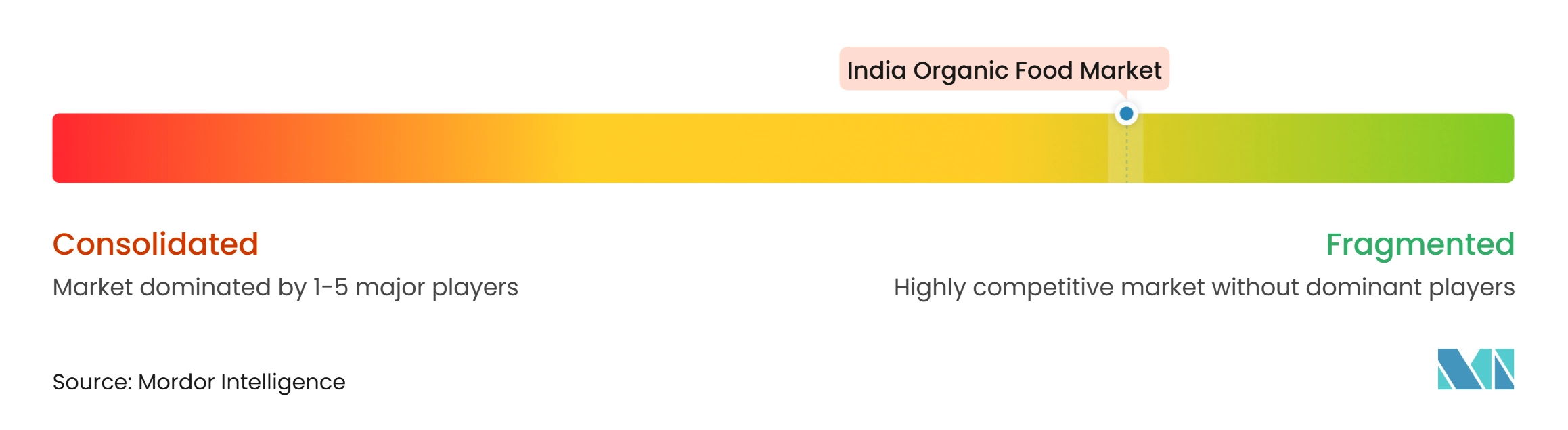
The Indian organic food market is fragmented, with visible participants including ITC through 24 Mantra Organic, Tata Consumer Products through Organic India, Akshayakalpa Organic, Nature Bio Foods, and Natureland Organics. ITC’s planned 2025 acquisition of Sresta Natural Bioproducts is expected to add the 24 Mantra Organic brand to its broader consumer products portfolio. The acquisition is also expected to provide ITC with access to a substantial farmer network and a broad product portfolio. Tata Consumer Products is expanding Organic India’s wellness portfolio and pharmacy presence while maintaining its focus on e-commerce. Companies compete primarily on sourcing capabilities, distribution reach, and consumer trust rather than price alone.
Traceability is emerging as a more prominent competitive differentiator. Bharat Organics uses QR codes on its quick-commerce listings to provide pesticide-residue test reports. Two Brothers Organic Farms also uses QR code-based traceability to provide information on sourcing and processing. These systems can help established brands communicate certification status and product origin to consumers while making it more difficult for unverified products to compete using similar claims. FSSAI’s Jaivik Bharat labeling framework and NPOP certification remain key compliance requirements for market participants.
Smaller direct-to-consumer brands are using subscription models and farmer-linked delivery to build customer loyalty, particularly in dairy products and staples. Akshayakalpa has committed INR 70 crore (USD 8.3 million) to expand its Hyderabad processing facility and has started planning a facility in Maharashtra. Nature Bio Foods is leveraging its Rotterdam facility to strengthen direct access to European consumers. Competition is likely to be particularly intense in frozen products and animal proteins, as both categories require certification and cold-chain capabilities. Brands that demonstrate consistent handling standards may gain a competitive advantage in these categories. Larger companies can leverage their established distribution networks, while specialist players can compete through direct farm relationships. Consequently, the market supports multiple operating models rather than a single uniform competitive approach. The available draft does not provide combined market share data for leading companies and, therefore, does not support a quantified market concentration estimate.
India Organic Food Industry Leaders
-
Akshayakalpa Farms & Foods Pvt Ltd
-
B&B Organics Pvt Ltd
-
Sresta Natural Bioproducts Pvt. Ltd.
-
Tata Consumer Products Ltd
-
ITC Limited
- *Disclaimer: Major Players sorted in no particular order
India Organic Food Market Companies Covered in this Report
- Akshayakalpa Farms & Foods Pvt Ltd
- B&B Organics Pvt Ltd
- Conscious Food Private Limited
- Ecofarms
- Elworld Organic
- ITC Limited
- Mehrotra Consumer Products Pvt. Ltd.
- Nature Bio-Foods Ltd
- Nature Pearls Pvt Ltd
- Natureland Organics
- Nourish Organic Foods Pvt. Ltd.
- Organic India Pvt. Ltd.
- Phalada Agro Research Foundations Pvt. Ltd.
- Reliance Retail Limited
- Sresta Natural Bioproducts Pvt. Ltd.
- Suminter India Organics
- Tata Consumer Products Ltd
- National Cooperative Organics Limited
- Patanjali Ayurved Limited
- Two Brothers Organic Farms
Recent Industry Developments in India Organic Food Market
- November 2026: Organic India, a Tata Consumer Products brand, launched its new Certified Organic Nuts and Seeds range in India, marking the brand’s expansion into the broader space of everyday nutrition. The range debuts with certified organic Almonds, cashews, and Walnuts, along with six seed variants, including Chia, Flax, Pumpkin, Sesame, sunflower, and Watermelon.
- January 2026: Akshayakalpa Organic launched 11 yogurt and buttermilk variants across Bengaluru, Chennai, and Hyderabad, expanding its certified organic dairy portfolio into higher-margin, value-added segments.
- July 2025: Nature Bio Foods (LT Foods' organic subsidiary) inaugurated a new B2C facility at Maasvlakte, Rotterdam, spread over 20,000 sq m, with four CO₂ treatment chambers, three processing lines, and smart warehouse management, with an initial capital expenditure of INR 20 crore (approximately USD 2.4 million) and an additional INR 15 crore planned over three years.
India Organic Food Market Report Scope
Organic food refers to fresh or processed food produced using ingredients from organic farming methods. The Indian organic food market is segmented by product type, form, and distribution channel. By product type, the market is segmented into fruits and vegetables, meat, fish and poultry, dairy products, frozen and processed foods, and other foods. By form, the market is segmented into fresh/chilled, canned, and frozen. By distribution channel, the market is segmented into supermarkets/hypermarkets, convenience stores, specialty stores, online retail stores, and other distribution channels. The market forecasts are provided in terms of value (USD).
Segmentation Overview
| Fruits and Vegetables |
| Meat, Fish and Poultry |
| Dairy Products |
| Frozen and Processed Foods |
| Other Foods |
| Fresh/Chilled |
| Canned |
| Frozen |
| Supermarkets/Hypermarkets |
| Convenience Stores |
| Specialty Stores |
| Online Retail Stores |
| Other Distribution Channels |
| By Product Type | Fruits and Vegetables |
| Meat, Fish and Poultry | |
| Dairy Products | |
| Frozen and Processed Foods | |
| Other Foods | |
| By Form | Fresh/Chilled |
| Canned | |
| Frozen | |
| By Distribution Channel | Supermarkets/Hypermarkets |
| Convenience Stores | |
| Specialty Stores | |
| Online Retail Stores | |
| Other Distribution Channels |
Key Questions Answered in the Report
What is the projected growth rate for organic food in India?
The Indian organic food market is forecast to grow at a 13.52% CAGR from 2027 to 2032, reaching USD 5.75 billion in 2032.
Which organic food category has the largest share in India?
Fruits and vegetables lead product demand with a 37.14% share in 2026.
Which organic food category is growing fastest in India?
Meat, fish, and poultry is forecast to grow at a 14.81% CAGR through 2032.
Which sales channel leads organic food purchases in India?
Supermarkets and hypermarkets held 46.45% of distribution-channel sales in 2026.