
India Optical Ground Wire (OPGW) Market Size and Share
Market Overview
| Study Period | 2022 - 2032 |
|---|---|
| Forecast Data Period | 2027 - 2032 |
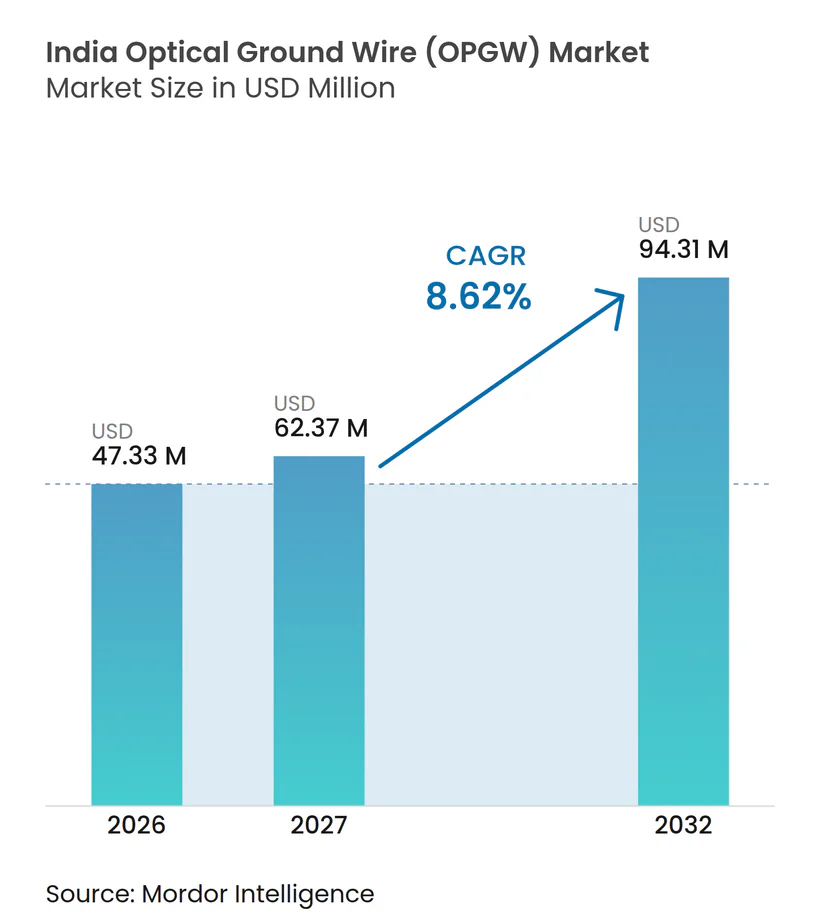
| Base Year Market Size (2026) | USD 47.33 Million |
| Market Size (2027) | USD 62.37 Million |
| Market Size (2032) | USD 94.31 Million |
| Growth Rate (2027 - 2032) | 8.62 % |
| Market Concentration | Medium |
Major Players *Disclaimer: Major Players sorted in no particular order Image © Mordor Intelligence. Reuse requires attribution under CC BY 4.0. | |
India Optical Ground Wire (OPGW) Market Analysis by Mordor Intelligence
The India Optical Ground Wire Market size is projected to be USD 47.33 million in 2026, USD 62.37 million in 2027, and reach USD 94.31 million by 2032, at a CAGR of 8.62% from 2027 to 2032. Expansion of the inter-state transmission system is creating a sustained requirement for communications and lightning protection on new high-voltage lines. The Central Electricity Authority has set a minimum 48-fiber planning standard for new transmission projects and requires 96-fiber cable within city limits, which raises the technical baseline for new procurement[1]. The India Optical Ground Wire (OPGW) market is also being supported by grid digitization, because SCADA, phasor measurement units, and teleprotection need dependable high-capacity links. National Broadband Mission 2.0 identifies OPGW as a means to improve connectivity in remote and hilly regions and to strengthen network resilience during disasters. Execution capacity, input costs, and vendor qualification remain important limits on how quickly the project pipeline converts into completed installations.
Key Report Takeaways
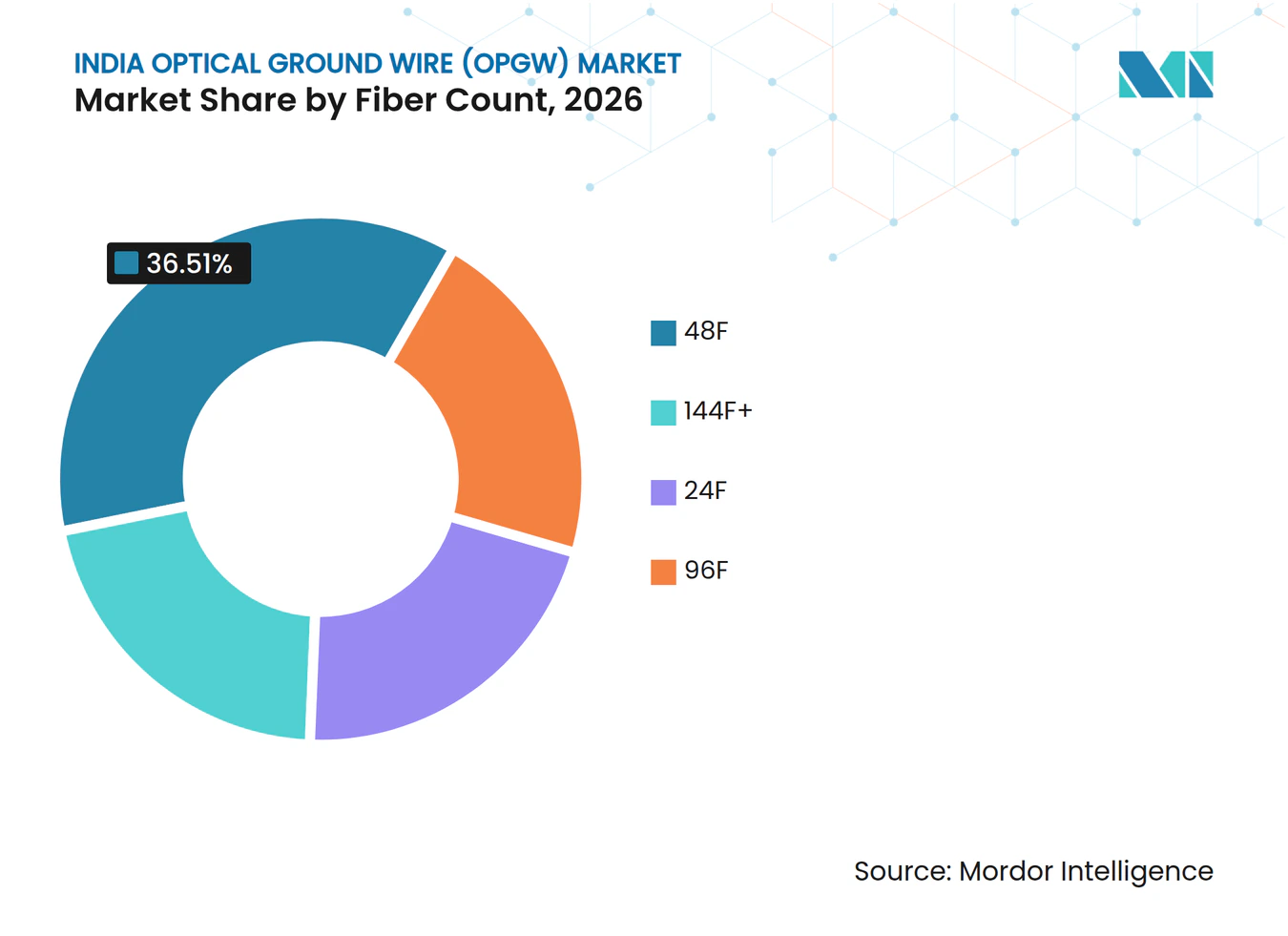
- By fiber count, 48F held 36.51% of the India Optical Ground Wire (OPGW) market share in 2026, while 96F is forecast to grow at a 12.11% CAGR through 2032.
- By cable design type, Design A accounted for 37.11% of the India Optical Ground Wire (OPGW) market size in 2026, while Design B is forecast to grow at a 9.23% CAGR through 2032.
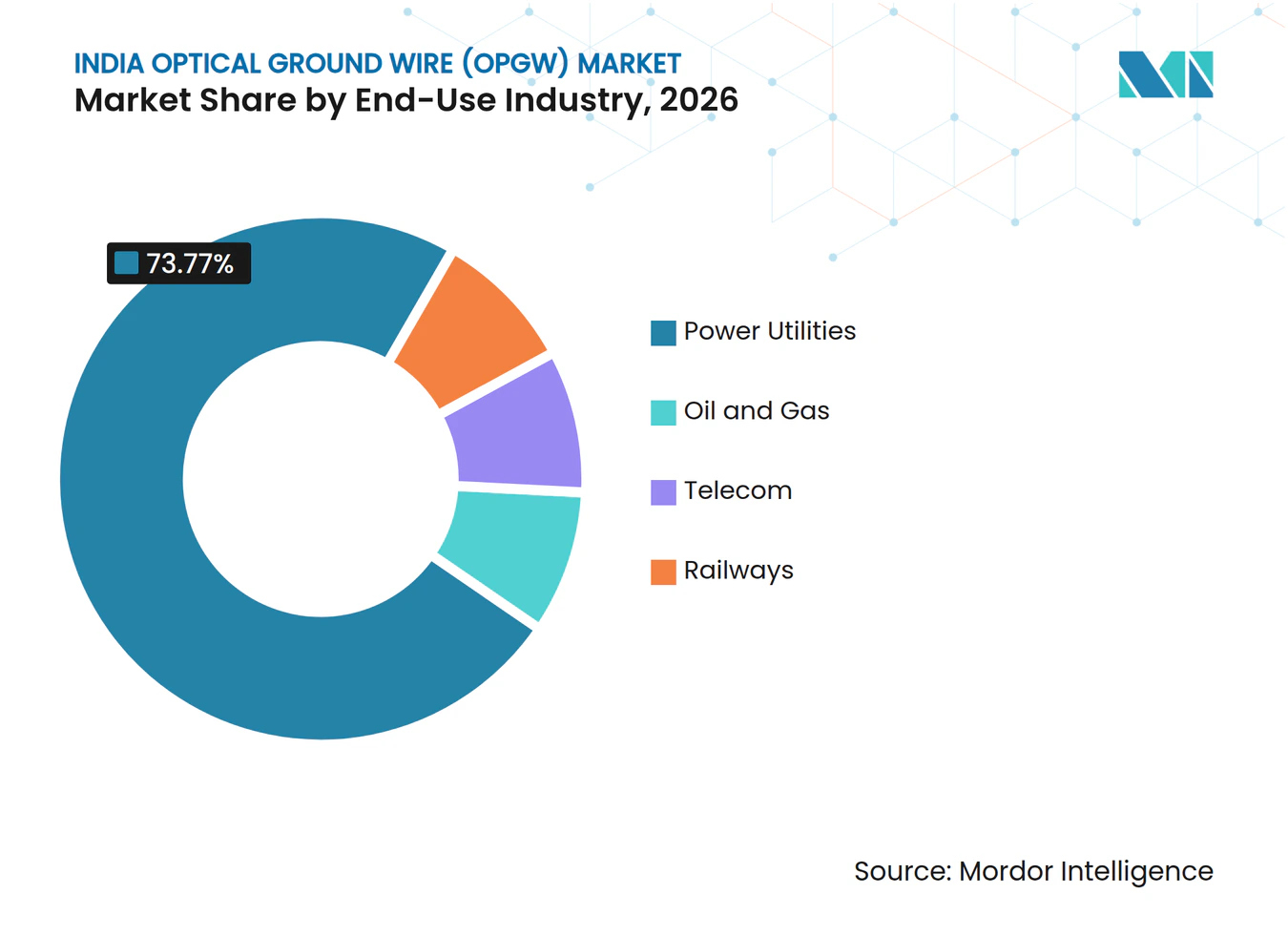
- By end-use industry, Power Utilities held 73.77% of the India Optical Ground Wire (OPGW) market share in 2026 and is forecast to grow at a 9.02% CAGR through 2032.
Note: Market numbers in this report are based on Mordor Intelligence's proprietary estimation framework, which combines nine months of actuals with Q4 projections for base year 2026.
India Optical Ground Wire (OPGW) Market Trends and Insights
Drivers Impact Analysis*
| Driver | (~) % Impact on CAGR Forecast | Geographic Relevance | Impact Timeline |
|---|---|---|---|
| Expansion of Inter-State Transmission Corridors for Renewable-Energy Evacuation | +2.80% | National, with concentrated activity in Gujarat, Rajasthan, Tamil Nadu, and Karnataka | Long term (≥ 4 years) |
| CEA-Backed Shift Toward 48F and 96F OPGW Planning | +2.20% | National; urban-corridor intensification in metro transmission rings | Short term (≤ 2 years) |
| Grid Digitization Through SCADA, PMU, Teleprotection and Fiber Leasing | +1.50% | National, with early gains in regional load despatch centres (NR, SR, ER, WR) | Medium term (2-4 years) |
| Replacement of Conventional Earth Wire on Existing High-Voltage Lines | +1.20% | National; concentrated on 132 kV and 220 kV legacy lines commissioned pre-2010 | Medium term (2-4 years) |
| Growing Deployment of Smart-Grid and Inter-Regional Communication Networks | +1.00% | National; spill-over to SAARC cross-border OPGW corridors (Bhutan, Nepal, Bangladesh) | Medium term (2-4 years) |
| Higher Fiber Demand from Rural Broadband and Last-Mile Connectivity | +0.70% | National; concentrated in hilly and remote regions (Northeast, Himachal, J&K) | Medium term (2-4 years) |
| Source: Mordor Intelligence | |||
Expansion Of Inter-State Transmission Corridors For Renewable-Energy Evacuation
The buildout of renewable-energy transmission corridors is a central source of demand for the India Optical Ground Wire (OPGW) market, because new inter-state lines need both a shield wire and a communications path. The supplied evidence identifies major activity in Gujarat, Rajasthan, Tamil Nadu, and Karnataka, where renewable generation zones need long-distance evacuation infrastructure. The Central Electricity Regulatory Commission recorded the Rajasthan Phase III Part I plan for evacuation from a 20 GW renewable-energy zone, confirming that the transmission pipeline extends into the forecast period[2]. Multi-circuit corridors can require more than 1 OPGW string on the same tower route, raising cable demand relative to a single-circuit line and increasing the importance of installation planning, hardware selection, and fiber testing across each route. Commissioned corridors also require jointing, testing, operations support, and future capacity additions, which keep the need for specialized cable work in place after the original transmission line is energized. Suppliers that meet utility specifications and coordinate installation with line construction are better placed to address this demand.
CEA-Backed Shift Toward 48F And 96F OPGW Planning
The Central Electricity Authority has changed the minimum fiber requirement for new transmission schemes, calling for at least 48 fiber cores in OPGW or underground fiber-optic cable planning. The same guidance provides for 96-fiber cable within city limits where several grid participants require last-mile connectivity. This shifts procurement away from lower-density specifications common in older projects, raises the technical requirement per cable, and places greater weight on buyers’ ability to plan enough capacity for future operating needs. The guidelines also set out a structured approach to fiber allocation among transmission and distribution entities, while providing a framework for commercially leasing unused fiber after the relevant allocation and reclaim provisions. The India Optical Ground Wire (OPGW) market is consequently moving toward cable that can serve protection, operations, communications, and possible fiber-leasing needs on a single route. It may favor suppliers that have completed qualification for 48F and 96F products and can meet related record-management and cybersecurity requirements.
Grid Digitization Through SCADA, PMU, Teleprotection And Fiber Leasing
Grid digitization is increasing the need for reliable, high-capacity communications links because SCADA, phasor measurement units, teleprotection, and substation automation require low-latency data exchange between assets that must remain synchronized during normal operations and grid events. CEA guidelines address fiber allocation for the CTU, STUs, transmission service providers, distribution companies, and load dispatch centers. This wider use increases the value of a cable installed on a transmission line because OPGW provides communications capability and an earth-wire function, allowing utilities to use one physical asset for network protection and operational data requirements. A 2025 CERC tariff order covered SCADA, RTU, and substation automation upgrades, as well as OPGW-network strengthening in the Eastern Region. The Department of Telecommunications also includes OPGW in the National Broadband Mission 2.0 approach for hilly and remote areas. The India Optical Ground Wire (OPGW) market therefore connects power-system investment with broader requirements for connectivity and disaster resilience.
Replacement Of Conventional Earth Wire On Existing High-Voltage Lines
Replacing conventional earth wire creates a demand source separate from greenfield transmission construction because existing high-voltage lines can be upgraded with OPGW, helping utilities modernize communications on assets that already serve important generation and load corridors. This supports a steadier project base for the India Optical Ground Wire (OPGW) market, even when new project schedules change. Live-line installation is important because it allows utilities to upgrade communications without switching off an operating circuit, a material advantage on lines where a shutdown could affect system operations or scheduled power transfers. The approach requires trained crews, specialized equipment, and close coordination with the asset owner. Existing lines can also need design changes when tower geometry or loading conditions differ from standard new-build applications. Retrofit work can address a known asset base, but it remains dependent on outage planning, site access, local coordination, and specialist labor.
Restraints Impact Analysis*
| Restraint | (~) % Impact on CAGR Forecast | Geographic Relevance | Impact Timeline |
|---|---|---|---|
| Volatility in Aluminum, Steel and Optical-Fiber Input Costs | -0.70% | National (global commodity exposure); most acute for fixed-price PGCIL supply contracts | Short term (≤ 2 years) |
| Lengthy Utility Qualification and Type-Testing Requirements | -0.50% | National; centrally administered by POWERGRID; mirrored by major state utilities | Medium term (2-4 years) |
| Limited Availability of Live-Line Installation and Maintenance Specialists | -0.30% | National; more acute in remote regions — Northeast India, high-altitude Himalayan corridors | Long term (≥ 4 years) |
| Design Complexity for High-Span, High-Wind, High-Altitude and Corrosive Environments | -0.20% | Regional; Himalayas, Rajasthan desert zones, coastal Gujarat and Andhra Pradesh | Long term (≥ 4 years) |
| Source: Mordor Intelligence | |||
Volatility In Aluminum, Steel And Optical-Fiber Input Costs
Input-cost volatility creates a direct margin risk for manufacturers and engineering contractors working under fixed-price supply terms because OPGW production depends on metallic components and optical fiber, while tender pricing may be established before all material purchases are completed. The supplied material notes that Indian wire rod prices moved from INR 37,600-37,900 per tonne in October 2025 to INR 43,000 per tonne in December 2025, a change that can be difficult to absorb after a contract award. Domestic fiber availability is also relevant because a concentrated supply base can expose manufacturers to price and lead-time changes that influence production scheduling, working capital, and the ability to meet delivery commitments. Finolex Cables reported expansion activity to increase fiber draw capacity, showing continued development of domestic supply capability. Suppliers with stronger procurement arrangements may offer more stable quotations, while local supply relationships can improve control over lead times. This restraint does not remove the need for OPGW, but it can narrow margins and make bidders more selective.
Lengthy Utility Qualification And Type-Testing Requirements
Utility qualification protects network reliability but can slow the availability of new cable types, particularly where a buyer requires product-specific evidence for mechanical, electrical, and optical performance before accepting a new design. POWERGRID technical specifications set detailed requirements for OPGW works and provide a reference point for national procurement. The Telecom Engineering Centre also publishes a generic requirement for OPGW cable used on power lines, adding an important performance and compliance reference. Product-specific assessment can make it harder for a new vendor to enter a tender quickly and can delay wider use of newer high-fiber-count grades, even when policy requirements create a clear need for additional fiber capacity. State utilities may rely on POWERGRID-aligned specifications where they do not maintain a separate approval process, narrowing the practical vendor pool. For suppliers, early investment in compliant designs and testing is therefore essential to compete in the India Optical Ground Wire (OPGW) market.
*Our forecasts treat driver/restraint impacts as directional, not additive. The impact forecasts reflect baseline growth, mix effects, and variable interactions.
Segment Analysis
By Fiber Count: Higher-Density Grades Support New Transmission Requirements
The 48F segment held 36.51% of the India Optical Ground Wire (OPGW) market in 2026. Its position reflects the minimum 48-fiber planning requirement for new transmission schemes set out by the Central Electricity Authority. This requirement makes 48F a practical baseline for many new high-voltage projects. It gives utilities the capacity for protection, control, operational communications, and future allocation needs. The segment also benefits from the need to avoid early upgrades after a line is commissioned. A standard specification can simplify procurement across large transmission programs.
The 96F segment is forecast to record a 12.11% CAGR through 2032, the highest rate among fiber-count categories. The CEA guidance calls for 96-fiber planning within city limits to connect distribution companies and load dispatch centers. Indian Railways also approved communication projects valued at INR 1,236 crore that include 96F OPGW on Central Railway electrified lines. This widens the addressable use of high-density grades beyond power utilities. Lower-density 24F cable remains relevant for certain legacy or limited-scope applications, while 144F+ serves locations where very high fiber throughput is justified. The India Optical Ground Wire (OPGW) market size for high-density grades is supported by the need to combine several communications functions on the same transmission or rail route.



By Cable Design Type: Standard Configurations Lead While Specialized Designs Address Site Conditions
Design A held 37.11% of the India Optical Ground Wire (OPGW) market size in 2026. It is widely suited to standard transmission spans, conventional tower geometry, and accessible terrain. POWERGRID technical specifications provide a detailed benchmark for OPGW procurement, which supports the continued use of proven configurations in national and state tenders[3]. Its established installation approach can reduce uncertainty for utilities and contractors. These characteristics help preserve demand in standard 132 kV to 400 kV transmission applications.
Design B is forecast to expand at a 9.23% CAGR through 2032. It is used where installations face longer spans, river crossings, strong winds, or complex multi-circuit tower loading. The supplied material identifies the Himalayan region, Rajasthan, Gujarat, and the Brahmaputra corridor as examples where mechanical demands are more significant. Other designs address corrosion exposure near coastal areas, high-altitude conditions, or configurations that require 2 OPGW strings on a common structure. The selected cable design must match the tower, span, weather exposure, and installation approach. This means the India Optical Ground Wire (OPGW) market does not operate as a uniform cable category even where the underlying communications need is similar.
By End-Use Industry: Power Utilities Remain the Core Demand Base
Power Utilities held 73.77% of the India Optical Ground Wire (OPGW) market in 2026 and is forecast to grow at a 9.02% CAGR through 2032. The segment covers POWERGRID and state transmission utilities that own or operate most high-voltage assets. New inter-state corridors, renewable-energy evacuation lines, and substation communication upgrades all place OPGW within their core procurement activity. The sector also has a large installed base of existing lines that can be upgraded with fiber-enabled earth wire. This combines new construction demand with retrofit potential. The segment’s scale makes utility tender requirements highly influential across the wider supplier base.
Railways are an important emerging user because OPGW can support communications on electrified routes. The Ministry of Railways project approval covers 2,250.68 route km of Central Railway lines and supports Kavach, automatic block signaling, LTE-4G, and IP-MPLS applications. Railway demand is linked to safety and operations requirements rather than conventional power-sector planning alone. Telecom use is centered on fiber capacity available on utility-owned routes. The Ministry of Power describes PowerTel’s network as an overhead OPGW fiber network serving cities and locations across India[4]. Oil and gas demand remains narrower and is mainly relevant to transmission corridors near energy infrastructure. These uses broaden the India Optical Ground Wire (OPGW) market while leaving power utilities as its principal end user.

Geography Analysis
India’s OPGW demand is concentrated where renewable-energy zones, inter-state lines, and remote connectivity needs overlap. Western India has a high near-term project density because Gujarat and Rajasthan require major evacuation infrastructure. The Khavda II-B project in Gujarat supports 4.5 GW of renewable-energy evacuation and was commissioned in December 2025. Rajasthan also has a planned Phase III Part I transmission system for a 20 GW renewable-energy zone. These projects favor cable suppliers that can meet high-volume utility specifications and coordinate across long corridors.
Southern India is another important demand area because Karnataka, Tamil Nadu, Andhra Pradesh, and Kerala have active transmission and renewable-energy programs. The CEA fiber-allocation guidelines apply nationally, but their city-limit 96F provision is particularly relevant to dense urban transmission rings. Maharashtra also shows demand for high-fiber-count cable through the supplied example of 96F and 144F deployment. No regional shares can be established from the supplied data, but the project examples show a broad geographic base. State-level procurement can complement the central POWERGRID pipeline and make local execution capability relevant to suppliers.
Northern, central, and northeastern regions have a different project profile. Himalayan routes need designs that can withstand low temperatures, high winds, and ice loading. The Central Transmission Utility’s 2025 Northeast communication planning material records active consideration of communications-network needs in the region. National Broadband Mission 2.0 also gives OPGW a role in hilly and remote areas, where projects can require more site-specific engineering and installation planning.
Competitive Landscape
Market Concentration
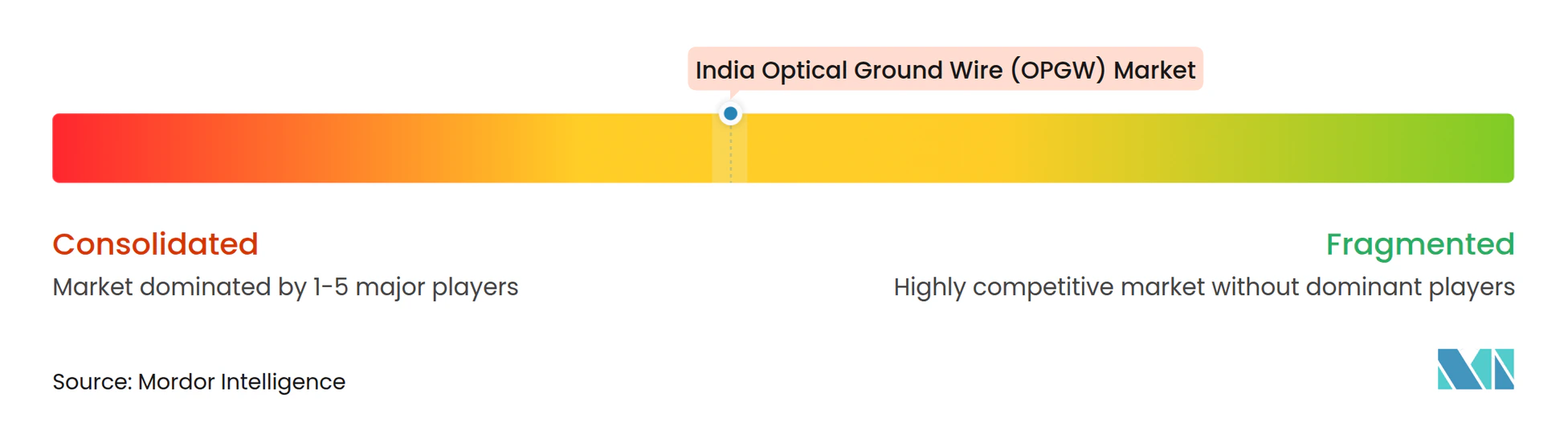
The India Optical Ground Wire (OPGW) market is moderately concentrated among vendors with utility approvals, manufacturing capability, and field-installation experience. Competition is shaped by product qualification, mechanical performance, fiber quality, and the ability to work safely on energized or remote lines. POWERGRID specifications create a technical threshold that supports established suppliers with tested designs. Sterlite Electric, APAR Industries, Advait Energy Transitions, Prysmian, Nexans, Sumitomo, and Furukawa are among the companies identified in the supplied material. The decisive factor is often the ability to meet the exact product and site conditions in a utility tender.
Sterlite Electric has supplied 96F and 144F OPGW cable for Maharashtra Transmission Communication Infrastructure Limited projects, according to the supplied company source. This example shows how suppliers are seeking positions in cable supply, installation, and long-term communications operations. Finolex Cables reported Phase 1 expansion of optical-fiber preform capability and plans for a further capacity increase. Product-specific testing makes rapid entry difficult for companies without prior qualification, while specialized spans and live-line retrofit work require specific engineering and field capability. The supplied material does not provide a combined top-player share, so a share-based concentration calculation cannot be made without introducing new data.
India Optical Ground Wire (OPGW) Industry Leaders
-
Prysmian S.p.A.
-
Sterlite Electric Limited
-
APAR Industries Limited
-
Jiangsu Zhongtian Technology Co., Ltd.
-
Advait Energy Transitions Limited
- *Disclaimer: Major Players sorted in no particular order
Recent Industry Developments
- June 2026: Sterlite Electric completed 986 km of 96F and 144F OPGW cable supply to Maharashtra Transmission Communication Infrastructure Limited. The cables have been installed and commissioned on MTCIL's ongoing transmission line projects, operating within maximum allowable attenuation thresholds and committed fiber loss limits as confirmed by MTCIL's project management.
- March 2026: Indian Railways approves USD 127.9 million communication infrastructure programme, including 96F OPGW deployment across 2,250.68 route km of Central Railway electrified lines. The programme covers Solapur, Nagpur, Pune, and Bhusawal divisions and supports Kavach anti-collision, Automatic Block Signalling, LTE-4G, and IP-MPLS deployments. A separate underground 2×48F OFC package for 2,673.21 route km complements the OPGW installation to provide fully redundant dual-path communication.
- March 2025: CEA issues comprehensive guidelines for usage and sharing of fiber cores in OPGW and UGFO cables. The guidelines establish a structured framework for fiber allocation across CTU, STUs, TSPs, and DISCOMs, mandate 48F minimum planning for all new ISTS projects, require 96F for city-limit installations, and institute an 18-month reclaim clause on commercially leased fibers.
India Optical Ground Wire (OPGW) Market Report Scope
Optical Ground Wire (OPGW) is a specialized overhead ground wire installed on electric power transmission lines that combines lightning protection and fault-current grounding with optical fiber communication capabilities. It consists of optical fibers housed within a protective metallic structure and is used by utilities for high-speed data transmission, substation communication, grid monitoring, protection, and control. OPGW serves a dual function by protecting transmission lines against lightning strikes while enabling reliable communication between power system facilities.
India optical ground wire (OPGW) market is segmented by fiber count, cable design type, and end-use industry. By fiber count, the market is segmented into 24F, 48F, 96F, and 144F and above. By cable design type, the market is segmented into Design A, Design B, Design C, Design D, Design E, and Design F. By end-use industry, the market is segmented into power utilities, telecommunications, railways, and oil and gas. For each segment, the market sizing and forecasts are provided on the basis of value (USD).
| 24F |
| 48F |
| 96F |
| 144F+ |
| Design A |
| Design B |
| Design C |
| Design D |
| Design E |
| Design F |
| Power Utilities |
| Telecom |
| Railways |
| Oil and Gas |
| By Fiber Count | 24F |
| 48F | |
| 96F | |
| 144F+ | |
| By Cable Design Type | Design A |
| Design B | |
| Design C | |
| Design D | |
| Design E | |
| Design F | |
| By End-Use Industry | Power Utilities |
| Telecom | |
| Railways | |
| Oil and Gas |
Key Questions Answered in the Report
What is driving demand for optical ground wire in India?
New renewable-energy evacuation corridors, grid digitization, and the 48F minimum planning requirement for new transmission schemes are central demand factors. The policy framework also supports OPGW use for connectivity and resilience in remote areas.
How large is the India Optical Ground Wire (OPGW) market?
The report projects the value to rise from USD 62.37 million in 2027 to USD 94.31 million by 2032, at an 8.62% CAGR. The forecast reflects utility demand, higher fiber-count requirements, and expanding communications needs.
Why is 96F OPGW becoming more important?
The CEA requires 96F planning within city limits for relevant connectivity needs. Indian Railways has also approved 96F deployment for communication infrastructure on Central Railway lines.
Which end user accounts for the largest demand?
Power Utilities held 73.77% of demand in 2026 and is forecast to grow at a 9.02% CAGR through 2032. Transmission construction and retrofit activity continue to make utilities the main source of procurement.
What are the main barriers for suppliers?
Input-cost changes and long utility qualification and type-testing cycles can limit bidding flexibility and delay entry for new products. Suppliers also need qualified teams for demanding installations.
How does OPGW support grid modernization?
OPGW provides the high-capacity links needed for SCADA, teleprotection, phasor measurement units, and other operational communications applications. This supports data exchange between substations and control centers,