
India Metal Forming Equipment Market Size and Share
Market Overview
| Study Period | 2020 - 2031 |
|---|---|
| Forecast Data Period | 2026 - 2031 |
| Base Year Market Size (2025) | USD 0.89 Billion |
| Market Size (2026) | USD 0.95 Billion |
| Market Size (2031) | USD 1.24 Billion |
| Growth Rate (2026 - 2031) | 5.47 % |
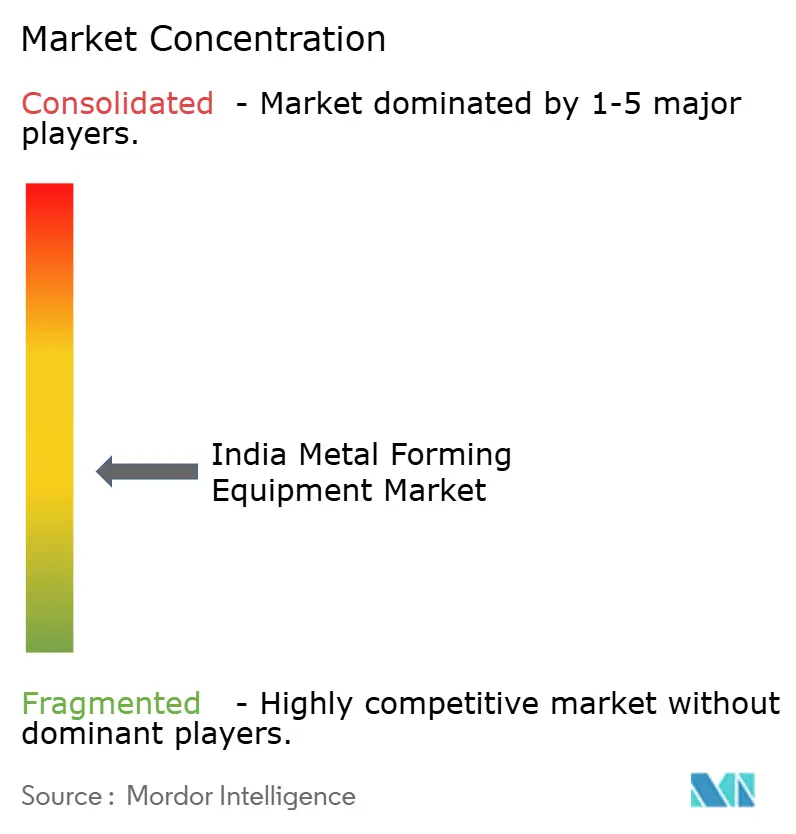
| Market Concentration | Medium |
Major Players *Disclaimer: Major Players sorted in no particular order Image © Mordor Intelligence. Reuse requires attribution under CC BY 4.0. | |
India Metal Forming Equipment Market Analysis by Mordor Intelligence
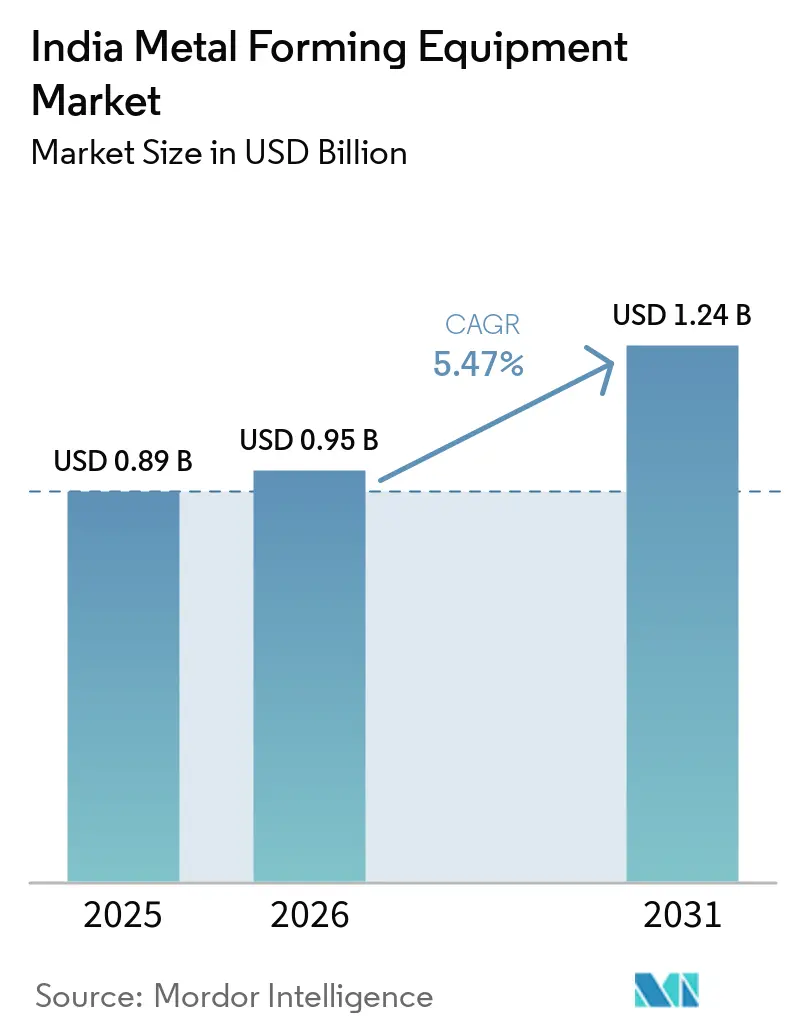
The India metal forming equipment market size was valued at USD 0.89 billion in 2025 and is estimated to grow from USD 0.95 billion in 2026 to reach USD 1.24 billion by 2031, at a CAGR of 5.47% during the forecast period (2026-2031).
The India metal forming equipment market is supported by higher capital goods output and continued public investment in industrial capacity. Capital goods production reached USD 24.4 billion in FY2025, while the capital goods sub-index of the Index of Industrial Production grew 8.1% year over year in December 2025.[1]Press Information Bureau, “Overall PLI Performance, Capital Goods Production Data, Union Budget FY2026-27 Capital Expenditure,” Press Information Bureau, pib.gov.in Automotive localization is increasing the demand for domestic forming capacity because OEMs need closer control of component quality and supply continuity. The PLI scheme for automobiles and auto components has attracted USD 4.24 billion in cumulative investment through September 2025 and created 48,974 direct jobs. The India metal forming equipment market also benefits from defense production, engineering exports, and new equipment requirements for stronger and lighter vehicle structures.
Key Report Takeaways
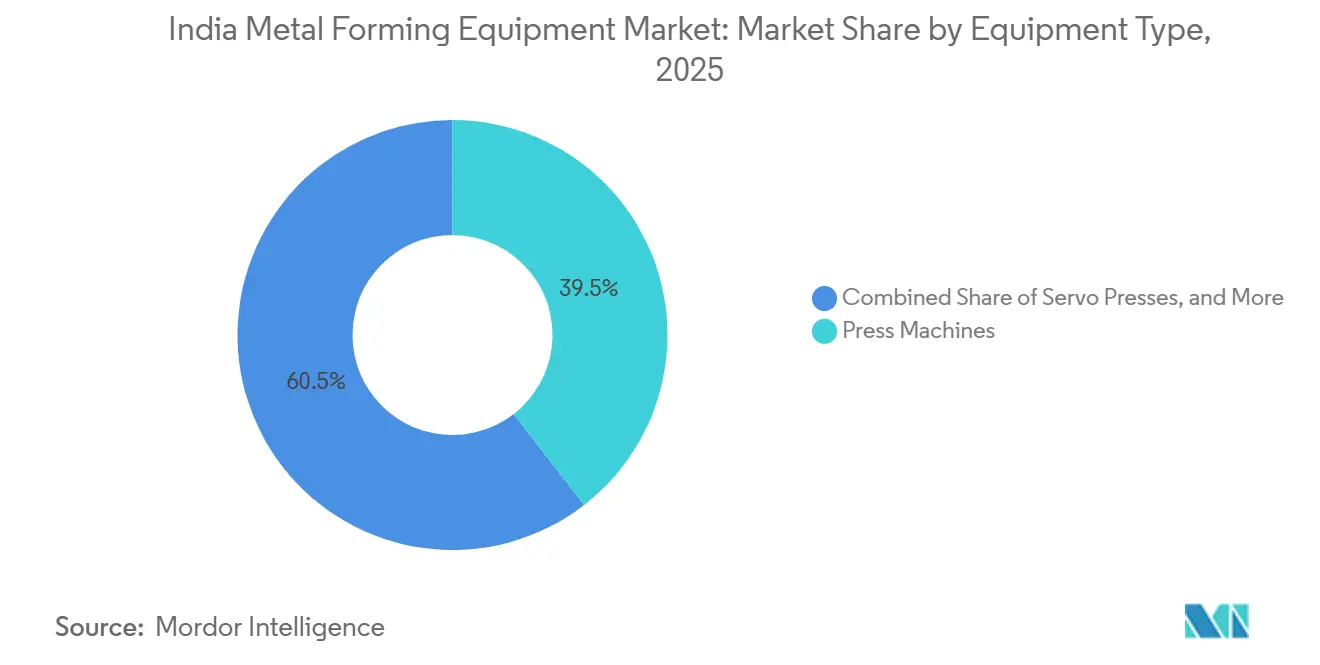
- By equipment type, press machines held 39.5% of the India metal forming equipment segment share in 2025, while servo presses are forecast to grow at an 8.2% CAGR through 2031.
- By forming process, stamping and punching accounted for 27.5% of the India metal forming equipment segment size in 2025, while hydroforming is projected to expand at an 8.5% CAGR through 2031.
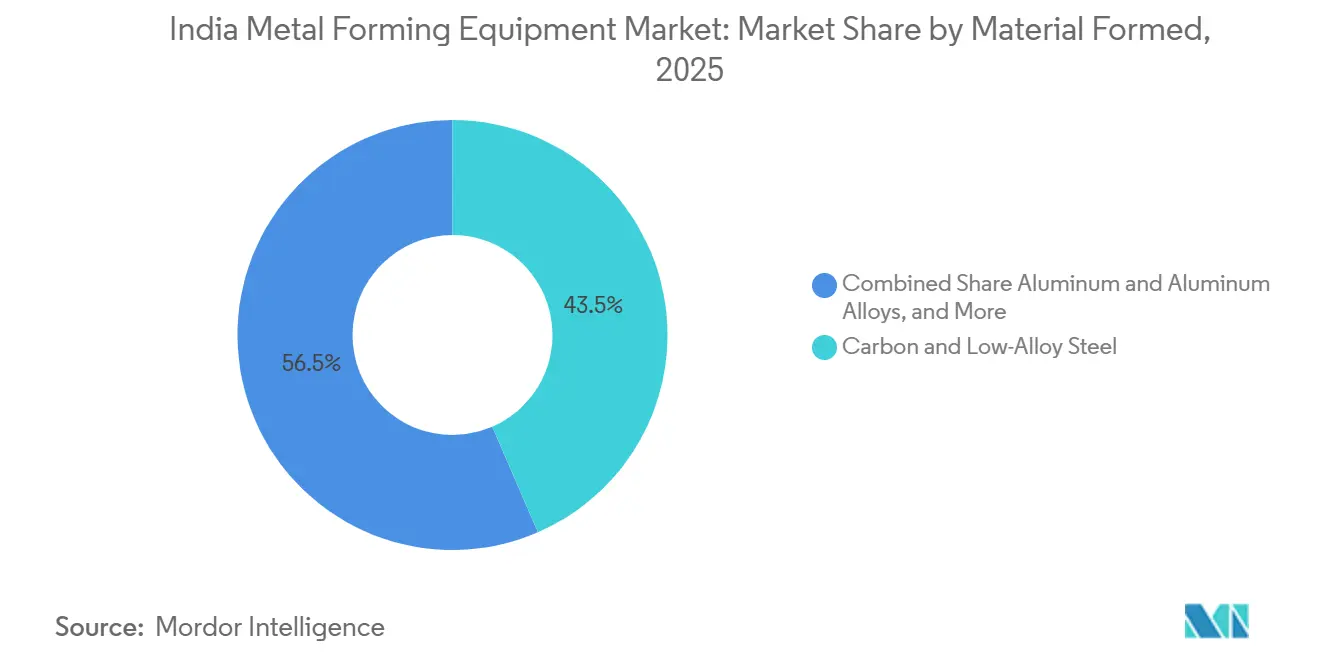
- By material formed, carbon and low-alloy steel held 43.5% of the India metal forming equipment segment share in 2025, while aluminum and aluminum alloys are forecast to grow at a 7.8% CAGR through 2031.
- By end-use industry, automotive and transportation accounted for 34.5% of the India metal forming equipment segment size in 2025, while aerospace and defense are projected to advance at an 8.7% CAGR through 2031.
Note: Market size and forecast figures in this report are generated using Mordor Intelligence’s proprietary estimation framework, updated with the latest available data and insights as of January 2026.
India Metal Forming Equipment Market Trends and Insights
Drivers Impact Analysis*
| Driver | (~) % Impact on CAGR Forecast | Geographic Relevance | Impact Timeline |
|---|---|---|---|
| Automotive and EV Platform Localization | +1.5% | National, with concentrated gains in Pune, Chennai, and Gurugram automotive clusters | Medium term (2-4 years) |
| Bharat NCAP Adoption of Hot-Stamped Structures | +1.1% | National, with early momentum in Pune and Chennai OEM stamping hubs | Short term (≤ 2 years) |
| CNC And Servo Automation Investment | +0.9% | National, with early penetration in Gujarat, Maharashtra, and Karnataka manufacturing parks | Medium term (2-4 years) |
| Import Substitution and China Plus One Sourcing | +0.7% | National, with spillover into Punjab, Rajasthan, and Coimbatore precision clusters | Long term (≥ 4 years) |
| Industrial and Infrastructure Capacity Expansion | +0.5% | National, with high relevance in road, rail, and energy corridors across Uttar Pradesh, Odisha, and Rajasthan | Medium term (2-4 years) |
| Export-Oriented Precision Engineering | +0.4% | Western India and Southern India | Long term (≥ 4 years) |
| Source: Mordor Intelligence | |||
Automotive and EV Platform Localization
EV localization is increasing demand for high-tonnage presses, servo transfer lines, and aluminum forming cells in the India metal forming equipment market. The PLI-Auto scheme has attracted USD 4.24 billion in cumulative investment through September 2025. The program had also generated 48,974 direct jobs by that point.[2]Press Information Bureau, “PLI Auto Scheme Investment, Employment and Domestic Value Addition Certificates,” Press Information Bureau, pib.gov.in Its 50% domestic value addition requirement encourages OEMs and tier-I suppliers to expand domestic forming capability. The FY2026-27 Union Budget increased the PLI-Auto allocation by 111% year over year to USD 707 million. This need for flexible blank handling favors lines that can process steel grades and aluminum on the same production line.
Bharat NCAP Adoption of Hot-Stamped Structures
Bharat NCAP has increased the importance of hot stamping for vehicle body structures. Hot-stamped content in Indian-made passenger vehicles reached 60 kg, compared with 10 kg 6 years earlier. The material is being used in B-pillars and door intrusion beams, including in B-segment cars. Hot stamping represented 15% of the average body-in-white structure. AM/NS India commissioned a continuous galvanizing line for high-strength automotive steel in 2025. The India metal forming equipment market, therefore, has demand for servo-controlled hot-stamping presses, quenching dies, and transfer automation.
CNC and Servo Automation Investment
CNC and servo investment is increasing at press shops and captive OEM stamping facilities. Jyoti CNC Automation received approval for a USD 121.5 million capital investment over 5 years. The project includes capacity expansion and a backward-integrated CNC controller manufacturing facility. The FY2026-27 Union Budget proposed 2 CPSE-operated Hi-Tech Tool Rooms for precise component design, testing, and manufacturing. Ball screws, linear guideways, and CNC controllers remain dependent on imports. This leaves scope for retrofit kits and remote diagnostics for legacy press controllers within the India metal forming equipment market.
Import Substitution and China Plus One Sourcing
Supply chain diversification is supporting India as a sourcing base for precision forgings and press-formed assemblies. China accounted for 45.2% of India’s industrial machinery imports in FY2024-25. This dependence creates a case for domestic equipment investment and local component production. Engineering exports reached USD 122.43 billion in FY2025-26, which marked a third consecutive annual record. Engineering exports then grew 18% year over year to USD 34.14 billion in Q1 FY2026-27. These export requirements support demand for reliable forming lines and closer process control.
Restraints Impact Analysis*
| Restraint | (~) % Impact on CAGR Forecast | Geographic Relevance | Impact Timeline |
|---|---|---|---|
| High Capital Cost and Extended Payback | -0.7% | National, with the greatest effect on MSME press shops in Punjab, Rajasthan, and Uttar Pradesh clusters | Short term (≤ 2 years) |
| Skilled Tool and Die Labor Shortage | -0.5% | National, concentrated in Tier 2 and Tier 3 clusters distant from ITI and NSTI hubs | Medium term (2-4 years) |
| Imported Controls and Critical Components Dependence | -0.3% | National, with greater exposure in servo and CNC-intensive press segments | Medium term (2-4 years) |
| Energy and Alloy-Price Volatility | -0.2% | National, with the greatest effect on energy-intensive forging and hot-stamping operations | Short term (≤ 2 years) |
| Source: Mordor Intelligence | |||
High Capital Cost and Extended Payback
Capital access limits modernization among many micro and small press shops. Servo and hot-stamping lines can cost more than USD 2 million. These systems remain difficult for SMEs to purchase under constrained credit terms. The Credit Linked Capital Subsidy Scheme provides a 15% upfront subsidy on institutional finance of up to USD 119,000. The maximum subsidy ceiling is USD 17,900, which does not cover the cost of servo presses or multi-station transfer lines.[3]Press Information Bureau, “National Capital Goods Policy and Phase II Scheme for Enhancement of Competitiveness,” Press Information Bureau, pib.gov.in Press guarding requirements and certification costs add to the payback burden for smaller buyers.
Skilled Tool and Die Labor Shortage
The toolroom workforce remains below the level needed for manufacturing expansion. CNC operators, turners, grinders, and tool-and-die machinists were identified as shortage occupations in automotive and capital goods manufacturing.[4]National Council of Applied Economic Research, “National Skill Gap Study for High Growth Sectors,” NCAER, ncaer.org New toolmakers often require 6 to 9 months of plant training before they can handle high-precision dies. This slows the ramp-up of new equipment lines. The Ministry of Skill Development proposed USD 119 million to upgrade 5 National Skills Training Institutes into National Centers of Excellence. The labor constraint remains more visible outside established industrial zones in the India metal forming equipment market.
*Our forecasts treat driver/restraint impacts as directional, not additive. The impact forecasts reflect baseline growth, mix effects, and variable interactions.
Segment Analysis
By Equipment Type: Servo Presses Support Higher-Value Production
Press machines held 39.5% of the India metal forming equipment market share in 2025. This category remains central to automotive body production and general engineering work in the India metal forming equipment market. Servo presses are forecast to grow at an 8.2% CAGR through 2031. They allow variable stroke velocities for advanced high-strength steel blanks. This capability matters for vehicle structures that need greater strength and consistent dimensional control. Mechanical presses remain important by unit count in northern and central India. SME fabricators use them for agricultural equipment and general engineering work. Their lower cost suits applications where servo payback remains difficult. Hydraulic presses retain a role in structural fabrication, extrusion, and deep drawing. These applications require steady force and support demand across industrial machinery and energy projects.
Press brakes and bending machines are the second-largest equipment type. Servo and electric variants are gaining attention because they can reduce energy use by 30% to 50% versus hydraulic models. Forging equipment remains important for automotive, defense, and railway applications. The India metal forming equipment industry needs these systems for parts that require high strength and repeatable quality. Hydroforming equipment is expected to benefit from the greater structural complexity of EV platforms. Roll-forming equipment serves structural steel and pre-engineered building requirements. Wire and tube equipment supports component suppliers that need shaped sections and finished tubular products. Extrusion equipment supports specialized profiles and material-efficient manufacturing. The Construction and Infrastructure Equipment scheme announced in FY2026-27 may support orders for large-tonnage presses and forging lines. Together, these equipment categories widen the addressable demand base beyond vehicle stamping.


By Forming Process: Hydroforming Meets Complex Structural Requirements
Stamping and punching accounted for 27.5% of the India metal forming equipment market share in 2025. The process supports automotive body panels and white goods production. High throughput makes it essential for volume manufacturing programs. Legacy mild-steel lines continue to operate at high utilization for established vehicle models. New vehicle programs are moving toward servo press lines for advanced high-strength steel. Deep drawing holds the second-largest process position. It supports consumer appliances, pressure vessels, and cookware. Bending remains widely used in construction and general fabrication. Forging provides shaped parts for demanding transport and industrial applications. Rolling and roll forming continue to support structural sections and building systems.
Hydroforming is forecast to grow at an 8.5% CAGR from 2026 to 2031. EV platforms use lightweight tubular members that can be made in one hydroforming operation. This can reduce the need for several stampings and welded assemblies in the India metal forming equipment market. The India metal forming equipment market benefits when vehicle architectures use these integrated components. Forging demand is also supported by defense manufacturing. Defense production reached USD 21.2 billion in FY2025-26. Aerospace structures and land-vehicle drive trains need precise forged components. Rolling and roll forming serve the structural steel and pre-engineered building sector. The National Infrastructure Pipeline covered projects valued at USD 2,217.78 billion as of April 2026. This mix links forming-process demand to both transport and infrastructure activity.
By Material Formed: Aluminum Grows While Steel Retains Scale
Carbon and low-alloy steel held 43.5% of the India metal forming equipment market share in 2025. Automotive stamping and infrastructure fabrication underpin this position. General engineering also uses hot-rolled and cold-rolled steel grades in large volumes. Press-shop clusters benefit from the availability of coil supplies. Stainless steel serves consumer appliances, food processing equipment, and chemical vessels. Its use supports demand for controlled forming in corrosion-sensitive applications. Steel remains the principal feedstock for many high-volume fabrication operations. Equipment suppliers must still accommodate increasing grade diversity. This includes high-strength grades for automotive body structures. The continued steel base provides a stable source of demand for presses, bending machines, and rolling systems.
Aluminum and aluminum alloys are forecast to grow at a 7.8% CAGR through 2031. EV lightweighting, aerospace sub-assembly localization, and solar panel framing support this material demand. Aluminum spring-back makes process control more important for equipment buyers. This favors servo presses and warm-forming cells over conventional lines. AM/NS India commissioned its high-strength automotive steel galvanizing line in 2025. The development shows that equipment builders must work with a wider range of advanced materials. Copper and copper alloys serve electrical equipment and heat exchanger applications. Titanium, nickel, and specialty non-ferrous alloys serve aerospace and defense requirements. These smaller-volume materials create a need for more precise forming and tooling capability.

By End-Use Industry: Aerospace And Defense Lead Growth
Automotive and transportation accounted for 34.5% of the India metal forming equipment market size in 2025. India’s passenger vehicle production base was close to 4 million units annually. New EV models require additional stamping tooling and forming capability. OEM lines require repeatable dimensions and in-line inspection. Manual shops cannot provide the same level of process consistency. This shifts capital spending toward servo and transfer press configurations. Consumer appliances are another important source of demand for stamping and deep drawing. Industrial machinery needs formed structural and functional components. Metal products fabrication supports demand from smaller, diversified customers. These uses sustain equipment demand across several manufacturing supply chains.
Aerospace and defense are forecast to grow at an 8.7% CAGR from 2026 to 2031. Defense production reached USD 21.2 billion in FY2025-26 and grew 15.6% year over year. Defense exports reached USD 4.57 billion in the same year. Private-sector firms contributed USD 2.07 billion of that export total. Aerospace and defense programs need aero-grade forging, precise bending, and hydroforming cells. These requirements are tied to strict material and process standards. Construction, infrastructure, and energy remain moderate-growth end-use areas. Renewable installations need formed structural steel and large-diameter pipe products. These end uses support roll-forming and ring-rolling equipment demand.
Geography Analysis
Western India is the largest regional base in the India metal forming equipment market. Maharashtra and Gujarat combine automotive demand with precision engineering capacity. The Pune-Aurangabad-Mumbai corridor has a dense network of OEM captive press shops and tier-I suppliers. Gestamp opened its 5th Indian plant in Gujarat in 2025. The USD 62.3 million investment expanded its footprint to 14 stamping lines, including 5 hot-stamping lines. Gujarat also has clusters in Rajkot, Vadodara, and Ahmedabad that serve hydraulic presses, bending machines, and SME-scale equipment. Western India generated USD 47.5 billion in engineering exports in FY2025-26. This represented 39% of India’s engineering exports and indicates the quality requirements facing regional forming operations.
Southern India is the fastest-growing domestic region for precision metal forming investment. Tamil Nadu, Karnataka, and Telangana are supported by automotive, railway, defense, and aerospace activities. The Titagarh Rail Systems and Ramkrishna Forgings joint venture began commercial forged-wheel production near Chennai in August 2026. The greenfield plant involved USD 238 million in investment. Karnataka’s Tumakuru Machine Tools Park is developing as a capital goods cluster. Jyoti CNC acquired 20 acres there in July 2025 for a high-precision CNC manufacturing base. Bharat Forge also began construction of a USD 178.6 million defense energetics facility in Andhra Pradesh. These investments support demand for large and precise forming equipment.
Northern and eastern India form a third regional production base. Punjab, Haryana, and Uttar Pradesh have many SME mechanical and hydraulic press shops. These facilities serve agricultural equipment, bicycle components, cookware, and general fabrication. The Faridabad-Manesar belt also supports automotive component production. Vardhman Special Steels laid the foundation for a USD 132.9 million precision forging facility in Ludhiana during July 2026. Jharkhand and Odisha add forging and metals capacity in eastern India. Ramkrishna Forgings commissioned an 8,000-tonne hot forging press in Jharkhand in March 2026. The line added 40,000 tons per year of capacity. Bharat Forge’s proposed Odisha project could further expand the region’s forming equipment requirements.
Competitive Landscape
The India metal forming equipment market is moderately fragmented, although high-end categories show greater concentration. Schuler India and AIDA Engineering India compete in servo and transfer presses. Their offerings focus on process capability and automated die changes. ISGEC Heavy Engineering, Larsen and Toubro, and Bharat Heavy Electricals participate in large-tonnage press and forging applications. Their engineering range supports work with public-sector and defense customers. Mid-market suppliers, including Hind Hydraulics and Presstech Machine India, focus on cost and local service for SME customers. Price competition is strongest below USD 2 million. Technical capability has more influence on servo and hot-stamping lines. This creates distinct competitive conditions across equipment categories.
Domestic suppliers are expanding capacity to serve expected infrastructure and defense orders. ISGEC approved a USD 59.8 million capacity plan covering plants in Bhartauli, Dahej, and Muzaffarnagar. The company expects the investment to unlock USD 145 million in incremental annual revenue. Major forging groups are also adding machining and assembly operations. This allows suppliers to serve a larger part of the component value chain. MM Forgings ordered a 16,500-tonne hot forging press valued at USD 27.4 million. The equipment is intended for heavy crankshafts and front axle beams. Such investments increase the technical capability available to global commercial vehicle customers.
Competitive opportunities also extend beyond new equipment sales. Legacy mechanical press shops can use servo retrofit kits to improve control and productivity. Press line operators can use predictive maintenance services to reduce unplanned downtime. These offerings address customers that may not purchase a full new line. The India metal forming equipment market has room for suppliers that combine equipment with local technical support. The July 2026 CNC Incentive Scheme links a 12% duty rebate to 60% local content in CNC assembly. This can affect the position of press OEMs that integrate their own controllers. Suppliers, therefore, face pressure to improve localization as well as automation capability. Competition remains broad because domestic fabricators and global OEMs serve different customer needs.
India Metal Forming Equipment Industry Leaders
Bharat Forge Limited
Ramkrishna Forgings Limited
Schuler India Private Limited
AIDA Engineering India Private Limited
Komatsu India Private Limited
- *Disclaimer: Major Players sorted in no particular order

Recent Industry Developments
- September 2026: Balu Forge Industries acquired a ring rolling production line capable of producing forged rings up to 6.7 meters in outer diameter, one of the largest in India, targeting aerospace, energy, and heavy industry segments previously reliant on imported large-diameter rings, with production trials expected before the end of 2026.
- August 2026: Ramkrishna Forgings committed to investing USD 35.7 million across multiple facilities in FY2026-27, including USD 20.2 million in a new passenger vehicle components plant in Jharkhand targeting commissioning in Q1 FY2027-28, reflecting continued private capacity expansion in eastern India.
- August 2026: Jyoti CNC Automation received Ministry of Electronics and Information Technology approval for a USD 121.5 million capital investment over 5 years, directed at expanding production capacity and building a backward-integrated CNC controller manufacturing facility in a landmark step toward localizing the electronic intelligence of metal forming equipment.
- July 2026: Vardhman Special Steels, in partnership with Aichi Steel Corporation of Japan, laid the foundation for a USD 132.9 million precision forging facility in Ludhiana, Punjab, targeting ring gears and driveline components for automotive OEMs across India, Europe, ASEAN, Africa, and Mexico.


India Metal Forming Equipment Market Report Scope
| Press Machines | Mechanical Presses |
| Hydraulic Presses | |
| Servo Presses | |
| Other General-Purpose Presses | |
| Press Brakes and Bending Machines | Hydraulic Press Brakes |
| Servo / Electric Press Brakes | |
| Mechanical Press Brakes | |
| Other Bending Machines | |
| Forging Equipment | Forging Presses |
| Forging Hammers | |
| Upsetting and Heading Machines | |
| Other Forging Equipment | |
| Roll Forming and Plate/Profile Rolling Equipment | Roll Forming Machines |
| Plate Rolling Machines | |
| Section and Profile Rolling Machines | |
| Other Secondary Rolling/Forming Equipment | |
| Wire, Tube and Profile Forming Equipment | Wire and Bar Drawing/Forming Equipment |
| Tube Forming and Bending Equipment | |
| Profile Forming Equipment | |
| Extrusion Presses | |
| Hydroforming Equipment | |
| Other Metal Forming Equipment |
| Stamping and Punching |
| Deep Drawing |
| Bending |
| Forging |
| Rolling and Roll Forming |
| Extrusion |
| Hydroforming |
| Other Forming Processes |
| Carbon and Low-Alloy Steel |
| Stainless Steel |
| Aluminum and Aluminum Alloys |
| Copper and Copper Alloys |
| Titanium, Nickel and Other Non-Ferrous Metals |
| Other Materials |
| Automotive and Transportation |
| Aerospace and Defense |
| Industrial Machinery and Capital Equipment |
| Metal Products and Fabrication |
| Electrical and Electronics |
| Construction and Infrastructure |
| Energy and Power |
| Consumer Appliances and Durable Goods |
| Medical and Precision Manufacturing |
| Other End-Use Industries |
| By Equipment Type | Press Machines | Mechanical Presses |
| Hydraulic Presses | ||
| Servo Presses | ||
| Other General-Purpose Presses | ||
| Press Brakes and Bending Machines | Hydraulic Press Brakes | |
| Servo / Electric Press Brakes | ||
| Mechanical Press Brakes | ||
| Other Bending Machines | ||
| Forging Equipment | Forging Presses | |
| Forging Hammers | ||
| Upsetting and Heading Machines | ||
| Other Forging Equipment | ||
| Roll Forming and Plate/Profile Rolling Equipment | Roll Forming Machines | |
| Plate Rolling Machines | ||
| Section and Profile Rolling Machines | ||
| Other Secondary Rolling/Forming Equipment | ||
| Wire, Tube and Profile Forming Equipment | Wire and Bar Drawing/Forming Equipment | |
| Tube Forming and Bending Equipment | ||
| Profile Forming Equipment | ||
| Extrusion Presses | ||
| Hydroforming Equipment | ||
| Other Metal Forming Equipment | ||
| By Forming Process | Stamping and Punching | |
| Deep Drawing | ||
| Bending | ||
| Forging | ||
| Rolling and Roll Forming | ||
| Extrusion | ||
| Hydroforming | ||
| Other Forming Processes | ||
| By Material Formed | Carbon and Low-Alloy Steel | |
| Stainless Steel | ||
| Aluminum and Aluminum Alloys | ||
| Copper and Copper Alloys | ||
| Titanium, Nickel and Other Non-Ferrous Metals | ||
| Other Materials | ||
| By End-Use Industry | Automotive and Transportation | |
| Aerospace and Defense | ||
| Industrial Machinery and Capital Equipment | ||
| Metal Products and Fabrication | ||
| Electrical and Electronics | ||
| Construction and Infrastructure | ||
| Energy and Power | ||
| Consumer Appliances and Durable Goods | ||
| Medical and Precision Manufacturing | ||
| Other End-Use Industries | ||


Key Questions Answered in the Report
What is the projected value of India metal forming equipment by 2031?
The India metal forming equipment market is forecast to reach USD 1.24 billion by 2031, growing at a 5.4% CAGR from 2026.
Which equipment type leads demand in India?
Press machines led with 39.5% share in 2025, while servo presses have the highest projected equipment growth at 8.2% CAGR.
Which forming process is growing fastest in India?
Hydroforming is forecast to grow at an 8.5% CAGR through 2031 as EV platforms use lightweight tubular structural components.
What material is used most in Indian metal forming?
Carbon and low-alloy steel held 43.5% share in 2025, supported by automotive stamping, infrastructure fabrication, and general engineering.
Which end-use sector is expected to grow fastest?
Aerospace and defense are expected to grow at an 8.7% CAGR through 2031, supported by rising domestic defense production and exports.
Which region has the largest installed base?
Western India has the largest installed base, supported by automotive and engineering clusters in Maharashtra and Gujarat.
Page last updated on:





