
India IC Design Services Market Size and Share
Market Overview
| Study Period | 2021 - 2032 |
|---|---|
| Forecast Data Period | 2027 - 2032 |
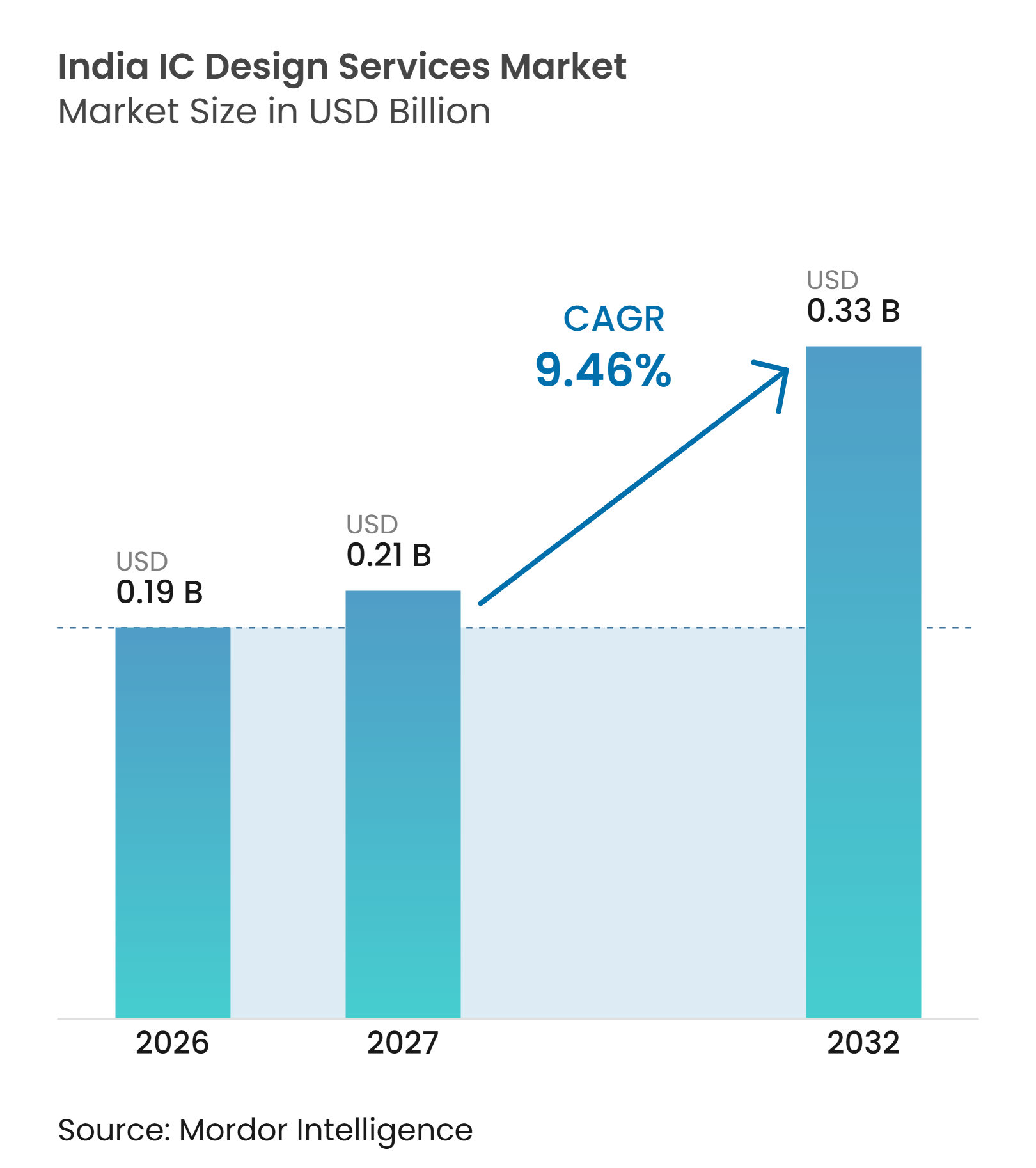
| Base Year Market Size (2026) | USD 0.19 Billion |
| Market Size (2027) | USD 0.21 Billion |
| Market Size (2032) | USD 0.33 Billion |
| Growth Rate (2027 - 2032) | 9.46 % |
| Market Concentration | Medium |
Major Players *Disclaimer: Major Players sorted in no particular order Image © Mordor Intelligence. Reuse requires attribution under CC BY 4.0. | |
India IC Design Services Market Analysis by Mordor Intelligence
The India IC design services market size is expected to increase from USD 0.19 billion in 2026 to USD 0.21 billion in 2027 and reach USD 0.33 billion by 2032, expanding at a CAGR of 9.46% over 2027-2032. The India IC design services market benefits from a broad engineering base that covers digital design, verification, analog design, and mixed-signal work. Long-running mandates from global semiconductor companies support recurring demand and reduce exposure to short project cycles. Public policy is directing more support toward commercial chip development, strategic designs, and scaled deployment. The India IC design services market also has an opportunity to move toward higher-value assignments as local teams take on more complete design and verification work.
Key Report Takeaways
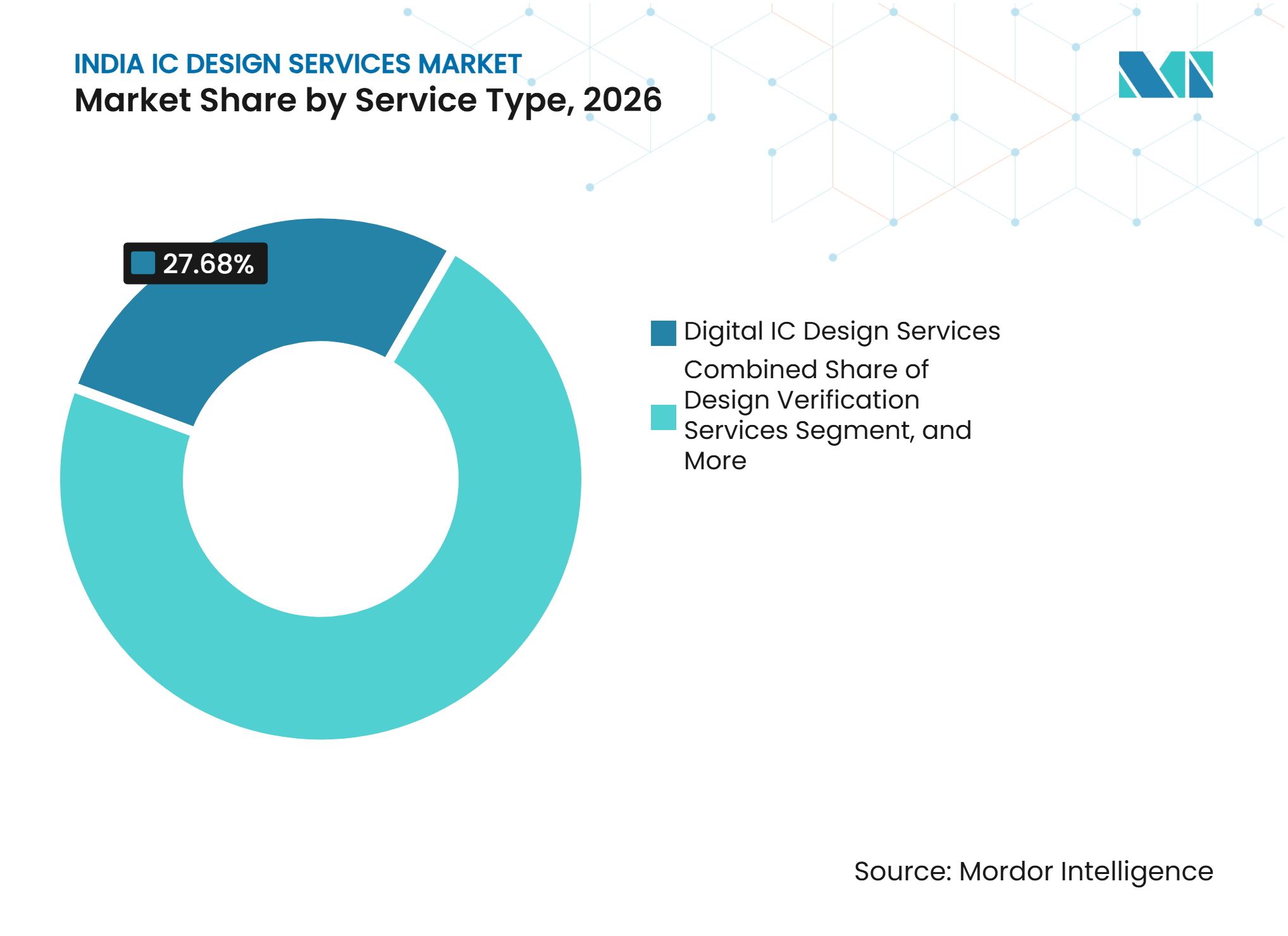
- By service type, Digital IC Design Services held 27.68% of the India IC design services market share in 2026, while Design Verification Services is projected to expand at a 10.81% CAGR through 2032.
- By end-user application, Consumer Electronics accounted for 29.32% of revenue in 2026, while AI, HPC, and Data Centers are expected to record the highest CAGR of 10.92% through 2032.
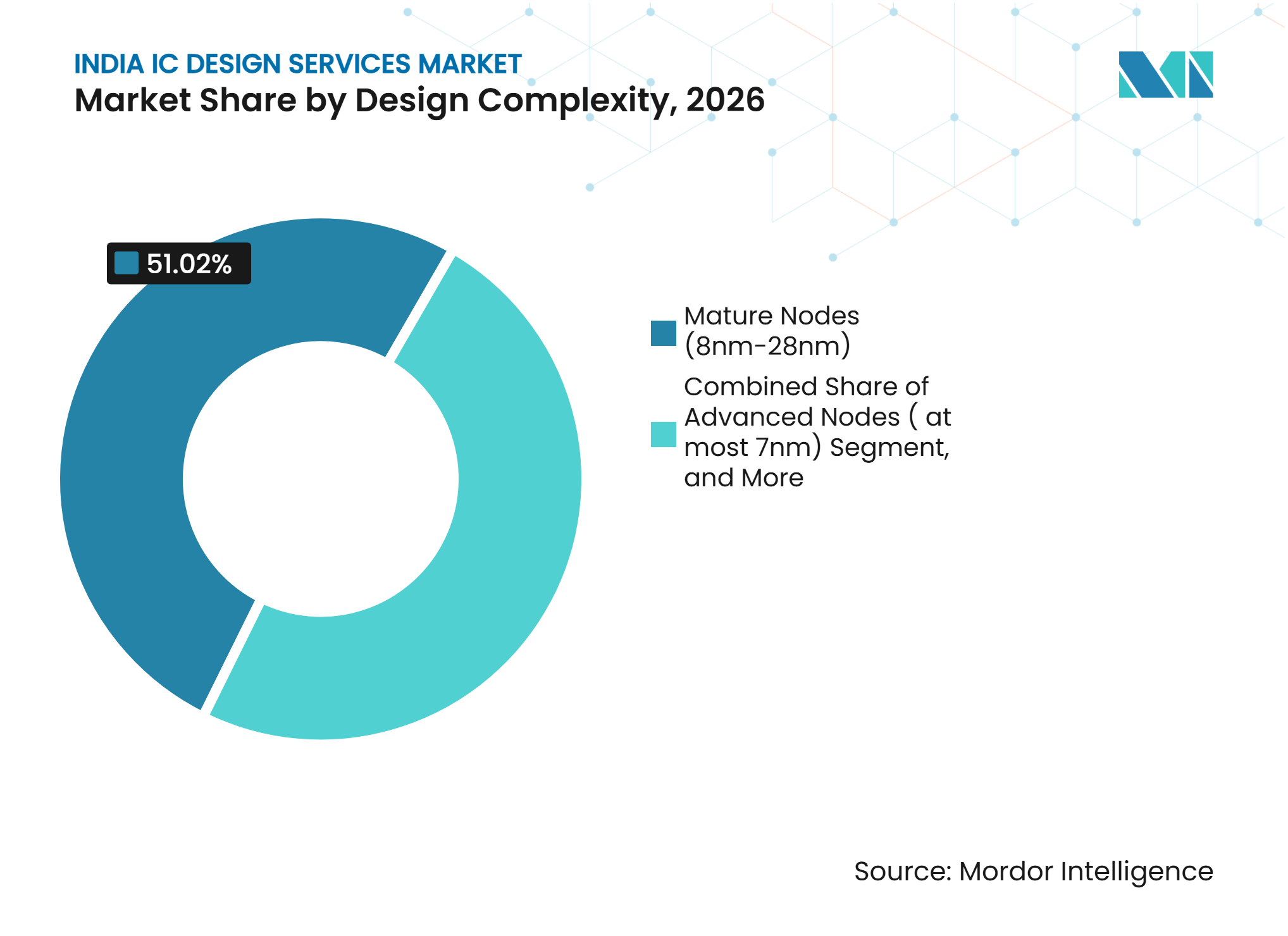
- By design complexity, Mature Nodes (8nm-28nm) held 51.02% of revenue in 2026, while Advanced Nodes (≤7nm) are projected to expand at a 10.07% CAGR through 2032.
Note: Market numbers in this report are based on Mordor Intelligence's proprietary estimation framework, which combines nine months of actuals with Q4 projections for base year 2026.
Market Trends and Insights
Drivers Impact Analysis of India IC Design Services Market*
| Driver | (~) % Impact on CAGR Forecast | Geographic Relevance | Impact Timeline |
|---|---|---|---|
| Outsourcing of Semiconductor Design Engineering to India | +2.8% | Global, with primary demand from North America, Europe, and Japan | Long term (≥ 4 years) |
| Government-Backed Semiconductor Design Initiatives and DLI Scheme | +2.3% | National, with early gains in Bengaluru, Noida, Hyderabad, and Ahmedabad | Medium term (2-4 years) |
| Expansion of Multinational Semiconductor R&D Centers | +1.9% | Bengaluru, Noida, Hyderabad, Pune, Chennai, Ahmedabad | Medium term (2-4 years) |
| Advanced Node Design Complexity | +1.5% | Bengaluru and Noida core, with spillover to Hyderabad and Pune | Long term (≥ 4 years) |
| Rising Semiconductor Design Demand Across Key Industries | +1.1% | National, with automotive demand concentrated in Pune and Chennai | Medium term (2-4 years) |
| Growth of Domestic Fabless Startups and Indigenous Chip Development | +0.7% | Bengaluru, Chennai, and Hyderabad | Long term (≥ 4 years) |
| Source: Mordor Intelligence | |||
Outsourcing of Semiconductor Design Engineering to India
The India IC design services market is supported by demand from North American, European, and Japanese chip companies that require specialized engineering capacity across successive product generations. Indian teams cover digital, analog, mixed-signal, physical design, and verification activities, allowing clients to place related tasks with a delivery location that understands the interfaces among them. This range supports larger work packages, including architecture support, RTL development, verification planning, implementation, and downstream validation preparation. It also shifts assignments away from short-term staffing support toward work that aligns with a client’s longer-term chip roadmap and design methodology. The India Electronics and Semiconductor Association has indicated that India requires a chip design talent pool of 275,000, compared with a current base of 120,000, highlighting the capacity still needed to meet outsourcing demand.
Government-Backed Semiconductor Design Initiatives and DLI Scheme
Government support is widening from design reimbursement toward commercial development, deployment, and closer coordination between public priorities and private product development. Semicon 2.0 set out three design tracks for national and strategic projects, commercial-sector projects, and designs deployed at scale.[1] The commercial track provides milestone-linked seed funding of up to 50% of project cost or INR 15 crore (USD 1.74 million), which can make early product work more viable for smaller teams. Under the earlier DLI phase, government programs trained 85,000 semiconductor professionals in 4 years and enabled EDA tool-hours across 315 academic institutions. For the India IC design services market, these measures can help more teams progress from prototypes to products that commercial customers can deploy.
Expansion of Multinational Semiconductor R&D Centers
Multinational semiconductor companies are expanding their engineering locations in India for work that includes advanced automotive, AI, and IoT designs, rather than relying on the country only for support assignments. Renesas opened 3nm design centers in Noida and Bengaluru in 2025, and the teams contribute to the R-Car X5H automotive multi-domain system-on-chip. Infineon opened a research and development hub in Ahmedabad in 2025 for advanced chip design and product software engineering, with a target of 500 engineers over 5 years. These facilities expand access to complex assignments and enable local engineers to gain experience in automotive, industrial, power-management, and connected-device programs. The India IC design services market also gains a broader customer mix when European and Japanese firms expand alongside established North American clients.
Advanced Node Design Complexity
Advanced-node programs require more verification, physical implementation, power analysis, and IP qualification work than mature-node projects, because tighter geometries leave less room for design errors. This raises the value of engineering services when projects use nodes of 7nm or below and requires close work among design, verification, implementation, and software teams. Marvell announced a planned USD 250 million investment in India in 2026, including expansions in Bengaluru and Hyderabad to develop next-generation AI technology. The government has also reported progress toward 2nm chip design capability in India. The India IC design services market can therefore gain assignments that require deeper engineering ownership, stronger design sign-off practices, and longer client engagement than isolated delivery tasks.
Restraints Impact Analysis of India IC Design Services Market*
| Restraint | (~) % Impact on CAGR Forecast | Geographic Relevance | Impact Timeline |
|---|---|---|---|
| Dependence on International Clients and Limited Domestic Fabless Scale | -0.5% | National, most acute for smaller pure-play firms in Tier-2 cities | Medium term (2-4 years) |
| Shortage of Specialized Semiconductor Design Engineers | -0.4% | National, with acute shortfalls in packaging, analog, and advanced-node process roles | Short term (≤ 2 years) |
| Dependence on International EDA, IP, and Foundry Access | -0.3% | National, with disproportionate impact on startups and mid-sized design houses | Long term (≥ 4 years) |
| High Employee Attrition and Pricing Pressure | -0.2% | Bengaluru, Hyderabad, and Pune, with pressure in commodity physical design segments | Short term (≤ 2 years) |
| Source: Mordor Intelligence | |||
Dependence on International Clients and Limited Domestic Fabless Scale
The India IC design services market depends heavily on clients based outside India, especially multinational companies with captive engineering centers that can alter spending when their global product priorities change. This model provides steady work, yet it leaves smaller firms exposed to overseas research budgets, semiconductor demand cycles, and decisions that are made outside the domestic ecosystem. A limited domestic fabless customer base also reduces the number of local programs that can provide repeat business at scale or create predictable demand for supporting services. The commercial and deployment tracks within Semicon 2.0 are intended to address this gap by supporting product development and deployment. The effect will depend on whether domestic developers can move from tape-out to commercially competitive silicon with customers, manufacturing access, and adequate product support.
Shortage of Specialized Semiconductor Design Engineers
The main talent constraint is concentrated in specialized roles rather than in basic engineering headcount, making it harder to address through general graduate recruitment alone. India was projected to face a shortage of 250,000-350,000 qualified semiconductor professionals by 2027. Shortfalls are especially material in advanced-node process work, analog design, packaging, and verification, where experienced engineers need a combination of domain knowledge and project exposure. These gaps can increase delivery costs when companies rely on lateral hiring and can delay projects that need niche technical review. The DLI talent programs and academic access to EDA tools can improve the pipeline, although workforce development will take time to reach the highest-value specialties.
*Our forecasts treat driver/restraint impacts as directional, not additive. The impact forecasts reflect baseline growth, mix effects, and variable interactions.
India IC Design Services Market Segment Analysis
By Service Type:
Verification Expands the Value of Digital Design WorkDigital IC Design Services held 27.68% of the India IC design services market share in 2026. The category benefits from continuing demand for system-on-chip architecture, RTL design, logic design, and synthesis. These tasks are present across consumer devices, networking equipment, data center hardware, and automotive electronics. Captive semiconductor centers use Indian teams for this work because it aligns with the country’s established VLSI engineering base. The segment also provides an entry point for service companies that later add verification and implementation capabilities.
Design Verification Services is projected to expand at a 10.81% CAGR through 2032. Verification becomes more demanding as chip functions, interfaces, power requirements, and safety expectations increase. AI-assisted EDA tools can improve selected tasks, but they do not remove the need for engineers who understand coverage goals, design intent, and system behavior. Physical Design and Layout Services remain important because timing closure and implementation quality determine whether a design can proceed to manufacturing. Analog IC Design Services and Analog Mixed-Signal IC Design Services support lower-volume programs in power management, automotive electronics, sensors, and industrial products. IP Development and Design Support Services can also help local fabless firms reuse proven design blocks and lower the cost of each tape-out.



By End-User Application:
AI and HPC Increase Demand for Advanced EngineeringConsumer Electronics accounted for 29.32% of the India IC design services market in 2026. Wearables, smart home devices, connected appliances, and other high-volume devices create continuing work for digital design, physical design, and testing support. Many of these products use mature or legacy process technologies that have proven yields and predictable costs. This demand provides a stable foundation for design teams, even as individual consumer device categories change. It also gives engineers experience across power, connectivity, user-interface, and embedded processing functions.
AI, HPC, and Data Centers are projected to expand at a 10.92% CAGR through 2032. These applications need chips with high compute density, efficient memory access, fast interconnects, and robust power management. Marvell’s planned investment in India shows that local teams are involved in AI and data infrastructure programs at advanced technology nodes. Automotive demand is also increasing as vehicle makers adopt software-defined architectures and more electronic control functions. TCS launched custom system-on-chip design services in 2026, covering architecture, RTL design, verification, implementation, and system validation for automotive and semiconductor companies. Industrial, telecom and networking, defense and aerospace, and medical and healthcare applications broaden the customer base beyond consumer-led demand.
By Design Complexity:
Mature Nodes Support Volume and Advanced Nodes Raise Technical DepthMature Nodes (8nm-28nm) commanded 51.02% of the India IC design services market size in 2026. These nodes are suitable for many automotive, industrial, power-management, and consumer applications because their performance and manufacturing behavior are well understood. Their use also allows clients to choose among several manufacturing options and manage cost with less uncertainty. Cyient Semiconductors qualified for the SCL Mohali modernization bid in 2025, covering RF-CMOS, BCD (HV LDMOS), and CMOS image-sensor processes. Mirafra Technologies also taped out a 22nm system-on-chip in 2026, demonstrating end-to-end delivery at a production-relevant node.
Advanced Nodes (≤7nm) are projected to expand at a 10.07% CAGR through 2032. The segment is largely supported by multinational programs for AI, high-performance computing, mobile processors, and complex automotive systems. Renesas has connected its Noida and Bengaluru teams to a 3nm automotive multi-domain system-on-chip program. Advanced-node work requires close coordination among architecture, verification, physical implementation, and software teams. It can therefore increase the value of each project for providers with strong technical depth. The India IC design services industry has an opportunity to build specialist capabilities in these fields while maintaining mature-node capacity for high-volume programs.

Geography Analysis
Bengaluru
Bengaluru is the leading delivery hub for the India IC design services market and combines multinational engineering centers with specialized local firms. The city supports work from mature-node analog and mixed-signal assignments to AI chip programs at advanced nodes. Microchip Technology expanded its Bengaluru footprint in 2025 through a new office facility planned to accommodate more than 3,000 employees over 10 years.[2] Marvell’s 2026 expansion includes a new Bengaluru wing for next-generation AI technology development. Its supplier base combines design, validation, software, and system engineering, while ISO 26262 requirements favor providers that can document automotive safety work.
Delhi NCR
Delhi NCR is a major center for advanced-node design activity outside Bengaluru. Renesas opened a 3nm design center in Noida in 2025, and its Noida and Bengaluru facilities work together on the R-Car X5H automotive system-on-chip.[3] The cluster supports EDA, verification, circuit design, layout, and 3D integrated-circuit development alongside a large engineering and software workforce. ISO 26262 and IEC 61508 compliance factors can help teams secure work that requires traceable safety evidence within engineering deliverables.
Hyderabad, Chennai, Pune, Ahmedabad, and Hubli
Hyderabad, Chennai, Pune, Ahmedabad, and Hubli complement the larger design clusters with specialized talent and links to distinct applications. Hyderabad supports ASIC turnkey and embedded product development, while Chennai draws on the IIT Madras ecosystem and university research. Ahmedabad added capacity when Infineon opened its research and development hub at GIFT City in 2025. Pune’s automotive engineering base supports power electronics and vehicle semiconductor projects, while Hubli gained an emerging role through the HCLTech and Rapidus centers. The India IC design services market size will increasingly depend on links among universities, local suppliers, and global product roadmaps.
Competitive Landscape
Market Concentration
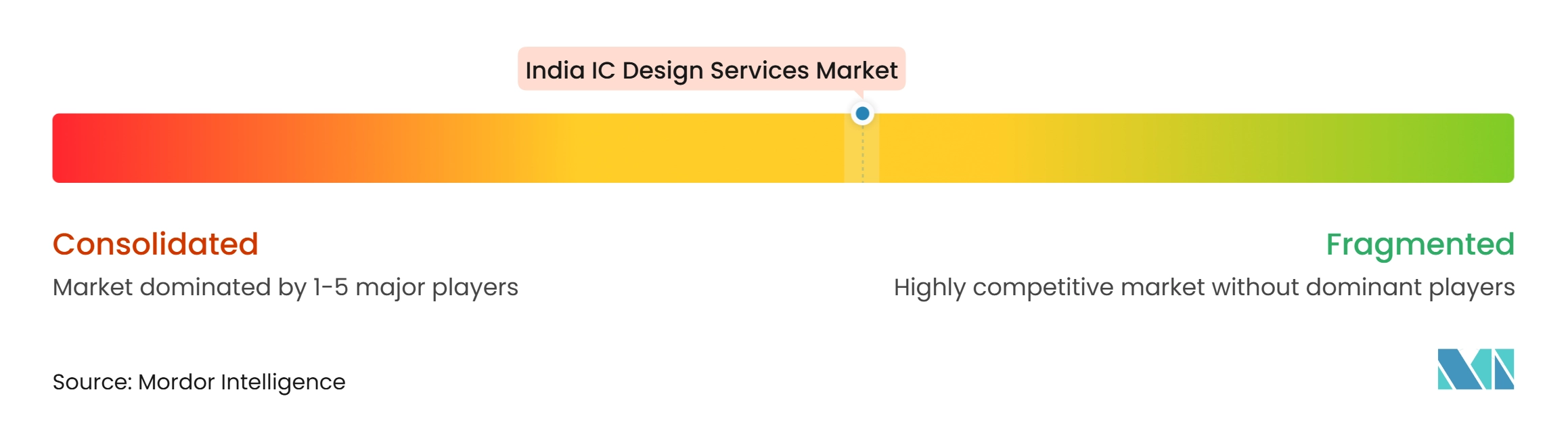
The India IC design services market is moderately fragmented, with broad engineering service companies competing alongside specialized semiconductor providers. HCLTech, Tata Elxsi, L&T Technology Services, and Cyient offer large delivery teams and connections to wider product engineering services. MosChip Technologies, Mirafra Technologies, Tessolve, eInfochips, and related specialists compete through chip-focused technical depth and turnkey delivery. The field includes architecture, analog and digital design, verification, physical implementation, validation, and embedded software. The market concentration score is 1 out of 10 because the leading provider holds less than 5% of global semiconductor engineering outsourcing activity, indicating a highly fragmented competitive structure.
Companies are seeking higher-value work by covering connected steps in the development process. Cyient created Cyient Semiconductors in 2025 as a wholly owned business focused on ASIC turnkey solutions for industrial, data center, automotive, and medical applications. eInfochips joined the Samsung Advanced Foundry Ecosystem as a Virtual Design Partner in 2025, extending certified design services from 180nm to 3nm. HCLTech and Rapidus established semiconductor engineering development centers in Bengaluru and Hubli in 2026 for mask design, process design kit development, and design technology co-optimization. These moves strengthen capabilities through focused entities, ecosystem memberships, and client partnerships.
Competition depends on managing complex flows and meeting customer quality requirements. Automotive programs favor providers that demonstrate ISO 26262 functional safety practices and can support AEC-Q100 qualification needs. Smaller firms can remain competitive through specialist expertise or by accepting full delivery responsibility for targeted programs. The India IC design services market will reward providers that combine engineering quality, certification readiness, and reliable program management.
India IC Design Services Industry Leaders
-
HCL Technologies Limited Pre footer link
-
L&T Technology Services Limited
-
Wipro Limited
-
Tata Elxsi Limited
-
Cyient Limited
- *Disclaimer: Major Players sorted in no particular order
India IC Design Services Market Companies Covered in this Report
- MosChip Technologies Limited
- Tessolve Semiconductor Private Limited
- eInfochips Private Limited
- HCL Technologies Limited
- L&T Technology Services Limited
- Wipro Limited
- Cyient Limited
- Quest Global Services Private Limited
- Tata Elxsi Limited
- Sasken Technologies Limited
- Sankalp Semiconductor Private Limited
- Mirafra Technologies Private Limited
- ACL Digital Private Limited
- SmartSoC Solutions Private Limited
- Silicon Interfaces Private Limited
Recent Industry Developments in India IC Design Services Market
- September 2026: TCS launched Custom SoC Design Services for automotive OEMs, covering chip architecture, RTL design, verification, implementation, and system validation for software-defined vehicle programs.
- September 2026: HCLTech and Japan's Rapidus inaugurated two semiconductor engineering development centers in Bengaluru and Hubli for mask design, process design kit development, and design technology co-optimization, with a talent pipeline component targeting Rapidus's Japan operations.
- July 2026: Marvell Technology announced a planned USD 250 million, three-year investment in India, including a new Bengaluru wing, Hyderabad expansion, and plans to double its India headcount, with the center engaged in AI chip programs at 2nm and beyond.
- January 2026: Mirafra Technologies successfully completed the tape-out of the 22nm "Ramanujan" system-on-chip (SoC) at TSMC through an internal program designed to establish and demonstrate its end-to-end silicon delivery capability.
India IC Design Services Market Report Scope
The India IC Design Services Market comprises revenue generated by companies that provide outsourced and specialized integrated circuit design, development, verification, and engineering support services to semiconductor manufacturers, fabless semiconductor companies, integrated device manufacturers, original equipment manufacturers, and system developers. The market covers analog IC design, digital IC design, analog mixed-signal design, physical design and layout, design verification, IP development, and other IC design support services.
The India IC Design Services Market Report is Segmented by Service Type (Analog IC Design Services, Digital IC Design Services, Analog Mixed-Signal (AMS) IC Design Services, Physical Design and Layout Services, Design Verification Services, IP Development and Design Support Services, and Other Service Types), End-User Application (Automotive, AI, HPC, and Data Centers, Consumer Electronics, Industrial, Defense and Aerospace, Medical and Healthcare, Telecom and Networking, and Other End-User Applications), Design Complexity (Advanced Nodes (≤7nm), Mature Nodes (8nm-28nm), and Legacy Nodes (Above 28nm)). The Market Forecasts are Provided in Terms of Value (USD).
Segmentation Overview
| Analog IC Design Services |
| Digital IC Design Services |
| Analog Mixed-Signal (AMS) IC Design Services |
| Physical Design and Layout Services |
| Design Verification Services |
| IP Development and Design Support Services |
| Other Service Types |
| Automotive |
| AI, HPC, and Data Centers |
| Consumer Electronics |
| Industrial |
| Defense and Aerospace |
| Medical and Healthcare |
| Telecom and Networking |
| Other End-User Industries |
| Advanced Nodes (≤7nm) |
| Mature Nodes (8nm-28nm) |
| Legacy Nodes (Above 28nm) |
| By Service Type | Analog IC Design Services |
| Digital IC Design Services | |
| Analog Mixed-Signal (AMS) IC Design Services | |
| Physical Design and Layout Services | |
| Design Verification Services | |
| IP Development and Design Support Services | |
| Other Service Types | |
| By End-User Application | Automotive |
| AI, HPC, and Data Centers | |
| Consumer Electronics | |
| Industrial | |
| Defense and Aerospace | |
| Medical and Healthcare | |
| Telecom and Networking | |
| Other End-User Industries | |
| By Design Complexity | Advanced Nodes (≤7nm) |
| Mature Nodes (8nm-28nm) | |
| Legacy Nodes (Above 28nm) |
Key Questions Answered in the Report
What is the size of India’s IC design services sector?
India’s IC design services sector is valued at USD 0.19 billion in 2026 and is expected to reach USD 0.33 billion by 2032 at a 9.46% CAGR from 2027 to 2032. The India IC design services market is supported by greater demand for complex design, verification, and validation assignments.
Which service type has the largest revenue share in India IC design services?
Digital IC Design Services leads with a 27.68% share in 2026, supported by demand for system-on-chip architecture, RTL design, and logic design. Its broad use across consumer, networking, automotive, and data infrastructure programs gives service providers a dependable foundation for technical delivery.
Which IC design service is expected to expand fastest in India?
Design Verification Services is projected to record the highest service-type CAGR of 10.81% through 2032 as chip complexity raises verification needs. Advanced designs require engineers to check functional behavior, coverage, power conditions, and system interfaces before silicon can proceed to manufacturing.
Which end-user application is expected to create the strongest demand?
AI, HPC, and Data Centers is expected to expand at a 10.92% CAGR through 2032 because these applications require complex compute, memory, and interconnect design. The India IC design services market is positioned to benefit from this work when local teams can deliver advanced-node design, verification, and implementation services.
Why do mature nodes remain important for Indian design teams?
Mature Nodes (8nm-28nm) held 51.02% of revenue in 2026 because they remain appropriate for automotive, industrial, power-management, and consumer applications. These processes offer well-understood manufacturing behavior, predictable yields, and practical costs for products that do not require the smallest available geometry.
What policy support is available for chip design in India?
Semicon 2.0 supports strategic designs, commercial designs, and scaled deployment, with commercial projects eligible for funding of up to 50% of project cost or INR 15 crore (USD 1.74 million). It also builds on DLI training and academic tool-access programs intended to improve the availability of specialized design talent.