
Market Overview
| Study Period | 2021 - 2031 |
|---|---|
| Forecast Data Period | 2026 - 2031 |
| Historical Data Period | 2021 - 2024 |
| Growth Rate | 5.45 % |
| Market Concentration | Medium |
Major Players *Disclaimer: Major Players sorted in no particular order Image © Mordor Intelligence. Reuse requires attribution under CC BY 4.0. | |
India Fuel Station Market Analysis by Mordor Intelligence
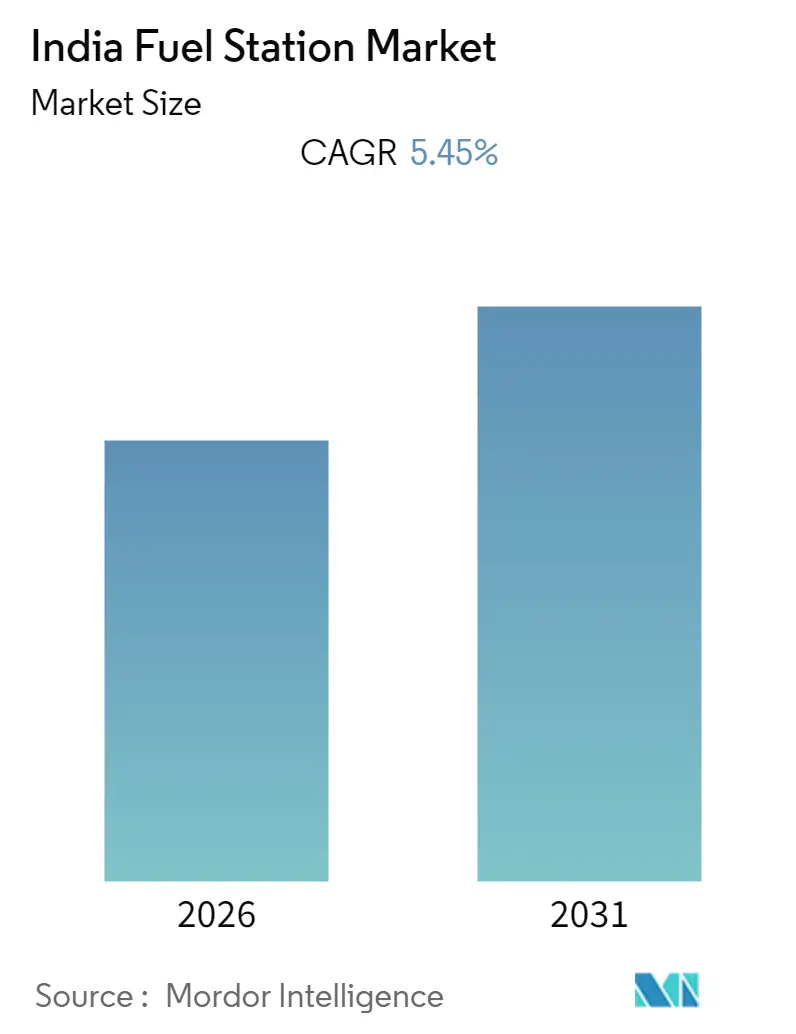
The India Fuel Station Market size is expected to register a CAGR of greater than 5.45% during the forecast period.
COVID-19 negatively impacted the market in 2020. Presently the market has now reached pre-pandemic levels.
- Over the long term, factors such as increasing demand for petroleum products and the rising sale of passenger vehicles in India are expected to help the market grow during the forecast period.
- On the other note, the increasing cost of petrol & diesel fuels is anticipated to restrain the growth of the fuel station fuel market in the coming years.
- Nevertheless, converting the fuel stations in India to provide multiple fueling options such as petrol, diesel, and flex fuels, besides electric vehicle (EV) charging facilities, compressed natural gas is expected to offer vast opportunities in the future.
Note: Market size and forecast figures in this report are generated using Mordor Intelligence’s proprietary estimation framework, updated with the latest available data and insights as of 2026.
India Fuel Station Market Trends and Insights
The Private Owned Segment is Expected to be the Fastest-Growing Market
- The private-owned segment is expected to witness significant growth during the forecast period due to rising fuel demand and the liberalization of fuel retailing in India.
- Looking at the future potential, various global players are interested in entering the Indian fuel retail segment. As of 1st May 2022, Reliance Industries Limited has 1,459 fuel stations, Nayara Energy (formerly Essar Oil) has 6,604, Royal Dutch Shell has 324 outlets, and other companies have 34 outlets. This, in turn, replicates the growth in the Indian fuel station market.
- In June 2022, The government of India announced the implementation of Universal Service Obligation (USO) for all retail outlets. As per the rule, petrol pumps cannot stop selling petrol and diesel. This rule is also applicable to petrol pumps in remote areas. The government has made it clear that whoever does not follow these rules will get their license canceled.
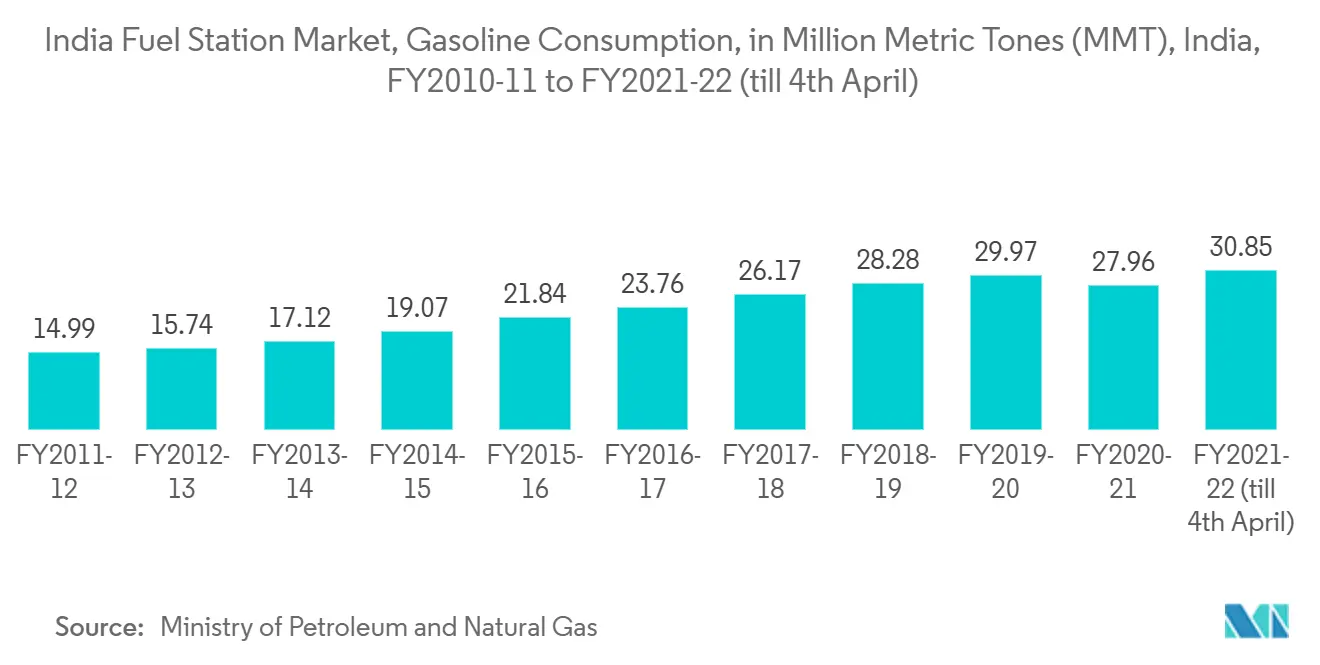
- Moreover, according to the Ministry of Petroleum and Natural Gas, during the FY2021-2022 (as of 9th April 2022), Indian gasoline consumption rose to 30.85 million metric tonnes (MMT), showing a growth of 13% compared to the previous year, and the diesel has reached 76.69 MMT with a 5% rise from FY2020-21. The Government of India is relaxing restrictions on the sale of gasoline and aviation fuel and encouraging private players like British Petroleum, TotalEnergies, and Trafigura in India. This is likely to make the companies in the private-owned segment dominate the market during the forecast period.
- Hence, with the increase in demand for fuel and the growing interest of the private players in the Indian fuel station sector, the private-owned segment is expected to grow significantly during the forecast period.


Rising Passenger Vehicles Penetration May Help the Market Grow
- India is one of the largest economies in the world. Further, the country is expected to remain the fastest-growing economy during the forecast period due to the rising population, urbanization, and industrialization.
- The country has seen remarkable economic growth in recent years, with rising living standards and average income. A steady rise in vehicle sales has also been witnessed in recent years.
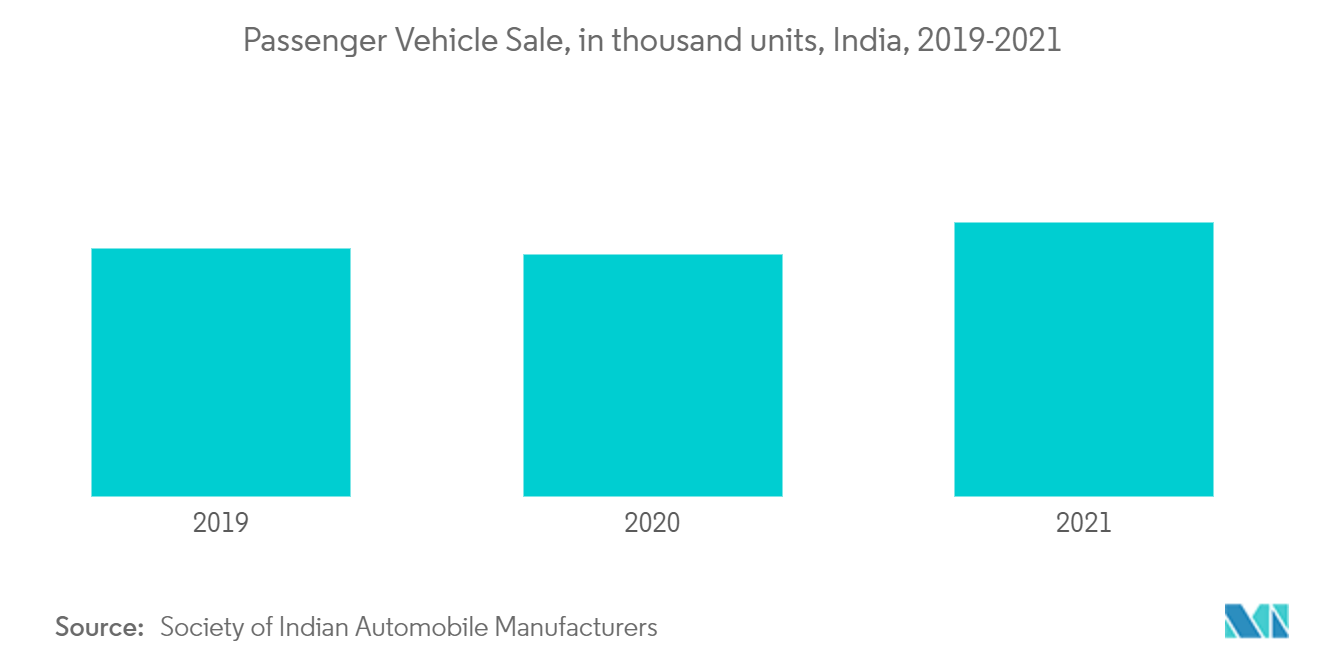
- India has seen a total annual vehicle sales rise from 1.98 million in 2008 to 3.78 million in 2021, of which the passenger vehicles alone accounted for 3.06 million. Further, vehicle sales are expected to grow during the forecast period, which may increase the demand for fuel and fuel stations in the country.
- The rise of the Indian middle class is essential in vehicle sales. Moreover, an estimated 500 million people will likely move into the middle-and high-income brackets by 2030. This is expected to go together with the rise in vehicle sales.
- Hence, all these factors are expected to cause a rise in vehicle sales in India, likely to propel the demand for retail fuel stations during the forecast period.
Regulatory Landscape
India's retail fuel station operations are governed through a mix of central controls and sector-specific rules, including the Motor Spirit and High Speed Diesel (Regulation of Supply and Distribution and Prevention of Malpractices) Order, 2005, Marketing Discipline Guidelines (MDG), dealership agreements, and the Universal Service Obligation (USO) framework referenced for retail outlets. In June 2022, the Government of India announced USO implementation for all retail outlets, reinforcing continuity of supply obligations, including for remote areas, with license cancellation risks for non-compliance.
More recently, consumer protection and supply-allocation measures have been tightened. The PNGRB (Consumer Protection) Regulations, 2025 were notified with effect from April 1, 2026, setting out eight essential consumer rights for petroleum product and natural gas consumers, including fuel quality aligned to BIS specifications, transparent price display, and multi-channel grievance redressal (including digital modes). Separately, the Ministry of Petroleum and Natural Gas issued the Motor Spirit and High Speed Diesel (Temporary Regulation of Supply through Retail Outlets) Order, 2026 on June 11, 2026, restricting bulk industrial or commercial purchases through retail outlets (including a daily cap such as 200 liters/day) to protect availability for ordinary consumers.
Value Chain Analysis
The fuel station value chain in India covers crude sourcing and refining (or product imports), primary logistics to terminals and depots, secondary distribution to retail outlets, and last-mile dispensing with related non-fuel services. Primary movement from refineries and import terminals to storage terminals and depots uses a mix of pipelines (about a 20,000 km network), rail (about 22%), coastal shipping, and road, while secondary movement from depots to retail outlets is largely road-based, making depot density, tanker fleet availability, and route efficiency important drivers of cost and service.
Oil marketing companies (OMCs) anchor downstream infrastructure and the dealership ecosystem. Public sector OMCs (IndianOil, BPCL, and HPCL) collectively operate about 82% of depots and led the retail network with 97,804 total pumps as of August 2025 (IndianOil: 40,666, BPCL: 23,959, HPCL: 23,901). Private retailers form the next tier of the retail interface and site development pipeline, with Nayara Energy reported at 6,763 outlets, Reliance-BP at 1,991 outlets, and Shell at 355 outlets, typically relying on a combination of owned infrastructure access and contracted logistics to supply and operate multi-format stations.
Competitive Landscape
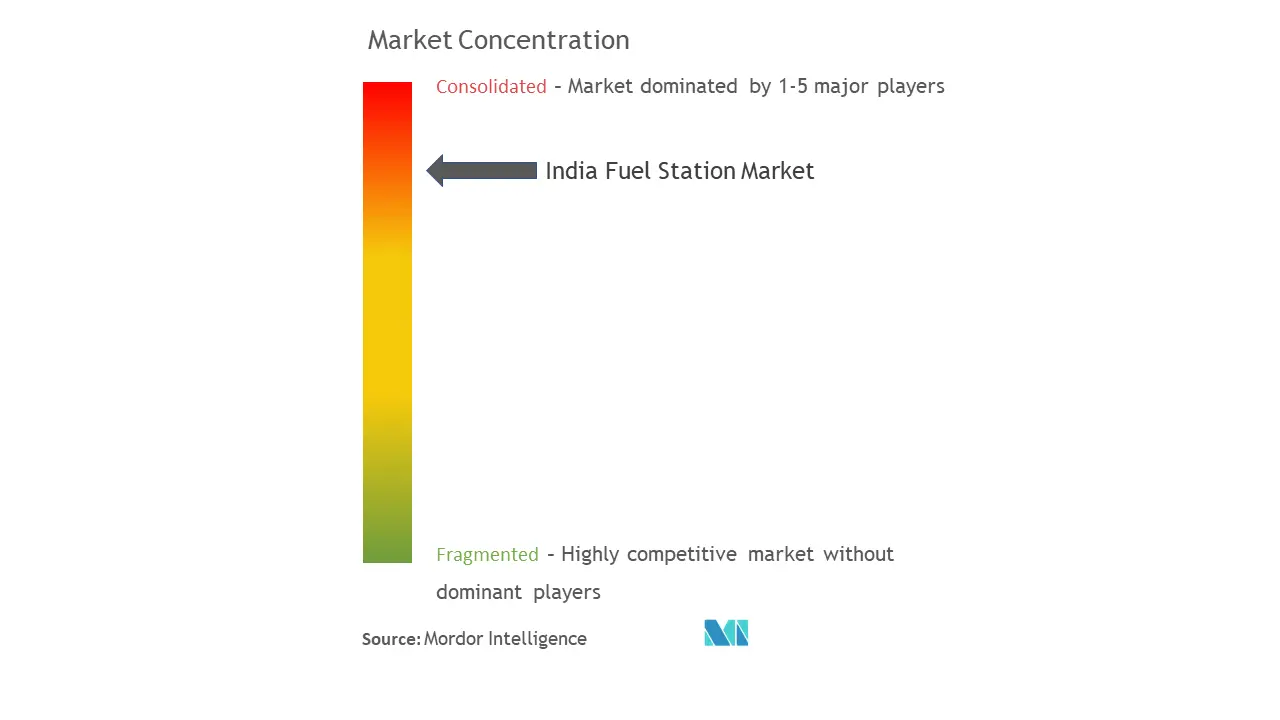
The Indian fuel station market is moderately consolidated. Some of the key players (in no particular order) include Indian Oil Corporation Ltd, Bharat Petroleum Corp. Ltd, Hindustan Petroleum Corporation Limited, Nayara Energy Limited, and Reliance Industries Limited.
India Fuel Station Industry Leaders
Indian Oil Corporation Ltd
Bharat Petroleum Corp Ltd
Hindustan Petroleum Corporation Limited
Nayara Energy Limited
Reliance Industries Limited
- *Disclaimer: Major Players sorted in no particular order

Market Opportunities and Future Outlook
A key opportunity is converting conventional petrol pumps into multi-energy mobility hubs that combine petrol and diesel with cleaner fuels and adjacent services. The Ministry of Petroleum and Natural Gas constituted an expert committee in August 2025 to review the 2019 fuel retailing guidelines in the context of decarbonization and alternative fuels (including CNG, LNG, biofuels, and EV charging), which creates a policy-linked pathway for retailers to standardize and scale multi-fueling formats at new and existing sites rather than treating additional fuels as standalone add-ons.
Infrastructure build-out and tighter service obligations also create whitespace for organized players with execution capability across rural and highway formats. Under the licensing framework, retail licensees are required to set up 100 outlets within five years of licensing, with a mandatory 5% rural footprint, which increases the importance of land acquisition, project management, and supply chain readiness beyond metros. On gaseous fuels, PNGRB's 2026-27 action focus on pipeline capacity booking and connectivity supports expansion of gas availability, aligning with national initiatives such as SATAT for compressed bio-gas and the broader push to raise natural gas share in the energy mix to 15% by 2030; together, these factors support station-level integration of CNG and related offerings where network connectivity and demand clusters make sense.
Recent Industry Developments
- July 2026: Hindustan Petroleum Corporation Limited (HPCL) commenced a project to establish 304 new retail fuel stations in Rajasthan with an investment of ₹400 crore. The expansion strengthens HPCL's regional footprint in Rajasthan's tier-2 markets and lays the groundwork for accelerated retail network growth in the region.
- June 2026: Nayara Energy Limited reported surpassing 7,000 retail fuel outlets across India, adding over 500 outlets in the preceding 18 months. The milestone expands the scale of Nayara Energy's retail network and enhances access for customers in rural and secondary markets, reinforcing its competitive positioning.
- May 2026: Bharat Petroleum Corporation Limited BPCL announced a ₹25,000 crore capital expenditure plan for FY27 focused on retail network expansion and ongoing refinery projects. The capex push accelerates network expansion and digital upskilling in 2026-27, positioning BPCL as a major enabler of retail growth.


Research Methodology Framework and Report Scope
Market Definition and Coverage
For this report, the India fuel station market covers the revenue pool linked to operating retail outlets that dispense transport fuels to end users, along with the forecourt retailing activity that is directly tied to fuel station throughput.
Scope exclusions: We exclude upstream extraction, crude refining, bulk fuel transport services, and purely wholesale depot sales that do not pass through a retail station.
Segmentation Overview
- Ownership
- Public Sector Undertakings
- Private Owned
- By End-User
- Public-Sector
- Private-Sector
Data Sources, Market Sizing, and Validation
Desk Research
Desk research starts by mapping the demand side for India fuel consumption and then matching it with the retail supply footprint. We lean on public data series such as the Ministry of Petroleum and Natural Gas (and related PPAC releases), national highway and transport updates, and Government of India statistics that help explain fuel demand and retail expansion.
To ground the station count, format mix, and the regulatory context, we also refer to sources such as OMC annual reports and investor decks, PNGRB and BIS notifications where relevant, and select trade bodies and energy associations that publish policy and retail network indicators. For pricing and currency consistency checks, RBI reference rates and official inflation series are reviewed, and paid subscriptions for company financials, news, and shipment-level import data are used selectively to cross-check disclosures and timing. This list is illustrative, and many other credible sources are also used for data collection, validation, and clarification.
Primary Interviews and Surveys
Primary work is used to validate what desk sources cannot fully explain, especially retail throughput patterns, dealer economics, and how pricing and margins move across geographies in India. We speak with a mix of public and private retail stakeholders, channel partners, and sector specialists, so assumptions can be tested across metro, highway, and rural station contexts before totals are finalized.
Distribution of primary research fieldwork respondents
| Company type | Respondent position |
|---|---|
| Top tier: 39% | CXOs: 12% |
| Mid tier: 41% | Functional/Unit leaders: 28% |
| Smaller Players: 20% | Managers: 60% |
Market-Sizing & Forecasting
Sizing starts from a top-down build where India fuel demand indicators are reconstructed into a retail station revenue pool using observed station throughput patterns and price realizations, and then these totals are pressure-tested through selective bottom-up checks. Bottom-up approximations are built from sampled outlet counts, typical fuel volumes per outlet, and indicative price per liter assumptions, which are then adjusted when gaps show up in channel checks.
Key inputs used in the model include retail outlet additions and closures, fuel category mix shifts (petrol versus diesel and the growing role of alternate fuels at stations), average retail selling price movements, typical forecourt throughput by location type, and changes in compliance and safety requirements that can alter operating uptime. Forecasting uses scenario analysis supported by expert consensus on fuel demand direction, pricing trend bands, and network expansion pace, so the model does not rely on one overly optimistic or conservative path. When station level data is not available for a pocket, we interpolate using comparable district traffic and demand signals and then re-validate the implied throughput with interviews.
Data Validation & Update Cycle
Outputs are checked through a triangulation loop, where totals must align with independent signals like reported retail fuel consumption trends, station network expansion commentary, and macro drivers that influence mobility demand in India. Any sharp variances are flagged, assumptions are revisited, and targeted re-contacts are triggered when the mismatch looks structural rather than timing related.
Before sign-off, the model and the written insights go through multi-step analyst reviews, including anomaly checks on prices, volumes, and implied per-station productivity. Reports are refreshed annually, and interim updates are made when material events occur, such as policy changes affecting retail pricing or large network announcements. Right before delivery, a final pass is completed so clients receive the latest updated view.
Mordor Intelligence's India Fuel Station Market Sizing Compared With Other Published Estimates
Different published market sizes for India fuel stations can look far apart because the counting rules are not always the same, even when the titles sound similar. The biggest swings usually come from what is treated as station revenue versus broader fuel retail value, and whether figures are normalized to a consistent year and currency conversion point.
In a refresh-led read, the timing of price snapshots matters a lot, since retail fuel prices and volumes can move meaningfully within a year and the same outlet base can show different revenue. By holding currency timing consistent, re-checking implied price per liter against official price movements, and re-contacting sources when model outputs drift from station network signals, Mordor Intelligence reduces avoidable volatility in the estimate.
Benchmark comparison
| Source | Market Size | Gaps in Research Methodology |
|---|---|---|
| Mordor Intelligence | USD 0.00 B (2025) | |
| Industry Association A | USD 0.00 B (2025) | This type of estimate often tracks fuel retail value more broadly and can include wholesale pass-through and non-station channels, which inflates the station-only revenue pool. |
| Trade Journal B | USD 0.00 B (2024) | Figures are frequently built from one-time price and demand snapshots and may not normalize currency timing or validate implied per-station throughput, which can shift the result up or down. |
The comparison shows that scope boundaries and refresh timing are usually the main reasons totals do not match. When station-only revenue is separated from wider downstream value, and when prices and currency are aligned to a clear reference period, the resulting market size is easier to reproduce and track year to year.


Key Questions Answered in the Report
What is the current India Petrol Station Market size?
The India Petrol Station Market is projected to register a CAGR of 5.45% during the forecast period (2026-2031)
Who are the key players in India Petrol Station Market?
Indian Oil Corporation Ltd, Bharat Petroleum Corp Ltd, Hindustan Petroleum Corporation Limited, Nayara Energy Limited and Reliance Industries Limited are the major companies operating in the India Petrol Station Market.
What years does this India Petrol Station Market cover?
The report covers the India Petrol Station Market historical market size for years: 2020, 2021, 2022, 2023 and 2024. The report also forecasts the India Petrol Station Market size for years: 2026, 2027, 2028, 2029, 2030 and 2031.
Page last updated on:


 Your data is secure and never sold or shared.


