
India Commercial Roofing Market Size and Share
Market Overview
| Study Period | 2021 - 2032 |
|---|---|
| Forecast Data Period | 2027 - 2032 |
| Base Year Market Size (2026) | USD 2.95 Billion |
| Market Size (2027) | USD 3.18 Billion |
| Market Size (2032) | USD 4.60 Billion |
| Growth Rate (2027 - 2032) | 7.69 % |
| Market Concentration | Low |
Major Players *Disclaimer: Major Players sorted in no particular order Image © Mordor Intelligence. Reuse requires attribution under CC BY 4.0. | |
India Commercial Roofing Market Analysis by Mordor Intelligence
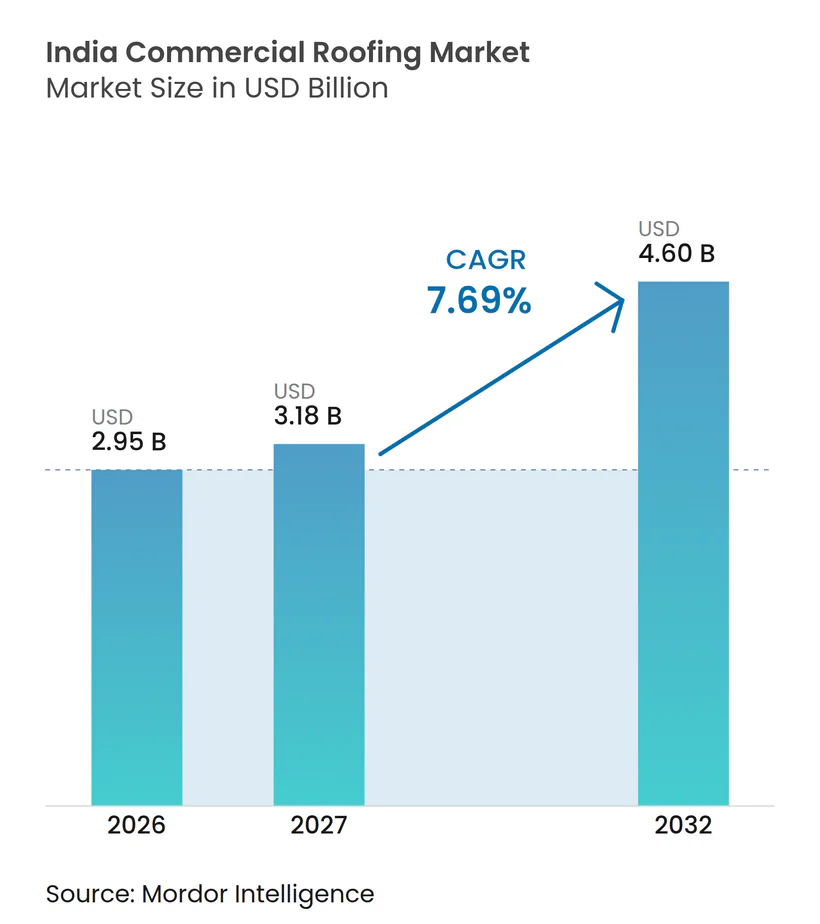
The India Commercial Roofing Market size is expected to increase from USD 2.95 billion in 2026 to USD 3.18 billion in 2027 and reach USD 4.60 billion by 2032, growing at a CAGR of 7.69% over 2027-2032.
Demand is moving from basic weather protection toward systems that meet structural, waterproofing, thermal, rooftop solar, drainage, installation, inspection, and maintenance requirements over the roof’s operating life, from initial design through repair or replacement. Industrial buildings, digital facilities, healthcare projects, public infrastructure, logistics sites, offices, retail properties, and commercial redevelopment are increasing the need for engineered metal roofs and higher-performance membranes that can be selected for specific building conditions, including roof shape, building use, local weather, expected equipment loads, drainage capacity, insulation needs, access for future inspection, planned changes to building operations, construction sequencing, the owner’s preferred maintenance approach, the availability of trained installers, the need for written warranties, and expected disruption to occupants during future repair work. Procurement decisions increasingly consider wind loads, rainfall patterns, roof geometry, drainage, reflective surfaces, rooftop equipment, installation records, written warranties, maintenance access, service-life expectations, contractor capability, expected repair needs, coordination with other trades, and the compatibility of materials with insulation or solar systems instead of evaluating only the initial material cost. These requirements give suppliers that combine product design, technical advice, certified installation, inspection support, maintenance planning, replacement guidance, project coordination, local service, and after-sales support a clearer position in the India commercial roofing market. Input-cost changes, weather-related scheduling limits, uneven contractor practices, roof-deck quality, replacement planning, material availability, site access, and waste-management constraints will remain important considerations. Still, they also increase the value of dependable systems and documented artistry, clearer accountability, and more reliable long-term building protection and maintenance outcomes for owners.
Key Report Takeaways
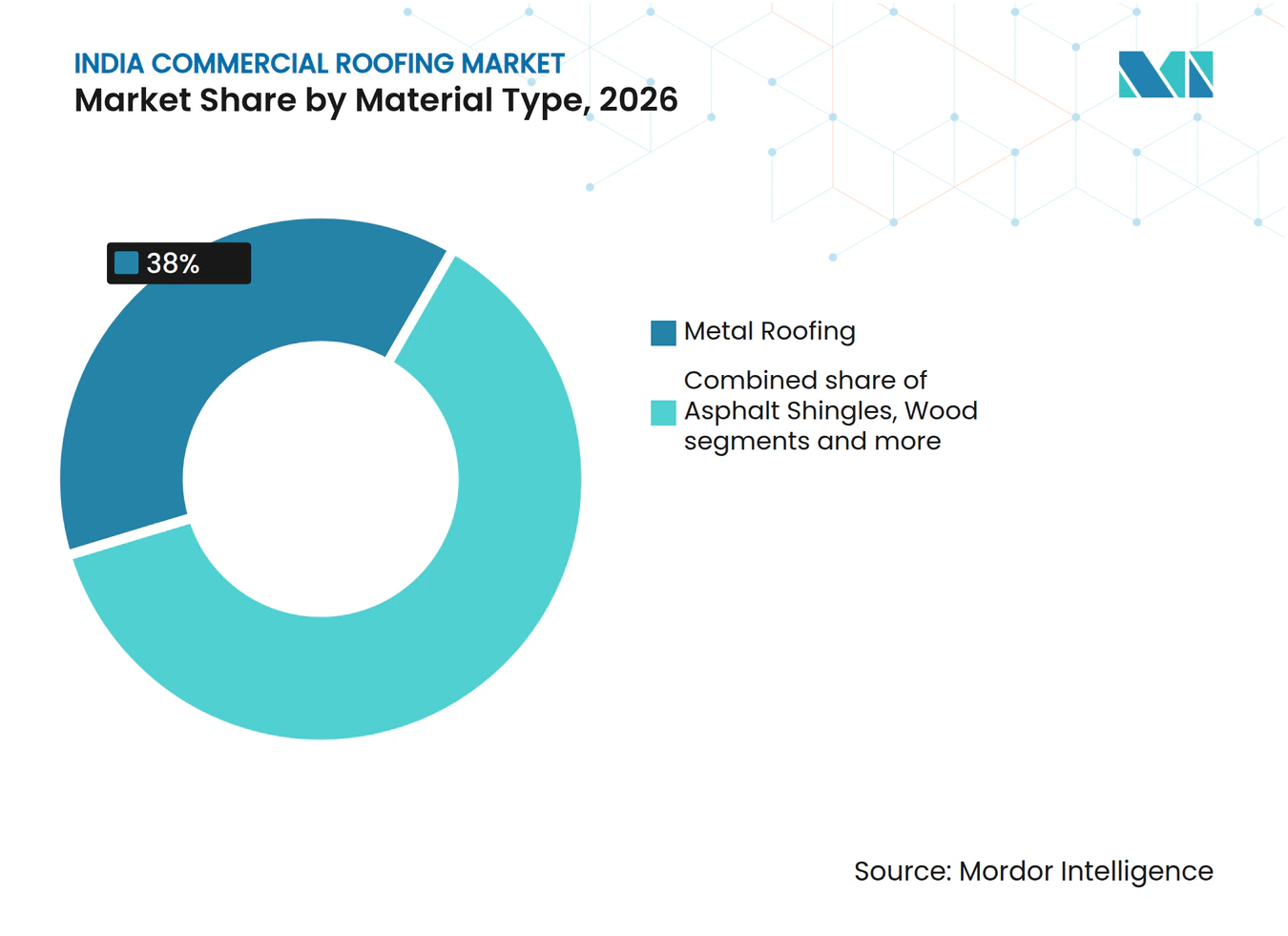
- By material type, metal roofing held 38.00% of the India commercial roofing market share in 2026, while single-ply membranes are forecast to grow at an 8.80% CAGR through 2032.
- By construction type, new construction accounted for 58.00% of the India commercial roofing market size in 2026 and is projected to expand at an 8.40% CAGR through 2032.
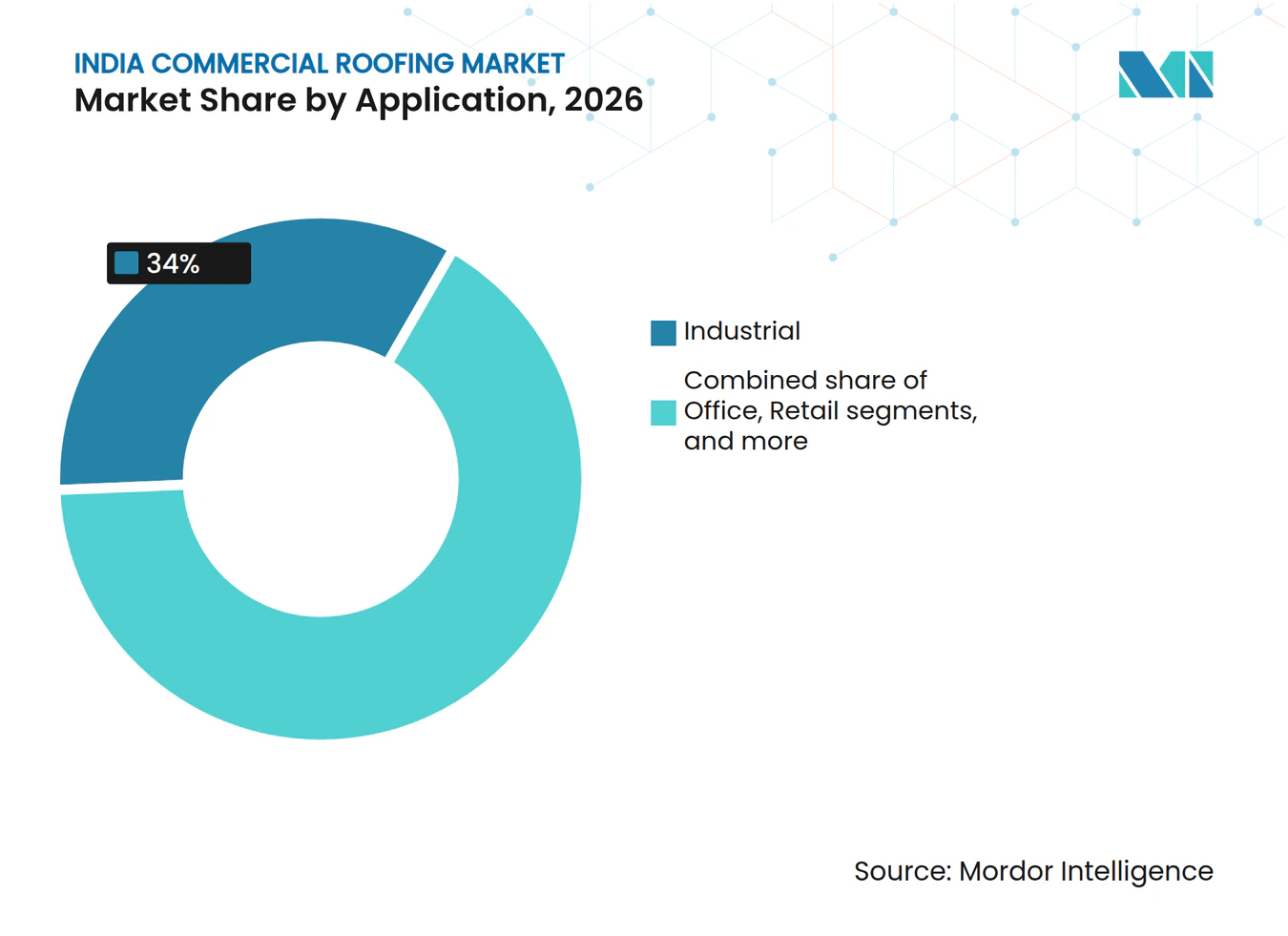
- By application, industrial buildings held 34.00% of the India commercial roofing market share in 2026 and are forecast to grow at a 9.10% CAGR through 2032.
- By geography, the Rest of India accounted for 24.00% of the India commercial roofing market size in 2026, while Bengaluru is expected to grow at a 9.20% CAGR through 2032.
Note: Market numbers in this report are based on Mordor Intelligence's proprietary estimation framework, which combines nine months of actuals with Q4 projections for base year 2026.
Market Trends and Insights
Drivers Impact Analysis of India Commercial Roofing Market*
| Drivers | (~) % Impact on CAGR Forecast | Geographic Relevance | Impact Timeline |
|---|---|---|---|
| Industrial Corridor and Warehouse Expansion | +2.2% | Pan-India, concentrated in Delhi NCR, Chennai, Bengaluru, Pune, and Mumbai. | Short term (≤ 2 years) |
| Data Center and Digital Infrastructure Buildout | +1.6% | Mumbai, Hyderabad, Chennai, Delhi NCR, and Bengaluru | Medium term (2-4 years) |
| Monsoon-Resilient Roof Specifications | +0.9% | Western India and coastal states including Maharashtra, Kerala, West Bengal, and Tamil Nadu | Short term (≤ 2 years) |
| Public Infrastructure and Healthcare Construction | +1.0% | National, with early gains in metro and Tier-2 districts | Medium term (2-4 years) |
| Rooftop Solar Readiness on Commercial Assets | +0.7% | Rajasthan, Karnataka, Maharashtra, Tamil Nadu, and Delhi | Medium term (2-4 years) |
| Domestic Steel and Insulation Capacity Expansion | +0.6% | West Bengal, Jharkhand, and Gujarat, with national spillover | Long term (≥ 4 years) |
| Source: Mordor Intelligence | |||
Industrial Corridors and Digital Infrastructure Buildout
New logistics facilities, manufacturing sites, and digital campuses are creating steady roofing demand across major industrial locations. Large-span pre-engineered buildings use metal roof systems because construction teams need fast installation, structural strength, broad coverage, and a workable approach to future extension or repair. Roof selection also affects drainage planning, fire safety coordination, future maintenance access, insulation choices, equipment supports, edge protection, and the ability to add equipment after the building enters service. Data centers require a different roof specification, often using thermoplastic polyolefin, ethylene propylene diene monomer, or polyvinyl chloride membranes on flat roofs. These systems support tightly sealed waterproofing, thermal management, rooftop equipment loads, regular maintenance access, and continuity for facilities that cannot tolerate water ingress or unexpected shutdowns. The India commercial roofing market benefits as industrial and digital projects shift purchasing toward systems with clear performance standards, installation guidance, and warranty requirements.
Data Center and Digital Infrastructure Buildout
Digital facilities require roof systems that perform differently from standard warehouse roofs. Data centers commonly need flat roofs with tightly sealed waterproofing, thermal management, controlled drainage, and capacity for cooling equipment and backup systems. Thermoplastic polyolefin, ethylene propylene diene monomer, and polyvinyl chloride membranes can serve these needs when installed with compatible insulation, flashing, and inspection access. Roof design is important because unexpected water entry can disrupt operations and damage sensitive equipment. This supports demand for membrane suppliers and installers that can meet strict performance and maintenance requirements.
Public Infrastructure and Healthcare Construction
Healthcare construction adds demand for roofs that protect sensitive equipment and integrate with heating, ventilation, and air-conditioning systems, electrical services, and emergency systems. The Pradhan Mantri Ayushman Bharat Health Infrastructure Mission approved funding for states and union territories through fiscal year 2025-26 to strengthen health centers, laboratories, and critical care blocks[1]. These buildings need consistent waterproofing because leaks can interrupt clinical activity, damage equipment, affect interior finishes, and complicate regular cleaning and maintenance. Public projects are more likely to formalize waterproofing and structural requirements within tender documents, which can make material compliance and installation records more relevant during procurement. This increases the role of suppliers able to provide technical documentation, suitable sealants, project-specific materials, and clear support for installation teams. The same need extends to education, transport, and civic assets that require long service life, predictable maintenance outcomes, and minimal disruption to building users.
Monsoon-Resilient Roof Specifications
Monsoon rainfall, coastal humidity, wind exposure, and drainage needs make roof design a core project decision for owners, contractors, and material suppliers. The Bureau of Indian Standards provides technical guidance through IS 3067 for waterproofing design and IS 875 Part 3 for wind loads[2]. Existing commercial roofs may require strengthening or replacement before rooftop solar equipment is installed, especially if inspection identifies weak deck areas, corrosion, or unresolved water entry points. This can turn a limited repair into a larger replacement project when water damage or inadequate load capacity is found. Tata BlueScope Steel has introduced engineered roof profiles and standing-seam systems that address drainage, weather resistance, solar-related design needs, and longer-term maintenance concerns[3]. The India commercial roofing market benefits when buyers choose systems designed for local weather conditions rather than basic sheet replacement.
Restraints Impact Analysis of India Commercial Roofing Market*
| Restraints | (~) % Impact on CAGR Forecast | Geographic Relevance | Impact Timeline |
|---|---|---|---|
| Monsoon-Season Installation Interruptions | -1.1% | Pan-India, most acute in Kerala, West Bengal, Maharashtra, and Odisha | Short term (≤ 2 years) |
| Fragmented Contractor Certification and Warranty Practices | -0.9% | Pan-India, most acute in Tier-2 and Tier-3 markets | Long term (≥ 4 years) |
| Volatile Bitumen, Polymer, and Imported Component Costs | -0.8% | Pan-India, with import exposure concentrated at Kandla, JNPT, and Chennai | Medium term (2-4 years) |
| Uneven Roof-Deck Quality in Rapid-Build Projects | -0.5% | North and Central India, including Tier-2 rapid-urbanization zones | Medium term (2-4 years) |
| Limited Formal Roofing-Recycling Infrastructure | -0.3% | National, with pilot activity in Maharashtra and Karnataka | Long term (≥ 4 years) |
| Source: Mordor Intelligence | |||
Monsoon Scheduling and Input-Cost Pressure
Monsoon conditions can reduce workable installation days in many parts of India and delay both new projects and replacement work, particularly when roof surfaces remain wet or access becomes difficult. The challenge is greater in coastal and high-rainfall states, where moisture can affect substrate preparation, membrane application, joint sealing, curing time, and safe movement of workers and materials. Installation teams must wait for suitable surface conditions before applying waterproofing materials or sealing roof joints, which can affect the sequence of other construction work. Construction restrictions in urban areas can further narrow project schedules during seasonal pollution-control periods. Contractors may procure materials earlier to protect schedules, which adds inventory, storage, cash-flow, and financing pressure. Volatile costs for bitumen, polymers, and imported components add another difficulty for fixed-price projects in the India commercial roofing market.
Fragmented Installation Practices and End-of-Life Gaps
Commercial roofing performance depends on installation quality as much as material selection, because weak joints, poorly prepared surfaces, and incorrect drainage details can affect the entire roof system. India does not have a mandated national licensing framework for commercial roofing applicators, while project contracts apply technical codes unevenly and often vary between regions and building types. This can lead building owners to select lower-cost materials without considering full-system waterproofing, joint treatment, drainage, testing, maintenance access, or warranty needs. Rapid construction schedules can also leave inconsistent roof-deck preparation, which raises the risk of later leaks, premature repair work, and disagreement over whether material or installation caused the issue. Limited recycling systems for used roofing materials add a longer-term waste-management issue, especially when replacement projects remove mixed materials. Organized suppliers can respond with installer training, written warranties, inspection records, site supervision, and lifecycle support.
*Our forecasts treat driver/restraint impacts as directional, not additive. The impact forecasts reflect baseline growth, mix effects, and variable interactions.
India Commercial Roofing Market Segment Analysis
By Material Type:
Metal Roofing Retains the Largest Position While Membranes Gain GroundMetal roofing held 38.00% of 2026 value in the India commercial roofing market, making it the largest material category. It is widely used for factories, warehouses, logistics parks, and other pre-engineered buildings because it offers structural performance, rapid installation, and broad coverage across large building footprints. Galvalume and color-coated galvanized steel remain important choices for roofs exposed to heat, wind, rain, and regular maintenance activity, especially where roof geometry and drainage conditions require predictable material performance. These materials can be selected with profiles, coatings, insulation, fasteners, flashings, and drainage details that suit a building’s location, operating requirements, and expected maintenance program. Metal roofs are also practical for solar-ready projects because the supporting structure, penetrations, drainage paths, and corrosion protection can be planned at the design stage. Tata BlueScope Steel’s LYSAGHT FORTISS 470 standing-seam system shows the movement toward engineered products that avoid roof perforations and support stronger water management.
Single-ply membranes are the fastest-growing material segment, with an expected 8.80% CAGR through 2032. Thermoplastic polyolefin, ethylene propylene diene monomer, and polyvinyl chloride membranes serve flat-roof needs in data centers, offices, retail assets, and solar-ready buildings, where watertight seams, roof loading, insulation coordination, and surface reflectivity can be important. Their welded seams and reflective surfaces can support waterproofing and cooling requirements when specified alongside compatible insulation, substrate preparation, flashing, drainage arrangements, and regular inspection procedures. Bituminous and modified bitumen systems retain a place in waterproofing and retrofit applications because many contractors are familiar with installation methods and owners recognize their established role in repair and renewal work. Asphalt shingles, clay and concrete tiles, and wood remain limited to specialized commercial uses, including premium mixed-use properties, institutional sites, heritage-adjacent buildings, and decorative applications where appearance has a greater role in material selection.



By Construction Type:
New Construction Leads While Replacement Demand BuildsNew construction accounted for 58.00% of 2026 demand and was also the fastest-growing construction category at an 8.40% CAGR through 2032. The segment is supported by industrial facilities, offices, retail space, data centers, healthcare buildings, and public infrastructure that require a complete roofing decision during construction. Each project allows owners to select a roof based on use case, weather conditions, equipment loading, energy needs, drainage arrangements, expected maintenance, desired warranty coverage, and whether rooftop equipment may be added later. Early design coordination can also reduce the risk that roof penetrations, edge details, insulation layers, and water discharge arrangements conflict with other building systems. Government capital expenditure continues to support assets that require long-lived building materials, formal procurement documents, and stronger technical documentation. The Reserve Bank of India reported central government capital expenditure for fiscal year 2025-26.
Reroofing and replacement represented the remaining 42% of demand in 2026. Many commercial buildings built between 2005 and 2015 are approaching the point where roof systems need more extensive repair or replacement after years of rain, heat, equipment changes, repairs, and maintenance activity. Solar additions can bring forward these decisions because the underlying roof may need a structural and waterproofing review before panels are installed and connected. Building owners may prefer replacement when repeated repairs no longer address leaks, drainage failures, corroded metal, failed joints, damaged insulation, or recurring disruption to building operations. This part of the India commercial roofing market should become more important as commercial building stock ages and organized installers offer inspection, scope definition, documented installation, warranty terms, and maintenance planning that support longer service life.
By Application:
Industrial Buildings Lead While Offices and Retail Add ValueIndustrial buildings held 34.00% of 2026 value in the India commercial roofing market and are forecast to grow at a 9.10% CAGR through 2032. Warehouses, manufacturing plants, logistics facilities, and pre-engineered buildings support this leading position because they often require wide roof spans, efficient installation, materials suited to continuous operating use, and systems that can accommodate changing storage or production layouts. These structures need metal spans, insulated panels, drainage design, corrosion resistance, load management, controlled roof penetrations, and detailing that can withstand local weather conditions over a long operating period. Data centers are usually grouped within industrial demand, but they have more demanding roof requirements than a standard warehouse. Their roofs may need precise membrane seams, heat-management performance, load ratings for cooling equipment and backup systems, inspection access, and well-controlled waterproofing around rooftop penetrations.
Retail and office projects contribute a smaller volume base but can command more specialized systems and higher service expectations. Grade-A malls and office parks may select reflective metal roofs or engineered membranes that support water control, cooling needs, visual requirements, roof-mounted equipment, and building certification objectives. Healthcare, education, hospitality, and mixed-use buildings are included within other applications, where the right system depends on the building’s operations, occupancy pattern, roof shape, maintenance needs, and tolerance for disruption during repair work. These applications allow suppliers to compete on technical support, design compatibility, installation quality, project coordination, and warranty terms rather than material price alone. The India commercial roofing industry gains from this mix because it reduces dependence on one end-use category while requiring installers to understand different roof shapes, drainage conditions, performance requirements, and the service expectations of each building owner.

Geography Analysis
The rest of India held 24.00% of 2026 demand, making it the largest geographic grouping in the India commercial roofing market. The grouping includes Tier-2 and Tier-3 industrial locations with manufacturing clusters, government projects, developing logistics capacity, and commercial construction that does not always follow the same procurement model as metropolitan projects. Demand in cities such as Nagpur, Coimbatore, Indore, Jaipur, Lucknow, and Surat is more dispersed than in the largest metropolitan markets. This dispersion broadens the need for dealer networks, local installation teams, accessible technical service, and roof systems that can be specified and maintained outside major cities. Government tenders that reference wind-load and waterproofing requirements can raise the standard for roofing procurement beyond the largest cities.
Bengaluru is forecast to record the fastest geographic growth at a 9.20% CAGR through 2032. The city combines demand from logistics, electronics, e-commerce, offices, data centers, and mixed-use commercial projects, creating demand for both large metal roofs and higher-performance flat-roof systems, which requires suppliers to support different specifications. Mumbai remains important for high-specification roof systems because of its large commercial base, digital infrastructure footprint, humid weather conditions, and need for strong waterproofing performance. Delhi NCR continues to support pre-engineered building activity across logistics and industrial locations. At the same time, Chennai adds manufacturing and industrial demand and needs weather-resistant roof design because of its coastal setting.
Hyderabad, Pune, Kolkata, and Ahmedabad provide additional sources of project demand in the India commercial roofing market. Hyderabad combines digital infrastructure, retail development, and commercial construction needs, which creates demand for membrane systems as well as conventional metal-roof applications. Pune has office, industrial, and automotive-related activity, with Chakan and Talegaon supporting large industrial facilities that need durable, large-span roofing. Kolkata benefits from industrial construction and access to regional steel supply, while Ahmedabad is an expanding logistics and warehousing location. Suppliers that can serve these cities with local project support, dependable material delivery, technical advice, and documented installation practices will be better placed than firms relying only on metro markets.
Competitive Landscape
Market Concentration
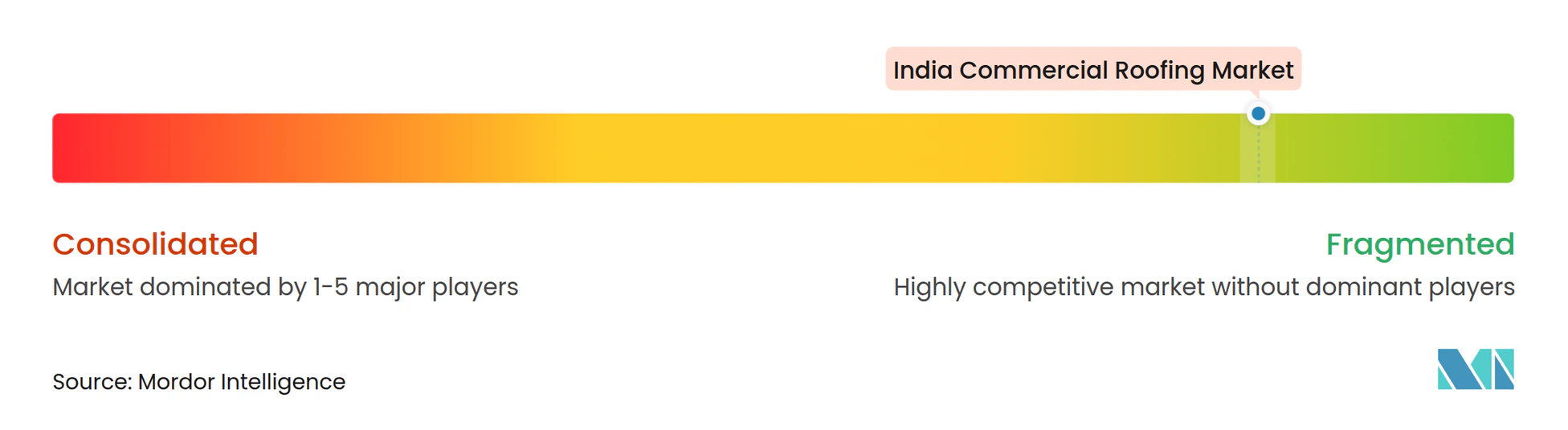
The India commercial roofing market is moderately fragmented, with several groups serving different parts of the value chain. Tata BlueScope Steel, Kirby Building Systems India, and Interarch Building Products compete in engineered metal roofs and pre-engineered building systems. At the same time, construction-chemical companies serve waterproofing, sealants, and membrane requirements. Everest Industries, DURATUF Products, PEB Steel Building Systems, and other coated-steel suppliers serve specific project and regional needs, so competition differs by material category, project scale, location, and the technical service required by the customer. The lack of a national contractor certification framework makes trained installation, system warranties, and inspection records practical ways for organized suppliers to stand apart.
Capacity expansion is a central competitive strategy. Kirby Building Systems India began construction of its fourth pre-engineered building facility in Manapparai, Tamil Nadu, in September 2026, and the facility is intended to serve industrial and logistics demand in southern India. Interarch is adding manufacturing capacity through projects in Andhra Pradesh and Gujarat, strengthening its ability to address decentralized demand and larger project requirements. Shyam Metalics expanded its color-coated steel capacity at Jamuria, which supports roofing and solar-related applications and raises competition in standard products. This places greater emphasis on project service, timely delivery, product engineering, and design support.
Product breadth and consolidation are also shaping the India commercial roofing market. Saint-Gobain completed its acquisition of Fosroc in February 2025, bringing waterproofing, concrete repair, and admixture offerings together within a broader building-materials portfolio. Tremco CPG acquired Kalzip GmbH in April 2026, adding aluminum standing-seam roof and facade systems to its portfolio for high-specification projects. Tata Steel’s announced acquisition of BlueScope’s stake in Tata BlueScope Steel points to greater emphasis on downstream, value-added building solutions, and companies that combine material supply, engineering guidance, certified installation, and written warranties are likely to be more competitive as buyers place more value on roof performance.
India Commercial Roofing Industry Leaders
-
Tata Steel
-
JSW Steel
-
Everest Industries Limited
-
SAIL
-
Lloyd Insulations (India) Limited
- *Disclaimer: Major Players sorted in no particular order
India Commercial Roofing Market Companies Covered in this Report
- Tata Steel
- JSW Steel
- Everest Industries Limited
- SAIL
- Lloyd Insulations (India) Limited
- Uttam Galva Steels Limited
- Kirby Building Systems India
- Interarch Building Products
- PEB Steel Building Systems
- DURATUF Products
- Fosroc India
- Saint-Gobain India Private Limited
- Sika India Private Limited
- Pidilite Industries Limited
- Asian Paints Limited
- Shalimar Paints Limited
- Tremco CPG India
- Kansai Nerolac Paints Limited
- Tata BlueScope Steel
- Larsen and Toubro Limited
Recent Industry Developments in India Commercial Roofing Market
- June 2026: Kirby Building Systems India broke ground on its fourth pre-engineered building manufacturing facility in Manapparai, Tamil Nadu. The facility will add 100,000 metric tons of annual capacity and is scheduled to begin commercial operations by mid-2027. The additional capacity is intended to support industrial and logistics projects in southern India, where suppliers need shorter delivery times and engineering support for large buildings.
- April 2026: Tremco CPG completed the acquisition of Kalzip GmbH, adding aluminum-based roof and facade systems to its roofing, sealing, and insulation portfolio. The transaction broadens the company’s position in standing-seam systems that can be specified for high-performance commercial projects.
- April 2026: Shyam Metalics and Energy Limited commissioned Phase II of its cold rolling mill at Jamuria, West Bengal, raising total color-coated steel capacity to 0.40 million metric tons per year. The facility supports roofing and solar-related applications and adds to the domestic supply of coated building materials.
India Commercial Roofing Market Report Scope
Segmentation Overview
| Asphalt Shingles |
| Clay & Concrete Tiles |
| Metal Roofing |
| Bituminous / Modified Bitumen Membranes |
| Single-Ply Membranes (TPO, EPDM, and PVC) |
| Wood |
| Others |
| New Construction |
| Reroofing and Replacement |
| Retail |
| Office |
| Industrial |
| Others |
| Others |
| Mumbai Metropolitan Region |
| Delhi NCR |
| Pune |
| Bengaluru |
| Hyderabad |
| Chennai |
| Kolkata |
| Ahmedabad |
| Rest of India |
| By Material Type | Asphalt Shingles |
| Clay & Concrete Tiles | |
| Metal Roofing | |
| Bituminous / Modified Bitumen Membranes | |
| Single-Ply Membranes (TPO, EPDM, and PVC) | |
| Wood | |
| Others | |
| By Construction Type | New Construction |
| Reroofing and Replacement | |
| By Application | Retail |
| Office | |
| Industrial | |
| Others | |
| Others | |
| By Cities | Mumbai Metropolitan Region |
| Delhi NCR | |
| Pune | |
| Bengaluru | |
| Hyderabad | |
| Chennai | |
| Kolkata | |
| Ahmedabad | |
| Rest of India |
Key Questions Answered in the Report
What is the projected value of the India commercial roofing market by 2032?
The India commercial roofing market is forecast to reach USD 4.60 billion by 2032, growing at a 7.69% CAGR from 2027. The outlook reflects demand for engineered systems in industrial, digital, public, and commercial buildings, rather than a narrow reliance on one building category. Growth also depends on whether suppliers can meet higher requirements for waterproofing, drainage, structural performance, and installation quality across new construction and replacement projects.
Which material has the largest commercial roofing demand in India?
Metal roofing leads with 38.00% of 2026 value, supported by warehouses, factories, logistics facilities, and pre-engineered buildings. Its role reflects the need for broad spans, rapid installation, drainage, weather resistance, and practical access for future maintenance or roof-mounted equipment. It remains suited to projects that need dependable coverage across wide industrial roofs, where construction schedules, lifecycle cost, corrosion control, and long-term upkeep all matter.
Which roofing material is growing fastest in India?
Single-ply membranes are expected to grow at an 8.80% CAGR through 2032 as data centers and solar-ready buildings need flat-roof waterproofing systems. Thermoplastic polyolefin, ethylene propylene diene monomer, and polyvinyl chloride are the key membrane types, each used where a tightly sealed and well-managed roof surface is needed. The category benefits when projects place greater value on reflective surfaces, controlled seams, insulation coordination, regular inspection, and protection around equipment penetrations.
Why are industrial buildings important for commercial roofing demand?
Industrial buildings held 34.00% of 2026 value and are forecast to expand at a 9.10% CAGR through 2032, supported by manufacturing and logistics construction. These projects need long roof spans, corrosion resistance, equipment access, durable drainage solutions, and materials that can be installed as the wider building schedule advances. Their scale can also make roof selection important for insulation, maintenance access, rooftop equipment, drainage capacity, construction sequencing, and operating continuity after the facility opens.
Which location is expected to grow fastest for commercial roofing projects?
Bengaluru is forecast to grow at a 9.20% CAGR through 2032, supported by logistics, digital infrastructure, offices, and industrial construction. The city requires both metal-roof solutions and flat-roof membranes because warehouse, office, mixed-use, and digital facilities do not have identical roof design needs. Suppliers must therefore provide products and installation support suited to varied roof profiles, equipment loads, climate exposure, maintenance plans, construction schedules, and waterproofing requirements.
What factors can limit commercial roofing project growth in India?
Monsoon delays, input-cost volatility, uneven roof-deck quality, fragmented contractor practices, and limited recycling infrastructure can affect project schedules and performance. Documented installation methods, inspection records, trained crews, and written warranties can help building owners manage these risks more effectively. Better planning before installation can also reduce disruption by identifying drainage needs, substrate issues, equipment locations, material storage requirements, weather-related schedule constraints, and access needs for later maintenance.