
Independent Lodgings Market Size and Share
Market Overview
| Study Period | 2021 - 2031 |
|---|---|
| Market Size (2026) | USD 235.56 Billion |
| Market Size (2031) | USD 345.34 Billion |
| Growth Rate (2026 - 2031) | 7.95 % |
| Fastest Growing Market | Asia-Pacific |
| Largest Market | Europe |
| Market Concentration | Low |
Major Players *Disclaimer: Major Players sorted in no particular order Image © Mordor Intelligence. Reuse requires attribution under CC BY 4.0. | |
Independent Lodgings Market Analysis by Mordor Intelligence
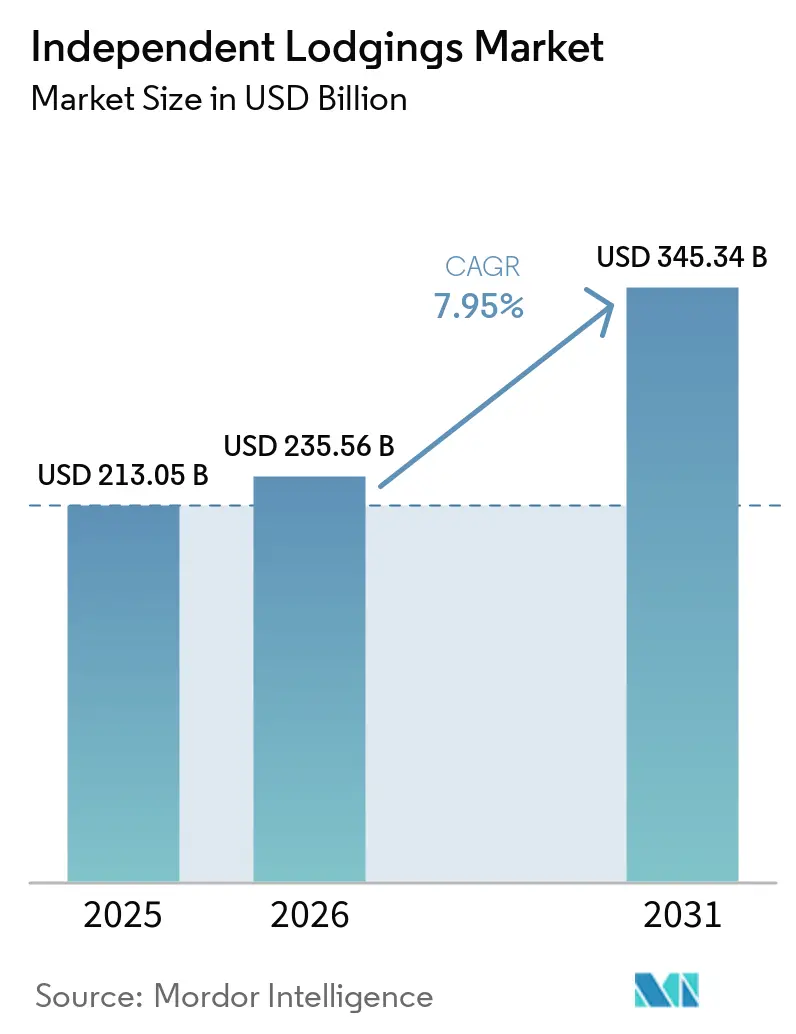
The Independent Lodging Market was valued at USD 213.05 billion in 2025 and estimated to grow from USD 235.56 billion in 2026 to reach USD 345.34 billion by 2031, at a CAGR of 7.95% during the forecast period (2026-2031). Growth is driven by increasing traveler demand for accommodations offering local, flexible, and unique experiences. Digital platforms are enhancing visibility for smaller operators, with India showing strong growth. Airbnb reported a 50% rise in nights booked from India and over 60% growth in first-time bookers in Q4 2025[1]. Professionalized operating models are improving distribution, service consistency, and pricing strategies while maintaining local identity. The rise in "bleisure" travel is extending stay durations and influencing room requirements, particularly for workspace, connectivity, and flexible check-in options, supporting higher-value use cases for independent properties. Challenges such as OTA commissions and stricter regulations persist. Operators who effectively manage compliance, protect margins, and build direct guest relationships are best positioned to capitalize on market opportunities.
Key Report Takeaways
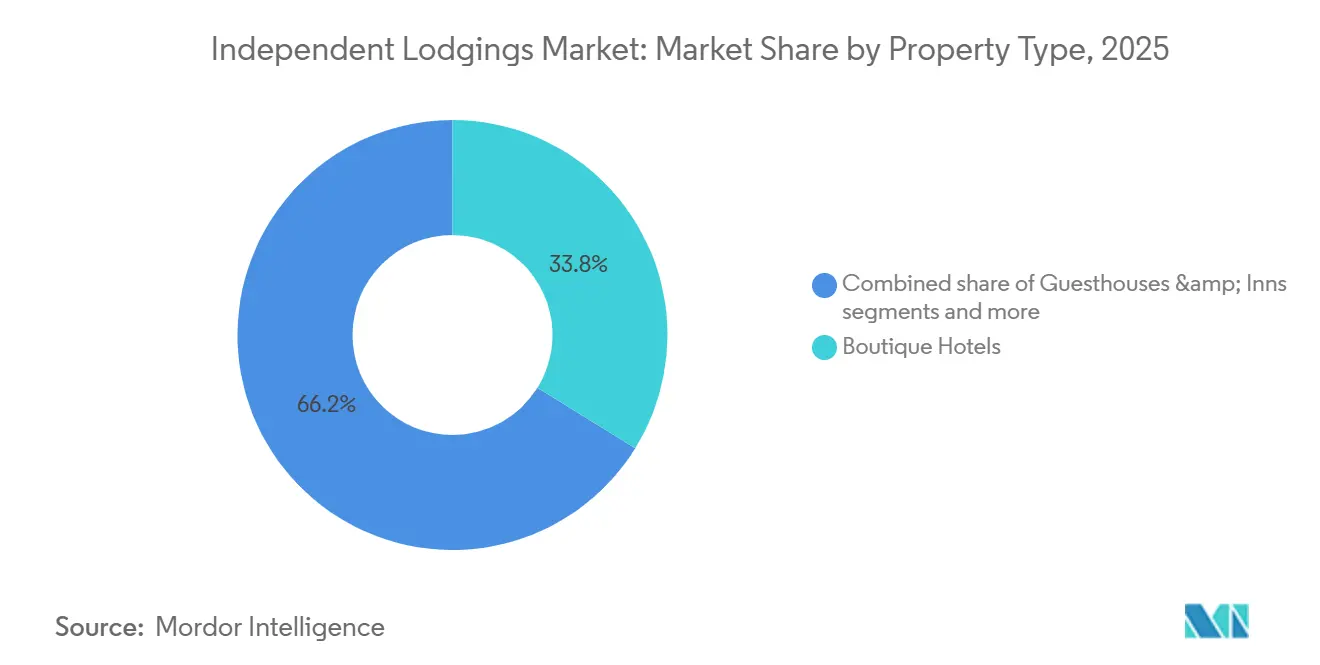
- By property type, boutique accommodations accounted for a 33.84% revenue share of the Independent Lodgings Market in 2025, while Other Independent Accommodations are projected to grow at the highest CAGR of 9.54% by 2031.
- By booking channel, online travel agencies held a 59.42% share of the Independent Lodgings Market in 2025, while direct booking is projected to grow at the highest CAGR of 8.86% by 2031.
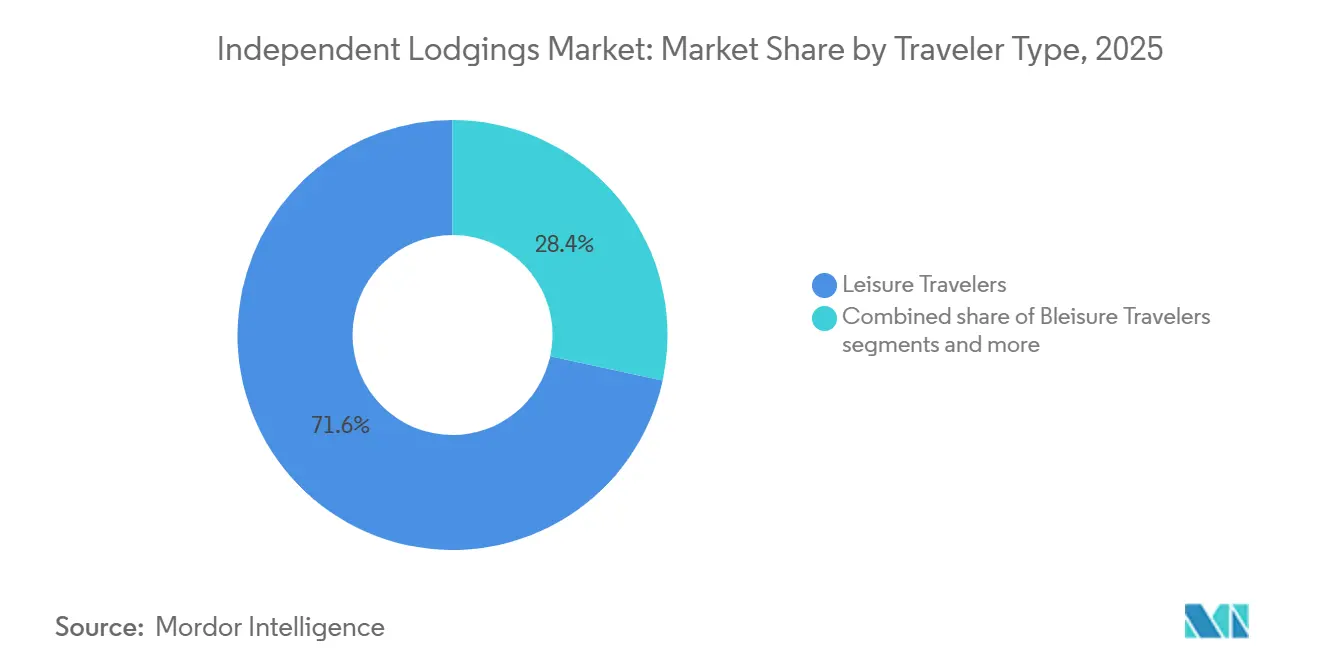
- By traveler type, leisure travelers held a 71.61% share of the Independent Lodgings Market in 2025, while bleisure is projected to grow at the highest CAGR of 10.42% by 2031.
- By price tier, midscale held a 46.21% revenue share of the Independent Lodgings Market in 2025, while luxury or premium is projected to grow at the highest CAGR of 10.19% by 2031.
- By geography, Europe held a 35.44% share of the Independent Lodgings Market in 2025, while Asia-Pacific is projected to grow at the highest CAGR of 9.97% by 2031.
Note: Market size and forecast figures in this report are generated using Mordor Intelligence’s proprietary estimation framework, updated with the latest available data and insights as of January 2026.
Global Independent Lodgings Market Trends and Insights
Drivers Impact Analysis*
| Driver | (~) % Impact on CAGR Forecast | Geographic Relevance | Impact Timeline |
|---|---|---|---|
| Rising Preference for Authentic, Localized Stays | +1.8% | Global, with concentration in Europe and North America | Long term (≥ 4 years) |
| Expansion of Digital Booking and Discovery Channels | +1.4% | Global, with early gains in Asia-Pacific and Latin America | Medium term (2-4 years) |
| Growth in Bleisure and Workation Travel | +1.2% | Global, with Asia-Pacific as the core and spillover to Europe and Middle East and Africa | Medium term (2-4 years) |
| Asset-Light Conversion of Underperforming Properties | +0.9% | North America and Europe | Medium term (2-4 years) |
| AI-Based Revenue Optimization for Small Operators | +0.7% | Global, with early gains in North America and Europe | Short term (≤ 2 years) |
| Greater Acceptance of Professionalized Independent Management Platforms | +0.8% | Global, with Asia-Pacific and emerging markets | Long term (≥ 4 years) |
| Source: Mordor Intelligence | |||
Rising Preference for Authentic, Localized Stays
The Independent Lodging Market is witnessing a shift in guest preferences toward accommodations that emphasize local character over standardized brand experiences. Reports indicate a rise in overnight stays within alternative lodging options in France, reflecting a growing interest in unique and localized travel experiences[2]. This trend is particularly notable in a mature tourism market like France, where the appeal of alternative formats is expanding beyond niche travelers. The shift is also driving growth in secondary cities, heritage towns, and rural areas, where independent properties represent a significant portion of available accommodations. These properties are well-positioned to meet the demand for local design, personalized service, and flexible stay options, all while operating without the cost structures associated with large hotel chains.
Expansion of Digital Booking and Discovery Channels
The Independent Lodging Market is growing through digital channels that extend beyond booking facilitation. Airbnb reported significant growth in nights booked and first-time bookers from India in late 2025, demonstrating the rapid influence of digital access in driving demand within markets with abundant independent lodging options. During the same period, Airbnb began testing direct partnerships with boutique and independent hotels in cities such as New York, Los Angeles, Madrid, and San Francisco. This shift indicates that digital platforms are increasingly incorporating hotel-like independent inventory. Enhanced discoverability plays a crucial role in transforming local relevance into global demand access. Additionally, operators in India and other markets undergoing rapid digitalization can connect with new travelers without relying on extensive physical network expansion.
Growth in Bleisure and Workation Travel
The Independent Lodging Market is evolving due to the increasing trend of combining business and leisure travel, leading to extended and higher-value stays. Many business travelers in the Asia-Pacific region are planning to integrate leisure activities into their work trips, with significant participation observed in countries like the Philippines, Thailand, and Vietnam. Research indicates a growing number of employees are extending international work trips for personal time, reflecting a shift in travel behavior. Seasonal rental reservations for summer are also showing notable growth compared to previous years, with the professional segment contributing to a significant portion of activity in certain markets. This shift underscores the demand for lodging options that seamlessly combine workspace functionality, residential comfort, and destination appeal, catering to the needs of modern travelers[3].
Asset-Light Conversion of Underperforming Properties
The Independent Lodging Market is growing through the reuse and repositioning of existing properties rather than focusing on extensive new construction. Casago's acquisition of Vacasa brought a large portfolio of professionally managed vacation rentals under a new operational framework. Collective Hospitality reintroduced 29 former Selina properties as Socialtel across Latin America, showcasing how underperforming assets can be revitalized with updated operating models. Transactions involving Marriott’s citizenM and Hilton’s Graduate Hotels emphasize the value of established operating platforms and existing room networks, which reduce reliance on long development timelines. This trend supports operators capable of quickly improving distribution and service performance across acquired or converted properties.
Restraints Impact Analysis*
| Restraint | (~) % Impact on CAGR Forecast | Geographic Relevance | Impact Timeline |
|---|---|---|---|
| Rising Regulatory Scrutiny on Short-Term and Independent Stays | -0.7% | Europe and North America, with spillover to Asia-Pacific | Medium term (2-4 years) |
| Inconsistent Service Standards Across Fragmented Operators | -0.5% | Global | Long term (≥ 4 years) |
| Limited Access to Capital for Property Upgrades and Technology | -0.6% | Emerging markets and smaller operators globally | Long term (≥ 4 years) |
| Channel Margin Pressure from OTAs and Meta-Search Dependence | -0.8% | Global, especially independent operators in Europe and North America | Medium term (2-4 years) |
| Source: Mordor Intelligence | |||
Rising Regulatory Scrutiny on Short-Term and Independent Stays
The Independent Lodging Market has been navigating a stricter regulatory landscape, influencing supply growth and operating costs. Spain introduced its Registro Único de Alquileres under the European Union framework for short-term rental data collection and sharing, with significant registration activity reported shortly after its launch. British Columbia enforced compliance with the Short-Term Rental Accommodations Act, reflecting tighter oversight at the regional level. California implemented the Short-Term Rental Facilitator Act, requiring data reporting to support local authorities in applying occupancy tax regulations to short-term rentals. These regulatory measures have increased compliance obligations for smaller operators, while professionally managed platforms benefit from clearer operational guidelines[4].
Inconsistent Service Standards Across Fragmented Operators
The Independent Lodging Market is fragmented, resulting in varied guest experiences due to differences in housekeeping, response times, booking support, and digital readiness. This inconsistency does not reduce demand but makes it challenging for operators to secure repeat customers and maintain reliable service standards. Airbnb's initiative to collaborate with boutique and independent hotels in select cities reflects the growing preference for professionally managed accommodations on platforms with diverse offerings. Regulatory changes are also encouraging the adoption of formal operating standards, which may further distinguish organized operators from informal hosts. Over time, inconsistent service standards hinder growth, as traveler trust develops gradually with each stay. Fragmented operators face greater difficulty in building and scaling this trust compared to organized networks.
*Our forecasts treat driver/restraint impacts as directional, not additive. The impact forecasts reflect baseline growth, mix effects, and variable interactions.
Segment Analysis
By Property Type: Boutique Hotels Lead, Serviced Apartments Drive Fast Growth
Boutique accommodations held 33.84% of the Independent Lodging Market share in 2025, making them the largest property type. Their popularity stems from combining local identity, smaller scale, and pricing flexibility, appealing to leisure and bleisure travelers. These properties are well-suited for urban infill locations and heritage buildings, where large chain developments are less practical. Bed and Breakfasts (B&Bs) remained significant, with the broader B&B and heritage inn sub-segment capturing a 31.62% revenue share in 2025. Guesthouses and inns remain important in Europe, South Asia, and Latin America, supporting local tourism corridors often underserved by larger hotel systems.
The Independent Lodging Market for Other Independent Accommodations is projected to grow at a 9.54% CAGR through 2031, making it the fastest-growing segment. This category includes serviced apartments, hostels, and hybrid lodging models, which cater to extended stays and mixed-purpose travel. These formats benefit from trends like bleisure and workation, which are increasing trip durations and demand for functional room layouts. Collective Hospitality’s launch of 29 Socialtel properties across Latin America highlights the scalability of hybrid models when supported by organized management and clear operational strategies. This positions the segment for faster growth compared to traditional formats focused on short leisure stays.

By Booking Channel: OTAs Dominate but the Direct Booking Recovery Accelerates
Online travel agencies (OTAs) accounted for 59.42% of bookings in 2025, with Cloudbeds estimating OTA dependence at 63.4% among independent hotels by year-end. OTAs aggregate demand, facilitate discovery, and reduce customer acquisition challenges for smaller operators. However, OTA bookings had a 21.8% cancellation rate, compared to 10.6% for direct bookings, impacting revenue predictability. Official Data reported OTA commissions ranging from 10% to 30%, posing economic challenges for small operators with limited margins. Despite these issues, the Independent Lodging Market continues to rely on OTAs for scale, even as operators aim to reduce dependence.
Direct bookings in the Independent Lodging Market are projected to grow at a compound annual growth rate (CAGR) of 8.86% through 2031, making it the fastest-growing channel. This growth stems from the economic benefits of shifting bookings away from high-commission channels, enabling operators to invest in service quality and direct demand generation. Airbnb’s rollout of the "Reserve Now, Pay Later" feature in the United States during Q4 2025 underscores the importance of payment flexibility in driving conversions. Travel agents and tour operators maintain a smaller but stable role, particularly for curated itineraries and long-haul leisure travel involving complex arrangements. The channel mix is expected to shift gradually as operators balance third-party visibility with strengthening direct relationships to protect margins.
By Traveler Type: Leisure Dominates, Bleisure Reshapes Demand at the Margin
Leisure travelers represented 71.61% of demand in 2025, establishing leisure travel as the primary driver in the Independent Lodging Market. This reflects the compatibility between independent lodging formats and experiential travel, where guests value location, character, and local immersion over standardized brand familiarity. Official data on increased overnight stays in France’s alternative accommodations during summer 2025 highlights this preference. Leisure demand spans a wide spending range, from budget-friendly short breaks to higher-cost destination stays, supporting various property types such as boutique hotels, guesthouses, rural accommodations, and vacation rentals.
The Independent Lodging Market for bleisure travel is projected to grow at a 10.42% CAGR through 2031, making it the fastest-growing segment. Official Data 2026 survey indicated strong interest among Asia-Pacific business travelers, with many trips extending into longer stays that align with independent lodging formats. Navan and Skift reported that 76% of employees extended international work trips for personal time in 2025, showing this trend is becoming mainstream. Atout France observed increased seasonal rental reservations and a professional segment in Gîtes de France activity, indicating business-related demand is influencing alternative accommodations. This trend supports properties offering residential comfort, work-friendly amenities, and destination experiences in one package.
By Price Tier: Midscale Anchors Revenue, Luxury/Premium Commands Growth
The midscale segment held a 46.21% revenue share in 2025, making it the primary revenue driver in the Independent Lodging Market. This is due to the significant presence of independent guesthouses, inns, and small hotels in the mid-price range. The segment caters to leisure, business, and bleisure travelers while requiring less service intensity than higher-priced tiers. Cloudbeds reported that more independent properties are shifting away from economy positioning, indicating reduced low-end supply and increased demand for well-curated midscale offerings. This trend supports the segment's stability, even as growth accelerates in higher-priced categories.
The Independent Lodging Market for luxury or high-end properties is expected to grow at a compound annual growth rate (CAGR) of 10.19% through 2031. Investment activity reflects this trend, with BDT and MSD Partners investing in Auberge Resorts Collection to support expansion, a transaction approved by the European Union Commission in 2024. Strategic acquisitions, such as Marriott’s citizenM deal and Hilton’s Graduate Hotels deal, further demonstrate interest in lifestyle-focused lodging brands. Growth in this segment is driven by travelers willing to pay more for unique design, prime locations, and superior quality. This allows high-quality independent properties to perform well, even as lower-priced segments remain more price-sensitive.
Geography Analysis
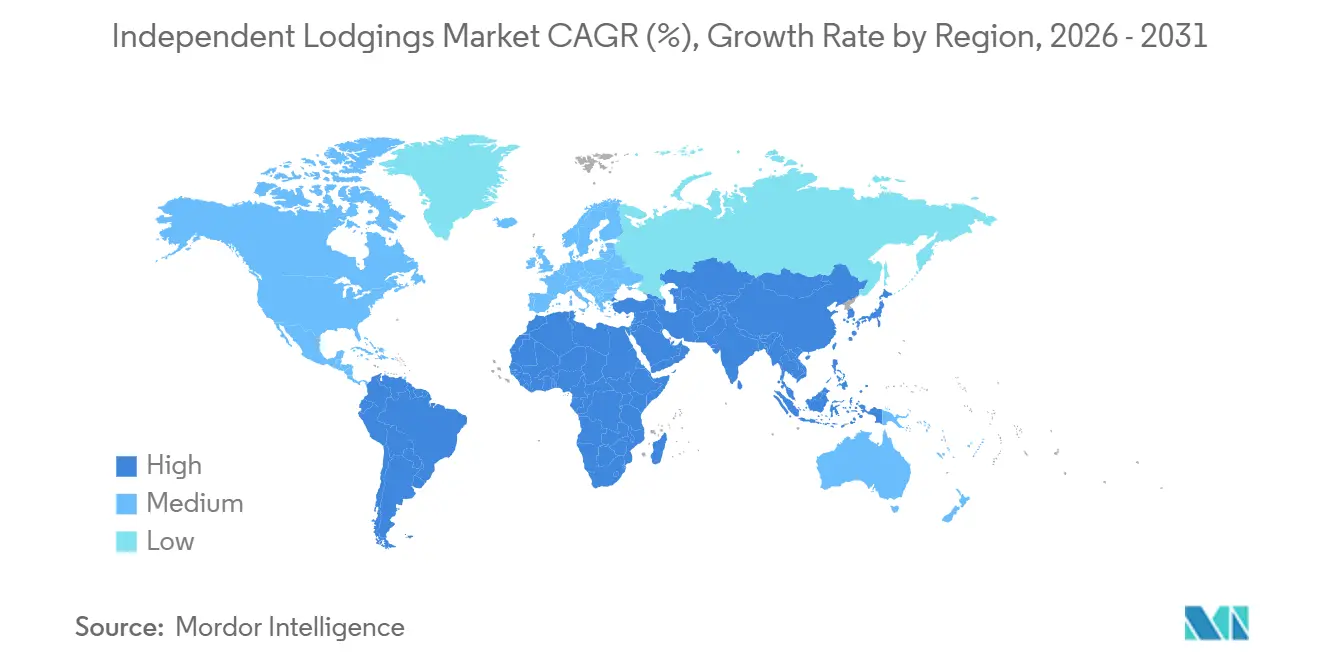
Europe held 35.44% of the Independent Lodging Market share in 2025 and is projected to grow at a 5.70% CAGR through 2031. The region’s dense heritage properties, urban boutique hotels, and rural accommodations in France, Italy, Spain, and the United Kingdom drive its significance. Official reported a 3.5% rise in France’s summer 2025 overnight stays in alternative accommodations compared to 2024, reflecting strong demand for independent formats. Spain’s implementation of the European Union short-term rental data framework recorded 255,172 registration requests in its first week, formalizing supply. Despite slower growth than Asia-Pacific, Europe benefits from its scale, heritage inventory, and mature tourism base.
Asia-Pacific is the fastest-growing region, with a projected 9.97% CAGR through 2031. India contributes significantly, with Airbnb reporting a 50% increase in nights booked and over 60% growth in first-time bookers in Q4 2025. Agoda’s 2026 travel outlook highlights the region as a hub for bleisure travel, benefiting independent properties in Southeast Asia and India. The China Hotel Association and Ctrip identified AI enablement, cultural tourism integration, and overseas expansion as key trends in 2025, supporting modernization. The region combines rapid digital adoption, large domestic travel bases, and diverse property formats.
North America is projected to grow steadily, supported by established vacation rentals and urban alternative stay models. Casago’s acquisition of Vacasa reorganized a large rental portfolio, emphasizing scale and professional management. South America benefits from Collective Hospitality’s Socialtel properties and planned openings. The Middle East and Africa see growth from tourism diversification and boutique hospitality expansion.
Competitive Landscape
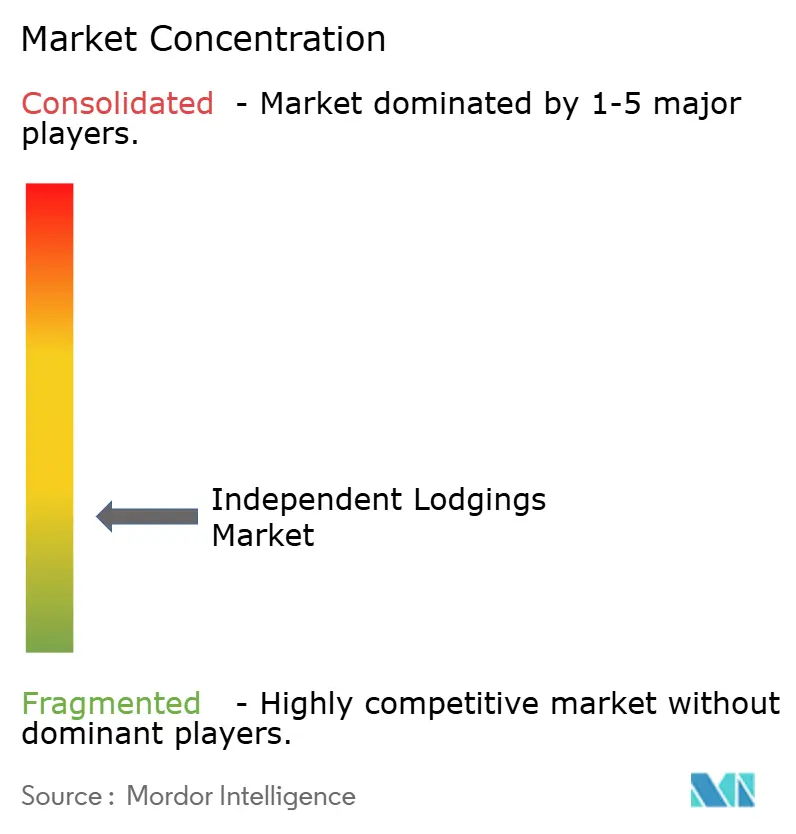
The Independent Lodging Market remains fragmented, with no single operator having enough supply control to influence the entire market. This structure allows independent owners, regional platforms, and managed portfolio operators to compete effectively. Airbnb’s hotel partnership pilots in select cities demonstrate a strategy to expand supply access while retaining the platform model. Additionally, its AI-enabled support and search enhancements aim to improve conversion rates and service efficiency across a diverse lodging base.
Brand consolidation around lifestyle and experience-driven assets is a notable trend. Acquisitions of brands like citizenM and Graduate Hotels have reduced the number of standalone lifestyle brands outside major systems. Similarly, moves such as Casago’s acquisition of Vacasa highlight a focus on scalable platforms, lifestyle positioning, and managed supply over informal networks. While consolidation has not eliminated fragmentation, it has concentrated institutional attention on a smaller group of organized operators.
The rise of hybrid and professionally managed lodging formats is reshaping the market. Collective Hospitality’s launch of Socialtel, repurposing former Selina properties, combines lodging, social spaces, and disciplined network operations. Airbnb’s focus on natural language search emphasizes the importance of metadata quality, listing structure, and digital responsiveness in property discovery. In regions like India, operators blending local relevance with platform-ready operations are well-positioned to meet growing digital demand despite fragmented supply. The market remains competitive, but successful operators are increasingly organized, data-driven, and deliberate in channel and service management.
Independent Lodgings Industry Leaders
-
Airbnb, Inc.
-
Booking Holdings Inc.
-
OYO Hotels and Homes
-
Vacasa, Inc.
-
Sonder Holdings Inc.
- *Disclaimer: Major Players sorted in no particular order
Recent Industry Developments
- June 2026: citizenM Georgetown (Washington D.C.) opens as the first Marriott-system property. This 230-room hotel reflects the integration of the citizenM portfolio into the Marriott Bonvoy system, with further integration planned for 2026.
- July 2025: Marriott completed the USD 355 million acquisition of citizenM, strengthening its presence in compact urban lifestyle lodging with an established brand and room network.
- May 2025: Casago acquired Vacasa for approximately USD 130 million, consolidating a large professionally managed vacation rental network under private ownership and delisting Vacasa from the Nasdaq.
- March 2025: Collective Hospitality has rebranded 29 former Selina properties as Socialtel in Latin America, with plans to expand into Brazil and Panama.
Global Independent Lodgings Market Report Scope
| Boutique Hotels |
| Bed & Breakfasts (B&Bs) |
| Guesthouses & Inns |
| Vacation Lodges & Cabins |
| Other Independent Accommodations (Hostels,Serviced Apartments) |
| Online Travel Agencies (OTAs) |
| Direct Booking |
| Travel Agents & Tour Operators |
| Leisure Travelers |
| Business Travelers |
| Bleisure Travelers |
| Economy |
| Midscale |
| Luxury/ Premium |
| North America | United States |
| Canada | |
| Mexico | |
| South America | Brazil |
| Peru | |
| Chile | |
| Argentina | |
| Rest of South America | |
| Europe | United Kingdom |
| Germany | |
| France | |
| Spain | |
| Italy | |
| BENELUX (Belgium, Netherlands, and Luxembourg) | |
| NORDICS (Denmark, Finland, Iceland, Norway, and Sweden) | |
| Rest of Europe | |
| Asia-Pacific | India |
| China | |
| Japan | |
| Australia | |
| South Korea | |
| South East Asia (Singapore, Malaysia, Thailand, Indonesia, Vietnam, and Philippines) | |
| Rest of Asia-Pacific | |
| Middle East and Africa | United Arab Emirates |
| Saudi Arabia | |
| South Africa | |
| Nigeria | |
| Rest of Middle East and Africa |
| By Property Type | Boutique Hotels | |
| Bed & Breakfasts (B&Bs) | ||
| Guesthouses & Inns | ||
| Vacation Lodges & Cabins | ||
| Other Independent Accommodations (Hostels,Serviced Apartments) | ||
| By Booking Channel | Online Travel Agencies (OTAs) | |
| Direct Booking | ||
| Travel Agents & Tour Operators | ||
| By Traveler Type | Leisure Travelers | |
| Business Travelers | ||
| Bleisure Travelers | ||
| By Price Tier | Economy | |
| Midscale | ||
| Luxury/ Premium | ||
| By Geography | North America | United States |
| Canada | ||
| Mexico | ||
| South America | Brazil | |
| Peru | ||
| Chile | ||
| Argentina | ||
| Rest of South America | ||
| Europe | United Kingdom | |
| Germany | ||
| France | ||
| Spain | ||
| Italy | ||
| BENELUX (Belgium, Netherlands, and Luxembourg) | ||
| NORDICS (Denmark, Finland, Iceland, Norway, and Sweden) | ||
| Rest of Europe | ||
| Asia-Pacific | India | |
| China | ||
| Japan | ||
| Australia | ||
| South Korea | ||
| South East Asia (Singapore, Malaysia, Thailand, Indonesia, Vietnam, and Philippines) | ||
| Rest of Asia-Pacific | ||
| Middle East and Africa | United Arab Emirates | |
| Saudi Arabia | ||
| South Africa | ||
| Nigeria | ||
| Rest of Middle East and Africa | ||
Key Questions Answered in the Report
What is the 2031 outlook for independent lodging rentals?
The independent lodging rentals market is forecast to reach USD 345.34 billion by 2031 from USD 235.56 billion in 2026, growing at a 7.95% CAGR over 2026-2031.
Which property type leads current revenue generation?
Boutique accommodations held the largest share at 33.84% in 2025, supported by demand for localized and differentiated stays.
Which booking channel is growing fastest through 2031?
Direct booking is projected to grow at an 8.86% CAGR through 2031, even though OTAs still held the largest booking share in 2025.
Why is bleisure important for operators?
Bleisure is forecast to grow at a 10.42% CAGR through 2031, and it favors properties that can combine workspace, flexibility, and destination appeal.
Which region is likely to expand fastest?
Asia-Pacific is projected to grow at a 9.97% CAGR through 2031, supported by India’s fast digital demand growth and strong bleisure intent across the region.
What is the main margin risk for independent operators?
OTA dependence poses a margin risk, with Cloudbeds projecting high OTA booking shares in the future. Recent data highlights commission rates varying significantly per booking.