
Hyperspectral Smart Camera Market Size and Share
Market Overview
| Study Period | 2020 - 2031 |
|---|---|
| Market Size (2026) | USD 130.09 Million |
| Market Size (2031) | USD 269.69 Million |
| Growth Rate (2026 - 2031) | 15.70 % |
| Fastest Growing Market | Asia-Pacific |
| Largest Market | Asia-Pacific |
| Market Concentration | Low |
Major Players *Disclaimer: Major Players sorted in no particular order Image © Mordor Intelligence. Reuse requires attribution under CC BY 4.0. | |
Hyperspectral Smart Camera Market Analysis by Mordor Intelligence
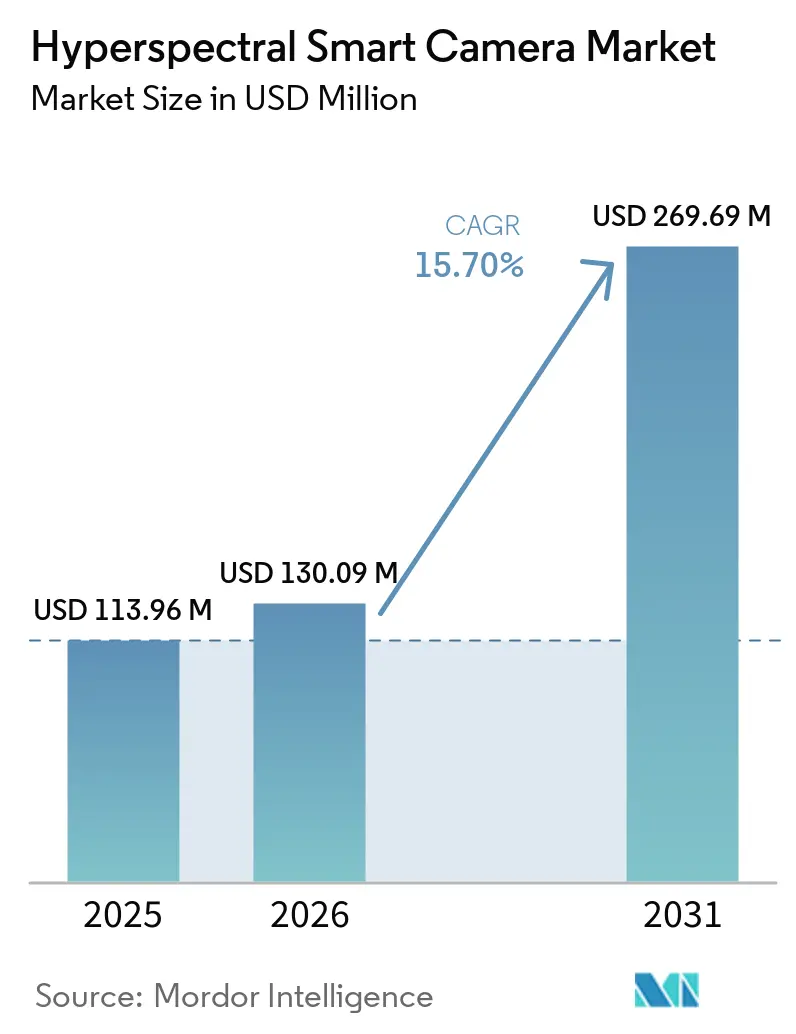
The Hyperspectral Smart Camera Market size was USD 113.96 million in 2025 and is estimated to increase from USD 130.09 million in 2026 to USD 269.69 million by 2031, at a CAGR of 15.70% during the forecast period, 2026-2031. The market is being shaped by cameras that process spectral information at the point of capture, reducing the need to transfer large raw files to external computing systems and making inspection more feasible where network capacity is limited. Semiconductor inspection, defense surveillance, food quality control, pharmaceutical manufacturing, environmental monitoring, and crop assessment are the principal demand settings, because each requires non-destructive material identification. Lower sensor costs are making VNIR and SWIR equipment relevant to a broader group of commercial users, while compact hardware allows deployment on drones, robotic systems, and production lines. Vendors are pairing hardware with software, platform integration, and application expertise, while lower-priced domestic Chinese products are increasing pressure in VNIR systems and reinforcing the need for differentiation through performance and workflow support.
Key Report Takeaways
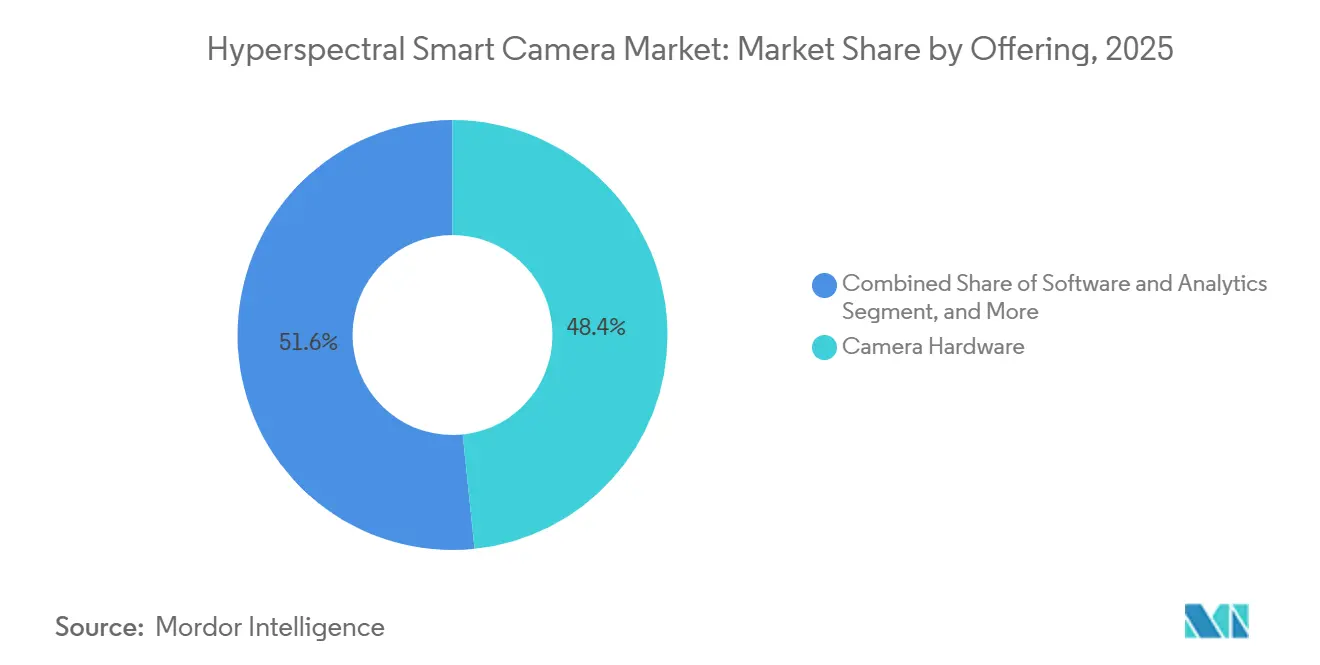
- By offering, camera hardware held 48.37% of the Hyperspectral Smart Camera Market share in 2025, while software and analytics are projected to expand at an 18.43% CAGR through 2031.
- By technology, pushbroom and line-scan architecture accounted for 39.26% of revenue in 2025, while snapshot technology is projected to expand at an 18.76% CAGR through 2031.
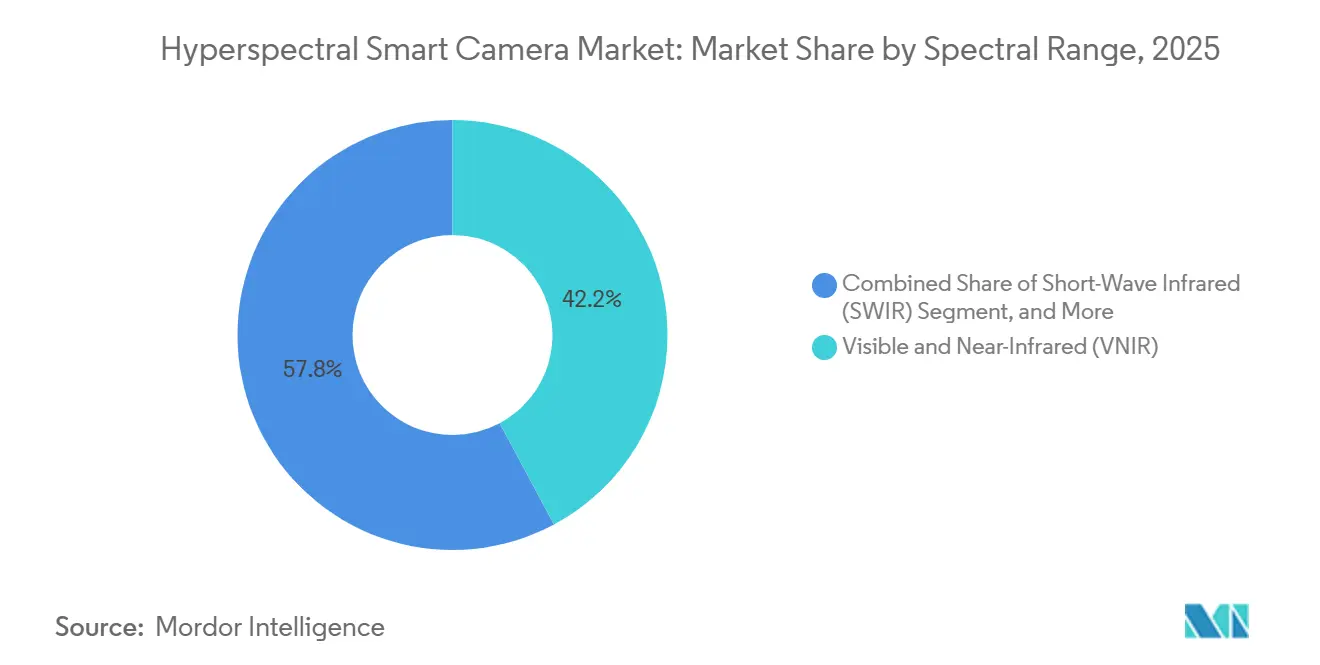
- By spectral range, VNIR held 42.18% of revenue in 2025, while SWIR is projected to expand at a 17.92% CAGR through 2031.
- By end-user, semiconductor and electronics accounted for 18.64% of revenue in 2025, while defense and government are projected to expand at an 18.58% CAGR through 2031.
- By geography, Asia-Pacific accounted for 38.72% of revenue in 2025 and is projected to expand at a 17.24% CAGR through 2031.
Note: Market size and forecast figures in this report are generated using Mordor Intelligence’s proprietary estimation framework, updated with the latest available data and insights as of January 2026.
Global Hyperspectral Smart Camera Market Trends and Insights
Drivers Impact Analysis*
| Driver | (~) % Impact on CAGR Forecast | Geographic Relevance | Impact Timeline |
|---|---|---|---|
| AI-Enabled Spectral Analytics at the Edge | +3.5% | Global, with early gains in North America and Europe | Short term (≤ 2 years) |
| Demand for Compact, Portable, and Low-Power Cameras | +2.8% | Global, Asia-Pacific core, with spillover to Middle East and Africa | Short term (≤ 2 years) |
| Expansion of Precision Agriculture and Automated Food Inspection | +2.4% | Asia-Pacific and Europe | Medium term (2-4 years) |
| Defense and Space Investment in Hyperspectral ISR | +2.1% | North America and Middle East | Medium term (2-4 years) |
| VNIR and SWIR Sensor Cost Erosion | +1.9% | Global, with a disproportionate effect in Asia-Pacific | Medium term (2-4 years) |
| Regulatory Pressure for Material Traceability and Environmental Monitoring | +1.2% | Europe and North America | Long term (≥ 4 years) |
| Source: Mordor Intelligence | |||
AI-Enabled Spectral Analytics at the Edge
Smaller sensors and on-device inference are removing a long-standing dependence on cloud or server processing. This change matters because earlier systems were better suited to laboratories or fixed industrial locations with dedicated data infrastructure. A 2026 camera architecture based on Zynq-7035 processed Euclidean distance-based spectral matching on board. It reduced data output by 2 orders of magnitude without reducing classification accuracy for diseased tissue detection. A 2026 Nature study reported real-time hyperspectral-polarimetric imaging at 55 frames per second. The reported spectral reconstruction error was 0.41%. These capabilities support use in surgical suites, field robotics, border-security uncrewed aircraft, and semiconductor process chambers, where transmitting full spectral cubes can be impractical. The Hyperspectral Smart Camera Market can therefore address applications that require local, immediate material classification rather than off-site analysis.
Demand for Compact, Portable, and Low-Power Cameras
Demand for battery-powered payloads and handheld devices is changing camera design priorities. Headwall Photonics introduced the Nano HP VNIR in November 2025. The system weighed under 1.1 kg and included LiDAR, 340 spectral bands, 1,020 spatial pixels, 480 GB of on-board storage, and compatibility with the DJI Matrice 350. MetaSpectra+, presented at CVPR 2026, used a compact snapshot design across 250 nm of the visible spectrum, a wider range than earlier designs limited to 10-100 nm.[1]Headwall Photonics, “Nano HP VNIR Hyperspectral Imaging System Is Ready to Fly on the DJI Matrice 350,” Headwall Photonics, headwall.com. The research also reported a short physical track length and strong reconstruction accuracy on benchmark datasets. Compact products can widen use in agricultural drones, robotic platforms, and field inspection equipment. They also expose established suppliers to price competition in cameras priced below USD 25,000, as domestic Chinese systems become more available for DJI-compatible agricultural platforms.[2]Yuxuan Liu, Wei Xu, and Qi Guo, “MetaSpectra+: A Compact Broadband Metasurface Camera for Snapshot Hyperspectral+ Imaging,” Proceedings of the IEEE/CVF Conference on Computer Vision and Pattern Recognition, openaccess.thecvf.com.
Expansion of Precision Agriculture and Automated Food Inspection
Precision agriculture and food inspection provide scalable uses for hyperspectral cameras. Konica Minolta documented Japanese deployments that mapped the distribution of chlorophyll and nitrogen in rice and wheat fields during 2025, alongside quality evaluation work involving apples and peaches.[3]Konica Minolta, “Applications of Hyperspectral Cameras in Agriculture,” Konica Minolta, konicaminolta.jp. These measurements supported variable-rate fertilization, crop quality assessment, and more targeted use of farm inputs. A 2025 review found that hyperspectral imaging could detect pesticide residues, moisture, origin, and adulteration across fruits, vegetables, meat, and grains. European Commission Implementing Regulation (EU) 2026/765 established updated official methods for the sampling and analysis of pesticide residues in food and feed. The regulation supports validated, non-destructive inspection workflows at European food processing facilities and increases the relevance of continuous screening. The Hyperspectral Smart Camera Market can benefit where operators need faster control without damaging products or interrupting a production line.[4]Food Analytical Methods, “Probabilistic VNIR Hyperspectral Screening of Pesticide Residues in Olives and Leaves,” Springer Nature, link.springer.com.
Defense and Space Investment in Hyperspectral ISR
Defense demand is moving hyperspectral intelligence, surveillance, and reconnaissance from trials toward deployed platforms. AeroVironment partnered with Arkeus in September 2025 to integrate the HSOR payload on the JUMP 20 Group 3 uncrewed platform. The system was stated to provide more than 8 times the range of conventional EO/IR sensors in degraded conditions. It also supported simultaneous multi-contact tracking without hardware changes across land, sea, and littoral settings. U.S. Army solicitations in 2026 included commercial Resonon Pika SWIR and Cubert ULTRIS X20 Plus systems. These procurement signals indicate a wider institutional role for commercial cameras in defense sensing. For the Hyperspectral Smart Camera Market, this can improve revenue visibility as procurement extends beyond project-by-project evaluation.
Restraints Impact Analysis*
| Restraint | (~) % Impact on CAGR Forecast | Geographic Relevance | Impact Timeline |
|---|---|---|---|
| High System Cost and Specialized Integration Requirements | -1.8% | Global, most acute in South America and Africa | Medium term (2-4 years) |
| Hyperspectral Data Storage and Processing Burden | -1.4% | Global | Short term (≤ 2 years) |
| Calibration Drift in Variable Field Conditions | -0.8% | Asia-Pacific and Middle East and Africa field deployments | Medium term (2-4 years) |
| Limited Standardization of Spectral Libraries and Data Formats | -0.5% | Global, particularly cross-border deployments | Long term (≥ 4 years) |
| Source: Mordor Intelligence | |||
High System Cost and Specialized Integration Requirements
Integrated inspection systems remain expensive despite lower prices for some VNIR sensors. VNIR camera hardware ranges from USD 25,000 to USD 75,000. Standard SWIR units range from USD 45,000 to USD 90,000, while MWIR systems can exceed USD 700,000. Production installations also require illumination, conveyor infrastructure, data acquisition equipment, software licenses, and application-specific integration work. Validation requirements for pharmaceutical inspection can add qualification and documentation costs to this total. Different vendor software development kits can add engineering effort for each deployment. Smaller food processors and agricultural cooperatives face these costs without the procurement scale of large industrial buyers, particularly in South America and Africa.
Hyperspectral Data Storage and Processing Burden
Production-rate cameras can generate data streams beyond the capacity of conventional industrial computing. A pushbroom camera operating at 527 fps with 640 spatial pixels and 224 spectral bands requires specialized real-time processing. GPU computing, FPGA pipelines, high-bandwidth storage arrays, and spectral compression tools can add cost and latency to an inline installation. These requirements compound the already high initial investment for mid-sized operators that need time-critical inspection. Open-source software and Cubert's CUVIS.AI platform reduce barriers for technical research users. They are less accessible to production teams without experience in spectral data pipelines. Wider adoption in the Hyperspectral Smart Camera Market depends on on-device inference and accelerated compression that can reduce the need for server-side processing.
*Our forecasts treat driver/restraint impacts as directional, not additive. The impact forecasts reflect baseline growth, mix effects, and variable interactions.
Segment Analysis
By Offering: Camera Hardware Leads Revenue, While Software and Analytics Accelerate
Camera hardware accounted for 48.37% of revenue in 2025, making it the largest segment of the Hyperspectral Smart Camera Market. The software and analytics segment is projected to expand at an 18.43% CAGR from 2026 to 2031. Hardware investment remains necessary in semiconductor fabrication, food processing lines, and defense programs. The relative value of a system is increasingly tied to classification models and spectral library management. Real-time decision engines can make spectral data useful without requiring specialist interpretation. This shift places greater weight on software that turns camera output into an operating decision.
Turnkey systems serve customers who need a complete inspection setup rather than a stand-alone camera. They are used in food sorting, inline pharmaceutical inspection, and semiconductor wafer characterization. These buyers may not have in-house spectral engineering capability. Calibration, integration, dark-current correction, and library development remain important service requirements. Cubert's CUVIS.AI framework and Living Optics' connected analytics platform reflect the interest in deploying models across compatible hardware. As interfaces become easier to use, the Hyperspectral Smart Camera industry may place a larger share of system value in analytics and reduce hardware-led margins.



By Technology: Pushbroom Retains Leadership, While Snapshot Systems Gain Ground
Pushbroom and line-scan systems commanded 39.26% of the Hyperspectral Smart Camera Market share in 2025. The snapshot segment is projected to expand at an 18.76% CAGR from 2026 to 2031. Pushbroom equipment provides high spectral fidelity and is well-suited to linear conveyor production systems. Its supplier base is mature, with Specim's FX-series cameras serving a range of industrial applications. Specim launched the FX19 in February 2026 with a 1,130-1,920 nm range and speeds of up to 527 fps. The camera targets e-waste sorting, pharmaceutical conveyors, and other high-throughput inspection settings.
Snapshot systems are suited to drone mapping, robotic inspection, and medical imaging, where objects are moving. A single exposure avoids the motion artifacts associated with line-scan capture. CVPR research in 2026 showed that metasurface-based snapshot hardware could reconstruct high-quality spectral cubes over the visible spectrum. Tunable filters and spectral-scanning cameras retain a role where wavelength selection is essential. Whiskbroom systems are facing greater competition from drone payloads with better coverage efficiency. Fourier transform cameras continue to serve low-light materials science and pharmaceutical research, where their resolution requirements justify high cost.
By Spectral Range: VNIR Has Broad Use, While SWIR Gains Momentum
VNIR sensors held 42.18% of revenue in 2025, representing the largest spectral range in the Hyperspectral Smart Camera Market. SWIR is projected to expand at a 17.92% CAGR through 2031. Silicon-based detectors help keep VNIR systems accessible for food inspection, pharmaceutical quality work, and crop monitoring. Established spectral libraries also support their broad use. A 2026 study validated probabilistic VNIR screening for pesticide residues on olives and leaves. This workflow is relevant to residue testing requirements in European food supply chains.
VNIR-SWIR and multiband systems support applications that require broader chemical differentiation. These applications include soil mapping and crop stress analysis during a single drone flight. Emberion reported progress in April 2025 toward wafer-level-packaged SWIR sensors, with an estimated volume fabrication cost of EUR 50 (USD 55) per sensor. The company associated this approach with a low-temperature hermetic packaging process. MWIR and LWIR equipment are used for defense, gas detection, and high-temperature monitoring. Cooling requirements and export controls continue to limit commoditization in those ranges.
By End-User: Semiconductor and Electronics Leads, While Defense and Government Expands Fastest
Semiconductor and electronics accounted for 18.64% of revenue in 2025, the leading end-user share in the Hyperspectral Smart Camera Market. Defense and government are projected to expand at an 18.58% CAGR from 2026 to 2031. Wafer inspection uses spectral imaging to detect thickness variations, contamination, photoluminescence anomalies, and crystal defects that conventional RGB imaging cannot resolve. A Specim-DIVE case study described 100% surface coverage of 300 mm wafers in scan times under 30 seconds. These applications support increasingly demanding process control requirements at advanced nodes. Patent activity in thin-film metrology and plasma diagnostics also reflects the importance of proprietary capability in this field. The Hyperspectral Smart Camera Market remains relevant to this vertical because full-surface measurements can support process control where defect detection and material characterization must be performed without contact.
Defense and government use is supported by ISR budgets and procurement of commercial hyperspectral platforms. The food, beverage, and agriculture sectors are high-volume users due to food safety requirements and the economics of precision farming. Pharmaceutical and biotechnology facilities use spectral systems for tablet composition verification, active ingredient distribution, and counterfeit detection. The U.S. Food and Drug Administration's PAT framework supports real-time process monitoring in pharmaceutical development and manufacturing. Living Optics demonstrated real-time blood perfusion mapping with edge hyperspectral imaging in September 2025. Oil, gas, chemicals, mining, solar energy, automotive, and industrial operations remain smaller applications for material identification, compliance monitoring, and defect detection.
Geography Analysis
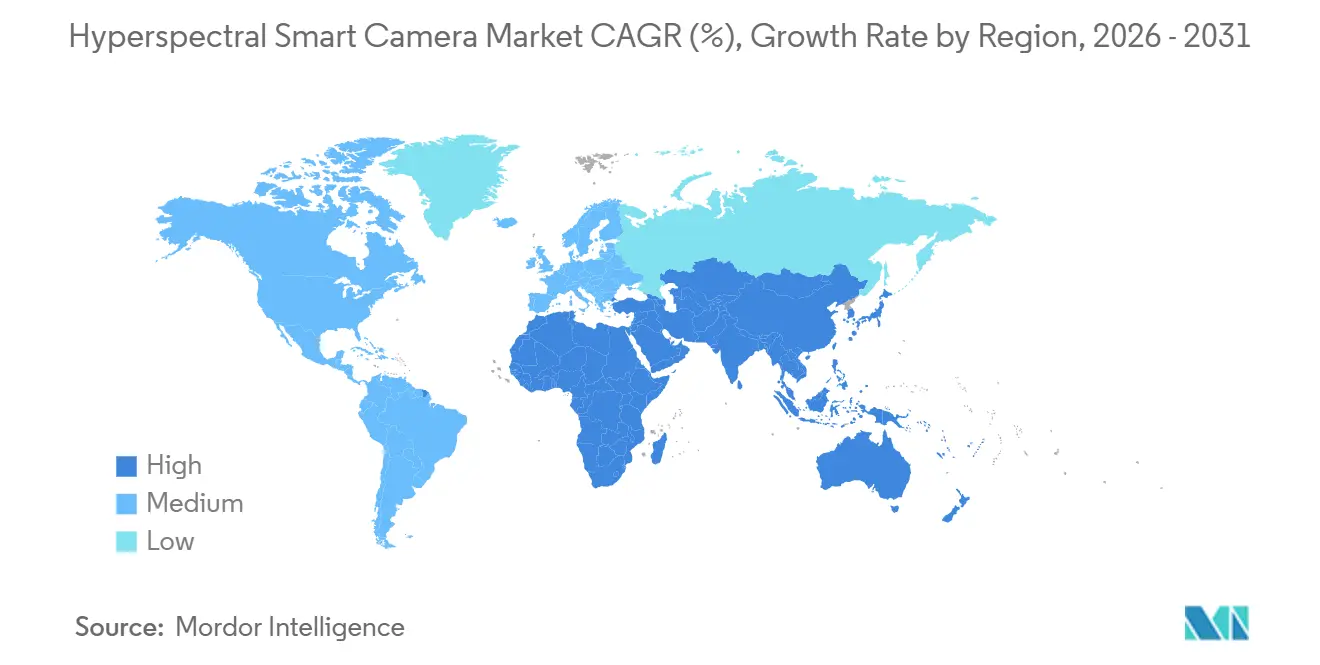
Asia-Pacific accounted for 38.72% of revenue in 2025 and is projected to expand at a 17.24% CAGR through 2031. China is the regional demand center for semiconductor fabrication and precision agriculture equipment, where VNIR and pushbroom systems support inspection and field mapping. Japan uses high-speed pushbroom cameras in food processing and industrial inspection, reflecting the fit between line-scan capture and conveyor-based operations. Konica Minolta documented agricultural evaluations involving rice, wheat, apples, and peaches in Japan during 2025. South Korean chipmakers use spectral systems for thin-film inspection and electroluminescence mapping, as tighter process control requirements increase the value of full-surface measurements.
India and the Association of Southeast Asian Nations countries are expanding from a smaller base. Food export requirements and drone-based agriculture are supporting this adoption, especially where visual inspection does not provide sufficient material detail. Chinese domestic VNIR manufacturing increases regional availability and lowers import pricing. This dynamic expands equipment volumes but places pressure on Western suppliers to differentiate through software, calibration, and spectral performance. The Hyperspectral Smart Camera Market in North America is the second-largest regional market. The United States is supported by defense procurement, pharmaceutical manufacturing, commercial precision agriculture, and compliance-related investment in food and process inspection.
A USD 2 million U.S. Air Force contract in June 2026 covered 2 advanced hyperspectral imaging systems for Eglin Air Force Base. Canada contributes through mining, forestry, and environmental remote sensing, while Mexico supports demand for food processing. Europe is the third-largest regional market, led by Germany, the United Kingdom, and France, where industrial machine vision, food safety, and pharmaceutical manufacturing are established demand bases. Regulation (EU) 2026/765 strengthens the case for validated food testing across member states. South America records gradual agricultural adoption, while the Middle East and Africa remain early-stage, with defense demand in Saudi Arabia and the United Arab Emirates and agriculture pilots in South Africa and Nigeria.

Competitive Landscape
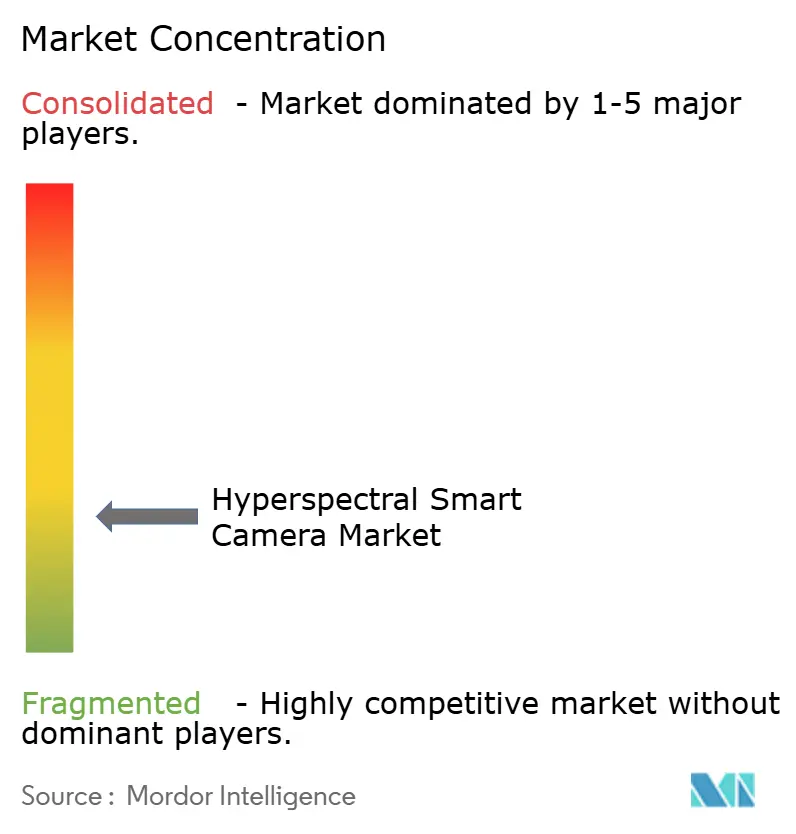
The Hyperspectral Smart Camera Market is fragmented, with no supplier dominating all technology types, spectral ranges, and end-user settings. Specim, Spectral Imaging Ltd., benefits from Konica Minolta ownership and a broad distribution network for pushbroom systems, with its installed base supporting industrial applications. Cubert GmbH operates as part of the Emtek Hyperspectral Group following Emtek Holdings' acquisition of a majority stake in November 2025. Norsk Elektro Optikk AS and Telops Inc. focus on high-specification airborne and defense sensors that require demanding technical qualifications. XIMEA GmbH offers small USB-powered modules for integration into drones and robotics as original equipment. CHNSpec Technology Co., Ltd. is extending domestic distribution and challenging lower-priced VNIR equipment internationally, particularly where buyers prioritize acquisition cost.
The Hyperspectral Smart Camera industry competes through spectral performance, analytics, integration, and application knowledge rather than price alone. Specim and Resonon use proprietary software environments to support their cameras and help users manage image capture, calibration, analysis, and reporting. Cubert's CUVIS.AI framework offers a software-oriented route for model deployment. Headwall's compatibility with the DJI Matrice 350 illustrates a strategy centered on drone platform integration. Resonon's December 2025 partnership with Vision Aerial similarly expanded the availability of integrated UAV systems. Diaspective Vision GmbH, Applied Spectral Imaging, Inc., and other specialists focus on applications requiring specific domain expertise, which can create a more defensible customer relationship than a general-purpose camera offering.
No supplier currently provides a universal software platform that accepts spectral cubes from several camera brands without customization. That gap limits interoperability for buyers with mixed hardware fleets and can make switching suppliers more difficult after a system has been validated. The HyperFree model presented at CVPR 2025 offered a channel-adaptive and tuning-free approach to hyperspectral classification. It points to potential alternatives to closed software ecosystems. Semiconductor customers also face high switching costs because camera performance, calibration, and processing workflows must fit specialized manufacturing processes. The Hyperspectral Smart Camera Market, therefore, remains open to specialists, although consolidation, proprietary software, and integrated platforms can strengthen supplier positions in focused applications
Hyperspectral Smart Camera Industry Leaders
Specim, Spectral Imaging Ltd.
Headwall Photonics, Inc.
Resonon Inc.
Cubert GmbH
BaySpec, Inc.
- *Disclaimer: Major Players sorted in no particular order

Recent Industry Developments
- September 2026: Elbit Systems signed contracts totaling approximately USD 270 million with an undisclosed international customer for SPECTRO-family multi-spectral ISR and targeting payloads integrating high-definition MWIR, visible, and SWIR imaging channels with AI-based analytics for target identification, tracking, and long-range intelligence gathering across airborne, naval, and ground platforms. Delivery is scheduled over up to 6 years, representing one of the largest single orders for spectral ISR systems recorded to date.
- August 2026: The U.S. Army's W6QK ACC-APG Adelphi office issued a sole-source solicitation for the Cubert ULTRIS X20 Plus Dual Sensor Hyperspectral Imaging System and Flight Lite Package, confirming the military's institutionalized adoption of commercial snapshot hyperspectral cameras alongside purpose-built defense sensors for research and applied sensing missions.
- July 2026: The U.S. Army issued a sole-source solicitation for a Resonon Pika SWIR Hyperspectral Imaging Camera Package for the Department of Defense facility in Adelphi, Maryland under NAICS code 334516, underscoring Resonon's established sole-supplier position for specialized SWIR research systems within U.S. DoD procurement.
- June 2026: Infrared Imaging, LLC was awarded a USD 2,061,516 firm-fixed-price contract by the U.S. Air Force for 2 advanced hyperspectral imaging systems, 1 SWIR/MWIR and 1 MWIR/LWIR unit, to support the 782nd Test Squadron's seekers-and-sensors test operations at Eglin Air Force Base, Florida, with delivery and on-site training within 36 weeks.


Global Hyperspectral Smart Camera Market Report Scope
Hyperspectral Smart Cameras are advanced imaging devices that integrate high-resolution spectral sensors with onboard processing capabilities to capture and analyze detailed spectral signatures across numerous narrow wavelength bands, enabling real-time material identification, quality control, and compositional analysis in industrial and scientific applications.
The Hyperspectral Smart Camera Market Report is Segmented by Offering (Camera Hardware, Camera-Enabled Turnkey Systems, Software and Analytics, and Calibration, Integration, and Services), Technology (Pushbroom and Line Scan, Snapshot, Tunable Filter and Spectral Scanning, Whiskbroom, and Fourier Transform Imaging), Spectral Range (Visible and Near-Infrared (VNIR), Short-Wave Infrared (SWIR), Mid-Wave Infrared (MWIR), Long-Wave Infrared (LWIR), and VNIR–SWIR and Multiband Systems), End-User (Food and Beverage, Agriculture and Agribusiness, Pharmaceutical and Biotechnology, Mining and Minerals, Oil, Gas, and Chemicals, Semiconductor and Electronics, Solar and Renewable Energy, Automotive and Industrial, Healthcare and Diagnostics, Defense and Government, and Other End-User Industries), and Geography (North America, South America, Europe, Asia-Pacific, Middle East and Africa). The Market Forecasts are Provided in Terms of Value (USD).
| Camera Hardware |
| Camera-Enabled Turnkey Systems |
| Software and Analytics |
| Calibration, Integration, and Services |
| Pushbroom and Line Scan |
| Snapshot |
| Tunable Filter and Spectral Scanning |
| Whiskbroom |
| Fourier Transform Imaging |
| Visible and Near-Infrared (VNIR) |
| Short-Wave Infrared (SWIR) |
| Mid-Wave Infrared (MWIR) |
| Long-Wave Infrared (LWIR) |
| VNIR-SWIR and Multiband Systems |
| Food and Beverage |
| Agriculture and Agribusiness |
| Semiconductor and Electronics |
| Automotive and Industrial |
| Healthcare and Diagnostics |
| Defense and Government |
| Other End-User Industries |
| North America | United States | |
| Canada | ||
| Mexico | ||
| South America | Brazil | |
| Argentina | ||
| Rest of South America | ||
| Europe | Germany | |
| United Kingdom | ||
| France | ||
| Italy | ||
| Spain | ||
| Rest of Europe | ||
| Asia-Pacific | China | |
| Japan | ||
| India | ||
| South Korea | ||
| Rest of Asia-Pacific | ||
| Middle East and Africa | Middle East | Saudi Arabia |
| United Arab Emirates | ||
| Turkey | ||
| Rest of the Middle East | ||
| Africa | South Africa | |
| Nigeria | ||
| Rest of Africa | ||
| By Offering | Camera Hardware | ||
| Camera-Enabled Turnkey Systems | |||
| Software and Analytics | |||
| Calibration, Integration, and Services | |||
| By Technology | Pushbroom and Line Scan | ||
| Snapshot | |||
| Tunable Filter and Spectral Scanning | |||
| Whiskbroom | |||
| Fourier Transform Imaging | |||
| By Spectral Range | Visible and Near-Infrared (VNIR) | ||
| Short-Wave Infrared (SWIR) | |||
| Mid-Wave Infrared (MWIR) | |||
| Long-Wave Infrared (LWIR) | |||
| VNIR-SWIR and Multiband Systems | |||
| By End-User | Food and Beverage | ||
| Agriculture and Agribusiness | |||
| Semiconductor and Electronics | |||
| Automotive and Industrial | |||
| Healthcare and Diagnostics | |||
| Defense and Government | |||
| Other End-User Industries | |||
| By Geography | North America | United States | |
| Canada | |||
| Mexico | |||
| South America | Brazil | ||
| Argentina | |||
| Rest of South America | |||
| Europe | Germany | ||
| United Kingdom | |||
| France | |||
| Italy | |||
| Spain | |||
| Rest of Europe | |||
| Asia-Pacific | China | ||
| Japan | |||
| India | |||
| South Korea | |||
| Rest of Asia-Pacific | |||
| Middle East and Africa | Middle East | Saudi Arabia | |
| United Arab Emirates | |||
| Turkey | |||
| Rest of the Middle East | |||
| Africa | South Africa | ||
| Nigeria | |||
| Rest of Africa | |||


Key Questions Answered in the Report
What is the size of the 3D Smart Camera Market?
The 3D Smart Camera Market was valued at USD 6.21 billion in 2025, is estimated at USD 7.17 billion in 2026, and is projected to reach USD 15.79 billion by 2031.
What CAGR is forecast for 3D smart cameras through 2031?
The market is projected to expand at a 17.10% CAGR between 2026 and 2031.
Which 3D smart camera technology held the largest share?
Time-of-Flight led technology demand with 34.71% share in 2025, supported by industrial automation and in-cabin monitoring.
What application is expected to expand fastest through 2031?
Driver and Occupant Monitoring is projected to expand at a 20.79% CAGR, supported by European vehicle safety requirements.
Why are manufacturers adopting 3D smart cameras?
Manufacturers use them for robotic guidance, detailed quality inspection, logistics automation, and centralized AI model management.
Which region offers the strongest outlook for 3D smart cameras?
Asia-Pacific held 38.57% share in 2025 and is projected to expand at a 21.47% CAGR through 2031.
Page last updated on:


 Your data is secure and never sold or shared.


