
High Performance Fluoropolymer (HPF) Market Size and Share
Market Overview
| Study Period | 2021 - 2031 |
|---|---|
| Market Size (2026) | USD 4.89 Billion |
| Market Size (2031) | USD 6.89 Billion |
| Growth Rate (2026 - 2031) | 7.07 % |
| Fastest Growing Market | Asia-Pacific |
| Largest Market | Asia-Pacific |
| Market Concentration | Medium |
Major Players *Disclaimer: Major Players sorted in no particular order Image © Mordor Intelligence. Reuse requires attribution under CC BY 4.0. | |
High Performance Fluoropolymer (HPF) Market Analysis by Mordor Intelligence
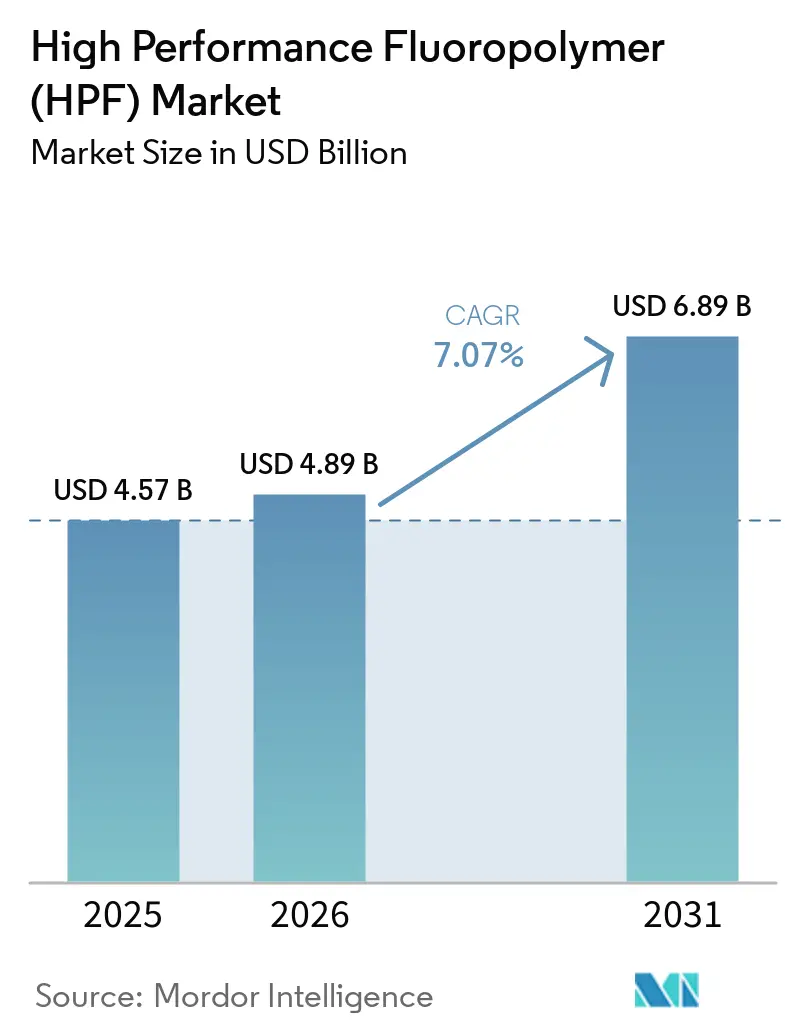
The High Performance Fluoropolymer (HPF) Market size was valued at USD 4.57 billion in 2025 and is estimated to grow from USD 4.89 billion in 2026 to reach USD 6.89 billion by 2031, at a CAGR of 7.07% during the forecast period (2026-2031). The high performance fluoropolymer market serves applications that require chemical resistance, thermal stability above 200 °C, and consistent electrical performance. These requirements make material substitution difficult in semiconductor equipment, electrification systems, chemical processing, and renewable-energy equipment. Demand is therefore tied more closely to technology investment and equipment replacement than to discretionary purchasing. Semiconductor manufacturing, battery production, and low-emission industrial systems are shaping procurement decisions in the high performance fluoropolymer market. Producers with qualified production processes and dependable fluorine feedstock are better positioned to manage regulatory and supply-chain pressure.
Key Report Takeaways
- By type, polytetrafluoroethylene held 40.42% of the high performance fluoropolymer market share in 2025, while perfluoroalkoxy alkane/modified perfluoroalkoxy is projected to advance at a 7.85% CAGR through 2031.
- By form, granules and pellets held 36.37% of the high performance fluoropolymer market share in 2025, while fine powder is projected to advance at an 8.17% CAGR through 2031.
- By application, coatings and liners held 31.81% of the high performance fluoropolymer market share in 2025, while components are projected to advance at an 8.33% CAGR through 2031.
- By end-use industry, electrical and electronics held 36.63% of the high performance fluoropolymer market share in 2025 and is projected to advance at an 8.52% CAGR through 2031.
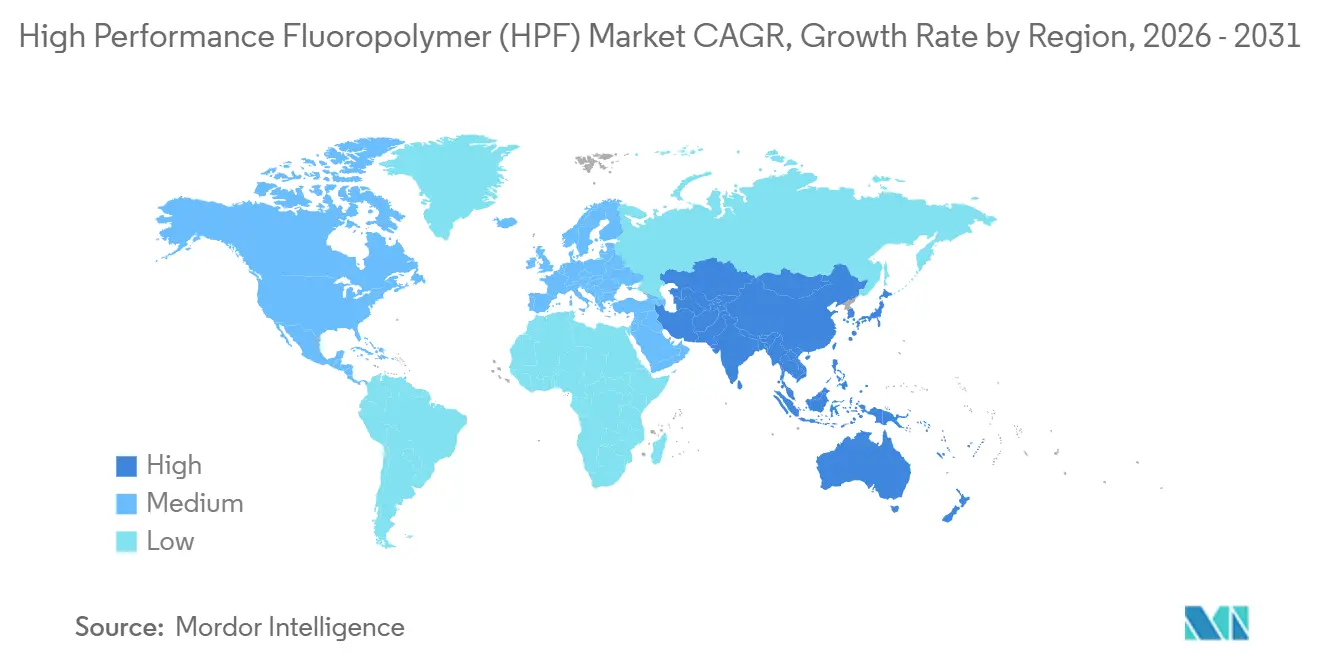
- By geography, Asia-Pacific held 37.22% of the high performance fluoropolymer market share in 2025 and is projected to advance at a 7.93% CAGR through 2031.
Note: Market size and forecast figures in this report are generated using Mordor Intelligence’s proprietary estimation framework, updated with the latest available data and insights as of January 2026.
Global High Performance Fluoropolymer (HPF) Market Trends and Insights
Drivers Impact Analysis*
| Driver | (~) % Impact on CAGR Forecast | Geographic Relevance | Impact Timeline |
|---|---|---|---|
| Semiconductor Cleanroom and Advanced Electronics Expansion | +2.1% | Global, concentrated in Asia-Pacific and North America | Medium term (2–4 years) |
| Electric Vehicle and Battery Electrification | +1.7% | Global, concentrated in Asia-Pacific and Europe | Medium term (2–4 years) |
| Corrosion-Resistant Chemical Processing Infrastructure | +1.0% | Global, with strong concentration in Asia-Pacific and Europe | Long term (≥ 4 years) |
| Renewable Energy and Hydrogen System Deployment | +0.7% | Asia-Pacific, Europe, North America | Long term (≥ 4 years) |
| Fluorochemical Supply-Chain Integration and Regionalization | +0.4% | North America, Europe | Medium term (2–4 years) |
| Source: Mordor Intelligence | |||
Semiconductor Cleanroom and Advanced Electronics Expansion
Advanced semiconductor production requires materials with very low contamination levels in chemical and ultrapure-water systems. The high performance fluoropolymer market benefits because ultra-high-purity perfluoroalkoxy alkane and polytetrafluoroethylene are used in manifolds, piping, wet-bench liners, and related fluid-handling equipment. The Semiconductor Equipment and Materials International F57 standard addresses polymer materials used in ultrapure-water and liquid-chemical distribution systems. The U.S. CHIPS and Science Act established USD 52 billion in funding authority to support semiconductor manufacturing and research[1]CHIPS for America, “CHIPS for America,” U.S. Department of Commerce, chips.gov. The Congressional Research Service reported that the USD 39 billion manufacturing-incentive program had been fully allocated and that more than USD 11 billion had been disbursed. A move to a new process node can require renewed assessment of wetted materials, which supports recurring demand after a fabrication facility begins operations. DAIKIN INDUSTRIES, Ltd. completed construction of a perfluoroelastomer facility at Kashima in August 2026, and commercial supply from the site is scheduled for 2027.
Electric Vehicle and Battery Electrification
Fluoropolymers are used in battery electrode binders, separator coatings, high-voltage wire insulation, and thermal-management seals. These uses link the high performance fluoropolymer market to changes in battery design as well as to vehicle production. Arkema reported that its fluorospecialty business grew 16% year over year in February 2026, supported by demand for polyvinylidene fluoride in batteries and energy-storage systems. In June 2026, Arkema completed a polyvinylidene fluoride capacity expansion at Calvert City, Kentucky, to serve energy storage, semiconductor, and data-center cooling applications. Syensqo signed multiyear Solef polyvinylidene fluoride supply contracts with automotive original equipment manufacturers and battery makers in 2025, with deliveries planned from its Tavaux facility. These agreements indicate that material qualification and capacity reservations can become important before battery programs reach their highest production rates. The transition toward higher-energy battery platforms also supports demand for fluoropolymer components with more demanding thermal and electrical requirements.
Corrosion-Resistant Chemical Processing Infrastructure
Chemical producers use polytetrafluoroethylene and fluorinated ethylene propylene linings in reactors, tanks, valves, and transfer piping that handle aggressive chemicals. The high performance fluoropolymer market gains from replacement cycles because corrosion control is a lifecycle requirement rather than a one-time design choice. Broader lining coverage can reduce contamination and leakage risk across fluid-handling networks. Gujarat Fluorochemicals Limited reported fluoropolymer-segment revenue of INR 848 crore (approximately USD 101 million) in Q4 FY2026. The company stated that value-added specialty grades for chemical and industrial processing supported its performance. As industrial operators place greater weight on emissions control and operating reliability, specifications can extend from isolated severe-service points to larger equipment networks.
Renewable Energy and Hydrogen System Deployment
Proton exchange membrane electrolyzers and fuel cells use perfluorosulfonic acid fluoropolymer membranes as functional components. This application gives the high performance fluoropolymer market exposure to green-hydrogen projects and related equipment supply chains. AGC Inc. began operations at its Kitakyushu production facility in June 2026 for FORBLUE S-SERIES fluorinated ion-exchange membranes used in green hydrogen production. Ethylene tetrafluoroethylene films also support photovoltaic modules and building-integrated photovoltaic applications because they combine ultraviolet resistance with high optical transmission. Demand from hydrogen equipment and photovoltaic films does not necessarily move at the same pace, which creates exposure to two distinct clean-energy application areas.
Restraints Impact Analysis*
| Restraint | (~) % Impact on CAGR Forecast | Geographic Relevance | Impact Timeline |
|---|---|---|---|
| PFAS Regulatory Restrictions and Compliance Costs | -1.4% | Europe, North America; spillover to APAC | Medium term (2–4 years) |
| High Polymerization, Processing, and Qualification Costs | -0.9% | Global | Long term (≥ 4 years) |
| Qualification Lock-In and Revalidation Delays | -0.5% | Global, most acute in semiconductor and aerospace | Long term (≥ 4 years) |
| Source: Mordor Intelligence | |||
PFAS Regulatory Restrictions and Compliance Costs
Per- and polyfluoroalkyl substances (PFAS) restrictions create an important planning issue for European producers and industrial users. The European Chemicals Agency process considers risks, socioeconomic effects, and potential derogations for specific uses under the Registration, Evaluation, Authorisation and Restriction of Chemicals (REACH) framework[2]European Chemicals Agency, “Registry of Restriction Intentions,” European Chemicals Agency, echa.europa.eu. Compliance requires continuous documentation, supplier review, and legal monitoring, particularly where high-technology applications depend on derogations. Smaller industrial users can face a greater administrative burden than integrated suppliers that spread compliance work across larger product portfolios. These requirements can change sourcing decisions and raise the value of traceable grades. The high performance fluoropolymer market must therefore balance the essential performance role of some materials with changing environmental expectations.
High Polymerization, Processing, and Qualification Costs
High performance fluoropolymers require specialized polymerization, purification, finishing, and packaging processes. Semiconductor and other high-purity applications add stringent controls for extractables, particles, and production consistency. These conditions make the high performance fluoropolymer market more costly to serve than commodity-polymer applications. Changes designed to improve energy or solvent efficiency can also trigger customer testing before modified materials are approved. The cost of this testing can slow process changes even when technical improvements are available. Producers with established process knowledge and long-term customer relationships are better able to manage this burden. The resulting cost structure limits rapid price-based competition in demanding applications.
*Our forecasts treat driver/restraint impacts as directional, not additive. The impact forecasts reflect baseline growth, mix effects, and variable interactions.
Segment Analysis
By Type: Perfluoroalkoxy Alkane/Modified Perfluoroalkoxy Narrowing the Gap with Polytetrafluoroethylene
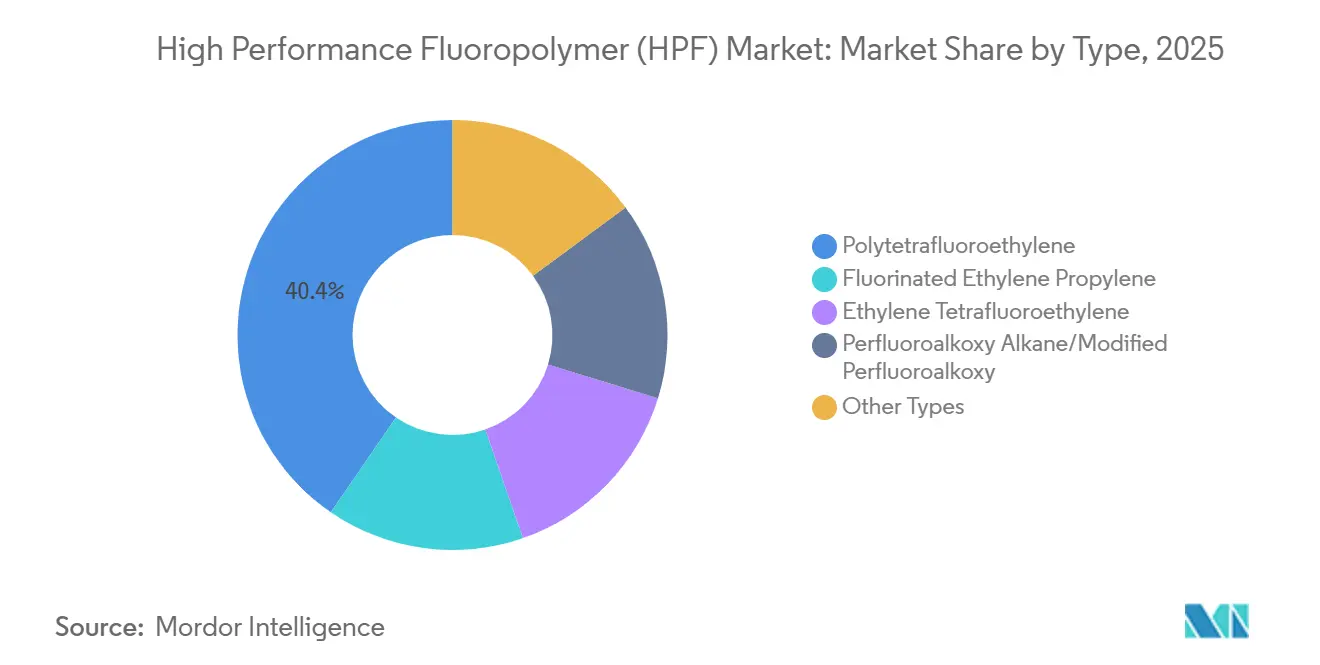
Polytetrafluoroethylene held 40.42% of the high performance fluoropolymer market share in 2025, while perfluoroalkoxy alkane/modified perfluoroalkoxy is projected to advance at a 7.85% CAGR through 2031. Ultra-high-purity grades are used where semiconductor fabrication systems require low contamination. Semiconductor Equipment and Materials International standards address polymer compatibility for ultrapure water and liquid-chemical distribution. Polytetrafluoroethylene remained the largest type in 2025 because it has long qualification histories across chemical processing, industrial sealing, and electrical insulation. This installed base maintains steady demand for established grades.
Fluorinated Ethylene Propylene has demand in data-center cable systems and other electrical applications. DAIKIN INDUSTRIES, Ltd. reported increased sales of Fluorinated Ethylene Propylene-based local area network cable products through FY2025. Ethylene tetrafluoroethylene is used in photovoltaic encapsulation and architectural membrane applications, where ultraviolet resistance and optical transmission are valuable. Polychlorotrifluoroethylene serves cryogenic applications, while other specialty variants support medical-device production. The high performance fluoropolymer industry depends on each type fulfilling a distinct processing or end-use requirement.



By Form: Fine Powder Outpacing Granules and Pellets on Aerospace and 5G Cable Pull
Granules and pellets held 36.37% of the high performance fluoropolymer market size in 2025. The form supports compression molding and ram extrusion for gaskets, valve components, and chemical-processing equipment. Established qualification criteria and repeat industrial demand support recurring use of these materials. Fine powder is projected to advance at an 8.17% CAGR through 2031. Fine powder is used in paste-extruded wire coatings, tubing, coaxial cable insulation, and filtration membranes.
Fine powder supports applications that need continuous extrusion and controlled fibril formation. Tighter requirements in 5G infrastructure, aerospace wiring, and medical devices can increase demand for higher-purity grades. Dispersion grades support coatings for complex equipment surfaces and technical textiles. Sheets and films are used in flat gaskets, printed-circuit-board substrates, and flexible heater elements. The high performance fluoropolymer market, therefore, uses form selection as a practical link between resin chemistry and fabrication needs.
By Application: Components Outpacing Coatings and Liners
Coatings and liners held 31.81% of the high performance fluoropolymer market size in 2025. Chemical-processing operators use these materials to protect vessels, tanks, and transfer piping from corrosive media. New facility construction and equipment replacement create recurring demand across a broad industrial customer base. Components are projected to advance at an 8.33% CAGR through 2031. Semiconductor tools, medical devices, and electric-vehicle battery systems use machined or molded parts where dimensions and material traceability are critical. These uses can command a higher value than standard protective-coating applications.
Films are used in photovoltaic encapsulation, high-frequency circuit substrates, and aerospace laminates. Additives use micro-powder polytetrafluoroethylene in engineering polymers, greases, and specialty inks to reduce friction and improve wear performance. The U.S. Food and Drug Administration database covers more than 250,000 approved medical devices that include fluoropolymer components, indicating the material's use in medical applications. Other application areas broaden the high performance fluoropolymer market beyond chemical protection alone.
By End-Use Industry: Electrical and Electronics Commands Both Scale and Momentum
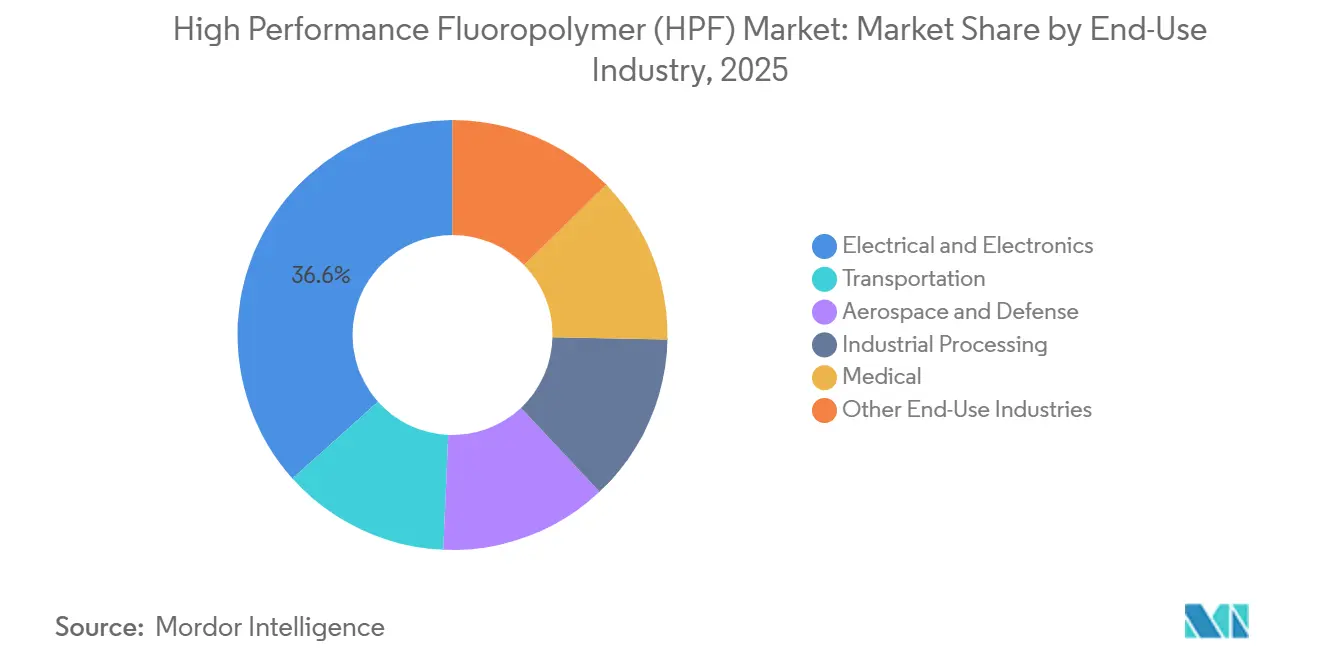
Electrical and electronics held 36.63% of high performance fluoropolymer market share in 2025 and is projected to advance at an 8.52% CAGR through 2031. The category includes semiconductor cleanroom equipment, 5G infrastructure, electric-vehicle battery systems, and data-center thermal-management applications. These demand sources serve different customer groups but use related fluoropolymer properties. DAIKIN INDUSTRIES, Ltd. reported continued demand for performance materials used in electronics-related applications. The Chemours Company identifies Advanced Performance Materials as serving several high-value applications, including semiconductor and data-center uses. This breadth gives the segment more than one route to growth.
Industrial processing uses fluoropolymer-lined equipment in chemical, pharmaceutical, and food-processing facilities. Transportation demand is changing as applications in internal-combustion fuel systems give way to higher-voltage insulation and battery thermal-management uses in electric vehicles. Medical applications include catheter liners, vascular grafts, and surgical instrument coatings that depend on biocompatibility and chemical resistance. Aerospace and defense uses include fuel-system parts, satellite seals, and wiring, where qualification standards make substitution difficult. This diversified customer base supports the high performance fluoropolymer market across long equipment replacement cycles.
Geography Analysis
Asia-Pacific held 37.22% of the high performance fluoropolymer market share in 2025 and is projected to advance at a 7.93% CAGR through 2031. China, South Korea, Japan, and India combine semiconductor manufacturing, battery investment, and fluorochemical production capabilities. This concentration allows suppliers to serve several demand centers within the same region. The U.S. Geological Survey identifies China as the largest fluorspar producer, confirming its importance in the upstream fluorochemical chain. Japanese producers are directing investment toward high-specification materials for semiconductor and hydrogen applications.
India is becoming a more important contributor as domestic suppliers expand specialty-material capabilities. Gujarat Fluorochemicals Limited reported INR 848 crore (approximately USD 101 million) in fluoropolymer revenue for Q4 FY2026. The company incorporated GFCL Semiconductor and Advanced Materials as a wholly owned subsidiary in June 2026 to target high-purity semiconductor specialty materials. North America has demand from new semiconductor fabrication projects supported by the CHIPS and Science Act. The law also includes a 35% investment tax credit for qualifying semiconductor manufacturing investment. Qualified perfluoroalkoxy alkane and polytetrafluoroethylene systems are needed for chemical-delivery networks in these facilities.
Europe combines chemical-processing demand with emerging green-hydrogen equipment requirements. The Fluoropolymers Product Group reported that the European Union fluoropolymer market reached 56,500 metric tons in 2025 and that imports supplied three-quarters of demand. Regulatory developments may influence the location and economics of regional production. South America and Middle East and Africa remain smaller demand areas, supported by chemical processing, oil and gas infrastructure, and long-cycle industrial investment. Brazil has a demand for corrosion-resistant equipment in pre-salt and downstream chemical applications. Saudi Arabia and the United Arab Emirates are building downstream petrochemical and green-hydrogen capabilities. Association of Southeast Asian Nations (ASEAN) manufacturing locations, including Vietnam, Malaysia, and Thailand, are expanding electronics production and may develop more independent procurement demand as local operations mature.

Competitive Landscape
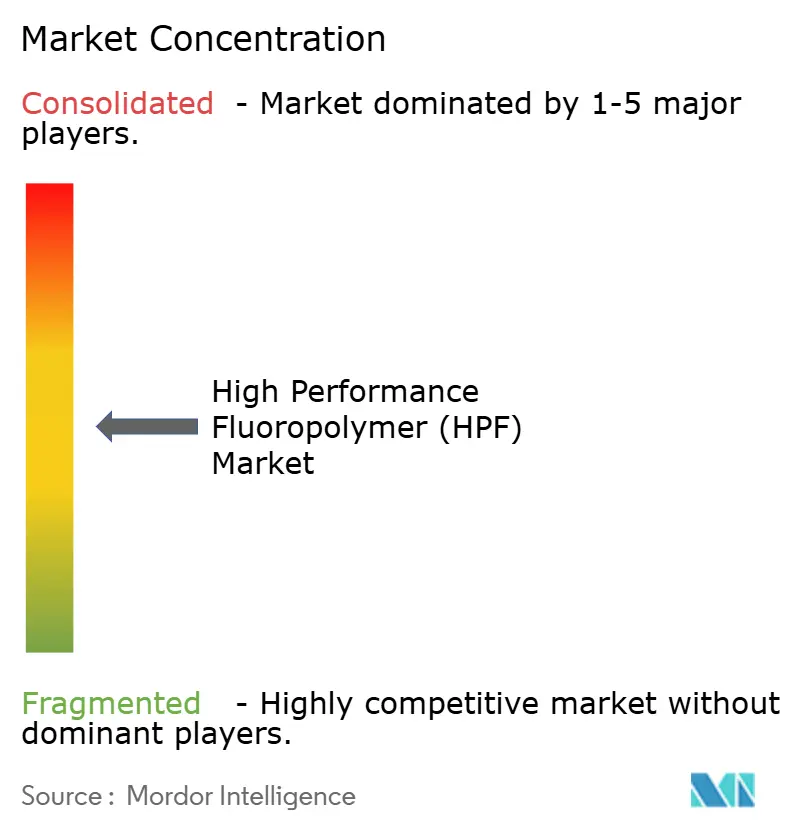
The high performance fluoropolymer (HPF) market is moderately concentrated, with the top five players including DAIKIN INDUSTRIES, Ltd., The Chemours Company, AGC Inc., 3M, and Gujarat Fluorochemicals Limited. Semiconductor-grade perfluoroalkoxy alkane and perfluoroelastomer supply is concentrated among qualified production sites with the required purity controls. Shanghai 3F New Materials Company Limited, Wuhan Everflon Fluoropolymers Co.,Ltd, and KUREHA CORPORATION serve selected regional or specialty positions. Saint-Gobain and HaloPolymer participate in downstream films, tubing, and specialized components.
Companies compete through vertical integration, specification-grade differentiation, and targeted application development. Chinese producers such as Dongyue Group Limited and Shanghai 3F New Materials Company Limited pursue integration from raw materials through finished resins. DAIKIN INDUSTRIES, Ltd. and AGC Inc. are focused on higher-specification products for semiconductor and hydrogen applications. DAIKIN INDUSTRIES, Ltd. completed its Kashima perfluoroelastomer plant in August 2026, with capacity exceeding 3 times that of its Yodogawa Plant and supply scheduled for 2027. AGC Inc. began operations at its Kitakyushu membrane facility in June 2026 for green-hydrogen applications. Arkema expanded polyvinylidene fluoride capacity at Calvert City to support energy storage and other high-value applications.
Non-Chinese-origin supply that meets established Western customer qualifications can address regional sourcing requirements. Arkema, Gujarat Fluorochemicals Limited, and HaloPolymer approach this opportunity from different production bases and customer networks. Sustainable production methods are also becoming relevant in customer qualification, particularly in Europe and North America. DAIKIN INDUSTRIES, Ltd. stated that the Kashima plant incorporates fluorinated surfactant-free production processes. AGC Inc.'s fluorinated membrane platform and Chemours' work on roll-to-roll proton exchange membrane manufacturing reflect continuing development in electrolyzer materials. The high performance fluoropolymer market rewards suppliers that can combine performance consistency, regulatory readiness, and dependable capacity.
High Performance Fluoropolymer (HPF) Industry Leaders
DAIKIN INDUSTRIES, Ltd.
The Chemours Company
AGC Inc.
3M
Gujarat Fluorochemicals Limited
- *Disclaimer: Major Players sorted in no particular order

Recent Industry Developments
- August 2026: DAIKIN INDUSTRIES, Ltd. completed a new perfluoroelastomer facility at its Kashima Plant in Japan, with capacity exceeding three times that of its Yodogawa Plant. The expansion supports demand for high performance fluoropolymers in semiconductor and chemical-processing applications.
- June 2026: Arkema commissioned a 15% expansion of its Kynar Polyvinylidene Fluoride (PVDF) production capacity at Calvert City, Kentucky, following a USD 20 million investment. The additional capacity supports growing demand for high performance fluoropolymers in lithium-ion batteries, energy storage systems, semiconductor manufacturing, data centers, and wire and cable applications.


Global High Performance Fluoropolymer (HPF) Market Report Scope
High performance fluoropolymers are specialized fluorinated polymers designed to maintain their properties under demanding thermal, chemical, and electrical conditions. They provide high chemical resistance, low friction, non-stick characteristics, and long-term stability in challenging operating environments.
The High Performance Fluoropolymer (HPF) Market is segmented by type, form, application, end-use industry, and geography. By type, the market is segmented into polytetrafluoroethylene, fluorinated ethylene propylene, perfluoroalkoxy alkane/modified perfluoroalkoxy, ethylene tetrafluoroethylene, and other types. By form, the market is segmented into granules and pellets, fine powder, dispersion, sheets and films, and other forms. By application, the market is segmented into coatings and liners, components, films, additives, and other applications. By end-use industry, the market is segmented into electrical and electronics, industrial processing, transportation, medical, aerospace and defense, and other end-use industries. The report also covers the market size and forecasts for high performance fluoropolymer (HPF) in 15 countries across major regions. For each segment, the market sizing and forecasts have been done on the basis of value (USD).
| Polytetrafluoroethylene |
| Fluorinated Ethylene Propylene |
| Perfluoroalkoxy Alkane/Modified Perfluoroalkoxy |
| Ethylene Tetrafluoroethylene |
| Other Types |
| Granules and Pellets |
| Fine Powder |
| Dispersion |
| Sheets and Films |
| Other Forms |
| Coatings and Liners |
| Components |
| Films |
| Additives |
| Other Applications |
| Electrical and Electronics |
| Industrial Processing |
| Transportation |
| Medical |
| Aerospace and Defense |
| Other End-Use Industries |
| Asia-Pacific | China |
| India | |
| Japan | |
| South Korea | |
| ASEAN Countries | |
| Rest of Asia-Pacific | |
| North America | United States |
| Canada | |
| Mexico | |
| Europe | Germany |
| United Kingdom | |
| France | |
| Italy | |
| NORDIC Countries | |
| Rest of Europe | |
| South America | Brazil |
| Argentina | |
| Rest of South America | |
| Middle East and Africa | Saudi Arabia |
| South Africa | |
| Rest of Middle East and Africa |
| By Type | Polytetrafluoroethylene | |
| Fluorinated Ethylene Propylene | ||
| Perfluoroalkoxy Alkane/Modified Perfluoroalkoxy | ||
| Ethylene Tetrafluoroethylene | ||
| Other Types | ||
| By Form | Granules and Pellets | |
| Fine Powder | ||
| Dispersion | ||
| Sheets and Films | ||
| Other Forms | ||
| By Application | Coatings and Liners | |
| Components | ||
| Films | ||
| Additives | ||
| Other Applications | ||
| By End-Use Industry | Electrical and Electronics | |
| Industrial Processing | ||
| Transportation | ||
| Medical | ||
| Aerospace and Defense | ||
| Other End-Use Industries | ||
| By Geography | Asia-Pacific | China |
| India | ||
| Japan | ||
| South Korea | ||
| ASEAN Countries | ||
| Rest of Asia-Pacific | ||
| North America | United States | |
| Canada | ||
| Mexico | ||
| Europe | Germany | |
| United Kingdom | ||
| France | ||
| Italy | ||
| NORDIC Countries | ||
| Rest of Europe | ||
| South America | Brazil | |
| Argentina | ||
| Rest of South America | ||
| Middle East and Africa | Saudi Arabia | |
| South Africa | ||
| Rest of Middle East and Africa | ||


Key Questions Answered in the Report
What is the size of the high performance fluoropolymer market?
The high performance fluoropolymer market stands at USD 4.89 billion in 2026 and is projected to reach USD 6.89 billion by 2031.
What is driving demand for high performance fluoropolymers?
Semiconductor cleanrooms, electric-vehicle batteries, chemical-processing equipment, and hydrogen systems are major demand areas.
Which type is projected to advance fastest through 2031?
Perfluoroalkoxy alkane/modified perfluoroalkoxy is projected to advance at a 7.85% CAGR through 2031.
Which application held the largest share in 2025?
Coatings and liners held 31.81% in 2025, supported by corrosion protection in industrial processing equipment.
Page last updated on:





