
Halloumi Cheese Market Size and Share
Market Overview
| Study Period | 2021 - 2031 |
|---|---|
| Market Size (2026) | USD 570.45 Million |
| Market Size (2031) | USD 864.75 Million |
| Growth Rate (2025 - 2031) | 8.68 % |
| Fastest Growing Market | Asia-Pacific |
| Largest Market | Europe |
| Market Concentration | Medium |
Major Players
*Disclaimer: Major Players sorted in no particular order Image © Mordor Intelligence. Reuse requires attribution under CC BY 4.0. |
|
Halloumi Cheese Market Analysis by Mordor Intelligence
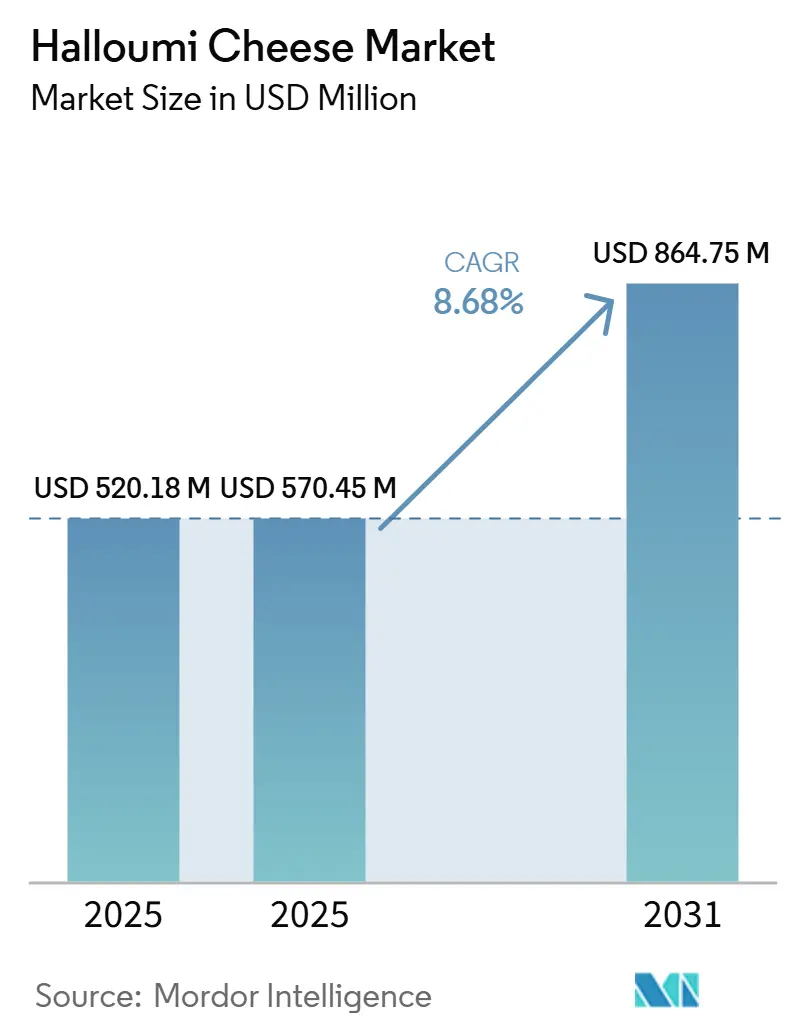
The Halloumi cheese market size is projected to expand from USD 520.2 million in 2025 and USD 570.5 million in 2026 to USD 864.8 million by 2031, registering a CAGR of 8.6% between 2026 to 2031. Demand for protein-rich dairy products within flexitarian eating patterns and the growing use of Mediterranean flavors on restaurant menus support the Halloumi cheese market, particularly where grilled vegetarian proteins are established offerings and consumers seek familiar meatless options. European Protected Designation of Origin (PDO) rules reserve PDO Halloumi production for Cyprus, supporting differentiation, origin recognition, and premium positioning in the Halloumi cheese market. These rules also require producers to maintain documented milk inputs, local processing, packaging requirements, and traceability. Such requirements can strengthen buyer confidence in product origin and reinforce the distinction between PDO Halloumi and products marketed as grilling cheese without the same designation across diverse retail and foodservice purchasing environments worldwide[1]Source: European Commission, "Commission Implementing Regulation (EU) 2021/591 of 12 April 2021 entering a name in the register of protected designations of origin and protected geographical indications (‘Χαλλούμι’ (Halloumi)/‘Hellim’ (PDO))", eur-lex.europa.eu . However, the same origin requirement exposes producers to risks related to livestock availability, milk-ratio compliance, processing capacity, and export logistics from a single production location, rather than a dispersed international manufacturing base. Producers are therefore balancing capacity investment, traceability, value-added formats, retail requirements, and foodservice demand while preserving reliable supplies of sheep and goat milk. The strongest opportunities exist for suppliers that can meet PDO requirements, maintain consistent quality, manage cold-chain delivery, offer blocks and convenient formats, support restaurant kitchens, build reliable distribution relationships in markets where the product is still developing, and communicate clearly with retailers on origin, storage, product performance, certification, delivery planning, pack sizes, shelf-life expectations, and the distinction between PDO Halloumi and competing grilling cheese products.
Key Report Takeaways
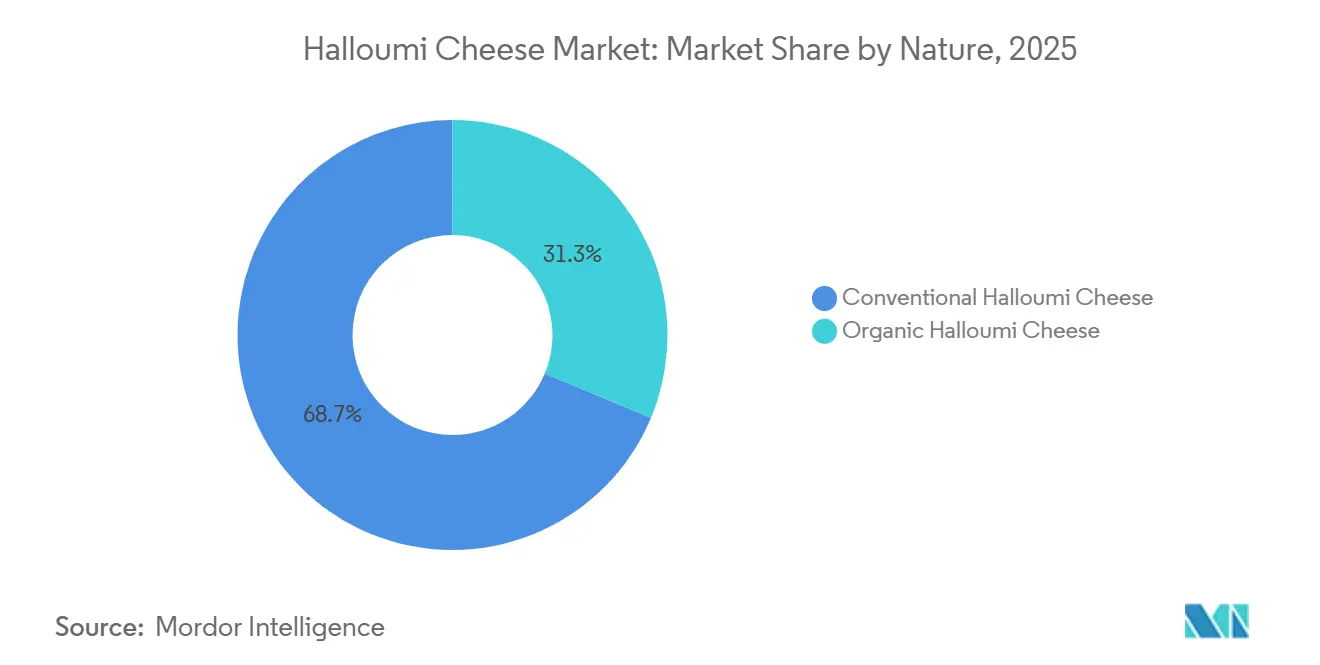
- By nature, Conventional Halloumi Cheese accounted for the largest share of the Halloumi cheese market, at 68.7% in 2025, while Organic Halloumi Cheese is projected to grow at the fastest CAGR of 9.4% during 2026-2031.
- By form, Blocks accounted for the largest share of the Halloumi cheese market, at 59.4% in 2025, while Others is projected to grow at the fastest CAGR of 8.9% during 2026-2031.
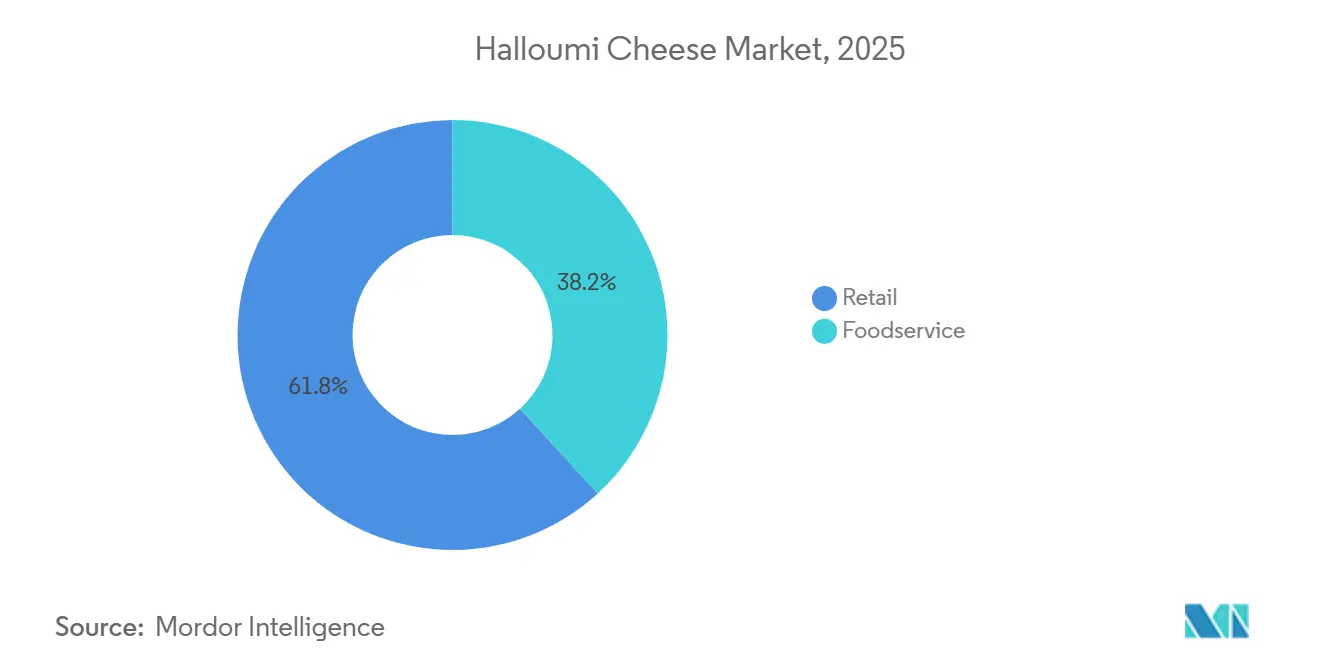
- By distribution channel, Retail accounted for the largest share of the Halloumi cheese market, at 61.8% in 2025, while Foodservice is projected to grow at the fastest CAGR of 10.1% during 2026-2031.
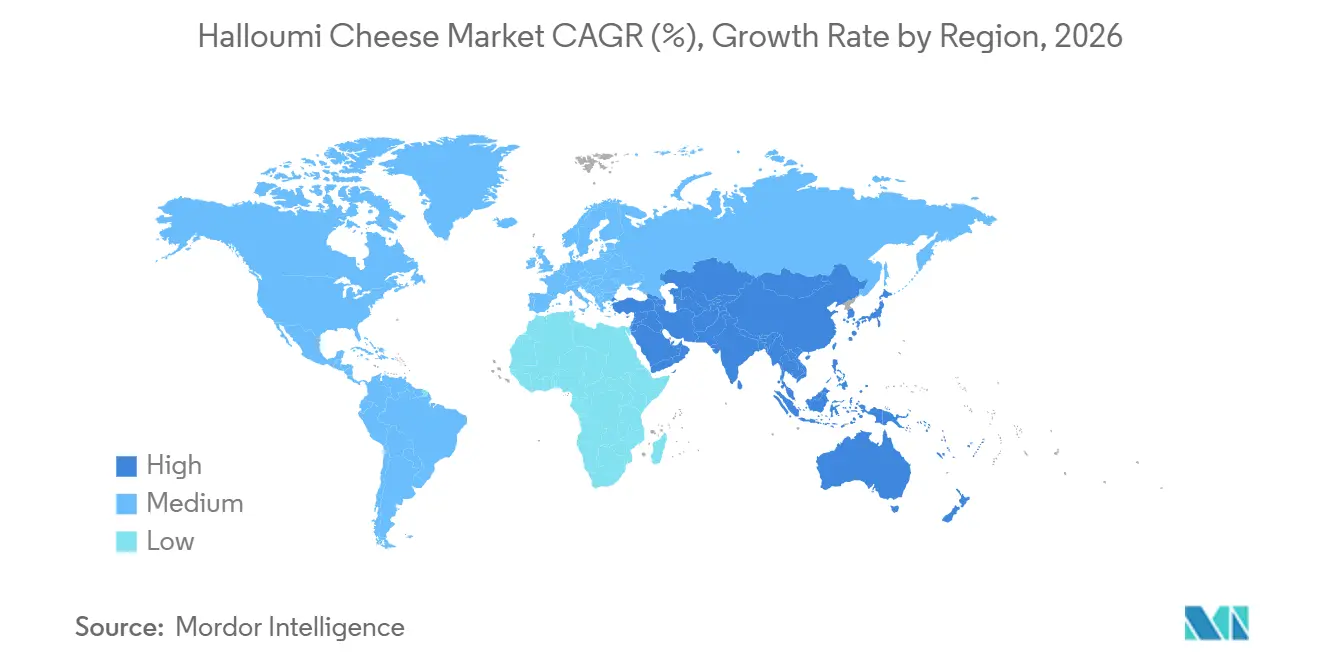
- By geography, Europe accounted for the largest share of the Halloumi cheese market, at 42.5% in 2025, while Asia-Pacific is projected to grow at the fastest CAGR of 9.6% during 2026-2031.
Note: Market size and forecast figures in this report are generated using Mordor Intelligence’s proprietary estimation framework, updated with the latest available data and insights as of January 2026.
Market Trends and Insights
Drivers Impact Analysis of Halloumi Cheese Market*
| Driver | (~) % Impact on CAGR Forecast | Geographic Relevance | Impact Timeline |
|---|---|---|---|
| Rising Adoption of High-Protein Flexitarian Diets | +2.2% | Global, with strong relevance in North America, the United Kingdom, Germany, and Australia | Long term (≥ 4 years) |
| Mainstream Penetration of Mediterranean Cuisine | +1.8% | North America and the European Union, with expansion into Asia-Pacific | Medium term (2-4 years) |
| Expansion of Halloumi-Based Foodservice Menus | +1.5% | Global, led by foodservice hubs in the United Kingdom, Canada, the United States, and Australia | Medium term (2-4 years) |
| Organized Retail, E-Commerce and Cold-Chain Expansion | +1.2% | Asia-Pacific, North America, and emerging Middle East and North Africa online retail corridors | Medium term (2-4 years) |
| PDO Authenticity Premium and Traceability | +0.8% | European compliance markets and North American premium retail | Short term (≤ 2 years) |
| New Cyprus-Based PDO Production Capacity | +0.6% | Global supply, with export concentration in Europe and Asia-Pacific | Short term (≤ 2 years) |
| Source: Mordor Intelligence | |||
Rising Adoption of High-Protein Flexitarian Diets
Halloumi contains 23.9 grams of protein per 100 grams, supporting its position in reduced-meat and protein-focused diets. The Halloumi cheese market benefits from the cheese’s ability to be grilled or fried and used as a substantial meatless component in sandwiches, salads, bowls, and plated meals. This functionality differentiates it from soft cheeses, which are less suitable for hot food preparation or high-heat kitchen service. Demand remains relevant in Europe, Australia, and parts of Asia, where shoppers increasingly consider protein content when comparing dairy products. The product also fits snacking and meal-replacement occasions when sold in convenient portions that require limited preparation. These applications allow producers to address home consumption and foodservice demand without changing the core product or its established taste and texture.
Mainstream Penetration of Mediterranean Cuisine
Mediterranean food culture has expanded the range of restaurant concepts that can use halloumi as a grilled protein, a meatless main dish, or a component in shared plates. This trend supports the halloumi cheese market, as Greek-oriented restaurants often feature grilled items and vegetarian dishes that align with the cheese’s cooking properties. However, restaurant demand does not translate evenly across all Mediterranean concepts, as some operators rely on falafel, grilled chicken, or other established protein options. Suppliers can achieve more consistent volumes by targeting restaurant groups that place grilled cheese at the center of menu development, rather than using it as an occasional special. This strategy is particularly relevant in North America and Australia, where restaurant operators can introduce halloumi to consumers before it becomes a regular retail purchase. Its texture after grilling gives kitchens a practical alternative to ingredients that soften, melt, or lose shape under the high heat used during busy service periods.
Expansion of Halloumi-Based Foodservice Menus
Halloumi has moved beyond a specialist menu item in the United Kingdom and Europe, where quick-service formats use it in limited-time and ongoing menu offerings. In Canada, Tahini’s Restaurants is set to add a Greek Halloumi Wrap and Greek Halloumi Salad to its permanent menu in July 2025, positioning the cheese as a meatless meal option. The Halloumi cheese market benefits from foodservice use because the cheese has a high melting point and can be fried or grilled without losing its shape. This performance supports high-throughput kitchens that require dependable preparation results, consistent portions, and fewer service disruptions. Demand can be seasonal in barbecue-oriented markets, particularly during spring and summer, when outdoor cooking occasions increase. Producers that ensure dependable year-round availability can better support restaurant procurement programs and reduce the risk of operators substituting other grilling cheeses.
Organized Retail, E-Commerce and Cold-Chain Expansion
Organized retail and cold-chain-enabled e-commerce are expanding access to halloumi beyond traditional specialty stores and diaspora-focused grocery outlets. In Australia, offline retail sales of halloumi totaled 2,041 tonnes during one barbecue season, indicating that the product has become part of routine grocery shopping. Online distribution helps premium and organic products reach customers in locations with limited specialty retail coverage and less-established import channels. The halloumi cheese market depends on controlled storage and delivery, as cold-chain failures can affect product quality, food safety, and consumer confidence. Therefore, packaging and fulfillment quality are as important as the online sales platform for suppliers entering distant markets and managing smaller order sizes. Broader retail access also supports the PDO authenticity premium and creates a route for new Cyprus-based capacity to reach consumers.
Restraints Impact Analysis of Halloumi Cheese Market*
| Restraint | (~) % Impact on CAGR Forecast | Geographic Relevance | Impact Timeline |
|---|---|---|---|
| Premium Retail Pricing | -1.2% | Price-sensitive European markets and North American mass retail | Medium term (2-4 years) |
| Competition from Other Grilling Cheeses and Plant-Based Alternatives | -0.9% | The United Kingdom, Western Europe, Australia, and North American vegan and flexitarian retail | Long term (≥ 4 years) |
| Sheep and Goat Milk Supply Scarcity | -1.0% | Cyprus, with effects across export markets | Medium term (2-4 years) |
| Tightening PDO Milk-Ratio and Traceability Requirements | -0.7% | Cyprus producers and PDO-qualified buyers globally | Long term (≥ 4 years) |
| Source: Mordor Intelligence | |||
Premium Retail Pricing
Halloumi carries a price premium over conventional cooking cheeses, which can limit adoption in price-sensitive retail settings and reduce repeat purchases among some households. This challenge is particularly relevant in Central and Eastern Europe and among lower-income consumers in the United Kingdom and Germany, where grocery budgets can drive substitution. Cold-chain requirements and the cost of PDO-qualified sheep and goat milk can limit producers’ ability to reduce prices without affecting quality, authenticity, or margins. Plant-based grilling alternatives may increase price pressure as production scales and retail prices become more competitive across mainstream supermarket shelves. Private-label production can narrow the visible price gap for shoppers and provide suppliers with access to larger grocery programs with more predictable volumes. Therefore, the Halloumi cheese market must preserve product quality while offering pack sizes, price points, and channel options that suit different household budgets.
Sheep and Goat Milk Supply Scarcity
Sheep milk production in the European Union is forecast to decline by 8% by 2030 due to farm demographics, climate pressures, and profitability challenges across key producing countries[2]Source: Organisation for Economic Co-operation and Development, "OECD‑FAO Agricultural Outlook 2025‑2034", oecd.org. This decline limits the raw material base for PDO-reliant cheeses and increases supply risk for the Halloumi cheese market, which depends on Cyprus-based milk inputs. The PDO framework sets progressive requirements for the sheep and goat milk content in PDO Halloumi, creating a clear compliance challenge for producers managing restricted milk supplies. Rebuilding livestock herds takes time, which may make short-term compliance adjustments insufficient for the July 2029 transition and reduce planning certainty for exporters. Digital milk-ratio tracking can improve traceability and demonstrate compliance, but it cannot replace constrained milk supplies or accelerate herd replacement.
*Our forecasts treat driver/restraint impacts as directional, not additive. The impact forecasts reflect baseline growth, mix effects, and variable interactions.
Halloumi Cheese Market Segment Analysis
By Nature:
Conventional Volume Supports Organic Premium GrowthConventional Halloumi cheese is expected to hold 68.7% of the nature segment in 2025, giving it a clear lead in the reported category and confirming its broad role in standard purchasing programs. Retail and bulk foodservice buyers continue to favor it, as unit cost, product familiarity, established supply arrangements, and predictable specifications strongly influence purchasing decisions. Decades of export-oriented production from Cyprus have supported conventional supermarket private-label programs and branded ranges across European markets, where distribution systems are well established. Its broad availability also serves buyers seeking familiar specifications for retail shelves, restaurant kitchens, routine promotional activity, and high-volume sales periods. The segment’s scale gives producers a stable base, even as premium purchasing habits develop in selected markets, and provides volume support for the wider Halloumi cheese market.
Organic Halloumi cheese is projected to grow at a CAGR of 9.4% through 2031, marking the fastest growth rate among the reported segmentation types and signaling premium demand. The Halloumi cheese industry uses certified organic milk supply and traceability to target shoppers seeking clean-label dairy, animal welfare visibility, and documented sourcing practices in premium products. Demand remains concentrated in retail settings in the United Kingdom and Germany, where certified products have gained additional shelf space, stronger shopper recognition, and relevance among flexitarian consumers. European organic dairy systems are expanding, while certification requirements guide investment decisions and support consumer confidence in the product. The need for milk that is both PDO-compliant and organically certified may tighten supply as this segment expands, increasing the value of long-term farm supply agreements.


By Form:
Blocks Retain Scale While Convenience Formats GrowBlocks accounted for 59.4% of the form segment in 2025, making them the largest format in the halloumi cheese market and the reference format for many buyers. They remain prominent in refrigerated retail displays because customers can inspect the vacuum-sealed product, recognize the familiar presentation, and select a pack suited to household use. Foodservice buyers also favor blocks because kitchen teams can slice each pack for sandwiches, salads, grills, shared plates, and other menu applications. This flexibility supports consistent preparation and allows operators to manage serving sizes across different dishes without stocking multiple product formats. As a result, established retail distribution and bulk procurement patterns continue to reinforce the format’s leading position across consumer and professional channels.
Other formats, including slices, cubes, grated products, and crumbled formats, are projected to grow at a CAGR of 8.9% through 2031. These formats serve home cooks who seek shorter preparation times and manufacturers that use halloumi in ready meals, salads, grain bowls, and other prepared food applications. They require additional cutting, packaging, temperature control, and quality checks, which can increase processing costs compared to conventional block exports. Producers with automated processing lines and modified-atmosphere packaging can manage these requirements more efficiently, protect product quality, and maintain a suitable shelf life during distribution. Charalambides Christis introduced Hand-Folded Halloumi with Fresh Mint in 2024, demonstrating how value-added formats can retain traditional product cues in premium offerings.
By Distribution Channel:
Retail Holds the Largest Base While Foodservice AcceleratesRetail is expected to account for 61.8% of the Halloumi cheese market size by distribution channel in 2025, supported by supermarket and hypermarket networks that offer broad consumer reach. Refrigerated dairy sections provide high visibility for branded and private-label products and allow shoppers to compare formats, package sizes, labels, and price points in one location. Online retail is the fastest-growing retail sub-channel, enabling artisanal and PDO-certified brands to reach customers in markets with limited access to specialist stores, established importers, and large diaspora communities. This channel remains relevant in Singapore, parts of North America, and secondary cities across the Middle East, where physical shelf space may be limited. European Union retail buyers also increasingly value PDO documentation and milk-ratio traceability when selecting suppliers.
Foodservice is projected to register a 10.1% CAGR through 2031, the fastest reported rate within the distribution segment and a key channel for consumer trial. The Halloumi cheese market benefits as restaurant operators use the product as a mainstream protein component rather than only as a vegetarian menu item or limited-time special. Its heat performance, stable texture, and suitability for high-volume preparation support its use in quick-service and casual dining kitchens that require consistent results. Buyers in North America and Asia-Pacific may face less stringent authenticity requirements than European retail buyers, improving access for non-PDO grilling-cheese competitors. Suppliers must compete on dependable volumes, cooking performance, texture, and year-round availability while using PDO credentials where they influence buyer decisions.
Geography Analysis
Europe Halloumi Cheese Market
Europe is expected to hold 42.5% of the Halloumi cheese market share in 2025, supported by established consumption patterns, mature retail networks, long-standing export relationships, and consumer familiarity with Mediterranean food. The United Kingdom remains the largest individual destination, absorbing 44% of Cyprus halloumi shipments, equivalent to 18,558 tonnes in 2024. Germany imports 1,950 metric tonnes annually, while Sweden and France are becoming increasingly important as Mediterranean food gains wider acceptance[3]Source: Federal Statistical Office of Germany, "Imports of agricultural products to the value of 57.9 billion euros", destatis.de. Per-capita consumption in the United Kingdom reached 1.4 kilograms per year, highlighting the category’s established presence in the country and the strength of habitual household purchasing. The European Union PDO framework determines which producers can access premium market positions and reinforces the commercial importance of compliance, pack labeling, and documented origin.
APAC Halloumi Cheese Market
Asia-Pacific is projected to expand at a CAGR of 9.6% through 2031, making it the fastest-growing geographic segment in the Halloumi cheese market. Australia remains an important regional outlet, with 2,041 tonnes sold through offline retail during one barbecue season, demonstrating the product’s fit with local grilling occasions. Japan is expected to have 350 retail outlets stocking imported halloumi in 2025, while Singapore has issued 45 import licenses, indicating growing access through formal retail and import channels. Restaurant use remains the primary mechanism for building consumer familiarity in the region, particularly in markets where local shoppers have less experience with the cheese. Retail demand can follow as restaurants establish regular menu use, consumers learn how halloumi performs in dishes, and grocery stores expand their product ranges.
The Americas and MEA Halloumi Cheese Market
North America is shifting from specialty-store distribution toward wider grocery availability, supported by premium retailers that favor branded positioning over white-label blocks. This approach can support higher-margin products and stronger supplier visibility in a region where consumer familiarity is still developing. South America, the Middle East, and Africa remain smaller but commercially relevant areas for the Halloumi cheese market, particularly where diaspora demand and hotel, restaurant, and catering channels are established. Petrou Bros Dairy Products exports to more than 40 countries, while Saudi Arabia imports 9,400 metric tonnes annually. Price sensitivity, long transport routes, and gaps in cold-chain coverage can moderate expansion outside the main European and Asia-Pacific markets.

Competitive Landscape
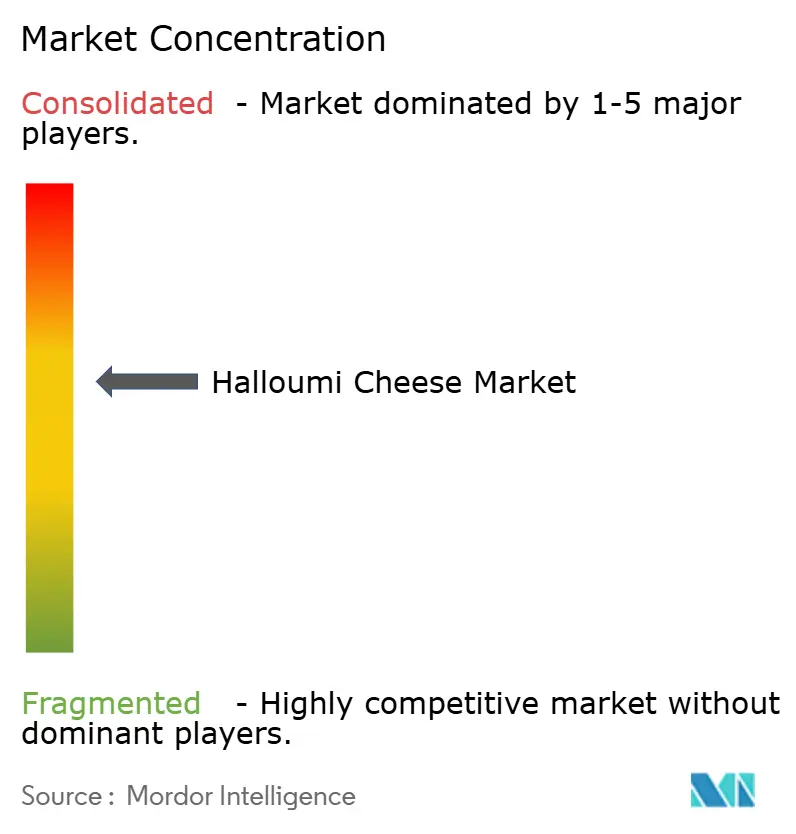
The Halloumi cheese market is moderately concentrated, as a core group of Cyprus-based producers holds origin-linked production advantages and established export relationships. These producers include Petrou Bros Dairy Products, Charalambides Christis, and Hellenic Dairies S.A., through its Olympus brand. They compete on capacity, compliance, and distribution reach. PDO rules require production in Cyprus, preventing competitors from establishing PDO production in lower-cost jurisdictions. As a result, production scale and documented compliance remain the main competitive factors in the Halloumi cheese market, along with the ability to meet retailer and foodservice requirements. New competitors must either acquire established Cypriot capacity or build facilities on the island, thereby raising entry requirements and reinforcing the importance of local supply relationships.
Hellenic Dairies inaugurated a EUR 70 million facility in Tseri, Nicosia, in October 2024, with an annual capacity of 18,000 tonnes for PDO Halloumi and Anari cheese. At its stated capacity, the 12,000-square-meter facility represented 40% of Cyprus’ annual halloumi output, increasing the group’s ability to support export demand. The facility uses biogas recovery from anaerobic wastewater treatment and photovoltaic panels as part of its production infrastructure, supporting sustainability discussions with retail buyers. The investment shows how larger dairy groups can add Cyprus-based capacity while maintaining the local production base required for PDO Halloumi. It also increases direct competitive pressure on established domestic producers with long-standing export relationships.
Value-added flavors and formats, export diversification beyond the United Kingdom, and verified organic supply remain significant competitive areas for suppliers seeking additional growth routes. Plant-based alternatives from Violife, GreenVie, and Tesco’s own-label range create price competition in Western Europe and Australia, especially among flexitarian consumers. Researchers at the University of Copenhagen developed a prototype hybrid cooking cheese with pea protein that matched the grilling and texture properties of paneer and halloumi. The product remains at an early stage, but it indicates the direction of alternative grilling-cheese development and the potential importance of product performance. Digital traceability, sustainability information, and broader format ranges can help suppliers differentiate their products with retail buyers and support premium positioning.
Halloumi Cheese Industry Leaders
-
Petrou Bros Dairy Products Ltd
-
HELLENIC DAIRIES S.A.
-
Charalambides Christis Ltd
-
Zita Dairies Ltd
-
PITTAS DAIRY INDUSTRIES LIMITED
- *Disclaimer: Major Players sorted in no particular order
Halloumi Cheese Market Companies Covered in this Report
- Petrou Bros Dairy Products Ltd
- HELLENIC DAIRIES S.A.
- Charalambides Christis Ltd
- Zita Dairies Ltd
- PITTAS DAIRY INDUSTRIES LIMITED
- Hadjipieris Ltd
- GALAKTOKOMIO A.D.S. DAFNI LTD
- NORDEX FOOD A/S
- Achnagal Dairies Industry
- Lefkonitziatis Dairy Products Ltd
- Arla Foods amba
- Almarai
- Lactalis Group
- Dodoni S.A.
- MEVGAL S.A.
- Saputo Inc.
- Fonterra Co-operative Group Limited
- Bel Group
- High Weald Dairy
- Olympus Cheese
- Kind LLC

Recent Industry Developments in Halloumi Cheese Market
- November 2025: In July 2026, Yoghurt Express is expected to launch its new halloumi cheese, which the company claims will be suitable for grilling, frying, and fresh consumption, targeting consumers seeking versatile cheese options for both cooked and uncooked applications.
- March 2025: The Cyprus Agriculture Ministry introduced a new decree to gradually increase the goat and sheep milk content in halloumi production. The cheesemakers' association described the October 2024 deployment of milk-ratio tracking software across Cyprus dairies as a "decisive move" to safeguard export viability and ensure PDO compliance.
- October 2024: Hellenic Dairies S.A. inaugurated a EUR 70 million PDO Halloumi and Anari cheese production facility in Tseri, Nicosia, Cyprus. The 12,000-square-meter facility has an annual capacity of 18,000 tonnes, representing 40% of Cyprus's annual halloumi output at the stated capacity. The site features biogas generation through anaerobic wastewater treatment and photovoltaic solar energy, aligning operations with sustainability information increasingly considered by European retail buyers. The facility also supports a higher-capacity export platform through the company’s grocery and foodservice customer relationships in established and developing destination markets and relevant retail accounts.


Global Halloumi Cheese Market Report Scope
| Conventional Halloumi Cheese |
| Organic Halloumi Cheese |
| Blocks |
| Others( Slices, Cubes, grated, crumbled) |
| Foodservice | |
| Retail | Supermarkets/Hypermarkets |
| Convenience/Grocery Stores | |
| Online Retail Stores | |
| Other Distribution Channel |
| North America | United States |
| Canada | |
| Mexico | |
| Rest of North America | |
| Europe | Germany |
| United Kingdom | |
| Italy | |
| France | |
| Spain | |
| Netherlands | |
| Belgium | |
| Sweden | |
| Poland | |
| Rest of Europe | |
| Asia-Pacific | China |
| India | |
| Japan | |
| Australia | |
| Singapore | |
| Rest of Asia-Pacific | |
| South America | Brazil |
| Argentina | |
| Colombia | |
| Rest of South America | |
| Middle East and Africa | South Africa |
| Saudi Arabia | |
| Rest of Middle East and Africa |
| By Nature | Conventional Halloumi Cheese | |
| Organic Halloumi Cheese | ||
| By Form | Blocks | |
| Others( Slices, Cubes, grated, crumbled) | ||
| By Distribution Channel | Foodservice | |
| Retail | Supermarkets/Hypermarkets | |
| Convenience/Grocery Stores | ||
| Online Retail Stores | ||
| Other Distribution Channel | ||
| By Geography | North America | United States |
| Canada | ||
| Mexico | ||
| Rest of North America | ||
| Europe | Germany | |
| United Kingdom | ||
| Italy | ||
| France | ||
| Spain | ||
| Netherlands | ||
| Belgium | ||
| Sweden | ||
| Poland | ||
| Rest of Europe | ||
| Asia-Pacific | China | |
| India | ||
| Japan | ||
| Australia | ||
| Singapore | ||
| Rest of Asia-Pacific | ||
| South America | Brazil | |
| Argentina | ||
| Colombia | ||
| Rest of South America | ||
| Middle East and Africa | South Africa | |
| Saudi Arabia | ||
| Rest of Middle East and Africa | ||


Key Questions Answered in the Report
What is the projected value of the Halloumi cheese market by 2031?
The Halloumi cheese market is projected to reach USD 864.8 million by 2031, from USD 570.5 million in 2026, at an 8.6% CAGR. Growth is linked to protein-focused eating habits, restaurant use, and wider retail access, while its pace depends on producers maintaining PDO compliance, adequate milk availability, appropriate formats, and reliable cold-chain delivery into export markets.
Which nature category is growing fastest in Halloumi cheese?
Organic Halloumi Cheese is projected to grow at a 9.4% CAGR through 2031, while Conventional Halloumi Cheese held 68.7% of the nature segment in 2025. Organic growth depends on certified milk that also meets PDO requirements, and suppliers with secure farmer relationships, traceable inputs, suitable processing capacity, and premium retail distribution can be better placed to serve demand.
Which distribution channel is expected to expand fastest?
Foodservice is projected to grow at a 10.1% CAGR through 2031. Retail remained the largest distribution channel with a 61.8% share in 2025, supported by supermarket, hypermarket, and expanding online access, while foodservice growth reflects restaurant use where heat performance, consistent texture, dependable volumes, and year-round availability guide purchasing decisions.
Which region is expected to record the fastest growth?
Asia-Pacific is projected to grow at a 9.6% CAGR through 2031, supported by foodservice adoption and expanding retail access. Japan and Singapore are developing access through retail listings and import licenses, while Australia has established retail demand, and long shipping routes from Cyprus make packaging, import coordination, regional distribution partnerships, and temperature-controlled logistics important to product availability and margins.
Page last updated on:





