
Green Water Treatment Chemicals Market Size and Share
Market Overview
| Study Period | 2022 - 2032 |
|---|---|
| Market Size (2027) | USD 2.03 Billion |
| Market Size (2032) | USD 2.89 Billion |
| Growth Rate (2027 - 2032) | 7.29 % |
| Fastest Growing Market | Asia-Pacific |
| Largest Market | Asia-Pacific |
| Market Concentration | Medium |
Major Players *Disclaimer: Major Players sorted in no particular order Image © Mordor Intelligence. Reuse requires attribution under CC BY 4.0. | |
Green Water Treatment Chemicals Market Analysis by Mordor Intelligence
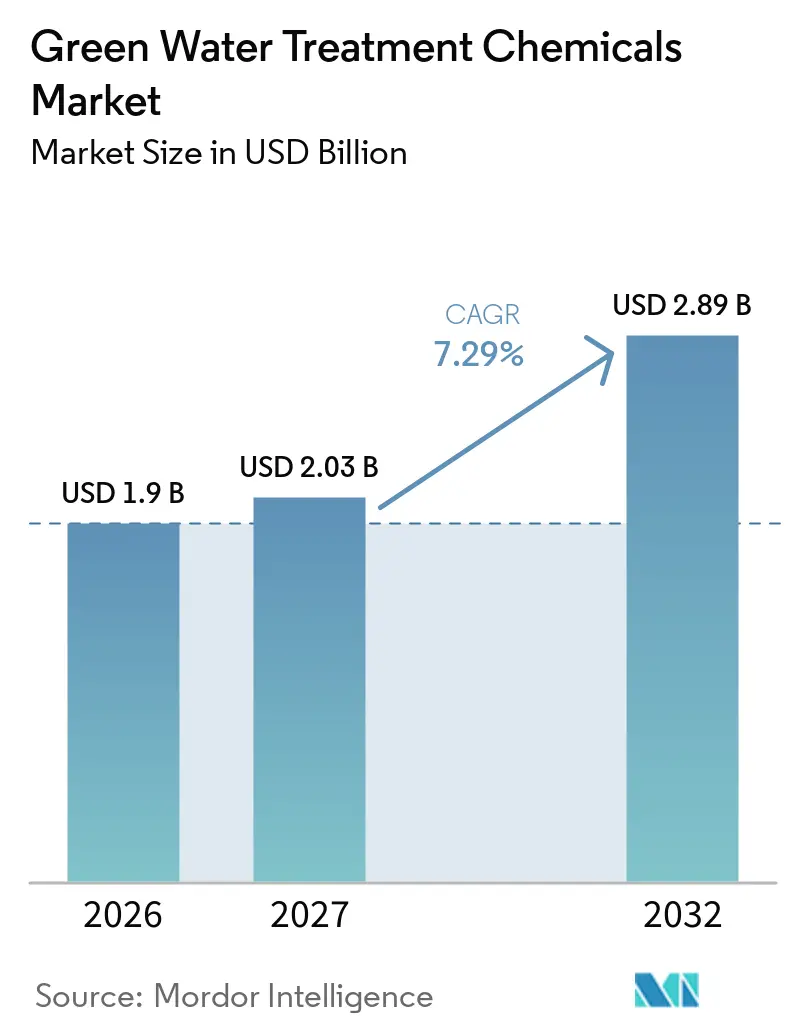
The green water treatment chemicals market size was valued at USD 1.90 billion in 2026 and is estimated to grow from USD 2.03 billion in 2027 to USD 2.89 billion by 2032, at a CAGR of 7.29% during the forecast period (2027-2032). The green water treatment chemicals market is shaped by regulations that turn sustainability goals into enforceable discharge and product-compliance requirements. Water reuse investments are increasing the demand for chemicals that can operate in repeated treatment cycles without creating persistent residuals. Suppliers are seeking to combine formulation expertise with dosing and monitoring, and to offer longer service agreements, to strengthen customer relationships. Industrial buyers are placing greater weight on verified environmental attributes, particularly when procurement programs cover supply chain emissions. The market also faces limitations due to performance variability under difficult treatment conditions and inconsistent agricultural feedstock supply.
Key Report Takeaways
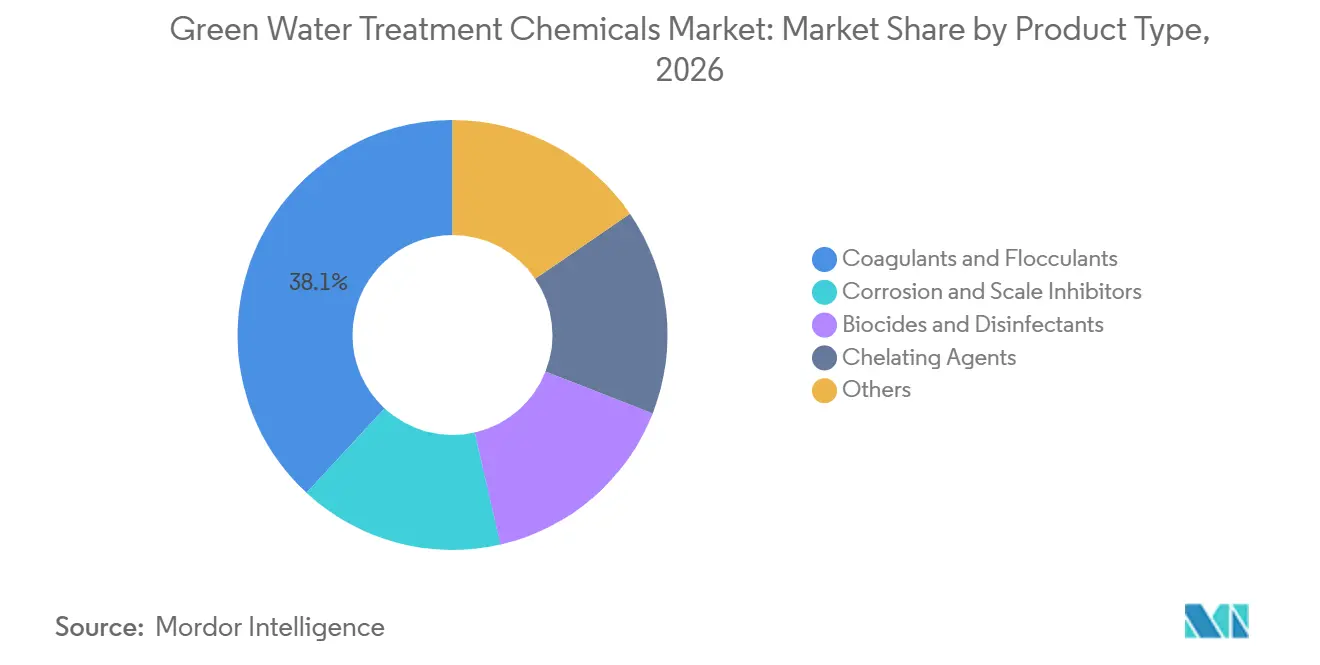
- By product type, Coagulants and Flocculants held 38.12% market share in 2026, while Biocides and Disinfectants are forecast to grow at a CAGR of 7.84% through 2032.
- By source of raw material, Plant-Based Sources held 49.56% market share in 2026, while Mineral-Based Sources are forecast to grow at a CAGR of 7.91% through 2032.
- By application, Wastewater Treatment held 52.71% market share in 2026, while Process Water Treatment is forecast to grow at a CAGR of 8.06% through 2032.
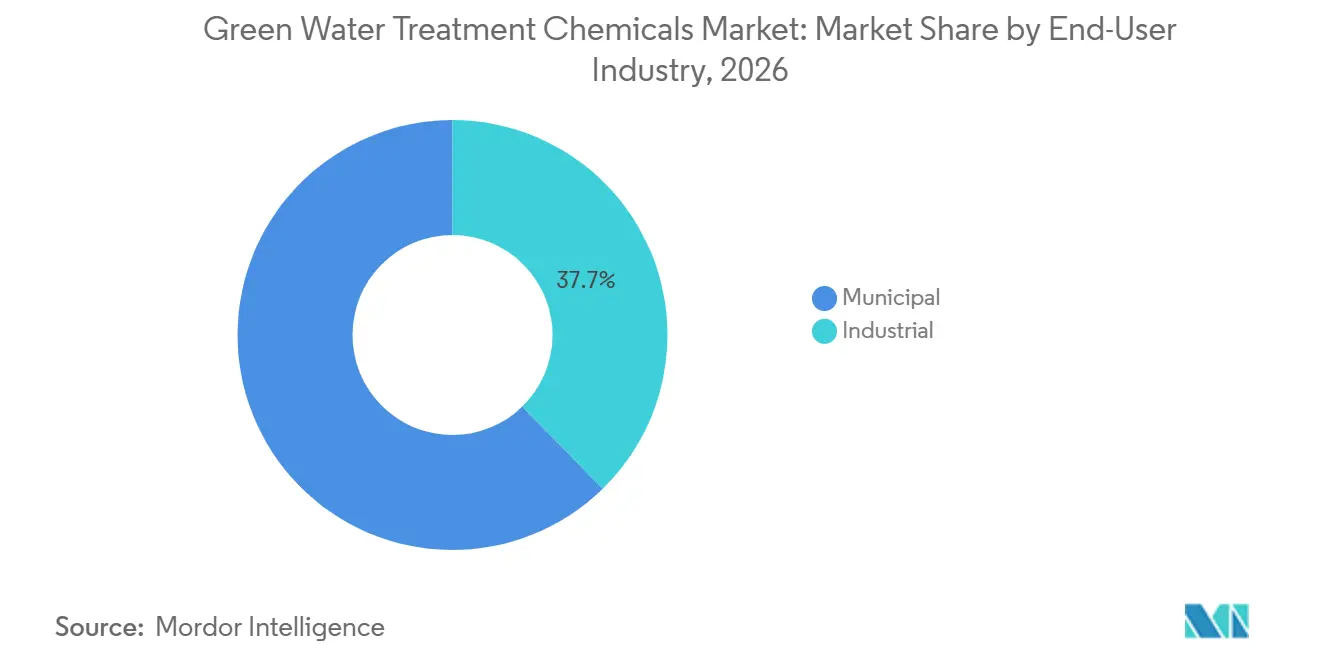
- By end-user industry, Industrial held 37.69% market share in 2026 and is forecast to grow at a CAGR of 8.52% through 2032.
- By geography, Asia-Pacific held 35.84% market share in 2026 and is forecast to grow at a CAGR of 8.13% through 2032.
Note: Market numbers in this report are based on Mordor Intelligence's proprietary estimation framework, which combines nine months of actuals with Q4 projections for base year 2026.
Market Trends and Insights
Drivers Impact Analysis of Green Water Treatment Chemicals Market*
| Drivers | (~) % Impact on CAGR Forecast | Geographic Relevance | Impact Timeline |
|---|---|---|---|
| Tightening Per- and Polyfluoroalkyl Substances (PFAS), Micropollutant, and Nutrient Discharge Requirements | +1.5% | North America, the EU, APAC, including China and Japan | Medium term (2-4 years) |
| Expansion of Water Reuse and Zero-Liquid-Discharge Projects | +1.3% | APAC core, with spillover to MEA and South America | Medium term (2-4 years) |
| Corporate Decarbonization and Scope 3 Chemistry Commitments | +1.0% | Global, with intensity in the EU and North America | Long term (≥ 4 years) |
| Rising Industrial Wastewater Loads and Water Scarcity | +1.2% | Global, with intensity in APAC and MEA | Short term (≤ 2 years) |
| Demand for Lower-Sludge and Lower-Residual Treatment Chemistry | +0.9% | North America, the EU, Japan, and South Korea | Medium term (2-4 years) |
| Source: Mordor Intelligence | |||
Tightening Per- and Polyfluoroalkyl Substances (PFAS), Micropollutant, and Nutrient Discharge Requirements
Binding requirements introduced in 2025 increased compliance risk for operators using persistent treatment chemistries. On April 28, 2025, the U.S. Environmental Protection Agency announced actions, including the development of effluent limitation guidelines for PFAS manufacturers and metal finishers under the Clean Water Act. France's Decree No. 2025-958 requires a 70% reduction in industrial PFAS discharges into waters from the 2023 baseline by February 27, 2028, and sets a path toward near-zero discharges by February 27, 2030. A related French measure requires PFAS surveillance at urban wastewater treatment stations serving more than 10,000 population equivalents. These rules require operators to examine both upstream inputs and end-of-pipe treatment options. The green water treatment chemicals market stands to benefit as persistent surfactants and process aids become more difficult to justify in compliance programs.
Expansion of Water Reuse and Zero-Liquid-Discharge Projects
Water reuse and zero-liquid-discharge projects are creating complex operating conditions that favor specialized treatment programs. In October 2025, Aditya Aluminum commissioned Odisha's first 200 kiloliters per day (KLD) zero-liquid-discharge plant, with mechanical vapor recompression designed to recover 90%-95% of clean water from industrial effluent. In September 2025, Jordan commissioned an integrated industrial zero-liquid-discharge unit at the target facility that reduced fresh water consumption by 25% and wastewater disposal costs by 30%. High-total-dissolved-solids brine concentrators and evaporative crystallizers require effective scale control and biofouling management. Supplier qualification in these systems can create durable demand for consumables, as the chemistry becomes part of the operating design. The green water treatment chemicals market has an opportunity where reuse infrastructure is being installed or upgraded.
Corporate Decarbonization and Scope 3 Chemistry Commitments
Supply chain emissions programs are changing how industrial buyers assess water treatment inputs. In March 2025, Nouryon introduced Eka HP Puroxide, a low-carbon-footprint hydrogen peroxide product for use in pulp and paper, mining, and water treatment. The company stated that the product can help customers reduce Scope 3 greenhouse gas emissions by up to 90% compared to conventional natural-gas steam reforming routes. The Carb'eau project is developing plant-based activated carbon from Program for the Endorsement of Forest Certification (PEFC)-certified French wood and reports a footprint of 0.36 t CO2e per metric ton of product[1]. Buyers with science-based targets may favor suppliers that provide verified lifecycle information. This requirement supports the green water treatment chemicals market, where both product performance and environmental documentation are available.
Rising Industrial Wastewater Loads and Water Scarcity
Industrial activity accounts for 20% of global freshwater abstraction, making industrial water management a key component of water-stress planning. Expanding activity in textiles, semiconductor fabrication, and petrochemicals is increasing the quantity and complexity of wastewater streams across several Asian economies. Bangladesh's large-scale textile water reuse project, unveiled in 2025, targets annual reuse of 438,000 cubic meters and a 22% reduction in production water consumption. Each reuse system creates a recurring need for coagulants, biocides, and scale inhibitors that can perform in recycling loops without building persistent residuals. Reference installations can also shorten future qualification cycles for similar facilities. These conditions support demand for green water treatment chemicals across water-intensive manufacturing.
Restraints Impact Analysis of Green Water Treatment Chemicals Market*
| Restraints | (~) % Impact on CAGR Forecast | Geographic Relevance | Impact Timeline |
|---|---|---|---|
| Performance and Cost Variability Versus Conventional Chemistry | -1.5% | Global | Short term (≤ 2 years) |
| Feedstock Seasonality and Supply-Chain Inconsistency | -0.9% | APAC, South America, and MEA | Short term (≤ 2 years) |
| Regulatory Qualification Gaps for Novel Bio-Based Formulations | -0.6% | EU and North America | Medium term (2-4 years) |
| Source: Mordor Intelligence | |||
Performance and Cost Variability Versus Conventional Chemistry
Green formulations can show less predictable results than conventional products in high-salinity, high-temperature, and mixed-contaminant systems. A 2025 scientific study reported 85-95% turbidity removal for plant-based coagulants at 50-100 mg/L under controlled conditions. Conventional aluminum and iron-salt products have established pH-dose-response curves that operators understand well. Bio-based production routes may require fermentation, extraction, or enzymatic synthesis, which keeps prices higher than those of synthetic alternatives. Municipal utilities in cost-sensitive markets may find it difficult to account for lifecycle benefits in lowest-cost-compliant tenders. The green water treatment chemicals market must therefore demonstrate consistent performance and clear total cost benefits in demanding applications.
Feedstock Seasonality and Supply-Chain Inconsistency
Tannins, chitosan, starch derivatives, and Moringa seed extracts are tied to agricultural and processing supply chains. Seasonal output and weather-related harvest variation can affect extraction costs and delivery reliability. This risk is more pronounced where several bio-coagulant inputs are sourced from a small group of countries with overlapping harvest calendars. Suppliers may respond by adopting dual sourcing, increasing inventory, or developing fermentation routes that do not rely on agricultural cycles. These measures add cost and are harder for smaller formulators to fund.
*Our forecasts treat driver/restraint impacts as directional, not additive. The impact forecasts reflect baseline growth, mix effects, and variable interactions.
Green Water Treatment Chemicals Market Segment Analysis
By Product Type:
Coagulants Anchor Demand While Biocide Innovation AcceleratesCoagulants and flocculants held 38.12% of the green water treatment chemicals market share in 2026. Their position reflects use in primary clarification at municipal facilities and industrial effluent systems. Chitosan from crustacean processing waste, tree-bark tannins, and lignin derivatives are gaining use where biodegradability and lower sludge volumes matter. A 2025 study found that plant-based coagulants achieved 85-95% turbidity removal at 50-100 mg/L dosing under controlled conditions, compared with alum dosing of 100-150 mg/L under equivalent feedwater conditions. Corrosion and scale inhibitors are also shifting toward phosphate-free and amino acid-based chelants as nutrient discharge requirements tighten. Chelating agents are relevant in closed-loop industrial systems, where persistent ethylenediaminetetraacetic acid (EDTA)-based formulations are subject to disposal limits.
Biocides and disinfectants are forecast to grow at a 7.84% CAGR from 2027 to 2032. The installed base of reverse osmosis and nanofiltration systems is expanding, and these systems are sensitive to biofouling. Controlled-release biocides and natural antimicrobials can limit disinfection-byproduct formation associated with chlorine-based treatment. European drinking-water applications are shaped by the EU Biocidal Products Regulation No. 528/2012 and its rules on permitted actives. The other category includes green defoamers, natural pH adjusters, and biodegradable sludge conditioners. Operators can use these inputs in integrated programs that reduce dependence on multiple synthetic products. The green water treatment chemicals market is therefore extending beyond primary clarification into more specialized process needs.

By Source of Raw Material:
Plant-Based Dominance Tested by Mineral-Based MomentumPlant-based sources accounted for 49.56% of segment revenue in 2026. This position reflects established supply chains for rice husk, tamarind seed polysaccharides, lignosulfonates, and guar gum derivatives. These inputs align with circular procurement policies, as many are by-products. A 2025 review found that plant-derived biocoagulants can generate lower dry sludge mass per cubic meter than aluminum salts, which can reduce disposal costs for treatment operators. However, variable feedwater pH and temperature can affect reproducible performance, which remains a constraint in industrial applications that require precise dose-response behavior. Plant-based materials remain an important part of the green water treatment chemicals market due to their well-established sourcing model.
Mineral-based sources are projected to expand at a 7.91% CAGR between 2027 and 2032. Zeolite and natural clay formulations can provide stable supply profiles and lower raw-material price variation than agricultural alternatives. They can also perform reliably across temperatures common in cooling systems and power-generation applications, making them relevant to process water treatment in oil and gas, power generation, and high-temperature manufacturing. Animal-based sources are led by chitosan from crustacean shell waste and serve algae-laden municipal water and high-turbidity estuarine settings. Supply concentration around shrimp and crab processing facilities in Southeast Asia limits broader scalability. Microbial routes for chitosan analogs are in late-stage research and development but have not reached commercial scale.
By Application:
Wastewater Treatment Drives Scale While Process Water Records Higher GrowthWastewater treatment represented 52.71% of segment revenue in 2026, supported by the quantity of municipal and industrial effluent requiring chemical treatment. Textile, pulp and paper, food processing, electronics, and mining facilities generate streams with varying contaminant loads that require coagulants, biocides, and chelating agents to meet treatment objectives. Municipal plants drive high-quantity, price-sensitive demand for plant-derived coagulants and disinfectants. Drinking water treatment benefits from infrastructure investment in second-tier cities across South Asia, Southeast Asia, and Latin America, where upgrades often aim to reduce sludge quantities and align with national water-quality requirements. This scale of demand makes wastewater treatment central to the green water treatment chemicals market.
Process water treatment is forecast to grow at an 8.06% CAGR from 2027 to 2032. Semiconductor fabs, battery facilities, pharmaceutical plants, and data center cooling systems require ultrapure or tightly conditioned water. These applications support premium pricing and longer supply partnerships where products meet technical specifications. In January 2026, Kurita America partnered with Solugen to commercialize Kurita TowerNG, a bio-based line of corrosion and scale inhibitors for cooling towers and process water circuits. Bio-based corrosion inhibitors, specialty biocides, and advanced scale-control products are needed to maintain membrane-grade water quality without persistent residuals. Other applications include cooling-tower blowdown conditioning, irrigation treatment, and aquaculture, where ecotoxicity requirements can support wider use of bio-based formulations.
By End-User Industry:
Industrial Sector Commands Both Scale and GrowthIndustrial end users accounted for 37.69% of segment revenue in 2026 and are projected to grow at an 8.52% CAGR through 2032. Industrial facilities generate large quantities of complex wastewater and face demanding discharge requirements. Semiconductor, oil refining, food and beverage, and mining sites often require precision dosing for process water and reuse loops. These facilities are also increasingly subject to Scope 3 reporting programs that include purchased chemistry, allowing buyers to use green chemistry as a measurable environmental performance metric in sustainability disclosures. Outcome-based water management contracts, which tie suppliers to recovery and compliance targets over several years, are becoming more relevant in this segment.
Municipal end users form the complementary share of demand and generally expand at a more measured rate. Procurement rules often favor the lowest-cost compliant option, and public budget cycles can slow adoption. Donor-funded and multilaterally financed projects in South Asia and Sub-Saharan Africa may specify bio-based treatment standards in their financing requirements, which can expand the addressable base in markets where conventional chemistry has been the standard option. Private water utility concessions may create a different purchasing pattern, as operators holding environmental responsibility under long contracts can invest earlier in compliance-assured treatment chemistry. Municipal opportunities may therefore grow where funding and accountability structures evolve.
Geography Analysis
APAC Green Water Treatment Chemicals Market
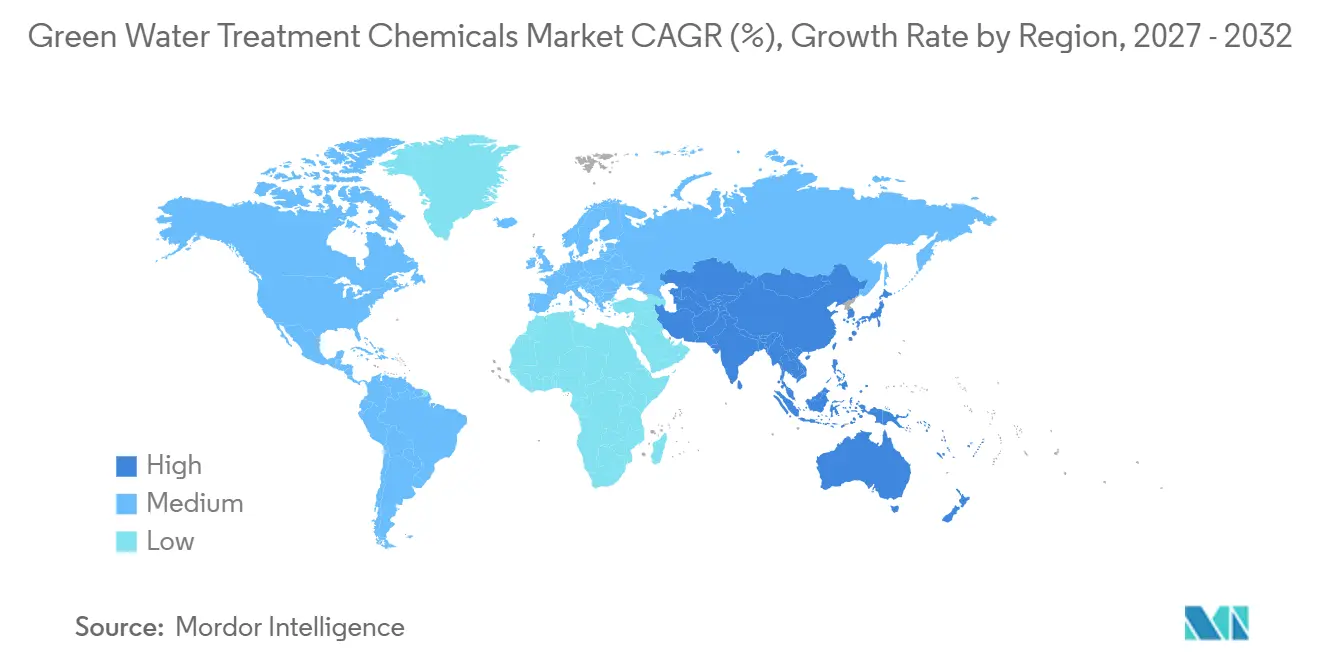
Asia-Pacific held 35.84% of the green water treatment chemicals market share in 2026 and is projected to grow at an 8.13% CAGR through 2032. China's 14th Five-Year Plan identifies bio-water treatment technology as a priority area for development. Sichuan Province introduced local PFAS control standards for chemical parks in 2024, with enforcement accelerating in 2025. India's Jal Jeevan Mission supports rural drinking-water infrastructure, while the expansion of industrial zones is increasing demand for process water. Japan and South Korea contribute specialized requirements from semiconductor and advanced electronics manufacturing. Kurita Water Industries and Sekisui Chemical are developing PFAS-free piping and component systems for ultrapure-water circuits, with commercialization targeted for 2026. Vietnam, Indonesia, and Thailand add demand through textiles, automotive components, and electronics manufacturing.
North America and Europe Green Water Treatment Chemicals Market
North America is a large, mature market where substitution rather than new capacity additions drives growth. The EPA's 2025 PFAS actions are expected to bring green chemistry into more industrial wastewater programs. Municipal utilities are replacing aging equipment, while food and beverage, petrochemical, and semiconductor operators are reviewing treatment inputs against supply-chain emissions targets. Europe is governed by linked compliance deadlines on micropollutants, drinking-water chemicals, and PFAS. Denmark introduced updated requirements for chemicals and filter media in contact with drinking water, including requirements for new sand-filter installations from January 2025 and a July 2026 deadline for treatment-chemical compliance[2]. France's PFAS discharge regulations add urgency for suppliers with approved formulations.
MEA and South America Green Water Treatment Chemicals Market
South America, the Middle East, and Africa are smaller but growing markets for green water treatment chemicals. Brazil supports demand through pulp and paper, mining, and agro-industrial operations. Solvay and Veolia reported near-total water independence at a manufacturing site in the São Paulo region, avoiding the equivalent of 8.5 million cubic meters of freshwater dependency annually. Argentina and the wider mining corridor require scale inhibitors and chelating agents as lithium and copper projects face environmental permitting requirements. Gulf Cooperation Council investments in desalination and industrial zero-liquid-discharge compliance are important drivers of demand in the Middle East and Africa (MEA). Jordan's integrated industrial zero-liquid-discharge unit serves as a regional reference for water-circularity projects.
Competitive Landscape
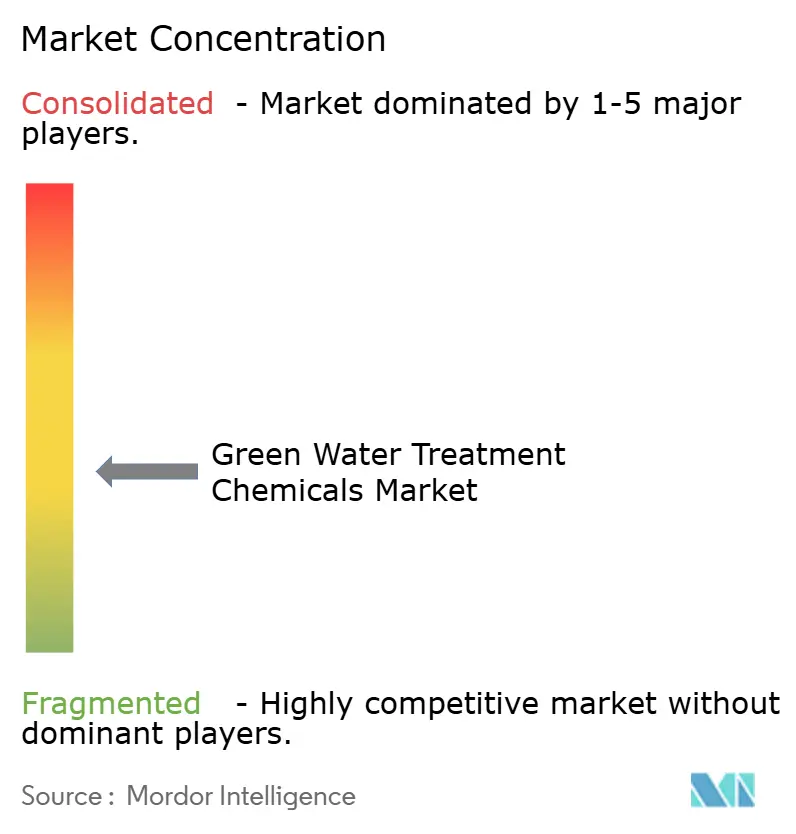
The green water treatment chemicals market is moderately fragmented, with large specialty chemical suppliers holding advantages in formulation capabilities, dosing systems, and geographic manufacturing. Kemira acquired Water Engineering, Inc. in September 2025 for approximately USD 150 million, adding industrial water treatment capabilities across the food and beverage, manufacturing, and healthcare sectors. This acquisition reflects the value of combining chemical products with embedded technical services. Veolia acquired the remaining 30% stake in Water Technologies & Solutions in May 2025, gaining full ownership of a platform that includes chemical services, membranes, monitoring, and engineering. Ecolab's Nalco Water division uses its 3D TRASAR real-time dosing platform to optimize chemical use against operating targets. These integrated offerings are difficult for regional formulators to replicate.
Solenis completed its acquisition of NCH Corporation in November 2025, expanding its presence into more than 160 countries and increasing its employee count to approximately 23,000. The company identified sustainable and digital water solutions as cross-selling opportunities for middle-market industrial accounts. Performance-validated bio-based chemistry for semiconductor water treatment, pharmaceutical purification, and zero-liquid-discharge brine management remains an area of opportunity. Kurita's partnership with Solugen on chemoenzymatic bio-based inhibitors illustrates the importance of technical differentiation in this space. Suppliers seeking authorization dossiers for novel bio-based antimicrobials in Europe face a regulatory barrier that disadvantages smaller firms. The market therefore rewards companies that combine validated performance with regulatory documentation.
Consolidation activity in 2025 and 2026 points to higher scale requirements for service infrastructure and raw material supply. Regional firms with single-product portfolios can struggle to finance digital service tools, testing capabilities, and supply resilience. Large competitors are also using acquisitions to broaden their treatment service coverage rather than adding chemical capacity alone. Ecolab acquired CoolIT Systems in July 2026, integrating direct liquid cooling solutions into its Nalco Water portfolio for high-density data center infrastructure. This acquisition responds to the demand for sustainable water management in data center cooling circuits. The green water treatment chemicals market has space for focused challengers, but they must demonstrate that their products perform in high-specification applications.
Green Water Treatment Chemicals Industry Leaders
-
Ecolab Inc.
-
Solenis
-
Kemira
-
Kurita Water Industries Ltd.
-
Veolia
- *Disclaimer: Major Players sorted in no particular order
Green Water Treatment Chemicals Market Companies Covered in this Report
- BASF
- Buckman
- CLARIANT
- DuPont
- Ecolab Inc.
- Hydrite Chemical
- Kemira
- Kurita Water Industries Ltd.
- Nouryon
- SNF Group
- Solenis
- SUEZ
- Thermax Limited
- Veolia
- Xylem
Recent Industry Developments in Green Water Treatment Chemicals Market
- July 2026: Ecolab acquired CoolIT Systems, integrating direct liquid cooling solutions for high-density data center infrastructure into its Nalco Water portfolio. The acquisition addressed demand from industrial customers for water management in AI-driven data center cooling circuits, supporting growth in the green water treatment chemicals industry.
- February 2026: Kemira acquired SIDRA Wasserchemie in Germany for approximately EUR 75 million, reinforcing its inorganic coagulant production base and strengthening its presence in European municipal and industrial wastewater segments, contributing to the green water treatment chemicals industry.
Global Green Water Treatment Chemicals Market Report Scope
Green water treatment chemicals are plant-based, animal-based, or mineral-derived substances used to purify, clarify, and treat water in an environmentally safe and sustainable manner. These chemicals serve as alternatives to conventional synthetic treatment agents, offering reduced ecological impact while maintaining effective water quality management.
The green water treatment chemicals market is segmented by product type, source of raw material, application, end-user industry, and geography. By product type, the market is segmented into coagulants and flocculants, corrosion and scale inhibitors, biocides and disinfectants, chelating agents, and others. By source of raw material, the market is segmented into plant-based sources, animal-based sources, mineral-based sources, and others. By application, the market is segmented into wastewater treatment, drinking water treatment, process water treatment, and others. By end-user industry, the market is segmented into municipal and industrial. The report also covers market sizes and forecasts for the global green water treatment chemicals across 15 countries in major regions. The market sizes and forecasts are provided in terms of value (USD).
Segmentation Overview
| Coagulants and Flocculants |
| Corrosion and Scale Inhibitors |
| Biocides and Disinfectants |
| Chelating Agents |
| Others |
| Plant-Based Sources |
| Animal-Based Sources |
| Mineral-Based Sources |
| Others |
| Wastewater Treatment |
| Drinking Water Treatment |
| Process Water Treatment |
| Others |
| Municipal |
| Industrial |
| Asia-Pacific | China |
| India | |
| Japan | |
| South Korea | |
| ASEAN Countries | |
| Rest of Asia-Pacific | |
| North America | United States |
| Canada | |
| Mexico | |
| Europe | Germany |
| United Kingdom | |
| France | |
| Italy | |
| NORDIC Countries | |
| Rest of Europe | |
| South America | Brazil |
| Argentina | |
| Rest of South America | |
| Middle East and Africa | Saudi Arabia |
| South Africa | |
| Rest of Middle East and Africa |
| By Product Type | Coagulants and Flocculants | |
| Corrosion and Scale Inhibitors | ||
| Biocides and Disinfectants | ||
| Chelating Agents | ||
| Others | ||
| By Source of Raw Material | Plant-Based Sources | |
| Animal-Based Sources | ||
| Mineral-Based Sources | ||
| Others | ||
| By Application | Wastewater Treatment | |
| Drinking Water Treatment | ||
| Process Water Treatment | ||
| Others | ||
| By End-User Industry | Municipal | |
| Industrial | ||
| By Geography | Asia-Pacific | China |
| India | ||
| Japan | ||
| South Korea | ||
| ASEAN Countries | ||
| Rest of Asia-Pacific | ||
| North America | United States | |
| Canada | ||
| Mexico | ||
| Europe | Germany | |
| United Kingdom | ||
| France | ||
| Italy | ||
| NORDIC Countries | ||
| Rest of Europe | ||
| South America | Brazil | |
| Argentina | ||
| Rest of South America | ||
| Middle East and Africa | Saudi Arabia | |
| South Africa | ||
| Rest of Middle East and Africa | ||
Key Questions Answered in the Report
What is current market size of Green Water Treatment Chemicals Market?
The green water treatment chemicals market size was valued at USD 1.90 billion in 2026 and is estimated to grow from USD 2.03 billion in 2027 to USD 2.89 billion by 2032, at a CAGR of 7.29% during the forecast period (2027-2032).
Which application is growing fastest?
In the green water treatment chemicals market, Process Water Treatment is projected to grow at an 8.06% CAGR through 2032, supported by semiconductors, battery, pharmaceutical, and data center water needs. These settings require precise quality control and can support longer technical supply relationships.
Why are industrial users important for green water treatment chemicals?
In the green water treatment chemicals market, industrial end users held 37.69% revenue share in 2026 and are forecast to grow at an 8.52% CAGR as they manage complex wastewater and supply chain emissions targets. They also use outcome-based contracts linked to recovery and compliance targets.
Which region leads global demand?
In the green water treatment chemicals market, Asia-Pacific held 35.84% revenue share in 2026 and is expected to record the highest regional growth at an 8.13% CAGR through 2032. Manufacturing expansion, water stress, and tighter effluent expectations support the region’s demand profile.