
Online Language Subscription Courses Market Size and Share
Market Overview
| Study Period | 2021 - 2031 |
|---|---|
| Market Size (2026) | USD 31.60 Billion |
| Market Size (2031) | USD 62.98 Billion |
| Growth Rate (2026 - 2031) | 14.79 % |
| Fastest Growing Market | Asia-Pacific |
| Largest Market | Asia-Pacific |
| Market Concentration | Medium |
Major Players *Disclaimer: Major Players sorted in no particular order Image © Mordor Intelligence. Reuse requires attribution under CC BY 4.0. | |
Online Language Subscription Courses Market Analysis by Mordor Intelligence
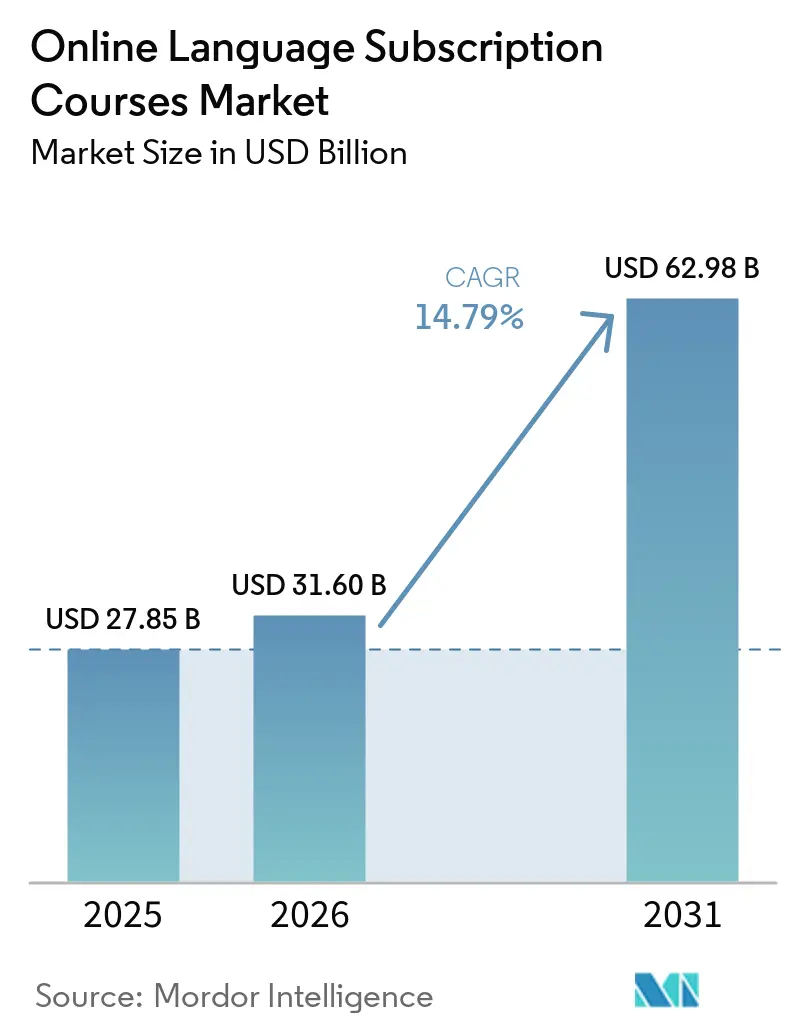
The global online language subscription courses market was valued at USD 27.85 billion in 2025 and estimated to grow from USD 31.60 billion in 2026 to reach USD 62.98 billion by 2031, at a CAGR of 14.79% during the forecast period (2026-2031). Growth is driven by stable corporate training budgets, expanded mobile internet access, and AI tools that reduce content creation costs. In 2025, Duolingo reported total revenue exceeding USD 1.04 billion, with subscription revenue at USD 873.4 million, a 44% year-over-year increase, indicating improved monetization across platforms[1]. The market is transitioning from a freemium-based model to a structure where free access increases reach, while enterprise contracts and AI-driven features enhance revenue. Enterprise demand is rising as buyers seek measurable outcomes, LMS integration, and connections between language skills, productivity, and workforce mobility. The market is shifting from broad consumer acquisition to structured monetization strategies, with AI investments and content scaling creating higher barriers for smaller entrants.
Key Report Takeaways
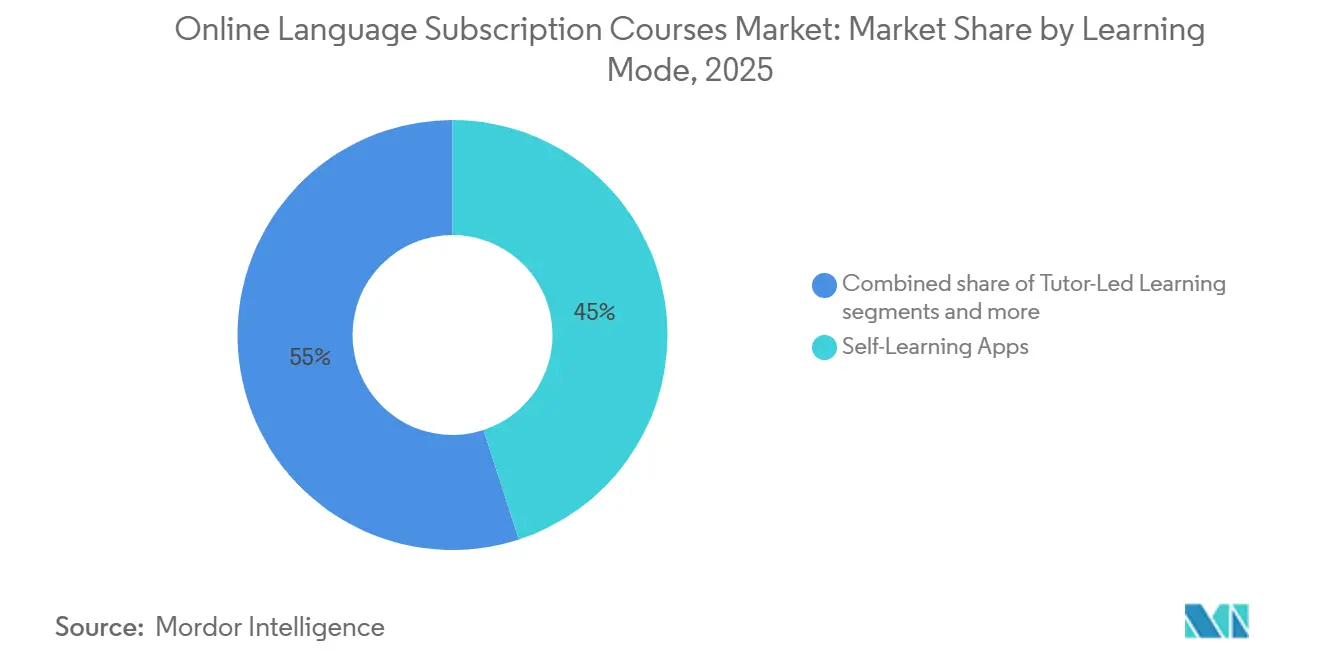
- By learning mode, self-learning apps held 45% of revenue in the Global Online Language Subscription Courses Market in 2025, while Enterprise AI-Assisted Learning Platforms are projected to expand at a 24.10% CAGR by 2031.
- By end user, individual learners accounted for 62% of revenue in the Global Online Language Subscription Courses Market in 2025, while corporate learners recorded the highest projected CAGR at 18.50% by 2031.
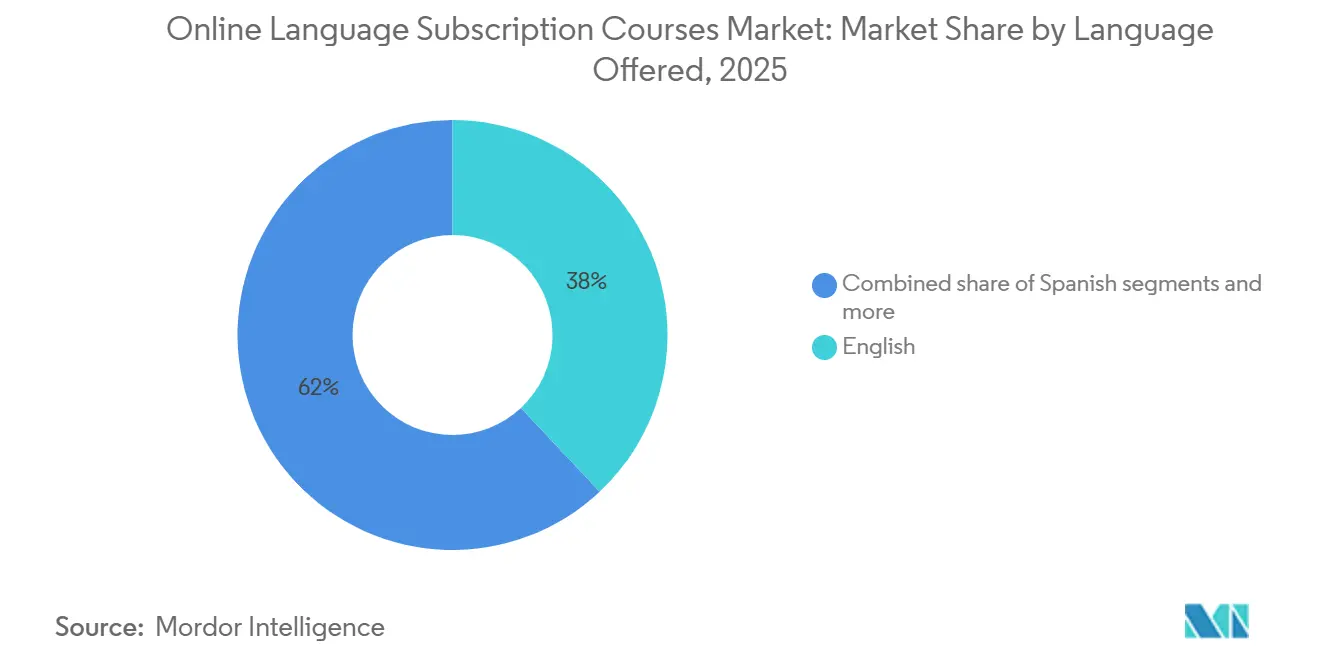
- By language offered, English accounted for 38% of revenue in the Global Online Language Subscription Courses Market in 2025, while Japanese is forecast to grow fastest at a 18.00% CAGR by 2031.
- By revenue model, subscription-based models represented 50% of revenue in the Global Online Language Subscription Courses Market in 2025, while enterprise licensing is projected to grow fastest at a 20.00% CAGR by 2031.
- By geography, Asia-Pacific held 31% of revenue in the Global Online Language Subscription Courses Market in 2025 and is also advancing at the fastest regional CAGR of 18.50% by 2031.
Note: Market size and forecast figures in this report are generated using Mordor Intelligence’s proprietary estimation framework, updated with the latest available data and insights as of January 2026.
Global Online Language Subscription Courses Market Trends and Insights
Drivers Impact Analysis*
| Driver | (~) % Impact on CAGR Forecast | Geographic Relevance | Impact Timeline |
|---|---|---|---|
| Corporate Upskilling for Cross-Border Workforces | +2.5% | Global, with concentration in North America, Europe, and Asia-Pacific enterprise hubs | Medium term (2-4 years) |
| AI-Powered Personalization And Interactive Learning Enhancement | +3.2% | Global, first-mover gains in North America, Europe, and advanced Asia-Pacific markets | Medium term (2-4 years) |
| Mobile-First Learning Adoption In Emerging Economies | +2.1% | Asia-Pacific core, especially India and Southeast Asia, with spillover to Africa and South America | Short term (≤ 2 years) |
| Increasing Demand For Measurable Language Proficiency In Hiring | +1.6% | Global, with regulatory influence led by the United States and Europe | Medium term (2-4 years) |
| Early Language Learning Adoption In Schools And Families | +1.0% | Asia-Pacific and Europe, with emerging activity in the Middle East and Africa | Long term (≥ 4 years) |
| Expansion Of Subscription-Based Digital Learning Ecosystems | +1.4% | Global, strongest in North America and Europe enterprise segments | Short term (≤ 2 years) to medium term (2-4 years) |
| Source: Mordor Intelligence | |||
Corporate Upskilling for Cross-Border Workforces
The global online language subscription courses market is experiencing a shift in enterprise purchasing behavior, with digital language training increasingly tied to business performance rather than discretionary employee learning. EF Corporate Learning reported that companies with high-maturity language programs achieved significantly higher net profit margins and AI implementation rates compared to low-maturity peers. This trend provides HR and L&D teams with stronger justification for structured language training deployments[2]. The delivery model is also evolving, as enterprises embed recurring language learning into broader talent management and workforce mobility systems rather than treating it as a standalone training program. EF Corporate Learning serves thousands of corporate clients, delivers thousands of online class hours daily, and supports millions of learners through its AI-powered Addi assistant, demonstrating the scale of corporate adoption. Similarly, Speexx has expanded its reach across numerous organizations and users, highlighting the rapid growth of enterprise-focused providers as online language learning becomes integral to multinational workforce programs.
AI-Powered Personalization and Interactive Learning Enhancement
Generative AI is driving rapid growth in the global online language subscription courses market by simplifying the creation, localization, and validation of course content. Duolingo demonstrated this shift by significantly reducing the time required to launch new language courses, transforming the economics of catalog expansion. This advancement allows platforms to offer a broader range of interface-language combinations, reducing development cycles and expanding their reach to both consumer and enterprise users. In enterprise applications, AI enhances spoken practice and fluency assessments. Speexx Talk, for example, incorporates pronunciation and fluency analysis to deliver consistent feedback for multinational learner groups. Additionally, goFLUENT’s integration into Microsoft Copilot highlights the market's evolution toward embedding language practice directly into workplace tools, making language learning more accessible and practical for employees in their daily workflows[3].
Mobile-First Learning Adoption In Emerging Economies
The online language subscription courses market is expanding in emerging economies due to increased accessibility through affordable smartphones and mobile data. These advancements have made language learning more accessible to individuals who previously lacked formal instruction opportunities. Data from Duolingo revealed significant growth in Indonesia, where mobile-first self-learning apps are becoming a common entry point into paid language courses in high-growth regions. In Japan, generative AI-powered English conversation apps have disrupted pricing by offering on-demand practice at lower costs compared to traditional schools. This shift highlights the combined impact of mobile technology and AI in reshaping demand for entry-level language learning. StudyPocket introduced a generative AI English conversation service for public school students, priced affordably to encourage adoption in the public sector. This mobile-first approach is driving growth in the global online language subscription courses market, particularly in regions where convenience, affordability, and short daily engagement are prioritized over traditional classroom structures.
Increasing Demand For Measurable Language Proficiency In Hiring
Employers are increasingly emphasizing verifiable language proficiency, driving growth in the global online language subscription courses market. Reports indicate that the rise of AI tools has increased demand for English proficiency, with many employers identifying it as critical to organizational success. A study published in the Journal of Human Resources found that language proficiency significantly improved the likelihood of receiving interview invitations, even for entry-level roles often filled by immigrants. In the United States, the Department of Labor issued guidance requiring English language proficiency standards for foreign labor certification applications in specific occupations, such as commercial motor vehicle operators. This has made language capability a compliance requirement in certain fields. Platforms offering CEFR-aligned pathways, certifications, assessments, and LMS-linked reporting are better positioned in the market than general-purpose apps, as they deliver measurable outcomes that meet both employer and regulatory demands.
Restraints Impact Analysis*
| Restraint | (~) % Impact on CAGR Forecast | Geographic Relevance | Impact Timeline |
|---|---|---|---|
| Low Course Completion Rates And Weak Learning Outcome Validation | -1.5% | Global, most acute in self-learning app formats and MOOC-adjacent models | Short term (≤ 2 years) to Medium term (2-4 years) |
| Price Sensitivity In Subscription-Based Learning Models | -1.0% | South America, Africa, and Southeast Asia, with moderate drag in Europe for individual learners | Short term (≤ 2 years) |
| Privacy And Data Security Concerns In Voice-Based Learning Platforms | -0.7% | Europe, with spillover to North America and Asia-Pacific enterprise segments | Medium term (2-4 years) |
| Strong Competition From Free And Immersive Alternative Learning Methods | -1.2% | Global, with the highest pressure in consumer segments across North America, Europe, and mobile-first Asia-Pacific markets | Short term (≤ 2 years) |
| Source: Mordor Intelligence | |||
Low Course Completion Rates And Weak Learning Outcome Validation
The global online language subscription courses market struggles with a persistent gap between enrollment and course completion, particularly in self-paced and MOOC-style formats. Research published by Springer Nature identified that only a small proportion of registrants completed general English MOOCs. Factors such as weak social accountability, poor goal alignment, and limited feedback were consistently associated with dropout rates. A longitudinal study in Behavioral Sciences examined Chinese elementary extracurricular English courses and found that dropout risks increased during chapter transitions compared to other points, indicating that course structure significantly impacts learner retention[4]. For subscription-based businesses, low completion rates reduce the perceived value of renewals, as users who fail to see progress are less likely to continue their subscriptions. The market faces a critical challenge in execution, where sustained growth relies not only on acquiring users but also on improving outcome validation and designing better progression systems to enhance learner engagement and retention.
Price Sensitivity In Subscription-Based Learning Models
The global online language subscription courses market is under pricing pressure in regions where consumers are less willing to pay compared to developed markets. AI-driven English conversation apps in Japan have emerged as cost-effective alternatives to traditional language schools, as reported in 2025. This shift highlights how quickly price expectations adjust when technology reduces delivery costs. StudyPocket’s pricing for public schools and the offerings from DMM and abceed reflect a market increasingly shaped by affordable access, influencing user expectations beyond institutional clients. Individual learners, often facing weak accountability and numerous low-cost or free substitutes, are particularly affected by this trend. Without clear evidence of better outcomes, providers in this market are likely to encounter challenges in converting and retaining users in price-sensitive segments.
*Our forecasts treat driver/restraint impacts as directional, not additive. The impact forecasts reflect baseline growth, mix effects, and variable interactions.
Segment Analysis
By Learning Mode: Enterprise AI Platforms Redefine Subscription Value
Self-learning apps accounted for 45% of revenue in 2025, maintaining their position as the largest learning mode in the global online language subscription courses market. Their popularity stems from accessibility, low commitment, and daily engagement mechanics that encourage repeated use. Duolingo reported 52.7 million daily active users by the end of 2025, a 30% year-over-year increase, demonstrating how habit-forming design drives scale. Self-learning platforms remain the primary entry point due to their ease of use, mobile-first design, and ability to convert free-tier users into paid subscribers over time.
Enterprise AI-assisted learning platforms are projected to grow at a 24.10% CAGR through 2031, making them the fastest-growing segment in the global online language subscription courses market. This growth is driven by multinational employers seeking measurable outcomes, LMS integration, and seamless alignment with work tools. Integrations such as goFLUENT’s Microsoft Copilot and Speexx’s SAP SuccessFactors highlight the focus on workflow and HR system compatibility. Tutor-led and blended models continue to serve learners needing structure and accountability. Preply’s USD 150 million funding round in January 2026 reflects ongoing investor interest in human-led, AI-enhanced tutoring. The market shows a balance where consumer-driven platforms remain significant, while enterprise AI platforms gain traction for higher-value contracts.

By End User: Corporate Learners Scale Fastest as ROI Proof Points Strengthen
Individual learners accounted for 62% of 2025 revenue, reflecting the consumer-focused history of the global online language subscription market. This segment addresses a range of needs, from freemium mobile learning in emerging markets to live tutoring for urban professionals. Duolingo reported 133.1 million monthly active users and 12.2 million paid subscribers in 2025, indicating a 9.2% paid conversion rate and demonstrating the scale required to convert large learner bases into subscription revenue. Individual learners dominate the market as self-study remains the most accessible entry point for language learning. Government and non-profit users also contribute to areas where public contracts or social access initiatives drive high learner volumes.
Corporate learners are projected to grow at an 18.50% CAGR through 2031, making them the fastest-growing end-user segment in the global online language subscription courses market. This growth is driven by productivity, mobility, and workforce retention needs rather than personal enrichment. Official Data reported that 83% of employers experienced productivity and retention challenges due to insufficient English skills among hires, supporting enterprise investment in structured programs. Educational institutions are also increasing their use of subscription platforms with LMS-ready delivery. The March 2026 partnership between Efekta and ECC in Japan highlighted the adoption of AI-driven subscription learning in institutional channels. The market is shifting toward longer contracts and measurable outcomes, gradually increasing the revenue share of corporate and institutional buyers.
By Language Offered: Japanese Fastest Growing as Asian Language Demand Broadens
English accounted for 38% of 2025 revenue, maintaining its position as the largest language category in the global online language subscription courses market. Duolingo's 2025 report identified English as the most studied language in 154 countries, an increase from the previous year, reflecting its growing global demand. Its appeal stems from its association with employability, migration, and business communication, transcending regional or cultural boundaries. Mandarin Chinese, Spanish, French, and German also hold significant market shares, addressing immigration, professional, educational, and cultural needs across regions. This language portfolio ensures English leads in scale, while other languages meet specialized demand.
Japanese is projected to grow at an 18.00% CAGR through 2031, making it the fastest-growing segment in the global online language subscription courses market. Duolingo's 2025 data showed Japan leading in polyglot learners and average learning time per user, indicating strong engagement. Rising demand for Japanese, Korean, and Mandarin prompted Duolingo's AI-powered course expansion in April 2025, signaling a shift toward Asian languages. Certifications, such as the Japanese Language Proficiency Test, are increasingly used as formal credentials by employers in parts of Asia, driving structured learning. Other languages, including Korean, Arabic, Hindi, Portuguese, and heritage languages, are gaining traction due to diaspora demand, public initiatives, and cultural interest, broadening the market beyond dominant categories.
By Revenue Model: Enterprise Licensing Outpaces Its Freemium and Subscription Peers
Subscription-based models accounted for 50% of 2025 revenue, making them the largest contributor to the global online language subscription courses market. This dominance reflects reliance on direct-to-consumer app subscriptions, which are driven by recurring monthly or annual payments. Duolingo’s 2025 results illustrate this, with subscription revenue reaching USD 873.4 million out of total revenue of over USD 1.04 billion. Freemium models aid user acquisition and widen the funnel but generate less revenue than paid tiers. Pay-per-course models remain relevant for exam preparation and one-time learning goals but are limited by single-purchase economics.
Enterprise licensing is projected to grow at a 20.00% CAGR through 2031, making it the fastest-growing revenue model in the global online language subscription courses market. Enterprises are shifting from seat-based purchases to contracts focused on proficiency gains, reporting quality, and system integration. Speexx’s focus on GDPR, CCPA, ISO, TISAX, and SAP SuccessFactors integration reflects the procurement standards enterprise buyers now demand. Providers are also incorporating AI features and subscription layers into earlier course or tutoring formats, increasing the appeal of recurring enterprise revenue. This shift in revenue models represents a structural change toward contracts that emphasizes measurability, interoperability, and durability over consumer-only subscriptions.
Geography Analysis
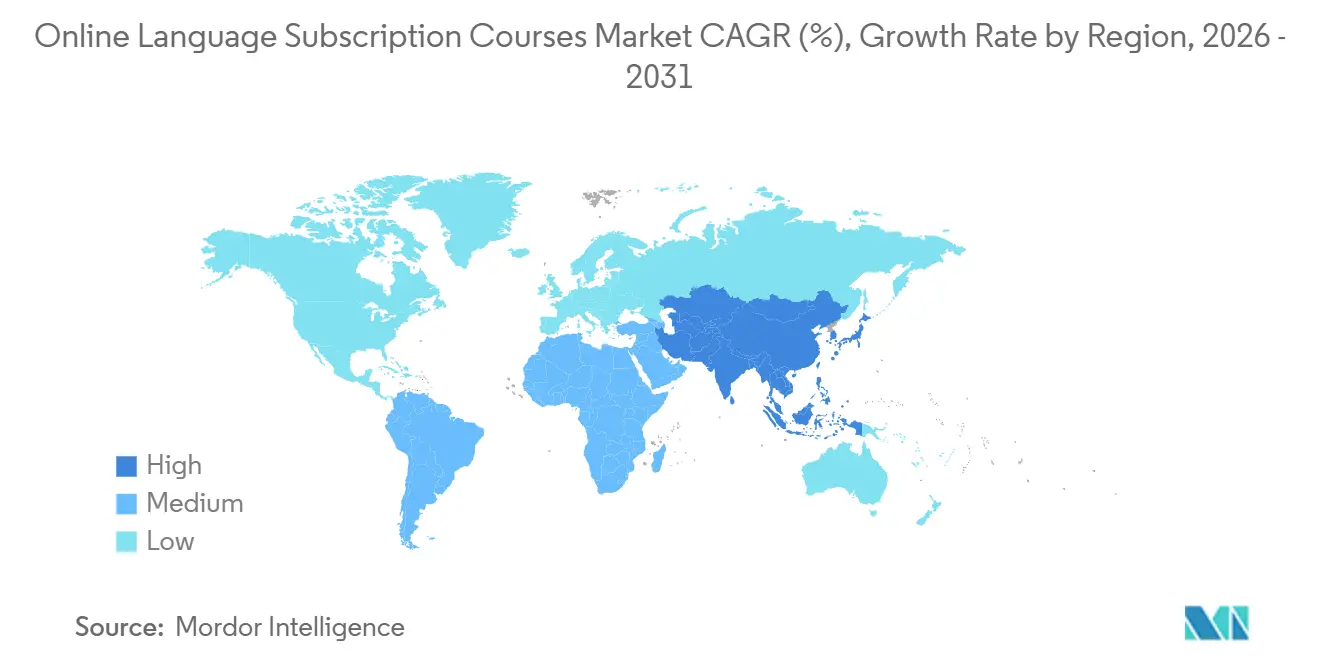
Asia-Pacific accounted for 31% of the global online language subscription courses market in 2025 and is projected to grow at a 18.50% CAGR through 2031. This growth is driven by affordable mobile data, high demand for English learning, supportive digital education policies, and increased adoption of app-based learning. Duolingo reported millions of monthly active users in India, making it the company’s fifth-largest market by user base, while China became its second-largest market by daily active users in 2025. Indonesia recorded 3.5 million downloads in the first half of 2024. South Korea’s AI-based Korean-learning platform and Australia’s funding for Asian-language education further support market expansion.
North America is forecast to grow at 12.5% CAGR, reflecting steady market growth. Enterprise licensing, immigration-related demand, and established consumer subscriptions drive monetization. Duolingo’s FY2025 data showed 62% of its revenue came from the Apple App Store. The United States Department of Labor’s May 2026 English proficiency guidance for foreign labor certifications supports enterprise demand. Europe, growing at 13.4%, combines corporate demand in Western markets with rising individual learners in Central and Eastern Europe, though voice data compliance may slow AI product adoption.
South America, with a 15.8% forecasted growth, is expanding due to localized payment systems and scalable contracts in Brazil and Colombia. In February 2026, dLocal and Open English expanded instant payments to over 11 countries. The Middle East and Africa, growing at 16.6% and 17.2% respectively, benefit from smartphone adoption, younger demographics, and government-backed initiatives. These regions, though smaller in revenue, are gaining relevance as digital delivery reduces access barriers.
Competitive Landscape
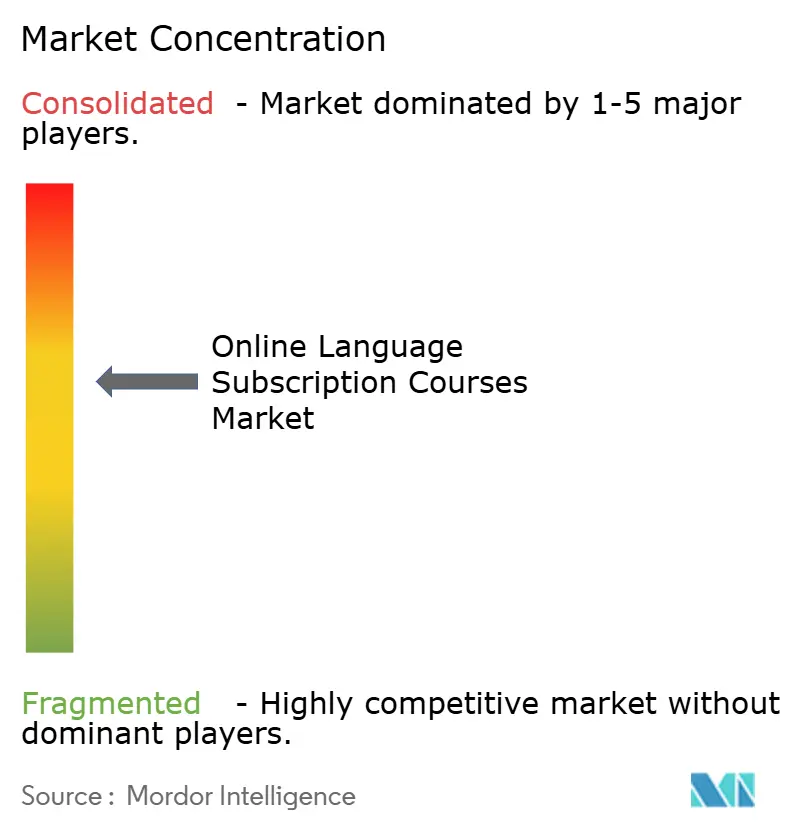
The global online language subscription courses market is moderately fragmented, with key players such as Duolingo, Babbel, Busuu, Rosetta Stone, and Preply accounting for a significant share of revenue. Duolingo maintains a strong presence with millions of active users, substantial revenue, and an expanding course catalog driven by AI-enabled production. Its competitive edge stems from gamified retention, rapid product updates, and the ability to scale both free and paid tiers. Babbel and Busuu focus on structured learning paths, CEFR alignment, and guided practice. Babbel’s launch of Babbel Speak highlights the use of AI voice tools to enhance user engagement and retention.
In the enterprise segment, competition shifts as buyers prioritize measurable outcomes, interoperability, and compliance readiness over gamification. Companies such as Speexx, EF Corporate Learning, goFLUENT, and Voxy compete on LMS integration, certification, and reporting capabilities. goFLUENT’s integration with Microsoft Copilot demonstrates the trend of embedding language learning into productivity workflows. Preply differentiates itself by combining human tutors with AI and data tools to improve discovery, support, and platform efficiency, a strategy that has attracted significant investment.
Large technology platforms pose challenges by offering free learning features or bundling them into widely used products. Google’s AI-powered updates to Google Translate exemplify how distribution at scale can shift user expectations regarding language learning costs. Subscription providers are increasingly focusing on verified outcomes, enterprise integration, and high-quality speaking feedback to stand out. AI investments are raising entry barriers, allowing larger firms to distribute costs across broader user bases. While opportunities remain for specialized providers, platforms that combine scale, trust, measurable outcomes, and integration are gaining an advantage in the competitive landscape.
Online Language Subscription Courses Industry Leaders
-
Duolingo, Inc.
-
Babbel GmbH
-
Busuu Ltd.
-
Rosetta Stone LLC.
-
Preply Inc.
- *Disclaimer: Major Players sorted in no particular order
Recent Industry Developments
- April 2026: goFLUENT introduced an AI-powered language learning integration with Microsoft Copilot, enabling real-time language practice within Microsoft 365 tools. The integration requires no custom IT development, establishing goFLUENT as the first embedded AI language learning system in Microsoft's enterprise ecosystem and driving adoption among Copilot-licensed organizations.
- April 2026: Babbel introduced its Group Plan, allowing up to six users to share one account with access to 14 languages and over 60,000 lessons. Each user maintains an independent learning path, and the plan includes Babbel Speak for all members.
- January 2026: Preply raised USD 150 million in a Series D round led by WestCap, reaching a USD 1.2 billion valuation. Total funding now stands at USD 299 million. The company plans to hire 100 engineers, enhance AI and data capabilities, and expand into South America.
- February 2026: Open English and dLocal launched Bre-B instant payments in Colombia, expanding their two-year partnership to over 11 countries, including Brazil, Argentina, Mexico, Chile, Peru, and Turkey. This initiative aims to reduce payment friction for subscription enrollments in emerging South American markets.
Global Online Language Subscription Courses Market Report Scope
| Self-Learning Apps |
| Tutor-Led Learning |
| Blended Learning |
| Enterprise AI-Assisted Learning Platforms |
| Individual Learners |
| Corporate Learners |
| Educational Institutions |
| Government and Non-Profit Bodies |
| English |
| Mandarin Chinese |
| Spanish |
| French |
| German |
| Japanese |
| Other Languages |
| Subscription-Based |
| Freemium |
| Pay-Per-Course |
| Enterprise Licensing |
| North America | United States |
| Canada | |
| Mexico | |
| South America | Brazil |
| Peru | |
| Chile | |
| Argentina | |
| Rest of South America | |
| Europe | United Kingdom |
| Germany | |
| France | |
| Spain | |
| Italy | |
| BENELUX (Belgium, Netherlands, and Luxembourg) | |
| NORDICS (Denmark, Finland, Iceland, Norway, and Sweden) | |
| Rest of Europe | |
| Asia-Pacific | India |
| China | |
| Japan | |
| Australia | |
| South Korea | |
| South East Asia (Singapore, Malaysia, Thailand, Indonesia, Vietnam, and Philippines) | |
| Rest of Asia-Pacific | |
| Middle East and Africa | United Arab Emirates |
| Saudi Arabia | |
| South Africa | |
| Nigeria | |
| Rest of Middle East and Africa |
| By Learning Mode | Self-Learning Apps | |
| Tutor-Led Learning | ||
| Blended Learning | ||
| Enterprise AI-Assisted Learning Platforms | ||
| By End User | Individual Learners | |
| Corporate Learners | ||
| Educational Institutions | ||
| Government and Non-Profit Bodies | ||
| By Language Offered | English | |
| Mandarin Chinese | ||
| Spanish | ||
| French | ||
| German | ||
| Japanese | ||
| Other Languages | ||
| By Revenue Model | Subscription-Based | |
| Freemium | ||
| Pay-Per-Course | ||
| Enterprise Licensing | ||
| By Geography | North America | United States |
| Canada | ||
| Mexico | ||
| South America | Brazil | |
| Peru | ||
| Chile | ||
| Argentina | ||
| Rest of South America | ||
| Europe | United Kingdom | |
| Germany | ||
| France | ||
| Spain | ||
| Italy | ||
| BENELUX (Belgium, Netherlands, and Luxembourg) | ||
| NORDICS (Denmark, Finland, Iceland, Norway, and Sweden) | ||
| Rest of Europe | ||
| Asia-Pacific | India | |
| China | ||
| Japan | ||
| Australia | ||
| South Korea | ||
| South East Asia (Singapore, Malaysia, Thailand, Indonesia, Vietnam, and Philippines) | ||
| Rest of Asia-Pacific | ||
| Middle East and Africa | United Arab Emirates | |
| Saudi Arabia | ||
| South Africa | ||
| Nigeria | ||
| Rest of Middle East and Africa | ||
Key Questions Answered in the Report
What is the 2031 outlook for online language subscription courses worldwide?
The global online language subscription courses market is forecast to reach USD 62.98 billion by 2031 from USD 31.60 billion in 2026, growing at a 14.79% CAGR over 2026-2031.
Which learning mode leads revenue and which one grows fastest?
Self-learning apps led with 45% of revenue in 2025, while Enterprise AI-Assisted Learning Platforms are projected to grow fastest at a 24.10% CAGR through 2031.
Why are corporate buyers spending more on language platforms?
Employers increasingly tie language skills to productivity, hiring, and cross-border workforce readiness. Official data in the supplied draft show stronger ROI and rising business need for measurable proficiency.
Which user group is expanding fastest?
Corporate learners are the fastest-growing end-user segment, with an 18.50% CAGR through 2031, even though individual learners still held 62% of revenue in 2025.
Which languages are driving demand beyond English?
English remains the largest category with 38% of 2025 revenue, while Japanese is growing fastest at an 18% CAGR, supported by cultural demand and formal credential value.
Which region offers the strongest growth opportunity?
Asia-Pacific offers the strongest combination of scale and growth, with 31% of 2025 revenue and an 18.50% CAGR through 2031, supported by mobile-first adoption and public digital education initiatives.