
Oil and Gas Analytics Market Size and Share
Market Overview
| Study Period | 2022 - 2032 |
|---|---|
| Market Size (2027) | USD 3.78 Billion |
| Market Size (2032) | USD 8.41 Billion |
| Growth Rate (2027 - 2032) | 17.36 % |
| Fastest Growing Market | Asia-Pacific |
| Largest Market | North America |
| Market Concentration | Medium |
Major Players *Disclaimer: Major Players sorted in no particular order Image © Mordor Intelligence. Reuse requires attribution under CC BY 4.0. | |
Oil and Gas Analytics Market Analysis by Mordor Intelligence
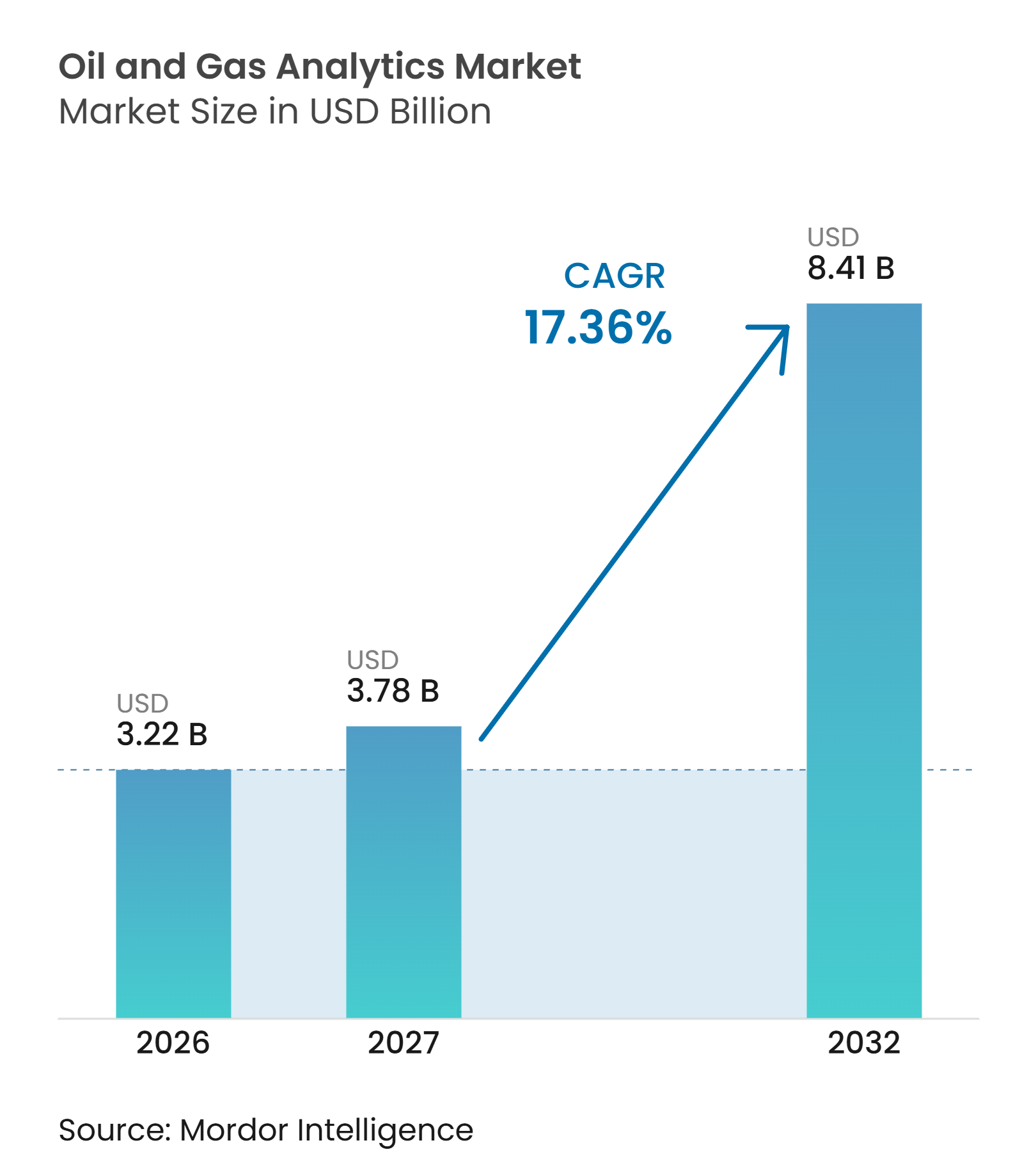
The oil and gas analytics market size was valued at USD 3.22 billion in 2026 and is estimated to grow from USD 3.78 billion in 2027 to reach USD 8.41 billion by 2032, at a CAGR of 17.36% during the forecast period (2027-2032). The market is expanding beyond reporting functions into daily decisions on well performance, emissions measurement, and asset reliability. Operators are directing more spending toward platforms that connect engineering records, production data, and field equipment signals. The strongest opportunities favor providers that combine energy domain knowledge with open data architectures and practical deployment support. Growth also depends on operators' ability to integrate older operational systems without exposing field networks to new cyber risks. As a result, procurement is increasingly shaped by interoperability, secure deployment, and measurable operating outcomes rather than analytics features alone.
Key Report Takeaways
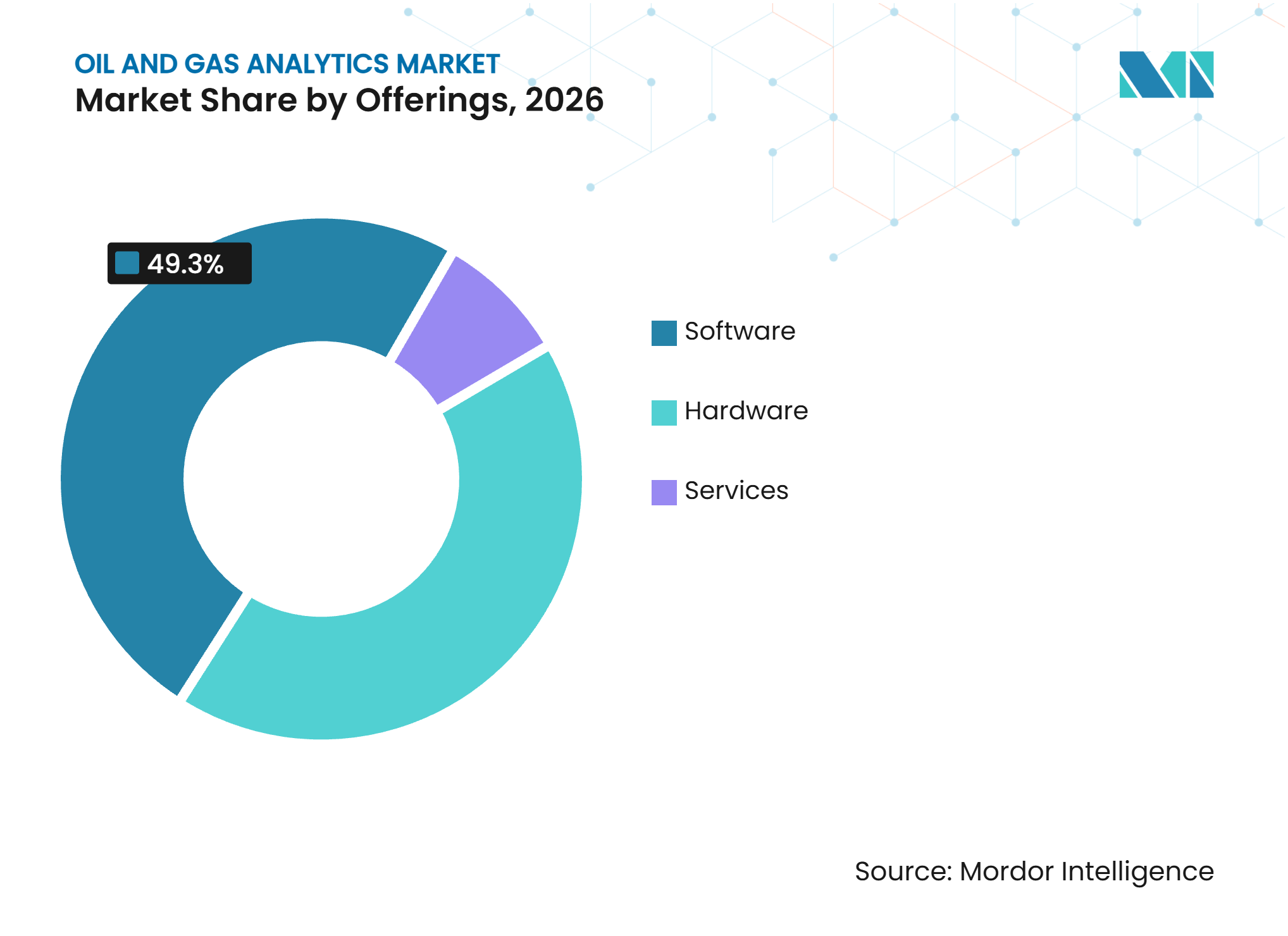
- By offering, software held 49.3% of revenue in 2026, while services are expected to record the highest forecast CAGR at 17.9% through 2032.
- By deployment, cloud-based systems held 58.4% of revenue in 2026 and are expected to record the highest forecast CAGR at 19.3% through 2032.
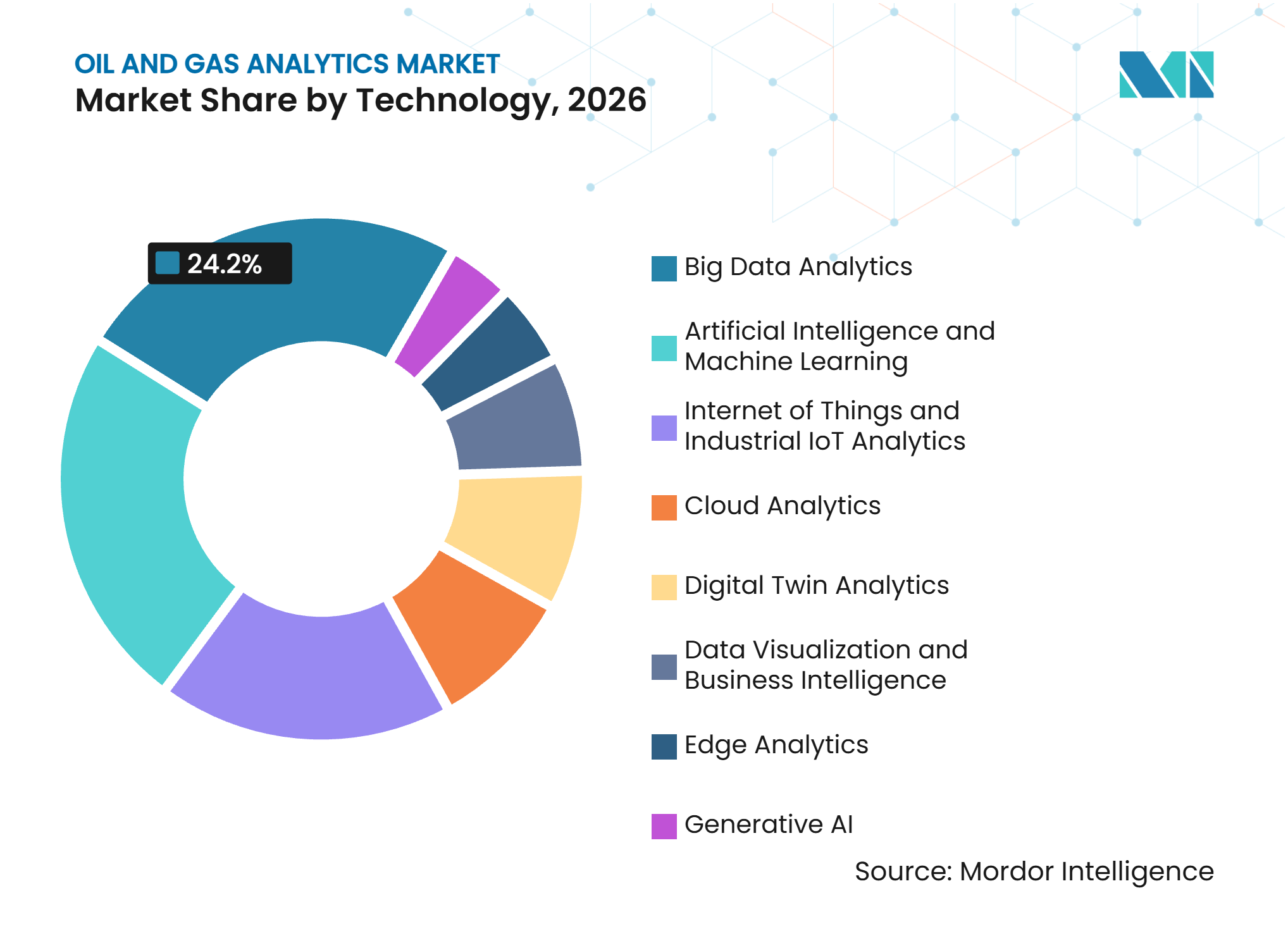
- By technology, big data analytics held 24.2% of revenue in 2026, while generative AI is expected to record the highest forecast CAGR at 21.4% through 2032.
- By application, upstream operations held 47.1% of revenue in 2026, while downstream analytics is expected to record the highest forecast CAGR at 17.6% through 2032.
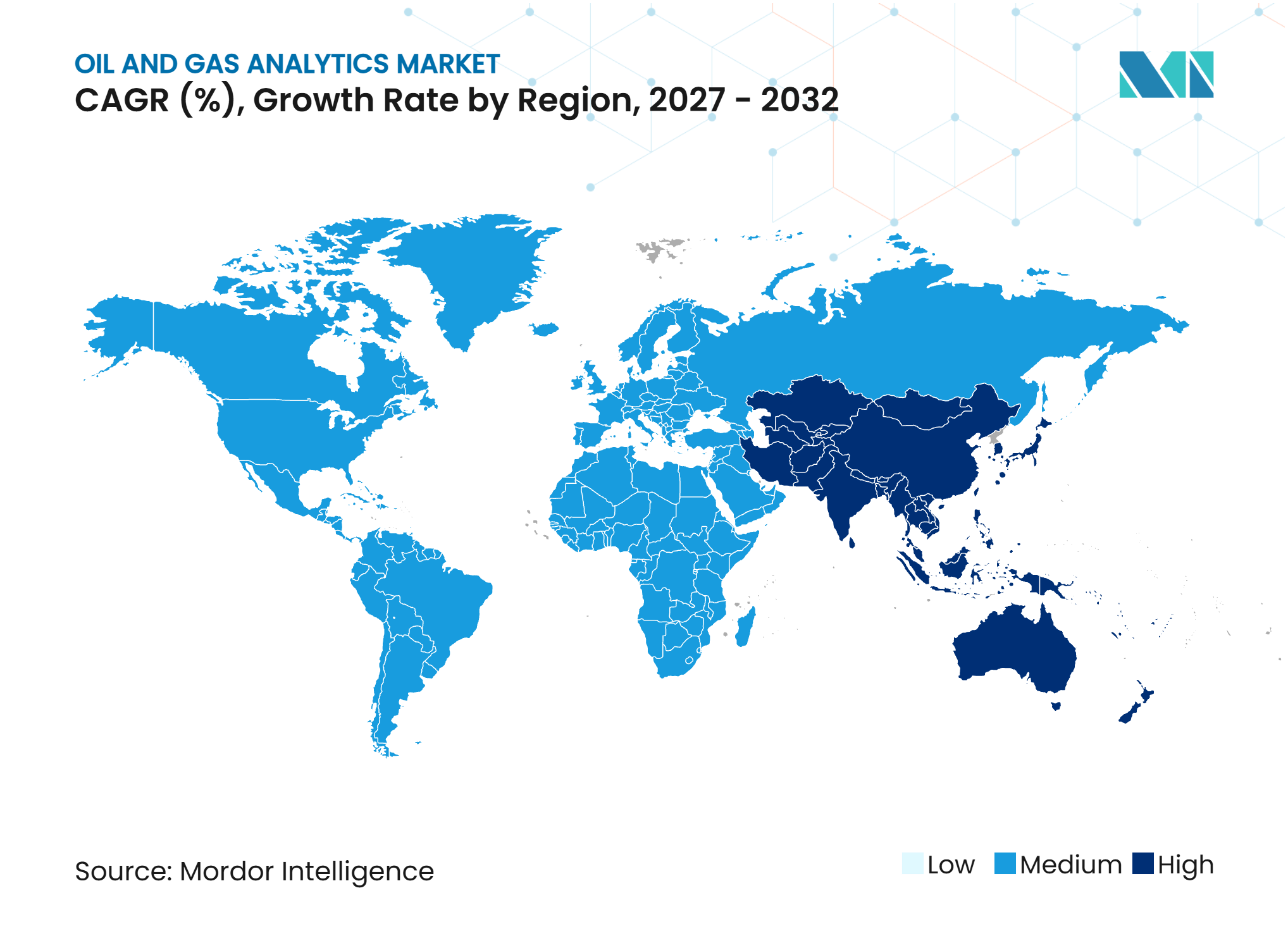
- By geography, North America held 37.9% of revenue in 2026, while Asia-Pacific is expected to record the highest forecast CAGR at 19.5% through 2032.
Note: Market numbers in this report are based on Mordor Intelligence's proprietary estimation framework, which combines nine months of actuals with Q4 projections for base year 2026.
Market Trends and Insights
Drivers Impact Analysis of Oil and Gas Analytics Market*
| Driver | (~) % Impact on CAGR Forecast | Geographic Relevance | Impact Timeline |
|---|---|---|---|
| AI-Enabled Operational Optimization | +5.2% | Global, concentrated in North America and the Middle East | Short term (≤ 2 years) |
| Cloud and Edge Analytics Adoption | +4.1% | Global, led by North America with rapid uptake in Asia-Pacific | Short term (≤ 2 years) |
| Predictive Maintenance for Aging and Remote Assets | +3.5% | North America, Europe, Middle East and Africa | Medium term (2-4 years) |
| Emissions Measurement and Methane Management Analytics | +2.3% | North America and the European Union, with spillover to Middle East and Africa and Asia-Pacific | Medium term (2-4 years) |
| Upstream Recovery Optimization in Mature and Unconventional Fields | +2.0% | North America, Asia-Pacific, and South America | Long term (≥ 4 years) |
| Data Interoperability for Cross-Value-Chain Decisions | +1.8% | Global, concentrated in Asia-Pacific and North America | Medium term (2-4 years) |
| Source: Mordor Intelligence | |||
AI-Enabled Operational Optimization
AI is becoming increasingly important in drilling optimization and production management, enabling field teams to adjust decisions quickly using current operating data. These systems can modify drilling parameters and production rates in real time, supporting the oil and gas analytics market. Saudi Aramco reported USD 5.3 billion in technology realized value for 2025, including USD 2.6 billion attributed to AI across nearly 500 use cases in upstream, midstream, and refining activities.[1] This demonstrates that analytics programs can support a broad operating model when integrated with field and plant workflows. Providers therefore need implementation teams that understand production constraints, safety controls, and maintenance practices. This requirement favors platforms that support recurring model updates and sustained use over isolated pilot projects.
Cloud and Edge Analytics Adoption
Cloud deployment is moving beyond basic data migration toward systems built for seismic processing, reservoir simulation, and production analysis. The Open Group states that the OSDU Data Platform has support from more than 200 energy companies, helping establish common approaches to managing subsurface information. This common framework can reduce integration work when operators use data from multiple vendors and operating environments. At the same time, edge computing keeps time-sensitive decisions close to wells, facilities, and offshore equipment. Schlumberger Limited and Qualcomm Technologies signed a memorandum of understanding in June 2026 to develop edge AI solutions using Schlumberger Limited's Agora IoT platform and Qualcomm Technologies' low-power computing capabilities. The oil and gas analytics market therefore requires both cloud capacity for large workloads and local processing for actions that cannot wait for a remote connection.
Predictive Maintenance for Aging and Remote Assets
Older pumps, compressors, and offshore equipment create recurring maintenance risks across production and transport operations. Analytics can shift maintenance from reactive responses to equipment failures toward planned interventions based on condition signals. A peer-reviewed 2026 study presented a physics-informed model for electrical submersible pump failure prediction using more than 58,000 multivariate time-series samples. Such methods are relevant because safety-critical equipment requires models that can operate alongside engineering and process safety requirements. The oil and gas analytics market also benefits from operators seeking better availability from existing assets without equivalent capital spending on replacements. This need is most pronounced where assets are remote, workforce access is limited, or downtime affects a large portion of a facility's output.
Emissions Measurement and Methane-Management Analytics
Methane (CH4) measurement is becoming an operating requirement rather than a separate environmental reporting activity. The International Energy Agency found that measured global CH4 emissions were 80% higher than national inventories reported, indicating a significant gap between reported and observed emissions.[2] This gap increases the value of systems that identify leaks, trace likely sources, and produce consistent records for company and regulatory reporting.[3] The United Nations Environment Programme reported that data-based CH4 solutions are available but require faster action by governments and companies. The oil and gas analytics market can benefit from this need, as CH4 tools use the same data integration, visualization, and alerting capabilities applied in production operations. Demand is likely to remain durable where operators must demonstrate credible measurement and response practices.
Restraints Impact Analysis of Oil and Gas Analytics Market*
| Restraint | (~) % Impact on CAGR Forecast | Geographic Relevance | Impact Timeline |
|---|---|---|---|
| Legacy OT and Enterprise-System Integration Complexity | -2.8% | Global, most acute in Middle East and Africa and South America legacy assets | Long term (≥ 4 years) |
| Cybersecurity and Operational-Technology Exposure | -2.4% | Global, concentrated in North America and Europe | Medium term (2-4 years) |
| Fragmented, Biased, and Nonstandardized Industrial Data | -1.9% | Global | Long term (≥ 4 years) |
| Scarcity of Domain-Fluent Data-Science Talent | -1.5% | Global, most acute in Asia-Pacific and Middle East and Africa | Medium term (2-4 years) |
| Source: Mordor Intelligence | |||
Legacy OT and Enterprise-System Integration Complexity
Many producing assets still operate with separate control systems, data historians, and equipment protocols that were not designed for cloud connectivity. These conditions can add 12 to 24 months to deployment timelines in brownfield environments. ExxonMobil Corporation has described siloed systems that are costly to integrate, customized, and complex, while pursuing open process automation standards to avoid repeated control-system replacement cycles. The oil and gas analytics market faces slower adoption when operators must replace field hardware before they can connect data sources. Middleware that translates older protocols can reduce this barrier without requiring a complete operational technology replacement. This approach remains particularly relevant in pipeline systems, mature fields, and facilities with equipment installed across several decades.
Cybersecurity and Operational-Technology Exposure
Connecting operational technology to enterprise applications can expand the attack surface around oil and gas facilities. The United States Cybersecurity and Infrastructure Security Agency issued a 2026 advisory on active threats to Siemens S7 series programmable logic controllers, highlighting the need to protect industrial controls. Cybersecurity reviews, segmentation design, and access controls can delay the rollout of systems that require real-time field data. The oil and gas analytics market therefore depends on vendors demonstrating that their deployment methods meet operational security requirements. Operators also need assurance that a platform will not interrupt production or expose alarm and configuration data. Security capability is becoming a selection requirement rather than a consideration addressed after implementation.
*Our forecasts treat driver/restraint impacts as directional, not additive. The impact forecasts reflect baseline growth, mix effects, and variable interactions.
Oil and Gas Analytics Market Segment Analysis
By Offering:
Software Anchors Revenue as Services Build Recurring ValueSoftware held 49.3% of the oil and gas analytics market share in 2026, reflecting its role as the primary layer for seismic interpretation, production optimization, and methane measurement. Subscription models align software spending with operating budgets rather than one-time capital approvals. Platforms are increasingly expected to combine data preparation, visual analysis, forecasting, and workflow support within a single operating environment. Software providers must also demonstrate that their products fit the daily work of geoscientists, production engineers, maintenance teams, and emissions staff. This requirement makes domain-specific design more important than generic dashboards and pushes vendors to connect their applications with existing asset data systems.
Hardware remains necessary for sensors, edge gateways, and rugged computing at wells, pipelines, and offshore installations. However, its role is largely supportive as cloud architectures reduce the need for large on-site data infrastructure. Services recorded the highest forecast CAGR at 17.9% through 2032, as many operators require assistance with system integration, model retraining, and operational change. EY reported in 2025 that 50% of oil and gas and chemicals companies used digital twins to manage assets, while 92% were implementing or planning new applications. That level of activity creates ongoing work for providers that can configure tools and support users after implementation. The oil and gas analytics market is therefore likely to reward companies that combine software products with credible managed and professional services.



By Deployment:
Cloud Commands Scale as Edge Extends the Operational FrontierCloud-based systems held 58.4% of the oil and gas analytics market share in 2026 and are forecast to grow at a 19.3% CAGR through 2032. Cloud platforms offer the computing scale needed for reservoir models, seismic processing, and large historical production datasets. They also allow specialists in different locations to work with common data and models. The Open Group's OSDU framework supports a more consistent approach to subsurface data exchange across energy companies. This can reduce concerns over vendor lock-in and make it easier to move workloads between compatible environments. The oil and gas analytics market has a clear reason to favor cloud systems where data access, storage scale, and collaboration are the primary needs.
On-premises deployment remains relevant in locations where data sovereignty rules limit the use of public cloud services. Hybrid systems are practical when sensitive operational technology data stays on site while AI training and batch workloads run in cloud environments. Edge computing extends this model by processing information close to equipment where connectivity is limited or response time is critical. Schlumberger Limited's June 2026 agreement with Qualcomm Incorporated focuses on edge AI for wells, facilities, and production systems. This approach supports artificial lift and flow assurance decisions that cannot wait for a cloud round trip. Deployment choices will continue to depend on data controls, connection quality, field conditions, and the speed required for each operating decision.
By Technology:
Big Data Leads but Generative AI Redraws the FrontierBig data analytics held 24.2% of revenue in 2026, supported by years of investment in supervisory control systems, data historians, and seismic data repositories. These systems give operators a large base of production, equipment, and subsurface information to analyze. The largest value comes when data is reliable enough to support a specific engineering or operating decision. Big data tools also remain essential for preparing information before it is used by more advanced models. This foundation helps explain why established data environments remain important across the oil and gas analytics market and why data quality and access determine the value of newer AI tools.
Generative AI is forecast to grow at a 21.4% CAGR through 2032, the fastest rate among the technology categories. Applications include well completion reporting, maintenance-record search, and interpretation of large volumes of engineering material. China National Petroleum Corporation reported in 2025 that its Kunlun model had reached 300 billion parameters and was used in 152 application scenarios across exploration, drilling, and refinery operations. BP p.l.c. has also described the use of its PlantPulse assistant to review maintenance records and identify underperforming assets in Gulf of America operations. Digital twins and industrial IoT analytics are developing alongside generative AI, as both rely on connected asset data. The practical advantage will go to systems that provide engineers with traceable and usable results rather than broad text responses.

By Application:
Upstream Commands Share as Downstream AcceleratesUpstream operations accounted for 47.1% of revenue in 2026, making them the leading application segment in the oil and gas analytics market. Exploration, drilling, reservoir management, and artificial lift create direct links between better decisions and production outcomes. This connection has supported long-standing investment in analytics for upstream workflows. Operators use these tools to interpret subsurface information, manage drilling parameters, monitor wells, and plan interventions. Upstream operations also generate high data volumes from equipment, wells, and geological studies, creating a broad base for analytics use when data systems are connected and reliable.
Midstream applications combine pipeline monitoring, flow analysis, integrity management, and cybersecurity awareness. These systems need to support operational efficiency while helping teams identify potential risks in control networks. Downstream analytics is forecast to grow at a 17.6% CAGR through 2032, supported by refinery optimization needs. Emerson Electric Co. and Saudi Aramco completed a multi-site deployment of Aspen Hybrid Model-based AI for refinery planning in April 2026. The oil and gas analytics market has growing downstream potential, as a common data environment can improve maintenance planning, process control, feed management, and operating margins. Refiners are likely to prioritize applications that can demonstrate value without compromising process safety or plant reliability.
Geography Analysis
North America held 37.9% of revenue in 2026, supported by dense unconventional activity, established digital service providers, and widespread use of data in drilling and production workflows. The region remains the largest oil and gas analytics market, as operators have strong incentives to improve capital efficiency and operating performance. The Permian and Marcellus basins provide demanding use cases for production optimization, equipment monitoring, and subsurface interpretation. Schlumberger Limited entered an agreement in April 2026 to acquire S&P Global Energy's geoscience and petroleum engineering software portfolio, expanding its upstream software capabilities. Canada's oil sands and Mexico's upstream activity also represent nearby demand areas with room for additional analytics use. Pipeline cybersecurity directives and public security advisories further increase attention to secure field data management.
Europe combines advanced offshore digital systems in the North Sea with compliance-driven adoption across continental operations. Siemens Energy AG and Aker BP ASA have worked on integrated automation and digital systems for the Yggdrasil field, allowing teams to test scenarios before operational changes are made. This approach can reduce operational uncertainty and help extend asset life. European refinery and production operators also face closer scrutiny on methane (CH4) measurement and reporting. The European position in platform development is reinforced by Cognite AS's links to industrial data projects at Aker BP ASA, Abu Dhabi National Oil Company, and Schlumberger Limited. Russia is developing domestic data and analytics capabilities where restricted access to Western platforms limits available options.
Asia-Pacific is forecast to grow at a 19.5% CAGR through 2032, the highest regional rate in the oil and gas analytics market. National oil companies in Malaysia, China, and Indonesia are using digital programs to improve production planning and asset performance. Petroliam Nasional Berhad signed its third joint development agreement with International Business Machines Corporation and Tridiagonal Solutions Inc. in July 2026 to advance TriCipta AI for upstream production optimization and maintenance.[4] South America offers data-intensive opportunities in unconventional and deepwater operations, particularly where reservoir monitoring and flow assurance can support high-value assets. Middle East national oil companies are also major buyers of analytics systems, while infrastructure limitations restrict cloud adoption in parts of Sub-Saharan Africa. The regional pattern favors providers that can adapt to national data rules, local operating models, and varying levels of digital infrastructure.
Competitive Landscape
Market Concentration
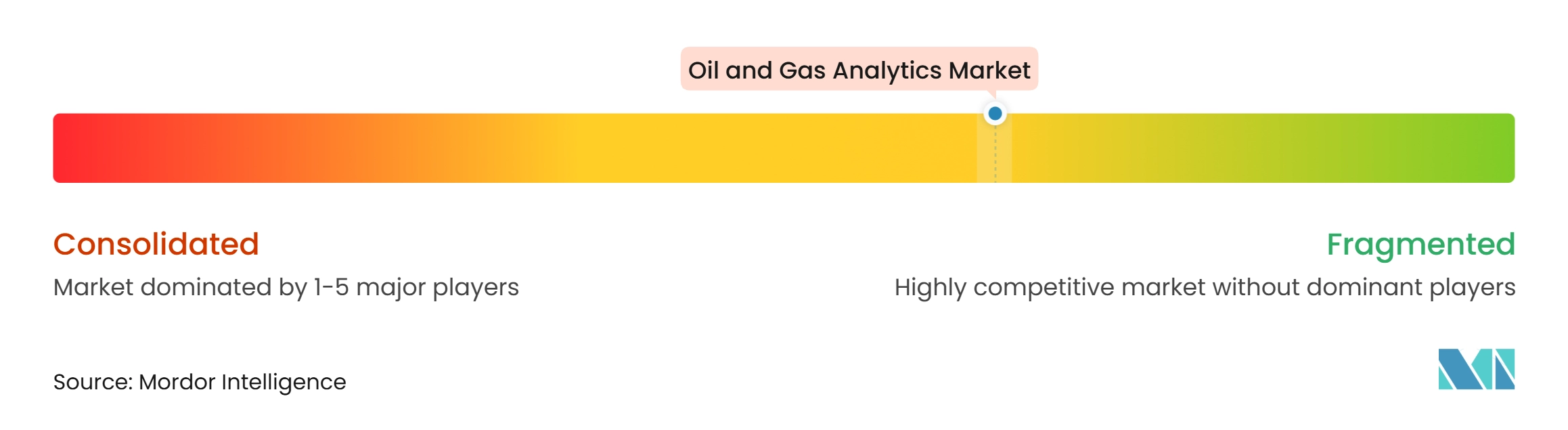
The oil and gas analytics market is moderately concentrated in large enterprise contracts, where oilfield services companies, industrial automation firms, enterprise technology platforms, and specialist providers compete. Competition depends on how well a provider connects data systems with field and plant workflows. Domain knowledge, open data platforms, and the quality of AI models are key points of differentiation. Large providers can offer broader implementation support and established relationships with major operators. Specialists can compete where focused software or time-series models solve a specific operational problem. This structure leaves room for both large platforms and narrower, application-led offerings.
Schlumberger Limited (SLB) expanded its position through a Digital Division and its April 2026 agreement to acquire S&P Global Energy's upstream software portfolio. The company also expanded its collaboration with NVIDIA Corporation in March 2026 to develop an AI Factory for Energy across its Delfi and Lumi platforms. Emerson Electric Co. and Saudi Aramco completed deployment of hybrid model-based AI for refinery planning across multiple sites in April 2026. Honeywell International Inc. introduced Experion Cognition in June 2026 as an AI-enabled autonomous control platform, demonstrated at Borouge International's Ruwais facility. These developments reflect competition to bring analytics closer to real-time operating decisions.
Specialist platforms are also competing through focused industrial AI models and data management capabilities. Aker BP ASA deployed Cognite AS's industrial data platform with NVIDIA Corporation time-series models for offshore anomaly detection and predictive maintenance in March 2026. Mid-sized operators with 10 to 50 producing assets remain underserved, as enterprise platforms can be difficult to procure and support without internal data science resources. This creates demand for managed analytics services and outcome-based commercial models. At the same time, industrial cybersecurity requirements raise barriers for entrants that cannot demonstrate secure operating-technology deployment practices. The oil and gas analytics market is likely to favor vendors that can combine practical applications, implementation support, and documented security controls. The available information does not include combined player market shares, which limits direct comparison of concentration across the listed providers.
Oil and Gas Analytics Industry Leaders
-
SLB N.V.
-
Halliburton Company
-
Baker Hughes Company
-
Aspen Technology, Inc.
-
Emerson Electric Co.
- *Disclaimer: Major Players sorted in no particular order
Oil and Gas Analytics Market Companies Covered in this Report
- SLB
- ABB Ltd.
- Amazon Web Services, Inc. (AWS)
- Aspen Technology, Inc.
- AVEVA Group Limited
- Baker Hughes Company
- Cognite AS
- Emerson Electric Co.
- Halliburton Company
- Honeywell International Inc.
- IBM Corporation
- Microsoft Corporation
- Oracle Corporation
- Palantir Technologies Inc.
- SAP SE
- SAS Institute Inc.
- Siemens AG
- TGS ASA
- Viridien SA
- Weatherford International plc
Recent Industry Developments in Oil and Gas Analytics Market
- September 2026: PETRONAS and Iraya Energies signed an agreement to integrate agentic AI capabilities into the myPROdata upstream platform. The initiative aims to accelerate exploration and production workflows, potentially reducing discovery-to-production timelines from approximately 100 months to 50 months, while supporting annual upstream investments estimated at MYR 50 to 60 billion.
- July 2026: PETRONAS Carigali signed its third joint development agreement (JDA) with IBM and Tridiagonal.AI to expand the deployment of TriCipta AI across upstream production optimization and maintenance workflows. The collaboration builds on earlier AI.SEEK and Global Exploration Basin Screening solutions already deployed within PETRONAS operations.
- June 2026: SLB and Qualcomm Technologies signed a memorandum of understanding to develop edge AI solutions for oilfield operations. The collaboration combines SLB's Agora™ IoT platform with Qualcomm Technologies' low-power edge computing technologies to enable real-time analytics for wells, production facilities, and field equipment.
- June 2026: Honeywell introduced Experion® Cognition, an AI-enabled autonomous control platform demonstrated at Borouge International's Ruwais facility in Abu Dhabi. The solution uses generative AI and advanced analytics to support autonomous control room operations and operational decision-making.
Global Oil and Gas Analytics Market Report Scope
Oil and gas analytics refers to the use of data analysis, artificial intelligence (AI), machine learning (ML), and digital technologies to improve decision-making, operational efficiency, and asset performance across the oil and gas value chain. These analytics solutions process large volumes of geological, operational, production, and maintenance data to generate actionable insights. Oil and gas analytics is widely applied in exploration, drilling, production optimization, pipeline monitoring, predictive maintenance, and refinery operations. The technology helps companies reduce costs, enhance safety, increase productivity, and support digital transformation across upstream, midstream, and downstream activities.
The global oil and gas analytics market is segmented by offering into hardware, software, and services. By deployment, the market is segmented into on-premises, cloud-based, and hybrid solutions. By technology, the market is segmented into artificial intelligence and machine learning, big data analytics, Internet of Things (IoT) and industrial IoT analytics, digital twin analytics, edge analytics, cloud analytics, generative AI, and data visualization and business intelligence. By application, the market is segmented into upstream, midstream, and downstream operations. The report also covers the market size and forecasts for the global oil and gas analytics market across 26 countries in key regions. For each segment, the market sizing and forecasts are provided on the basis of value (USD).
Segmentation Overview
| Hardware |
| Software |
| Services |
| On-Premises |
| Cloud-Based |
| Hybrid |
| Artificial Intelligence and Machine Learning |
| Big Data Analytics |
| Internet of Things and Industrial IoT Analytics |
| Digital Twin Analytics |
| Edge Analytics |
| Cloud Analytics |
| Generative AI |
| Data Visualization and Business Intelligence |
| Upstream |
| Midstream |
| Downstream |
| North America | United States |
| Canada | |
| Mexico | |
| Europe | Germany |
| France | |
| Italy | |
| Spain | |
| United Kingdom | |
| Norway | |
| Netherlands | |
| Russia | |
| Rest of Europe | |
| Asia-Pacific | China |
| India | |
| Australia | |
| Indonesia | |
| Vietnam | |
| Thailand | |
| Rest of Asia-Pacific | |
| South America | Brazil |
| Argentina | |
| Chile | |
| Rest of South America | |
| Middle East and Africa | Saudi Arabia |
| United Arab Emirates | |
| Egypt | |
| Nigeria | |
| Oman | |
| Rest of Middle East and Africa |
| By Offering | Hardware | |
| Software | ||
| Services | ||
| By Deployment | On-Premises | |
| Cloud-Based | ||
| Hybrid | ||
| By Technology | Artificial Intelligence and Machine Learning | |
| Big Data Analytics | ||
| Internet of Things and Industrial IoT Analytics | ||
| Digital Twin Analytics | ||
| Edge Analytics | ||
| Cloud Analytics | ||
| Generative AI | ||
| Data Visualization and Business Intelligence | ||
| By Application | Upstream | |
| Midstream | ||
| Downstream | ||
| By Geography | North America | United States |
| Canada | ||
| Mexico | ||
| Europe | Germany | |
| France | ||
| Italy | ||
| Spain | ||
| United Kingdom | ||
| Norway | ||
| Netherlands | ||
| Russia | ||
| Rest of Europe | ||
| Asia-Pacific | China | |
| India | ||
| Australia | ||
| Indonesia | ||
| Vietnam | ||
| Thailand | ||
| Rest of Asia-Pacific | ||
| South America | Brazil | |
| Argentina | ||
| Chile | ||
| Rest of South America | ||
| Middle East and Africa | Saudi Arabia | |
| United Arab Emirates | ||
| Egypt | ||
| Nigeria | ||
| Oman | ||
| Rest of Middle East and Africa | ||
Key Questions Answered in the Report
What is the projected size of the oil and gas analytics market by 2032?
The oil and gas analytics market is forecast to reach USD 8.41 billion by 2032, growing from USD 3.78 billion in 2027 at a CAGR of 17.36%.
Which offering leads oil and gas analytics revenue?
Software led with 49.3% of revenue in 2026, while services is forecast to record the highest growth at a CAGR of 17.9% through 2032.
Why is cloud deployment significant for oil and gas analytics?
Cloud-based systems held 58.4% of revenue in 2026 and are forecast to grow at 19.3% through 2032, as they support large data workloads and collaboration.
Which technology has the strongest forecast growth?
Generative AI is projected to grow at a CAGR of 21.4% through 2032, supported by applications in engineering records, maintenance histories, and operational reporting.
Which application accounts for the highest share of analytics spending?
Upstream operations held 47.1% of revenue in 2026, as exploration, drilling, reservoir management, and artificial lift all depend on data-intensive decisions.
Which region is growing fastest in oil and gas analytics?
Asia-Pacific is forecast to grow at a CAGR of 19.5% through 2032, supported by digital programs at national oil companies in Malaysia, China, and Indonesia.