
Off-Grid Remote Sensing Power System Market Size and Share
Market Overview
| Study Period | 2022 - 2032 |
|---|---|
| Market Size (2027) | USD 2.04 Billion |
| Market Size (2032) | USD 3.09 Billion |
| Growth Rate (2027 - 2032) | 8.70 % |
| Fastest Growing Market | Asia-Pacific |
| Largest Market | North America |
| Market Concentration | Low |
Major Players *Disclaimer: Major Players sorted in no particular order Image © Mordor Intelligence. Reuse requires attribution under CC BY 4.0. | |
Off-Grid Remote Sensing Power System Market Analysis by Mordor Intelligence
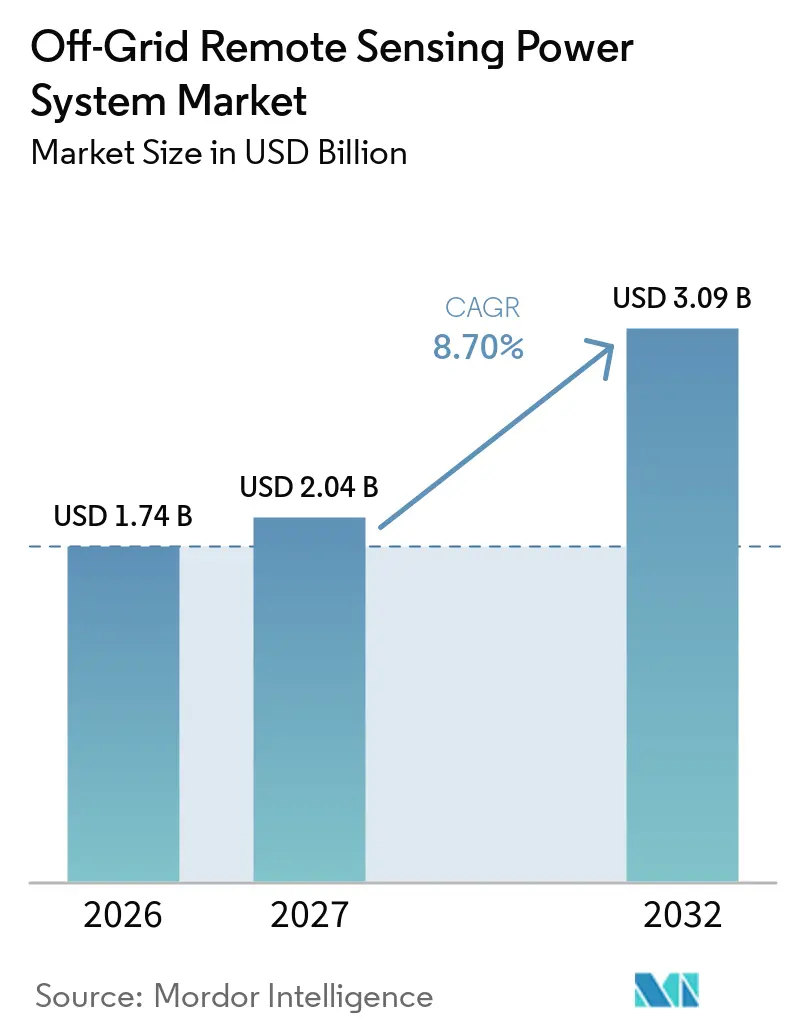
The off-grid remote sensing power system market size is expected to grow from USD 1.74 billion in 2026 to USD 2.04 billion in 2027 and is forecast to reach USD 3.09 billion by 2032 at 8.70% CAGR over 2027-2032. The market is expanding as operators require continuous data from sites where grid connection is impractical. Declining renewable equipment costs have strengthened the case for solar and hybrid systems in remote locations. Remote monitoring now supports compliance, asset protection, environmental measurement, and operational decisions across multiple user groups. Suppliers are responding by integrating power equipment with software, battery management, and communications capabilities. The strongest opportunities favor systems that can operate reliably under extreme heat, cold, limited access, and variable solar conditions.
Key Report Takeaways
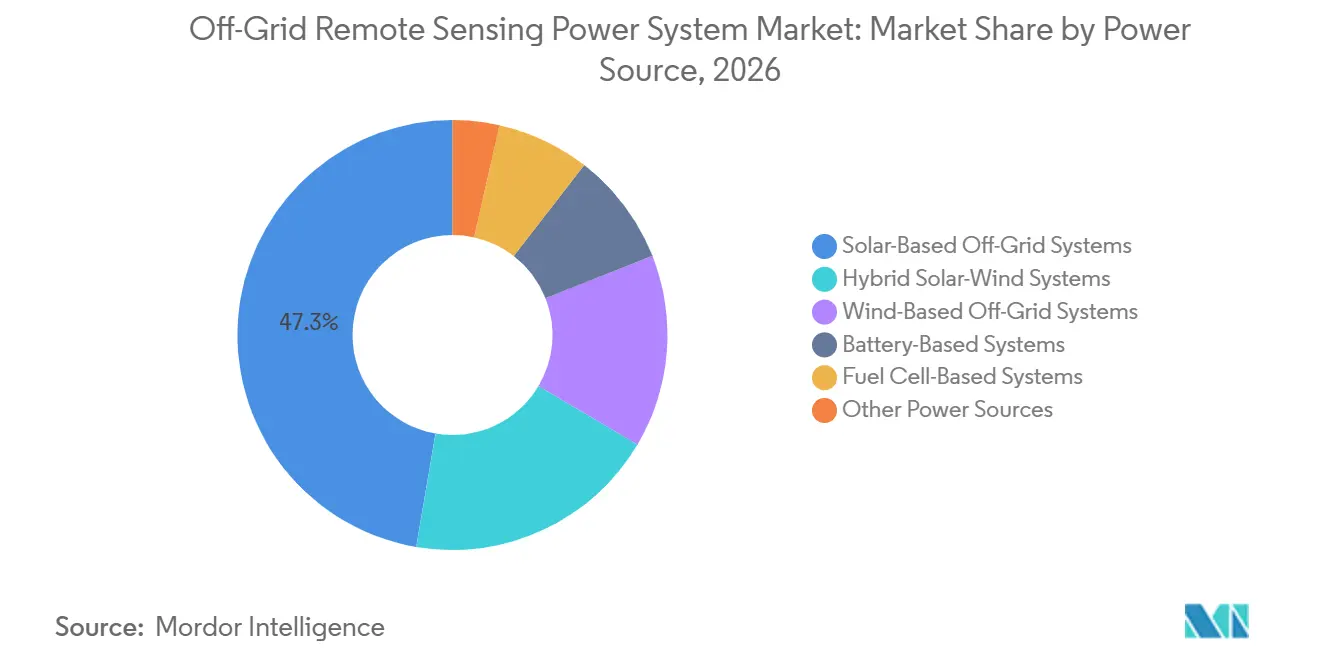
- By power source, solar-based off-grid systems held 47.3% of the market share in 2026, while hybrid solar-wind systems are projected to grow at a 9.3% CAGR through 2032.
- By component, power generation units accounted for 32.2% of the 2026 revenue, while energy storage systems are forecast to expand at a 9.6% CAGR through 2032.
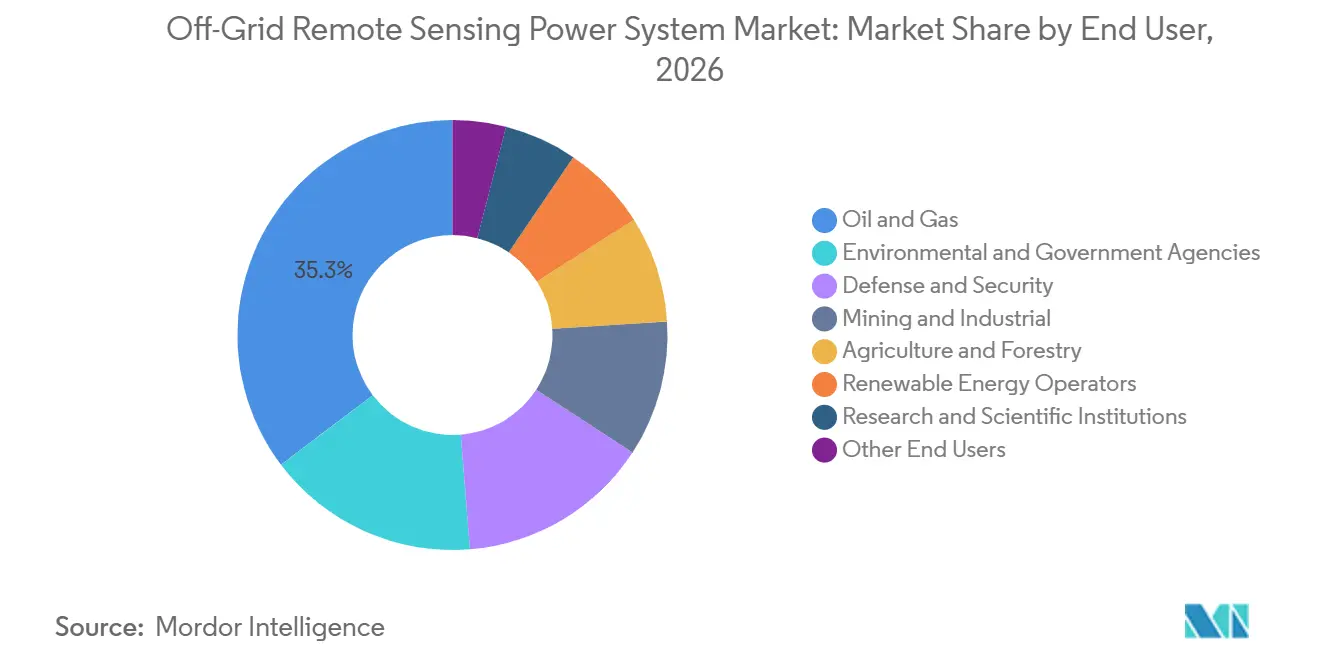
- By end user, oil and gas held 35.3% of the 2026 revenue, while agriculture and forestry is forecast to grow at an 8.9% CAGR through 2032.
- By power capacity, below 100 W accounted for 37.6% of the 2026 revenue, while the 1-5 kW segment is projected to grow at an 8.8% CAGR through 2032.
- By geography, North America held 31.4% of the 2026 revenue, while Asia-Pacific is projected to grow at a 9.2% CAGR through 2032.
Note: Market numbers in this report are based on Mordor Intelligence's proprietary estimation framework, which combines nine months of actuals with Q4 projections for base year 2026.
Market Trends and Insights
Drivers Impact Analysis of Off-Grid Remote Sensing Power System Market*
| Driver | (~) % Impact on CAGR Forecast | Geographic Relevance | Impact Timeline |
|---|---|---|---|
| Continuous Monitoring of Remote and Unattended Assets | +2.5% | Global, concentrated in North America and Europe | Long term (≥ 4 years) |
| Renewable-Powered Expansion of Remote IoT and Sensor Networks | +2.0% | APAC core, spill-over to MEA and South America | Medium term (2-4 years) |
| Oil and Gas Pipeline, Wellhead, and Methane-Monitoring Demand | +1.5% | North America and Middle East, spill-over to Europe | Medium term (2-4 years) |
| Climate-Smart Agriculture and Distributed Weather Monitoring | +0.8% | APAC core, South America, and Sub-Saharan Africa | Long term (≥ 4 years) |
| Modular Hybrid Power for Extreme-Climate LiDAR and Security Sites | +0.6% | North America, Europe, and Northern Asia | Medium term (2-4 years) |
| Satellite-Enabled Monitoring Beyond Cellular Coverage | +0.7% | Global, concentrated in remote boreal and offshore corridors | Short term (≤ 2 years) |
| Source: Mordor Intelligence | |||
Continuous Monitoring of Remote and Unattended Assets
Operators in oil and gas, utilities, and defense are reducing physical inspections at hazardous or difficult-to-reach sites. Labor costs and safety restrictions make regular site visits costly and, in some cases, impractical. A 2025 tropical weather-station study recorded complete data collection for 64.5 continuous hours at humidity as high as 97.6%. The same study found that the cellular module consumed 69% of the daily energy budget, indicating that communications can determine system sizing more than the sensor payload.[1] This favors suppliers that design generation, storage, and communications equipment as an integrated system. It also supports modular hybrid systems for LiDAR, security, and unattended sensing sites exposed to severe weather.
Renewable-Powered Expansion of Remote IoT and Sensor Networks
Solar-powered IoT deployment is expanding the addressable base for the off-grid remote sensing power system market across several climate zones. Predictive control can adjust loads using expected solar conditions and improve uptime at off-grid nodes. A 2025 study found that forecast-based energy management can improve operation by adapting load cycles to expected irradiance. As a result, power management and control systems carry greater importance than a simple comparison of module wattage would suggest. In 2025, Deutsche Telekom introduced multi-orbit IoT roaming across 15 companies and 5 research institutions, linking GEO and LEO capacity for connected devices. Broader connectivity expands the locations in which autonomous power can support viable sensor networks.
Oil and Gas Pipeline, Wellhead, and Methane-Monitoring Demand
Environmental compliance is making remote monitoring a required operating expense for more oil and gas assets. The United States finalized changes to Subpart W in 2024 that allow advanced and emerging technologies to quantify annual facility CH4 emissions. The Methane Super Emitter Program under NSPS OOOOb defines qualifying events at 100 kg/h and depends on approved remote-sensing methods. Sensors at wellheads and compressor stations require dependable local electricity for measurement and communications. In 2025, Sensirion Connected Solutions received EPA approval for its Kuva continuous methane camera, creating demand for associated autonomous power. The Methane Emissions Reduction Program also provides assistance for monitoring infrastructure, which helps sustain the funding base.[2]
Climate-Smart Agriculture and Distributed Weather Monitoring
Farm monitoring is shifting from occasional field visits to distributed networks that measure soil, crop, and weather conditions continuously. These installations often require solar or hybrid power because the sensors are located far from electrical infrastructure. A 2025 study reported 98.2% energy-flow prediction accuracy for an edge-cloud architecture used in smart farmland and found a 9.5% reduction in energy waste. India's PM-KUSUM program combines distributed agricultural solar installations with monitoring requirements, supporting rural sensing applications. Agrivoltaic systems may require a single monitoring platform to support both energy performance and crop-health measurement. Reliable autonomous power allows more nodes to be deployed across large farming areas, benefiting agriculture and forestry applications.
Restraints Impact Analysis of Off-Grid Remote Sensing Power System Market*
| Restraint | (~) % Impact on CAGR Forecast | Geographic Relevance | Impact Timeline |
|---|---|---|---|
| Battery Replacement Logistics and Degradation in Harsh Climates | -0.8% | Sub-Saharan Africa, MEA, South and Southeast Asia | Long term (≥ 4 years) |
| Solar-Resource Variability and Seasonal Under-Sizing Risk | -0.6% | Northern Europe, Northern Asia, High-Latitude North America | Medium term (2-4 years) |
| High Site-Access, Commissioning, and Maintenance Costs | -0.5% | Global, most acute in mountainous and island geographies | Long term (≥ 4 years) |
| Fragmented Power, Sensor, and Communications Interoperability | -0.4% | Global | Medium term (2-4 years) |
| Source: Mordor Intelligence | |||
Battery Replacement Logistics and Degradation in Harsh Climates
Battery performance is a major operational concern at sites that are hot, remote, and costly to access. A 2025 thermal-degradation assessment by Hamad Bin Khalifa University found that lithium-ion cells aged at 55°C showed the most severe capacity decline. The same research indicates that tropical conditions can raise degradation rates by 20-60% above baseline. A separate 2025 study found that battery life declined by 24% when average annual temperature increased from 25°C to 28°C. Lithium iron phosphate (LiFePO4) chemistry is increasingly viable in off-grid applications, though lead-acid batteries can still offer an economic advantage at certain system sizes. This split complicates procurement, maintenance planning, and replacement strategies for widely distributed networks.
Solar-Resource Variability, Access Costs, and Interoperability
Solar resource estimates can differ significantly from field performance in humid, rainy, or high-latitude locations. A 2025 field study published in IOP Science found that a nominal solar module met only 22-29% of daily demand, leaving deficits of 54-63 Wh per day under tropical conditions. Northern systems face large seasonal variation, requiring larger battery banks or supplementary wind and fuel-cell support. Poor road access, mountain sites, and island locations increase commissioning and service costs. Incompatible power, sensor, and communications equipment can add integration work and slow replacement activity. These constraints favor suppliers that offer validated system packages with clear lifecycle support over individual components alone.
*Our forecasts treat driver/restraint impacts as directional, not additive. The impact forecasts reflect baseline growth, mix effects, and variable interactions.
Off-Grid Remote Sensing Power System Market Segment Analysis
By Power Source:
Solar Holds the Largest Position While Hybrid Systems Gain GroundSolar-based off-grid systems held 47.3% of 2026 revenue, the largest share in the off-grid remote sensing power system market. This position reflects long-term photovoltaic cost reductions and broad familiarity with charge-controller technology. These systems perform well for low-load sensors in locations with dependable sunlight. Wind-based off-grid systems remain useful for coastal and ridge-line sites where wind resources are more consistent. Fuel cell-based systems support Arctic, military-perimeter, and dense-canopy locations where solar energy is insufficient. Battery-based systems and other sources serve bridging, backup, or specialized roles rather than primary generation in many deployments.
Hybrid solar-wind systems are projected to grow at a 9.3% CAGR through 2032. This pace reflects the need to maintain uptime where one renewable source is variable. Hybrid configurations can reduce exposure to weather-related supply gaps and can support larger monitoring loads. SFC Energy AG presented the EFOY ProShelter at Eurosatory 2026 as a hybrid station combining methanol fuel cells with solar and wind inputs for 12 to 36 months of autonomous operation.[3] SFC Energy AG LFP batteries can further improve field reliability under dynamic duty cycles and cold conditions. Integration standards for hybrid renewable systems can also reduce custom engineering work over time.

By Component:
Storage Growth Increases the Value of Energy ManagementPower generation units accounted for 32.2% of 2026 revenue, reflecting their role as the entry point for new installations. Energy storage systems are expected to grow at a 9.6% CAGR through 2032. Lithium iron phosphate (LFP) adoption is a central factor, as the chemistry can extend replacement intervals in field deployments. The analysis places lead-acid replacement cycles at 4 to 5 years in tropical conditions, compared with 8 to 12 years for LFP packs. That difference can improve lifecycle economics even where LFP carries a higher initial cost. The off-grid remote sensing power system market size for storage is therefore supported by both new installations and more demanding reliability requirements.
Power management and control systems are becoming more important as vendors add forecast-based charge control and load management. Maximum power point tracking (MPPT) controllers, battery management systems, and dispatch software can extend battery life without increasing installed hardware. Communications modules hold a smaller component share but become critical when a site uses satellite IoT. Iridium Communications Inc. made its 9604 hybrid IoT module commercially available in June 2026, combining short burst data (SBD) satellite connectivity, LTE-M cellular, and multi-constellation GNSS. Such modules raise the energy requirement of a remote sensing node. Auxiliary equipment also matters, as mounting systems, lightning protection, enclosures, and DC infrastructure determine whether a full installation can operate reliably.
By End User:
Oil and Gas Remains the Largest User While Agriculture ExpandsOil and gas held 35.3% of 2026 revenue, giving it the largest end-user position. Pipeline, wellhead, and compressor-station monitoring requires dependable energy for sensing and data transmission. U.S. methane regulations have reinforced the compliance case for continuous remote observation. Environmental and government agencies represent another large user group, as weather, water-quality, and biodiversity installations often operate where grid power is unavailable. Defense and security applications command high unit values where surveillance and communications cannot tolerate extended outages. SFC Energy AG secured an order worth EUR 42.7 million in 2026 for hybrid fuel-cell systems supporting Ukrainian reconnaissance, communications, and drone charging.
Agriculture and forestry is projected to grow at an 8.9% CAGR through 2032, the fastest rate among end users. Precision farming increases the number of soil-moisture, microclimate, and crop-stress sensors installed far from established power lines. Direct-to-satellite IoT can provide remote agricultural systems with a communications path where terrestrial links are unavailable. Mining and industrial users favor diesel-hybrid systems where higher loads require redundancy. Renewable energy operators use solar-storage packages to monitor distributed generation assets. Research and scientific institutions tend to choose low-power modular systems for ecological sensing that must operate unattended for several years.
By Power Capacity:
Low-Power Nodes Lead While Larger Loads Grow FasterThe below 100 W band accounted for 37.6% of 2026 revenue, making it the largest capacity group. This reflects the prevalence of sensor nodes running low-drain instruments, a controller, a small LFP battery, and a communications module. This unit profile keeps the off-grid remote sensing power system market concentrated on many small distributed installations rather than a limited number of large platforms. The 100 W to 500 W and 500 W to 1 kW bands serve intermediate needs, including pipeline monitors, satellite-enabled SCADA nodes, and remote weather stations. The above 5 kW group remains specialized for pumping stations, research bases, and offshore monitoring installations. Hazardous-area certification under ATEX and IECEx limits the number of viable suppliers for certain oil and gas applications.
The 1 kW to 5 kW band is forecast to grow at an 8.8% CAGR through 2032. This growth indicates that edge computing, AI inference, multi-camera security arrays, and LiDAR are being co-located with sensing equipment. These systems require more power than a conventional low-load node. The research identified a solar-powered livestock-monitoring setup with a combined monitoring and inference load near 75 W under a 125 W solar input, illustrating the design balance at the lower boundary of more capable applications. Larger systems also require more redundancy and can use combinations of solar, storage, wind, fuel cells, or generator support, resulting in a larger role for system integration and project-specific engineering.
Geography Analysis
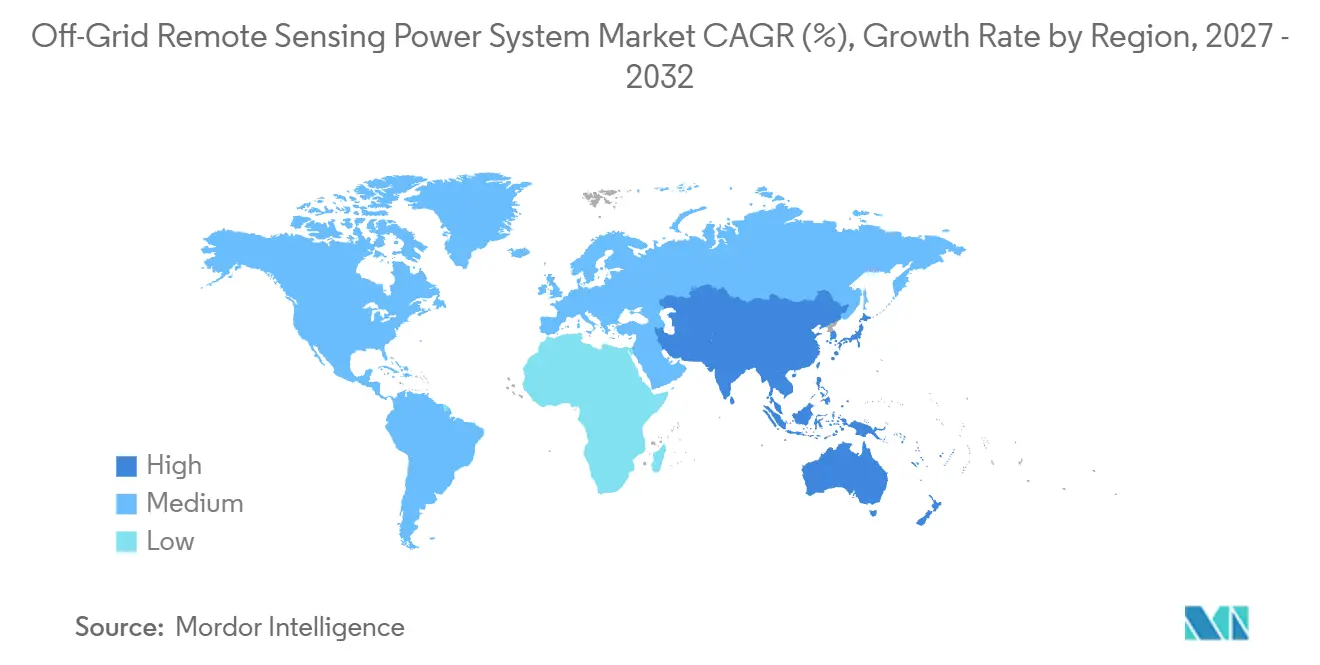
North America held 31.4% of 2026 revenue, making it the leading regional market. Extensive pipeline infrastructure, federal compliance requirements, and commercial surveillance demand support deployment across the region. In the United States, methane-related regulations create a baseline requirement for continuously powered monitoring at upstream and midstream assets. The U.S. EPA and Canada drive demand for remote solar-battery infrastructure in northern and isolated communities. Mexico represents a secondary opportunity through industrial and agricultural monitoring activity. Morningstar Corporation and OutBack Power Technologies have established positions in charge-controller and off-grid inverter channels that serve industrial remote sites.
Europe holds the second-largest geographic position in the off-grid remote sensing power system market. Germany, the United Kingdom, France, and Poland have active environmental and industrial monitoring applications. Reporting and energy requirements encourage corporate measurement of emissions and energy conditions. Northern Europe and high-altitude areas experience greater solar variability than most other regions, making hybrid solar-wind and methanol fuel-cell systems more relevant at these sites. In November 2025, SFC Energy received a EUR 7.5 million follow-up order for EFOY Pro fuel cells used in AI-driven mobile security units at European industrial sites, illustrating the overlap between industrial surveillance and remote sensing applications.[4]
Asia-Pacific is forecast to grow at a 9.2% CAGR through 2032, the fastest pace among all regions. The region has large tracts of agricultural land that remain lightly monitored and have limited grid access. India's agricultural solar activity, Indonesia's and Vietnam's distributed renewable projects, and China's CH4 reduction initiatives support demand for remote sensing power. Australia's experience with extreme-climate engineering can also inform designs for Southeast Asian remote systems. South America presents potential in precision agriculture and hydrocarbon and mining monitoring, with Brazil and Chile being particularly relevant due to large agricultural areas, solar development, copper mining, and demanding remote operating conditions. This regional expansion supports the case for adaptable products capable of performing across wet, hot, and remote environments.
Competitive Landscape
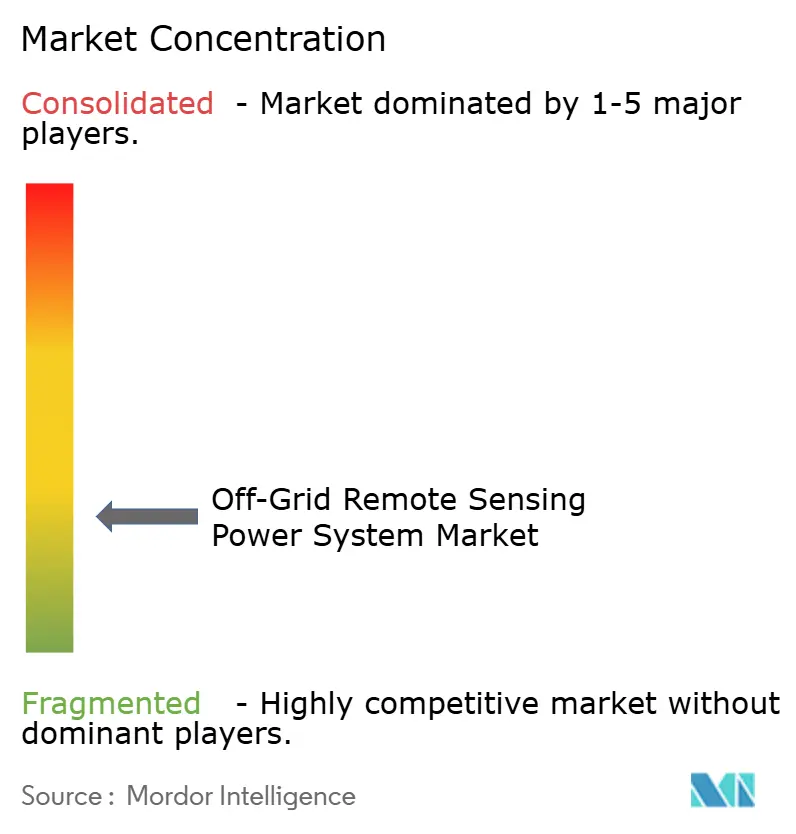
The off-grid remote sensing power system market is fragmented, with no single vendor holding a dominant revenue share. SFC Energy, Victron Energy, and Morningstar Corporation compete through technical specialization rather than a common product model. SFC Energy focuses on fuel-cell technology and connected autonomous-power equipment. Victron Energy offers remote management through its VRM portal, while Morningstar Corporation holds a strong position in charge-controller firmware. JinkoSolar and Canadian Solar participate primarily through system integrators and compete on module efficiency and supply capability. This structure means buyers often combine equipment from multiple vendors to meet application-specific requirements.
Product strategy is increasingly centered on integrated systems rather than stand-alone hardware. In October 2025, Enphase Energy introduced a complete off-grid solar and battery system in the United States, combining IQ Battery 5P, IQ8 microinverters, Sunlight JumpStart capability, and generator support, with more than 100 fully off-grid operational sites reported. In 2025, SFC Energy acquired key Siqens assets to extend its fuel-cell portfolio into the 1 to 5 kW range, strengthening its position in a faster-growing capacity band and raising the technical barrier for competitors. Iridium's hybrid module reflects closer coordination between connectivity and energy management.
Open opportunities remain in power-plus-communications units for satellite IoT, LFP battery packs qualified for both cold and hot climates, and predictive maintenance services that reduce site visits. Direct methanol fuel-cell efficiency and solid oxide fuel-cell reforming are areas where specialized intellectual property can be a differentiator. Renogy, Tycon Systems, and Omnivoltaic Power address lower-cost demand with modular systems that prioritize installation simplicity and total installed cost. ATEX and IECEx certification requirements remain significant barriers in hazardous oil and gas locations. Where sites require certification, long maintenance intervals, and reliable remote management, the market favors established suppliers. The market concentration score is 3 out of 10, reflecting a moderately fragmented field with no dominant revenue leader.
Off-Grid Remote Sensing Power System Industry Leaders
-
SFC Energy AG
-
Tycon Systems Inc.
-
Victron Energy B.V.
-
Leading Edge Power
-
UPS Systems plc
- *Disclaimer: Major Players sorted in no particular order
Off-Grid Remote Sensing Power System Market Companies Covered in this Report
- UPS Systems plc
- Schneider Electric SE
- JinkoSolar Holding Co., Ltd.
- Canadian Solar Inc.
- Enphase Energy, Inc.
- SMA Solar Technology AG
- SFC Energy AG
- SunPower Corporation
- Pulsar Industries Inc.
- Acumentrics Holding Corporation
- Victron Energy B.V.
- OutBack Power Technologies
- Renogy
- Ensol Systems Inc.
- Cellula Robotics Ltd.
- Tycon Systems Inc.
- Energy Solutions (UK) Ltd.
- Leading Edge Power
- Morningstar Corporation
- Omnivoltaic Power Co. Ltd.
Recent Industry Developments in Off-Grid Remote Sensing Power System Market
- May 2026: SFC Energy AG secured a EUR 2.8 million order from International Security GmbH for EFOY Pro 2800 methanol fuel cells. The systems will power International Security GmbH's Video Guard mobile surveillance units deployed at construction and infrastructure sites in off-grid environments. The order highlights the standardized integration of fuel cells into recurring surveillance deployments, reflecting scalable demand for autonomous remote power systems.
- June 2026: Iridium Communications announced the commercial availability of the Iridium 9604 hybrid IoT module and development kit. The module combines Iridium Short Burst Data satellite connectivity, LTE-M cellular communications, and multi-constellation GNSS positioning within a single platform, enabling globally connected remote monitoring and sensing devices in areas lacking terrestrial networks.
- January 2026: Iridium Communications announced successful on-air testing of Iridium NTN Direct, a standards-based NB-IoT direct-to-device non-terrestrial network service. The platform entered beta preparation with two-way messaging demonstrated over Iridium's LEO satellite network, offering connectivity solutions for remote sensing, utility monitoring, agriculture, logistics, and infrastructure monitoring applications.
- October 2025: Enphase Energy launched a complete off-grid solar and battery solution in the United States. The system combines IQ Battery 5P, IQ8 Series Microinverters with Sunlight JumpStart, and generator integration to deliver autonomous power in locations without utility grid access, supporting remote monitoring and off-grid infrastructure applications.
Global Off-Grid Remote Sensing Power System Market Report Scope
An off-grid remote sensing power system is a self-contained power solution designed to provide reliable electricity to sensors, monitoring equipment, communication devices, and control systems located in remote or inaccessible areas without access to the utility grid. These systems typically integrate renewable energy sources such as solar panels, wind turbines, fuel cells, and battery storage to ensure continuous operation. They are widely used in environmental monitoring, oil and gas operations, defense and security, agriculture, mining, weather stations, and scientific research.
The global off-grid remote sensing power system market is segmented by power source into solar-based off-grid systems, wind-based off-grid systems, hybrid solar-wind systems, fuel cell-based systems, battery-based systems, and other power sources. By component, the market is segmented into power generation units, energy storage systems, power management and control systems, communication modules, and auxiliary components. By end user, the market is segmented into oil and gas, environmental and government agencies, defense and security, agriculture and forestry, mining and industrial, renewable energy operators, research and scientific institutions, and other end users. By power capacity, the market is segmented into below 100 W, 100 W to 500 W, 500 W to 1 kW, 1 to 5 kW, and above 5 kW. The report also covers the market size and forecasts for the global off-grid remote sensing power system market across 26 countries in key regions. For each segment, the market sizing and forecasts are provided on the basis of value (USD).
Segmentation Overview
| Solar-Based Off-Grid Systems |
| Wind-Based Off-Grid Systems |
| Hybrid Solar-Wind Systems |
| Fuel Cell-Based Systems |
| Battery-Based Systems |
| Other Power Sources |
| Power Generation Unit |
| Energy Storage System |
| Power Management and Control System |
| Communication Module |
| Auxiliary Components |
| Oil and Gas |
| Environmental and Government Agencies |
| Defense and Security |
| Agriculture and Forestry |
| Mining and Industrial |
| Renewable Energy Operators |
| Research and Scientific Institutions |
| Other End Users |
| Below 100 W |
| 100 W–500 W |
| 500 W–1 kW |
| 1–5 kW |
| Above 5 kW |
| North America | United States |
| Canada | |
| Mexico | |
| Europe | Germany |
| France | |
| Italy | |
| Spain | |
| United Kingdom | |
| Poland | |
| Russia | |
| Rest of Europe | |
| Asia-Pacific | China |
| India | |
| Japan | |
| South Korea | |
| Australia | |
| Indonesia | |
| Vietnam | |
| Thailand | |
| Rest of Asia-Pacific | |
| South America | Brazil |
| Argentina | |
| Chile | |
| Rest of South America | |
| Middle East and Africa | Saudi Arabia |
| United Arab Emirates | |
| Egypt | |
| South Africa | |
| Morocco | |
| Rest of Middle East and Africa |
| By Power Source | Solar-Based Off-Grid Systems | |
| Wind-Based Off-Grid Systems | ||
| Hybrid Solar-Wind Systems | ||
| Fuel Cell-Based Systems | ||
| Battery-Based Systems | ||
| Other Power Sources | ||
| By Component | Power Generation Unit | |
| Energy Storage System | ||
| Power Management and Control System | ||
| Communication Module | ||
| Auxiliary Components | ||
| By End User | Oil and Gas | |
| Environmental and Government Agencies | ||
| Defense and Security | ||
| Agriculture and Forestry | ||
| Mining and Industrial | ||
| Renewable Energy Operators | ||
| Research and Scientific Institutions | ||
| Other End Users | ||
| By Power Capacity | Below 100 W | |
| 100 W–500 W | ||
| 500 W–1 kW | ||
| 1–5 kW | ||
| Above 5 kW | ||
| By Geography | North America | United States |
| Canada | ||
| Mexico | ||
| Europe | Germany | |
| France | ||
| Italy | ||
| Spain | ||
| United Kingdom | ||
| Poland | ||
| Russia | ||
| Rest of Europe | ||
| Asia-Pacific | China | |
| India | ||
| Japan | ||
| South Korea | ||
| Australia | ||
| Indonesia | ||
| Vietnam | ||
| Thailand | ||
| Rest of Asia-Pacific | ||
| South America | Brazil | |
| Argentina | ||
| Chile | ||
| Rest of South America | ||
| Middle East and Africa | Saudi Arabia | |
| United Arab Emirates | ||
| Egypt | ||
| South Africa | ||
| Morocco | ||
| Rest of Middle East and Africa | ||
Key Questions Answered in the Report
What is the projected value of the off-grid remote sensing power system market by 2032?
The market is projected to reach USD 3.09 billion by 2032, growing at an 8.7% CAGR from 2027.
Which power source held the largest share in 2026?
Solar-based off-grid systems led with 47.3% of 2026 revenue.
Which end user is growing fastest through 2032?
Energy Storage System is projected to grow at an 9.6% CAGR as grids expands.
Why do oil and gas operators use autonomous sensing power?
Methane (CH₄) monitoring and remote compliance systems require continuous power at wells, pipelines, and compressor stations.
Which capacity band is expected to grow fastest?
The 1 to 5 kW band is forecast to grow at an 8.8% CAGR as LiDAR, cameras, and edge computing increase power requirements.
Which region is forecast to grow fastest?
Asia-Pacific is forecast to grow at a 9.2% CAGR through 2032, supported by agricultural and distributed-energy monitoring.