
Molten Salt Battery Market Size and Share
Market Overview
| Study Period | 2022 - 2032 |
|---|---|
| Market Size (2027) | USD 5.30 Billion |
| Market Size (2032) | USD 14.67 Billion |
| Growth Rate (2027 - 2032) | 22.56 % |
| Fastest Growing Market | Asia-Pacific |
| Largest Market | North America |
| Market Concentration | Medium |
Major Players *Disclaimer: Major Players sorted in no particular order Image © Mordor Intelligence. Reuse requires attribution under CC BY 4.0. | |
Molten Salt Battery Market Analysis by Mordor Intelligence
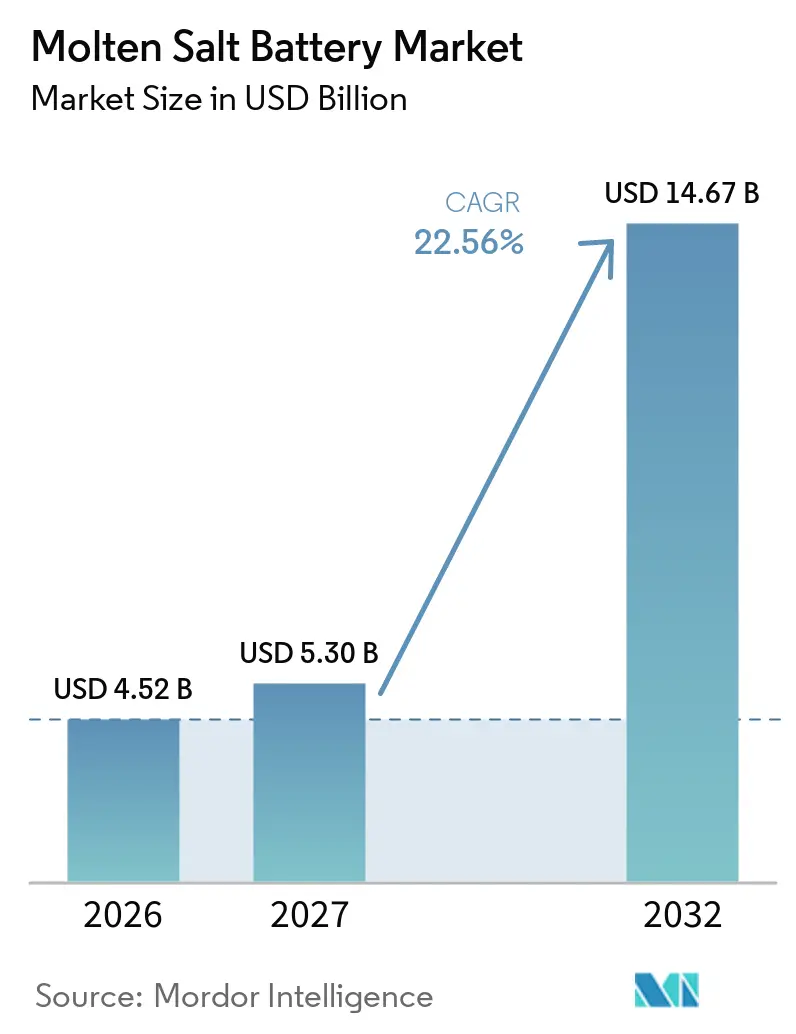
The gloabl molten salt battery market size is expected to grow from USD 4.52 billion in 2026 to USD 5.30 billion in 2027 and is forecast to reach USD 14.67 billion by 2032 at 22.56% CAGR over 2027-2032. The market is shifting toward grid applications that require long discharge periods, reliable operation, and dispatchable stored energy for periods when wind and solar output declines. Growth in renewable generation is increasing demand for storage capable of delivering power for 8 hours or longer, particularly where system operators must manage extended periods of low generation. Policy support in Europe and North America is strengthening the case for long-duration systems, while China is expanding procurement for sodium-based storage and developing a more established domestic supply chain. The exit of established suppliers has altered the competitive landscape, creating opportunities for companies with lower-cost production, specialized systems, and access to regional component manufacturing. High project costs, thermal equipment requirements, limited commercial scale, and competition from lithium-ion batteries continue to constrain wider adoption.
Key Report Takeaways
- By battery type, liquid metal batteries held 32.4% of revenue in 2026 and are expected to grow at 23.3% CAGR through 2032.
- By capacity, the 1-10 MWh range held 41.4% of revenue in 2026, while systems above 10 MWh are forecast to grow at a 24.6% CAGR through 2032.
- By deployment, stationary systems held 82.3% of revenue in 2026, while hybrid energy storage systems are forecast to grow at a 24.1% CAGR through 2032.
- By end user, utilities and power generation companies held 46.5% of revenue in 2026, while renewable energy developers are forecast to grow at a 23.6% CAGR through 2032.
- By geography, North America held 33.6% of revenue in 2026, while Asia-Pacific is forecast to grow at a 24.2% CAGR through 2032.
Note: Market numbers in this report are based on Mordor Intelligence's proprietary estimation framework, which combines nine months of actuals with Q4 projections for base year 2026.
Market Trends and Insights
Drivers Impact Analysis of Molten Salt Battery Market*
| Driver | (~) % Impact on CAGR Forecast | Geographic Relevance | Impact Timeline |
|---|---|---|---|
| Renewable-Powered Long-Duration Storage Demand | +5.5% | Global | Short term (≤ 2 years) |
| Grid Modernization and Ancillary-Service Procurement | +4.2% | North America and Europe | Medium term (2-4 years) |
| Lithium and Cobalt Supply-Chain Diversification | +3.2% | Global, with early gains in Europe and North America | Long term (≥ 4 years) |
| Thermal-Standby Optimization Through Improved Insulation and Controls | +1.8% | Asia-Pacific core, with spillover to North America | Medium term (2-4 years) |
| Salt-Based Storage for Harsh-Environment and Off-Grid Assets | +1.5% | Global, concentrated in the Middle East, Africa, and North America | Long term (≥ 4 years) |
| Source: Mordor Intelligence | |||
Renewable-Powered Long-Duration Storage Demand
Long-duration storage requirements are becoming part of energy policy rather than remaining a preference of individual developers. Ofgem's cap-and-floor scheme opened Window 1 applications in April 2025 and provisionally selected 16 projects totaling 7.65 GW in June 2026. The scheme requires at least 50 MW of output and 8 hours of full-power discharge, which narrows the eligible technology set toward longer-duration systems.[1] Energy UK reported that the selected projects ranged from 8 to 22 hours of discharge, creating a visible pipeline for the molten salt battery market.[2] This pipeline can encourage earlier investment in cells, containment equipment, and other specialized components, giving project developers a clearer route to revenue support for assets designed around renewable integration.
Grid Modernization and Ancillary-Service Procurement
Grid modernization is creating more opportunities for batteries that can supply grid services as well as stored energy. A 2026 study found that molten salt thermal storage integrated with coal-fired units increased ancillary-service revenue from CNY 3,364 per hour to CNY 4,632 per hour, while non-compliant operating time fell from 729 seconds to 256 seconds through faster automatic generation control response. The Federal Energy Regulatory Commission has continued to focus on reliability standards for inverter-based resources and faster interconnection reviews in 2026. These developments give the molten salt battery market a stronger basis for utility procurement where revenue depends on reliability services, and a more predictable ancillary-service revenue stream can improve financing for long-duration projects.
Lithium and Cobalt Supply-Chain Diversification
Energy security policies are supporting interest in storage systems that reduce exposure to lithium and cobalt supply chains. Germany funded the SIB:DE ENTWICKLUNG consortium in 2025, bringing together 25 industrial and scientific partners to develop a sodium-ion manufacturing ecosystem. The consortium includes Fraunhofer Institutes, the Karlsruhe Institute of Technology, and Zentrum für Sonnenenergie- und Wasserstoff-Forschung Baden-Württemberg, with an industrialization recommendation expected by the end of 2027. This work supports manufacturing methods that can use established lithium battery production infrastructure and may strengthen the supply base for sodium-related technologies used alongside the molten salt battery market. Procurement decisions may increasingly consider supply chain resilience and material availability alongside the initial purchase price.
Thermal-Standby Optimization Through Improved Insulation and Controls
Improved thermal management can reduce the operating burden of high-temperature battery systems. Badische Anilin und Soda Fabrik and Nippon Gaishi Kaisha launched the NAS MODEL L24 in June 2024 with a degradation rate below 1% per year. The companies stated that reduced corrosion and better heat management lowered lifetime project costs by 20% compared with earlier systems. Better insulation and controls can reduce heat loss during standby periods and increase usable output over the operating life, improving the value proposition for fixed assets that require frequent cycling. Nonetheless, the need for specialized containment and operating procedures in the molten salt battery market remains.
Restraints Impact Analysis of Molten Salt Battery Market*
| Restraint | (~) % Impact on CAGR Forecast | Geographic Relevance | Impact Timeline |
|---|---|---|---|
| High-Temperature Balance-of-Plant Requirements | -3.8% | Global | Short term (≤ 2 years) |
| High Upfront Cost and Limited Commercial Scale | -3.2% | Global, particularly Asia-Pacific emerging markets | Medium term (2-4 years) |
| Startup, Shutdown, and Thermal-Cycling Penalties | -1.4% | North America and Europe | Medium term (2-4 years) |
| Concentration Risk for Specialized Materials and Ceramic Components | -1.2% | Asia-Pacific core, with spillover to North America | Long term (≥ 4 years) |
| Source: Mordor Intelligence | |||
High Upfront Cost and Limited Commercial Scale
Limited commercial scale remains a major barrier for developers attempting to move from pilot projects to repeatable manufacturing. Nippon Gaishi Kaisha recorded extraordinary losses of JPY 18,000 million (USD 117 million) when it decided to stop sodium-sulfur (NaS) battery manufacturing and sales in 2025. The company cited higher material costs and stronger competition from lithium-ion batteries as barriers to stable operations and profitability.[3] Nippon Gaishi Kaisha had installed more than 5 GWh of sodium-sulfur battery systems globally before its withdrawal. This exit may make investors more cautious toward companies that have not reached high-volume production. Manufacturing support could ease the funding gap, but the available evidence does not indicate a molten salt-specific incentive program operating at meaningful scale.
High-Temperature Balance-of-Plant Requirements
High-temperature systems require heat tracing, insulated containment, safety equipment, and specialized operations training, all of which increase capital costs before a project begins generating revenue. Ceramic separators used in sodium-sulfur systems also require high-purity inputs, hermetic sealing, dry-room assembly, and qualified welding processes. The resulting supply chain can slow capacity expansion even when project demand rises. The molten salt battery industry also faces sourcing concentration for specialized components and battery-grade materials. Safety and performance standards for high-temperature secondary batteries are still evolving across jurisdictions, which can extend permitting timelines in markets without prior installations.
*Our forecasts treat driver/restraint impacts as directional, not additive. The impact forecasts reflect baseline growth, mix effects, and variable interactions.
Molten Salt Battery Market Segment Analysis
By Battery Type:
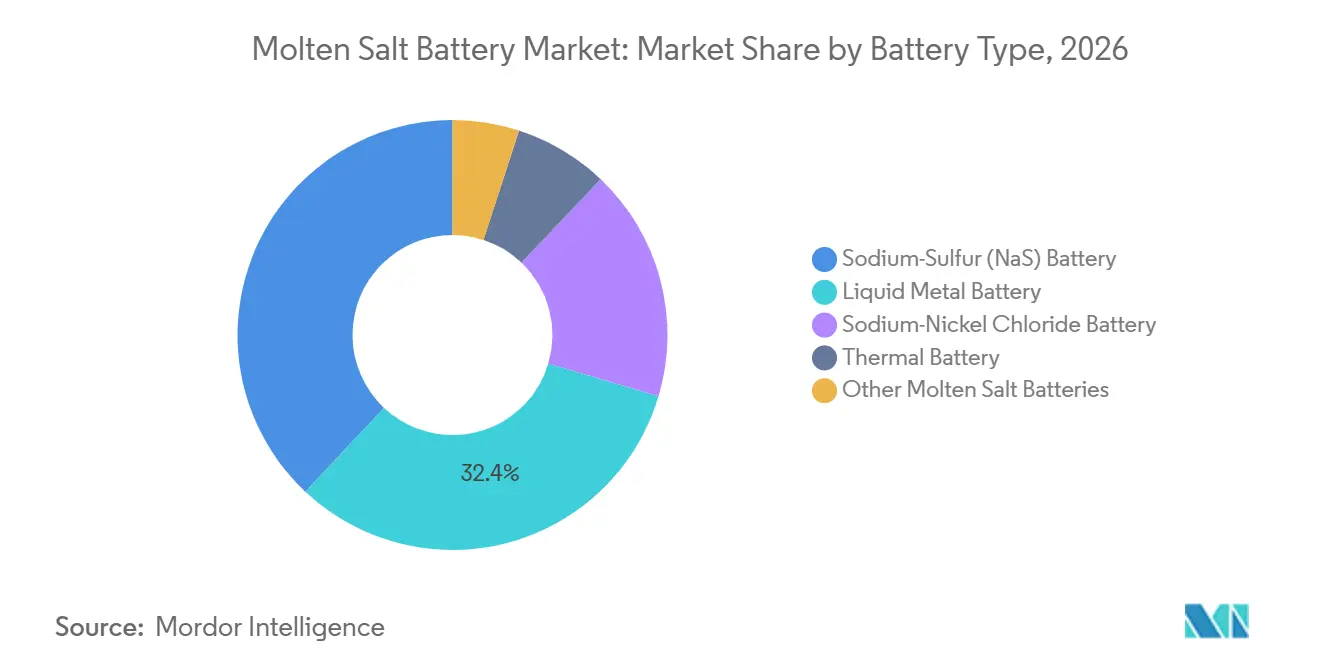
Liquid Metal Chemistry Holds the Largest Current PositionLiquid metal batteries held 32.4% of the molten salt battery market share in 2026, making this chemistry the largest battery-type category. Their position reflects long cycle-life stability in stationary grid applications. These systems operate without the thermal runaway profile associated with lithium-ion batteries. The segment has attracted capital toward architectures with multi-year operating evidence, favoring developers that can demonstrate reliable cell operation and practical thermal control.
Sodium-sulfur systems had more than 5 GWh of cumulative global deployments before NGK Insulators, Ltd. ended new manufacturing and sales in 2025. The company's exit has left new project pipelines without their historic primary supplier. Sodium-nickel chloride batteries remain relevant for industrial and uninterruptible power applications, particularly where fire resistance and wide operating temperature ranges are valued. Thermal batteries serve a separate defense and aerospace niche as primary, non-rechargeable systems. Their demand is supported by long qualification cycles and sole-source purchasing arrangements rather than utility storage economics. The molten salt battery market therefore includes chemistry groups with distinct customer needs and purchasing structures.

By Capacity:
Systems Above 10 MWh Lead Future ExpansionThe 1 MWh to 10 MWh range accounted for 41.4% of the molten salt battery market size in 2026. This range is used in commercial, industrial, and grid-connected applications that require more energy than small backup systems provide. Lithium-ion batteries retain advantages in familiar installation practices and power-to-energy performance at smaller scales. Molten salt systems present a stronger economic case when long discharge duration is required, and this distinction shapes how developers assess storage alternatives across capacity ranges.
Systems above 10 MWh are forecast to expand at a 24.6% CAGR through 2032. At this scale and beyond 8 hours of discharge, energy capacity can become more important than power rating in the project cost structure. Small systems below 100 kWh continue to serve military and off grid uses, including qualified thermal battery applications. The 100 kWh to 1 MWh range supports industrial peak shaving and backup power. Contemporary Amperex Technology Co., Limited introduced its TENER sodium-ion energy storage system in June 2026 and expects cumulative shipments to reach 1 GWh by the end of 2026.[4] Its arrival adds a competing long-duration platform to the most contested capacity bands of the molten salt battery market.
By Deployment:
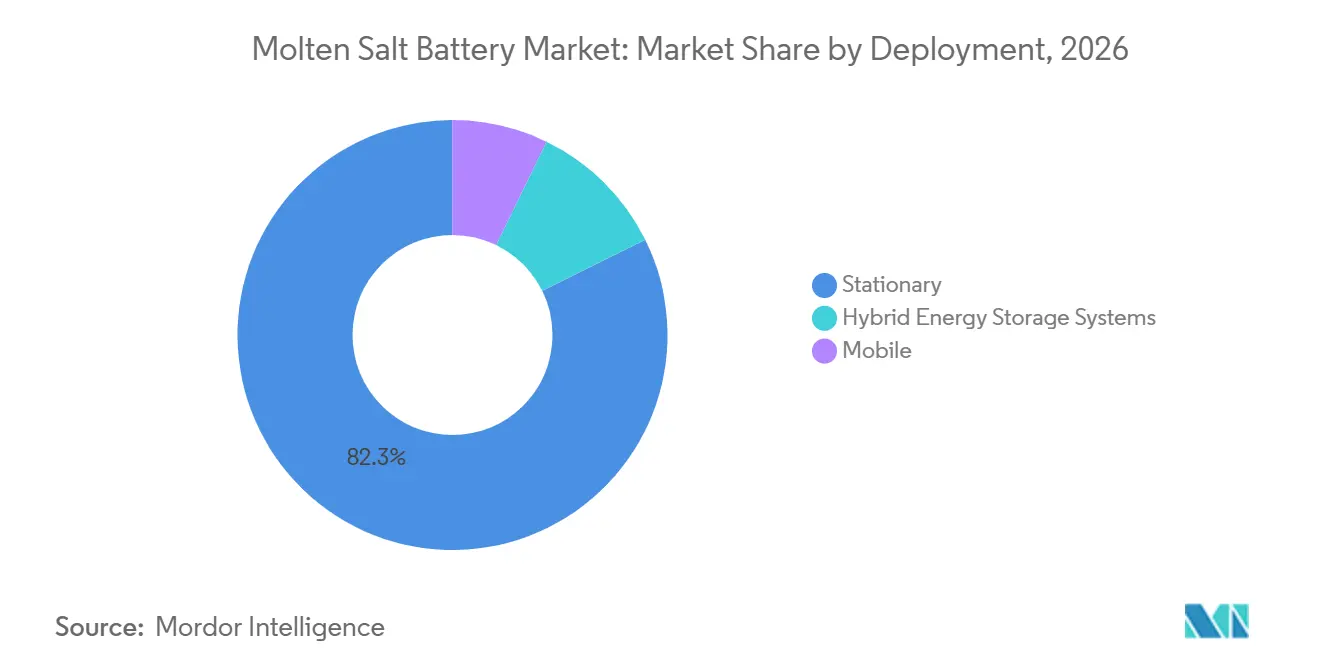
Stationary Systems Remain the Main Revenue BaseStationary systems accounted for 82.3% of the molten salt battery market in 2026. Fixed deployment allows thermal management costs to be amortized over long asset lives. The category includes utility-scale projects, behind-the-meter industrial systems, and storage linked to renewable plants. This broad application base supports demand even as individual battery designs evolve, and it also explains why mobile deployment remains limited.
Hybrid energy storage systems are forecast to grow at a 24.1% CAGR through 2032. Grid operators can combine long-duration molten salt capacity with faster lithium-ion systems when a project requires both energy depth and rapid response. Such combinations address requirements that are difficult for a single chemistry to meet. Mobile applications remain constrained by temperature requirements and weight-to-energy considerations, with defense systems being the main exception, as sealed thermal batteries can meet demanding reliability and shelf-life specifications. These deployment patterns keep the molten salt battery market focused on fixed infrastructure and specialized mission-critical equipment.
By End User:
Renewable Developers Have the Fastest Growth OutlookUtilities and power generation companies accounted for 46.5% of 2026 revenue. They can use long-term grid-service contracts and established procurement processes to support larger storage investments. Their projects often require storage for grid balancing, reliability, and renewable integration. These customers are also better positioned to spread thermal management costs across long operating periods, and utility demand remains central to the molten salt battery market.
Renewable energy developers are forecast to grow at a 23.6% CAGR through 2032. Independent generators increasingly need storage they can own, and dispatch as variable renewable output affects project finance. NGK Insulators, Ltd. commissioned a sodium-sulfur battery for MVM Balance Zrt. in Hungary in June 2025 to verify grid storage and ancillary-service provision. Commercial and industrial customers use high-temperature batteries for peak shaving and backup power where fire safety requirements restrict lithium-ion deployment. Military customers generate high value from qualified thermal batteries, while telecommunications users value maintenance-free operation in remote locations. Residential adoption remains limited because high operating temperatures require safety infrastructure that is not practical for most homes.
Geography Analysis
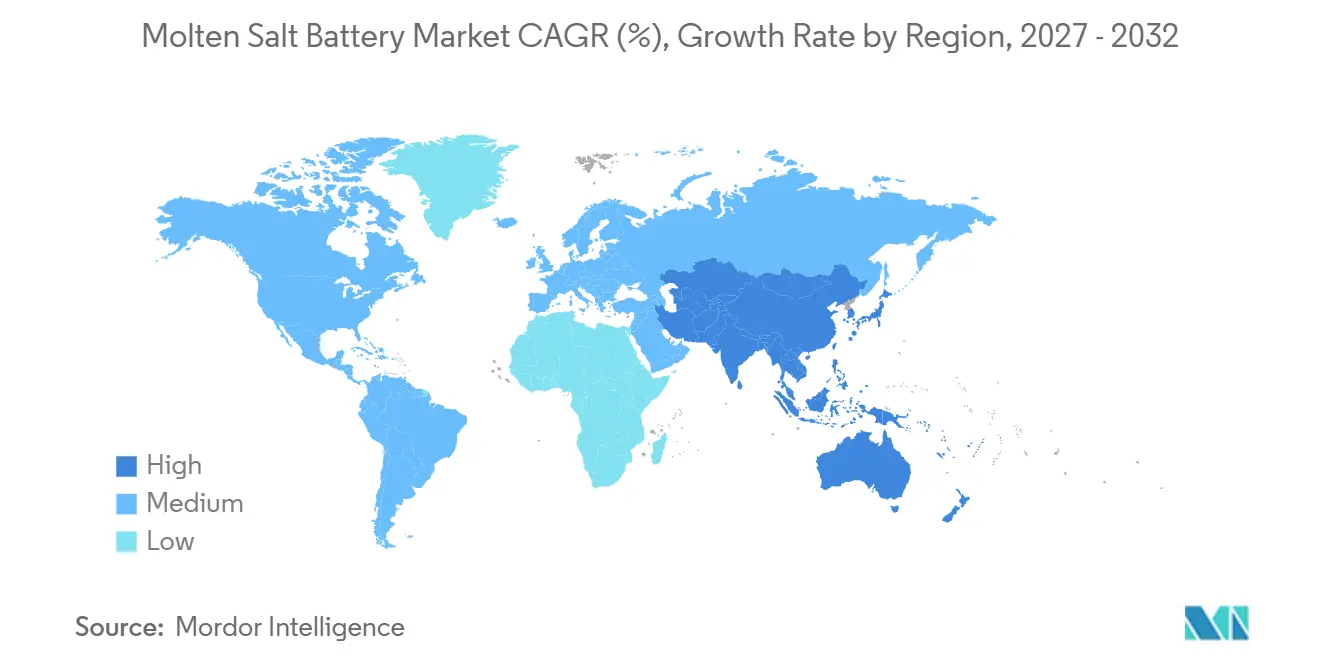
North America accounted for 33.6% of the molten salt battery market share in 2026. The United States supports demand through grid reliability initiatives, federal energy programs, and utility procurement for long-duration assets. FERC's 2026 work on inverter-based resource reliability and expedited interconnection studies supports the broader storage pipeline. Canada's clean-energy incentives and Mexico's industrial storage demand add to the regional base. North America combines policy support with established utility purchasing capacity.
Asia-Pacific is forecast to grow at a 24.2% CAGR through 2032, the fastest regional rate in the analysis. China is building a significant procurement base for sodium-related energy storage. The China Energy Storage Alliance (CNESA) reported that in the first half of 2026, 8 sodium-based storage tenders totaling 170 MW and 512 MWh were awarded. China's domestic component supply and manufacturing scale may support lower system costs for the molten salt battery market. India and Southeast Asia remain earlier-stage markets where demand is centered on industrial backup and off-grid systems in the 100 kWh to 1 MWh range.
Europe holds the second-largest regional position in this analysis. The United Kingdom's Long-Duration Energy Storage (LDES) scheme provides an explicit demand signal for projects that can discharge for 8 hours or longer. Germany is developing sodium-ion manufacturing capabilities through a consortium that includes research and industrial partners. The Middle East and Africa offer a niche for stationary systems, while South America remains an earlier-stage renewable-firming opportunity.
Competitive Landscape
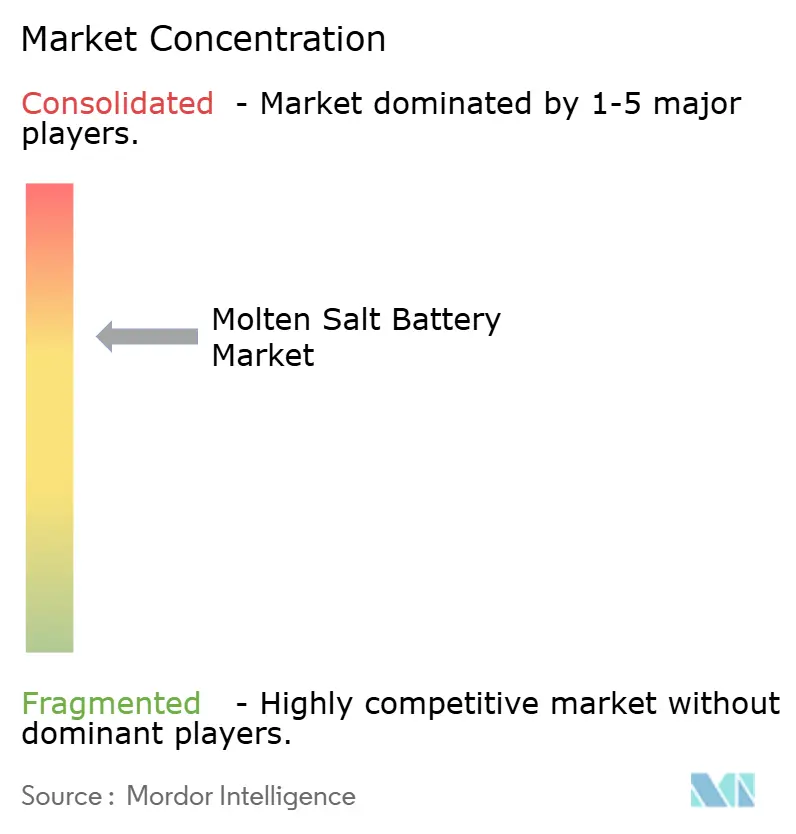
The molten salt battery market is moderately fragmented at the global level, although individual regions have concentrated supply positions. Chinese manufacturers are positioned to benefit from domestic sodium-based storage procurement and local component supply. Western suppliers are more focused on defense, industrial, and other high-value niches. NGK Insulators' 2025 decision to stop NAS battery manufacturing and sales reduced the number of established suppliers for new sodium-sulfur projects. This has created openings for companies able to supply high-temperature systems at competitive prices.
EaglePicher Technologies is pursuing a defense-focused strategy through thermal battery manufacturing for missile, space, and unmanned underwater vehicle programs. The company announced a new energetics facility in Joplin, Missouri, in November 2024, with semi-automated manufacturing and annual revenue capacity of USD 80 million. NGK Insulators completed commissioning of a sodium-sulfur system for Hungary's MVM Balance Zrt. in June 2025 to assess grid storage and ancillary services. BASF and NGK Insulators also introduced the NAS MODEL L24 in 2024 with improved corrosion management and heat control. These developments indicate that manufacturers are competing through specialized applications, operating performance, and manufacturing capability.
Future opportunities include systems that reduce high-temperature operating requirements, sodium-nickel chloride products for industrial users, and hybrid storage designs. A 2025 Nature Communications paper described a calcium-antimony liquid metal cell with self-assembling porous electrode networks in a calcium chloride (CaCl2)-lithium chloride (LiCl) electrolyte. This research points to possible reductions in material and manufacturing complexity for liquid metal designs. Standards work and qualified-supplier status can become important competitive barriers in defense and aerospace applications.
Molten Salt Battery Industry Leaders
-
NGK INSULATORS, LTD.
-
BASF Stationary Energy Storage GmbH
-
Sumitomo Electric Industries, Ltd.
-
Ambri Inc.
-
HORIEN Salt Battery Solutions
- *Disclaimer: Major Players sorted in no particular order
Molten Salt Battery Market Companies Covered in this Report
- Altech Batteries Limited
- Ambri Inc.
- ASB Group
- BASF SE
- BroadBit Batteries Oy
- Diehl Defence GmbH & Co. KG
- EaglePicher Technologies, LLC
- EnerSys
- FIAMM Energy Technology S.p.A.
- General Electric Company / GE Vernova
- HORIEN Salt Battery Solutions
- Kanto Denka Kogyo Co., Ltd.
- Mitsubishi Heavy Industries, Ltd.
- NGK Insulators, Ltd.
- POSCO Holdings Inc.
- Saft Groupe S.A. / TotalEnergies
- Shanghai Electric Group Co., Ltd.
- Sumitomo Electric Industries, Ltd.
- Technosetbee S.r.l.
- Zhejiang AMPower Co., Ltd.
Recent Industry Developments in Molten Salt Battery Market
- September 2026: A 250 kW / 1.45 MWh NAS sodium-sulfur battery manufactured by NGK Insulators is commissioned at Lava Blue's Centre for Predictive Research into Specialty Materials (PRiSM) in Brisbane. The molten-salt battery is connected to the grid and integrated with a 200 kW solar installation to demonstrate long-duration storage performance under Australian operating conditions.
- October 2025: NGK Insulators decided to discontinue manufacturing and sales of its sodium-sulfur (Na-S) battery business and cease accepting new orders. The company cited rising material costs, competition from lithium-ion batteries, and slower-than-expected adoption of long-duration storage.
- June 2025: NGK Insulators completed the installation and commissioning of a sodium-sulfur (Na-S) battery system for MVM Balance Zrt., part of MVM Group. The project was intended to validate grid-scale energy storage and ancillary services for the Hungarian power network.
Global Molten Salt Battery Market Report Scope
A molten salt battery is an electrochemical cell that uses molten salts as its electrolyte to conduct electrical charge. Also known as a liquid metal or thermal battery, it operates at high temperatures, typically between 200°C and 700°C, to keep the chemical components in a fluid, highly conductive state. This elevated temperature enables high power density and energy efficiency, making molten salt batteries suitable for large-scale grid energy storage.
The global molten salt battery market is segmented by battery type, capacity, deployment, end user, and geography. By battery type, the market is segmented into sodium-sulfur (NaS) batteries, sodium-nickel chloride batteries, liquid metal batteries, thermal batteries, and other molten salt batteries. By capacity, the market is segmented into below 100 kWh, 100 kWh to 1 MWh, 1 to 10 MWh, and above 10 MWh. By deployment, the market is segmented into stationary, mobile, and hybrid energy storage systems. By end user, the market is segmented into utilities and power generation companies, commercial and industrial, renewable energy developers, telecommunications, transportation, military and defense, residential, and other end users. The report also covers the market size and forecasts for the global molten salt battery market across 26 countries in key regions. For each segment, the market sizing and forecasts are provided on the basis of value (USD).
Segmentation Overview
| Sodium-Sulfur (NaS) Battery |
| Sodium-Nickel Chloride Battery |
| Liquid Metal Battery |
| Thermal Battery |
| Other Molten Salt Batteries |
| Below 100 kWh |
| 100 kWh–1 MWh |
| 1–10 MWh |
| Above 10 MWh |
| Stationary |
| Mobile |
| Hybrid Energy Storage Systems |
| Utilities and Power Generation Companies |
| Commercial and Industrial |
| Renewable Energy Developers |
| Telecommunications |
| Transportation |
| Military and Defense |
| Residential |
| Other End Users |
| North America | United States |
| Canada | |
| Mexico | |
| Europe | Germany |
| France | |
| Italy | |
| Spain | |
| United Kingdom | |
| Poland | |
| Russia | |
| Rest of Europe | |
| Asia-Pacific | China |
| India | |
| Japan | |
| South Korea | |
| Australia | |
| Indonesia | |
| Vietnam | |
| Thailand | |
| Rest of Asia-Pacific | |
| South America | Brazil |
| Argentina | |
| Chile | |
| Rest of South America | |
| Middle East and Africa | Saudi Arabia |
| United Arab Emirates | |
| Egypt | |
| South Africa | |
| Morocco | |
| Rest of Middle East and Africa |
| By Battery Type | Sodium-Sulfur (NaS) Battery | |
| Sodium-Nickel Chloride Battery | ||
| Liquid Metal Battery | ||
| Thermal Battery | ||
| Other Molten Salt Batteries | ||
| By Capacity | Below 100 kWh | |
| 100 kWh–1 MWh | ||
| 1–10 MWh | ||
| Above 10 MWh | ||
| By Deployment | Stationary | |
| Mobile | ||
| Hybrid Energy Storage Systems | ||
| By End User | Utilities and Power Generation Companies | |
| Commercial and Industrial | ||
| Renewable Energy Developers | ||
| Telecommunications | ||
| Transportation | ||
| Military and Defense | ||
| Residential | ||
| Other End Users | ||
| By Geography | North America | United States |
| Canada | ||
| Mexico | ||
| Europe | Germany | |
| France | ||
| Italy | ||
| Spain | ||
| United Kingdom | ||
| Poland | ||
| Russia | ||
| Rest of Europe | ||
| Asia-Pacific | China | |
| India | ||
| Japan | ||
| South Korea | ||
| Australia | ||
| Indonesia | ||
| Vietnam | ||
| Thailand | ||
| Rest of Asia-Pacific | ||
| South America | Brazil | |
| Argentina | ||
| Chile | ||
| Rest of South America | ||
| Middle East and Africa | Saudi Arabia | |
| United Arab Emirates | ||
| Egypt | ||
| South Africa | ||
| Morocco | ||
| Rest of Middle East and Africa | ||
Key Questions Answered in the Report
What is the projected value of the molten salt battery market by 2032?
The molten salt battery market is forecast to reach USD 14.67 billion by 2032, growing at a 22.56% CAGR from 2027, driven by demand for longer-duration storage in grid and renewable energy projects.
Which battery type held the largest share in 2026?
Liquid metal batteries held the largest battery-type share at 32.4% in 2026, reflecting their long cycle-life stability in stationary applications.
Which capacity range is growing fastest?
Systems above 10 MWh are forecast to grow at a 24.6% CAGR through 2032, driven by the expansion of longer-duration projects where discharge duration is prioritized over rapid power delivery.
Why are utilities adopting molten salt batteries?
Utilities use these systems for grid reliability, ancillary services, and longer-duration renewable energy integration. They are most suitable where fixed assets can spread thermal management costs over long operating periods.
Which region is expanding fastest through 2032?
Asia-Pacific is forecast to grow at a 24.2% CAGR through 2032, supported by sodium-based storage procurement in China. The regional supply base can influence system pricing in the molten salt battery market.