
Long Duration Energy Storage Market Size and Share
Market Overview
| Study Period | 2022 - 2032 |
|---|---|
| Market Size (2027) | USD 6.64 Billion |
| Market Size (2032) | USD 12.33 Billion |
| Growth Rate (2027 - 2032) | 13.18 % |
| Fastest Growing Market | Asia-Pacific |
| Largest Market | North America |
| Market Concentration | Low |
Major Players *Disclaimer: Major Players sorted in no particular order Image © Mordor Intelligence. Reuse requires attribution under CC BY 4.0. | |
Long Duration Energy Storage Market Analysis by Mordor Intelligence
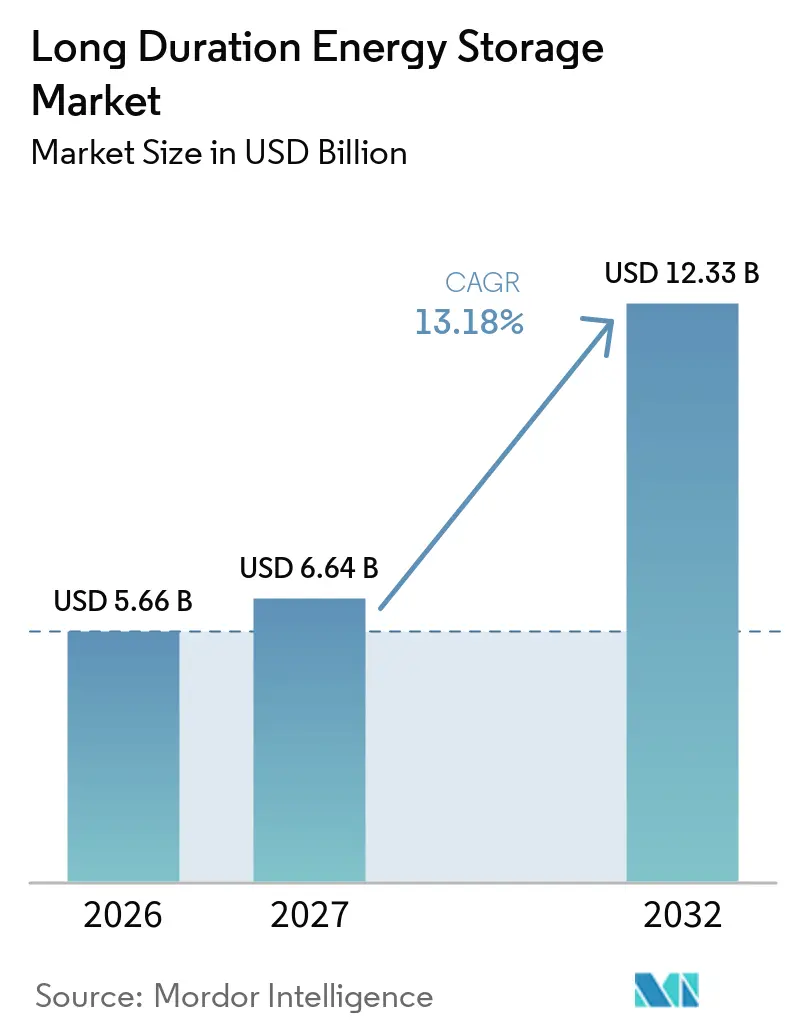
The global long duration energy storage market size was valued at USD 5.66 billion in 2026 and is estimated to grow from USD 6.64 billion in 2027 to reach USD 12.33 billion by 2032, at a CAGR of 13.18% during the forecast period (2027-2032). The market is moving beyond short daily balancing as power systems require reliable capacity during extended periods of low wind and solar output. Demand is supported by utility procurement, storage tax incentives, and direct contracts from data center developers. These contracts provide project developers with clearer revenue visibility before manufacturing capacity is established. The market also faces high capital requirements, long permitting timelines, and strong competition from lithium-ion systems in applications requiring up to 8 hours of storage. Projects that reuse existing grid connections or combine renewable generation with storage can reduce development constraints and improve delivery schedules. Mordor Intelligence
Key Report Takeaways
- By technology, mechanical storage held 43.2% of the long duration energy storage market share in 2026, while chemical storage is forecast to expand at a 14.5% CAGR through 2032.
- By storage duration, the 10-24 hour category held a 70.1% share in 2026, while the 36-100 hour category is forecast to grow at a 15.4% CAGR through 2032.
- By installation type, grid-scale systems held a 71.6% share in 2026, while hybrid renewable-storage systems are forecast to grow at a 15.6% CAGR through 2032.
- By energy capacity, the 100-500 MWh category accounted for 45.3% of the long duration energy storage market size in 2026, while projects above 1 GWh are forecast to expand at a 15.4% CAGR through 2032.
- By geography, North America held 35.7% share in 2026, while Asia-Pacific is forecast to expand at a 14.6% CAGR through 2032.
Note: Market numbers in this report are based on Mordor Intelligence's proprietary estimation framework, which combines nine months of actuals with Q4 projections for base year 2026.
Market Trends and Insights
Drivers Impact Analysis of Long Duration Energy Storage Market*
| Driver | (~) % Impact on CAGR Forecast | Geographic Relevance | Impact Timeline |
|---|---|---|---|
| Rising Variable Renewable-Energy Penetration | +3.2% | Global, most acute in China, Germany, Australia, and the United States | Medium term (2-4 years) |
| Grid Resilience and Reliability Requirements | +2.1% | North America, the United Kingdom, and Australia | Medium term (2-4 years) |
| Decarbonization and Fossil-Fuel Peaker Replacement | +1.5% | North America and Europe | Long term (≥ 4 years) |
| Revenue-Certain Procurement and Storage Incentives | +1.8% | United States, United Kingdom, Italy, and Australia | Short term (≤ 2 years) |
| Data-Center Load Clustering and Firm-Capacity Demand | +2.0% | North America, with spillover to Europe and Asia-Pacific | Short term (≤ 2 years) |
| Brownfield Grid-Interconnection and Thermal-Asset Repurposing | +0.7% | North America, Europe, and Southern Africa | Long term (≥ 4 years) |
| Source: Mordor Intelligence | |||
Rising Variable Renewable-Energy Penetration
The long duration energy storage market benefits when renewable generation becomes too large for short-duration batteries to manage periods of low output. Japan's New Energy and Industrial Technology Development Organization expects annual LDES deployment to rise from 10 GWh in 2025 to 118 GWh by 2035 as grid needs shift toward interday balancing. China added 18 GW of pumped hydro capacity in 2025 and had more than 120 GW in construction or advanced planning. These additions indicate that large power systems are preparing for storage needs beyond intraday balancing. Brazil's renewable electricity share reached 90%, while its curtailment losses totaled USD 1.1 billion in 2025.[1] Such losses strengthen the case for long duration energy storage market growth in systems where variable output can no longer be absorbed by existing grid flexibility.
Data-Center Load Clustering and Firm-Capacity Demand
The long duration energy storage market is gaining a new customer group as data centers seek continuous power near constrained transmission networks. Bloom Energy projected that U.S. IT load capacity could increase from 80 GW in 2025 to 150 GW in 2028. Developers in these locations can value firm power contracts more highly than merchant market revenues because delayed grid connections can affect construction schedules. Form Energy and Xcel Energy announced a 300 MW, 30 GWh iron-air project for a Google data center in Minnesota in March 2026. Form Energy also signed a 12 GWh capacity agreement with Crusoe Energy for AI data center infrastructure. These commitments can support long duration energy storage market manufacturing scale before technologies compete broadly in wholesale electricity markets.
Revenue-Certain Procurement and Storage Incentives
The long duration energy storage market is supported when policy moves from grants toward arrangements that provide predictable revenue. The U.S. Section 48E credit can offset 30% to 50% of qualifying standalone storage capital costs, depending on eligibility for adders. For a USD 400 million iron-air project, a 30% credit would reduce effective equity exposure by more than USD 120 million. The United Kingdom provisionally selected 16 projects for its first LDES cap and floor scheme in June 2026. The scheme includes revenue protection that addresses merchant risk and can support long duration energy storage market projects with long construction periods. China also introduced capacity pricing that pays higher fees to grid-side systems capable of 6 or more hours of full-power discharge.
Grid Resilience and Reliability Requirements
Grid operators are placing more weight on long-duration assets as thermal generation retires and variable renewable output increases. The U.S. Department of Energy set a target to reduce the cost of grid-scale long-duration storage to below USD 0.05 per kWh by 2030. The department also committed USD 505 million for LDES demonstration projects under the Inflation Reduction Act. California required procurement of 1 GW of resources capable of 12 or more hours of duration by 2031.[2] Massachusetts and New York also set storage goals that include long-duration components. Existing market rules still often favor short-duration systems, which means capacity payments remain important for longer-duration projects.
Restraints Impact Analysis of Long Duration Energy Storage Market*
| Restraint | (~) % Impact on CAGR Forecast | Geographic Relevance | Impact Timeline |
|---|---|---|---|
| High Upfront Capital Costs and Long Project Development Cycles | -2.8% | Global | Short term (≤ 2 years) |
| Immature Technologies and Limited Economies of Scale | -1.5% | Global, more acute in emerging markets | Medium term (2-4 years) |
| Lithium-Ion Cost Leadership in the 4-to-8-Hour Market | -1.8% | Global | Medium term (2-4 years) |
| Limited Standardization, Insurance Data and Long-Term Performance Guarantees | -0.9% | Global | Long term (≥ 4 years) |
| Source: Mordor Intelligence | |||
High Upfront Capital Costs and Long Project Development Cycles
The long duration energy storage market faces cost constraints that arise from entire system designs rather than battery cells alone. Pumped hydro and compressed air projects require specialized civil works, while flow batteries require large electrolyte volumes and balance-of-plant equipment. In January 2025, Hydrostor received a conditional loan guarantee of up to USD 1.76 billion for its 500 MW, 4,000 MWh Willow Rock compressed-air project in California. The project still needed to complete environmental review, demonstrating how regulatory approvals can delay deployment even after financing commitments are secured. Project development for pumped hydro and compressed air can take 8 to 15 years from site identification to commissioning. Developers must also address IEC 62933 requirements and national fire safety requirements, which can vary across jurisdictions.
Lithium-Ion Cost Leadership in the 4-to-8-Hour Market
Lithium-ion systems remain a strong alternative for projects requiring 4 to 8 hours of storage rather than multiday dispatch. This cost position can limit the adoption of long-duration technologies until duration-specific procurement rules are more widely implemented. Utility planning models often select 4-hour lithium-ion systems as the lowest-cost option for current capacity needs. The practical advantage of longer storage depends on local renewable output, grid congestion, and the availability of capacity revenues. Long-duration energy storage developers therefore need use cases where system reliability has a clear value beyond daily price arbitrage. The long duration energy storage market has greater room to expand where procurement frameworks distinguish multiday capacity from short-duration flexibility.
*Our forecasts treat driver/restraint impacts as directional, not additive. The impact forecasts reflect baseline growth, mix effects, and variable interactions.
Long Duration Energy Storage Market Segment Analysis
By Technology:
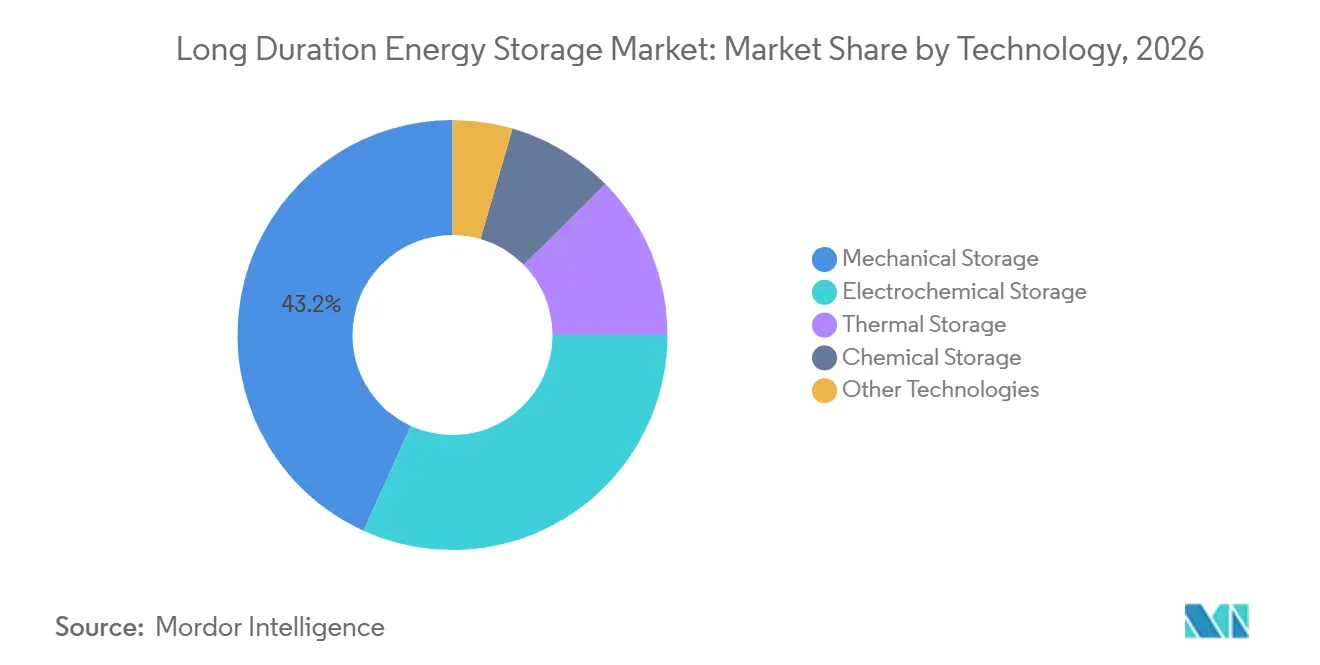
Chemical Storage Gains Ground on Mechanical IncumbencyMechanical storage held 43.2% of the long duration energy storage market share in 2026. Pumped hydro provided the main installed base, as plants can operate for 50-60 years and typically achieve round-trip efficiencies of 70-85%. Compressed air and gravity systems are broadening mechanical storage options where suitable sites are available. Electrochemical systems include vanadium, iron, and zinc flow batteries, which separate energy capacity from power capacity. Thermal storage supports industrial heat applications through molten salt, thermochemical materials, and solid-state media.
Chemical storage is forecast to achieve a 14.5% CAGR through 2032, the fastest rate among technology categories. Form Energy's West Virginia facility began commercial production and targets 500 MW of annual output by 2028. CMBlu Energy completed an initial EUR 50 million Series C close in April 2026 and reported a valuation above EUR 1 billion. Chemical storage can expand in urban and data center corridors because flow and iron-air systems do not require mountainous terrain or large reservoirs. Commercial execution will depend on repeatable manufacturing, customer contracts, and long-term performance data.

By Storage Duration:
36-100 Hours Supports Multi-Day ApplicationsThe 10–24-hour range held a 70.1% share in 2026. It supports daily charging during lower-demand periods and discharge during morning or evening peaks. Pumped hydro, vanadium flow batteries, and iron flow systems can serve applications in this range. The 24–36-hour range serves specialized needs such as extended critical backup and regional balancing. Storage above 100 hours remained a small category led by early iron-air installations and compressed-air research.
The 36–100-hour category is forecast to grow at a 15.4% CAGR through 2032. The New Energy and Industrial Technology Development Organization identifies storage exceeding 10 hours as an area where lithium-ion economics become less favorable for grid balancing. Data center load requirements can increase demand for continuous onsite power across multiple days. A 2025 study in iScience found that adiabatic compressed-air storage using low-cost rock caverns could support economically viable storage beyond 100 hours.[3] Projects with verified delivery and operating performance will be needed to establish this category at scale.
By Installation Type:
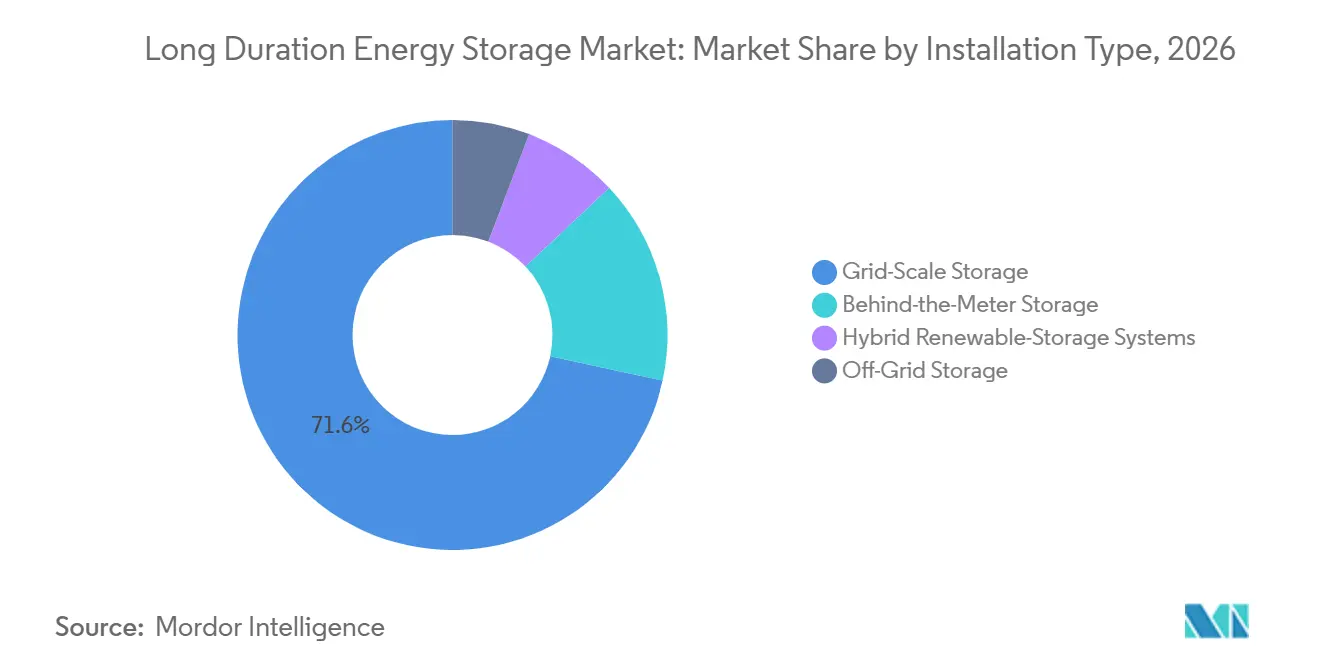
Hybrid Renewable-Storage Systems ExpandGrid-scale systems held a 71.6% share in 2026. This position reflects utility-scale pumped hydro and front-of-meter flow and compressed-air projects supported by tenders and long-term agreements. Behind-the-meter systems serve commercial and industrial sites that seek lower demand charges and improved power resilience. Off-grid systems can replace diesel generation in remote communities and on islands.
Hybrid renewable-storage systems are forecast to be the fastest-growing installation type at a 15.6% CAGR through 2032. They combine renewable generation with dispatchable storage under a single project structure. India's Barmer solar-wind-pumped storage project secured a power purchase agreement at INR 4.04 per kWh.[4] These structures can improve renewable deliverability and reduce exposure to standalone merchant storage revenues.
By Energy Capacity:
Above 1 GWh Projects Raise Project ScaleThe 100-500 MWh category accounted for 45.3% of the long duration energy storage market size in 2026. This range is suited to utility-scale projects that pair with grid-connected solar and wind farms. Systems below 100 MWh serve commercial sites, campus microgrids, and community resilience projects. The 500 MWh to 1 GWh category is growing as projects selected through public procurement move toward financial close. Larger projects require land, interconnection, financing, and delivery capabilities that are not always available to smaller developers.
Projects above 1 GWh are forecast to grow at a 15.4% CAGR through 2032. CMBlu Energy and Uniper signed a 10-year framework agreement for at least 5 GWh of SolidFlow storage capacity, with deliveries beginning in 2027 in minimum 100 MWh tranches. Form Energy's Minnesota project with Xcel Energy has 30 GWh of planned energy capacity. The United States Department of Energy identified 40 GW of retiring coal capacity that could offer existing grid interconnection for storage redevelopment. Reusing these locations can reduce interconnection delays for large projects.
Geography Analysis
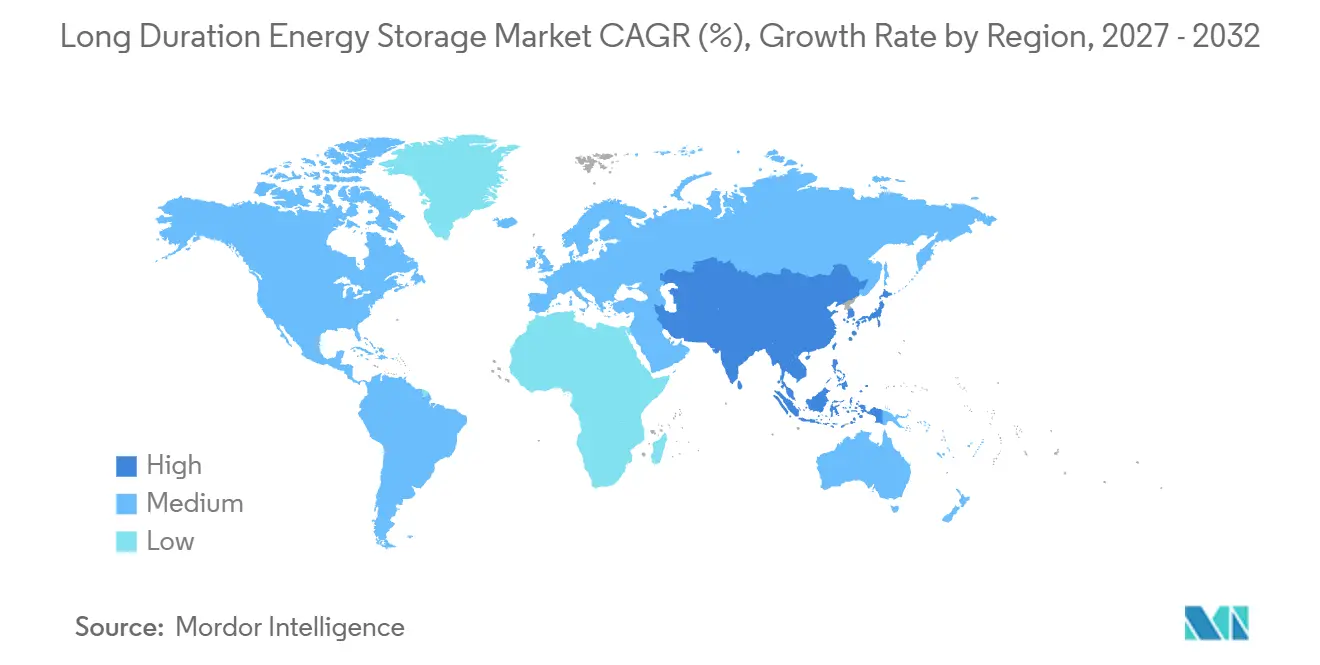
North America held a 35.7% share in 2026. The United States is the main deployment driver in the region, supported by federal incentives and state procurement requirements. The U.S. Department of Energy issued Hydrostor a conditional loan guarantee of up to USD 1.76 billion for the 500 MW, 4,000 MWh Willow Rock project. California required 1 GW of 12-hour-plus resources by 2031. Illinois enacted a 2026 law directing procurement of 3,000 MW of utility-scale storage by 2030.
Europe's long duration energy storage market is supported by a policy framework that combines revenue support with early commercial deployment. Ofgem provisionally selected 16 projects in June 2026 under the United Kingdom's first long duration energy storage cap and floor scheme. The selection included pumped hydro and battery projects eligible for a defined revenue floor. Germany's long-term grid planning assumptions also assign a larger role to battery storage. Invinity Energy Systems delivered a 20.7 MWh vanadium flow battery to the Copwood Energy Hub in East Sussex in May 2026.
Asia-Pacific is forecast to be the fastest-growing long duration energy storage market region, at a 14.6% CAGR through 2032. China added 35.3 GW of new energy storage in 2025, including 8.7 GW of systems with at least 4 hours of duration. Its energy plan calls for 160 GW of pumped hydro and 300 GW of new-type storage by 2030. India awarded contracts for 1,344 MW of combined pumped hydro and large-scale flow battery capacity in late 2025.
Competitive Landscape
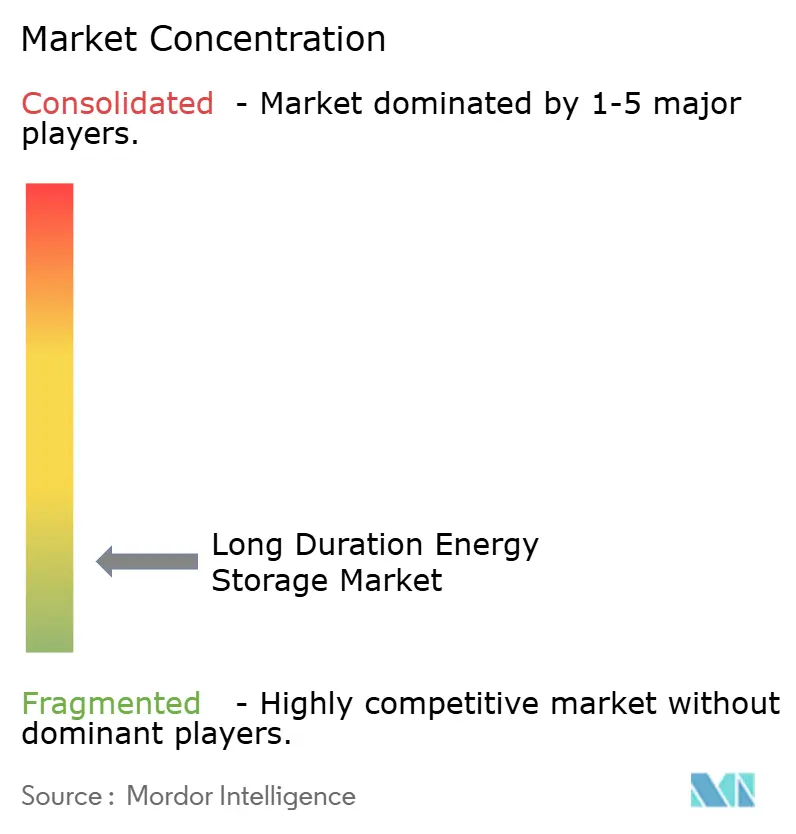
The long duration energy storage market is highly fragmented, with no company reported to hold more than a low single-digit share of installed commercial capacity. Pumped hydro remains largely within the domain of utilities and major engineering contractors. Form Energy and Eos Energy Enterprises focus on customer agreements that support manufacturing scale before broad deployment. CMBlu Energy, Invinity Energy Systems, and Sumitomo Electric Industries have pursued framework arrangements with industrial and utility customers.
Form Energy's agreement with Xcel Energy and Google covers a 300 MW, 30 GWh iron-air project in Minnesota. The company's agreement with Crusoe Energy Systems covers 12 GWh of iron-air batteries for AI data centers. Invinity Energy Systems was selected in June 2026 to design a 1.5 GWh vanadium flow battery system for the Laufenburg Technology Centre in Switzerland. These arrangements indicate that data center demand is becoming a key route to early commercial scale, while also raising the bar for developers that lack contracted customers or credible manufacturing plans.
MGA Thermal's 195 MWh thermochemical block project at Tronox's Kwinana Pigment Plant was supported by the Australian Renewable Energy Agency. Eos Energy Enterprises launched commercial production on a second automated line at its Thorn Hill facility in 2026 and is targeting 8 GWh of annual capacity. Invinity Energy Systems' Endurium platform holds CE, UL 1973, and UL 9540A certifications. Customer confidence in the long duration energy storage market will depend on project delivery, safety, and long operating records.
Long Duration Energy Storage Industry Leaders
-
Form Energy, Inc.
-
Eos Energy Enterprises, Inc.
-
Energy Vault Holdings, Inc.
-
Sumitomo Electric Industries, Ltd.
-
Highview Power
- *Disclaimer: Major Players sorted in no particular order
Long Duration Energy Storage Market Companies Covered in this Report
- CMBlu Energy AG
- Energy Dome S.p.A.
- Energy Vault Holdings, Inc.
- Eos Energy Enterprises, Inc.
- ESS Tech, Inc.
- e-Zinc Inc.
- Form Energy, Inc.
- Highview Power
- Hydrostor Inc.
- Invinity Energy Systems plc
- Malta Inc.
- MAN Energy Solutions SE
- MGA Thermal Pty Ltd
- Primus Power Corporation
- RheEnergise Limited
- Rondo Energy, Inc.
- StorEn Technologies Inc.
- Sumitomo Electric Industries, Ltd.
- VFlowTech Pte Ltd.
- VoltStorage GmbH
Recent Industry Developments in Long Duration Energy Storage Market
- September 2026: MN8 Energy, Google, and Eos Energy Enterprises announced a West Virginia project combining 86 MW of solar generation, 10 MW/100 MWh of Eos Z3 zinc battery long-duration storage, and 70 MW/280 MWh of lithium-ion storage. The project marks Google's first deployment of Eos Energy Enterprises' American-made zinc-based long-duration energy storage (LDES) technology.
- August 2026: Eos Energy Enterprises launched commercial production on its second automated manufacturing line at the Thorn Hill facility in Pennsylvania. The new line operates approximately 10% faster than the first line, representing a milestone toward Eos Energy Enterprises' planned 8 GWh annual manufacturing capacity for zinc-based long-duration batteries.
- July 2026: Eos Energy Enterprises received a USD 100 million purchase order from Frontier Power USA for deployment of its Z3 zinc-based long-duration storage technology at a US defense installation under the "Golden Dome for America" initiative, highlighting growing defense-sector adoption of long-duration energy storage.
- June 2026: Invinity Energy Systems was selected to design and engineer a 1.5 GWh vanadium flow battery system, expandable to 2.1 GWh, for FlexBase's Laufenburg Technology Centre in Switzerland. The project is among the largest announced vanadium flow battery developments globally, targeting power supply for AI data center infrastructure.
Global Long Duration Energy Storage Market Report Scope
Long-duration energy storage (LDES) refers to a class of technologies capable of capturing electrical energy from the grid or renewable sources and storing it for extended periods, typically ranging from 10 hours to several days or weeks, before discharging it back as power. Unlike standard lithium-ion batteries that are optimized for short durations of 2 to 4 hours, LDES systems use mechanical, chemical, thermal, or electrochemical mechanisms to manage prolonged grid imbalances. These technologies are critical for maintaining grid reliability during extended periods of low renewable generation, such as consecutive cloudy or windless days. By absorbing excess wind and solar energy, LDES prevents curtailment and ensures a continuous, decarbonized power supply during peak demand.
The global long-duration energy storage market is segmented by technology into mechanical storage, electrochemical storage, thermal storage, chemical storage, and other technologies. By storage duration, the market is segmented into 10 to 24 hours, 24 to 36 hours, 36 to 100 hours, and above 100 hours. By installation type, the market is segmented into grid-scale storage, behind-the-meter storage, off-grid storage, and hybrid renewable-storage systems. By energy capacity, the market is segmented into up to 100 MWh, 100 to 500 MWh, 500 to 1,000 MWh, and above 1 GWh. The report also covers market size and forecasts across 26 countries in key regions. For each segment, market sizing and forecasts are provided on the basis of value (USD).
Segmentation Overview
| Mechanical Storage |
| Electrochemical Storage |
| Thermal Storage |
| Chemical Storage |
| Other Technologies |
| 10–24 Hours |
| 24–36 Hours |
| 36–100 Hours |
| Above 100 Hours |
| Grid-Scale Storage |
| Behind-the-Meter Storage |
| Off-Grid Storage |
| Hybrid Renewable-Storage Systems |
| Up to 100 MWh |
| 100–500 MWh |
| 500–1,000 MWh |
| Above 1 GWh |
| North America | United States |
| Canada | |
| Mexico | |
| Europe | Germany |
| France | |
| Italy | |
| Spain | |
| United Kingdom | |
| Poland | |
| Russia | |
| Rest of Europe | |
| Asia-Pacific | China |
| India | |
| Japan | |
| South Korea | |
| Australia | |
| Indonesia | |
| Vietnam | |
| Thailand | |
| Rest of Asia-Pacific | |
| South America | Brazil |
| Argentina | |
| Chile | |
| Rest of South America | |
| Middle East and Africa | Saudi Arabia |
| United Arab Emirates | |
| Egypt | |
| South Africa | |
| Morocco | |
| Rest of Middle East and Africa |
| By Technology | Mechanical Storage | |
| Electrochemical Storage | ||
| Thermal Storage | ||
| Chemical Storage | ||
| Other Technologies | ||
| By Storage Duration | 10–24 Hours | |
| 24–36 Hours | ||
| 36–100 Hours | ||
| Above 100 Hours | ||
| By Installation Type | Grid-Scale Storage | |
| Behind-the-Meter Storage | ||
| Off-Grid Storage | ||
| Hybrid Renewable-Storage Systems | ||
| By Energy Capacity | Up to 100 MWh | |
| 100–500 MWh | ||
| 500–1,000 MWh | ||
| Above 1 GWh | ||
| By Geography | North America | United States |
| Canada | ||
| Mexico | ||
| Europe | Germany | |
| France | ||
| Italy | ||
| Spain | ||
| United Kingdom | ||
| Poland | ||
| Russia | ||
| Rest of Europe | ||
| Asia-Pacific | China | |
| India | ||
| Japan | ||
| South Korea | ||
| Australia | ||
| Indonesia | ||
| Vietnam | ||
| Thailand | ||
| Rest of Asia-Pacific | ||
| South America | Brazil | |
| Argentina | ||
| Chile | ||
| Rest of South America | ||
| Middle East and Africa | Saudi Arabia | |
| United Arab Emirates | ||
| Egypt | ||
| South Africa | ||
| Morocco | ||
| Rest of Middle East and Africa | ||
Key Questions Answered in the Report
What is the projected size of the long duration energy storage market by 2032?
The market is forecast to reach USD 12.33 billion by 2032, up from USD 6.64 billion in 2027, at a CAGR of 13.18%.
Which long duration energy storage technology holds the largest market share?
Mechanical storage held a 43.2% share in 2026, primarily due to the installed base of pumped hydro systems.
Which storage duration category is growing the fastest?
The 36-to-100-hour category is projected to grow at a CAGR of 15.4% through 2032, driven by multi-day grid and data center requirements.
Why are data centers adopting long duration storage?
Data centers require firm power where grid connections are constrained, and several developers have signed multi-gigawatt-hour iron-air battery agreements to meet this need.
Which region is forecast to record the fastest growth through 2032?
Asia-Pacific is projected to record a CAGR of 14.6% through 2032, led by storage deployment and policy support in China.
What are the key constraints limiting wider adoption of long duration storage systems?
High upfront costs, lengthy development timelines, and the cost advantages of lithium-ion systems in the 4 to 8 hour range remain the central constraints to wider adoption.