
Cultural Tourism Market Size and Share
Market Overview
| Study Period | 2021 - 2031 |
|---|---|
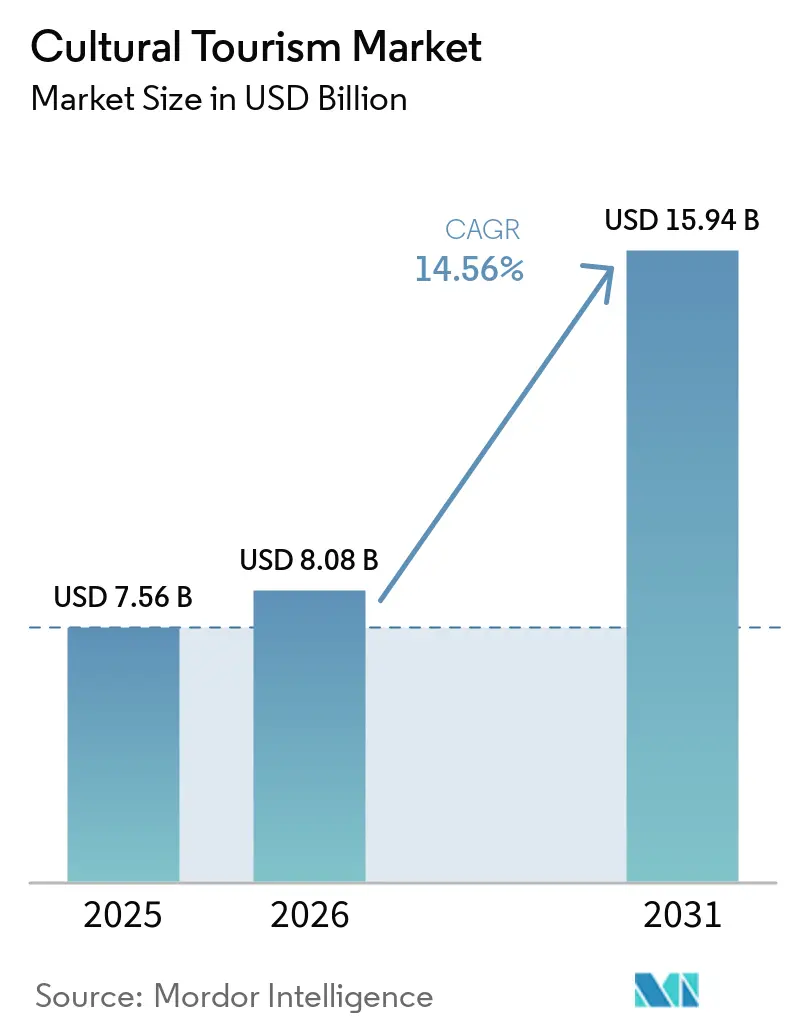
| Market Size (2026) | USD 8.08 Billion |
| Market Size (2031) | USD 15.94 Billion |
| Growth Rate (2026 - 2031) | 14.56 % |
| Fastest Growing Market | Asia-Pacific |
| Largest Market | Europe |
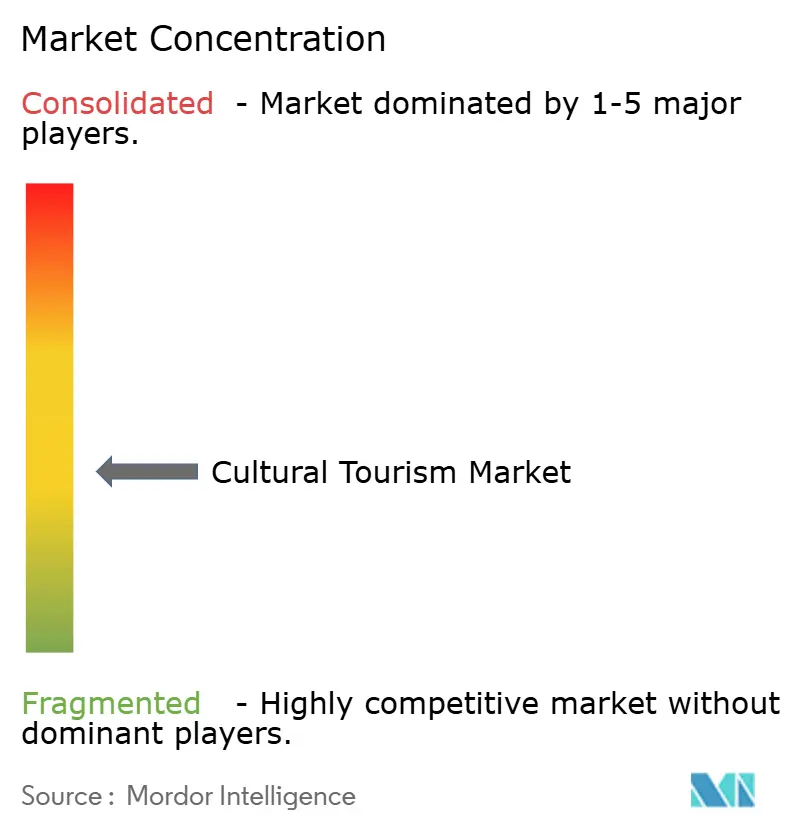
| Market Concentration | Medium |
Major Players *Disclaimer: Major Players sorted in no particular order Image © Mordor Intelligence. Reuse requires attribution under CC BY 4.0. | |
Cultural Tourism Market Analysis by Mordor Intelligence
The Global Cultural Tourism Market was valued at USD 7.56 billion in 2025 and is estimated to grow from USD 8.08 billion in 2026 to reach USD 15.94 billion by 2031, at a CAGR of 14.56% during the forecast period (2026–2031). This growth reflects stronger demand for travel centered on heritage, food, identity, and place-based experiences rather than standard sightseeing. International tourist arrivals reached 1.5 billion in 2025, and export revenues from international tourism rose to USD 2.2 trillion, providing a supportive operating environment for the market[1]. Europe remained the largest regional market, supported by 3.1 billion overnight stays in European Union tourism establishments in 2025 and strong visitor traffic to Spain, Italy, and France. Asia-Pacific is expected to expand faster than other regions, with Europe-bound arrivals from Asia-Pacific projected to rise by 16.8% in 2026. Tighter visitor management at major heritage sites is prompting operators and destination planners to expand into secondary cities, adding greater geographic depth to the Global Cultural Tourism Market over time.
Key Report Takeaways
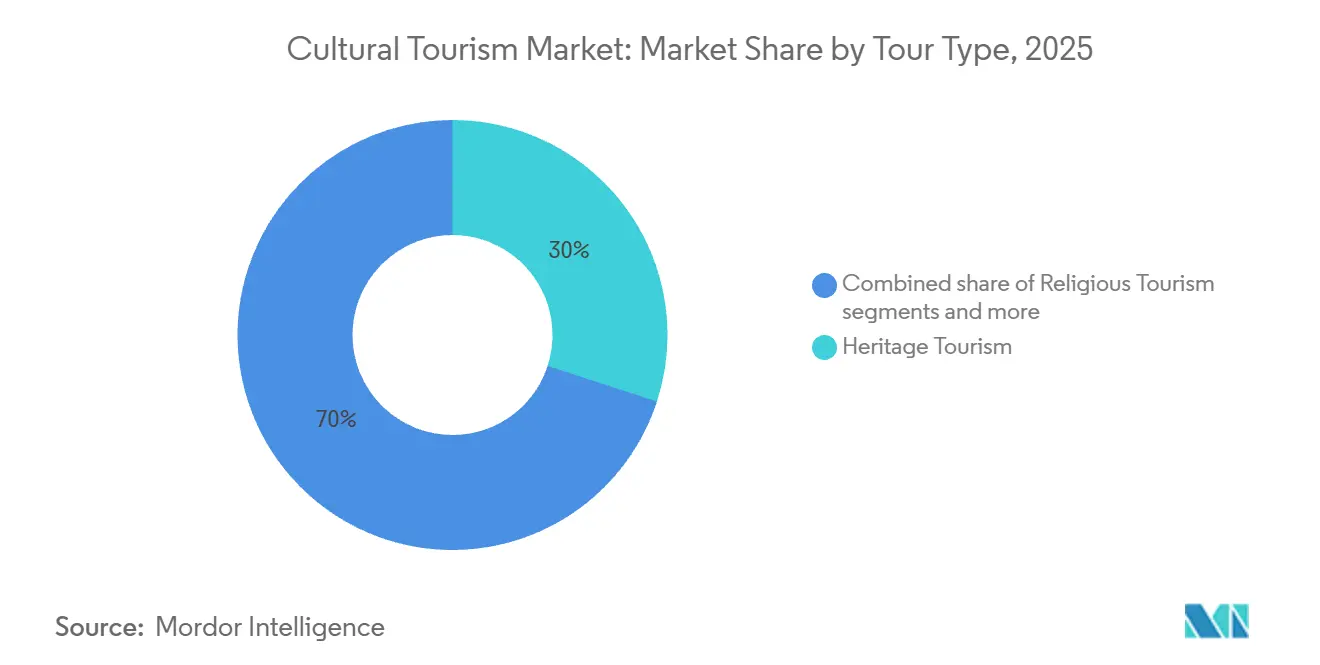
- By tour type, Heritage Tourism commanded a 30% share of the Global Cultural Tourism Market in 2025, while Culinary Tourism is projected to grow at the highest CAGR of 15.10% by 2031.
- By booking channel, Online Booking accounted for a 56% share of the Global Cultural Tourism Market in 2025 and is also projected to grow at the highest CAGR of 16.12% by 2031.
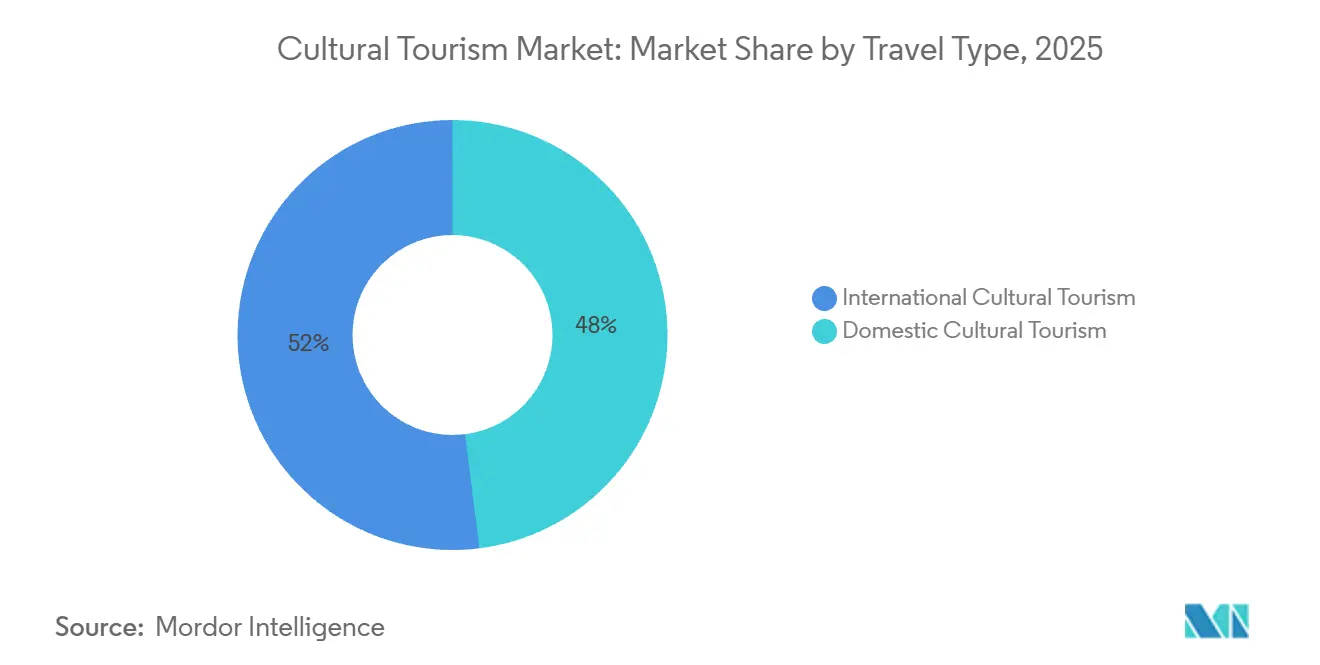
- By travel type, International Cultural Travel accounted for a 52% share of the Global Cultural Tourism Market in 2025 and is projected to grow at the highest CAGR of 14.88% by 2031.
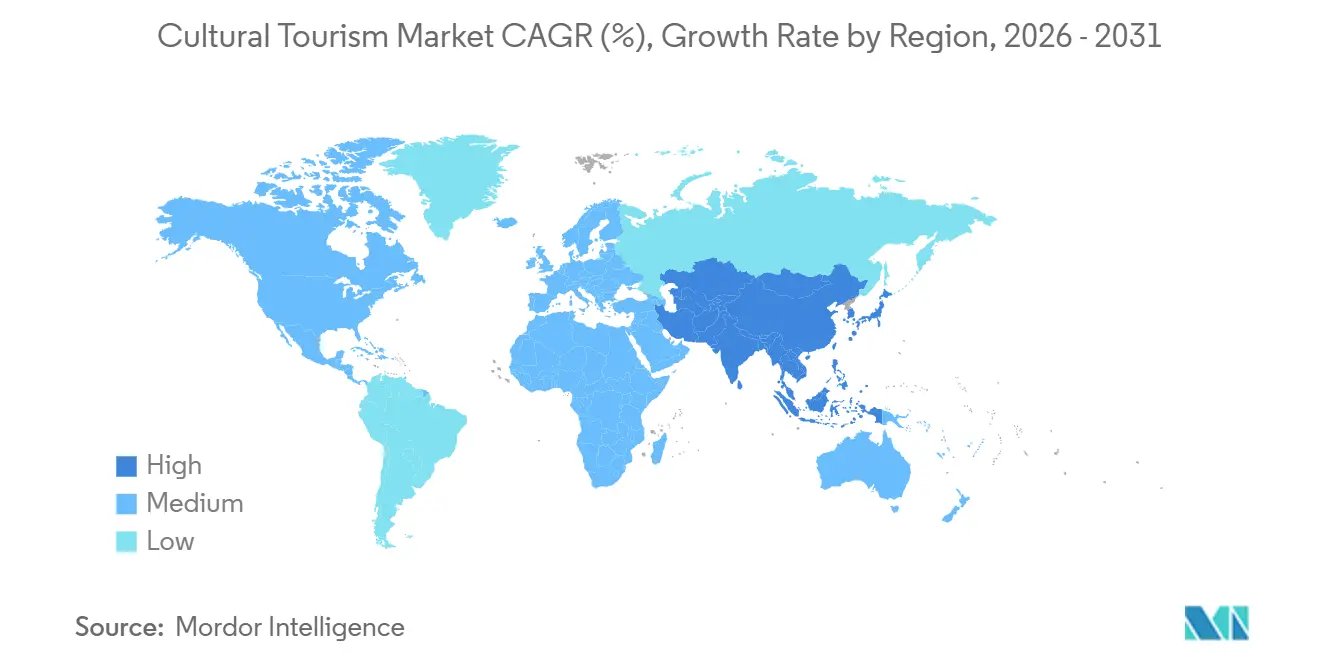
- By geography, Europe commanded a 33% share of the Global Cultural Tourism Market in 2025, while Asia-Pacific is projected to grow at the highest CAGR of 17.13% by 2031.
Note: Market size and forecast figures in this report are generated using Mordor Intelligence’s proprietary estimation framework, updated with the latest available data and insights as of January 2026.
Global Cultural Tourism Market Trends and Insights
Drivers Impact Analysis*
| Driver | (~) % Impact on CAGR Forecast | Geographic Relevance | Impact Timeline |
|---|---|---|---|
| Rising Demand for Authentic Heritage Experiences | +3.8% | Global, concentrated in Europe and the Asia-Pacific | Long term (≥ 4 years) |
| Social Media Amplification of Culture-Led Travel Discovery | +2.5% | Global accelerated in the Asia-Pacific core, with spillover to the Middle East and Africa | Medium term (2-4 years) |
| Expansion of Low-Cost Air Connectivity to Secondary Heritage Destinations | +2.1% | Europe, Southeast Asia, South America | Medium term (2-4 years) |
| Community-Led Curation and Local Entrepreneurship | +1.3% | Asia-Pacific core, South America, the Middle East, and Africa | Long term (≥ 4 years) |
| Growing Interest in Experiential and Slow Travel | +1.7% | North America and Europe, with spillover to the Asia-Pacific | Medium term (2-4 years) |
| Government-Led Heritage Preservation and Destination Repositioning | +1.9% | Middle East, South Asia | Long term (≥ 4 years) |
| Source: Mordor Intelligence | |||
Rising Demand for Authentic Heritage Experiences
Demand in the global cultural tourism market is shifting toward travel that carries historical significance, local participation, and a stronger cultural context. France recorded 102 million international arrivals in 2025 and EUR 77.50 billion (USD 91.16 billion) in international tourism receipts, equivalent to USD 83.7 billion, indicating that culture-rich destinations continue to attract high visitor volumes and high-value spending[2]. The French Ministry of Culture reported that visits to major heritage assets remained concentrated and resilient, supporting the view that monument-led travel still underpins the global cultural tourism market. This demand is not limited to major cities, as craft, fashion, and artisanal traditions in secondary destinations are also generating additional overnight stays and broader itinerary design. Community-led curation and local entrepreneurship support this shift, as travelers are increasingly willing to pay for guided access, local storytelling, and smaller-format experiences. Government-led preservation and destination repositioning reinforce this pattern, as improved interpretation, site management, and thematic route planning make heritage assets easier to package into bookable products over a longer period.
Social Media Amplification of Culture-Led Travel Discovery
Social media now plays a direct role in how consumers discover, compare, and decide on culture-led trips. A May 2026 study published in PLOS ONE found that government culture and tourism accounts on TikTok can improve destination image and raise travel intention through emotional and cognitive pathways[3]. Official destination promotion is no longer limited to broad awareness campaigns and now influences actual booking consideration for heritage and cultural circuits. The effect is particularly relevant for secondary destinations with limited marketing budgets, as short-form video can bring niche museums, food districts, living heritage zones, and local festivals to the attention of high-intent audiences. Local creators and small operators can present destinations through lived experience rather than generic advertising, supporting community-led curation. For the global cultural tourism market, the outcome is a shorter path from inspiration to booking and greater visibility for cultural products that previously fell outside mainstream tourism distribution.
Expansion of Low-Cost Air Connectivity to Secondary Heritage Destinations
Improved air access remains one of the clearest growth drivers for the global cultural tourism market, as many heritage assets are located outside primary leisure corridors. According to IATA, 58% of global tourists travel by air, confirming that aviation access shapes destination reach, trip frequency, and route viability. Lower-cost routes connecting secondary cities to major source markets make cultural travel more price-accessible and easier to package into shorter itineraries. This benefits destinations with strong cultural assets but limited historical tourism penetration, particularly in Southeast Asia, parts of Europe, and select South American corridors. It also reduces dependence on a narrow set of iconic gateway cities, which is important for the long-term balance of the global cultural tourism market. As route networks expand, operators with established local partnerships, transport integration, and curated on-ground inventory are likely to convert demand faster than generalist players.
Growing Interest in Experiential and Slow Travel
The growing preference for longer stays and slower-paced travel is driving growth in the Global Cultural Tourism Market, as cultural travelers increasingly prioritize immersion and local connections. Expedia reported in 2026 that 84% of consumers expressed interest in farm-stay accommodations, and Vrbo guest reviews mentioning farms rose by 300% year over year, indicating stronger demand for place-based and community-linked travel formats. A 2025 peer-reviewed study on Portugal's Alentejo region found that slow tourism supports deeper visitor connection, more authentic experiences, and stronger local economic sustainability. This trend supports cultural products that rely on workshops, culinary interaction, neighborhood exploration, and longer dwell time rather than rapid site-hopping. Smaller operators can monetize engagement quality rather than relying solely on volume, strengthening the business case for local entrepreneurship. For the Global Cultural Tourism Market, growth can be driven by greater itinerary depth and stronger local participation, rather than just increased visitor arrivals.
Restraints Impact Analysis*
| Restraint | (~) % Impact on CAGR Forecast | Geographic Relevance | Impact Timeline |
|---|---|---|---|
| Seasonality and Peak-Load Congestion at Cultural Attractions | -1.2% | Europe, especially the Southern Mediterranean, and South America | Short term (≤ 2 years) |
| Overtourism Pressure on Heritage Assets and Local Infrastructure | -1.1% | Global, concentrated in Europe and Peru | Medium term (2-4 years) |
| High Entry, Transport, and On-Site Experience Costs | -0.9% | North America and Europe | Medium term (2-4 years) |
| Geopolitical and Policy Volatility Affecting Cross-Border Travel Demand | -1.0% | Middle East, North Africa, with spillover to Europe | Short term (≤ 2 years) |
| Source: Mordor Intelligence | |||
Seasonality and Peak-Load Congestion at Cultural Attractions
Seasonality remains a practical constraint for the global cultural tourism market, as visitor demand continues to concentrate within narrow travel windows. France's Patrimostat 2025 showed that a large share of cultural visitation clustered around peak months, leaving destinations with periods of overcrowding followed by lower asset utilization for the remainder of the year[4]. This pattern increases transport costs, ticketing pressure, and staffing complexity while operators are expected to deliver a high-quality cultural experience. Scaling secondary heritage destinations also becomes more difficult, as traveler attention and airline capacity tend to remain tied to high-season schedules. Off-season packaging, timed access, and improved regional dispersal are becoming necessary tools for the market rather than optional enhancements. Without this shift, congestion will continue to limit visitor satisfaction and constrain the revenue potential of well-known cultural assets.
Overtourism Pressure on Heritage Assets and Local Infrastructure
Overtourism is a structural restraint on the global cultural tourism market, as conservation limits and local capacity constraints are increasingly difficult to separate from commercial planning. UNESCO's World Heritage and Sustainable Tourism Program has been implemented across World Heritage properties to support visitor management, conservation, and balanced tourism distribution, indicating that preservation pressure is no longer confined to a few destinations. As high-demand sites adopt stricter reservation systems, timed entry, and managed circulation, part of the market will shift from open access to rationed access. This improves conservation outcomes but caps volume growth at flagship destinations and raises operational demands for operators dependent on those sites. UNWTO reported that international arrivals grew by only 2% in Q1 2026 amid rising uncertainty, which first affects long-haul cultural travel. Combined with high entry and transport costs in mature destinations, these constraints are encouraging travelers and planners to consider newer cultural routes where pricing, access, and local capacity remain more manageable.
*Our forecasts treat driver/restraint impacts as directional, not additive. The impact forecasts reflect baseline growth, mix effects, and variable interactions.
Segment Analysis
By Tour Type: Heritage Anchors the Base, Culinary Tourism Redefines the Growth Ceiling
Heritage Tourism accounted for 30% of the Global Cultural Tourism Market in 2025, making it the largest tour type by revenue contribution. UNESCO lists 972 cultural World Heritage properties across 167 countries, providing the market with a wide and durable base of destination assets. Heritage products are easier to package across age groups, trip lengths, and spending levels, as they can be built around monuments, museums, districts, archaeological sites, and living traditions. They also align well with domestic demand, regional circuits, and religious or civilizational travel patterns, broadening the market's appeal in both mature and emerging destinations.
Culinary Tourism is projected to grow at 15.10% CAGR from 2026 to 2031, making it the fastest-growing tour type in the Global Cultural Tourism Market. Its expansion reflects the stronger role of food in destination identity, particularly when cuisine is linked with local narratives, markets, family-run venues, and regional traditions. UN Tourism's work on fashion and cultural tourism supports the broader point that creative and lifestyle expressions are becoming stronger commercial drivers for destination selection and overnight stays. Food-led experiences represent one of the clearest opportunities for secondary cities and smaller operators to grow without relying on landmark-scale heritage infrastructure.

By Booking Channel: Online Scale Converges with AI-Led Personalization
Online booking accounted for 56% of the global cultural tourism market in 2025 and is expected to remain the fastest-growing distribution format through 2031, with a forecast CAGR of 16.12%. This share reflects a broader shift in how cultural tourism is discovered, compared, and booked, with digital interfaces increasingly replacing physical booking points. Major travel brands are reinforcing this trend by expanding activity inventory, itinerary support, and in-trip assistance on their platforms. In May 2026, TUI launched an AI-powered in-tour planning service in partnership with Google, using the Gemini Enterprise Agent Platform to deliver real-time local activity recommendations. This illustrates how online distribution is moving beyond basic reservation functions to influence trip planning, local discovery, and selection of the last-mile experience.
Offline distribution remains relevant in the cultural tourism market, particularly for high-touch itineraries that require specialist guidance, sequence planning, or restricted-access experiences. When trips include private guides, multi-site heritage access, academic interpretation, or complex transport coordination, travelers often require more than a standard digital booking flow. This creates demand for curated operators whose value is based on expertise and reliability rather than volume or broad inventory. The market is separating into two layers: online channels capturing more standardized and scalable bookings, while offline channels retain strength in complex cultural products. Channel shift in the cultural tourism market is therefore real, but it is not uniform across all price points or itinerary types.
By Travel Type: International Drives Value, Domestic Broadens the Volume Base
International cultural travel held 52% of the travel type segment in 2025 and is forecast to grow at 14.88% annually through 2031, making cross-border demand the primary value driver for the global cultural tourism market. Long-haul travelers increasingly combine heritage, food, and urban culture within a single itinerary. Europe remains a key beneficiary, as arrivals from Asia-Pacific are expected to rise by 16.8% in 2026, representing the strongest corridor growth tracked by the European Travel Commission. Booking.com's 2025 Chinese outbound travel trends report indicated rising interest in destinations such as Italy, Spain, and the Netherlands, underscoring the importance of culture-rich
Domestic cultural travel accounted for the remaining 48% of the travel type segment in 2025 and remains essential for volume stability in the global cultural tourism market. In large countries, domestic demand sustains heritage assets between international peaks and supports secondary circuits with limited foreign visibility. PATA reported that Asia-Pacific destinations received 295.7 million international arrivals in the first half of 2025, suggesting that regional normalization can also support domestic and short-haul cultural travel across nearby markets. Domestic travel aligns well with short cultural breaks, festival attendance, and repeat visitation, giving operators the opportunity to build year-round products rather than relying solely on long-haul flows.
Geography Analysis
Europe accounted for 33% of the global cultural tourism market in 2025, maintaining its position as the largest region by current scale. France alone recorded 102 million international arrivals and EUR 77.5 billion (USD 91.16 billion) in tourism receipts, reflecting the commercial weight of culture-rich destinations across the region. UN Tourism reported more than 130 million international tourist arrivals in Europe in Q1 2026, up 4% year-on-year. The European Commission's support for cultural heritage research and innovation has strengthened digital interpretation, route development, and site-level visitor experience. This combination of dense heritage inventory, transport connectivity, and institutional support gives Europe a durable advantage in the global cultural tourism market, even as crowd management and conservation regulations tighten.
Asia-Pacific is the fastest-growing region in the global cultural tourism market, with a forecast CAGR of 17.13% for 2026–2031. UNWTO reported that Japan received 15.8% more international visitors in 2025, with tourism receipts in local currency rising by 21%. PATA reported that Asia-Pacific destinations received 295.7 million international arrivals in the first half of 2025, equivalent to 92.6% of pre-pandemic levels. The region benefits from a broad cultural offering, spanning heritage urban districts, food-led travel, and local creative circuits, which widens the product base within the global cultural tourism market.
North America, South America, and the Middle East are each contributing to the global cultural tourism market through distinct demand patterns. The US National Travel and Tourism Office projected that US international arrivals would reach 70.5 million in 2026, up 3.2%. Brazil closed 2025 with a record 9.2 million international tourists, confirming stronger demand for culture and place-based travel across South America. UN Tourism's 2025 factsheet showed that the Middle East remained above pre-pandemic arrival levels, indicating a shift from recovery to active destination development.
Competitive Landscape
The global cultural tourism market remains moderately fragmented, with large online travel brands, integrated leisure groups, and specialist cultural operators competing across different segments of the value chain. Leading platforms influence discovery, booking, packaging, and merchandising, but no single player fully controls the journey from inspiration to on-ground delivery. This creates room for both scale-driven brands and niche specialists, particularly where local access, thematic curation, and expert guidance matter more than inventory alone. Competitive advantage is increasingly defined by the ability to combine digital convenience with credible local experience design. Brands that can simplify discovery while maintaining authenticity at the point of delivery are better positioned to earn traveler trust and repeat demand.
TUI illustrates this repositioning. The company has strengthened its broader travel portfolio and is investing in more connected trip-planning tools that bring local activity selection closer to the booking experience. It has also expanded structured itinerary distribution into additional source markets, reflecting a deeper move into cultural travel packaging. Airbnb is widening its role by expanding experiences led by local experts across food, landmarks, and events. Expedia Group is strengthening destination partnerships to highlight heritage and cultural attractions across markets. These moves indicate that competition is shifting toward curation, destination storytelling, and local relevance. Specialist operators retain strong competitive room because cultural travelers often prioritize access, narrative depth, and trust over scale alone.
Cultural Tourism Industry Leaders
-
Booking Holdings Inc.
-
Airbnb Inc.
-
Expedia Group Inc.
-
TUI AG
-
TripAdvisor Inc.
- *Disclaimer: Major Players sorted in no particular order
Recent Industry Developments
- May 2026: TUI AG and Google launched an AI-powered in-tour planning service using the Gemini Enterprise Agent Platform, integrating a conversational AI assistant with Google Maps to provide real-time recommendations for local cultural activities and experiences across all major TUI source markets.
- May 2026: Airbnb's Summer 2026 release added thousands of new Experiences led by local experts across food, culture, landmarks, and events, and introduced independent hotels and car rentals on the platform.
- February 2026: TUI AG's FY26 Q1 quarterly statement, released on February 10, 2026, reported a record EUR 77 million (USD 90.578 million) underlying EBIT. The company expanded its digital tours platform and launched its largest-ever tour for Summer 2026, supported by a 77% increase in customer demand.
- January 2026: Intrepid Travel signed a five-year partnership with the Indigenous Tourism Association of Canada, committing CAD 500,000 (USD 365,180) to include Indigenous cultural experiences in 75% of its Canadian itineraries by the end of 2026, and opened a new operational hub in Squamish, British Columbia.
Global Cultural Tourism Market Report Scope
| Heritage Tourism |
| Religious Tourism |
| Culinary Tourism |
| Arts and Cultural Experiences Tourism |
| Festival and Event-Based Cultural Tourism |
| Other Tour Types |
| Online |
| Offline |
| Domestic Cultural Tourism |
| International Cultural Tourism |
| North America | United States |
| Canada | |
| Mexico | |
| South America | Brazil |
| Peru | |
| Chile | |
| Argentina | |
| Rest of South America | |
| Europe | United Kingdom |
| Germany | |
| France | |
| Spain | |
| Italy | |
| BENELUX (Belgium, Netherlands, and Luxembourg) | |
| NORDICS (Denmark, Finland, Iceland, Norway, and Sweden) | |
| Rest of Europe | |
| Asia-Pacific | India |
| China | |
| Japan | |
| Australia | |
| South Korea | |
| South East Asia (Singapore, Malaysia, Thailand, Indonesia, Vietnam, and Philippines) | |
| Rest of Asia-Pacific | |
| Middle East and Africa | United Arab Emirates |
| Saudi Arabia | |
| South Africa | |
| Nigeria | |
| Rest of Middle East and Africa |
| By Tour Type | Heritage Tourism | |
| Religious Tourism | ||
| Culinary Tourism | ||
| Arts and Cultural Experiences Tourism | ||
| Festival and Event-Based Cultural Tourism | ||
| Other Tour Types | ||
| By Booking Channel | Online | |
| Offline | ||
| By Travel Type | Domestic Cultural Tourism | |
| International Cultural Tourism | ||
| By Geography | North America | United States |
| Canada | ||
| Mexico | ||
| South America | Brazil | |
| Peru | ||
| Chile | ||
| Argentina | ||
| Rest of South America | ||
| Europe | United Kingdom | |
| Germany | ||
| France | ||
| Spain | ||
| Italy | ||
| BENELUX (Belgium, Netherlands, and Luxembourg) | ||
| NORDICS (Denmark, Finland, Iceland, Norway, and Sweden) | ||
| Rest of Europe | ||
| Asia-Pacific | India | |
| China | ||
| Japan | ||
| Australia | ||
| South Korea | ||
| South East Asia (Singapore, Malaysia, Thailand, Indonesia, Vietnam, and Philippines) | ||
| Rest of Asia-Pacific | ||
| Middle East and Africa | United Arab Emirates | |
| Saudi Arabia | ||
| South Africa | ||
| Nigeria | ||
| Rest of Middle East and Africa | ||
Key Questions Answered in the Report
What is the projected value of the Global Cultural Tourism Market by 2031?
The Global Cultural Tourism Market is projected to reach USD 15.94 billion by 2031, rising from USD 8.08 billion in 2026 at 14.56% CAGR.
Which region leads the Global Cultural Tourism Market at present?
Europe leads the Global Cultural Tourism Market with a 33% share in 2025, supported by dense heritage assets, strong inbound demand, and mature tourism infrastructure.
Which region is expected to grow the fastest through 2031?
Asia-Pacific is forecast to grow the fastest at a 17.13% CAGR from 2026 to 2031, supported by regional recovery and stronger culture-led travel demand.
Which tour type is the largest and which is fastest growing?
Heritage Tourism is the largest segment with a 30% share in 2025, while Culinary Tourism is the fastest-growing segment with a 15.10% CAGR through 2031.
Why are online channels gaining share in this space?
Online booking held 56% of the market in 2025 because digital discovery, AI-assisted trip support, and easier activity comparison are improving conversion across cultural travel.
What are the main risks affecting future growth?
The main risks are seasonality, overtourism pressure, rising travel and site costs, and policy or geopolitical volatility that can disrupt international cultural travel flows.