
Culinary Tourism Market Size and Share
Market Overview
| Study Period | 2022 - 2031 |
|---|---|
| Market Size (2026) | USD 61.90 Billion |
| Market Size (2031) | USD 86.66 Billion |
| Growth Rate (2026 - 2031) | 6.96 % |
| Fastest Growing Market | Asia-Pacific |
| Largest Market | Europe |
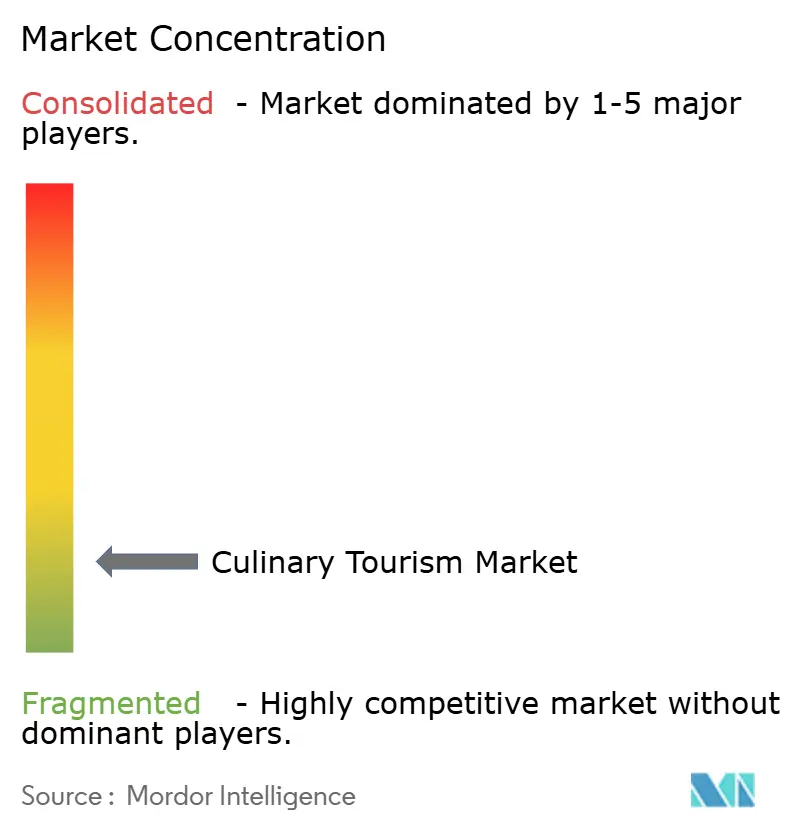
| Market Concentration | Low |
Major Players *Disclaimer: Major Players sorted in no particular order Image © Mordor Intelligence. Reuse requires attribution under CC BY 4.0. | |
Culinary Tourism Market Analysis by Mordor Intelligence
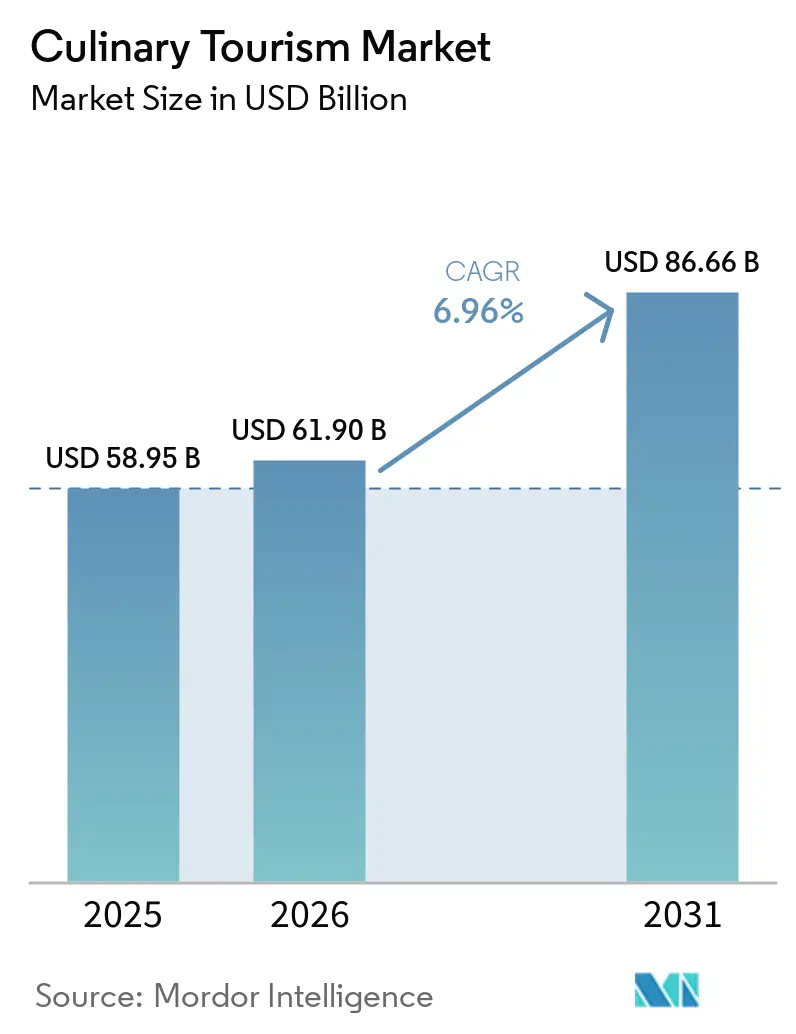
The Culinary Tourism Market size is expected to grow from USD 58.95 billion in 2025 to USD 61.90 billion in 2026 and is forecast to reach USD 86.66 billion by 2031 at 6.96% CAGR over 2026-2031.
The culinary tourism market has moved beyond a niche leisure category. It now sits closer to the center of destination choice, as food experiences increasingly shape how travelers compare places, plan itineraries, and allocate spend once they arrive. The culinary tourism market also creates value across a wider local chain than standard sightseeing travel, because spending flows into restaurants, artisanal producers, hosts, guides, transport links, and destination managers rather than staying concentrated in a narrow set of tourism assets. This shift is becoming more visible in India as well, where the depth of heritage is clear, but visitor-facing systems still need work. That gap matters because India ranked 34th in the 2026 Gastronomy Tourism Maturity Index even as Lucknow entered UNESCO’s Creative Cities Network for gastronomy in 2025. The culinary tourism market is also being supported by stronger digital discovery, more formal destination branding around cuisine, and better product packaging by operators that can turn local food culture into bookable formats. The result is a culinary tourism market where authenticity, ease of booking, and trusted local access now matter as much as traditional tourism drawcards.[1]
Key Report Takeaways
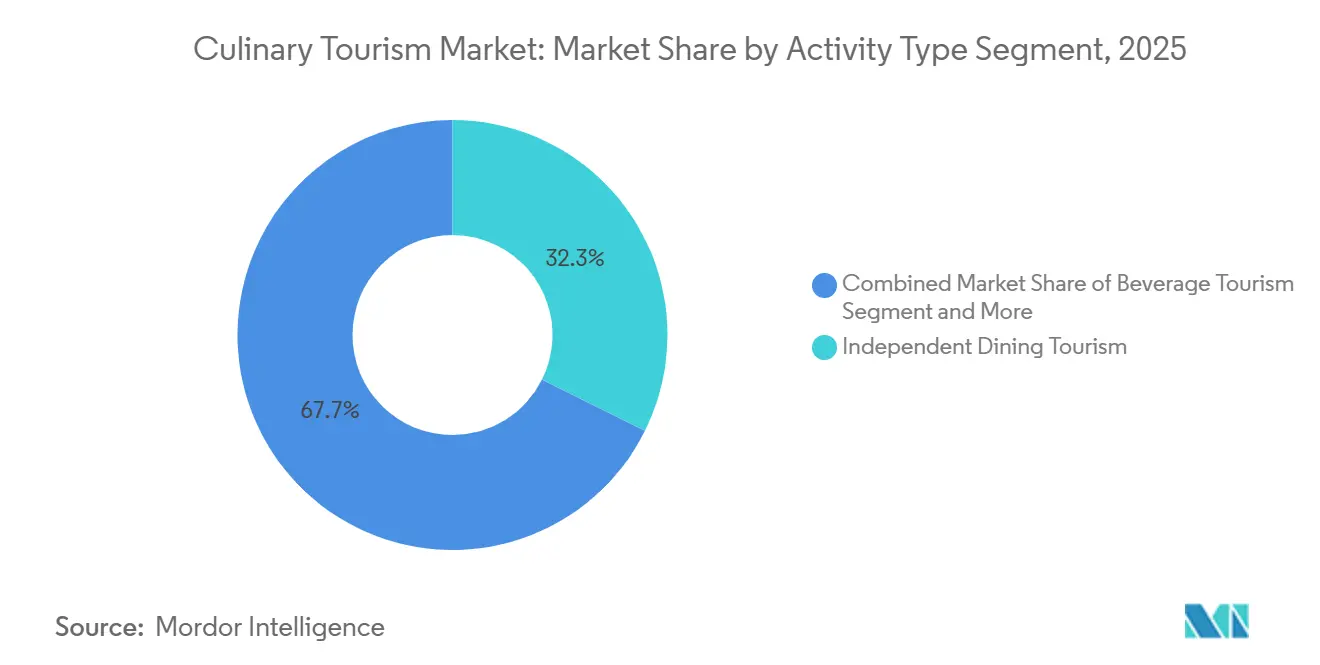
- By activity type, Independent Dining Tourism led with a 32.34% share in 2025, while Experiential Learning and Cooking Classes recorded the highest projected CAGR at 7.46% through 2031.
- By tourist type, Domestic Culinary Tourists held 61.12% share in 2025, while International Culinary Tourists were forecast to grow faster at 7.97% through 2031.
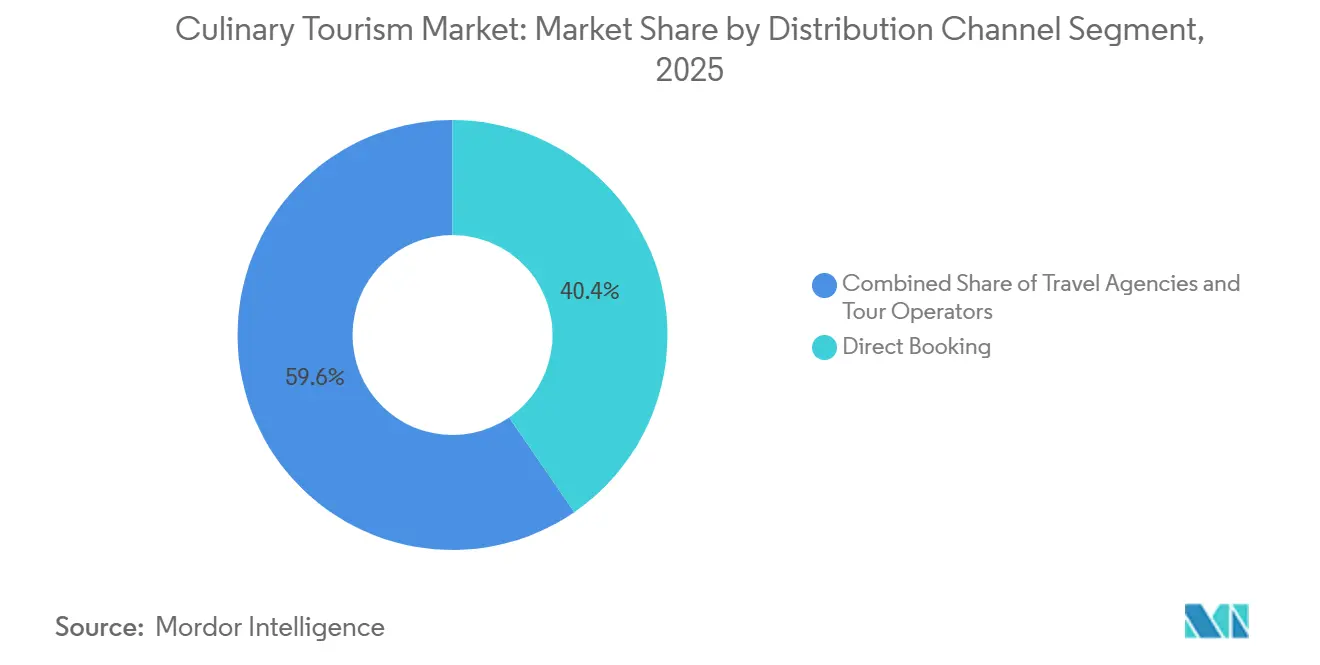
- By distribution channel, Direct Booking accounted for 40.41% share in 2025, while Online Travel Platforms advanced at the highest CAGR of 8.52% through 2031.
- By travel type, Group Travelers held 65.93% of the culinary tourism market share in 2025 and also posted the highest projected CAGR of 8.09% through 2031.
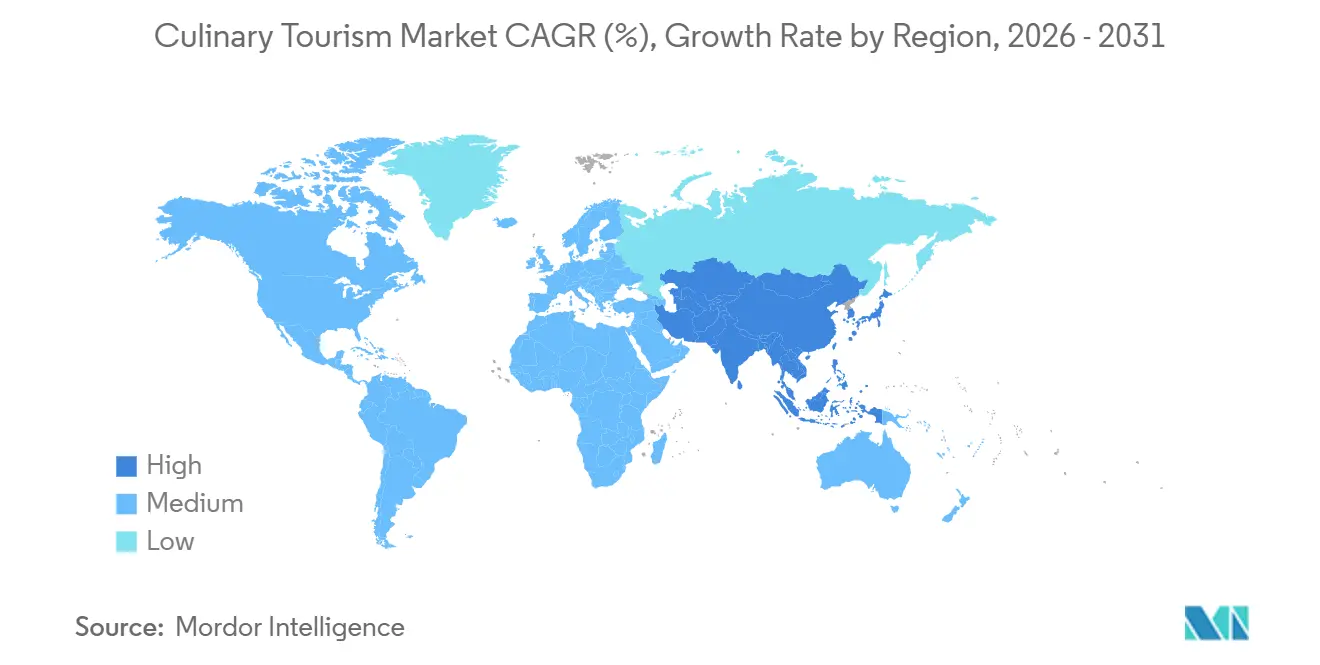
- By geography, Europe held 32.85% of the culinary tourism market share in 2025, while Asia-Pacific was projected to expand at an 8.85% CAGR through 2031.
Note: Market size and forecast figures in this report are generated using Mordor Intelligence’s proprietary estimation framework, updated with the latest available data and insights as of January 2026.
Market Trends and Insights
Drivers Impact Analysis of Culinary Tourism Market*
| Drivers | (~) % Impact on CAGR Forecast | Geographic Relevance | Impact Timeline |
|---|---|---|---|
| Rising demand for authentic local food experiences | +1.9% | Global, especially Asia-Pacific, Europe, and South America | Medium term (2-4 years) |
| Social media-driven food discovery | +1.4% | Global, with the highest intensity in Asia-Pacific, North America, and Western Europe | Short term (≤ 2 years) |
| Expansion of food festivals and gastronomic events | +0.8% | Europe, the Middle East, and the Asia-Pacific | Medium term (2-4 years) |
| Government-led destination branding through cuisine | +0.7% | Asia-Pacific, the Middle East, and select European cities | Long term (≥ 4 years) |
| Premiumization of experiential travel itineraries | +0.9% | North America, Western Europe, and high-income Asia-Pacific markets | Medium term (2-4 years) |
| Digital booking and AI-curated culinary planning | +0.7% | Global, with faster adoption in North America and the Asia-Pacific | Short term (≤ 2 years) |
| Source: Mordor Intelligence | |||
Rising Demand for Authentic Local Food Experiences
The culinary tourism market is growing as travelers look beyond famous restaurants and increasingly seek food experiences that reveal everyday local identity. In practical terms, that means greater demand for market walks, family-hosted meals, regional recipes, and direct contact with producers rather than only formal dining rooms. This shift matters for the culinary tourism market because it raises the value of local access, cultural credibility, and community relationships, which are harder to standardize at scale. India fits this pattern well, since Lucknow’s recognition as a UNESCO Creative City of Gastronomy in October 2025 gave formal global visibility to an existing culinary tradition rather than creating a new one from scratch. For operators, the message is clear: the culinary tourism market increasingly rewards those who can convert lived food culture into reliable visitor experiences without stripping away local context.
Social Media-Driven Food Discovery
Social media is also pushing the culinary tourism market, because food imagery and short-form travel content now influence where people want to go and what they want to book once a destination enters consideration. This effect is especially strong in Asia, where Agoda’s 2026 Travel Outlook showed that food was a key travel driver for 47% of travelers in Taiwan, 35% in Vietnam, and 34% in South Korea, all above the regional average of 31%. The same demand pattern is evident in travel search behavior, as Agoda reported year-on-year growth in accommodation searches for South Korean travelers to seasonal food destinations such as Changwon, Seocheon, and Gwangyang in early 2026. For the culinary tourism market, that means awareness is no longer built only through destination campaigns, because food stories, festival moments, and regional specialties can generate travel intent through distributed digital content. These dynamic features favor destinations and operators that can offer authentic experiences in a visual, searchable, and easy-to-book format.
Expansion of Food Festivals and Gastronomic Events
The culinary tourism market benefits when destinations turn food into a public event, because festivals create concentrated visibility, temporary urgency, and broad participation across local tourism businesses. Macao’s 2025 International Cities of Gastronomy Fest drew around 100,000 participants in 9 days, while the International Gastronomy Forum in the same program brought together more than 250 attendees from across UNESCO gastronomy cities. In the Middle East, the 9th UN Tourism World Forum on Gastronomy Tourism was held in Bahrain in November 2024, and its location was significant because it was the first time the forum had taken place in the region. These developments show that the culinary tourism market grows faster when destinations package cuisine as a calendar event rather than leaving food only as an unstructured background attraction. The same pattern is relevant for India, where city-level heritage, regional food trails, and festival-based demand could support more organized culinary visits if destination systems and booking pathways are strengthened.
Government-Led Destination Branding Through Cuisine
Public institutions increasingly shape the culinary tourism market because governments now use cuisine as part of destination positioning, cultural policy, and visitor economy planning. The World Food Travel Association’s 2026 index ranked Italy and France first among 84 countries. It gave Thailand a perfect leadership score, indicating that policy organization and destination stewardship are becoming visible markers of competitiveness. UNESCO’s October 2025 recognition of Lucknow added an India-specific example of how institutional endorsement can strengthen destination signaling for a culinary corridor with established heritage. For the culinary tourism market, this type of formal branding reduces trust barriers for international travelers and gives local operators a stronger platform from which to develop bookable experiences. It also suggests that destinations with clear public backing may attract investment sooner than places with equally rich food culture but weaker visitor infrastructure.
Restraints Impact Analysis of Culinary Tourism Market*
| Restraints | (~) % Impact on CAGR Forecast | Geographic Relevance | Impact Timeline |
|---|---|---|---|
| High cost of travel and culinary experiences | -1.5% | Global, acute in Western Europe, North America, and premium Asia-Pacific markets | Medium term (2-4 years) |
| Limited culinary infrastructure in emerging destinations | -0.9% | Sub-Saharan Africa, South and Southeast Asia, outside gateway cities, and parts of South America | Long term (≥ 4 years) |
| Shortage of skilled culinary guides and hospitality staff | -0.6% | Global, most acute in rapidly scaling Asia-Pacific, Middle East and Africa destinations | Medium term (2-4 years) |
| Overcommercialization and loss of culinary authenticity | -0.4% | Mature culinary corridors in Europe and the Asia-Pacific | Long term (≥ 4 years) |
| Source: Mordor Intelligence | |||
High Cost of Travel and Culinary Experiences
The culinary tourism market still faces a clear affordability barrier, especially when curated gastronomic experiences sit well above standard travel budgets. In 2025, premium culinary packages were priced 22% above conventional itineraries, and 36% of mid-range travelers skipped curated gastronomy experiences, indicating that interest does not always translate into purchase. The pressure also runs through the supply side of the culinary tourism market, where insurance, labor, and food sourcing costs make it harder for smaller operators to offer lower-priced formats without weakening service quality. That cost gap matters in India and other price-sensitive markets, because heritage depth alone is not enough if travelers cannot find credible experiences within reasonable spending bands. Unless operators create layered products across budget levels, the culinary tourism market risks remaining stronger in aspiration than in broad-based conversion.
Limited Culinary Infrastructure in Emerging Destinations
The culinary tourism market is also limited by uneven visitor infrastructure, particularly in destinations where food culture is rich but supporting systems are still developing. The World Food Travel Association’s 2026 maturity index highlighted this issue clearly, because India ranked 34th overall, and the index specifically evaluates access and stewardship rather than heritage alone. For the culinary tourism market, that means cold chain quality, hygiene compliance, signage, multilingual interpretation, booking systems, and last-mile access all influence whether interest turns into sustained spend. The gap is especially important for India, where strong regional cuisines can draw demand, but traveler confidence depends on more visible, consistent, and visitor-ready delivery. Without those systems, the culinary tourism market tends to concentrate in better-known gateway cities rather than spreading into deeper regional food corridors.
*Our forecasts treat driver/restraint impacts as directional, not additive. The impact forecasts reflect baseline growth, mix effects, and variable interactions.
Culinary Tourism Market Segment Analysis
By Activity Type:
Authentic Experiences Accelerate Cooking Class DemandIndependent Dining Tourism held 32.34% of the culinary tourism market share in 2025, making it the largest activity segment because it offers the simplest and most flexible entry point for food-led travel. The segment benefits from how travelers use restaurant bookings as a structured way to explore a destination, especially in cities where dining density, review visibility, and transport convenience are already strong. That pattern was visible in Trip.com Group’s data, which showed a 30% year-on-year increase in culinary travel bookings in the first half of 2025 and strong dining interest in Paris, London, New York, Madrid, and Milan. Experiential Learning and Cooking Classes are the fastest-growing activity segment, and the culinary tourism market size for this segment is projected to expand at a 7.46% CAGR through 2031. The growth reflects a clear shift from passive consumption toward hands-on participation, where travelers want to understand ingredients, techniques, and local food stories rather than only sample finished dishes.
Guided Food Tours and Culinary Trails continue to occupy a strong middle position in the culinary tourism market because they combine structure, local interpretation, and manageable price points. Secret Food Tours’ expansion to more than 100 cities and over 200 tours shows that guided formats can scale across geographies when the operator builds recognizable quality and city-specific curation into the model. Culinary Events and Festivals add seasonal demand, while Beverage Tourism remains smaller in volume but important for spend depth and destination identity. Overall, the culinary tourism market is seeing boundaries blur, as dining, classes, trails, and event-led participation are increasingly combined into single itineraries.

By Tourist Type:
Domestic Demand Anchors the Market While International Segment Leads GrowthDomestic Culinary Tourists accounted for 61.12% of the culinary tourism market in 2025, indicating that most food-led travel still occurs within national borders rather than through cross-border trips alone. This matters because domestic demand provides the culinary tourism market with a more stable base, especially in large countries where regional cuisines create reasons for repeat short-haul travel. In India, that structure is particularly relevant because culinary diversity across states supports recurring domestic exploration even before international visitation reaches its full potential. International Culinary Tourists held the remaining 38.88% share, but they are projected to expand faster at a 7.97% CAGR through 2031. The growth case is supported by Asia travel intent data, which shows that food was a major travel driver for 47% of travelers in Taiwan, 35% in Vietnam, and 34% in South Korea.
The split between domestic scale and international acceleration creates a balanced structure for the culinary tourism market. Domestic travelers support the use of local operators, while international visitors often justify upgrades in language support, experience design, and quality assurance. India stands out within this framework because its food heritage can serve both audiences. Yet, its 34th-place GTMI rank shows that stronger visitor systems are still needed to convert global interest into a wider spend base. For operators, the strongest model is one that serves both groups through common core experiences with flexible adaptation rather than through fully separate product lines.
By Distribution Channel:
Direct Booking Dominates but Digital Platforms Reshape the StackDirect Booking held 40.41% of the distribution channel segment in 2025, reflecting the trust-led nature of the culinary tourism market, where travelers often want direct contact with the operator before confirming an experience. This channel remains strong because culinary products are personal and variable, and customers often value clarity on host profile, group size, menu type, or dietary handling before payment. Travel Agencies and Tour Operators continue to matter for curated itineraries and premium planning, especially when a food experience is bundled with transport, lodging, or broader destination programs. At the same time, the culinary tourism market size for Online Travel Platforms is projected to grow at an 8.52% CAGR through 2031. That growth is supported by greater digital discovery, better review layering, and platform-led scale, as evidenced by Eatwith’s presence in more than 100 countries and American Express’s AI-enabled dining discovery flow.
The distribution mix shows that the culinary tourism market is not moving in a simple direction from offline to online. Instead, travelers use digital tools earlier in the journey, but many still seek reassurance from direct operator touchpoints before purchase. This is relevant in India, where digital discovery is rising quickly, but experience credibility still depends heavily on visible trust signals and smooth post-inquiry communication. The operators that should benefit most are those that combine strong direct booking capability with structured platform visibility rather than treating the channels as substitutes.
By Travel Type:
Group Travel’s Dual Role as Largest Segment and Fastest-Growing FormatGroup Travelers held a 65.93% share in 2025 and posted the highest projected CAGR of 8.09% through 2031, making this the only segment line in the culinary tourism market where the leader is also the fastest grower. The format is well-suited to shared tastings, collaborative cooking sessions, and guided food walks, all of which are easier to deliver and price when participants travel together. Group-based design also helps operators manage staffing, scheduling, and local coordination more efficiently across the culinary tourism market. That operating logic is visible in Secret Food Tours’ multi-city scaling model, where standardized service frameworks support local delivery across more than 100 destinations. The segment’s strength suggests that food tourism still works best when the social side of eating is built into the product rather than left as an afterthought.
Independent Travelers accounted for 34.07% of the market share, and this group remains important because self-directed travelers often seek greater control over itinerary shape and spending choices. In the culinary tourism market, this segment tends to value customization, flexible pacing, and selective premium experiences within a broader solo or couple-based trip. The commercial outcome is a market where group formats drive volume, while independent formats often support yield and experimentation. For India, a mixed supply model is likely to work best, with bookable group experiences in major hubs and more flexible culinary pathways in mature heritage destinations.
Geography Analysis
Europe Culinary Tourism Market
Europe held a 32.85% share of the culinary tourism market in 2025, giving it the largest regional share, on the back of a dense culinary heritage, strong visitor infrastructure, and long-established destination trust. France received 102 million international visitors in 2025. It generated a record EUR 77.5 billion in international tourism receipts, up 9% from 2024, which underlines the economic depth that supports food-led travel across the country. Europe’s advantage in the culinary tourism market also comes from how food heritage is institutionalized, promoted, and embedded in broader tourism journeys rather than sold as a narrow add-on. This structure helps travelers trust quality and helps operators price for depth, not only for convenience. The result is a region where cuisine remains a durable demand anchor across both mass and premium visitor segments.[2]
APAC Culinary Tourism Market
Asia-Pacific is the fastest-growing regional segment, and the culinary tourism market in Asia-Pacific is projected to expand at a 8.85% CAGR through 2031. Agoda’s 2026 findings showed strong food-led travel intent across the region, led by Taiwan at 47%, Vietnam at 35%, and South Korea at 34%, while South Korean searches for seasonal food destinations such as Changwon, Seocheon, and Gwangyang rose sharply in early 2026. The culinary tourism market in Asia-Pacific is also supported by a mix of social discovery, festival-led travel, and public branding, making product innovation more visible than in many mature regions. India represents one of the clearest structural opportunities in this regional picture, because Lucknow’s 2025 UNESCO gastronomy designation strengthened destination visibility while India’s 34th-place GTMI rank confirmed that infrastructure development still has room to improve.
North America, APAC and Middle East Culinary Tourism Market
North America presents a more digitally mature demand environment in the culinary tourism market, with strong platform usage and high spending on dining, but a relatively less formal gastronomy positioning than Europe. The United States placed 9th in the 2026 GTMI, which indicates meaningful maturity but also room for stronger destination-level institutionalization. In the Middle East, Bahrain’s hosting of the 9th UN Tourism World Forum on Gastronomy Tourism in November 2024, and Macao’s large 2025 gastronomy festival, both show how newer or fast-rising hubs are using cuisine to sharpen their tourism identities and attract higher-value visitors. Together, these patterns suggest that the culinary tourism market will continue to expand most strongly where cultural depth is matched by event programming, digital visibility, and credible public support.[3]
Competitive Landscape
The culinary tourism market remains fragmented, with no single operator dominating across all regions, formats, or customer types. Competition is spread across specialist food tour operators, broader experiential travel companies with culinary programs, and digital experience platforms that aggregate hosts and local offerings. This fragmented structure shapes the culinary tourism market in a very direct way: brand trust matters, but local delivery quality still determines whether the product works on the ground. Specialists usually compete through city-level expertise and community access, while larger players compete through scale, distribution, and repeat customer reach. The result is a market where local authenticity and operating systems both matter, but neither is sufficient on its own.
One visible strategic move has come from Secret Food Tours, which announced expansion to more than 100 cities and over 200 tours, while also reporting more than 100,000 five-star reviews and plans for continued geographic growth. The company also announced the acquisition of Ultimate Food Tours in New York City in March 2026, showing that even in a fragmented culinary tourism market, selected operators are beginning to use acquisition-led expansion alongside organic city launches. Another strategic example comes from Trip.com Group, which launched the immersive “Taste of China” dining show in Shanghai in August 2025 and linked that launch to strong culinary travel booking growth in the first half of the year. These moves show that the culinary tourism market is rewarding both physical expansion and higher-value packaging around food-led experiences.
A third strategic direction is visible in platform positioning and booking technology. Eatwith’s 2025 repositioning around cultural stewardship suggests that platforms now recognize authenticity as a competitive asset rather than only a marketing theme. American Express’s Dining Companion beta also points to a more integrated booking journey, where dining discovery, recommendations, and reservations occur within a connected ecosystem. For India, this means the strongest competitive position will likely come from operators that combine credible regional storytelling with professional booking, language access, and dependable service standards. In that environment, the culinary tourism market should remain open to smaller local specialists, but only if they can translate authenticity into a format that is easy for travelers to discover and trust.
Culinary Tourism Industry Leaders
-
TripAdvisor, Inc.
-
Viator, Inc.
-
G Adventures Inc.
-
Intrepid Group Pty Ltd
-
The Travel Corporation
- *Disclaimer: Major Players sorted in no particular order
Culinary Tourism Market Companies Covered in this Report
- Secret Food Tours
- Gourmet On Tour
- Culinary Backstreets LLC
- Eating Europe
- The International Kitchen
- Food Tours of America, Inc.
- Epicurean Ways LLC
- Context Travel, LLC
- Arigato Travel
- Foodies Colombia
- Innsbruck Food Tours
- Aquitaine Travel Guide
- The Travel Corporation
- Intrepid Group Pty Ltd
- G Adventures Inc.
- Abercrombie & Kent USA, LLC
- TripAdvisor, Inc.
- TourRadar GmbH
- Eatwith Inc.
- Cookly Pte. Ltd.
Recent Industry Developments in Culinary Tourism Market
- January 2026: Ireland’s Department of Agriculture, Food and the Marine launched the 2026 Agri-Food Tourism Initiatives under the Rural Innovation and Development Fund. The program allocated nearly EUR 300,000 (USD 0.34 million) in competitive grants to develop regional food festivals, artisan markets, and farm-to-table trails, highlighting a government-led strategy to strengthen the visitor economy by linking local agriculture directly with tourism.
- November 2025: Eatwith launched a new brand positioning centered on cultural stewardship, emphasizing local host agency in how their cuisine and culture are presented to international travelers. The platform operates in more than 130 countries with experiences ranging from home dinners to chef-led tours.
- October 2025: UNESCO announced 58 new Creative Cities designations, including Lucknow, India as a Creative City of Gastronomy, recognizing the city’s Awadhi culinary heritage. The designation marks a significant step in India’s government-led culinary destination branding and is expected to drive structured culinary tourism investment in the Uttar Pradesh region.
- August 2025: Trip.com Group launched “Taste of China,” a multi-sensory dining show blending fine cuisine with digital storytelling and live performance, in Shanghai. The company disclosed a 30% year-on-year rise in culinary travel bookings in H1 2025, with Paris, London, New York, Madrid, and Milan as top dining destinations.
Global Culinary Tourism Market Report Scope
Segmentation Overview
| Guided Food Tours & Culinary Trails |
| Experiential Learning & Cooking Classes |
| Independent Dining Tourism |
| Culinary Events & Festivals |
| Beverage Tourism |
| Domestic Culinary Tourists |
| International Culinary Tourists |
| Direct Booking |
| Travel Agencies & Tour Operators |
| Online Travel Platforms |
| Independent Travelers |
| Group Travelers |
| North America | United States |
| Canada | |
| Mexico | |
| South America | Brazil |
| Peru | |
| Chile | |
| Argentina | |
| Rest of South America | |
| Europe | United Kingdom |
| Germany | |
| France | |
| Spain | |
| Italy | |
| BENELUX (Belgium, Netherlands, and Luxembourg) | |
| NORDICS (Denmark, Finland, Iceland, Norway, and Sweden) | |
| Russia | |
| Rest of Europe | |
| Asia-Pacific | India |
| China | |
| Japan | |
| Australia | |
| South Korea | |
| South East Asia (Singapore, Malaysia, Thailand, Indonesia, Vietnam, and Philippines) | |
| Rest of Asia-Pacific | |
| Middle East and Africa | United Arab Emirates |
| Saudi Arabia | |
| South Africa | |
| Nigeria | |
| Rest of Middle East and Africa |
| By Activity Type | Guided Food Tours & Culinary Trails | |
| Experiential Learning & Cooking Classes | ||
| Independent Dining Tourism | ||
| Culinary Events & Festivals | ||
| Beverage Tourism | ||
| By Tourist Type | Domestic Culinary Tourists | |
| International Culinary Tourists | ||
| By Distribution Channel | Direct Booking | |
| Travel Agencies & Tour Operators | ||
| Online Travel Platforms | ||
| By Travel Type | Independent Travelers | |
| Group Travelers | ||
| By Geography | North America | United States |
| Canada | ||
| Mexico | ||
| South America | Brazil | |
| Peru | ||
| Chile | ||
| Argentina | ||
| Rest of South America | ||
| Europe | United Kingdom | |
| Germany | ||
| France | ||
| Spain | ||
| Italy | ||
| BENELUX (Belgium, Netherlands, and Luxembourg) | ||
| NORDICS (Denmark, Finland, Iceland, Norway, and Sweden) | ||
| Russia | ||
| Rest of Europe | ||
| Asia-Pacific | India | |
| China | ||
| Japan | ||
| Australia | ||
| South Korea | ||
| South East Asia (Singapore, Malaysia, Thailand, Indonesia, Vietnam, and Philippines) | ||
| Rest of Asia-Pacific | ||
| Middle East and Africa | United Arab Emirates | |
| Saudi Arabia | ||
| South Africa | ||
| Nigeria | ||
| Rest of Middle East and Africa | ||
Key Questions Answered in the Report
What is the current size of the culinary tourism space and how fast is it growing?
The culinary tourism market was valued at USD 58.95 billion in 2025, reached USD 61.90 billion in 2026, and is forecast to reach USD 86.66 billion by 2031 at a 6.96% CAGR.
Which region leads global demand for food-led travel?
Europe held the largest share at 32.85% in 2025, supported by strong visitor infrastructure and deep culinary heritage, while Asia-Pacific is growing faster.
Which activity type attracts the largest share of traveler spending?
Independent Dining Tourism led with a 32.34% share in 2025, showing that restaurant-led exploration remains the most accessible and scalable format.
What is driving faster growth in Asia-Pacific culinary travel?
Food-led travel intent is high across the region, with Agoda reporting 47% in Taiwan, 35% in Vietnam, and 34% in South Korea, alongside strong search growth for food festival destinations.
Why is India important in this space?
India combines deep regional food heritage with rising global visibility, and Lucknow’s 2025 UNESCO gastronomy designation strengthens that position, even though India ranked 34th in the 2026 GTMI due to infrastructure gaps.
What is the main challenge limiting broader adoption of curated food travel?
Cost remains the biggest barrier, with premium culinary packages priced 22% above standard itineraries in 2025 and 36% of mid-range travelers skipping curated gastronomy experiences.