
Commercial Wine Cooler Market Size and Share
Market Overview
| Study Period | 2021 - 2032 |
|---|---|
| Market Size (2027) | USD 1.26 Billion |
| Market Size (2032) | USD 1.59 Billion |
| Growth Rate (2027 - 2032) | 4.86 % |
| Fastest Growing Market | Asia-Pacific |
| Largest Market | Europe |
| Market Concentration | Medium |
Major Players *Disclaimer: Major Players sorted in no particular order Image © Mordor Intelligence. Reuse requires attribution under CC BY 4.0. | |
Commercial Wine Cooler Market Analysis by Mordor Intelligence
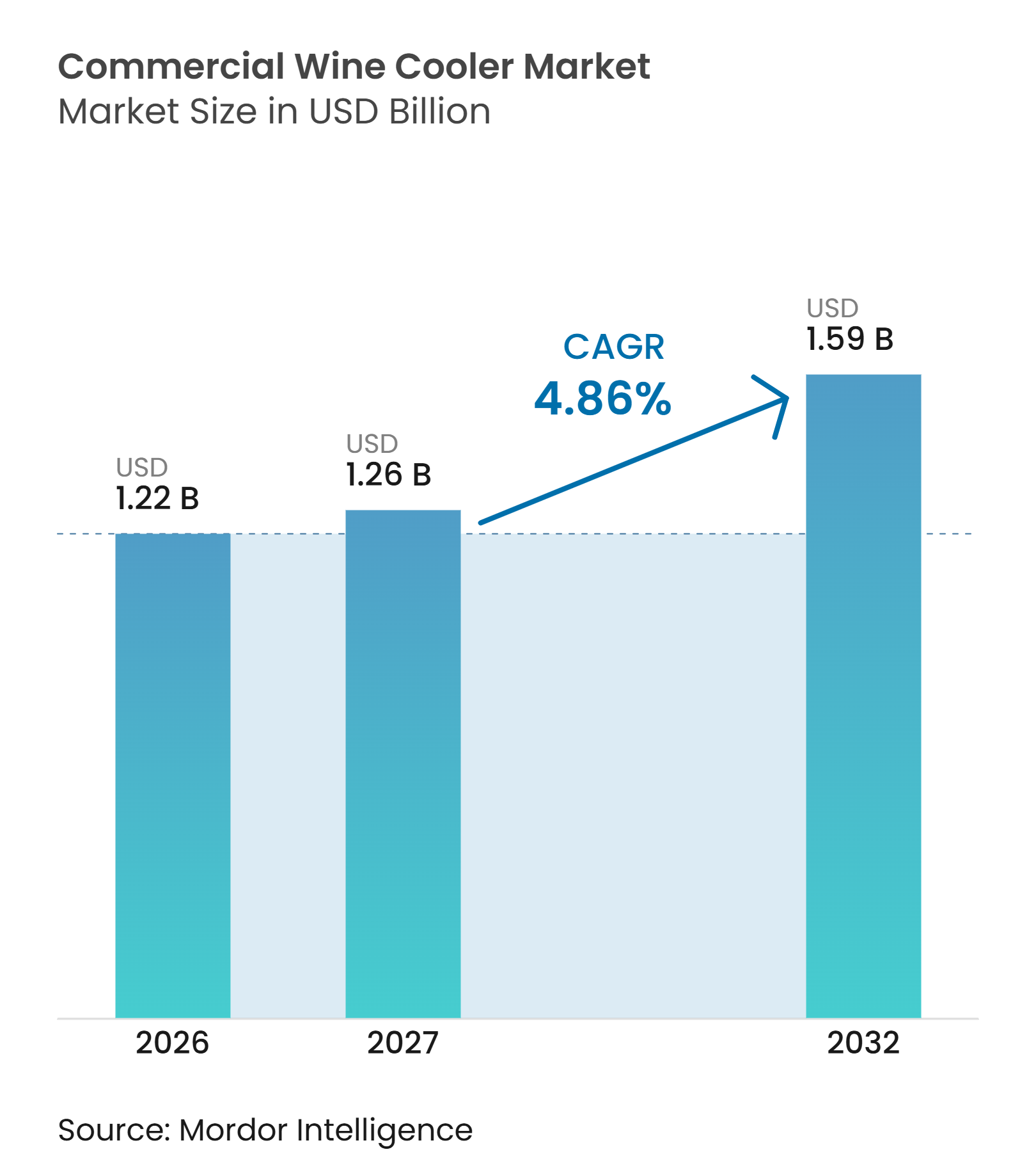
The commercial wine cooler market size was valued at USD 1.22 billion in 2026 and is estimated to grow from USD 1.26 billion in 2027 to reach USD 1.59 billion by 2032, at a CAGR of 4.86% during the forecast period (2027-2032). Demand is moving toward equipment that protects inventory and supports wine service in restaurants, hotels, wineries, and specialist retail locations. Hospitality operators are giving more weight to temperature control, display quality, and dependable service support when they select commercial wine coolers. Refrigerant rules and energy requirements are also affecting product design, particularly in Europe and Australia. Connected monitoring, larger capacities, and built-in installations create opportunities for suppliers that can meet hospitality specifications across more than 1 geography.
Key Report Takeaways
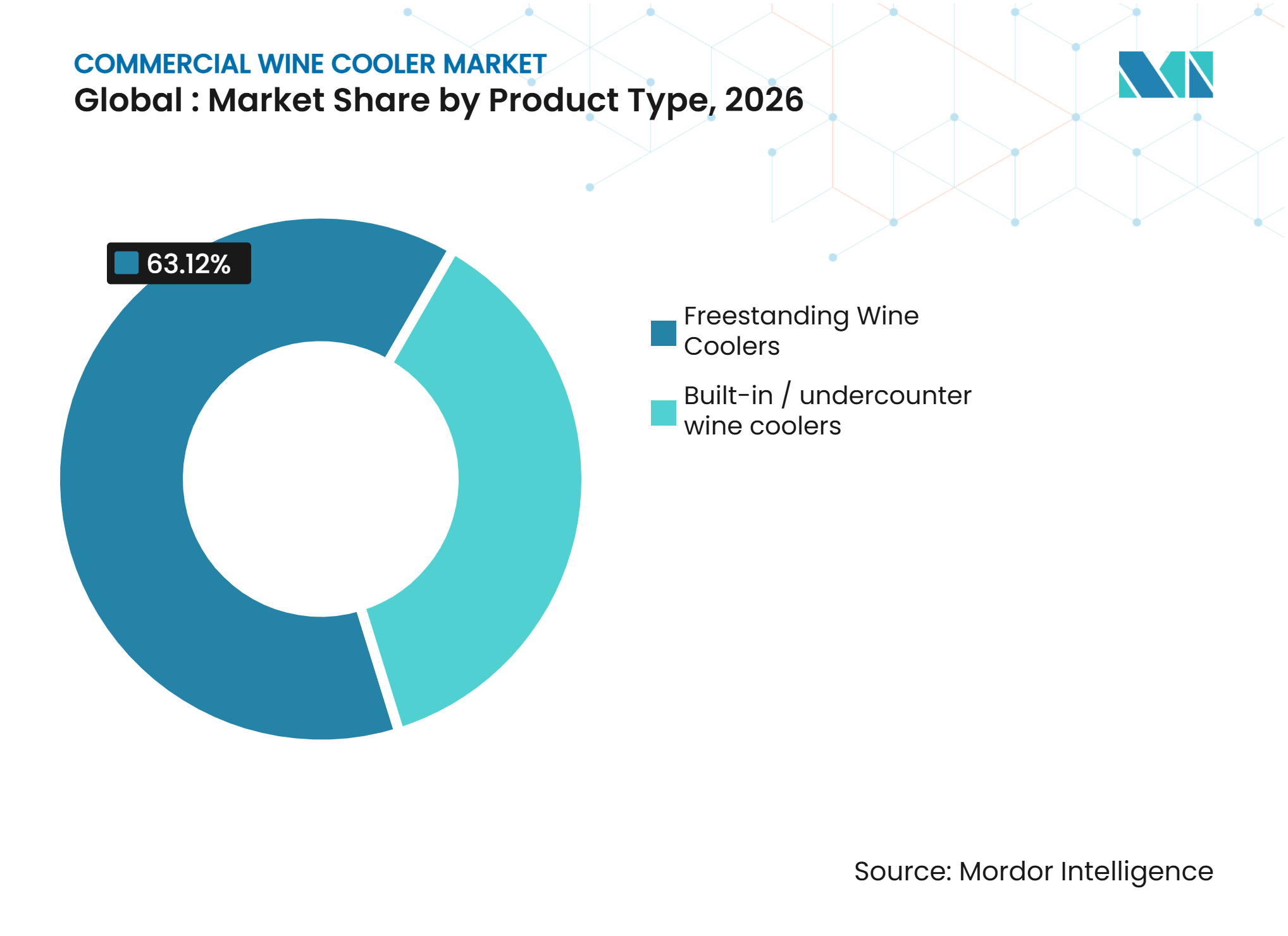
- By product type, freestanding wine coolers held 63.12% of the commercial wine cooler market share in 2026, while built-in and undercounter wine coolers are projected to grow at the fastest CAGR of 5.88% between 2027 and 2032.
- By capacity, 101-200-bottle units held 33.52% of the commercial wine cooler market share in 2026, while above-200-bottle units are projected to grow at the fastest CAGR of 6.90% between 2027 and 2032.
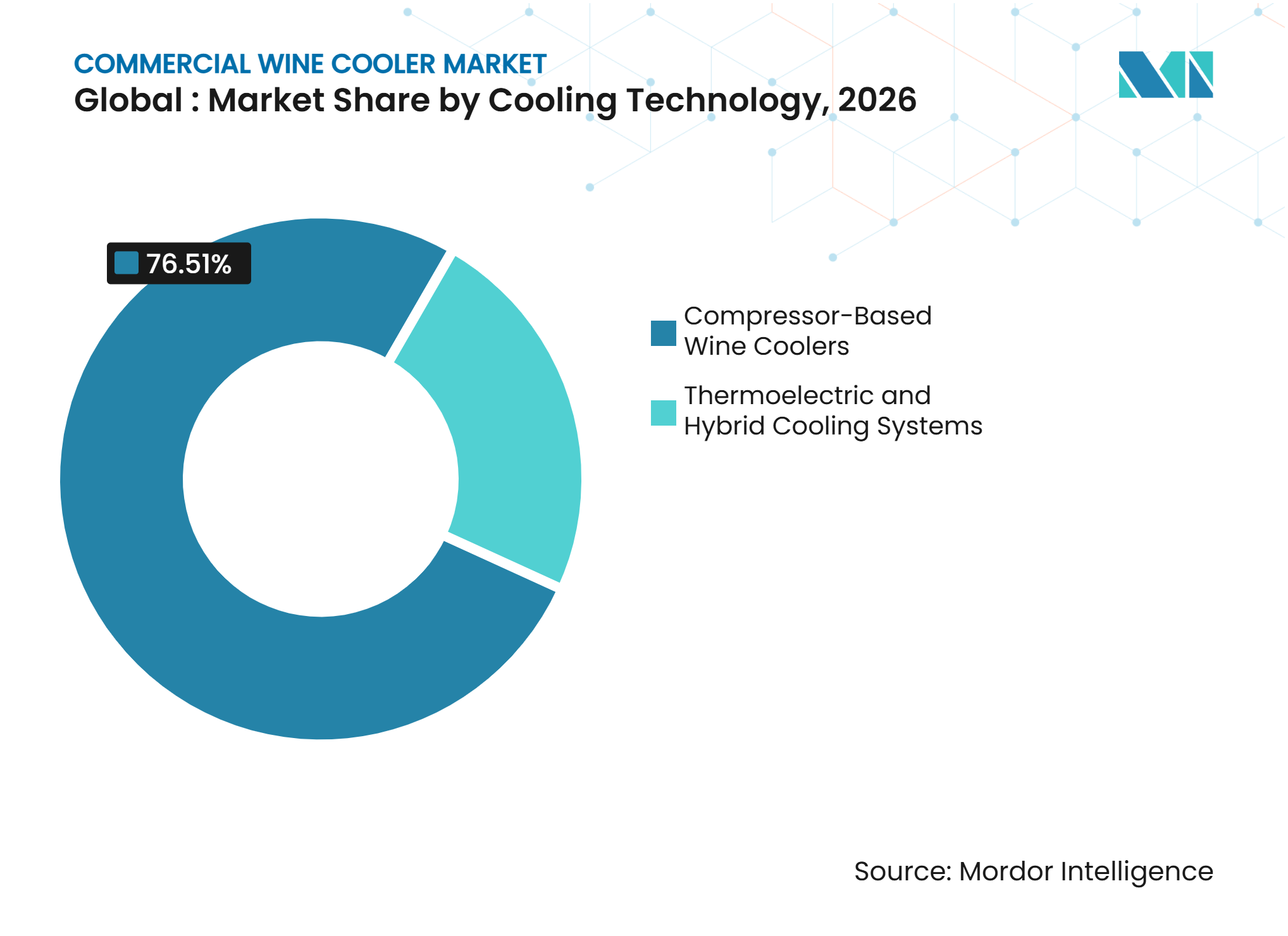
- By cooling technology, compressor-based units held 76.51% of the share in the commercial wine cooler market in 2026, while hybrid cooling systems are projected to grow at the fastest CAGR of 6.54% between 2027 and 2032.
- By price range, mid-range units held 46.32% of the share in the commercial wine cooler market in 2026, while premium units are projected to grow at the fastest CAGR of 6.15% between 2027 and 2032.
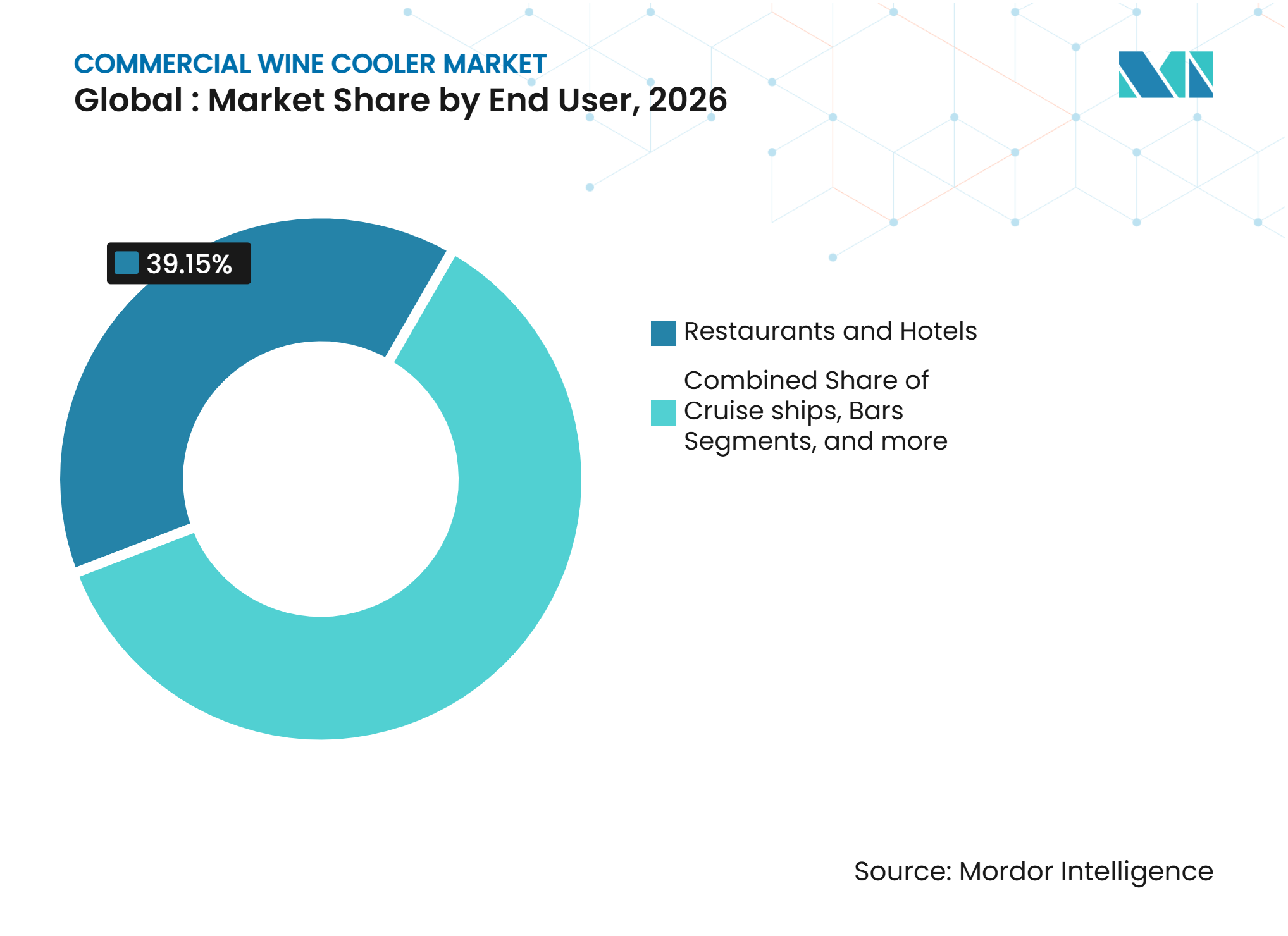
- By end user, restaurants and hotels held 39.15% of the share in the commercial wine cooler market in 2026, while wineries and tasting rooms are projected to grow at the fastest CAGR of 7.26% between 2027 and 2032.
- By distribution channel, dealers and distributors held 74.63% of the share in the commercial wine cooler market in 2026, while direct sales are projected to grow at the fastest CAGR of 7.14% between 2027 and 2032.
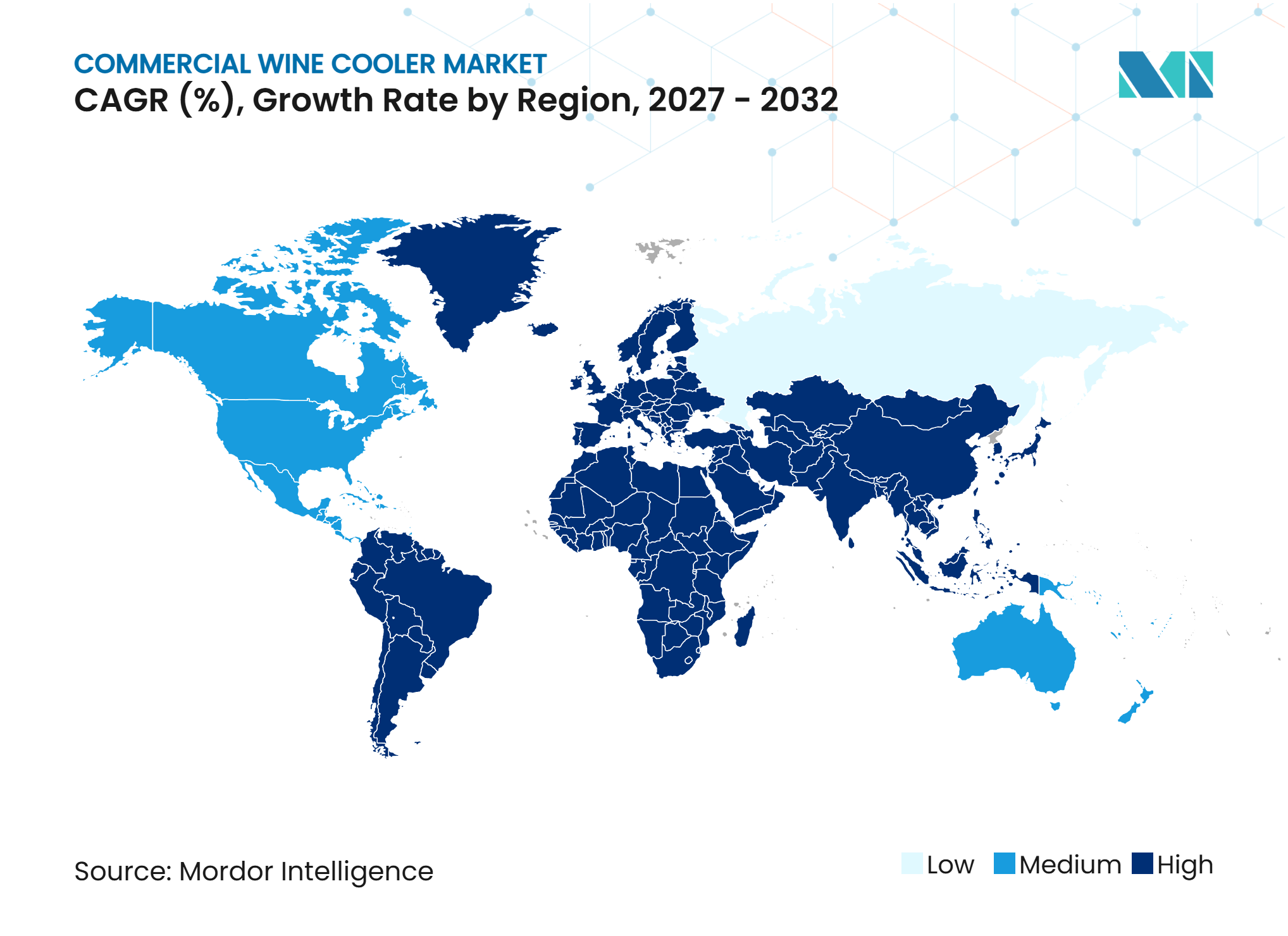
- By geography, Europe held 33.54% of the share in the commercial wine cooler market in 2026, while Asia-Pacific is projected to grow at the fastest CAGR of 7.54% between 2027 and 2032.
Note: Market numbers in this report are based on Mordor Intelligence's proprietary estimation framework, which combines nine months of actuals with Q4 projections for base year 2026.
Market Trends and Insights
Drivers Impact Analysis of Commercial Wine Cooler Market *
| Driver | (~) % Impact on CAGR Forecast | Geographic Relevance | Impact Timeline |
|---|---|---|---|
| Hospitality Premiumization and Wine-Program Expansion | +1.3% | North America and Europe, with early spillover to Asia-Pacific urban centers | Short term (≤ 2 years) |
| Commercial Demand for Reliable Temperature and Humidity Control | +0.9% | Global | Medium term (2-4 years) |
| Energy-Efficient and Low-GWP Refrigeration Upgrades | +0.7% | European Union, expanding to Asia-Pacific and Australia and New Zealand | Medium term (2-4 years) |
| Smart Monitoring and Multi-Site Operations | +0.5% | Global, strongest in North America and Northern Europe | Medium term (2-4 years) |
| Wine Tourism and Premium On-Premise Experiences | +0.4% | Europe, South America, and Asia-Pacific | Medium term (2-4 years) |
| Space-Efficient Display and Service Integration | +0.2% | Urban markets globally | Long term (≥ 4 years) |
| Source: Mordor Intelligence | |||
Hospitality Premiumization and Wine-Program Expansion
Wine service is becoming a more deliberate revenue stream for full-service hospitality venues, which supports spending on commercial wine storage. The commercial wine cooler market benefits when restaurants and hotels need equipment that can preserve several wines at distinct service temperatures. Larger wine lists also make dual-zone equipment and visible presentation more valuable to operators. The commercial wine cooler market is supported by winery visitor facilities, where storage equipment must protect stock while remaining suitable for guest-facing areas. UN Tourism reported that wine tourism generated 25% of overall winery revenue among the 1,310 wineries surveyed across 47 countries, showing the commercial role of tasting-room operations. Capacity, appearance, and service reliability therefore influence procurement alongside purchase price.
Reliable Temperature and Humidity Control for Commercial Use
The commercial wine cooler market depends on reliable temperature and humidity control because storage failures can damage high-value inventory. Liebherr states that its Vinidor and Vinidor Selection models provide temperature settings from 41°F to 68°F and include temperature-protection features designed to identify deviations[1]. These requirements favor commercial-grade systems that can maintain stable conditions during frequent door openings and long operating hours. Restaurants and hotels, which held 39.15% of the share in the commercial wine cooler market in 2026, need equipment that suits varied wine lists and active service periods. Australia also requires energy-efficiency information for regulated refrigerated cabinets, making equipment specifications more important in buyer evaluation. Suppliers with documented performance and established service capability are better placed to meet these requirements.
Energy-Efficient Refrigeration and Low-GWP Upgrades
The commercial wine cooler market is being shaped by the replacement of refrigerants with high global-warming potential. From January 2025, EU Regulation 2024/573 requires new self-contained commercial refrigeration equipment to meet a global-warming-potential limit below 150[2]. The rule affects new product engineering and pushes suppliers toward lower-GWP refrigerants such as R-290 and R-600a. The European Environment Agency reported that hydrofluorocarbon placements in the EU declined 37% in 2024 from 2023 as the transition progressed. A California Energy Commission field study also found 45% energy savings for the evaluated R-290 display-case configuration against an R-134a benchmark, reinforcing the operational case for efficient refrigeration.
Smart Monitoring and Multi-Site Operations
The commercial wine cooler market is increasingly served by equipment that supports remote monitoring and efficient use of limited hospitality space. Liebherr added SmartDeviceBox connectivity to its 2026 undercounter beverage refrigerator portfolio, which includes products intended for hospitality settings. Remote alerts can help multi-site operators respond to temperature deviations before a storage problem becomes a loss event. Built-in and undercounter units are projected to expand at a 5.88% CAGR because they can be integrated into renovated hotel suites, restaurant counters, and compact bar layouts. Freestanding units remain useful where visible storage and quick installation matter more than built-in detailing. These parallel needs allow manufacturers to offer connected products across both display-led and space-constrained formats.
Restraints Impact Analysis of Commercial Wine Cooler Market *
| Restraint | (~) % Impact on CAGR Forecast | Geographic Relevance | Impact Timeline |
|---|---|---|---|
| High Upfront Cost and Long Commercial Replacement Cycles | -1.1% | Global, most acute in cost-sensitive Middle East and Africa and emerging Asia-Pacific markets | Short term (≤ 2 years) |
| Energy Consumption and Refrigerant-Compliance Burden | -0.7% | European Union, expanding to Asia-Pacific and Australia and New Zealand | Medium term (2-4 years) |
| Serviceability, Spare-Parts, and Connectivity Gaps | -0.5% | Emerging markets globally | Medium term (2-4 years) |
| Tariff, Import, and Component-Sourcing Volatility | -0.4% | North America, with spillover to India and Southeast Asia | Short term (≤ 2 years) |
| Source: Mordor Intelligence | |||
High Upfront Cost and Long Commercial Replacement Cycles
Commercial wine coolers often require capital approval, which can delay purchases by independent restaurants, boutique hotels, and smaller wineries. Compressor-based equipment can remain in service for 10-15 years when properly maintained, limiting replacement demand for recently installed fleets. This issue is more visible in mature hospitality markets where prior investment cycles left many operators with functioning equipment. Cost-sensitive operators may choose repairs, smaller units, or delayed projects when cash flow is constrained. The commercial wine cooler market also faces uneven access to financing, certified refurbished equipment, and modular entry-level commercial offerings. These conditions make the restraint strongest where operators lack the budget or scale for immediate replacement.
Compliance, Serviceability, and Sourcing Constraints
Legacy equipment can create energy, refrigerant, and service costs that complicate replacement decisions. EU restrictions limit the servicing of equipment using refrigerants with a global-warming potential above 2,500, which raises the risk of costly maintenance or earlier retirement for affected assets. Eurovent notes that commercial refrigeration safety and environmental requirements affect equipment design, documentation, and technician competence[2]. Australia’s cabinet-efficiency rules add compliance work for importers and equipment specifiers. Limited spare parts, weak service coverage, and incomplete connectivity support can further deter buyers in emerging markets. Tariff and component-sourcing pressures can also increase input costs, and the Foodservice Equipment Distributors Association identified tariffs as a supply-chain challenge for foodservice equipment distribution[3].
*Our forecasts treat driver/restraint impacts as directional, not additive. The impact forecasts reflect baseline growth, mix effects, and variable interactions.
Commercial Wine Cooler Market Segment Analysis
By Product Type:
Freestanding Units Remain the Main Commercial FormatFreestanding wine coolers held 63.12% of the share in the commercial wine cooler market in 2026 because they can combine wine storage with visible presentation in restaurants, hotel lobbies, and retail settings. They can be installed without the millwork required for a built-in cabinet, which supports flexible placement and quicker deployment. Liebherr’s 2025 Vinidor and Vinidor Selection freestanding ranges include presentation lighting, flexible shelving, filtration, and temperature-protection features. These attributes align with venues that want the equipment to support service as well as display. Product selection in this part of the commercial wine cooler market is influenced by door use, ambient conditions, and the number of wine styles served.
Built-in and undercounter wine coolers are projected to grow at a 5.88% CAGR from 2027 to 2032. This format fits renovation projects where wine storage is specified as part of a bar, suite, or restaurant service counter. Liebherr’s 2026 fully integrated undercounter models include adjustable shelves, wine racks, filtration, and SmartDeviceBox connectivity. Low-GWP refrigerant requirements may encourage suppliers to update cabinet designs when they reengineer cooling systems. The segment will depend on architects, designers, and operators coordinating product specifications early in refurbishment planning.


By Capacity:
Large Cabinets Support Expanding Hospitality InventoriesThe 101-200-bottle tier accounted for 33.52% of the share in the commercial wine cooler market in 2026. It addresses the needs of full-service restaurants and hotel bars that carry broad but space-conscious wine inventories. This capacity range can support multiple varietals without requiring the floor area of a large-format unit. It also suits operators that need separate temperature zones for red, white, and sparkling wines. Its position reflects the balance between inventory depth and the physical limits of commercial dining and bar locations.
Above-200-bottle units are forecast to grow at a 6.90% CAGR through 2032. Wineries, tasting rooms, convention catering, and cruise-ship beverage programs need higher capacity and fewer separate cabinets. UN Tourism found that wine tourism delivers 25% of winery revenue across its surveyed sample, supporting the case for visitor-facing equipment investment. The up-to-50-bottle segment continues to serve small wine bars, specialty retailers, and secondary venue locations. The 51-100-bottle tier remains an option for independent restaurants and caterers that need commercial performance with a lower initial outlay.
By Cooling Technology:
Compressor Systems Lead While Hybrid Options AdvanceCompressor-based systems held 76.51% of the share in the commercial wine cooler market in 2026. Their position reflects the need for stable cooling, humidity control, and reliable performance in active hospitality environments. These systems are more suitable than thermoelectric alternatives for high-demand service periods and warmer operating conditions. Variable-speed inverter compressors can also improve energy performance in premium cabinets. Compressor systems therefore remain the central technology for venues that need capacity, recovery performance, and consistent storage conditions.
Hybrid cooling systems are projected to grow at a 6.54% CAGR from 2027 to 2032. Their appeal is tied to lower refrigerant charge requirements and product designs that respond to EU F-Gas rules. The European Commission identifies lower-GWP alternatives as central to refrigeration compliance under Regulation 2024/573. Thermoelectric systems retain a role in quieter, vibration-sensitive settings, but high ambient temperatures can limit their commercial use. The 45% energy saving identified in the California field study supports continued product development around efficient, low-GWP refrigeration configurations.


By Price Range:
Mid-Range Products Hold the Broadest Customer BaseMid-range units held 46.32% of the share in the commercial wine cooler market in 2026. The tier serves independent restaurants, established wine bars, mid-scale hotels, and specialist retailers that need dependable commercial performance. These buyers generally seek a balance between storage features, appearance, and operating cost. Mid-range cabinets are also accessible to operators that cannot justify premium customization or advanced connected functions. This broad user base keeps the tier central to unit demand across the commercial wine cooler market.
Premium wine coolers are projected to grow at a 6.15% CAGR through 2032. Tasting-room upgrades and high-end hotel renovations favor cabinets that support brand presentation and specified interior finishes. EuroCave’s 2025 Harmonie collection introduced a horizontal format, separate temperature-adjustable compartments, lighting choices, exterior finishes, and planned connectivity. The economy tier continues to serve entry-level commercial buyers, caterers, and high-turnover venues where price and durability drive the purchase decision. Premium demand depends on hospitality projects that treat wine storage as part of the guest experience rather than only back-of-house equipment.
By End User:
Restaurants and Hotels Lead Demand While Wineries Expand FasterRestaurants and hotels accounted for 39.15% of the share in the commercial wine cooler market in 2026. These venues need wine storage that supports menu breadth, by-the-glass service, and guest-facing presentation. Procurement decisions increasingly consider capacity, service continuity, energy use, and the cost of protecting inventory. Freestanding display cabinets remain relevant in dining rooms and lobby bars, while undercounter products suit compact service stations. The commercial wine cooler market therefore benefits from investment across several hospitality formats instead of one venue type.
Wineries and tasting rooms are projected to grow at a 7.26% CAGR from 2027 to 2032. UN Tourism’s 2025 study covered 1,310 wineries in 47 countries and showed that wine tourism can be a significant commercial activity for producers. Rioja recorded 1,164,388 winery visits in 2025, and wine bar services increased 22.5% in the region. Retail stores require visually appealing cabinets, while cruise ships, event venues, and caterers need products that can tolerate varied operating conditions. This range of end users broadens product requirements for manufacturers.
By Distribution Channel:
Dealers Retain Scale While Direct Engagement GrowsDealers and distributors held 74.63% of the share in the commercial wine cooler market in 2026. Their role remains important because they coordinate site surveys, installation, service agreements, and parts access for many independent operators. Regional dealer networks can help manufacturers reach fragmented hospitality customers without building local sales organizations. Dealers also provide practical support where buyers need help with cabinet positioning, ventilation, and electrical requirements. These services keep the channel important across the commercial wine cooler market, particularly for smaller operators.
Direct sales are forecast to expand at a 7.14% CAGR through 2032. Digital specifications and connected equipment allow manufacturers to maintain a relationship with operators after installation. Connected alerts and performance data can make the supplier relationship more relevant during the life of a cabinet. Direct engagement is particularly useful for premium projects, multi-site customers, and buyers with detailed design requirements. The channel’s growth does not remove the need for dealers, but it shifts some high-value specification activity closer to manufacturers.
Geography Analysis
Europe
Europe accounted for 33.54% of the share in the commercial wine cooler market in 2026. Its wine-producing regions, fine-dining base, and established hospitality infrastructure support demand across France, Italy, Spain, Germany, and the United Kingdom. From January 2025, EU Regulation 2024/573 has become a major regulatory influence because it requires a global-warming-potential limit below 150 for new self-contained commercial refrigeration equipment. Operators with legacy systems also face more restricted maintenance options for high-GWP refrigerants. Atout France recorded a 5% increase in wine-tourism search queries, including a 33% rise in searches originating in the United States, which supports continued visitor-focused winery investment. Rioja’s 2025 visitor and infrastructure activity further illustrates the demand for wine-service equipment in established European wine destinations.
Asia-Pacific
Asia-Pacific is projected to expand at a 7.54% CAGR between 2027 and 2032. Rising hospitality investment and a growing preference for premium dining support commercial wine storage demand across China, India, South Korea, Japan, and Southeast Asia. European suppliers are seeking these opportunities through built-in and design-led products. Liebherr’s February 2026 hospitality-oriented undercounter launch demonstrates how product connectivity and compact installation are becoming relevant in the region. Australia creates a compliance-driven replacement opportunity because its refrigerated-cabinet rules require regulated efficiency information. Buyers in mature markets such as South Korea and Japan are likely to emphasize product finish, reliability, and specification support. In contrast, developing markets may place more weight on dealer service and initial cost.
North America, South America, and Middle East and Africa
North America remains a stable commercial wine cooler market where premium hospitality projects and service infrastructure sustain demand. Tariff exposure affecting foodservice equipment distribution can add supply-chain pressure for imported components and products. South America benefits from wine tourism in Argentina, Chile, and Brazil, where visitor facilities create recurring needs for tasting-room cooling equipment. The Rio Grande do Sul tourism authority reported a 57.8% rise in wine-tourism experiences sold in 2025, pointing to expanding visitor activity in Brazil’s wine regions. The Middle East and Africa include luxury hospitality demand in licensed venues and established wine tourism in South Africa’s Western Cape. Hot climates, service availability, refrigerant supply, and technician capability remain structural constraints, which favor durable, low-GWP products with well-developed service support.
Competitive Landscape
Market Concentration
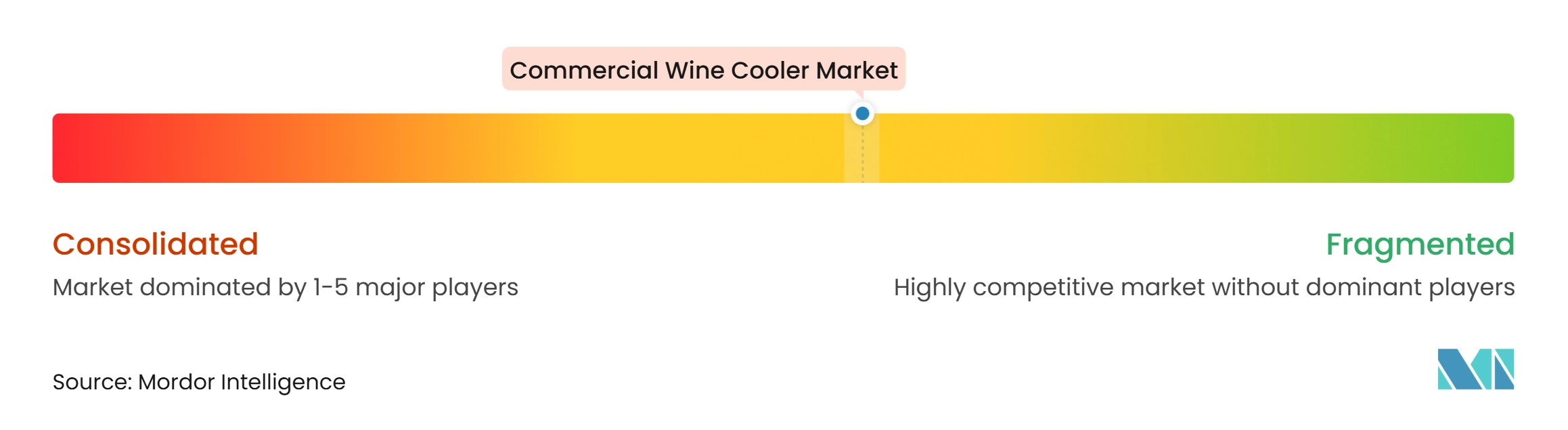
The commercial wine cooler market is moderately fragmented across European specialists, Asian volume manufacturers, and North American refrigeration suppliers. EuroCave and Liebherr have strong positions in precision storage and premium presentation, while Haier and VRBON are associated with mid-range and dealer-led volumes. True Manufacturing, Perlick, and Sub-Zero address North American hospitality specifications. This structure means that suppliers compete through product fit, service networks, and regional reach rather than one company dominating every category. Built-in installations, winery capacity expansion, and connected monitoring remain areas where product portfolios are still developing.
Liebherr expanded its undercounter portfolio in February 2026 with integrated beverage refrigerators that include SmartDeviceBox connectivity, wine racks, and filtration features. The move gives the company a connected offering for compact hospitality installations. EuroCave’s 2025 Harmonie collection added a horizontal furniture format, two temperature-adjustable compartments, lighting options, and planned app connectivity. These examples show that connectivity and presentation are becoming part of product competition alongside cooling performance. Companies that can support operators after installation may strengthen their position in direct relationships with hospitality customers.
Refrigerant compliance is also a competitive requirement because manufacturers need products that meet the European Union’s lower-GWP rules. Eurovent identifies safety, environmental, and documentation requirements that apply to commercial refrigeration equipment. Established companies are better able to manage certification needs across EN, UL, and AS/NZS frameworks. Smaller companies may struggle with engineering investment, parts availability, and multi-region approvals. The commercial wine cooler market can therefore favor suppliers with established technical resources and service coverage. At the same time, specialized providers can compete by offering customization, compact formats, or support for hot-climate hospitality settings.
Commercial Wine Cooler Industry Leaders
-
Haier Group Corporation
-
Electrolux AB
-
Eurocave SAS
-
Liebherr
-
Danby Products Limited
- *Disclaimer: Major Players sorted in no particular order
Commercial Wine Cooler Market Companies Covered in this Report
- Haier Group Corporation
- Shenzhen VRBON Electrical Appliance Co., Ltd.
- Electrolux AB
- Eurocave SAS
- Liebherr
- Danby Products Limited
- The Legacy Companies (Avanti Products Inc)
- La Sommeliere Int. SAS
- Dunavox Kft.
- LG Corporation
- Equator Advanced Appliances
- Caple
- Vinotemp International, Inc.
- Sub-Zero Group, Inc.
- U-Line Corporation
- Perlick Corporation
- Hoshizaki Corporation
- Smeg S.p.A.
- Marvel Refrigeration, LLC
- True Manufacturing Company
- BSH Home Appliances Group
- Samsung Electronics Co., Ltd.
Recent Industry Developments in Commercial Wine Cooler Market
- February 2026: Liebherr USA expanded its undercounter appliance portfolio with fully integrated beverage refrigerators, including the UBCgb3730 and UBC3760 models. Features include adjustable glass shelves, pull-out wine racks, PowerCooling with FreshAir filtration, and SmartDeviceBox connectivity for remote access in hospitality settings.
- February 2026: EuroCave launched the Inspiration built-in wine cellar series in South Korea through a dedicated brand zone at Lotte Himart Jamsil. The range includes four models with capacities of 29 to 89 bottles, stainless steel glass doors, and 360-degree amber LED lighting. The series targets business-to-business customers and the premium interior design segment.
- September 2025: True Residential opened a dedicated 2,100-square-foot showroom in Clayton, Missouri, adjacent to the O'Fallon manufacturing headquarters. The showroom includes 5 vignettes featuring the full-size and undercounter refrigeration portfolio, including wine cabinets. The facility supports direct engagement with design professionals and commercial hospitality buyers.
- July 2025: Liebherr USA introduced standard-height and Americans with Disabilities Act-compliant undercounter appliances for residential kitchens and hospitality settings. Wine refrigerator models include dimmable LED ceiling lighting, FlexFit beechwood shelves, 3-pane UVProtect Plus glass doors, and soft-telescopic bottom shelves. These specifications align with commercial hospitality requirements.
Global Commercial Wine Cooler Market Report Scope
Commercial wine coolers are specialized refrigeration units designed to store, age, and display wine at optimal temperatures in professional settings. The commercial wine cooler market is segmented by product type, capacity, cooling technology, price range, end user, distribution channel, and geography. By product type, the market is segmented into freestanding wine coolers and built-in/undercounter wine coolers. By capacity, the market is segmented into up to 50 bottles, 51 to 100 bottles, 101 to 200 bottles, and above 200 bottles. By cooling technology, the market is segmented into compressor-based wine coolers, thermoelectric wine coolers, and hybrid cooling systems. By price range, the market is segmented into economy, mid-range, and premium. By end user, the market is segmented into restaurants and hotels; bars, pubs, and wine bars; cruise ships, event venues, and catering; retail stores and specialty shops; wineries and tasting rooms; and other commercial users. By distribution channel, the market is segmented into direct sales and dealers and distributors. By geography, the market is segmented into North America (Canada, United States, Mexico), South America (Brazil, Peru, Chile, Argentina, Rest of South America), Europe (United Kingdom, Germany, France, Spain, Italy, BENELUX, NORDICS, Rest of Europe), Asia-Pacific (India, China, Japan, Australia, South Korea, South-East Asia, Rest of Asia-Pacific), and the Middle East & Africa (United Arab Emirates, Saudi Arabia, South Africa, Nigeria, Rest of Middle East & Africa). The report offers the market size in value terms in USD for all the above-mentioned segments.
Segmentation Overview
| Freestanding Wine Coolers |
| Built-in / undercounter wine coolers |
| Up to 50 Bottles |
| 51 to 100 Bottles |
| 101 to 200 Bottles |
| Above 200 Bottles |
| Compressor-Based Wine Coolers |
| Thermoelectric Wine Coolers |
| Hybrid Cooling Systems |
| Economy |
| Mid-Range |
| Premium |
| Restaurants and Hotels |
| Bars, pubs and wine bars |
| Cruise ships, event venues and catering |
| Retail Stores and Specialty Shops |
| Wineries and Tasting Rooms |
| Other Commercial Users |
| Direct Sales |
| Dealers and Distributors |
| North America | Canada |
| United States | |
| Mexico | |
| South America | Brazil |
| Peru | |
| Chile | |
| Argentina | |
| Rest of South America | |
| Europe | United Kingdom |
| Germany | |
| France | |
| Spain | |
| Italy | |
| BENELUX (Belgium, Netherlands, Luxembourg) | |
| NORDICS (Denmark, Finland, Iceland, Norway, Sweden) | |
| Rest of Europe | |
| Asia-Pacific | India |
| China | |
| Japan | |
| Australia | |
| South Korea | |
| South-East Asia | |
| Rest of Asia-Pacific | |
| Middle East & Africa | United Arab Emirates |
| Saudi Arabia | |
| South Africa | |
| Nigeria | |
| Rest of Middle East & Africa |
| By Product Type | Freestanding Wine Coolers | |
| Built-in / undercounter wine coolers | ||
| By Capacity | Up to 50 Bottles | |
| 51 to 100 Bottles | ||
| 101 to 200 Bottles | ||
| Above 200 Bottles | ||
| By Cooling Technology | Compressor-Based Wine Coolers | |
| Thermoelectric Wine Coolers | ||
| Hybrid Cooling Systems | ||
| By Price Range | Economy | |
| Mid-Range | ||
| Premium | ||
| By End User | Restaurants and Hotels | |
| Bars, pubs and wine bars | ||
| Cruise ships, event venues and catering | ||
| Retail Stores and Specialty Shops | ||
| Wineries and Tasting Rooms | ||
| Other Commercial Users | ||
| By Distribution Channel | Direct Sales | |
| Dealers and Distributors | ||
| By Geography | North America | Canada |
| United States | ||
| Mexico | ||
| South America | Brazil | |
| Peru | ||
| Chile | ||
| Argentina | ||
| Rest of South America | ||
| Europe | United Kingdom | |
| Germany | ||
| France | ||
| Spain | ||
| Italy | ||
| BENELUX (Belgium, Netherlands, Luxembourg) | ||
| NORDICS (Denmark, Finland, Iceland, Norway, Sweden) | ||
| Rest of Europe | ||
| Asia-Pacific | India | |
| China | ||
| Japan | ||
| Australia | ||
| South Korea | ||
| South-East Asia | ||
| Rest of Asia-Pacific | ||
| Middle East & Africa | United Arab Emirates | |
| Saudi Arabia | ||
| South Africa | ||
| Nigeria | ||
| Rest of Middle East & Africa | ||
Key Questions Answered in the Report
What is the commercial wine cooler market size?
The commercial wine cooler market size is estimated at USD 1.26 billion in 2027 and is forecast to reach USD 1.59 billion by 2032, at a 4.86% CAGR.
Which product type leads commercial wine cooler sales?
Freestanding wine coolers lead with a 63.12% share in the commercial wine cooler market in 2026 because they support both storage and guest-facing display.
Which commercial wine cooler product type is growing fastest?
Built-in and undercounter wine coolers are forecast to grow at a 5.88% CAGR from 2027 to 2032, supported by renovation and compact-service projects.
Which end user is expanding fastest for commercial wine coolers?
Wineries and tasting rooms are forecast to grow at a 7.26% CAGR through 2032, supported by wine-tourism investment.
Which region has the greatest demand for commercial wine coolers?
Europe holds a 33.54% share in the commercial wine cooler market in 2026, supported by wine culture, hospitality infrastructure, and refrigerant replacement requirements.
What regulations affect commercial wine coolers in Europe?
From January 2025, EU Regulation 2024/573 requires new self-contained commercial refrigeration equipment to use refrigerants with a global-warming potential below 150.