
Beach Hotels and Resorts Market Size and Share
Market Overview
| Study Period | 2022 - 2032 |
|---|---|
| Market Size (2027) | USD 203.31 Billion |
| Market Size (2032) | USD 262.19 Billion |
| Growth Rate (2027 - 2032) | 5.22 % |
| Fastest Growing Market | Asia-Pacific |
| Largest Market | Europe |
| Market Concentration | Low |
Major Players *Disclaimer: Major Players sorted in no particular order Image © Mordor Intelligence. Reuse requires attribution under CC BY 4.0. | |
Beach Hotels and Resorts Market Analysis by Mordor Intelligence
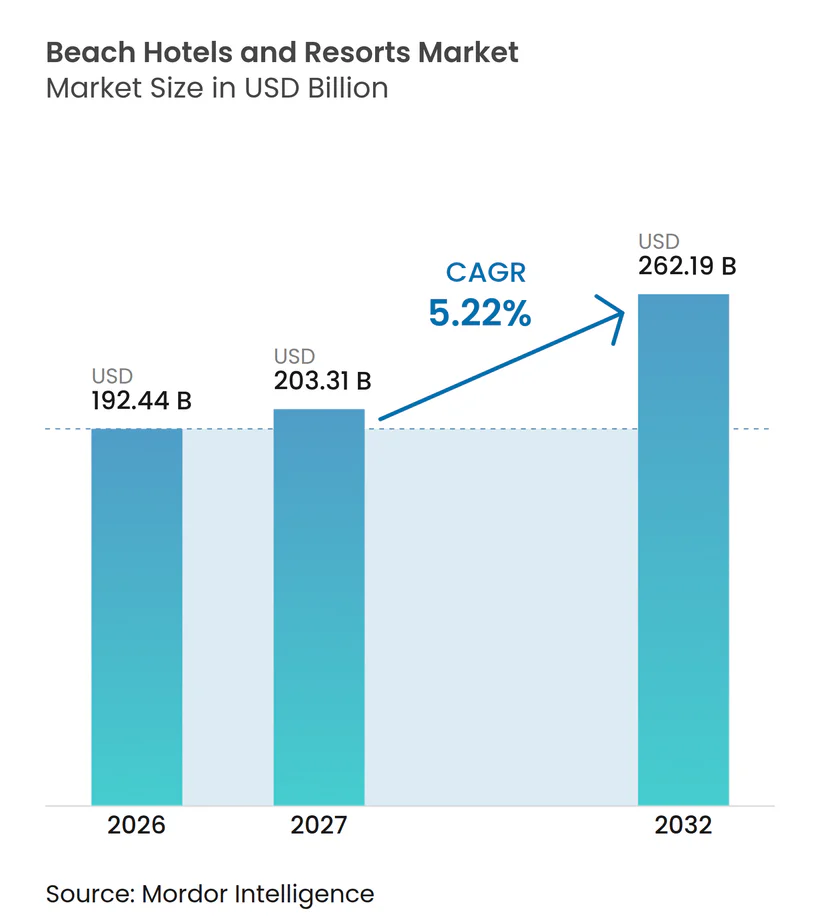
The global beach hotels and resorts market was valued at USD 192.44 billion in 2026 and is estimated to grow from USD 203.31 billion in 2027 to reach USD 262.19 billion by 2032, at a CAGR of 5.22% during the forecast period (2027-2032). International tourism recorded 1.52 billion overnight visitors in 2025, up 4% from 2024. Tourism receipts reached USD 1.900 trillion, supporting demand for operators in the global beach hotels and resorts market. Expanded air connectivity, demand for higher-value stays, and direct digital sales are enabling operators to extend demand beyond established coastal destinations. However, the market faces higher insurance costs, seasonal demand shifts, and competition from alternative accommodations. Branded operators are responding through asset-light expansion, all-inclusive formats, loyalty programs, and experience-based offerings. Independent properties compete by emphasizing local character and maintaining flexible pricing.
Key Report Takeaways
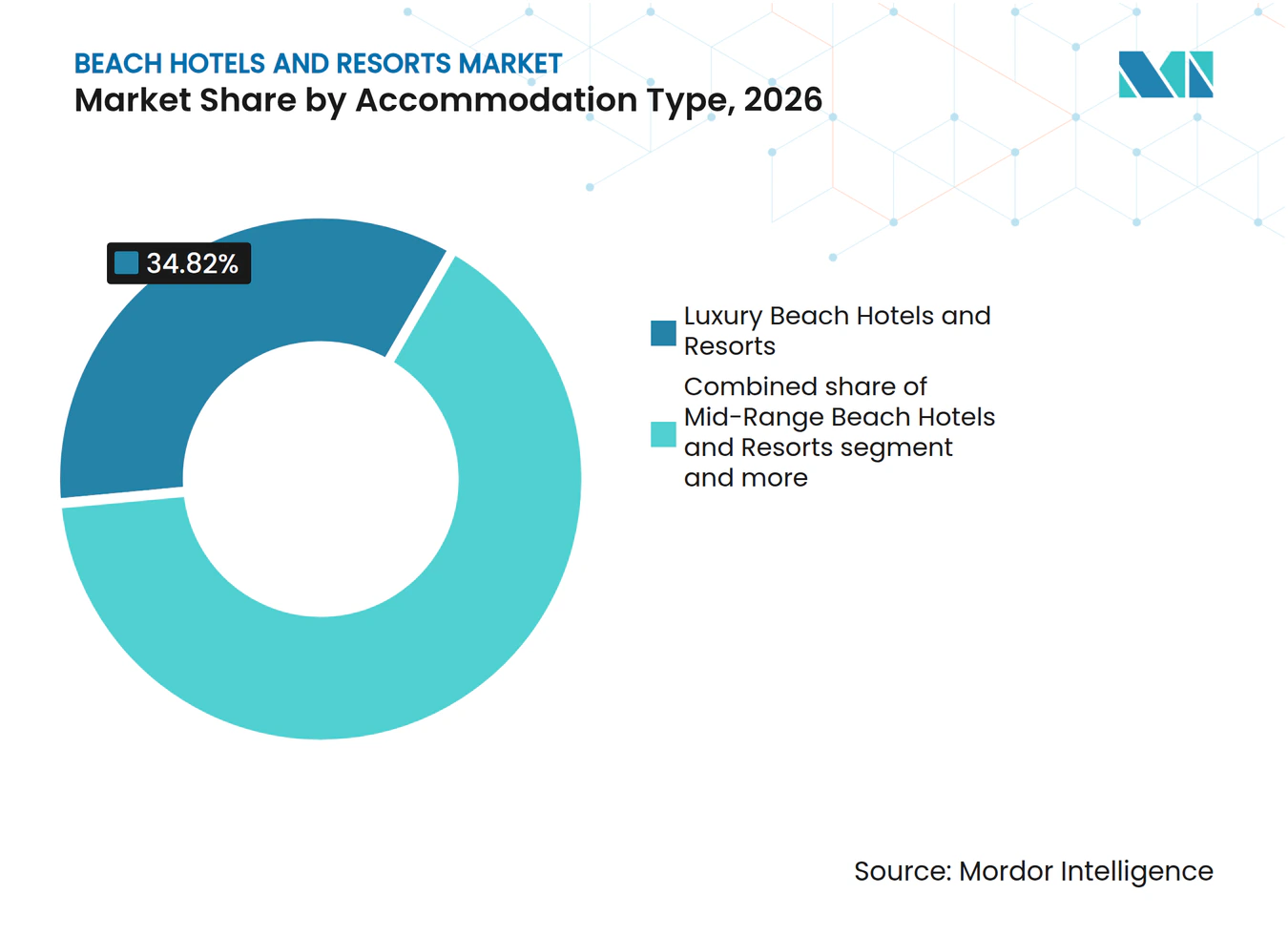
- By accommodation type, Luxury Beach Hotels and Resorts accounted for 34.82% of the global beach hotels and resorts market share in 2026, and Eco-Resorts and Regenerative Beach Resorts are projected to grow at a 6.83% CAGR through 2032.
- By booking channel, Online Travel Agencies accounted for 38.84% of the global beach hotels and resorts market share in 2026, and Direct Booking Channels are projected to grow at a 6.53% CAGR through 2032.
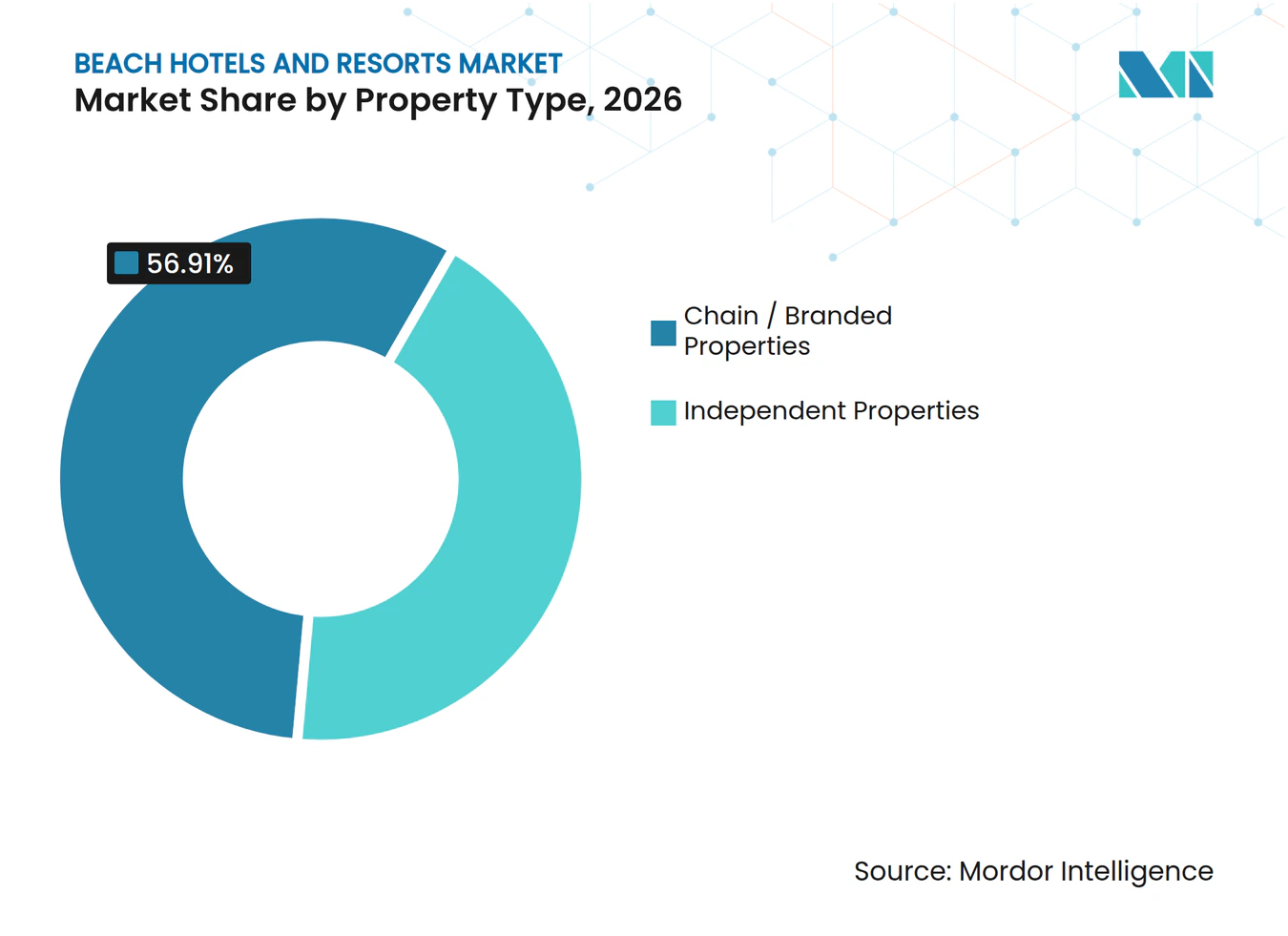
- By property type, Chain and Branded Properties accounted for 56.91% of the global beach hotels and resorts market share in 2026, and Independent Properties are projected to grow at a 6.91% CAGR through 2032.
- By tourism type, International Tourism accounted for 52.62% of the global beach hotels and resorts market share in 2026, and Domestic Tourism is projected to grow at a 6.14% CAGR through 2032.
- By geography, Europe accounted for 32.73% of the global beach hotels and resorts market share in 2026, and Asia-Pacific is projected to grow at a 6.98% CAGR through 2032.
Note: Market numbers in this report are based on Mordor Intelligence's proprietary estimation framework, which combines nine months of actuals with Q4 projections for base year 2026.
Market Trends and Insights
Drivers Impact Analysis of Beach Hotels and Resorts Market*
| Driver | (~) % Impact on CAGR Forecast | Geographic Relevance | Impact Timeline |
|---|---|---|---|
| Recovery in International Leisure and Coastal Tourism | +1.5% | Global, led by Europe and Asia-Pacific | Short term (≤ 2 years) |
| Premiumization of Beach Stays and Experiential Hospitality | +0.9% | Global, strongest in the Middle East, Indian Ocean, and Caribbean | Medium term (2-4 years) |
| Expansion of All-Inclusive and Integrated Resort Concepts | +0.8% | Americas, expanding to Asia-Pacific and Middle East and Africa | Medium term (2-4 years) |
| Mobile-First Booking, Direct Commerce, and Revenue Personalization | +0.6% | Global, fastest in North America and Western Europe | Short term (≤ 2 years) |
| Destination Weddings, Wellness, and Multi-Generational Travel | +0.5% | Indian Ocean, Mediterranean, and Caribbean | Medium term (2-4 years) |
| Coastal Airlift and Destination Infrastructure Unlocking New Room Supply | +0.5% | Asia-Pacific, Middle East and Africa, and Caribbean | Short term (≤ 2 years) |
| Source: Mordor Intelligence | |||
Recovery in International Leisure and Coastal Tourism
International leisure travel remains a major driver of the global beach hotels and resorts market, as coastal resorts depend on visitors traveling across borders. Africa recorded 8% growth in international arrivals in 2025, with North Africa registering 11% growth, enhancing the appeal of emerging Mediterranean and Red Sea destinations. Improved air connectivity can translate this demand into bookings, particularly when routes serve island and secondary coastal destinations. UN Tourism forecasts international arrivals to grow by 3% to 4% in 2026, supporting continued resort investment. In India, improved air connectivity and easier access to Goa, Kerala, the Andaman and Nicobar Islands, and other coastal destinations can expand the visitor base, if product offerings and infrastructure quality keep pace[1].
Premiumization of Beach Stays and Experiential Hospitality
Beach stays are gaining importance as guests increasingly prioritize privacy, wellness, cultural activities, and personalized services. A peer-reviewed study found that experiential programs at luxury resorts - including fitness, entertainment, children’s activities, and romance packages - improve guest satisfaction and encourage repeat bookings. These programs support the global beach hotels and resorts market by enabling higher room rates and increasing on-property spending. Programming and service quality are therefore becoming as important as location and room inventory. For Asia-Pacific resorts, locally rooted wellness offerings, cuisine, nature-based activities, and cultural programs are becoming more relevant than standardized luxury formats. This approach can help properties attract high-value domestic demand and selected international leisure travelers.
Expansion of All-Inclusive and Integrated Resort Concepts
All-inclusive resorts are expanding beyond their traditional Caribbean concentration and becoming a broader model for beach destinations. In June 2025, Hyatt completed its USD 2.6 billion acquisition of Playa Hotels & Resorts, adding 15 all-inclusive resorts across Mexico, the Dominican Republic, and Jamaica[2]. Accor announced the addition of 17 Royal Holiday Group hotels in the Americas, including plans to introduce Rixos to the region. These moves indicate that international operators value packages combining rooms, food, leisure, and activities. The model can improve guest convenience and support more predictable property-level spending. All-inclusive options suit family holidays, wedding groups, and short leisure breaks where transparent pricing is important.
Mobile-First Booking, Direct Commerce, and Revenue Personalization
Mobile booking and direct digital commerce can improve the value captured by resort operators. Direct bookings averaged USD 519 per reservation, compared with USD 320 through OTAs, according to SiteMinder’s 2025 study. This encourages operators to improve booking speed, loyalty benefits, and personalized offers on their own websites. Direct channels also allow resorts to package rooms with dining, spa services, airport transfers, and excursions. Independent properties still need OTAs for reach, so direct commerce is a complement rather than a full replacement. In the beach hotels and resorts industry, operators can use mobile-first design and clear offers to convert repeat guests while preserving third-party distribution for new customers.
Restraints Impact Analysis of Beach Hotels and Resorts Market*
| Restraint | (~) % Impact on CAGR Forecast | Geographic Relevance | Impact Timeline |
|---|---|---|---|
| Seasonality and Shoulder-Period Occupancy Volatility | -0.5% | Global, most acute in Europe and the Caribbean | Short term (≤ 2 years) |
| Climate Exposure, Insurance Repricing, and Disaster Recovery Costs | -0.6% | Caribbean, Pacific islands, United States Gulf Coast, and Southeast Asia | Long term (≥ 4 years) |
| Coastal Utility Capacity as a Development Bottleneck | -0.4% | Asia-Pacific, Caribbean, and emerging coastal markets | Medium term (2-4 years) |
| Alternative Accommodation and Direct-Booking Margin Pressure | -0.5% | Global, most acute in North America and Western Europe | Short term (≤ 2 years) |
| Source: Mordor Intelligence | |||
Seasonality and Shoulder-Period Occupancy Volatility
Seasonality remains a key restraint, as coastal demand often concentrates within a limited number of peak months. In the Caribbean, hotel occupancy declined year over year for nine consecutive months in 2025 before improving in December, with full-year occupancy at 63.7%[3]. This pattern can force operators to discount room rates, reduce available inventory, or absorb fixed costs during weaker periods. Resorts can mitigate this exposure by targeting weddings, meetings, wellness stays, and group travel, which are less dependent on school holidays. Dynamic pricing can also align room rates with events, weather conditions, and demand shifts. Indian coastal resorts face similar seasonal demand patterns, and diversified programming and domestic weekend travel can help manage softer periods.
Climate Exposure, Insurance Repricing, and Disaster Recovery Costs
Climate exposure increases operating and financing costs for beachfront properties in the global beach hotels and resorts market. The Government of Barbados has stated that higher insurance costs may limit boutique hotels’ ability to finance refurbishments. Extreme weather can disrupt air services, reduce arrivals, and increase recovery costs. These risks highlight the need for careful site selection, resilient design, business continuity planning, and reliable insurance arrangements in coastal development. Operators must consider monsoon exposure, coastal erosion, and local infrastructure resilience when developing new beach properties.
*Our forecasts treat driver/restraint impacts as directional, not additive. The impact forecasts reflect baseline growth, mix effects, and variable interactions.
Consumer Behavior Analysis
A 2025 study of 30 United States luxury resorts found that fitness activities, evening entertainment, children’s cultural activities, and personalized experiences can differentiate resort offerings and enhance guest satisfaction. SiteMinder’s analysis of more than 125 million hotel reservations found that direct website bookings generated an average of USD 519 per booking in 2024, compared with USD 320 through online travel agencies (OTAs). These findings highlight opportunities for beach resorts to develop destination-specific experiences and strengthen direct-booking channels.
Premium group events also support higher-value resort offerings. Mar del Cabo introduced a beachfront property buyout starting at USD 75,000 for at least three nights, accommodating up to 80 guests. Separately, the FII Institute reported that 43% of surveyed global travelers were willing to pay more for sustainable stays, supporting the potential of credible environmental initiatives.
Hospitality Performance Intelligence
Global accommodation occupancy reached 66% in November 2025, matching the November 2024 level. Caribbean hotel occupancy averaged 63.7% in 2025, down 1.3 percentage points year on year. Despite lower occupancy, the Caribbean’s average daily rate (ADR) rose 2.1% to USD 350.37, while revenue per available room (RevPAR) increased 0.8% to USD 223.12. Higher rates partly offset weaker room demand.
Coastal resort profitability also depended on property-level cost management and rate maintenance. Club Med reported 75.8% occupancy in 2025, up 1.8 percentage points, with ADR rising 5% to EUR 241 (USD 283.49). Barbados’ government identified rising insurance costs as a constraint on boutique resort competitiveness and refurbishment. These pressures support investment in climate resilience, operating-cost discipline, and ancillary revenue from dining, wellness, and excursions.
Beach Hotels and Resorts Market Segment Analysis
By Accommodation Type:
Luxury Leads, but Eco-Resorts Gain Structural GroundLuxury beach hotels and resorts accounted for 34.82% of the global beach hotels and resorts market size in 2026. Travelers seeking privacy, high service levels, villas, wellness facilities, and curated activities support this segment. Luxury properties can maintain rates when their experiences differ clearly from standard accommodations. Boutique and lifestyle properties compete through local character and intimate guest experiences. Mid-range hotels face pressure from brands using loyalty offers and alternative rentals targeting price-sensitive travelers.
Eco-resorts and regenerative beach resorts are forecast to grow at a CAGR of 6.83% through 2032. The segment benefits from the 43% of travelers willing to pay for credible regenerative stays, as reported by the FII Institute. Environmental standards strengthen positioning when integrated into guest experiences and operations. Budget beach hotels, hostels, and guesthouses remain vulnerable where short-term rentals offer similar prices and more space. In India, eco-resorts can differentiate through verified conservation practices and community partnerships rather than broad sustainability messaging.



By Booking Channel:
OTAs Dominate by Volume, but Direct Commerce Captures ValueOnline travel agencies accounted for 38.84% of revenue in 2026, making them the largest booking channel in the global beach hotels and resorts market. Their scale supports comparison between shopping and international demand across destinations. They are important for independent hotels without global loyalty programs or large marketing budgets. OTA listings also provide visibility for new destinations and newly opened properties. However, reliance on OTAs can increase distribution costs and reduce direct guest relationships.
Direct booking channels are forecast to grow at 6.53% CAGR through 2032. SiteMinder reports an average value of USD 519 per direct booking, compared with USD 320 for OTA bookings. Loyalty rewards, mobile booking engines, and add-on offers can strengthen direct channels. Offline agents remain relevant for complex trips, long-haul packages, destination weddings, and multi-generational travel. Corporate and travel management company bookings may support year-round demand as business and leisure travel overlap.
By Property Type:
Branded Scale vs. Independent DifferentiationChain and branded properties held 56.91% of revenue in 2026. Their advantage stems from global distribution, loyalty programs, recognized standards, and lower perceived booking risk among international visitors. Conversion-led expansion enables global brands to enter coastal locations without waiting for ground-up development. It also gives independent owners access to distribution systems while retaining asset ownership. This asset-light approach suits resort owners seeking stronger distribution without selling real estate.
Independent properties are forecast to grow at a 6.91% CAGR through 2032. They compete through local knowledge, flexibility, distinctive design, and experience-led service. However, they depend more on online travel agencies (OTAs). Cloudbeds reported that OTAs accounted for 61% of global independent-property bookings in 2024[4]. Distribution costs therefore remain a key concern. Independent coastal resorts can protect margins through personalized service, local partnerships, repeat business, and direct booking benefits.

By Tourism Type:
International Travelers Drive Revenue, Domestic Travel AcceleratesInternational tourism accounted for 52.62% of revenue in 2026. Iconic beach destinations often rely on international guests, who generate higher spending per night and longer stays. UN Tourism expects international arrivals to grow by 3% to 4% in 2026, following the recovery in 2025. This demand supports remote-island, luxury, and all-inclusive properties that depend on long-haul travelers. It also highlights the importance of destination access, visa processes, safety, and air capacity in the global beach hotels and resorts market.
Domestic tourism is projected to grow at a CAGR of 6.14% through 2032. It provides an accessible demand base across Asia-Pacific and South America, where leisure spending is increasing. Domestic guests support short breaks, repeat visits, family holidays, and off-peak demand. Resorts serve this segment through domestic-language services, regional cuisine, and packages aligned with school holidays and long weekends. A mix of domestic and international demand can improve revenue stability when international travel conditions change.
Geography Analysis
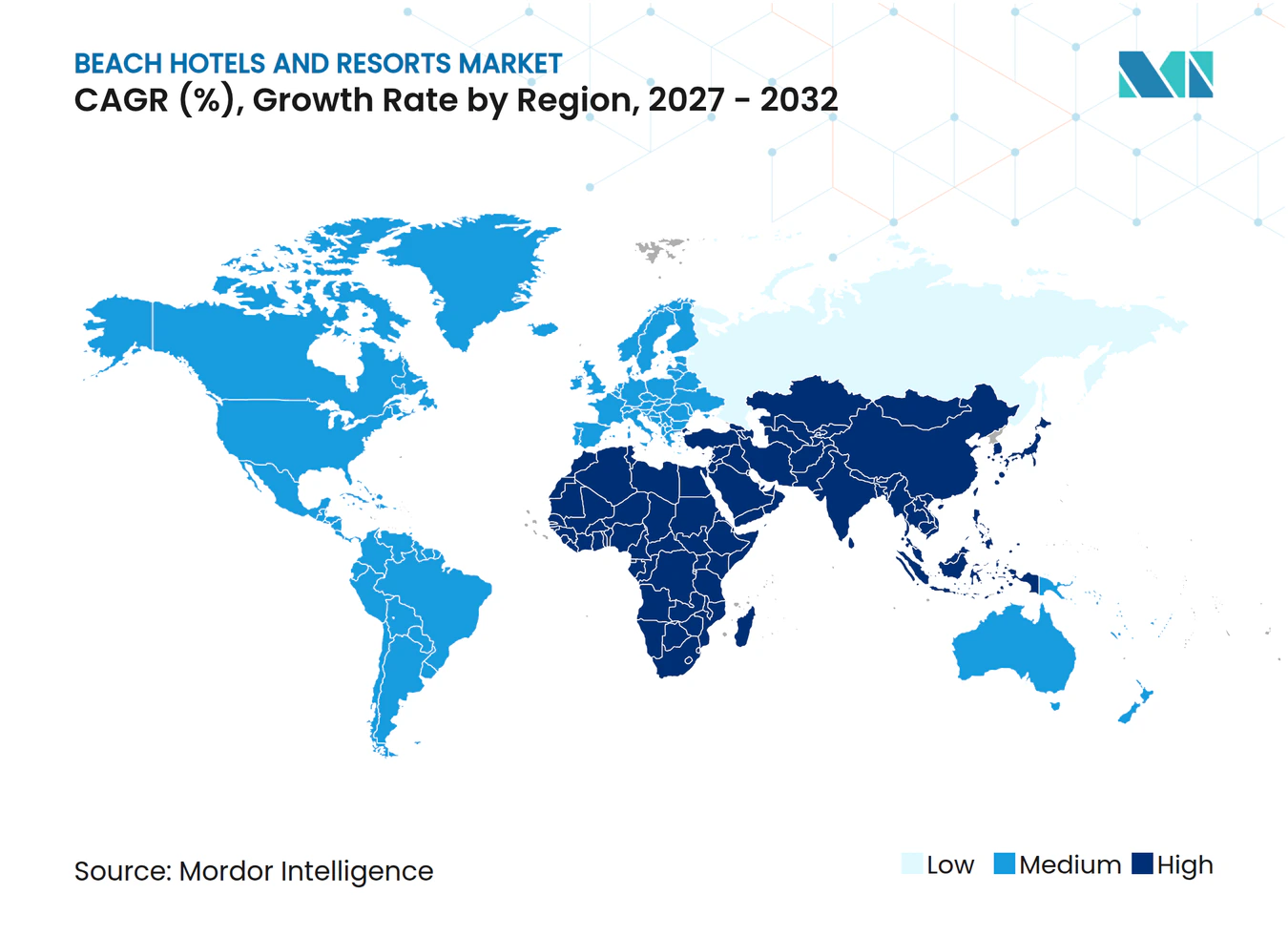
Europe held a 32.73% share of the global beach hotels and resorts market in 2026. The region received 793 million international arrivals in 2025, 6% above pre-pandemic levels. Spain remains a major coastal market, supported by mature resort infrastructure and leisure demand. Limited beachfront land in the Canary and Balearic Islands supports supply discipline and higher rates. Greece continues to attract international brands seeking established Mediterranean leisure destinations.
Asia-Pacific is forecast to grow at a 6.98% CAGR through 2032. The region recorded 331 million international arrivals in 2025, up 6%, while North-East Asia grew 13%. The Maldives and Seychelles recorded 13% arrival growth, and Minor Hotels opened NH Collection Maldives Reethi Resort in December 2025. Indonesia, Thailand, Vietnam, and the Philippines remain competitive luxury resort markets. India benefits from domestic travel demand and opportunities to improve coastal access, product quality, and environmental management.
The Americas, Middle East, and Africa offer additional growth opportunities. The Middle East approached 100 million international visitors in 2025, 39% above pre-pandemic levels, while the UAE and Saudi Arabia expanded luxury coastal infrastructure. Ras Al Khaimah recorded 11.5% RevPAR growth. Africa recorded 8% arrival growth, including 11% in North Africa. New supply requires reliable transport, services, and environmental resilience.
Hospitality Supply & Development Intelligence
The global beach hotels and resorts market is expanding capacity across South America, the Caribbean, the Middle East, Mediterranean Europe, and Asia-Pacific. In Q2 2025, South America’s construction pipeline included 748 hotel projects with 116,648 rooms, up 22% in project count and 20% in room count from the previous year. Mexico accounted for 263 projects and 40,428 rooms, while Mexico, Brazil, and the Dominican Republic represented nearly two-thirds of regional pipeline activity. New developments increasingly combine hotel rooms with branded residences, particularly in Caribbean destinations, where presales can support project financing. This model may enable developers to advance coastal projects where room revenue alone does not support construction economics.
Ras Al Khaimah had more than 9,000 hotel keys in 2025 and has over 9,500 additional rooms in the pipeline for 2026–2030. Five-star properties comprise most of the pipeline, led by the AED 19 billion (USD 5.17 billion) Wynn Al Marjan Island integrated resort. In Spain, the 1,037-key Mare Nostrum Resort in Tenerife sold for EUR 430 million (USD 505.81 million) in 2025, indicating sustained investor interest in large coastal assets. Minor Hotels expects to exceed 850 properties worldwide by the end of 2027, with expansion priorities in the Middle East, Egypt, and Asia-Pacific. Banyan Group entered 2026 after reaching 100 resorts, reflecting continued expansion among specialty resort groups.
Competitive Landscape
Market Concentration
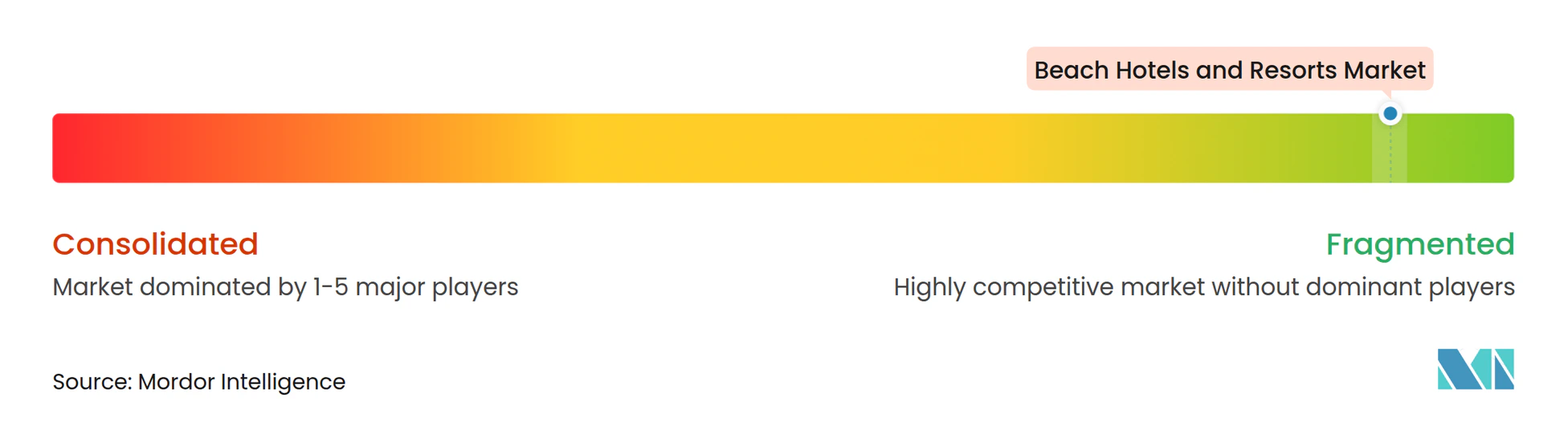
The global beach hotels and resorts market remains fragmented, with regional, boutique, and independent operators important across coastal destinations. Marriott, Hilton, Hyatt, Accor, and IHG benefit from distribution, loyalty programs, standards, and conversion capabilities rather than dominant ownership. In 2025, Marriott signed 94 deals in the Caribbean and South America, with all-inclusive properties accounting for 21% of regional pipeline rooms. Hyatt acquired Playa Hotels & Resorts, adding 15 all-inclusive properties to its Inclusive Collection. Accor’s 2025 Royal Holiday Group transaction similarly expanded its managed hotel portfolio and introduced Rixos to the Americas.
Independent and specialist operators compete through destination knowledge and distinctive guest experiences. Minor Hotels reported 32% profit growth in 2025 and a 285-plus-hotel development pipeline over the following three years. Banyan Group’s 100-resort milestone demonstrates the scale specialist luxury groups can achieve. Sustainability, personalized service, and local programming can support pricing and repeat visits but do not replace dependable operations and distribution.
Management and franchise models reduce capital needs and support geographic expansion. Minor Hotels also formed a joint venture with SUNRISE Resorts and Cruises to target 50 hotels in Egypt over the next decade. In India, domestic operators and local owners can partner with global brands where distribution and standards offer clear benefits. Competition remains strong where infrastructure, service quality, and differentiated experiences converge.
Beach Hotels and Resorts Industry Leaders
-
Marriott International, Inc.
-
Hilton Worldwide Holdings Inc.
-
Hyatt Hotels Corporation
-
Accor S.A.
-
InterContinental Hotels Group PLC
- *Disclaimer: Major Players sorted in no particular order
Beach Hotels and Resorts Market Companies Covered in this Report
- Marriott International, Inc.
- Hilton Worldwide Holdings Inc.
- Hyatt Hotels Corporation
- Accor S.A.
- InterContinental Hotels Group PLC
- Wyndham Hotels & Resorts, Inc.
- Four Seasons Hotels Limited
- Radisson Hotel Group
- Rosewood Hotel Group
- Shangri-La International Hotel Management Limited
- Mandarin Oriental Hotel Group Limited
- Jumeirah Group LLC
- Meliá Hotels International, S.A.
- Barceló Hotel Group
- Sandals Resorts International
- Club Med SAS
- Aman Group Sarl
- Banyan Tree Holdings Limited
- Minor International Public Company Limited
- Kerzner International Holdings Limited
- The Indian Hotels Company Limited
- The Oberoi Group
- Soneva Group
- Palladium Hotel Group
- Riu Hotels & Resorts
Recent Industry Developments in Beach Hotels and Resorts Market
- March 2026: Marriott reported 94 signed Caribbean and South America agreements during 2025, adding 10,461 rooms to its pipeline and including the first all-inclusive W Hotel in Punta Cana.
- July 2025: Selenta Group sold the 1,037-key Mare Nostrum Resort in Tenerife to Spring Hotels for EUR 430 million (USD 505.81 million), which was described as Spain’s largest single-asset hotel transaction.
- June 2025: Hyatt acquired Playa Hotels & Resorts for USD 2.6 billion, adding 15 all-inclusive beachfront resorts across Mexico, the Dominican Republic, and Jamaica, including Secrets La Romana, Dreams Rose Hall in Montego Bay, and Hyatt Vivid Playa del Carmen.
- April 2025: Accor entered exclusive negotiations to acquire 17 hotel management agreements from Royal Holiday Group across Mexico, Argentina, Puerto Rico, and the United States. The transaction was valued at USD 79 million, with the proceeds intended to partially fund a USD 130 million renovation plan for over 30 months.
Global Beach Hotels and Resorts Market Report Scope
The global beach hotels and resorts market report analyzes accommodation services provided by coastal hotels and resorts serving leisure and experience-led travel. The market is segmented by accommodation type, booking channel, property type, tourism type, and geography. The study assesses drivers, including the recovery of international leisure and coastal tourism, premium beach stays, all-inclusive resort concepts, mobile-first booking, destination weddings, wellness travel, and coastal infrastructure development. It also examines restraints such as seasonal occupancy fluctuations, climate exposure, insurance costs, coastal utility constraints, and margin pressure from alternative accommodation and direct-booking competition. The report evaluates hospitality supply, room inventory, occupancy rates, average daily rates, traveler preferences, booking behavior, channel selection, travel spending, and emerging demand patterns. It provides market size and growth forecasts, regional and country-level analyses, competitive landscape assessments, market concentration, market shares, strategic developments, and profiles of global hotel groups, resort operators, and hospitality brands. The study also explores opportunities in climate-resilient coastal redevelopment and underpenetrated coastal destinations supported by new airlift. Market estimates and forecasts are presented in value (USD) across all covered segments for 2022–2032.
Segmentation Overview
Key Questions Answered in the Report
What is the projected value of beach hotels and resorts by 2032?
The global beach hotels and resorts market is projected to reach USD 262.19 billion by 2032, growing at a 5.22% CAGR from 2027.
Which accommodation type leads to beach hotels and resorts?
Luxury Beach Hotels and Resorts lead with 34.82% revenue share in 2026, while Eco-Resorts and Regenerative Beach Resorts have the highest projected growth at 6.83% CAGR.
Which booking channel has the largest share of beach hotel reservations?
Online Travel Agencies accounted for a 38.84% share in 2026, although Direct Booking Channels are projected to grow faster at 6.53% CAGR.
Which region is expected to grow the fastest through 2032?
Asia-Pacific is forecast to grow at 6.98% CAGR through 2032, supported by travel recovery and coastal development.
What factors constrain new coastal resort development?
Seasonal demand, climate exposure, insurance costs, utility capacity, and alternative accommodation can constrain coastal resort returns and expansion.