
Alkaline Water Electrolysis Market Size and Share
Market Overview
| Study Period | 2022 - 2032 |
|---|---|
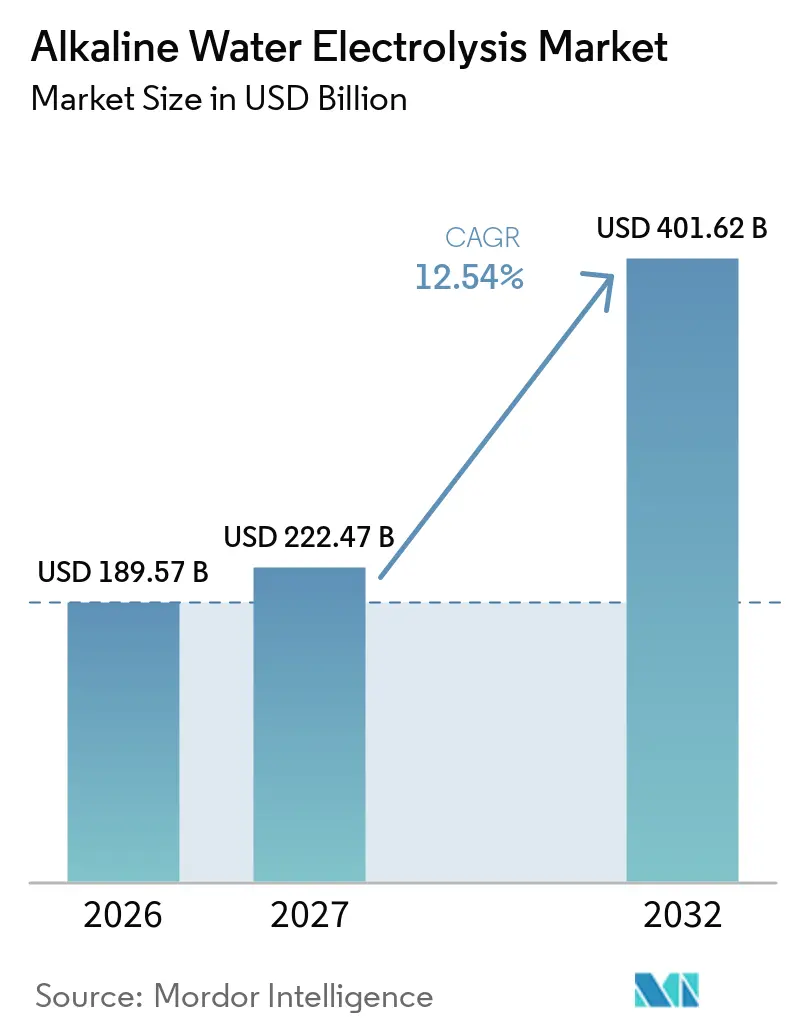
| Market Size (2027) | USD 222.47 Billion |
| Market Size (2032) | USD 401.62 Billion |
| Growth Rate (2027 - 2032) | 12.54 % |
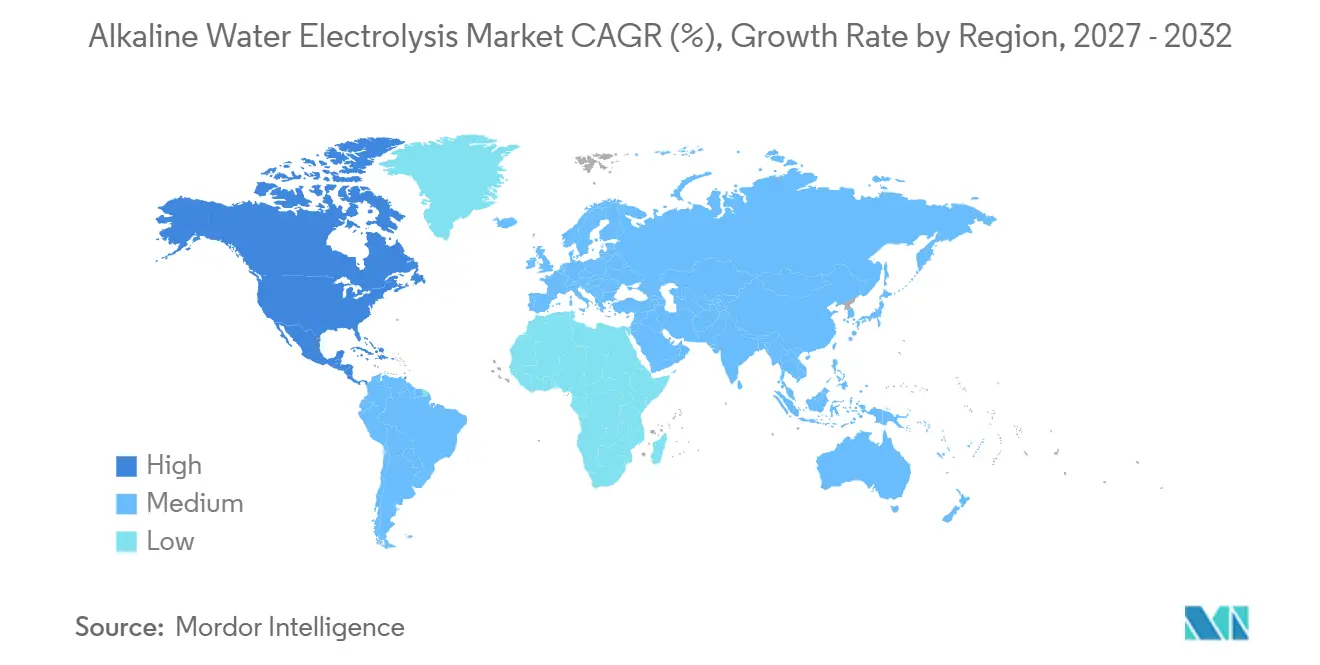
| Fastest Growing Market | North America |
| Largest Market | Asia-Pacific |
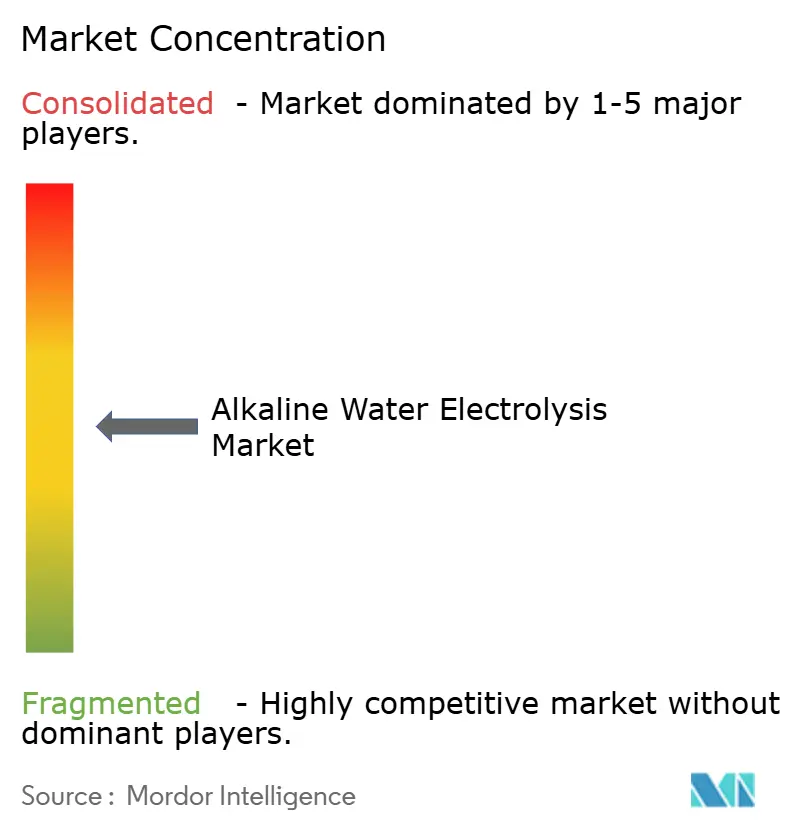
| Market Concentration | Medium |
Major Players *Disclaimer: Major Players sorted in no particular order Image © Mordor Intelligence. Reuse requires attribution under CC BY 4.0. | |
Alkaline Water Electrolysis Market Analysis by Mordor Intelligence
The alkaline water electrolysis market size was valued at USD 189.57 billion in 2026 and is estimated to grow from USD 222.47 billion in 2027 to reach USD 401.62 billion by 2032, at a CAGR of 12.54% during the forecast period (2027-2032). The alkaline water electrolysis market is supported by industrial buyers that need continuous hydrogen supplies for refining, ammonia, steel, and industrial gases. Large renewable hydrogen projects are moving procurement toward standardized modules, which can be repeated across larger plants and reduce project engineering complexity. China combines fast project development with a broad manufacturing base, while European and North American suppliers compete through certifications, service arrangements, and system design. Electricity prices and the slower response of alkaline systems under changing power conditions still limit use in projects with highly variable renewable generation. The alkaline water electrolysis market therefore has its strongest opportunity in stable, large-volume operations, while hybrid configurations may serve projects that need faster operating response.
Key Report Takeaways
- By capacity, the 30-50 m³/h segment held a 22.6% revenue share in 2026 and is forecast to grow at a 14.3% CAGR through 2032.
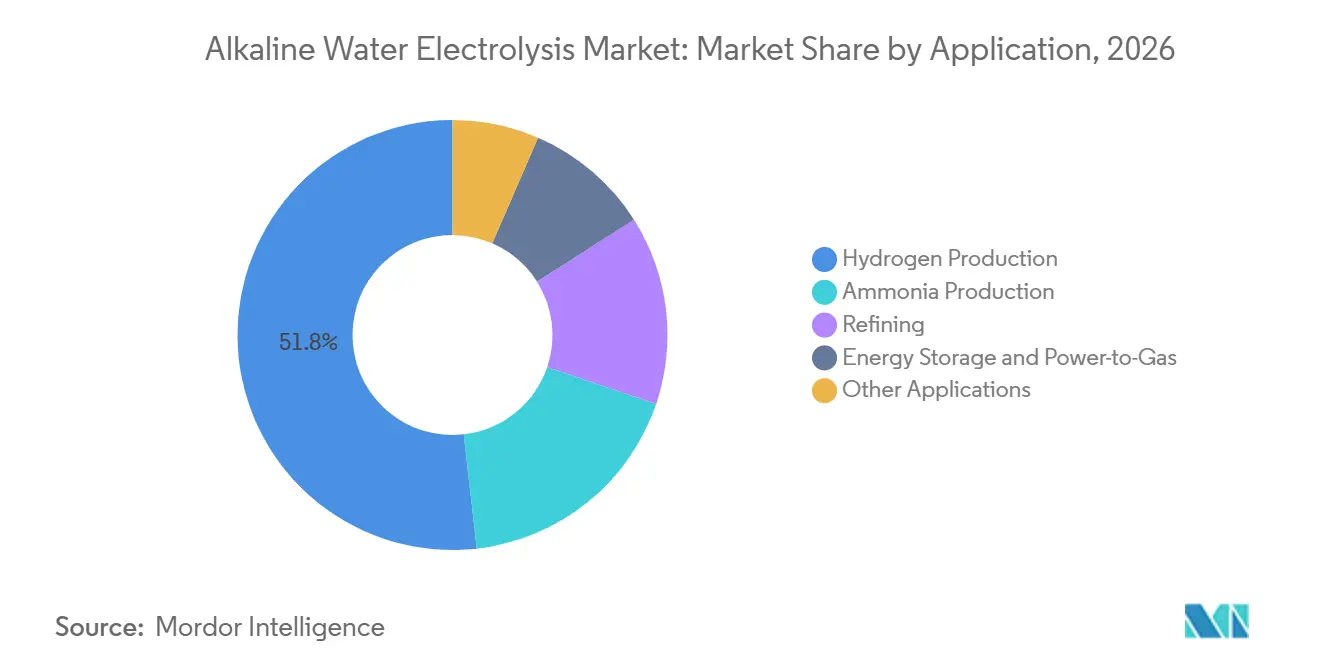
- By application, hydrogen production accounted for a 51.8% revenue share in 2026, while ammonia production is forecast to grow at a 15.6% CAGR through 2032.
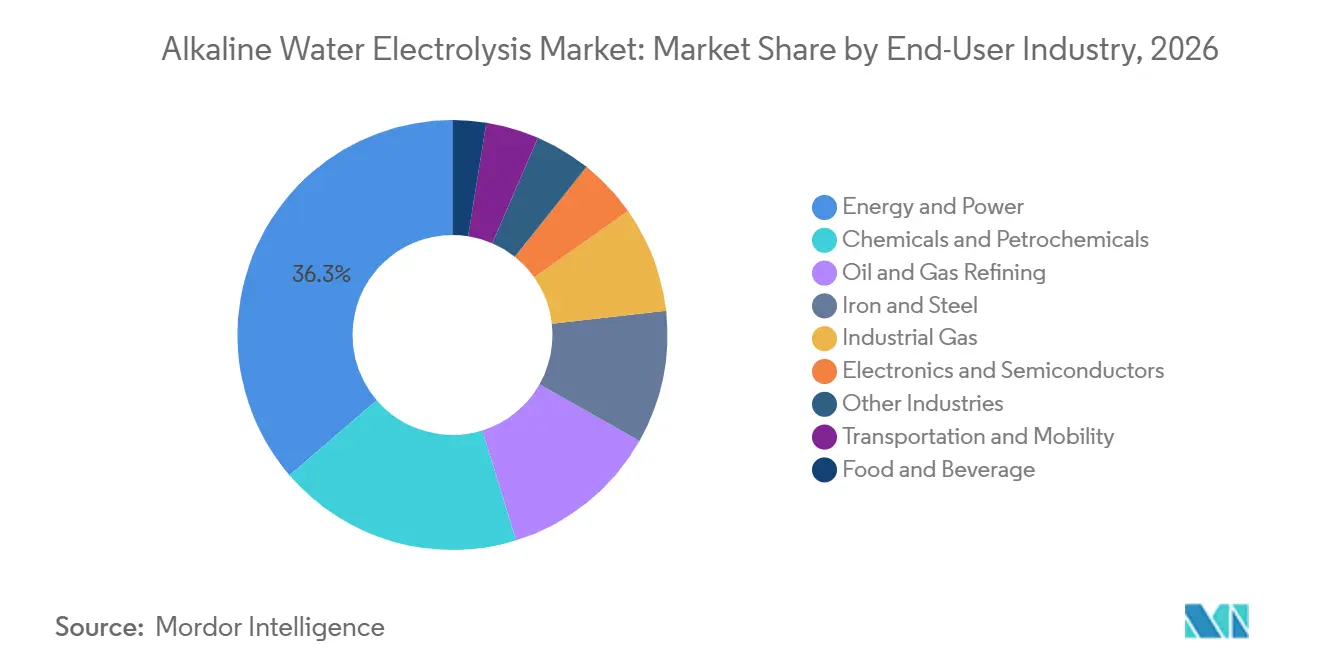
- By end-use industry, energy and power held a 36.3% revenue share in 2026, while chemicals and petrochemicals is forecast to grow at a 13.5% CAGR through 2032.
- By geography, Asia-Pacific held a 41.2% regional share in 2026, while North America is the fastest-growing region through 2032.
Note: Market numbers in this report are based on Mordor Intelligence's proprietary estimation framework, which combines nine months of actuals with Q4 projections for base year 2026.
Global Alkaline Water Electrolysis Market Trends and Insights
Drivers Impact Analysis*
| Driver | (~) % Impact on CAGR Forecast | Geographic Relevance | Impact Timeline |
|---|---|---|---|
| Industrial Decarbonization and Green Hydrogen Offtake | +3.2% | Global, concentrated in EU, China, and Middle East | Medium term (2-4 years) |
| Gigawatt-Scale Renewable Hydrogen Projects | +2.5% | APAC core, with relevance in Middle East, Africa, and South America | Medium term (2-4 years) |
| Alkaline Technology Cost and Durability Advantage | +2.0% | Global, strongest in emerging markets across APAC, MENA, and South America | Short term (≤ 2 years) |
| Hydrogen-Based Green Steel and Ammonia Expansion | +1.8% | EU, East Asia, and South America | Medium term (2-4 years) |
| Policy-Linked Hydrogen Hubs and Production Incentives | +1.5% | North America, EU, and Australia | Short term (≤ 2 years) |
| Repurposing Chlor-Alkali Expertise for Water Electrolysis | +0.7% | EU, Japan, and North America | Short term (≤ 2 years) |
| Source: Mordor Intelligence | |||
Industrial Decarbonization and Green Hydrogen Offtake
Steel, ammonia, refining, and industrial-gas buyers are developing long-term hydrogen demand that favors steady production from alkaline systems. These industries often need hydrogen as a continuous process input rather than an occasional energy source. Long-duration supply agreements can shape equipment choices for years because they give project developers clearer demand visibility. The European Union has set renewable hydrogen targets for industry and transport by 2030, strengthening the basis for project planning and financing.[1] High-temperature industrial processes remain a less developed source of demand, although their use of hydrogen can fit integrated energy and process systems. The alkaline water electrolysis market can benefit where buyers combine renewable electricity, hydrogen production, and downstream consumption within the same industrial location. These arrangements give the alkaline water electrolysis market a clearer connection between equipment selection and an industrial buyer’s long-term hydrogen demand.
Gigawatt-Scale Renewable Hydrogen Projects
The alkaline water electrolysis market is shifting from projects measured in tens of megawatts to facilities planned in the hundreds of megawatts or gigawatts. Global electrolyzer capacity totaled 2.15 GW in operation by mid-2025, while 16 GW was under construction and 3.5 GW had reached final investment decision.[2] Alkaline systems represented 84% of the construction pipeline, showing their established role in larger projects. Standard module designs, including thyssenkrupp nucera’s 20 MW Scalum unit, can simplify repeat procurement across large plants. Envision Energy’s Chifeng facility entered operation in 2025 at 500 MW and is planned to expand to 2.5 GW by 2028. This model can increase competition among suppliers that offer similar equipment while placing greater importance on delivery capability and operating support.
Alkaline Technology Cost and Durability Advantage
The alkaline water electrolysis market retains a cost advantage over Proton Exchange Membrane (PEM) technology in applications that operate at stable loads. Chinese alkaline (ALK) stacks reached USD 75/kW without balance-of-plant equipment in Sinopec’s September 2025 Ordos tender. That price was 60% below the 2022 level, indicating rapid cost reduction in stack manufacturing. A seven-year evaluation of a 2,000 kW industrial alkaline electrolyzer found iron deposition on nickel-foam electrodes reduced oxygen-evolution overpotential by 315 mV.[3] This operating evidence gives equipment buyers a practical basis for assessing electrode durability over a long project life. Lower stack costs do not remove the need to control balance-of-plant spending but they support deployment where equipment pricing is a central procurement criterion.
Hydrogen-Based Green Steel and Ammonia Expansion
Hydrogen-based direct reduction is making electrolysis a central component of proposed green steel plants rather than a supporting process. Stegra is installing more than 700 MW of alkaline electrolysis at Boden, Sweden, for operations ramping in 2026 and green steel capacity of 2.5 million metric tons per year.[4] The project is intended to reduce carbon dioxide emissions by up to 95% relative to conventional steelmaking. Green ammonia projects also require continuous, high-volume hydrogen supplies, which can support large alkaline procurement packages. LONGi Hydrogen reported that its 3,000 Nm³/h alkaline unit used in a green steel setting reduced blast-furnace carbon emissions by 8–11% and increased steel output by 13%. The alkaline water electrolysis market is exposed to larger orders when renewable power, hydrogen generation, and ammonia or steel production are developed as one integrated project.
Restraints Impact Analysis*
| Restraint | (~) % Impact on CAGR Forecast | Geographic Relevance | Impact Timeline |
|---|---|---|---|
| High Electricity Cost and Renewable-Input Volatility | -2.1% | Global, most acute in Europe and South Asia | Short term (≤ 2 years) |
| High Upfront System and Balance-of-Plant Cost | -1.8% | Emerging markets in APAC outside China, South America, and MEA | Medium term (2-4 years) |
| Slower Ramp Response Than PEM Systems | -1.2% | Areas with high variable renewable penetration in Northern Europe and APAC | Medium term (2-4 years) |
| Water, Nickel, Diaphragm, and Skilled-Engineering Constraints | -0.9% | MENA, Sub-Saharan Africa, and South Asia | Long term (≥ 4 years) |
| Source: Mordor Intelligence | |||
High Electricity Cost and Renewable-Input Volatility
Electricity represented more than 64% of the levelized hydrogen cost for alkaline electrolyzer configurations examined in a 2025 study. This makes the alkaline water electrolysis market sensitive to power prices even when stack equipment costs decline. At EUR 85/MWh electricity prices in 2025, levelized hydrogen costs for alkaline electrolysis reached EUR 6.1–6.6/kg. Those costs exceeded the cited cost of steam methane reforming with carbon capture, which can delay investment decisions in expensive power markets. Variable renewable input also creates an operating challenge because alkaline systems have a slower ramp response than Proton Exchange Membrane (PEM) systems. Cold-start times averaged 175.4 seconds for alkaline systems, compared with 40 seconds for PEM systems, which makes hybrid ALK-PEM designs relevant where renewable output changes quickly.
High Upfront System and Balance-of-Plant Cost
Installed alkaline systems cost USD 800–1,200/kW for Chinese-sourced equipment in emerging markets and USD 1,200–1,800/kW for European-supplied equipment. Balance-of-plant equipment can account for 40–60% of total capital expenditure, including gas conditioning, water treatment, power electronics, and safety systems. These supporting systems have not reduced in cost at the same rate as electrolyzer stacks. Developers of 30–100 MW plants can therefore face higher per-kilogram costs until standardization becomes more widespread. Water availability, nickel supply, diaphragm availability, and specialized engineering capability add further constraints in some developing regions. The alkaline water electrolysis market will depend on equipment packages that reduce both stack prices and the cost of the surrounding infrastructure.
*Our forecasts treat driver/restraint impacts as directional, not additive. The impact forecasts reflect baseline growth, mix effects, and variable interactions.
Segment Analysis
By Capacity: Mid-Scale Modular Systems Drive Standardization
The 30–50 m³/h band held 22.6% revenue share in 2026 and is projected to grow at a 14.3% CAGR through 2032. This range brings together project developers’ preference for modules that can be repeated and suppliers’ ability to manufacture proven equipment. It can be incorporated into larger plant designs without relying on a custom system for each site. The alkaline water electrolysis market size for this band is supported by buyers seeking units that are familiar to lenders, contractors, and operations teams. Below-10 m³/h equipment has historically served pilot projects, but developers are increasingly moving directly toward commercial-scale deployments. That change reduces the role of small systems where project sponsors already have defined demand and renewable power plans. The 80 m³/h and above range is gaining use in projects such as NEOM and Stegra, where fewer high-capacity units can simplify logistics and maintenance arrangements. Larger units can reduce equipment counts, although they also require confidence in delivery schedules and site-level integration.
The 10–30 m³/h and 50–80 m³/h ranges connect pilot activity with full industrial operation. These ranges are being procured in South and Southeast Asia as projects advance from feasibility work toward commercial construction. Asahi Kasei’s Aqualyzer draws on the company’s chlor-alkali manufacturing experience and illustrates how established electrolysis knowledge can be used in modular alkaline equipment. This connection between chlor-alkali operations and water electrolysis can shorten the path from existing production know-how to new product deployment. Nel ASA commercially launched its PA-Series pressurized alkaline platform in May 2026.[5] The platform targets 51–53 kWh per kilogram of hydrogen and an 80% smaller footprint than atmospheric designs. Suppliers that pair standardized capacity ranges with efficiency and site-footprint improvements can address both project scale and physical space constraints.
By Application: Green Ammonia Set to Challenge Hydrogen Production Dominance
Hydrogen production accounted for 51.8% revenue share in 2026, reflecting its role as the direct output for refining, chemicals, and industrial gases. This application is tied to existing hydrogen demand that can be served by on-site or dedicated renewable supply. It remains important because many users consume hydrogen before it needs conversion into another product. Ammonia production is forecast to expand at a 15.6% CAGR through 2032, making it the fastest-growing application in the alkaline water electrolysis market. Green fertilizer demand, ammonia’s role as a hydrogen carrier, and marine fuel rules support this outlook. Ammonia projects need continuous, high-volume hydrogen feeds for synthesis, which can result in larger electrolyzer procurement than many standalone hydrogen projects. This means ammonia equipment purchases may rise faster than the application’s initial revenue share. Refining and other uses may grow more slowly because blue hydrogen and carbon capture remain competing investment paths.
Energy storage and power-to-gas applications use alkaline electrolyzers for longer-duration storage linked to wind generation. Northern Europe and Australia have projects that require durable stacks over many operating cycles. The Murchison Green Hydrogen project in Western Australia targets 2.5 GW of electrolysis capacity and 1.8 million tonnes per year of green ammonia for export to Asian markets. Its scale shows how ammonia developments can establish the equipment requirement for future alkaline procurement. Other applications include float glass manufacturing and food processing, where reliable hydrogen supply can be important to local operations. These applications are smaller than ammonia production, but they widen the buyer base for the alkaline water electrolysis market. The application mix will depend on whether producers use hydrogen directly, convert it into ammonia, or connect it with storage systems. This gives the alkaline water electrolysis market several routes to demand, even where the relevant buyer groups differ. Equipment suppliers therefore need offerings that suit both continuous industrial demand and projects designed around renewable generation.
By End-Use Industry: Chemicals Sector's Expanding Role Masks a Supply-Chain Shift
Energy and Power held 36.3% revenue share in 2026 because utilities use electrolyzers for grid balancing, seasonal storage, and decarbonization programs. The alkaline water electrolysis market size in this end-use area is linked to how power systems value flexible storage and clean hydrogen production. Utilities can use electrolyzers to convert renewable output into a product that can be stored or supplied to other sectors. Chemicals and Petrochemicals is projected to expand at a 13.5% CAGR through 2032. Green ammonia, methanol, and lower-carbon refinery hydrogen are central to the segment’s demand. Integrated industrial sites in China and the Middle East combine renewable power, alkaline electrolysis, and downstream chemical synthesis. This structure changes the buyer from a separate equipment purchaser to a chemical producer that manages several linked assets. It also increases the value of systems that can maintain dependable operation within a larger production process.
Iron and Steel is becoming a material demand area as hydrogen-based direct reduction gains support from projects in Sweden and Luxembourg. ArcelorMittal stated in July 2026 that it would integrate hydrogen-based reduction into 3 blast furnaces by 2028. The sector’s requirements favor large, stable hydrogen volumes and long operating periods. Transportation and Mobility and Food and Beverage remain smaller users in the alkaline water electrolysis market. They can still support distributed projects where hydrogen is produced near the point of use. Industrial gas companies provide a stable demand base as they consider replacing hydrogen from steam methane reforming with on-site electrolysis. Long-term power purchase agreements are important for this change because electricity costs determine project economics. End-user demand will remain shaped by the ability to combine renewable supply, production assets, and regular hydrogen consumption at one location. The alkaline water electrolysis market will be most relevant where this combination supports regular operation and clearly defined offtake.
Geography Analysis
Asia-Pacific held 41.2% of alkaline water electrolysis market share in 2026 and remains the largest regional center for deployment and manufacturing. China’s built and under-construction renewable-energy hydrogen capacity exceeded 1 million tonnes per year at the end of March 2026. The national platform also recorded more than 908 wind-solar-hydrogen projects in the pipeline and disclosed electrolyzer demand of 13.81 million Nm³/h. China held 85% of global alkaline manufacturing capacity, reinforcing its position as both a leading producer and user of the equipment.
India is developing as a regional growth area through the Kakinada green hydrogen and ammonia project, which includes 1,950 MW of electrolyzer capacity and targets exports to Germany, Japan, and Singapore. Japan and South Korea are pursuing long-term offtake agreements for hydrogen derivatives rather than manufacturing scale comparable with China. North America is the fastest-growing region through 2032, supported by the Section 45V clean hydrogen production tax credit of up to USD 3 per kilogram and the USD 7 billion Regional Clean Hydrogen Hubs program. The ACES Delta facility in Utah represents a large U.S. alkaline project at 220 MW. Plug Power’s 275 MW Courant project in Québec is advancing through front-end engineering and design, indicating a broader regional pipeline.
Europe is the second-largest regional area in the alkaline water electrolysis market, supported by renewable hydrogen programs and industrial decarbonization goals. The European Hydrogen Bank’s second auction selected 15 projects in May 2025 that are expected to produce nearly 2.2 million tonnes of renewable hydrogen over 10 years. Spain’s Onuba project reached final investment decision in March 2026, while the NEOM project in Saudi Arabia completed construction in August 2026 and entered commissioning. South America has potential through Chile’s Patagonian wind resources and Brazil’s offshore wind potential, creating a foundation for project activity later in the decade.
Competitive Landscape
The alkaline water electrolysis market has a moderately consolidated technology supply base that includes thyssenkrupp nucera, LONGi Hydrogen, Nel ASA, PERIC, and Sungrow Hydrogen. Chinese manufacturers compete primarily through lower prices and large output volumes. European and North American suppliers differentiate through certification, service contracts, digital tools, and project delivery capability. Chinese alkaline systems were priced at USD 270–280/kW in domestic sales and USD 350/kW for exports in 2025, compared with USD 800/kW for European and U.S. ex-factory systems.
PERIC had 6.5 GW of annual alkaline manufacturing capacity, while thyssenkrupp nucera had 1.5 GW of capacity and 3,220 MW under construction. The contrast shows why project execution can be as important as manufacturing capacity for high-value contracts. Thyssenkrupp nucera reported EUR 471 million of order intake in the first 9 months of fiscal 2025/26, nearly double the prior-year level. Its 20 MW Scalum module supports a standardized approach to large projects. Nel ASA launched its pressurized PA-Series in May 2026, targeting up to 60% lower capital expenditure and an 80% smaller footprint than atmospheric designs. These moves show that the alkaline water electrolysis market is competing through both lower equipment cost and more compact, efficient system designs.
Suppliers have an opening in modular systems below 5 MW for microgrids and off-grid renewable projects, because many manufacturers prioritize larger installations. Containerized systems could serve distributed demand in Southeast Asia and Sub-Saharan Africa where large projects are not always practical. Service-based equipment arrangements, where manufacturers retain ownership and charge by kilograms of hydrogen, remain limited but could be viable as stack costs decline. The alkaline water electrolysis market also draws on chlor-alkali expertise, as shown by thyssenkrupp nucera’s December 2025 contract for a major Middle East chlor-alkali project. Competition is expected to remain balanced between China’s scale advantage and other suppliers’ focus on certified, supported, and integrated equipment.
Alkaline Water Electrolysis Industry Leaders
-
Thyssenkrupp nucera AG & Co. KGaA
-
Nel ASA
-
John Cockerill
-
McPhy Energy S.A.
-
Asahi Kasei Corporation
- *Disclaimer: Major Players sorted in no particular order
Recent Industry Developments
- May 2026: Nel ASA commercially launched its next-generation PA-Series pressurized alkaline electrolyzer platform, developed after more than eight years of R&D and full-scale testing at its Herøya facility in Norway. The modular, skid-mounted system is designed to simplify large-scale hydrogen projects through factory-built standardization, reducing engineering complexity, site work, and execution timelines.
- March 2026: thyssenkrupp nucera signed an engineering, procurement, fabrication, and supply contract with Moeve to provide 300 MW of alkaline water electrolysis capacity for the Onuba project in Huelva, Spain. Under the agreement, thyssenkrupp nucera will supply 15 standardized 20 MW electrolyzer units for the first phase of the Andalusian Green Hydrogen Valley.
- March 2026: thyssenkrupp nucera was selected by Juno Joule Green Energy Private Limited to conduct a front-end engineering and design (FEED) study for a 260 MW alkaline electrolysis facility in India. The project forms part of a green ammonia complex being developed jointly by Juno Joule Green Energy Private Limited and SELECT Energy GmbH, with RFNBO-compliant ammonia primarily intended for export to European markets.
- November 2025: LONGi Hydrogen secured a contract to supply 24 units of 1,000 Nm³/h alkaline electrolyzers for Sinopec Zhongtian Hechuang Energy Co., Ltd.'s Uxin Banner (Wushenqi) integrated wind-solar-hydrogen project in Ordos. The project is designed to produce 30,000 tonnes of green hydrogen annually and will ultimately utilize 48 electrolyzers, making it one of China's largest single alkaline electrolyzer procurement programs.
Global Alkaline Water Electrolysis Market Report Scope
Alkaline water electrolysis is an established electrochemical process that splits water into hydrogen and oxygen gases using a liquid alkaline electrolyte, typically potassium hydroxide (KOH) or sodium hydroxide (NaOH). When an electrical current is applied, water molecules are reduced at the cathode to produce hydrogen gas, while hydroxide ions travel through a porous separator to the anode to release oxygen gas. It is currently the most commercially mature and cost-effective technology for large-scale green hydrogen production.
The global alkaline water electrolysis market is segmented by capacity (below 10 m³/h, 10-30 m³/h, 30-50 m³/h, 50-80 m³/h, and 80 m³/h and above), application (hydrogen production, ammonia production, refining, energy storage and power-to-gas, and other applications), and end-use industry (energy and power, chemicals and petrochemicals, oil and gas refining, iron and steel, industrial gas, electronics and semiconductors, transportation and mobility, food and beverage, and other industries). The report also covers the market size and forecasts for the global alkaline water electrolysis market across 26 countries in key regions. For each segment, the market sizing and forecasts have been provided on the basis of value (USD).
| Below 10 m³/h |
| 10–30 m³/h |
| 30–50 m³/h |
| 50–80 m³/h |
| 80 m³/h and Above |
| Hydrogen Production |
| Ammonia Production |
| Refining |
| Energy Storage and Power-to-Gas |
| Other Applications |
| Energy and Power |
| Chemicals and Petrochemicals |
| Oil and Gas Refining |
| Iron and Steel |
| Industrial Gas |
| Electronics and Semiconductors |
| Transportation and Mobility |
| Food and Beverage |
| Other Industries |
| North America | United States |
| Canada | |
| Mexico | |
| Europe | Germany |
| France | |
| Italy | |
| Spain | |
| United Kingdom | |
| Poland | |
| Russia | |
| Rest of Europe | |
| Asia-Pacific | China |
| India | |
| Japan | |
| South Korea | |
| Australia | |
| Indonesia | |
| Vietnam | |
| Thailand | |
| Rest of Asia-Pacific | |
| South America | Brazil |
| Argentina | |
| Chile | |
| Rest of South America | |
| Middle East and Africa | Saudi Arabia |
| United Arab Emirates | |
| Egypt | |
| South Africa | |
| Morocco | |
| Rest of Middle East and Africa |
| By Capacity | Below 10 m³/h | |
| 10–30 m³/h | ||
| 30–50 m³/h | ||
| 50–80 m³/h | ||
| 80 m³/h and Above | ||
| By Application | Hydrogen Production | |
| Ammonia Production | ||
| Refining | ||
| Energy Storage and Power-to-Gas | ||
| Other Applications | ||
| By End-Use Industry | Energy and Power | |
| Chemicals and Petrochemicals | ||
| Oil and Gas Refining | ||
| Iron and Steel | ||
| Industrial Gas | ||
| Electronics and Semiconductors | ||
| Transportation and Mobility | ||
| Food and Beverage | ||
| Other Industries | ||
| By Geography | North America | United States |
| Canada | ||
| Mexico | ||
| Europe | Germany | |
| France | ||
| Italy | ||
| Spain | ||
| United Kingdom | ||
| Poland | ||
| Russia | ||
| Rest of Europe | ||
| Asia-Pacific | China | |
| India | ||
| Japan | ||
| South Korea | ||
| Australia | ||
| Indonesia | ||
| Vietnam | ||
| Thailand | ||
| Rest of Asia-Pacific | ||
| South America | Brazil | |
| Argentina | ||
| Chile | ||
| Rest of South America | ||
| Middle East and Africa | Saudi Arabia | |
| United Arab Emirates | ||
| Egypt | ||
| South Africa | ||
| Morocco | ||
| Rest of Middle East and Africa | ||
Key Questions Answered in the Report
What is the forecast for the alkaline water electrolysis market?
The alkaline water electrolysis market is projected to grow from USD 222.47 million in 2027 to USD 401.62 million by 2032, at a CAGR of 12.54%.
Which capacity range leads alkaline electrolysis demand?
The 30 to 50 m³/h range held a 22.6% share in 2026 and is projected to grow at a CAGR of 14.3% through 2032.
Why is green ammonia a key application for electrolyzer suppliers?
Ammonia (NH₃) production is the fastest-growing application, at a CAGR of 15.6%, as it requires a continuous, large-volume hydrogen (H₂) supply.
Which region has the largest deployment base?
Asia-Pacific held a 41.2% share in 2026, supported by China's manufacturing capacity and renewable hydrogen pipeline.
What is the main cost challenge for alkaline electrolysis?
Electricity accounted for more than 64% of the levelized cost of hydrogen, making project economics highly sensitive to renewable power prices.
How concentrated is the supplier base?
The supplier base is moderately consolidated, with major manufacturers including PERIC Hydrogen Technologies, thyssenkrupp nucera, LONGi Hydrogen Technology, Nel ASA, and Sungrow Hydrogen Technology.