
Airport Hospitality Market Size and Share
Market Overview
| Study Period | 2021 - 2031 |
|---|---|
| Market Size (2026) | USD 25.74 Billion |
| Market Size (2031) | USD 33.86 Billion |
| Growth Rate (2026 - 2031) | 5.63 % |
| Fastest Growing Market | Middle East and Africa |
| Largest Market | Asia-Pacific |
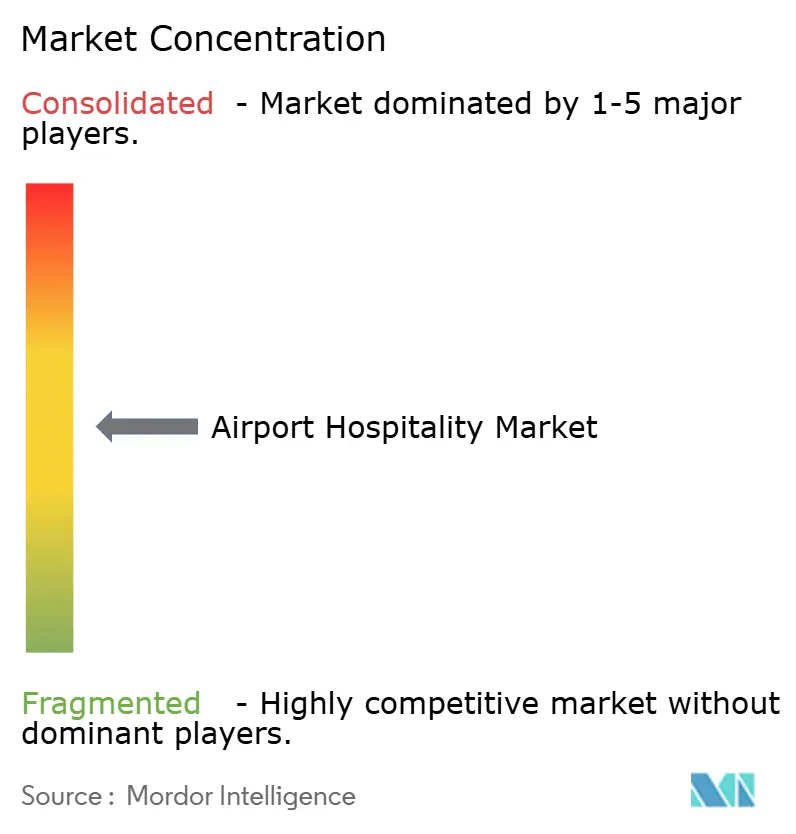
| Market Concentration | Medium |
Major Players *Disclaimer: Major Players sorted in no particular order Image © Mordor Intelligence. Reuse requires attribution under CC BY 4.0. | |
Airport Hospitality Market Analysis by Mordor Intelligence
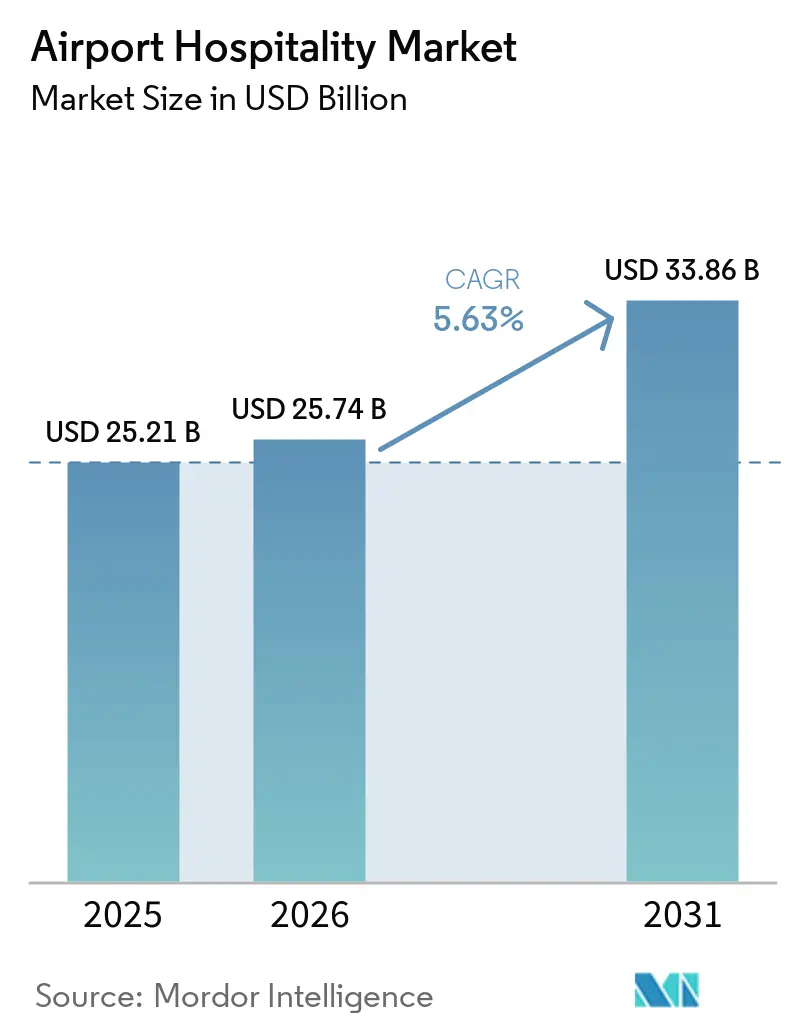
The Global Airport Hospitality Market was valued at USD 25.21 billion in 2025 and is estimated to grow from USD 25.74 billion in 2026 to reach USD 33.86 billion by 2031, at a CAGR of 5.63% during the forecast period (2026–2031). Passenger volumes reached 4.99 billion in 2025, increasing demand for lounges, airport hotels, sleep facilities, concierge services, and other in-terminal offerings at major airports. Business travel spending totaled USD 1.57 trillion in 2025 and is projected to rise in 2026, driving spending by time-sensitive travelers with high service expectations. Airlines are forecast to generate USD 145 billion in ancillary revenues in 2026, reflecting travelers' growing willingness to pay for added comfort and convenience beyond airfare. This trend supports the market's growth across various service formats. Airport operators are focusing on rebuilding non-aeronautical revenues, while advancements in digital booking, biometric access, and long-term concession partnerships are improving accessibility and monetization opportunities[1].
Key Report Takeaways
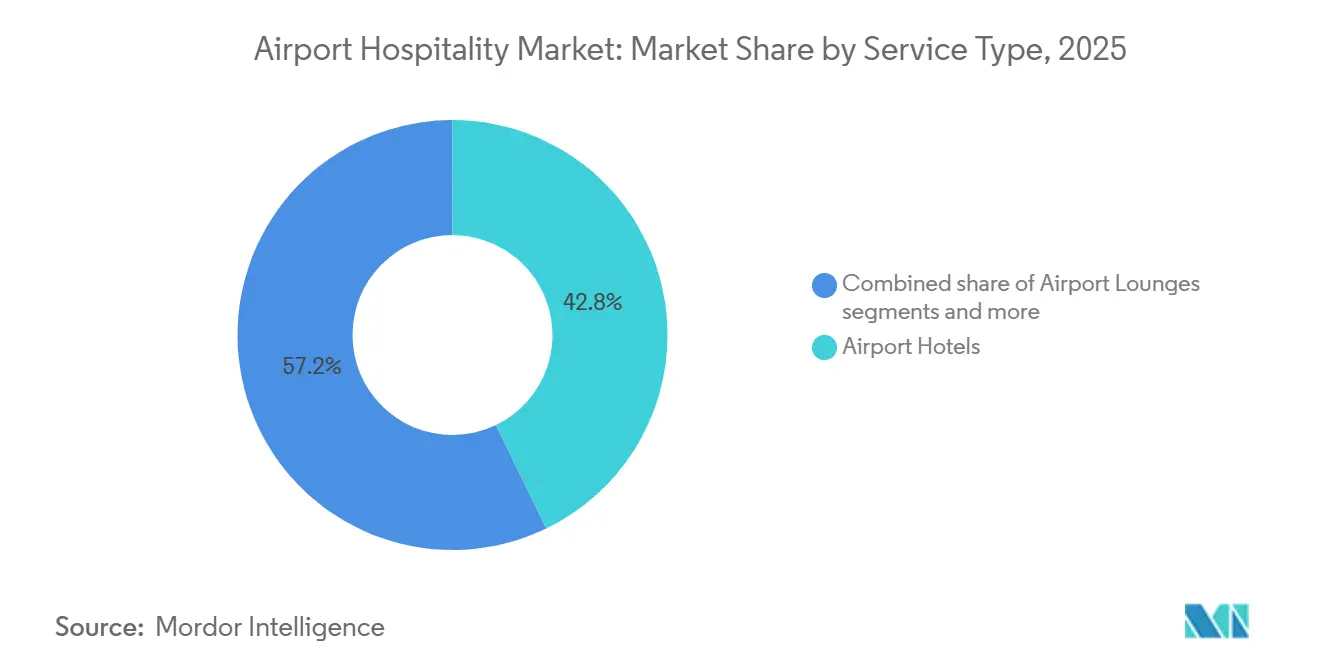
- By service type, Airport Hotels held a 42.82% share of the Global Airport Hospitality Market in 2025, while Sleep Pods and Micro-Stay Facilities are projected to grow at the highest CAGR of 6.07% by 2031.
- By airport type, International Airports accounted for a 56.81% share of the Global Airport Hospitality Market in 2025, while Hub Airports are projected to grow at the highest CAGR of 6.43% by 2031.
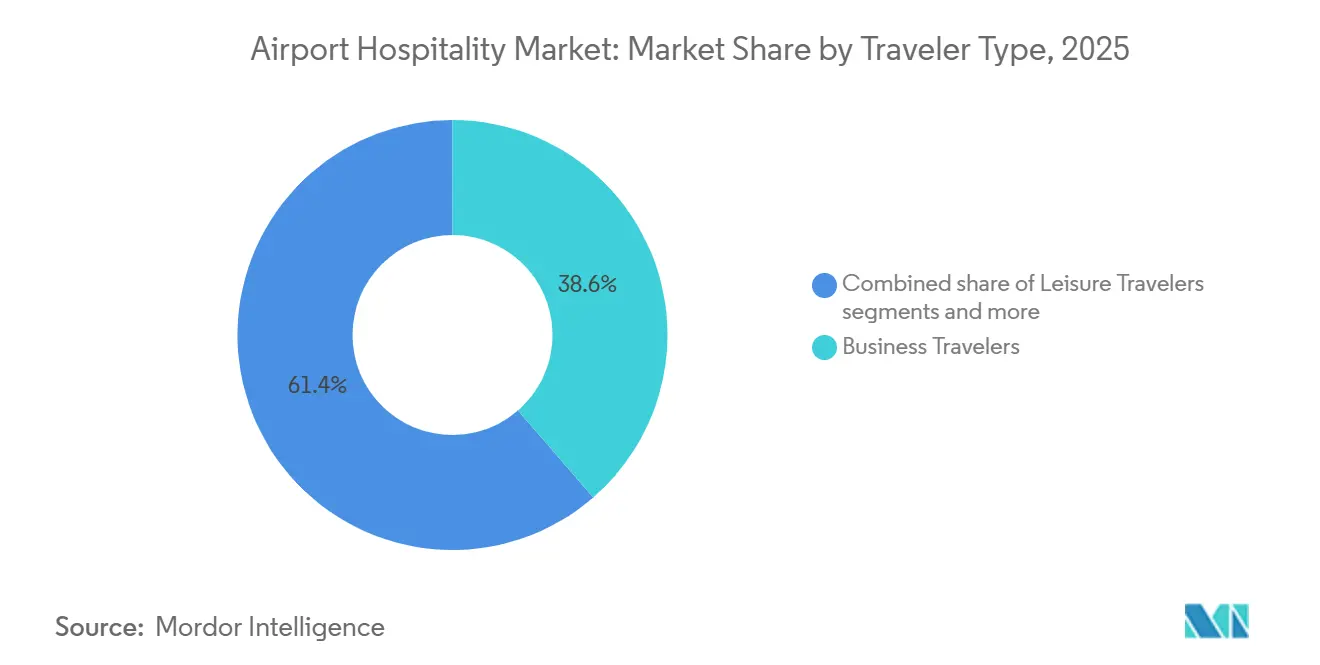
- By traveler type, Business Travelers accounted for 38.64% of the Global Airport Hospitality Market in 2025, while Transit Passengers are projected to grow at the highest CAGR of 6.29% by 2031.
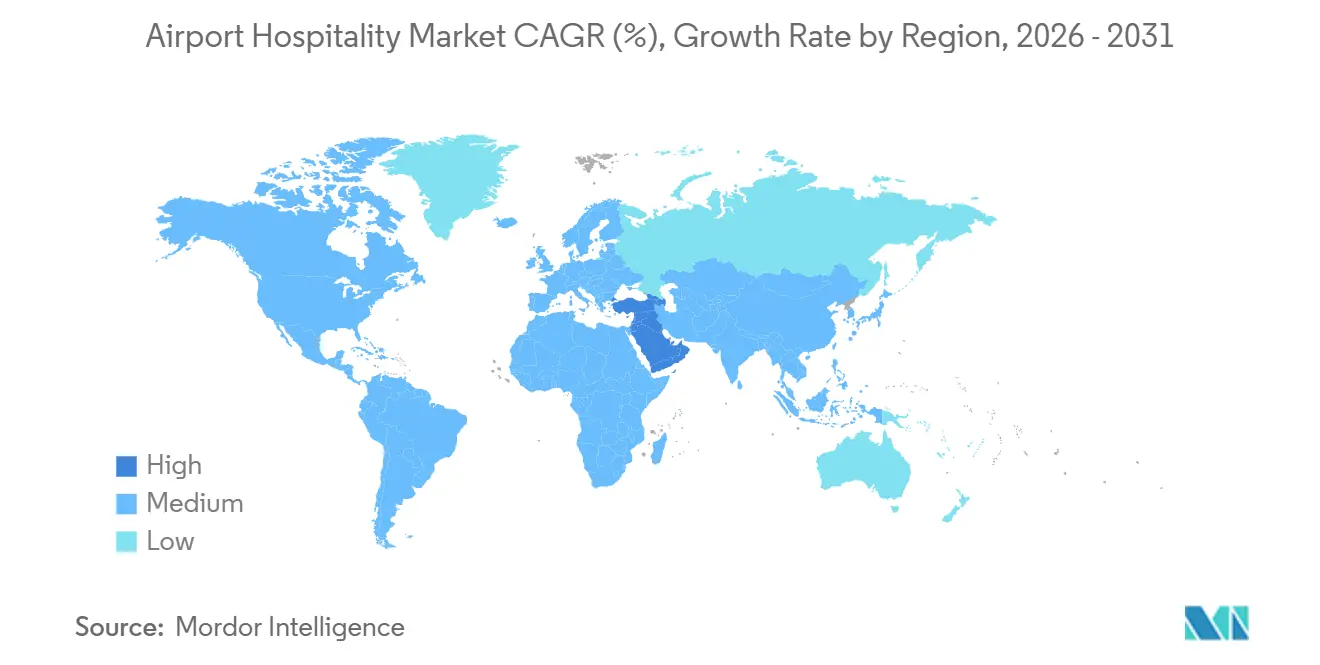
- By geography, Asia-Pacific captured a 33.86% share of the Global Airport Hospitality Market in 2025, while the Middle East and Africa are projected to grow at the highest CAGR of 6.81% by 2031.
Note: Market size and forecast figures in this report are generated using Mordor Intelligence’s proprietary estimation framework, updated with the latest available data and insights as of January 2026.
Global Airport Hospitality Market Trends and Insights
Drivers Impact Analysis*
| Driver | (~) % Impact on CAGR Forecast | Geographic Relevance | Impact Timeline |
|---|---|---|---|
| Rising Premium Passenger Traffic and Business Travel Recovery | +1.5% | Global | Medium term (2-4 years) |
| Airport Commercialization and Non-Aeronautical Revenue Expansion | +1.2% | Global, concentrated in Asia-Pacific, the Middle East, and Africa | Medium term (2-4 years) |
| Airline and Airport Partnerships for Premium Passenger Experience | +0.7% | North America, Europe, the Middle East | Short term (≤ 2 years) |
| Digitization of Lounge, Concierge, and Pre-Booked Hospitality Services | +0.8% | Global | Short term (≤ 2 years) |
| Expansion of Hub Airports and Terminal Modernization Programs | +0.6% | Asia-Pacific, the Middle East and Africa, and North America | Long term (≥ 4 years) |
| Rising Ancillary Spending on Comfort, Wellness, and Time-Saving Services | +0.5% | Global, especially Europe and North America | Medium term (2-4 years) |
| Source: Mordor Intelligence | |||
Rising Premium Passenger Traffic and Business Travel Recovery
Business travel globally reached USD 1.57 trillion in 2025 and is projected to reach USD 1.7 trillion in 2026, driving demand for the Global Airport Hospitality Market. Average per-trip spending increased from USD 834 in 2024 to USD 1,128 in 2025, indicating larger budgets and greater capacity for travelers to afford lounge access, rest products, and fast-track services[2]. European business travel spending is expected to reach EUR 389.9 billion (USD 458.64 billion) in 2026, maintaining its relevance as a high-value demand base amid post-pandemic recovery rates normalizing. The market benefits as fewer but higher-value trips concentrate demand in key terminals, transfer corridors, and long-haul gateway airports, where hospitality conversion rates are higher than at smaller domestic airports. Operators capturing spending across multiple touchpoints, such as lounge access, short-stay rest, food and beverage services, and concierge support, are well-positioned to benefit from this trend.
Airport Commercialization and Non-Aeronautical Revenue Expansion
Airport operators reported USD 73 billion in non-aeronautical revenues in 2024, with ACI World forecasting sustained long-term growth, which should support the Global Airport Hospitality Market. Non-aeronautical revenue per passenger decreased from USD 8.61 in 2017 to USD 7.57 in 2024, prompting airports to enhance yields from retail, lounges, food, wellness, and hospitality services rather than relying solely on traffic recovery. ACI World noted that over 850 airports in more than 90 countries involve private-sector participation, with 132 transactions in various pipeline stages as of January 2025. This reflects the growing adoption of third-party concession models in airport commercial systems[3]. The market benefits from this shift, as specialized operators often increase passenger spending more effectively than self-managed setups, especially when terminal redesigns focus on service-oriented formats. ACI World’s ANARA platform and policy initiatives promote knowledge sharing on commercial best practices, improving conditions for hospitality-driven revenue strategies at member airports.
Airline and Airport Partnerships for Premium Passenger Experience
Partnership-driven expansion is a key growth strategy in the Global Airport Hospitality Market. Airports, airlines, lounge operators, and consumer access platforms are increasingly collaborating to share investments and customer traffic. Plaza Premium Group and Changi Airport Group announced a joint redevelopment of the former Commercially Important Persons terminal site at Singapore Changi Terminal 2, creating a private terminal and lifestyle hub. This highlights how airport authorities are working with specialist operators to develop infrastructure. Swissport expanded its Aspire network through airport and partner-led lounge openings, including Verona, and confirmed additional lounges across Europe and North America. Avolta secured long-term concession agreements at Toronto Pearson, Jacksonville, and Norfolk, demonstrating how airport operators use partnerships to enhance terminal dining and hospitality over extended periods. This model improves scalability in the Global Airport Hospitality Market by reducing market entry barriers, ensuring passenger volume through integrated distribution channels, and providing revenue stability through long-term contracts.
Digitization of Lounge, Concierge, and Pre-Booked Hospitality Services
Digital access is streamlining the Global Airport Hospitality Market by improving booking, scalability, and operational management during peak travel periods. The IATA 2025 Global Passenger Survey reported that 50% of global air passengers used biometric identification during their airport journey in 2025, up from 46% in 2024, reflecting increased acceptance of touchless identity tools. In November 2025, Emirates invested AED 85 million (USD 23.14 million) to install over 200 biometric cameras at Dubai International Airport’s Terminal 3, enabling facial recognition for lounge entry, check-in, and boarding. Priority Pass offers pre-booking for over 200 lounges in more than 10 countries, helping operators manage demand, plan occupancy, and secure early revenue. The market is expected to benefit as biometric verification, app-based reservations, and mobile-first services reduce queueing and enhance capacity utilization. Operators managing these digital tools are positioned to improve upselling, repeat usage, and customer retention.
Restraints Impact Analysis*
| Restraint | (~) % Impact on CAGR Forecast | Geographic Relevance | Impact Timeline |
|---|---|---|---|
| High Concession Fees and Revenue-Sharing Pressure | -0.8% | Global, concentrated in Asia-Pacific and North America | Medium term (2-4 years) |
| Capacity Constraints at Mature Hub Airports | -0.4% | Europe, North America | Medium term (2-4 years) |
| Labor Intensity and Service Standardization Challenges | -0.5% | Global | Short term (≤ 2 years) |
| Air Traffic Disruption and Demand Volatility Exposure | -0.6% | Global | Short term (≤ 2 years) |
| Source: Mordor Intelligence | |||
High Concession Fees and Revenue-Sharing Pressure
High concession charges significantly impact the Global Airport Hospitality Market, as operators face fixed costs for staffing, fit-out, and compliance before passenger traffic or spending fully recovers. ACI World reported that total airport revenue in 2024 remained below pre-pandemic levels in real terms, with non-aeronautical revenue per passenger also falling short of earlier benchmarks. This has led airport authorities to maintain aggressive commercial take rates. ACI World’s 2025 concession guidance emphasizes the importance of structured airport development agreements, requiring operators to manage varied contract structures, revenue-sharing models, and performance obligations across markets. These factors limit profitability even as passenger volumes improve, particularly at major hub locations with intense concession competition. Operators with diversified revenue streams, such as direct pay, airline partnerships, membership access, and card-linked channels, are better positioned to navigate these challenges compared to those relying on a single concession model.
Capacity Constraints at Mature Hub Airports
Capacity constraints at established gateway airports challenge the Global Airport Hospitality Market, as service demand often outpaces available commercial space. At many hubs in North America and Europe, terminal modernization is carried out within active, high-traffic airports rather than on open greenfield sites, increasing costs and slowing expansion[4]. Limited space reduces concession slots, restricts lounge seating, and limits the feasibility of larger hotel or sleep-stay formats, even when traveler demand exists. These constraints lead to overcrowding, waitlists, or reduced service quality during peak periods. Revenue opportunities depend not only on passenger growth but also on whether terminal layouts can support service expansion without disrupting throughput and security operations.
*Our forecasts treat driver/restraint impacts as directional, not additive. The impact forecasts reflect baseline growth, mix effects, and variable interactions.
Segment Analysis
By Service Type: Airport Hotels Anchor Revenue While Sleep Pods Redefine Short-Stay Economics
Airport hotels accounted for 42.82% of the Global Airport Hospitality Market share in 2025, making them the largest service category. This segment serves overnight layovers, airline crew stays, early departures, late arrivals, and long-haul transfers. Their on-airport locations save time and reduce uncertainty for travelers prioritizing schedule reliability. Airport hotels often charge higher prices than city-center alternatives, as the time required to reach the city center can outweigh the price difference. This positioning ensures their continued relevance despite the emergence of newer formats.
Airport lounges are the second-largest segment, serving traditional travelers and a growing number of card-linked and membership-linked users. Priority Pass expands lounge access through its global network and pre-booking model, helping independent operators reach more users. Differentiated rest solutions are also growing. Airport Dimensions introduced Sleepover, a sleep-station concept, in Lima, Dubai, and Doha. Miami International Airport launched North America’s first dedicated sleep rooms in 2025, highlighting demand for short-duration rest services. Sleep pods and micro-stay facilities are projected to grow at a 6.07% CAGR by 2031, addressing sub-four-hour rest needs not efficiently served by full-service airport hotels.

By Airport Type: International Airports Command Volume, While Hub Airports Define The Growth Trajectory
International airports accounted for 56.81% of the Global Airport Hospitality Market in 2025, supported by higher traveler density, longer dwell times, and significant transfer traffic. These airports offer diverse services, including lounges, short-stay accommodations, dining, wellness facilities, and concierge support across terminals. Cross-border travelers often seek comfort during irregular schedules or long connections. Biometric and digital facilitation are critical at these airports due to larger passenger volumes and the need to manage service bottlenecks efficiently. IATA’s 2025 Global Passenger Survey highlighted the growing use of biometric technology, enabling smoother access to services in international terminals.
Hub airports are expected to grow at a 6.43% CAGR through 2031, making them the fastest-growing airport type in the market. Growth is driven by developments in Asia-Pacific, the Middle East, and select North American gateways, where terminal capacities are being upgraded. Hub airports support multiple hospitality use cases, including transfer rest areas, waiting lounges, airline-linked access, and terminal dining. This scalability makes hubs more attractive than smaller airports with shorter dwell times and simpler operations. While domestic and regional facilities offer opportunities, hubs provide the largest near-term value due to robust service planning and high passenger traffic.
By Traveler Type: Business Travelers Sustain Yield While Transit Passengers Expand the Revenue Frontier
Business travelers accounted for 38.64% of the Global Airport Hospitality Market share in 2025, making them the highest-yielding group. Global business travel is expected to rise in 2026, maintaining demand for airport services even during weaker travel sentiment. These travelers prioritize punctuality, privacy, rest quality, and productive waiting time over cost, driving for lounges, airport hotels, and time-saving services. Operators with a strong airport presence on business-heavy routes remain well-positioned in the market.
Transit passengers are projected to grow at a 6.29% CAGR through 2031, making them the fastest-growing traveler type. Their potential lies in long dwell times at transfer hubs, where services such as sleeping options, showers, and dining can be offered without requiring overnight stays. Initiatives such as Airport Dimensions’ Sleepover rollout and Miami’s sleep-room launch show how operators are adapting to this group’s needs. Leisure travelers are increasingly choosing higher-service travel options, expanding the market beyond corporate travel. Airline crew and airport staff form a stable but smaller segment, typically served through operational contracts rather than open-market pricing.
Geography Analysis
Asia-Pacific held 33.86% of the Global Airport Hospitality Market in 2025, driven by passenger growth, rising middle-class travel, and airport investments in China, India, and Southeast Asia. IATA projected 7.3% passenger traffic growth for 2026, while ICAO reported USD 240 billion in infrastructure spending between 2025 and 2035. These factors support growth in lounges, hotels, sleep products, food services, and passenger handling, particularly in India.
North America remains a key market due to non-aeronautical recovery and terminal renewals. Europe continues terminal modernization and concession restructuring. Lagardère Travel Retail introduced new concepts at Düsseldorf Airport in May 2026, and Avolta secured a 12-year contract at Toronto Pearson in February 2026, reflecting ongoing investments in airport commercial platforms. South America is gaining importance as operators test larger-format concepts. Airport Dimensions launched Club LIM and Sleepover at Lima Airport in June 2025, showcasing growth through redesigned commercial offerings.
The Middle East and Africa are projected to grow at 6.81% CAGR through 2031, supported by transfer-heavy airports, aviation investments, and strong non-aeronautical revenue. ACI reported USD 16 per passenger in 2024, compared to the global average of USD 7.57. Plaza Premium Group expanded in Saudi Arabia, and Menzies Aviation grew its lounge network in Egypt and other hubs, highlighting long-term growth potential.
Competitive Landscape
The Global Airport Hospitality Market is moderately concentrated, with a few operators managing significant scale across lounges, food and beverage services, and rest and concierge formats. Airline-managed lounges, local concessionaires, and single-airport specialists also contribute to the market. Plaza Premium Group expanded its presence with new facilities in Rome and Dallas, while Swissport reported record performance and grew its Aspire network, reflecting ongoing capacity additions at key airports.
Competitive differentiation is shifting toward access strategies, technology, and contract depth. Operators integrating digital booking, loyalty programs, card partnerships, and airport authority relationships are better positioned to enhance yields and customer reach. Initiatives like Priority Pass pre-booking and Emirates’ biometric deployment highlight the importance of convenient access without increasing physical space. Combining contract discipline with digital capabilities offers a competitive advantage. Strategic moves include Avolta securing long-term contracts in Toronto, Jacksonville, and Norfolk, and Menzies Aviation reopening its refurbished Pearl Lounge in Copenhagen. gategroup’s acquisitions focused on airline catering and adjacent services. Opportunities remain in comfort services and integrating rest products into booking systems, particularly in airports with rising demand but limited operator coverage.
Airport Hospitality Industry Leaders
-
Plaza Premium Group
-
Collinson Group
-
Swissport International Ltd.
-
dnata
-
Avolta AG
- *Disclaimer: Major Players sorted in no particular order
Recent Industry Developments
- June 2026: gategroup acquired 100% of LSG's aviation catering operations in Latvia and Estonia from Aurelius. This expansion includes Riga and Tallinn airports with about 250 employees, supporting its strategy to create a unified Nordics and Baltic hospitality network for European carrier customers.
- May 2026: Avolta secured a 12-year contract with Norfolk International Airport to operate nine retail and F&B stores, including four hybrid formats. This is part of the airport's largest modernization effort in over 50 years.
- May 2026: Menzies Aviation reopened its flagship Pearl Lounge at Copenhagen Airport after a three-month refurbishment costing EUR 2.7 million (USD 3.18 million). The 800 SQ.M facility accommodates over 180 guests, making it the largest Pearl Lounge in the network.
- March 2026: Plaza Premium Group opened two lounges at Dallas Fort Worth International Airport, introducing Plaza Premium First in the United States as part of its North America strategy.
Global Airport Hospitality Market Report Scope
| Airport Hotels |
| Airport Lounges |
| Sleep Pods & Micro-Stay Facilities |
| Meet & Greet / Concierge Services |
| Other Airport Hospitality Services |
| International Airports |
| Domestic Airports |
| Regional Airports/ Hub Airports |
| Business Travelers |
| Leisure Travelers |
| Transit Passengers |
| Airline Crew & Airport Staff |
| North America | United States |
| Canada | |
| Mexico | |
| South America | Brazil |
| Peru | |
| Chile | |
| Argentina | |
| Rest of South America | |
| Europe | United Kingdom |
| Germany | |
| France | |
| Spain | |
| Italy | |
| BENELUX (Belgium, Netherlands, and Luxembourg) | |
| NORDICS (Denmark, Finland, Iceland, Norway, and Sweden) | |
| Rest of Europe | |
| Asia-Pacific | India |
| China | |
| Japan | |
| Australia | |
| South Korea | |
| South East Asia (Singapore, Malaysia, Thailand, Indonesia, Vietnam, and Philippines) | |
| Rest of Asia-Pacific | |
| Middle East and Africa | United Arab Emirates |
| Saudi Arabia | |
| South Africa | |
| Nigeria | |
| Rest of Middle East and Africa |
| By Service Type | Airport Hotels | |
| Airport Lounges | ||
| Sleep Pods & Micro-Stay Facilities | ||
| Meet & Greet / Concierge Services | ||
| Other Airport Hospitality Services | ||
| By Airport Type | International Airports | |
| Domestic Airports | ||
| Regional Airports/ Hub Airports | ||
| By Traveler Type | Business Travelers | |
| Leisure Travelers | ||
| Transit Passengers | ||
| Airline Crew & Airport Staff | ||
| By Geography | North America | United States |
| Canada | ||
| Mexico | ||
| South America | Brazil | |
| Peru | ||
| Chile | ||
| Argentina | ||
| Rest of South America | ||
| Europe | United Kingdom | |
| Germany | ||
| France | ||
| Spain | ||
| Italy | ||
| BENELUX (Belgium, Netherlands, and Luxembourg) | ||
| NORDICS (Denmark, Finland, Iceland, Norway, and Sweden) | ||
| Rest of Europe | ||
| Asia-Pacific | India | |
| China | ||
| Japan | ||
| Australia | ||
| South Korea | ||
| South East Asia (Singapore, Malaysia, Thailand, Indonesia, Vietnam, and Philippines) | ||
| Rest of Asia-Pacific | ||
| Middle East and Africa | United Arab Emirates | |
| Saudi Arabia | ||
| South Africa | ||
| Nigeria | ||
| Rest of Middle East and Africa | ||
Key Questions Answered in the Report
What is the forecast value of the Global Airport Hospitality Market by 2031?
The Global Airport Hospitality Market is forecast to reach USD 33.86 billion by 2031, rising from USD 25.74 billion in 2026 to a CAGR of 5.63% over 2026-2031.
What is driving growth in the Global Airport Hospitality Market?
Growth is being supported by rising passenger traffic, recovery in business travel spending, airport commercialization, digital access to lounges and premium services, and ongoing terminal modernization.
Which service type held the largest share in the Global Airport Hospitality Market?
Airport Hotels held the largest share in 2025 with 42.82% of the Global Airport Hospitality Market share, supported by layover demand, crew stays, and time-sensitive travel needs.
Which airport type is growing the fastest in the Global Airport Hospitality Market?
Hub Airports are projected to record the fastest growth, with a forecast CAGR of 6.43% through 2031 as new capacity and terminal upgrades create more hospitality opportunities.
Which traveler segment contributes the most revenue in the Global Airport Hospitality Market?
Business Travelers accounted for 38.64% of revenue in 2025, making them the largest traveler group, while Transit Passengers are expected to grow the fastest through 2031.
Which region leads the Global Airport Hospitality Market?
Asia-Pacific led the Global Airport Hospitality Market in 2025 with a 33.86% share, while the Middle East and Africa is projected to post the fastest regional CAGR at 6.81% through 2031.