
Advanced Semiconductor Cooling Systems Market Size and Share
Market Overview
| Study Period | 2022 - 2032 |
|---|---|
| Market Size (2027) | USD 5.85 Billion |
| Market Size (2032) | USD 11.25 Billion |
| Growth Rate (2027 - 2032) | 13.98 % |
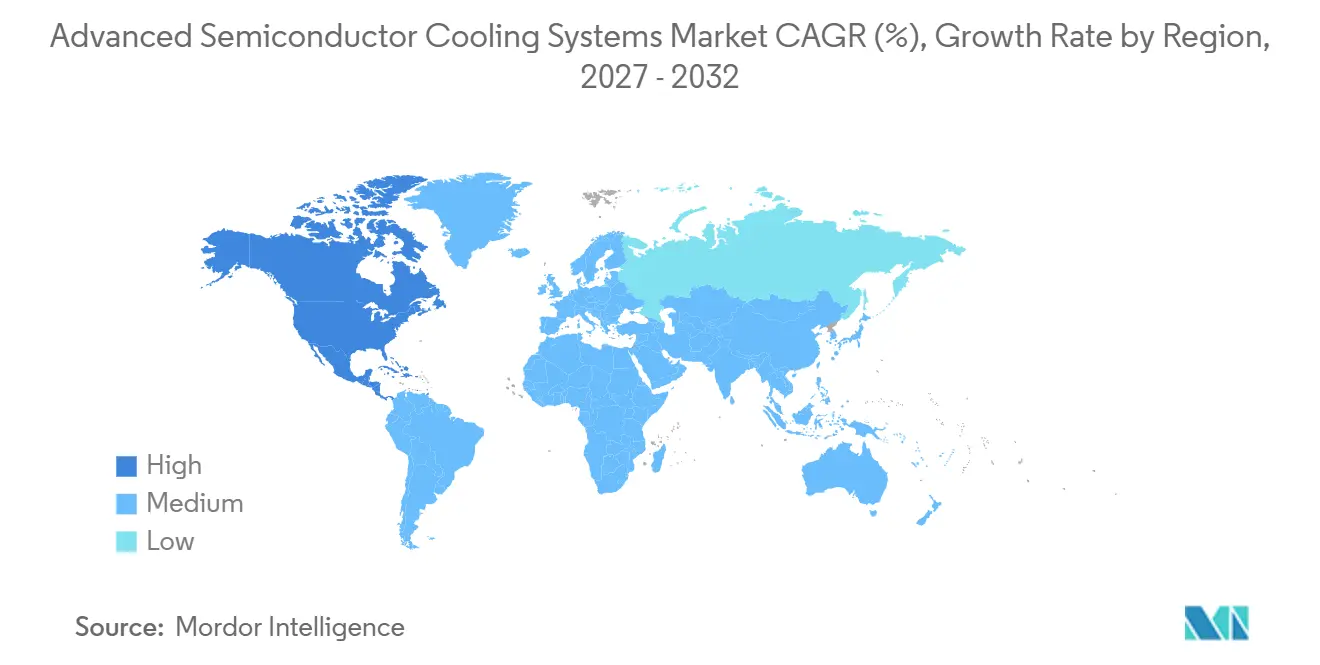
| Fastest Growing Market | North America |
| Largest Market | Asia-Pacific |
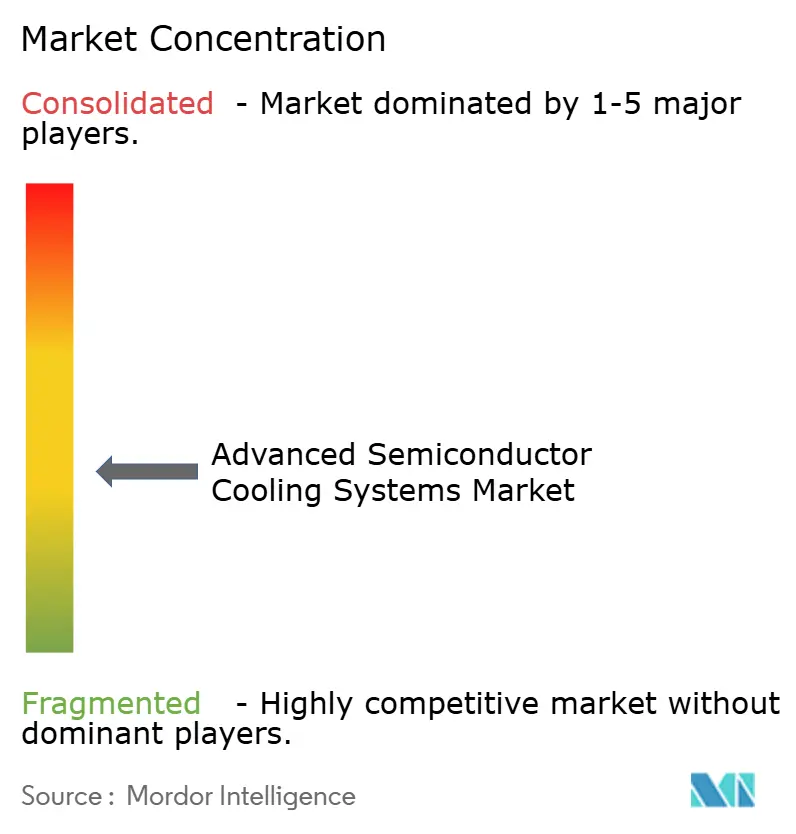
| Market Concentration | Medium |
Major Players *Disclaimer: Major Players sorted in no particular order Image © Mordor Intelligence. Reuse requires attribution under CC BY 4.0. | |
Advanced Semiconductor Cooling Systems Market Analysis by Mordor Intelligence
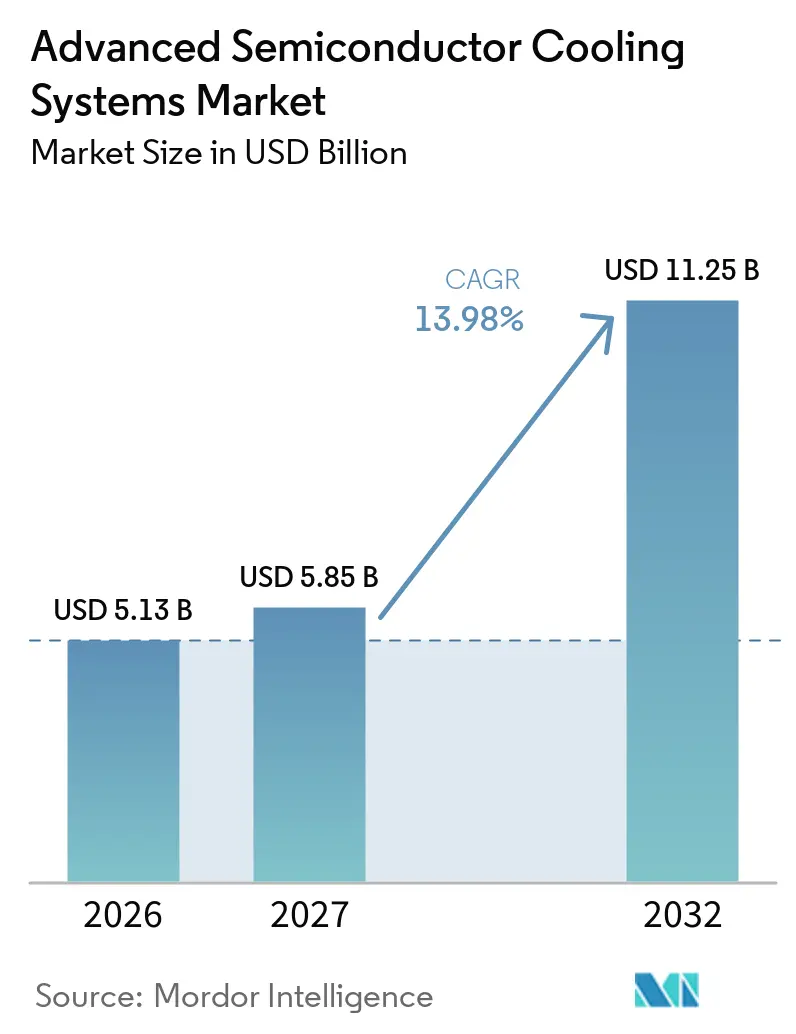
The Advanced Semiconductor Cooling Systems Market size is expected to grow from USD 5.13 billion in 2026 to USD 5.85 billion in 2027 and is forecast to reach USD 11.25 billion by 2032 at 13.98% CAGR over 2027-2032. Rising chip power density is making liquid cooling necessary for high-performance computing deployments, particularly where GPU and rack loads exceed what air systems can manage efficiently. NVIDIA states that its liquid-cooled AI infrastructure is designed for systems operating at high temperatures and power densities, which is accelerating demand for compatible thermal hardware.[1] The advanced semiconductor cooling systems market is moving from selective upgrades toward a core part of new AI infrastructure, which shortens purchasing cycles for qualified suppliers. Vendors are responding by pairing cooling equipment with controls, fluid management, and services that help operators manage installation and maintenance. This shift also favors suppliers that can meet hyperscaler specifications and deliver equipment within short construction schedules.
Key Report Takeaways
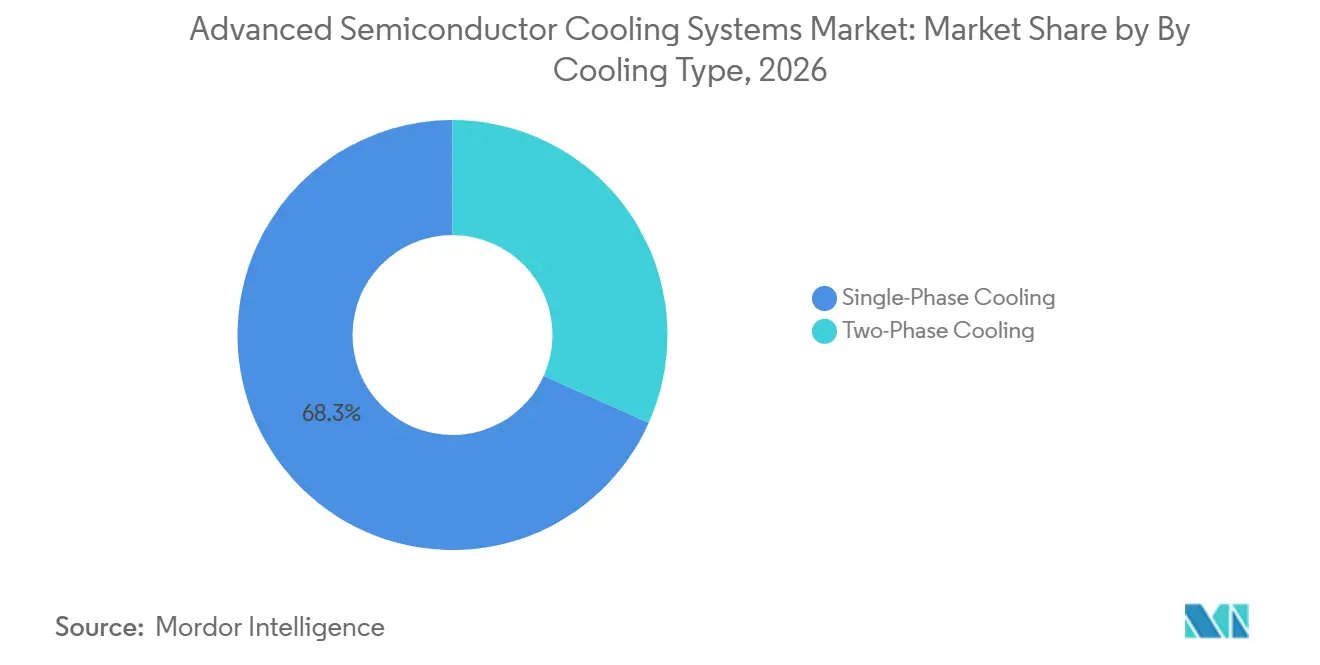
- By cooling type, single-phase cooling held 68.3% of advanced semiconductor cooling systems market share in 2026, while two-phase cooling is forecast to record a 14.2% CAGR through 2032.
- By component, microchannel heat sinks accounted for 22.1% of the advanced semiconductor cooling systems market size in 2026, while coolant distribution units are forecast to expand at a 14.8% CAGR through 2032.
- By end user, data center operators held 24.7% of the market in 2026, while cloud service providers are forecast to grow at a 15.5% CAGR through 2032.
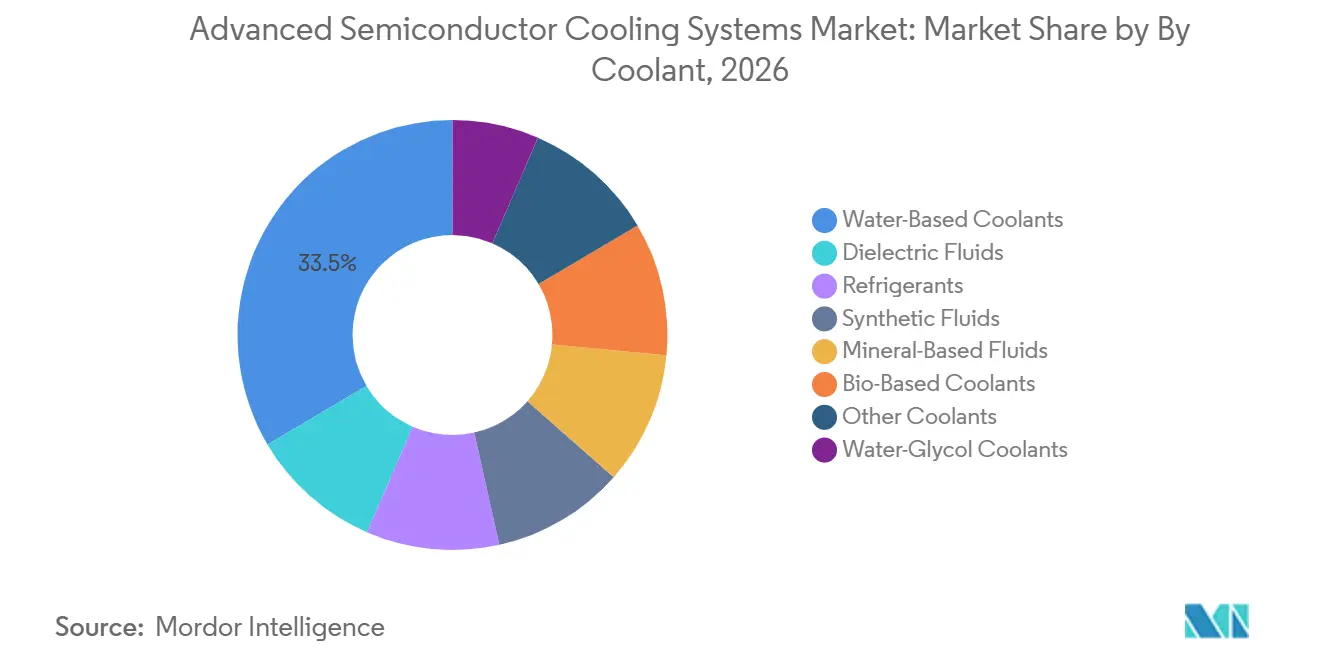
- By coolant, water-based coolants held 33.5% of the market in 2026, while dielectric fluids are forecast to grow at a 15.8% CAGR through 2032.
- By geography, North America held 37.6% of revenue in 2026, and the Asia-Pacific forecast to grow at a 14.9% CAGR through 2032.
Note: Market numbers in this report are based on Mordor Intelligence's proprietary estimation framework, which combines nine months of actuals with Q4 projections for base year 2026.
Global Advanced Semiconductor Cooling Systems Market Trends and Insights
Drivers Impact Analysis*
| Driver | (~) % Impact on CAGR Forecast | Geographic Relevance | Impact Timeline |
|---|---|---|---|
| AI and HPC Chip Power-Density Escalation | +4% | Global, with highest intensity in North America and East Asia | Short term (≤ 2 years) |
| Expansion of Liquid-Cooled Hyperscale Infrastructure | +2.8% | North America and Asia-Pacific, with spillover to Europe and the Middle East and Africa | Short term (≤ 2 years) |
| Chiplet, 3D Packaging, and High-Bandwidth Memory Thermal Complexity | +2% | Asia-Pacific, especially Taiwan and South Korea, and North America | Medium term (2-4 years) |
| Semiconductor Fabrication and Advanced Packaging Capacity Expansion | +1.8% | Taiwan, South Korea, the United States, and Japan | Medium term (2-4 years) |
| Energy, Water, and Carbon-Reduction Requirements in Data Centers | +1.5% | Europe and North America, with growing relevance in Asia-Pacific | Medium term (2-4 years) |
| Embedded Microfluidic Cooling for Ultra-High-Flux Devices | +0.8% | North America and East Asia | Long term (≥ 4 years) |
| Source: Mordor Intelligence | |||
AI and HPC Chip Power-Density Escalation: Physics Makes Liquid Cooling Non-Negotiable
GPU thermal design power continued to rise in 2026, and the advanced semiconductor cooling systems market is responding to sustained heat-density growth in AI and HPC hardware. Blackwell B100 and B200 heat fluxes of 100-140 W/cm², near the stated practical limit for single-phase cold-plate cooling. Two-phase and microfluidic approaches are necessary above 200 W/cm², where phase-change methods can remove more heat from a smaller area and maintain performance in compact chip layouts. NVIDIA describes liquid cooling as a key element in AI factory designs, where dense compute systems place greater demands on thermal infrastructure. As rack-density requirements become part of server qualification processes, cooling systems are becoming a required part of the hardware design rather than an optional facility upgrade. This requirement strengthens the position of vendors that have already qualified their equipment for demanding AI deployments and established service capabilities.
Expansion of Liquid-Cooled Hyperscale Infrastructure: Architecture Locks In the Stack
NVIDIA’s Rubin platform entered mass production in 2026 with liquid cooling specified across chips and network components, replacing hybrid designs that allowed a slower transition from air cooling. This design choice focuses procurement on compatible coolant distribution units, manifolds, quick connectors, and thermal interface materials that meet the platform’s operating requirements. The advanced semiconductor cooling systems market benefits when platform requirements are defined early because hardware suppliers can plan capacity around known technical specifications. NTT DATA’s USD 10 billion infrastructure plan targets liquid-cooling-ready AI campuses with more than 200 kW per row, according to the supplied research. Aligned Data Centers reported that ODATA launched DeltaFlow liquid cooling in Brazil and Mexico, supported by USD 630 million in September 2026. Suppliers that can complete qualification, manufacture equipment, coordinate with site contractors, and support installation quickly are likely to receive the largest volumes from these projects.
Chiplet, 3D Packaging and HBM Thermal Complexity: A Cooling Mandate Beyond AI
2.5D stacks can operate with air cooling at 300 W, while 3D stacks require liquid or hybrid cooling at 350 W because heat accumulates across vertically stacked dies.[2] Imec reported that simulated 3D HBM-on-GPU designs reached 141.7°C without thermal mitigation, compared with 69.1°C for equivalent 2.5D configurations. These thermal limits extend the need for advanced cooling beyond the largest AI accelerators, especially where closely packed dies concentrate heat inside a small footprint. Telecommunications systems-on-chip, automotive computing devices, and networking ASICs are also moving toward multi-die designs with different hotspot patterns. The advanced semiconductor cooling systems market, therefore, serves more applications than data center deployments alone. Cooling suppliers need equipment that can be tailored to the heat profile, package arrangement, and reliability requirements of each device type.
Semiconductor Fabrication and Advanced Packaging Capacity Expansion: Process Intensity Drives In-Fab Demand
Semiconductor fabrication and advanced packaging are thermally intensive activities, creating cooling demand inside factories as well as in the data centers that use finished chips. TSMC and Amkor announced a long-term partnership in June 2026 to extend advanced packaging capacity in Arizona. South Korean expansion by Samsung and SK hynix was stated at 800 trillion KRW, equivalent to USD 580 billion, across fabs and a packaging hub. Deposition, etch, and wafer-bonding processes require precise temperature control throughout production. The advanced semiconductor cooling systems market can therefore draw demand from fab expansion even when data center construction follows a different schedule.
Restraints Impact Analysis*
| Restraint | (~) % Impact on CAGR Forecast | Geographic Relevance | Impact Timeline |
|---|---|---|---|
| High Retrofit Cost and Facility Modification Requirements | -1.8% | Global, with the strongest effect in mature markets with legacy infrastructure | Short term (≤ 2 years) |
| Leakage, Contamination, and Coolant Reliability Risk | -1.4% | Global, with high concern in colocation and mission-critical facilities | Medium term (2-4 years) |
| Shortage of Liquid-Cooling Design and Service Expertise | -1% | Emerging Asia-Pacific markets, South America, and the Middle East and Africa | Medium term (2-4 years) |
| Specialty Coolant, Pump, and Thermal-Interface Supply Vulnerability | -0.8% | Global, with higher exposure in two-phase immersion systems | Medium term (2-4 years) |
| Source: Mordor Intelligence | |||
High Retrofit Cost and Facility Modification Requirements: The Workflow Problem Outweighs the Hardware One
Liquid-cooling conversion costs at USD 2 million per MW, compared with USD 11 million per MW for a greenfield build, but existing facilities often face physical and operational barriers. Raised-floor congestion, limited structural capacity for coolant distribution units, slab penetrations, and live-site constraints can prevent simple equipment replacement. ASHRAE notes that sites designed for 5-10 kW racks have fundamental challenges when adapting to direct-to-chip cooling above 50 kW per rack without redesigning power distribution. Tenant power agreements can also require renegotiation, adding administrative delay to technical work and coordinating facility upgrades with customer workloads. Google introduced Brazos in June 2026 as a 60 kW-per-rack, rack-mounted liquid-to-air system that does not require a facility water connection. Its modular installation approach addresses the operational disruption that can delay retrofit decisions in the advanced semiconductor cooling systems market.
Leakage, Contamination and Coolant Reliability Risk: The Operational Trust Deficit
Operators remain concerned about the consequences of a coolant failure in a live computing environment. Testing of 15 commercial dielectric fluids recorded junction-to-coolant thermal resistances of 4.9-7.8 K/W, indicating that fluid choice affects both performance and material compatibility. The withdrawal of 3M Novec at the end of 2025 created further uncertainty for two-phase users that relied on 49°C saturation-point chemistries. A commercially scaled hydrocarbon alternative was not available by mid-2026 for those applications. Particulate ingress and oxidation can reduce dielectric-fluid quality over time, so operators need periodic testing, replacement, and documented maintenance procedures. In the advanced semiconductor cooling systems market, suppliers that provide verified fluids, service support, and performance monitoring can reduce a key operational concern for buyers.
*Our forecasts treat driver/restraint impacts as directional, not additive. The impact forecasts reflect baseline growth, mix effects, and variable interactions.
Segment Analysis
By Cooling Type: Single-Phase Scale Meets Two-Phase Performance Frontier
Single-phase cooling accounted for 68.3% of the advanced semiconductor cooling systems market size in 2026. Its installed base reflects retrofit suitability, wide coolant compatibility, lower fluid costs, and familiar commissioning without phase-boundary management. Single-phase fluid costs at USD 30-100 per liter, compared with USD 100-300 per liter for two-phase chemistries. Frore introduced LiquidJet Nexus for 2 Blackwell GPUs and a Grace CPU, reporting a 6°C junction-temperature reduction and 10% higher token generation.
Two-phase cooling is forecast to grow at a 14.2% CAGR through 2032, the fastest cooling-type rate in the advanced semiconductor cooling systems industry. Growth is driven by loads above 200 W/cm², at which point phase-change cooling becomes necessary. ZutaCore's HyperCool uses a closed-loop boiling-and-condensation design that eliminates water at the chip level. A Nature Electronics study reported jet-enhanced manifold microchannels dissipating 3,000 W/cm², supporting potential future chip-level applications.

By Component: Cold Plates and CDUs Define the Infrastructure Stack
Coolant distribution units are forecast to grow at a 14.8% CAGR from 2027 to 2032, the fastest component rate in the advanced semiconductor cooling systems market. Hyperscalers are adopting rack-level cooling layouts, increasing demand for CDUs rather than separate point solutions. Nortek launched a skidded CDU in September 2025 with capacity above 5 MW, aligning with high-density campus deployment blocks.
Microchannel heat sinks held 22.1% of the market in 2026, supported by compatibility with multiple cooling architectures. IEEE ICEPT research reported an embedded manifold microfluidic design with 0.116 K/W resistance at 1,527.8 W/cm². An IEEE EPTC paper reported a diamond-lidded microchannel design at 0.02°C/W under a 2,000 W load. Cold plates, heat exchangers, thermal interface materials, heat pipes, vapor chambers, thermoelectric modules, pumps, valves, tubing, manifolds, and sensors give the advanced semiconductor cooling systems market a broad set of specialized system components.
By End User: Data Center Operators Lead; Cloud Providers Set Vendor Roadmaps
Data center operators held 24.7% of the market in 2026, making them the largest end-user group in the advanced semiconductor cooling systems market. Large colocation operators embed liquid-cooling requirements in new designs, extending specifications across equipment makers and installers. The supplied research identifies NTT DATA’s USD 10 billion plan for liquid-cooling-ready AI campuses above 200 kW per row. These projects create visibility for suppliers of cold plates, CDUs, fluid loops, and related components.
Cloud service providers are forecast to grow at a 15.5% CAGR through 2032, the fastest end-user rate in the advanced semiconductor cooling systems industry. NVIDIA’s Rubin platform requires liquid cooling across chips and network components, linking hyperscaler hardware purchases to cooling-system orders. HPC and supercomputing operators have smaller volumes but help set performance targets for commercial systems. Semiconductor manufacturers, foundries, OSAT companies, electronics manufacturers, integrated device manufacturers, and research institutions need precise thermal control as packaging temperatures rise.
By Coolant: Water Dominates Today; Dielectric Fluids Define the Growth Trajectory
Water-based coolants held 33.5% of the market in 2026 because they are available, familiar, and cost-effective for data center applications. Google specifies deionized water or 25% propylene glycol for Brazos, using established facility maintenance practices. Water-glycol mixtures support freeze protection in Nordic and high-altitude installations. Water-based systems give the advanced semiconductor cooling systems market a practical basis for direct-to-chip cooling deployments.
Dielectric fluids are forecast to grow at a 15.8% CAGR through 2032, the fastest coolant-category rate in the advanced semiconductor cooling systems market. Growth depends on replacing Novec-class fluids phased out on PFAS grounds and scaling alternatives for two-phase cooling above 49°C saturation points. The bio-based coolants are considered early-stage because high-temperature stability and service-life evidence remains limited. European PFAS restrictions under REACH are supporting formulation investment that could reach commercial scale during the forecast period.
Geography Analysis
North America accounted for 37.6% of the advanced semiconductor cooling systems market share in 2024. Regional demand is driven by hyperscaler AI capacity, semiconductor expansion under the CHIPS and Science Act, and a dense supplier base. TeraWulf's Lake Mariner campus received more than USD 290 million in integrated power and liquid-cooling infrastructure in May 2026. Vertiv announced a USD 50 million Ohio expansion in March 2026, targeting 45% additional production capacity by Q2 2027. Canada offers hydropower for low-carbon designs, while Mexico is emerging as a nearshore AI infrastructure location.
Asia-Pacific is forecast to grow at a 14.9% CAGR through 2032, the fastest regional growth rate in the advanced semiconductor cooling systems market. This growth is supported by major semiconductor expansion and new AI data center development. TSMC and Amkor announced a partnership in June 2026 to expand advanced packaging capacity in Arizona. TSMC has targeted 130,000 CoWoS wafers per month, with USD 265 billion of United States investment, including Arizona packaging facilities. Samsung and SK Hynix have announced a combined expansion of 800 trillion KRW, equivalent to USD 580 billion. China's segment grew 45.2% in 2026, and Singapore applies energy-efficiency benchmarks to new facility licenses.
Europe's market is anchored by the United Kingdom, Germany, the Netherlands, and France, where energy-transparency requirements and REACH restrictions are driving cooling-system demand. Panasonic entered the European coolant distribution unit (CDU) market in March 2026 with 400 kW and 800 kW models and announced a model exceeding 1,200 kW. South America is gaining greenfield activity through ODATA's DeltaFlow launch, supported by USD 630 million in investments across Brazil and Mexico. Saudi Arabia and the United Arab Emirates are incorporating liquid-cooling readiness into new AI campus designs, expanding the geographic opportunity for the advanced semiconductor cooling systems market.
Competitive Landscape
The advanced semiconductor cooling systems market is moderately fragmented. Vertiv, Schneider Electric, Rittal, Stulz, and Boyd Thermal, now part of Eaton, were identified as the leading group. The remaining is distributed among technology specialists, allowing space for varied products and service models. Consolidation increased as Ecolab acquired CoolIT Systems, Eaton acquired Boyd Thermal, Trane Technologies acquired LiquidStack, and Daikin Applied acquired Chilldyne. Ecolab completed its USD 4.75 billion CoolIT acquisition in July 2026 and said it would expand its AI cooling platform.
Eaton completed its USD 9.5 billion Boyd Thermal acquisition in March 2026, adding liquid-cooling products to its portfolio. Trane announced its LiquidStack acquisition in February 2026, extending its offering into on-chip liquid cooling and two-phase immersion. Ecolab plans to combine CoolIT equipment with 3D TRASAR digital optimization at Supercomputing Chicago in November 2026. These moves bring equipment, fluid management, monitoring, and services closer together. Vertiv’s USD 15 billion backlog, reported for Q1 2026, reflects the importance of manufacturing capacity and delivery capability.
Frore reported 6-12°C lower Rubin junction temperatures and 10-25% higher tokens per watt from semiconductor-grade cold plates. ZutaCore’s waterless two-phase system addresses concerns about water exposure at the chip. Iceotope’s OEM co-development model targets embedded precision cooling, supported by more than 225 patents and a USD 26 million Series B. Vendors that combine thermal hardware, fluid chemistry, and digital monitoring in validated systems are better positioned in the advanced semiconductor cooling systems market.
Advanced Semiconductor Cooling Systems Industry Leaders
-
CoolIT Systems
-
Vertiv Group Corp.
-
Schneider Electric SE
-
Boyd Corporation
-
Asetek A/S
- *Disclaimer: Major Players sorted in no particular order
Recent Industry Developments
- July 2026: Ecolab closed its USD 4.75 billion acquisition of CoolIT Systems, with CoolIT reporting year-to-date sales growth above 100% at close. Ecolab plans to combine CoolIT CDUs and cold plates with its 3D TRASAR digital optimization platform, targeting a debut at Supercomputing Chicago in November 2026.
- June 2026: Google released Brazos, a rack-mounted liquid-to-air system, 60 kW per rack and 3 modular units, for deploying liquid-cooled GPUs in existing air-cooled facilities without facility water infrastructure. Google committed to open-sourcing technical specifications through the Open Compute Project
- March 2026: Eaton completed the acquisition of Boyd Thermal for USD 9.5 billion. Boyd Thermal projected USD 1.7 billion in 2026 sales, of which USD 1.5 billion is liquid cooling, positioning Eaton as a grid-to-chip thermal provider.
Global Advanced Semiconductor Cooling Systems Market Report Scope
Advanced semiconductor cooling systems are engineered thermal management technologies that dissipate high heat flux densities and maintain precise junction temperatures in modern power-dense microelectronics and power semiconductors.
The global advanced semiconductor cooling systems market is segmented by cooling type, component, operation mode, end user, coolant, and geography. By cooling type, the market is segmented into single-phase cooling and two-phase cooling. By component, the market is segmented into ColC48, microchannel heat sinks, heat exchangers, thermal interface materials, coolant distribution units, pumps, valves, tubing and manifolds, heat pipes and vapor chambers, thermoelectric modules, sensors, and thermal monitoring systems, and other components. By end-user, the market is segmented into semiconductor manufacturers, semiconductor foundries, integrated device manufacturers, OSAT companies, data center operators, cloud service providers, HPC and supercomputing operators, electronics manufacturers, research institutions, and others. By coolant, the market is segmented into water-based coolants, water-glycol coolants, dielectric fluids, refrigerants, synthetic fluids, mineral-based fluids, bio-based coolants, and other coolants. The report also covers the market size and forecasts for the global advanced semiconductor cooling systems market across 26 countries in the key regions. For each segment, market sizing and forecasts are provided in terms of value (USD).
| Single-Phase Cooling |
| Two-Phase Cooling |
| ColC48 |
| Microchannel Heat Sinks |
| Heat Exchangers |
| Thermal Interface Materials |
| Coolant Distribution Units |
| Pumps |
| Valves |
| Tubing and Manifolds |
| Heat Pipes and Vapor Chambers |
| Thermoelectric Modules |
| Sensors and Thermal Monitoring Systems |
| Other Components |
| Semiconductor Manufacturers |
| Semiconductor Foundries |
| Integrated Device Manufacturers |
| OSAT Companies |
| Data Center Operators |
| Cloud Service Providers |
| HPC and Supercomputing Operators |
| Electronics Manufacturers |
| Research Institutions |
| Others |
| Water-Based Coolants |
| Water-Glycol Coolants |
| Dielectric Fluids |
| Refrigerants |
| Synthetic Fluids |
| Mineral-Based Fluids |
| Bio-Based Coolants |
| Other Coolants |
| North America | United States |
| Canada | |
| Mexico | |
| Europe | Germany |
| France | |
| Italy | |
| Spain | |
| United Kingdom | |
| Poland | |
| Rest of Europe | |
| Asia-Pacific | China |
| India | |
| Japan | |
| South Korea | |
| Australia | |
| Taiwan | |
| Vietnam | |
| Thailand | |
| Singapore | |
| Rest of Asia-Pacific | |
| South America | Brazil |
| Colombia | |
| Peru | |
| Rest of South America | |
| Middle East and Africa | Saudi Arabia |
| United Arab Emirates | |
| Qatar | |
| South Africa | |
| Kuwait | |
| Rest of Middle East and Africa |
| By Cooling Type | Single-Phase Cooling | |
| Two-Phase Cooling | ||
| By Component | ColC48 | |
| Microchannel Heat Sinks | ||
| Heat Exchangers | ||
| Thermal Interface Materials | ||
| Coolant Distribution Units | ||
| Pumps | ||
| Valves | ||
| Tubing and Manifolds | ||
| Heat Pipes and Vapor Chambers | ||
| Thermoelectric Modules | ||
| Sensors and Thermal Monitoring Systems | ||
| Other Components | ||
| By End User | Semiconductor Manufacturers | |
| Semiconductor Foundries | ||
| Integrated Device Manufacturers | ||
| OSAT Companies | ||
| Data Center Operators | ||
| Cloud Service Providers | ||
| HPC and Supercomputing Operators | ||
| Electronics Manufacturers | ||
| Research Institutions | ||
| Others | ||
| By Coolant | Water-Based Coolants | |
| Water-Glycol Coolants | ||
| Dielectric Fluids | ||
| Refrigerants | ||
| Synthetic Fluids | ||
| Mineral-Based Fluids | ||
| Bio-Based Coolants | ||
| Other Coolants | ||
| By Geography | North America | United States |
| Canada | ||
| Mexico | ||
| Europe | Germany | |
| France | ||
| Italy | ||
| Spain | ||
| United Kingdom | ||
| Poland | ||
| Rest of Europe | ||
| Asia-Pacific | China | |
| India | ||
| Japan | ||
| South Korea | ||
| Australia | ||
| Taiwan | ||
| Vietnam | ||
| Thailand | ||
| Singapore | ||
| Rest of Asia-Pacific | ||
| South America | Brazil | |
| Colombia | ||
| Peru | ||
| Rest of South America | ||
| Middle East and Africa | Saudi Arabia | |
| United Arab Emirates | ||
| Qatar | ||
| South Africa | ||
| Kuwait | ||
| Rest of Middle East and Africa | ||
Key Questions Answered in the Report
How large is Global Advanced Semiconductor Cooling Systems Market in 2027 ?
The Advanced Semiconductor Cooling Systems Market size is expected to grow from USD 5.13 billion in 2026 to USD 5.85 billion in 2027 and is forecast to reach USD 11.25 billion by 2032 at 13.98% CAGR over 2027-2032.
Which cooling type leads current demand?
Single-phase cooling led with 68.3% share in 2026 because it supports retrofits, broad fluid compatibility, lower fluid costs, and familiar operating procedures.
Which cooling technology is growing fastest?
Two-phase cooling is forecast to grow at a 13.98% CAGR through 2032 because it can address heat flux above 200 W/cm² through phase-change cooling.
What role do coolant distribution units play in AI facilities?
CDUs are forecast to grow at a 14.8% CAGR through 2032 as hyperscalers standardize rack-level liquid-cooling infrastructure for larger AI deployment blocks.
Which end users are expanding liquid cooling fastest?
Cloud service providers are forecast to record a 15.5% CAGR through 2032, supported by liquid-cooled AI hardware requirements that influence cooling specifications across suppliers.
Which region is forecast to grow fastest?
Asia-Pacific is forecast to grow at a 14.9% CAGR through 2032, supported by semiconductor capacity expansion, advanced packaging activity, and AI data center deployments.