
Germany STATCOM Market Size and Share
Market Overview
| Study Period | 2021 - 2032 |
|---|---|
| Forecast Data Period | 2027 - 2032 |
| Base Year Market Size (2026) | USD 146.32 Million |
| Market Size (2027) | USD 154.47 Million |
| Market Size (2032) | USD 232.68 Million |
| Growth Rate (2027 - 2032) | 8.54 % |
| Market Concentration | Medium |
Major Players *Disclaimer: Major Players sorted in no particular order Image © Mordor Intelligence. Reuse requires attribution under CC BY 4.0. | |
Germany STATCOM Market Analysis by Mordor Intelligence
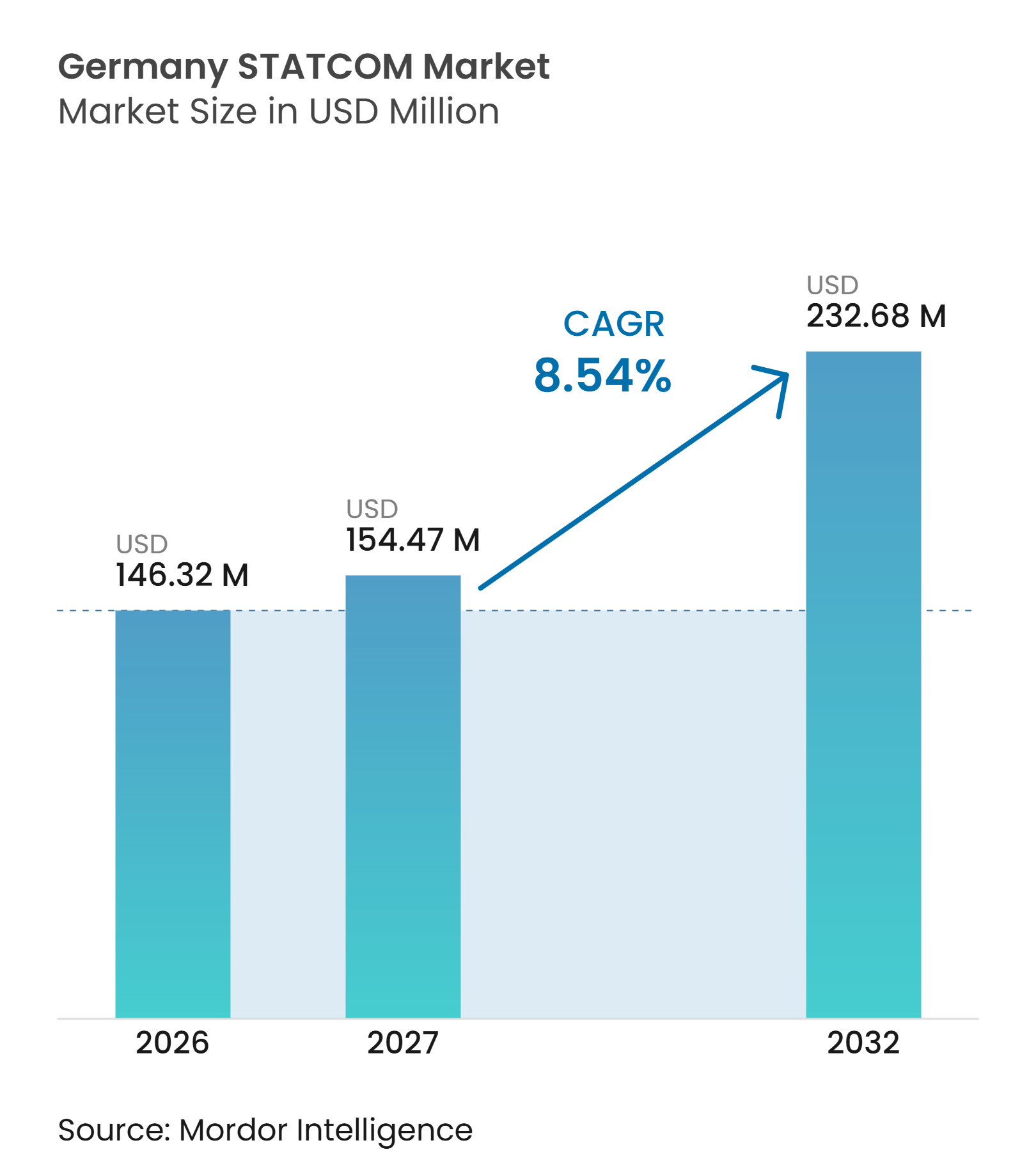
The Germany STATCOM market size was valued at USD 146.32 million in 2026 and is estimated to grow from USD 154.47 million in 2027 to reach USD 232.68 million by 2032, at a CAGR of 8.54% during the forecast period (2027-2032). Germany’s withdrawal of nuclear generation and the ongoing reduction of coal capacity are changing how the grid maintains voltage and frequency. Transmission operators are shifting from planning to procuring equipment that can provide reactive power and grid-forming support. The strongest opportunities are likely to arise at constrained north-south transmission nodes and around new large electricity loads. Suppliers with established relationships with transmission operators, manufacturing capacity, and proven grid-forming designs are well positioned for major projects. The Germany STATCOM market also faces longer project cycles because each installation must meet the conditions of a specific substation and permitting process.
Key Report Takeaways
- By technology type, Modular Multilevel Converter and other multilevel VSC topologies held 36.78% of Germany STATCOM market share in 2026, while Grid-Forming STATCOM and E-STATCOM is projected to expand at a 9.34% CAGR through 2032.
- By reactive power rating, Large-Scale Transmission STATCOM held 44.93% of the Germany STATCOM market share in 2026, while Small-Scale Distribution and Industrial STATCOM is expected to expand at a 9.27% CAGR through 2032.
- By application, Transmission and Grid Infrastructure accounted for 35.84% of the Germany STATCOM market size in 2026, while Data Centers and Commercial Infrastructure is projected to grow at a 9.43% CAGR through 2032.
- By component, Power Electronic Converter Valves held 38.62% of the Germany STATCOM market size in 2026, while Control, Protection, and Monitoring Systems is expected to grow at a 9.38% CAGR through 2032.
Note: Market numbers in this report are based on Mordor Intelligence's proprietary estimation framework, which combines nine months of actuals with Q4 projections for base year 2026.
Market Trends and Insights
Drivers Impact Analysis of Germany STATCOM Market*
| Driver | (~) % Impact on CAGR Forecast | Geographic Relevance | Impact Timeline |
|---|---|---|---|
| Accelerating Renewable Power Integration | +2.5% | National | Short term (≤ 2 years) |
| North-South Transmission Congestion | +1.8% | Northern Germany, with spill-over to Central Germany | Short term (≤ 2 years) |
| Retirement of Conventional Synchronous Generation | +1.5% | National | Medium term (2-4 years) |
| Grid-Forming and E-STATCOM Procurement by German TSOs | +1.3% | National, concentrated in TenneT and Amprion grid areas | Medium term (2-4 years) |
| Standardization of STATCOM Ratings and Designs | +0.9% | National | Medium term (2-4 years) |
| Expansion of Electrified Industrial and Data-Center Loads | +0.8% | National, with early gains in Frankfurt, Munich, Berlin, and Hamburg metropolitan areas | Long term (≥ 4 years) |
| Source: Mordor Intelligence | |||
Accelerating Renewable Power Integration
Germany’s move toward inverter-based generation is increasing the need for dedicated reactive power support at transmission nodes. The National Grid Development Plan 2025 projected a reactive power deficit of up to 65 Gvar by 2037 if battery storage, electrolyzers, and renewable plants are not deployed at scale. The stated deficit is equivalent to the reactive capability of 80 coal-fired plants, making voltage support a central grid-planning issue rather than a contingency. The Federal Network Agency’s market-based procurement framework allows operators to seek reactive power from renewable sites, storage assets, and electrolyzers, while retaining the option to procure dedicated equipment when those sources are insufficient. This framework gives the Germany STATCOM market a clearer commercial reference point as transmission operators can compare equipment costs with market-provided reactive power. It also increases the appeal of modular designs that can lower lifecycle costs and be deployed across multiple substations.
North-South Transmission Congestion
Wind generation in northern states and industrial demand in southern states continue to place pressure on Germany’s main transmission corridors. Redispatch can manage power flows, but it does not resolve the reactive power deficits that develop at individual nodes. The government maintained its preference for network expansion and improved congestion management rather than splitting the national electricity price zone. This choice supports the use of STATCOM systems at key nodes because they can improve voltage profiles and enable existing lines to operate nearer to their thermal limits. Amprion awarded EDF Power Solutions a 250 MW decentralized Grid Booster project in December 2025, comprising 5 battery sites intended to ease north-south congestion from January 1, 2028. The project indicates that active-power storage and reactive-power equipment may be considered together at constrained locations, widening the project pipeline for the Germany STATCOM market.
Retirement of Conventional Synchronous Generation
The retirement of synchronous generation removes active power capacity, inertia, and reactive power capability from the German system. Germany completed its nuclear phase-out in 2023 and continued to retire hard-coal and lignite generation, while installed wind and solar capacity exceeded 160 GW in 2025. Inverter-connected plants do not provide continuous reactive current through the same physical mechanism as rotating generators. Grid-forming STATCOM systems are designed to address this gap by providing reactive power and, where combined with energy storage, artificial inertia. Siemens Energy commissioned an E-STATCOM at TenneT’s Mehrum site in December 2025 that combines supercapacitors with reactive power support and responds within milliseconds. TenneT’s expectation that Germany will need 30 comparable systems suggests that suppliers capable of delivering both services can justify higher capital costs than reactive-only designs.
Grid-Forming and E-STATCOM Procurement by German TSOs
Germany’s 4 transmission system operators have moved from defining grid-forming requirements to awarding equipment contracts. In late 2024, 50Hertz selected GE Vernova for 3 FACTSFLEX STATCOM units and Nidec Conversion for 1 E-STATCOM with supercapacitor storage at 2 substations. The Fraunhofer ISE GFM Benchmark project established a test procedure for grid-forming inverters in 2025.[1] The procedure is expected to support mandatory grid-forming requirements for newly connected large power plants from 2027 to 2028. Common testing and procurement requirements reduce the amount of front-end engineering needed for future projects. They also favor participants in the Germany STATCOM market that can demonstrate compliance with the required performance standards.
Restraints Impact Analysis of Germany STATCOM Market*
| Restraint | (~) % Impact on CAGR Forecast | Geographic Relevance | Impact Timeline |
|---|---|---|---|
| High Project Cost and Long Procurement Cycles | -1.5% | National | Short term (≤ 2 years) |
| Site-Specific Permitting and Substation Footprint Constraints | -0.8% | National, most acute in dense urban and industrial areas | Medium term (2-4 years) |
| Scarcity of Grid-Forming Power-Electronics Engineering Capacity | -0.6% | National | Medium term (2-4 years) |
| Dependence on Imported Power Semiconductor and Transformer Components | -0.5% | National | Medium term (2-4 years) |
| Source: Mordor Intelligence | |||
High Project Cost and Long Procurement Cycles
High-voltage STATCOM projects require significant capital commitments even when policy conditions are supportive. Amprion invested EUR 58 million (USD 63.2 million) in its ±600 Mvar Rheinau installation at 380 kV. The project required 2.5 years of construction and shows the cost and time needed for a grid-forming installation at a single transmission node. Procurement commonly takes several years from specification through commissioning, especially where equipment requires grid-forming performance validation. The market-based reactive power framework introduces planning uncertainty because more than half of the early tenders examined since April 2025 have not been awarded. Transmission operators must therefore balance direct procurement with market-based provision, which can slow the development of a consistent national deployment program for the Germany STATCOM market.
Site-Specific Permitting and Substation Footprint Constraints
STATCOM installations must often be added to substations that have operated for decades and have limited available space. Amprion’s Rheinau site has been an important southwestern grid node for more than 100 years, so changes require coordination across civil, environmental, and electrical approvals. Indoor prefabricated systems can reduce land needs and reduce on-site assembly time. They do not remove the permitting constraints at established and congested substations. Germany implemented a first-ready, first-served protocol for major-load connections in April 2026, covering data centers, electrolyzers, and large battery systems. The rule may improve connection queue management, but STATCOM approvals remain on distinct planning tracks and can still limit delivery speed.
*Our forecasts treat driver/restraint impacts as directional, not additive. The impact forecasts reflect baseline growth, mix effects, and variable interactions.
Germany STATCOM Market Segment Analysis
By Technology Type:
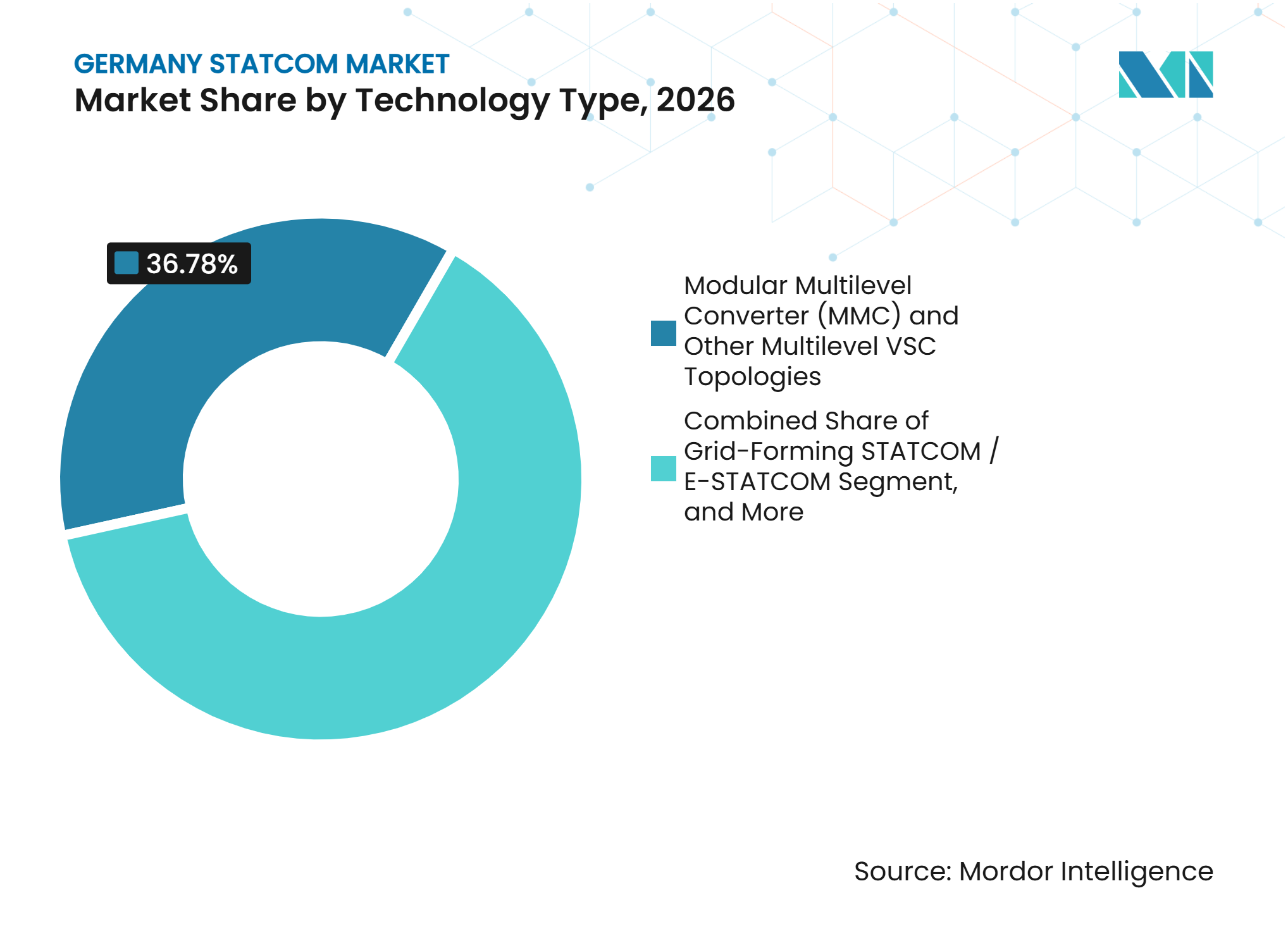
MMC Leads While Grid-Forming Redefines the High EndModular Multilevel Converter and other multilevel VSC topologies held 36.78% of Germany STATCOM market share in 2026. These systems form the established base of the country’s transmission-level STATCOM fleet. The 4-TSO working group used MMC double-wye configurations in its harmonized E-STATCOM parameters. That decision reinforces MMC as the preferred architecture for future transmission projects. Conventional voltage source converter systems remain in service at older sites. Their role in new installations is narrowing as buyers favor designs that can be upgraded for grid-forming operation.
Grid-Forming STATCOM and E-STATCOM are projected to grow at a 9.34% CAGR from 2027-2032. Procurement pipelines are becoming more concrete now that the Mehrum and Rheinau systems are operational. Medium-Voltage and Distribution STATCOM is also gaining ground as industrial parks and renewable projects need localized reactive power support. Fraunhofer ISE started fieldwork at Föhren in Rhineland-Palatinate in October 2025, using grid-forming inverters with a 20 MW capacity and a 55 MWh battery. The project provides operating evidence that can extend technical requirements and procurement budgets into the medium-voltage tier. This part of the Germany STATCOM industry has more individual projects, although each project typically has a lower value than a transmission installation.



By Reactive Power Rating:
Transmission Scale Commands Value as Distribution Closes the GapLarge-Scale Transmission STATCOM held 44.93% of the Germany STATCOM market share in 2026. These high-MVAr systems are deployed at extra-high-voltage substations and generally have the highest contract values. Each unit must be engineered for a site’s short-circuit capacity, voltage profile, and reactive power requirements. This site-specific work constrains standardization and supports premium pricing for suppliers with proven grid-forming capability. Medium-Scale STATCOM serves sub-transmission systems and large industrial users whose requirements remain below the ±400 Mvar to ±600 Mvar range seen in flagship transmission projects.
Small-Scale Distribution and Industrial STATCOM is expected to expand at a 9.27% CAGR from 2027-2032. Higher renewable penetration and growing use of power electronics in industrial facilities can increase local voltage variation. Transformer tap changes alone may not adequately manage these events. Alterric’s 2026 study identified unused reactive power potential in German distribution grids and outlined 11 measures to improve procurement efficiency. Standardized tender contracts across operators could make smaller projects easier to procure and support broader deployment.
By Application:
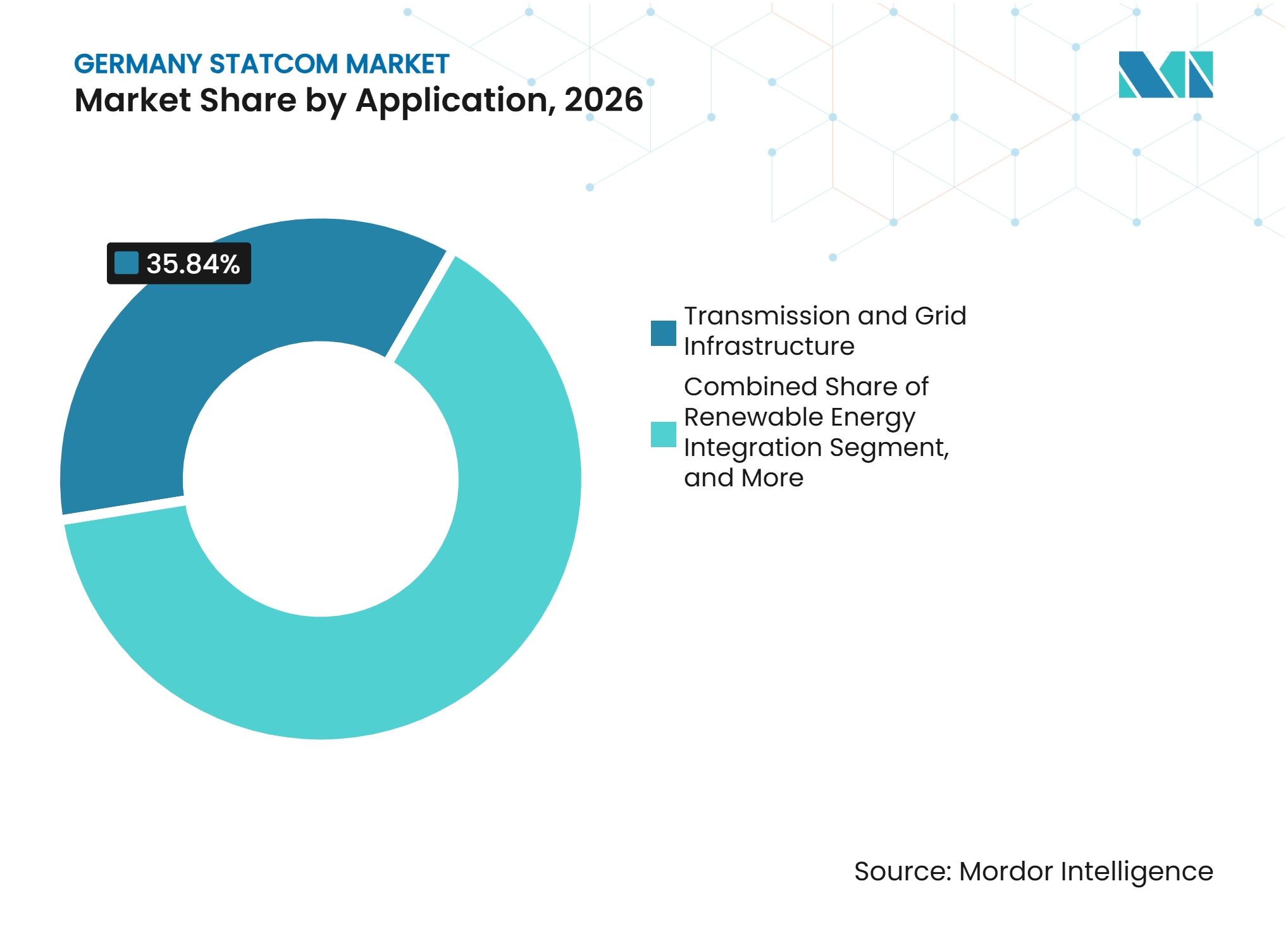
Grid Infrastructure Anchors Demand, Data Centers Emerge as a Structural PullTransmission and Grid Infrastructure accounted for 35.84% of the Germany STATCOM market size in 2026. Demand is tied to the 4 transmission operators’ need to manage stability gaps as nuclear and coal capacity exits the system. Renewable Energy Integration remains closely connected to this demand because wind and solar plants affect reactive conditions at their points of connection. Operators can address these conditions through dedicated STATCOM systems or grid-forming inverter functions. Industrial and Manufacturing applications include arc-furnace compensation, motor-start buffering, and power-factor correction. These uses help energy-intensive facilities protect production reliability when power quality varies.
Data Centers and Commercial Infrastructure is projected to grow at a 9.43% CAGR from 2027-2032. Germany had installed data center computing power of 3 GW in 2025, and FfE projected a 78% increase by 2030. The scale of that expansion puts pressure on local substation capacity and requires active reactive-power management at connection points. The 4 TSOs published technical requirements in October 2026 for data centers connecting at high and extra-high voltage. The requirements include reactive power control, a suitable response to frequency events, and verified simulation models. Railway Electrification and Other Applications also contribute to demand because static frequency converters used for the 16.7 Hz traction grid can incorporate STATCOM capability.

By Component:
Converter Valves Set the Cost Baseline, Control Systems Drive DifferentiationPower Electronic Converter Valves accounted for 38.62% of the Germany STATCOM market size in 2026. They represent the largest single equipment cost in a STATCOM system. Large MMC installations need advanced power semiconductors and precise water-cooling equipment. These inputs are exposed to global component supply constraints. Trench Group reached framework agreements in May 2025 with Siemens Energy, Hitachi Energy, and GE Vernova for air-core coils, instrument transformers, and transformer bushings extending into the mid-2030s.[2] Control, Protection, and Monitoring Systems is forecast to grow at a 9.38% CAGR from 2027-2032.
Grid-forming operation requires controls capable of managing virtual inertia, supercapacitor state of charge, and frequency deviations within milliseconds. This need distinguishes grid-forming systems from conventional voltage-following arrangements. In May 2025, DB Energie awarded Hitachi Energy a framework contract for ACX performance control systems for central converter stations. The award shows that controls are becoming a separate strategic procurement line in grid modernization programs. Capacitors, harmonic filters, cooling equipment, and auxiliary systems remain necessary for reliable operation, while indoor water-cooled designs are increasingly specified for lifecycle management and remote operation.
Geography Analysis
Northern Germany
Northern Germany includes Lower Saxony, Schleswig-Holstein, Mecklenburg-Vorpommern, and Brandenburg, where large onshore and offshore wind fleets create significant reactive-power requirements. 50Hertz began Germany’s first market-based reactive-power tender in April 2025 for renewable facilities, battery storage, and electrolyzers. The mechanism supplements dedicated STATCOM equipment at transmission substations. TenneT commissioned the supercapacitor-coupled E-STATCOM at the former coal plant site in Mehrum, Lower Saxony, in December 2025. The project replaced stability services once provided by a rotating turbine with a fully automated system that is monitored remotely. TenneT expects to need 30 comparable systems across Germany, and northern areas are likely to receive a substantial share because inverter-based generation is concentrated there. GE Vernova systems planned for 2 northeastern 50Hertz substations provide an additional route for voltage support as offshore connections expand.
Southern Germany
Southern Germany combines dense industrial demand, metropolitan loads, and rising digital infrastructure, which heighten reactive-current requirements at key transmission points. Amprion commissioned a ±600 Mvar grid-forming STATCOM at 380 kV at the Rheinau substation in Mannheim in January 2026. The EUR 58 million (USD 63.2 million) installation was the first grid-forming STATCOM in Baden-Württemberg. Amprion also operates STATCOM sites at Kriftel, Kusenhorst, and Gersteinwerk, creating a layered voltage-management approach across its 11,000 km extra-high-voltage network. The 250 MW Grid Booster project spans 5 sites and is expected to begin operating on January 1, 2028. It is intended to ease congestion along the Stuttgart-Munich corridor while supporting the LVN distribution network. Growing data center activity in Bavaria means that long-range substation planning must increasingly account for both large reactive loads and conventional industrial demand.
Central, Western, and Eastern Germany
Central and western Germany provide a mix of demand sources between wind-heavy northern regions and load-heavy southern regions. The Germany STATCOM market can serve railway traction networks, industrial centers, transmission corridors, and major data hubs across the country. DB Energie operates its railway system at 16.7 Hz, necessitating reactive power compensation at the point where the traction supply connects to the 50 Hz public grid. GE Vernova has completed static frequency converter projects with STATCOM capability at Lohsa, Mannheim, Bützow, and Schwerin.[3] Hitachi Energy won the Neufinsing substation renewal contract in November 2025, supporting TenneT’s modernization work in central Bavaria. Eastern industrial transition zones also provide development opportunities because retired thermal plants leave grid-stability gaps and existing substation infrastructure. Frankfurt’s established data center cluster and Berlin’s growing digital corridor create new high-load connections, which are increasingly assessed for active voltage management rather than passive compensation.
Competitive Landscape
Market Concentration
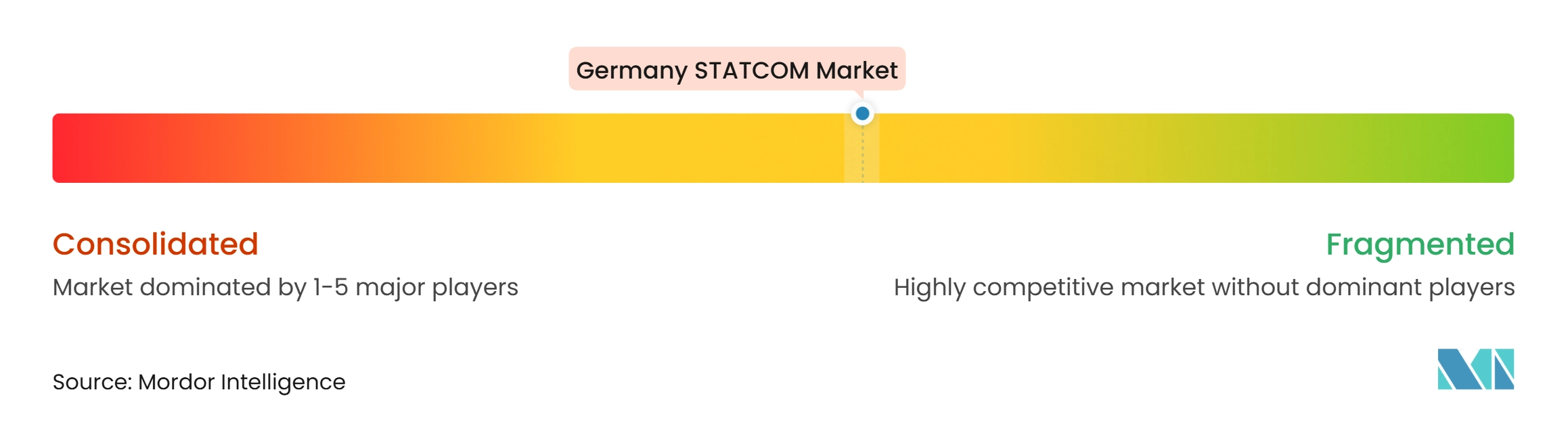
The Germany STATCOM market is moderately concentrated in transmission applications because grid-forming equipment requires specialized power electronics, high-voltage manufacturing capacity, and established relationships with transmission operators. Siemens Energy, Hitachi Energy, and GE Vernova hold prominent recent large-project references. Their access to component supply agreements with Trench Group for coils, instrument transformers, and bushings through the mid-2030s supports delivery planning. Siemens Energy has deployed SVC PLUS systems at Amprion’s Rheinau project and TenneT’s Mehrum project. These references cover a grid-forming STATCOM and a supercapacitor-coupled E-STATCOM. The combination gives Siemens Energy a broad German reference base in premium applications.
Compliance requirements shape competition as strongly as equipment cost. Fraunhofer ISE’s grid-forming inverter test procedure provides a technical basis for requirements that the 4 TSOs are expected to apply to future projects. Suppliers that cannot demonstrate the required performance face a high barrier to entry in transmission procurement. Siemens Energy’s commissioning of the Rheinau system in January 2026 provides a major operational reference for grid-forming performance. GE Vernova’s supply agreement for 3 STATCOM units to 50Hertz also strengthens its position in the northeastern transmission corridor.[4] Nidec’s supply of an E-STATCOM with supercapacitor storage to 50Hertz shows that specialized suppliers can enter the high-end tier when they meet the required system performance.
Competition is broader in medium-voltage and distribution projects. FREQCON and WSTECH target wind farms and industrial customers with modular reactive-power equipment. Hyosung Heavy Industries and Mitsubishi Electric have global FACTS portfolios that may compete for projects as industrial and distribution demand grows. The medium-scale rating range and data center connection work remain open areas of opportunity because technical requirements are driving demand beyond established turnkey transmission procurement. New data center connection rules can support recurring work for suppliers that integrate reactive-power controls with connection compliance.
Germany STATCOM Industry Leaders
-
Siemens Energy AG
-
Hitachi Energy Ltd
-
GE Vernova Inc.
-
Mitsubishi Electric Corporation
-
Nidec Corporation
- *Disclaimer: Major Players sorted in no particular order
Germany STATCOM Market Companies Covered in this Report
- Siemens Energy AG
- Hitachi Energy Ltd
- GE Vernova Inc.
- Mitsubishi Electric Corporation
- Nidec Corporation
- Ingeteam S.A.
- JEMA Energy, S.A.
- American Superconductor Corporation
- Hyosung Heavy Industries Corporation
- Sieyuan Electric Co., Ltd.
- Rongxin Power Electronic Co., Ltd.
- NR Electric Co., Ltd.
- TBEA Co., Ltd.
- NARI Technology Co., Ltd.
- FREQCON GmbH
- WSTECH GmbH
- Germarel GmbH
Recent Industry Developments in Germany STATCOM Market
- October 2026: Germany’s 4 TSOs published technical requirements for connecting data centers to the high- and extra-high-voltage grid on October 16, 2026, supplementing VDE-AR-N 4120/4130 with specific reactive power control obligations and requirements for grid-compatible behavior. The document establishes a mandatory reactive power compliance framework for the growing data center segment and expands future STATCOM procurement to be linked to large-consumer connection upgrades.
- June 2026: Alterric GmbH and E-Bridge Consulting published the study “Macroeconomic Potential of Market-Based Procurement of Reactive Power” on June 12, 2026. The study identified structural deficiencies in Germany’s new reactive-power tender market. More than half of tenders evaluated since April 2025 went unawarded. The study proposed 11 short- and medium-term measures, including standardized contracts across grid operators and centralized tender publication.
- April 2026: Germany’s 4 TSOs implemented a first-ready, first-served grid-connection protocol for data centers, electrolyzers, and large-scale battery storage systems, effective April 1, 2026. The measure prioritizes applications by project maturity. It is intended to reduce connection-queue congestion at high-voltage nodes and may shorten timelines for nearby STATCOM installations at new large-load connection sites.
- January 2026: Siemens Energy commissioned the ±600 Mvar grid-forming STATCOM at Amprion’s Rheinau substation in Mannheim, Baden-Württemberg, on January 29, 2026. The system is one of the most powerful reactive-power compensation systems operating globally and the first STATCOM in Baden-Württemberg with grid-forming capability. Amprion invested EUR 58 million (USD 63.2 million) over a 2.5-year construction period.
Germany STATCOM Market Report Scope
The Germany STATCOM market covers the deployment and sale of static synchronous compensators (STATCOMs), which are power electronic devices that regulate voltage and improve power quality and grid stability. These systems provide reactive power compensation and support the integration of renewable energy sources into Germany's electricity grid.
The Germany STATCOM Market Report is Segmented by Technology Type (Modular Multilevel Converter (MMC) and Other Multilevel VSC Topologies, Conventional Voltage Source Converter (VSC)-Based STATCOM, Grid-Forming STATCOM / E-STATCOM, and Medium-Voltage and Distribution STATCOM), Reactive Power Rating (Large-Scale Transmission STATCOM, Medium-Scale STATCOM, and Small-Scale Distribution and Industrial STATCOM), Application (Transmission and Grid Infrastructure, Renewable Energy Integration, Industrial and Manufacturing, Data Centers and Commercial Infrastructure, and Railway Electrification and Other Applications), and Component (Power Electronic Converter Valves, Converter Transformers and Reactors, Capacitors and Harmonic Filters, Control, Protection, and Monitoring Systems, and Cooling Systems and Auxiliary Components). The Market Forecasts are Provided in Terms of Value (USD).
Segmentation Overview
| Modular Multilevel Converter (MMC) and Other Multilevel VSC Topologies |
| Conventional Voltage Source Converter (VSC)-Based STATCOM |
| Grid-Forming STATCOM / E-STATCOM |
| Medium-Voltage and Distribution STATCOM |
| Large-Scale Transmission STATCOM |
| Medium-Scale STATCOM |
| Small-Scale Distribution and Industrial STATCOM |
| Transmission and Grid Infrastructure |
| Renewable Energy Integration |
| Industrial and Manufacturing |
| Data Centers and Commercial Infrastructure |
| Railway Electrification and Other Applications |
| Power Electronic Converter Valves |
| Converter Transformers and Reactors |
| Capacitors and Harmonic Filters |
| Control, Protection, and Monitoring Systems |
| Cooling Systems and Auxiliary Components |
| By Technology Type | Modular Multilevel Converter (MMC) and Other Multilevel VSC Topologies |
| Conventional Voltage Source Converter (VSC)-Based STATCOM | |
| Grid-Forming STATCOM / E-STATCOM | |
| Medium-Voltage and Distribution STATCOM | |
| By Reactive Power Rating | Large-Scale Transmission STATCOM |
| Medium-Scale STATCOM | |
| Small-Scale Distribution and Industrial STATCOM | |
| By Application | Transmission and Grid Infrastructure |
| Renewable Energy Integration | |
| Industrial and Manufacturing | |
| Data Centers and Commercial Infrastructure | |
| Railway Electrification and Other Applications | |
| By Component | Power Electronic Converter Valves |
| Converter Transformers and Reactors | |
| Capacitors and Harmonic Filters | |
| Control, Protection, and Monitoring Systems | |
| Cooling Systems and Auxiliary Components |
Key Questions Answered in the Report
What is the Germany STATCOM market size?
The Germany STATCOM market size is USD 154.47 million in 2027 and is projected to reach USD 232.68 million by 2032 at an 8.54% CAGR.
What is driving demand for STATCOM systems in Germany?
Renewable integration, north-south transmission congestion, synchronous generation retirement, and grid-forming procurement by the 4 TSOs are major demand factors.
Which technology type leads STATCOM demand in Germany?
Modular Multilevel Converter and other multilevel VSC topologies held 36.78% share in 2026, supported by their scalable design and grid-forming upgrade potential.
Which application is expected to grow fastest through 2032?
Data Centers and Commercial Infrastructure is projected to grow at a 9.43% CAGR as high-load connections require reactive-power control and grid-compliant operation.
Why are grid-forming STATCOM systems important for the German power system?
They can provide voltage support and artificial inertia as conventional synchronous generators leave the system and inverter-based resources become more prevalent.
Which companies are active in Germany’s STATCOM sector?
Siemens Energy, Hitachi Energy, GE Vernova, Nidec, FREQCON, and WSTECH are active across transmission, distribution, industrial, and grid-forming applications.