
Germany Organic Food Market Size and Share
Market Overview
| Study Period | 2022 - 2032 |
|---|---|
| Forecast Data Period | 2027 - 2032 |
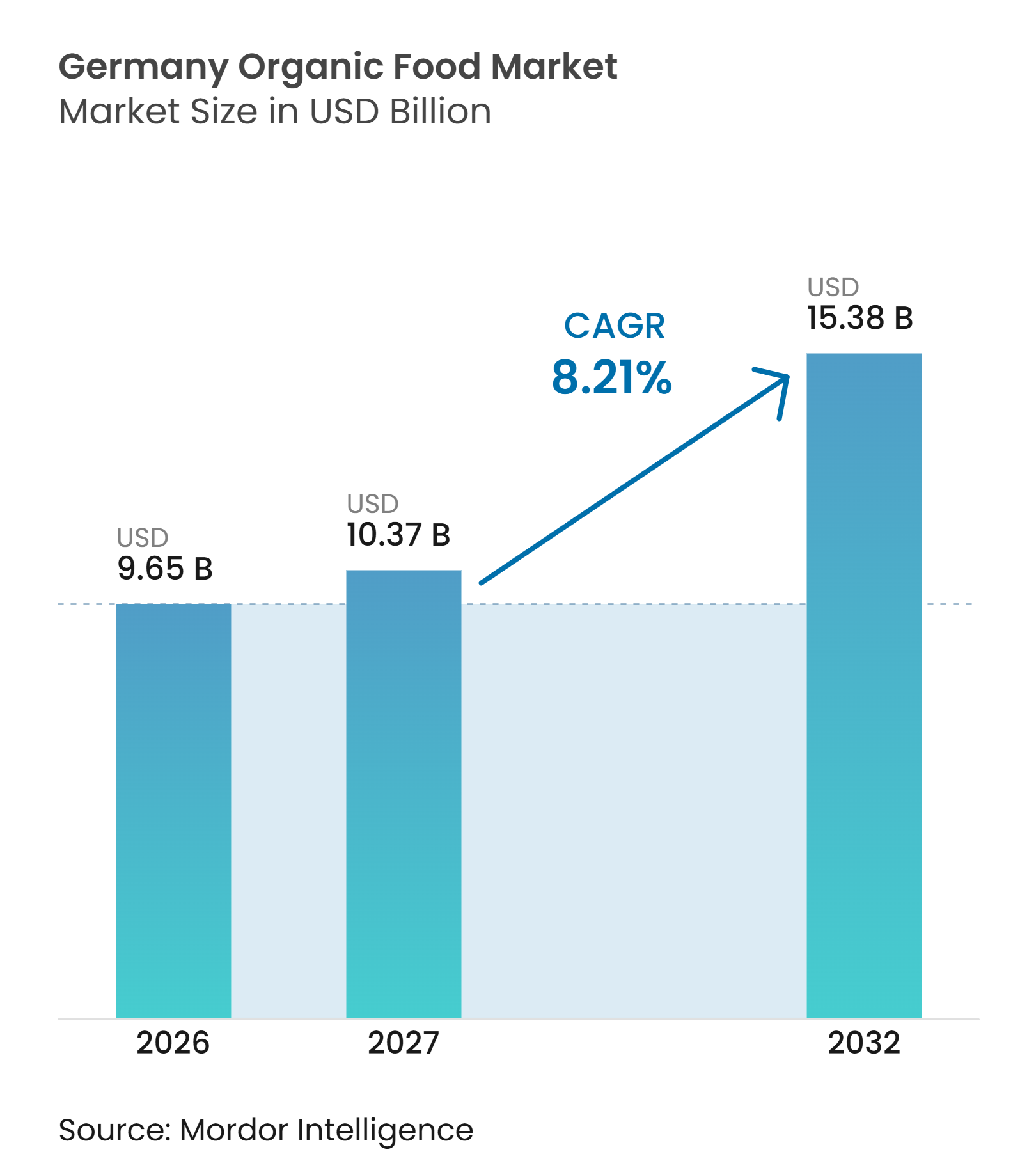
| Base Year Market Size (2026) | USD 9.65 Billion |
| Market Size (2027) | USD 10.37 Billion |
| Market Size (2032) | USD 15.38 Billion |
| Growth Rate (2027 - 2032) | 8.21 % |
| Market Concentration | Medium |
Major Players *Disclaimer: Major Players sorted in no particular order Image © Mordor Intelligence. Reuse requires attribution under CC BY 4.0. | |
Germany Organic Food Market Analysis by Mordor Intelligence
The germany organic food market size was valued at USD 9.65 billion in 2026 and is estimated to grow from USD 10.37 billion in 2027 to reach USD 15.38 billion by 2032, at a CAGR of 6.65% during the forecast period (2027-2032). The Germany organic food market is increasingly transitioning into conventional retail channels, with supermarkets, discounters, and drugstores expanding access beyond specialist outlets. This shift broadens purchasing occasions while increasing pressure on suppliers to manage costs, maintain certified sourcing, and differentiate their products. Additionally, expanding product availability across fresh, chilled, frozen, and processed categories is creating opportunities to attract a wider consumer base and strengthen organic food penetration across Germany.
Key Report Takeaways
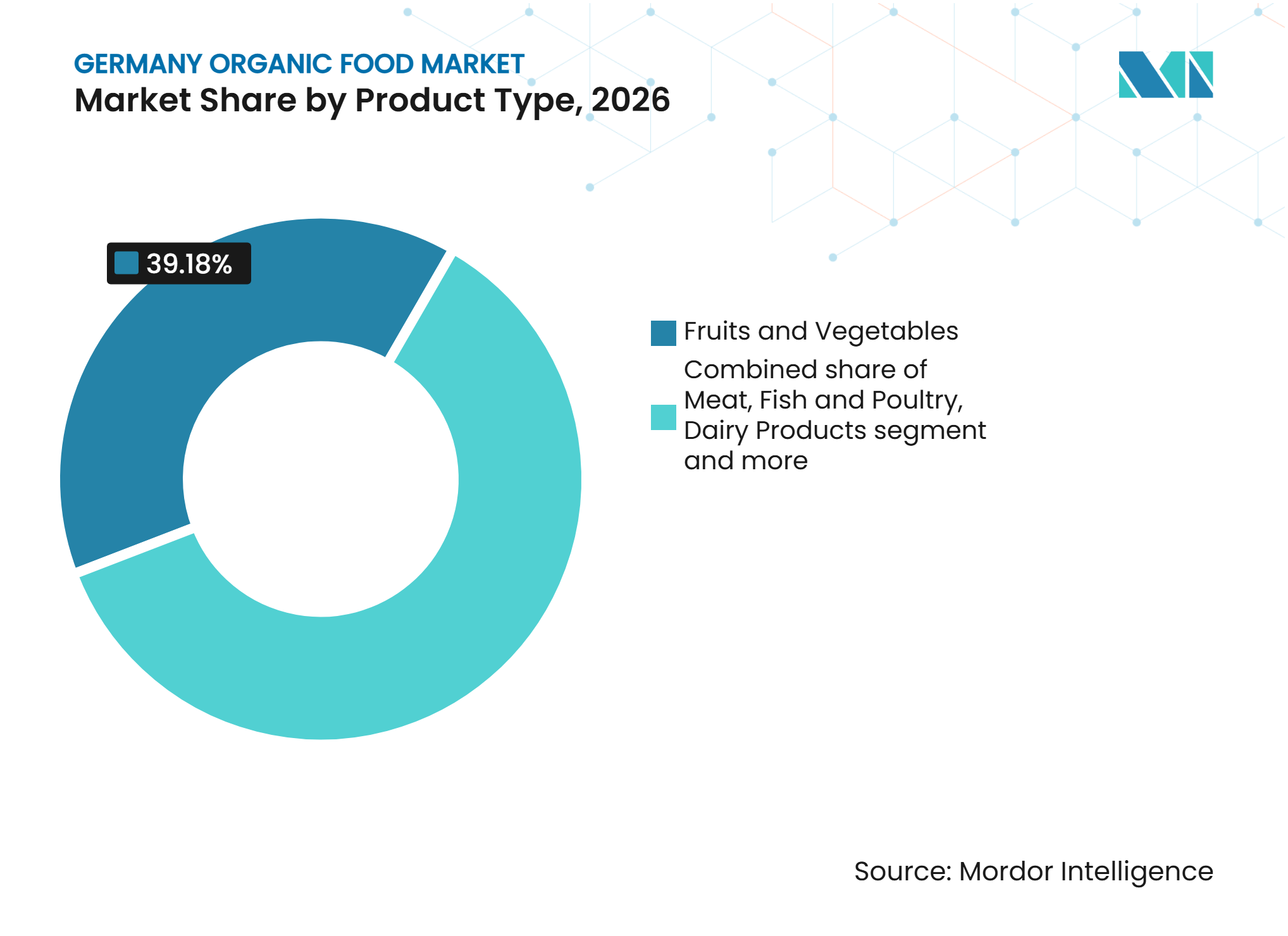
- By product type, fruits and vegetables dominated the Germany organic food market, accounting for 39.18% in 2026, while meat, fish and poultry is expected to register the fastest CAGR of 9.33% during 2027-2032.
- By form, fresh/chilled organic food led the market with a 72.25% share in 2026, while frozen is expected to record the fastest CAGR of 9.54% during 2027-2032.
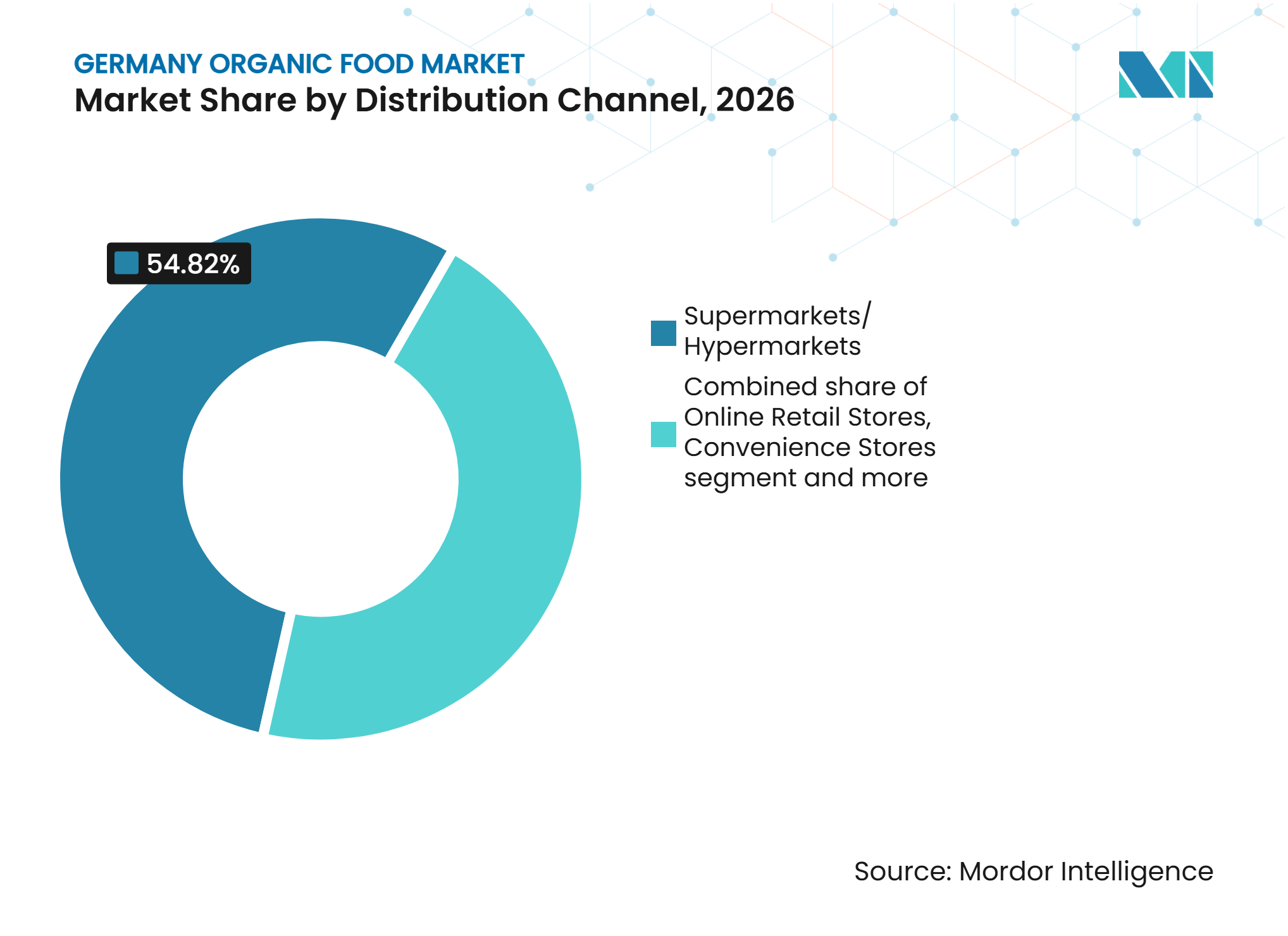
- By distribution channel, supermarkets/hypermarkets dominated the market with a 54.82% share in 2026, while online retail stores are projected to register the fastest CAGR of 9.89% during 2027-2032.
Note: Market numbers in this report are based on Mordor Intelligence's proprietary estimation framework, which combines nine months of actuals with Q4 projections for base year 2026.
Market Trends and Insights
Drivers Impact Analysis of Germany Organic Food Market*
| Driver | (~) % Impact on CAGR Forecast | Geographic Relevance | Impact Timeline |
|---|---|---|---|
| Rising consumer expenditure on organic food products | +1.8% | National | Medium term (2-4 years) |
| Expansion of organic product availability across supermarkets and discounters | +1.6% | National, with early gains in Baden-Württemberg, Bavaria, and North Rhine-Westphalia | Short term (≤ 2 years) |
| Increasing consumer preference for sustainable food production | +1.2% | National | Long term (≥ 4 years) |
| Supportive government initiatives promoting organic farming and products | +1.0% | National, with urban and suburban markets leading | Medium term (2-4 years) |
| Expanding demand for organic baby food, dairy and plant-based alternatives | -0.8% | National, particularly urban and health-conscious consumer markets | Medium term (2–4 years) |
| Greater consumer attention to food quality and pesticide residues | +0.6% | National, with stronger implementation across major organic farming regions | Long term (≥ 4 years) |
| Source: Mordor Intelligence | |||
Rising Consumer Expenditure on Organic Food Products
Rising consumer expenditure on organic food products is driving the expansion of Germany's organic food market, as households allocate a larger share of their food budgets to certified organic alternatives. Consumers prioritize food quality, transparent production practices, and products produced under regulated organic farming standards. The wider availability of organic products through supermarkets, discounters, and drugstores is also improving accessibility for a broader consumer base. In February 2026, Germany's Federal Information Centre for Agriculture (BZL) reported that consumer expenditure on organic food and beverages reached EUR 18.23 billion in 2025, representing a 6.7% increase from 2024[1]. Higher sales volumes are expected to drive this increase, reflecting stronger underlying consumer demand. This spending trend creates opportunities for organic food manufacturers to expand their product portfolios and strengthen retail distribution. It also reinforces the premium positioning of certified organic products across major food categories.
Expansion of Organic Product Availability Across Supermarkets and Discounters
Supermarkets, hypermarkets, discounters, and drugstores are making organic products more accessible during routine grocery trips. This broader availability reduces the reliance on specialist stores as the primary channel for certified products. It also increases price and assortment pressure on established organic retailers and national brands. Alnatura has started distributing through REWE supermarkets and Netto discount stores, while Rapunzel Naturkost supplies more than 420 EDEKA stores. Consequently, the Germany organic food market provides certified manufacturers with broader reach but less channel exclusivity than in previous years. The expansion of organic private-label ranges by mainstream retailers further strengthens competition by offering consumers more affordable alternatives to established organic brands.
Increasing Consumer Preference for Sustainable Food Production
Growing consumer preference for sustainable food production is supporting demand for organic food products in Germany, as consumers become increasingly aware of the environmental impact of conventional agriculture. Organic farming practices restrict the use of synthetic chemical pesticides and mineral fertilizers, promote soil fertility, and support biodiversity, making certified products attractive to environmentally conscious consumers. These factors are encouraging purchases across fruits and vegetables, dairy products, meat, and packaged organic food categories. Germany's Environment Agency, in its September 2025 update, identified organic agriculture as an environmentally beneficial farming approach that supports biodiversity and sustainable land management[2]. These developments reinforce the role of environmental considerations in shaping organic food purchasing decisions and encourage manufacturers to expand their certified organic product offerings.
Expanding Demand for Organic Baby Food, Dairy, and Plant-Based Alternatives
Expanding demand for organic baby food, dairy products, and plant-based alternatives is creating additional growth opportunities in Germany's organic food market. Parents' preference for certified ingredients in infant nutrition is driving demand for organic baby food, while consumer interest in naturally produced dairy products is supporting sales of organic milk, cheese, yogurt, and butter. Additionally, changing dietary preferences, increased awareness of ingredient quality, and interest in alternative protein sources are encouraging consumers to adopt organic plant-based beverages and dairy substitutes. Furthermore, innovations in taste, texture, nutritional composition, and convenience are helping manufacturers attract younger households and health-conscious consumers. These developments are expanding the consumer base for organic food beyond traditional fresh produce categories.
Restraints Impact Analysis of Germany Organic Food Market*
| Restraint | (~) % Impact on CAGR Forecast | Geographic Relevance | Impact Timeline |
|---|---|---|---|
| Higher production costs and limited economies of scale | -1.6% | National | Long term (≥ 4 years) |
| Limited availability of organic agricultural raw materials | -1.3% | National, most acute in regions with constrained organic farmland | Medium term (2-4 years) |
| Shorter shelf life and higher food wastage | -0.5% | National | Short term (≤ 2 years) |
| Intense competition from conventional and private-label products | -0.9% | National | Medium term (2-4 years) |
| Source: Mordor Intelligence | |||
Higher Production Costs and Limited Economies of Scale
Higher production costs and limited economies of scale restrain the expansion of Germany's organic food market, particularly among small and medium-sized agricultural producers. Organic farming requires more labor-intensive cultivation, specialized crop management, and additional handling procedures to maintain certified production standards. In July 2025, Germany's Thünen Institute published an analysis of organic farm economics for the 2023/24 accounting year, reporting that the average income gap between organic farms and comparable conventional farms had narrowed to EUR 2,040 per annual work unit (AWU). The analysis also highlighted weaker economic performance among several organic farm types than among their conventional counterparts. These cost pressures limit farmers' ability to expand production, invest in processing infrastructure, and supply organic raw materials at competitive prices.
Limited Availability of Organic Agricultural Raw Materials
Germany’s organic supply base is expanding more slowly than demand, increasing the country’s reliance on imported ingredients and finished products. In 2024, neighboring countries supplied more than one-third of Germany’s organic pork, while Spain and Belgium were added as supplier countries in 2025. Perishable protein categories face the most significant supply gaps, whereas flour, pasta, and muesli have relatively higher levels of self-sufficiency. In December 2025, the European Commission proposed amendments to simplify equivalence rules for organic imports under Regulation (EU) 2018/848. The Commission projected annual administrative cost savings of EUR 47.8 million (USD 52.1 million)[3]. These changes could simplify the management of certified supplies from third-country producers; however, import dependence remains a structural challenge for the German organic food market.
*Our forecasts treat driver/restraint impacts as directional, not additive. The impact forecasts reflect baseline growth, mix effects, and variable interactions.
Germany Organic Food Market Segment Analysis
By Product Type:
Protein Categories Gain Ground on Fresh StaplesFruits and Vegetables accounted for 39.18% of the Germany organic food market size in 2026, making the category the primary entry point for households purchasing organic products. The category benefits from frequent purchasing occasions and strong consumer interest in fresh foods. Frozen and Processed Foods and Other Foods also benefit from the wider availability of dry goods in mainstream retail channels, where private-label products have gained a significant presence. The expansion of organic product ranges across supermarkets and discount retailers further supports category visibility and encourages repeat purchases among everyday consumers.
Meat, Fish and Poultry is forecast to grow at a CAGR of 9.33% during 2027-2032. Retailers supplemented domestic supply with products from Spain, Belgium, France, and Baltic producers. While sourcing from multiple origins can help maintain product availability, it also increases the need for verified certification and effective supply chain coordination. The Germany organic food industry faces a particular challenge in protein categories, as limited farm conversion can constrain production capacity even when consumer demand remains strong. Greater investment in organic livestock farming, processing capabilities, and reliable sourcing partnerships will therefore be important for supporting the segment's projected expansion.



By Form:
Fresh Dominance Masks a Frozen RecalibrationFresh/chilled products accounted for 72.25% of the Germany organic food market in 2026. Consumers continue to prefer minimally processed organic produce and dairy products. Fresh products, including fruit, vegetables, dairy, and meat, account for 62.5% of organic specialty retailer revenue in Germany. This concentration underscores the role of specialist retailers in product curation and fresh-food expertise. Canned products remain the smallest form category, as some consumers associate thermal processing with a weaker organic proposition.
Frozen products are forecast to grow at a CAGR of 9.54% from 2027 to 2032, supported by demand for convenience and improving perceptions of product quality. Frozen formats offer households greater flexibility than fresh products while maintaining an organic offering. The clean-label focus within organic food also supports interest in convenient products with recognizable ingredient lists. The value gap between fresh and frozen products may narrow as consumers place greater emphasis on preparation time and food quality. The Germany organic food market can leverage frozen formats to address demand from urban households seeking shorter preparation times without compromising their clean-label expectations.
By Distribution Channel:
Mainstream Formats Capture Organic’s Mass MarketSupermarkets and hypermarkets accounted for 54.82% of the Germany organic food market share in 2026. These formats provide broad access to consumers across income groups and have become the primary mainstream channel for organic food purchases. EDEKA and REWE are expanding their certified organic assortments across established grocery networks. Their scale enables them to position organic products alongside conventional alternatives, making it easier for consumers to compare products and make repeat purchases. Their presence in established neighborhoods also allows consumers to purchase certified foods alongside other essential items, reducing the need for dedicated shopping trips as households increasingly make frequent, smaller grocery purchases. Specialist stores face growing pressure as brands that were once exclusive to these channels expand into conventional retail distribution.
Online retail stores are forecast to grow at a CAGR of 9.89% from 2027 to 2032. Organic products accounted for 20% to 28% of revenue at leading German online grocery platforms in 2025, compared with 6.5% across total food retail. This indicates that online grocery represents a high-organic channel rather than a minor extension of store-based retail. The channel provides manufacturers with a direct route to consumers who already include organic products in their routine orders. Its combination of delivery convenience, broad assortment, and repeat ordering creates more customer touchpoints for certified suppliers than a single store visit. In the Germany organic food market, delivery platforms are becoming increasingly important for brand visibility and consumer loyalty.

Geography Analysis
Southern Germany: Organic’s Agricultural Heartland
Bavaria and Baden-Württemberg form a strong organic ecosystem supported by substantial agricultural capacity, higher consumer spending, and a dense network of specialist retailers. One in seven German farms operates organically, while the southern states host a high concentration of certified producers and processing facilities. HiPP, based in Pfaffenhofen an der Ilm, Bavaria, continues to invest in organic ingredient sourcing and crop traceability. In southern Germany, the organic food market benefits from close integration among agricultural production, processing, and retail. The presence of established organic brands, regional farming cooperatives, and specialised distribution networks further strengthens supply-chain coordination and supports the availability of locally produced certified organic products.
Northern and Urban Markets: Digital and Discounter Channels Drive Volume
Hamburg, Berlin, Cologne, and Frankfurt demonstrate strong online organic purchasing patterns, supported by digital-first consumer behavior and higher urban incomes. Berlin has a concentrated specialist organic retail base serving the Berlin-Brandenburg-Dresden-Leipzig corridor. Discounter access also plays an important role in northern urban areas, where price sensitivity can constrain purchases from specialist stores. Aldi Nord’s cooperation with Naturland and Lidl’s partnership with Bioland have expanded access to certified organic products through mainstream retail channels. These certification partnerships demonstrate how retail compliance requirements can broaden product access while maintaining certification standards. Consequently, online organic spending remains particularly significant across major metropolitan areas.
Regional Balance Shapes Longer-Term Opportunity
North Rhine-Westphalia, Saxony, Thuringia, Rhineland-Palatinate, and other eastern states combine substantial populations and agricultural activity with lower per capita organic spending than southern and metropolitan markets. Eastern Germany is improving access through the expansion of discounter private-label offerings, including Penny’s Naturland-certified Naturgut range and the nationwide availability of organic products at Aldi and Lidl. This regional mix enables the Germany organic food market to expand both farm supply and retail access beyond its established strongholds. The expansion of affordable organic product ranges through mainstream retail outlets also provides opportunities to attract price-sensitive households and strengthen organic food penetration across these regions.
Competitive Landscape
Market Concentration
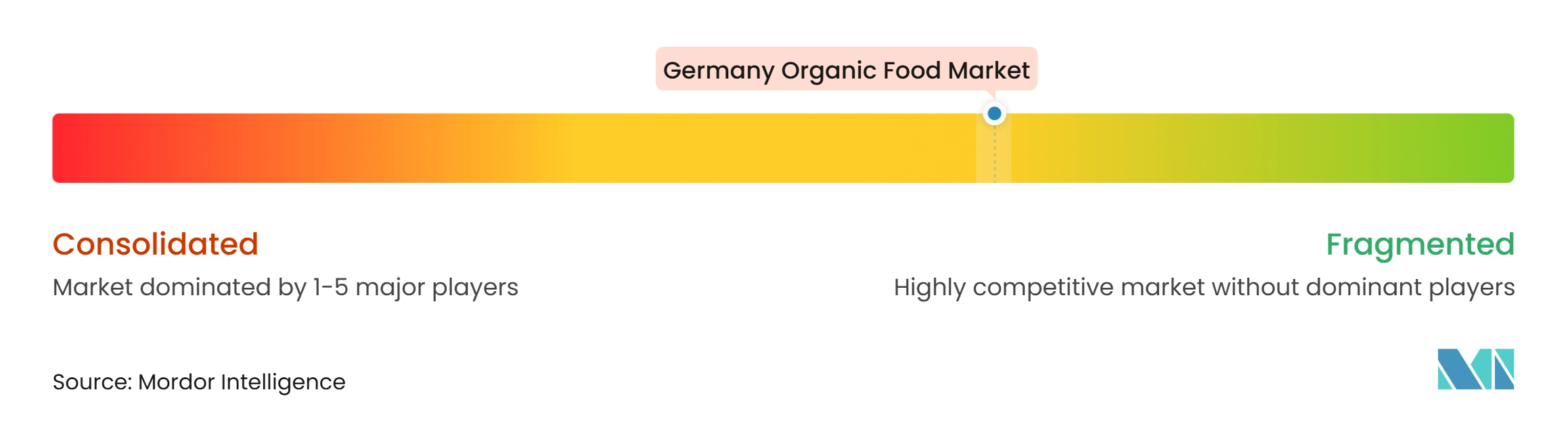
The Germany organic food market has a moderately fragmented structure, with full-service retailers, specialist chains, branded manufacturers, and private-label platforms competing across overlapping categories. EDEKA and REWE hold strong channel positions because they can integrate organic products into broad grocery supply chains. Dennree and Denns BioMärkte differentiate themselves through curated product portfolios and certified assortments, including products associated with Demeter, Bioland, Naturland, and Biokreis. By the end of 2025, Dennree operated 411 stores and generated consolidated revenue of EUR 1.6 billion (USD 1.74 billion).
Private labels are projected to hold a major share of packaged organic products sold through conventional food retail in 2025, shaping competitive conditions for branded manufacturers. This share gives retailers greater leverage over pricing and shelf placement while increasing pressure on brands to demonstrate clear product benefits. Rapunzel Naturkost and other national brands are seeking broader mainstream shelf placement, including distribution through EDEKA stores. In 2026, Alnatura expanded beyond its specialist store network by entering REWE supermarkets and Netto discount stores. Competitive advantage is increasingly linked to certified supply, reliable product availability, and the ability to maintain consumer trust across multiple retail formats.
Manufacturers are pursuing opportunities in premium organic frozen food and digital offerings that serve time-constrained urban consumers. The European Commission's proposed changes to Regulation (EU) 2018/848 may also influence competition by easing certain import-related administrative requirements. Companies with certified, multi-country supply networks may be better positioned to manage category shortages than businesses that rely on a single domestic source. Digital ordering and loyalty tools are becoming increasingly relevant as retailers seek to improve repeat purchases and reduce waste. The Germany organic food market remain competitive, as scale alone does not address the need for certification, product quality, and dependable supply.
Germany Organic Food Industry Leaders
-
EDEKA ZENTRALE Stiftung & Co. KG
-
REWE Group
-
Bionade GmbH
-
Dennree GmbH
-
Bio Company SE
- *Disclaimer: Major Players sorted in no particular order
Germany Organic Food Market Companies Covered in this Report
- EDEKA ZENTRALE Stiftung & Co. KG
- REWE Group
- ALDI Einkauf SE & Co. oHG
- Lidl Dienstleistung GmbH & Co. KG
- Bionade GmbH
- Dirk Rossmann GmbH
- Dennree GmbH
- Alnatura Produktions- und Handels GmbH
- Bio Company SE
- Naturland - Verband für ökologischen Landbau e.V.
- EBL Naturkost GmbH & Co. KG
- Naturata AG
- Rapunzel Naturkost GmbH
- Andechser Molkerei Scheitz GmbH
- HiPP GmbH & Co. Vertrieb KG
- Dr. August Oetker Nahrungsmittel KG
- Frosta AG
- Rügenwalder Mühle Carl Müller GmbH & Co. KG
- Neumarkter Lammsbräu Gebr. Ehrnsperger KG
- Lebensbaum / Ulrich Walter GmbH
Recent Industry Developments in Germany Organic Food Market
- September 2026: Alnatura announced that REWE supermarkets will carry its products, marking a significant channel expansion. This move extended the brand’s reach beyond its specialist store network and delivery partners for the first time at scale.
- April 2025: HiPP GmbH launched three new certified organic baby snack products, including Bio Erdbeere-Mango Maiswaffeln and Bio Knusper Stangen Apfel-Karotte, through drugstore and supermarket channels.
- April 2025: HiPP GmbH launched its organic children’s muesli range-Crunchy Lions, Crunchy Crocos, and Crunchy Dinos-for children aged 3 years and older. The products use tapioca syrup instead of refined sugar.
Germany Organic Food Market Report Scope
Organic food refers to food products cultivated, raised, and processed using certified organic farming methods that restrict synthetic pesticides, chemical fertilisers, genetically modified organisms (GMOs), and artificial additives.
The Germany organic food market is segmented by product type, form, and distribution channel. By product type, the market is segmented into fruits and vegetables, meat, fish and poultry, dairy products, frozen and processed foods, and other foods. By form, the market is segmented into fresh/chilled, canned, and frozen. By distribution channel, the market is segmented into supermarkets/hypermarkets, convenience stores, specialty stores, online retail stores, and other distribution channels. The market forecasts are provided in terms of value (USD).
Segmentation Overview
| Fruits and Vegetables |
| Meat, Fish and Poultry |
| Dairy Products |
| Frozen and Processed Foods |
| Other Foods |
| Fresh/Chilled |
| Canned |
| Frozen |
| Supermarkets/Hypermarkets |
| Convenience Stores |
| Specialty Stores |
| Online Retail Stores |
| Other Distribution Channels |
| By Product Type | Fruits and Vegetables |
| Meat, Fish and Poultry | |
| Dairy Products | |
| Frozen and Processed Foods | |
| Other Foods | |
| By Form | Fresh/Chilled |
| Canned | |
| Frozen | |
| By Distribution Channel | Supermarkets/Hypermarkets |
| Convenience Stores | |
| Specialty Stores | |
| Online Retail Stores | |
| Other Distribution Channels |
Key Questions Answered in the Report
What is the projected growth of the Germany organic food market by 2032?
The Germany organic food market is projected to grow from USD 9.65 billion in 2026 to USD 15.38 billion by 2032, after reaching USD 10.37 billion in 2027, registering a CAGR of 8.21% during 2027-2032.
Which product type held the largest share in the Germany organic food market in 2026?
The Fruits and Vegetables segment held the largest market share in 2026, accounting for 39.18% of the Germany organic food market.
Which form segment dominated the Germany organic food market in 2026?
The Fresh/Chilled segment dominated the market in 2026, capturing 72.25% of the total market share.
Which distribution channel accounted for the largest market share in 2026?
Supermarkets/Hypermarkets led the Germany organic food market in 2026, accounting for 54.82% of total sales.